
Warning: Brooklyn DSCR Deals Are Far Riskier Than Most Investors Realize in 2026
The Brooklyn rent 2026 DSCR impact is real — and it runs in one direction only. Brooklyn’s median rent hit $4,296 in February 2026, per Corcoran Group data, an all-time high up 7.5% year over year. What that does to your DSCR ratio depends entirely on what you are buying, at what price, and at what rate — not on what the borough headline says.
Most investors see a number like $4,296 and assume the DSCR math on their next deal just got easier. Some of it did. But the Brooklyn rent 2026 DSCR impact on a specific outer-borough 2-4 family transaction is a much more precise calculation than a borough-wide median implies — and getting the precision wrong costs you deals, or puts you into deals that don’t hold.
Table of content
The brutal truth about Brooklyn rent 2026 DSCR impact is that rent growth alone will not save a marginal deal at today’s rates. Before you model anything, run your specific numbers through the DSCR Stress Test and find out exactly where you stand before you make an offer.
Brooklyn Rent 2026 DSCR Impact Starts With the Right Number
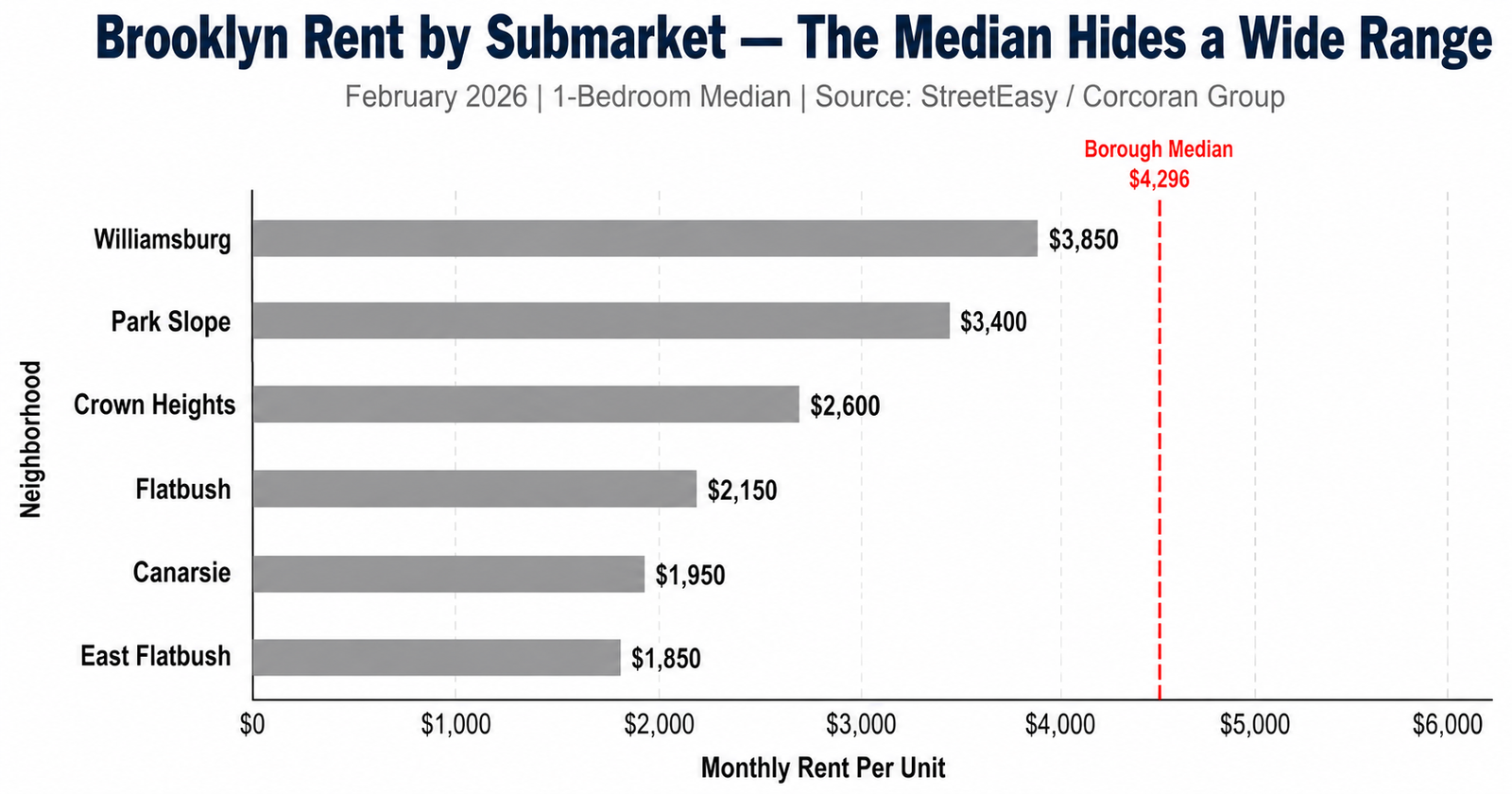
The $4,296 median covers all unit types — studios through 3-bedrooms — across every Brooklyn submarket from Williamsburg to Sheepshead Bay. The Brooklyn rent 2026 DSCR impact on a deal in Canarsie or East Flatbush looks nothing like that headline figure. Per-unit rents in outer-borough 2-4 family properties in those submarkets run $1,800 to $2,400 depending on unit size, condition, and lease vintage. That is the number that enters your DSCR calculation. The borough median does not.
Chandan Economics, using Zillow’s Observed Rent Index through February 2026, puts Brooklyn’s year-over-year rent growth at 5.6%, with 0.4% month-over-month momentum — the highest of any NYC borough. NYC is growing rents at more than 3× the national rate of 1.8%. The trajectory of the Brooklyn rent 2026 DSCR impact is unambiguously positive. The magnitude on any given deal is a separate, property-specific question.
The distinction matters because investors who anchor to the borough median going into purchase negotiations tend to overpay on gross rent assumptions and then discover the underwriting gap after they are under contract. DSCR lenders use the signed lease or the appraiser’s market rent estimate, whichever is lower. A projection based on the borough headline does not enter the calculation.
How Submarket Rent Diverges From the Borough Median
The $4,296 borough figure is weighted heavily by high-rent submarkets — Williamsburg, DUMBO, Park Slope, and Downtown Brooklyn — where median rents for a 1-bedroom commonly exceed $3,500. An outer-borough investor buying a 3-family in Crown Heights or a 4-family in Flatbush is operating in a fundamentally different rent tier. Tracking median rents on StreetEasy or Zillow by neighborhood, filtered to the specific unit size of the target property, is the correct starting point for any deal analysis — not the borough median.
What the Brooklyn Rental Income DSCR Calculation Actually Shows
The DSCR formula is Monthly Gross Rent ÷ Monthly PITIA — Principal, Interest, Taxes, Insurance, and HOA fees. A ratio of 1.0 means rent exactly covers obligations. A ratio of 1.25 means the property earns 25 cents for every dollar it costs to hold. The Brooklyn rental income DSCR calculation on an outer-borough deal lives or dies on three numbers: gross rent, loan payment, and property taxes.
Take a concrete 4-unit outer-Brooklyn deal: $1,100,000 purchase price, 25% down ($275,000), financing $825,000 at a 30-year DSCR rate of 7.75%. Principal and interest runs approximately $5,906/month. Add realistic Brooklyn 4-unit property taxes of $800/month and insurance of $300/month. PITIA = $7,006/month.
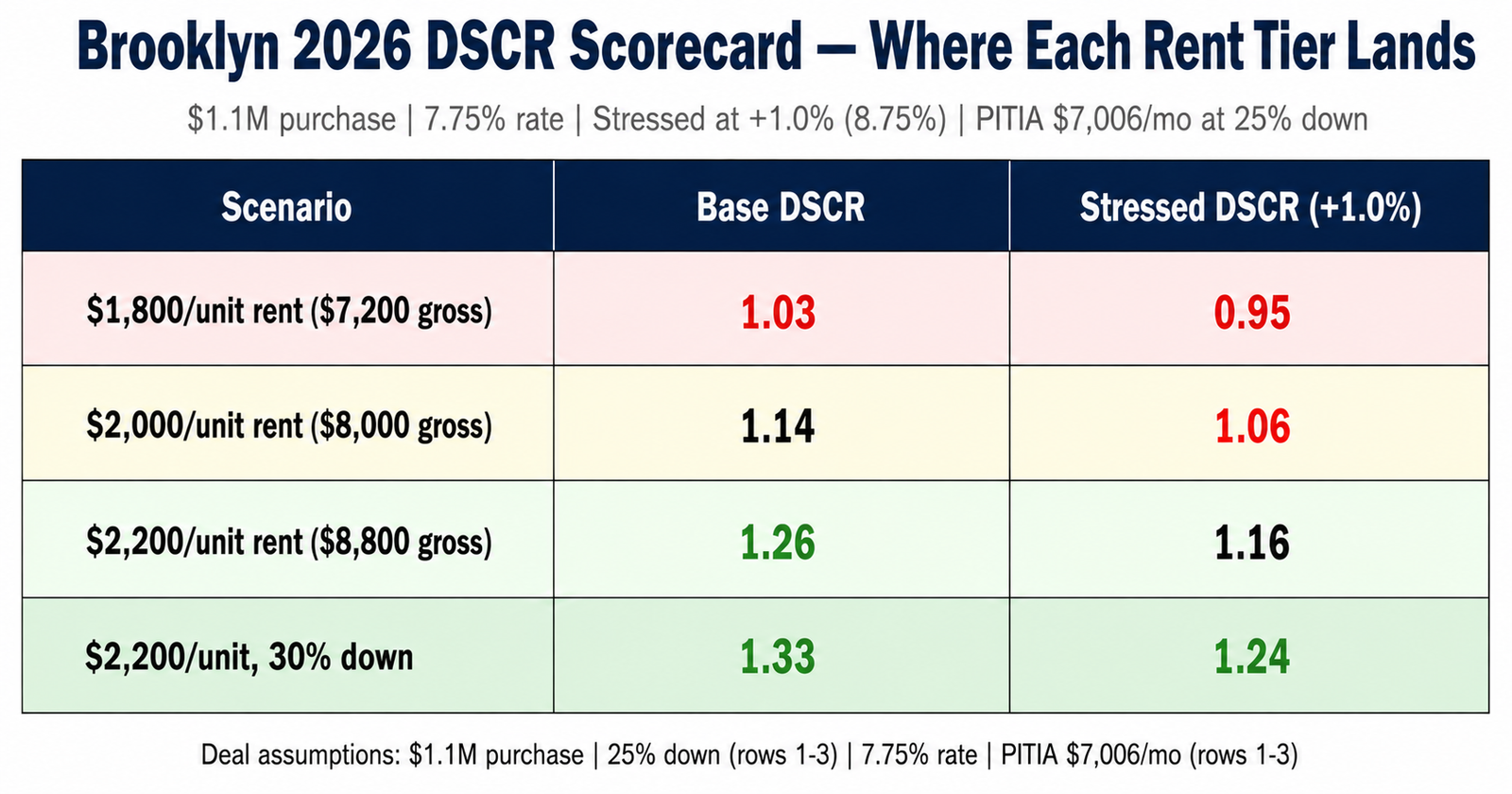
At $2,000/unit × 4 units = $8,000 gross rent: DSCR = 1.14. Above the lender floor of 1.10. Below the BKDSCR standard of 1.25. Push each unit to $2,200 — well within reach in today’s outer-borough market — and gross rent becomes $8,800. DSCR climbs to 1.26, clearing the standard. A $200/unit improvement in rent is the difference between a deal that needs work and one that qualifies with room to absorb a rate move. That is the Brooklyn rent 2026 DSCR impact expressed in actual numbers.
The complete deal analysis on any outer-borough property needs to run this math at three rent scenarios — current lease, appraised market rent, and a realistic forward projection — before you make an offer. The lender will use the lowest of the first two. You need the third to evaluate the hold-period case.
The $200-Per-Unit Conversion Factor
Understanding the rent-to-ratio conversion on your specific deal is the most practical output of any deal analysis. On this $825,000 loan at 7.75%: every $100/month in added gross rent = approximately 0.014 DSCR points. Moving from $1,800 to $2,000/unit adds $800/month gross and 0.11 DSCR points. Moving from $2,000 to $2,200 adds the same. That conversion factor changes with every loan amount, rate, and tax load — which is why running it on the specific deal matters more than referencing a general rule.
Brooklyn 2026 Multifamily Rent — What Is Driving the Market
Manhattan rental inventory fell 26% year-over-year in February 2026 according to Corcoran Group — the longest consecutive streak of inventory declines in StreetEasy’s 20-year history, per a Brick Underground market report. When Manhattan inventory drops that sharply, renters migrate to Brooklyn — not just prime Brooklyn, but middle-market neighborhoods. That overflow is showing up in lease data across Crown Heights, Flatbush, and Canarsie right now.
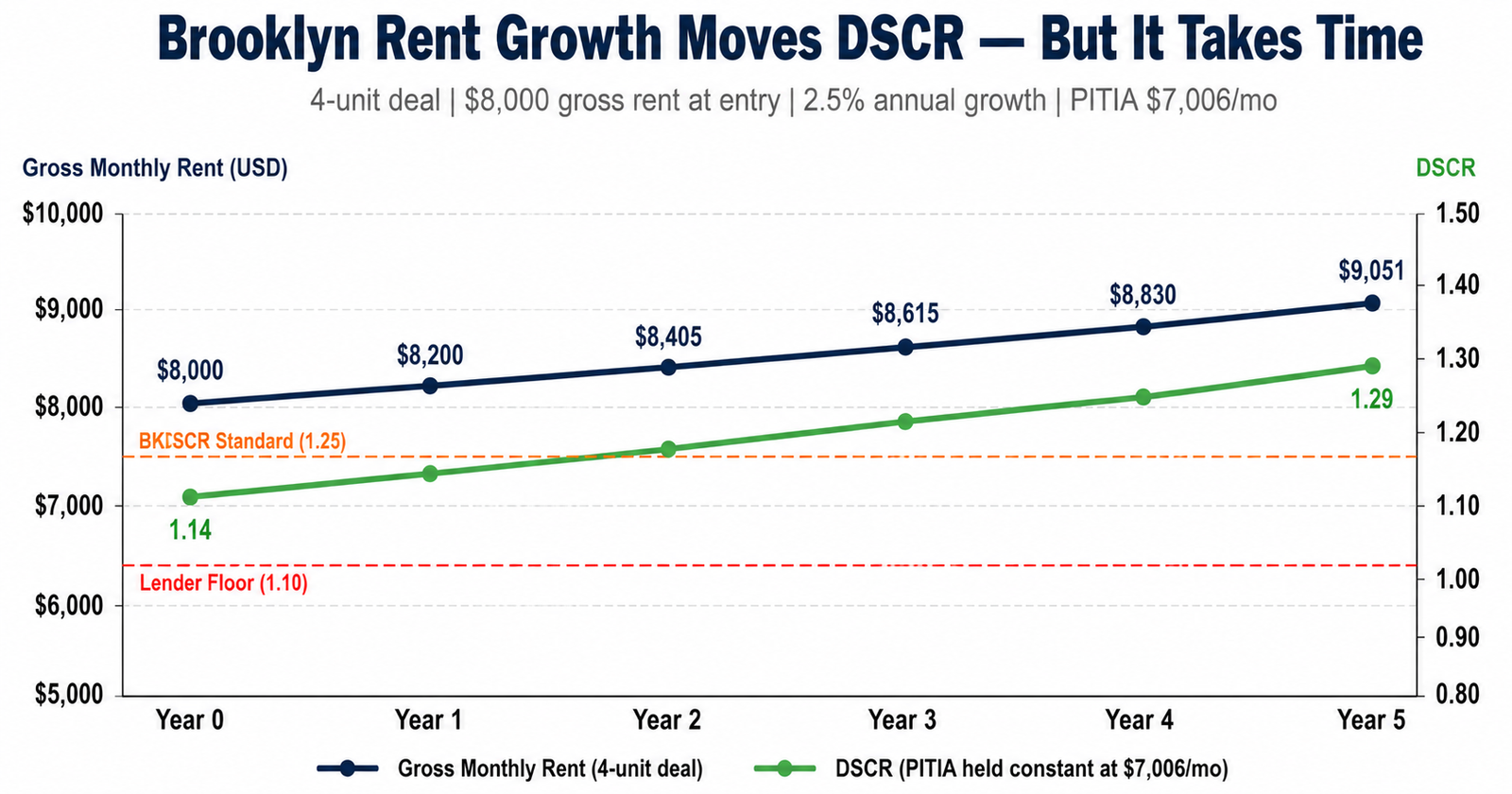
On a 3-month annualized basis, Chandan Economics shows NYC rent growth at 2.4% versus 0.8% nationally. Brooklyn leads all boroughs at 0.4% month-over-month. That is sustained upward pressure on gross rents — not a spike that will correct. For a deal underwritten at $1,800/unit in early 2026, a 2.5% annual rent growth assumption produces $2,030/unit by year five. That shift changes the hold-period return calculation meaningfully even when the entry DSCR is borderline.
None of that changes the entry underwriting. DSCR lenders use current rent. The Brooklyn 2026 multifamily rent trajectory is relevant to your hold-period IRR, not to your qualification ratio on day one. Understanding the difference between those two timeframes is what separates investors who model a deal correctly from those who get surprised in underwriting.
Brooklyn Rent 2026 DSCR Impact at the Rate Level
Rising rents improve DSCR, but rates move the denominator in the same window. DSCR loan rates on 30-year products are currently ranging from approximately 7.50% to 8.25% depending on LTV, property type, prepayment structure, and lender program. On an $825,000 loan, that spread produces a $440/month difference in P&I — and on a deal producing $8,000 gross rent, that $440 is the difference between a 1.18 DSCR and a 1.10 DSCR. One has margin. One is at the floor.
This is where lender criteria matter as much as the rent number itself. DSCR lenders do not price identically. A deal that fails at one lender’s 8.25% rate may clear cleanly at another’s 7.50% — same property, same rent, different qualification outcome. Rate shopping across multiple DSCR lenders before locking a purchase price is not optional on any deal where the Brooklyn rent 2026 DSCR impact puts you within 0.15 points of the qualifying floor.
There is a second variable most investors underweight: property tax reassessment risk. Brooklyn assessments have risen sharply in recent cycles. A property currently taxed at $700/month that gets reassessed to $950/month adds $250 to PITIA — which removes 0.036 DSCR points on this deal. On a deal sitting at 1.14 entry, a reassessment of that magnitude is meaningful.
The deal killers that surface most often on outer-borough DSCR deals in 2026 are not on the rent side. They are on the PITIA side: underestimated taxes, stale insurance quotes, and rate assumptions that don’t reflect actual lender pricing on the specific property type.
If your deal is sitting between 1.10 and 1.20 on DSCR, the difference between qualifying and not qualifying is often lender selection and PITIA precision — not the rent number. Run a full Deal Review and get the complete picture before you approach any lender.
DSCR Stress Test Brooklyn — Running the Rate Shock Scenario
A deal clearing 1.10 at today’s rates does not automatically hold under pressure. The BKDSCR DSCR stress test standard adds 1.0% to the purchase rate and requires the deal to stay above 1.00 on a stressed basis — a five-to-seven year hold test that reflects real market risk. For a Purchase scenario, stress is +1.0%. For a Refinance, it’s +0.5% because you are locking into a fixed rate for a full term.
On the 4-unit deal above ($825,000 loan, $8,000 gross rent, PITIA $7,006):
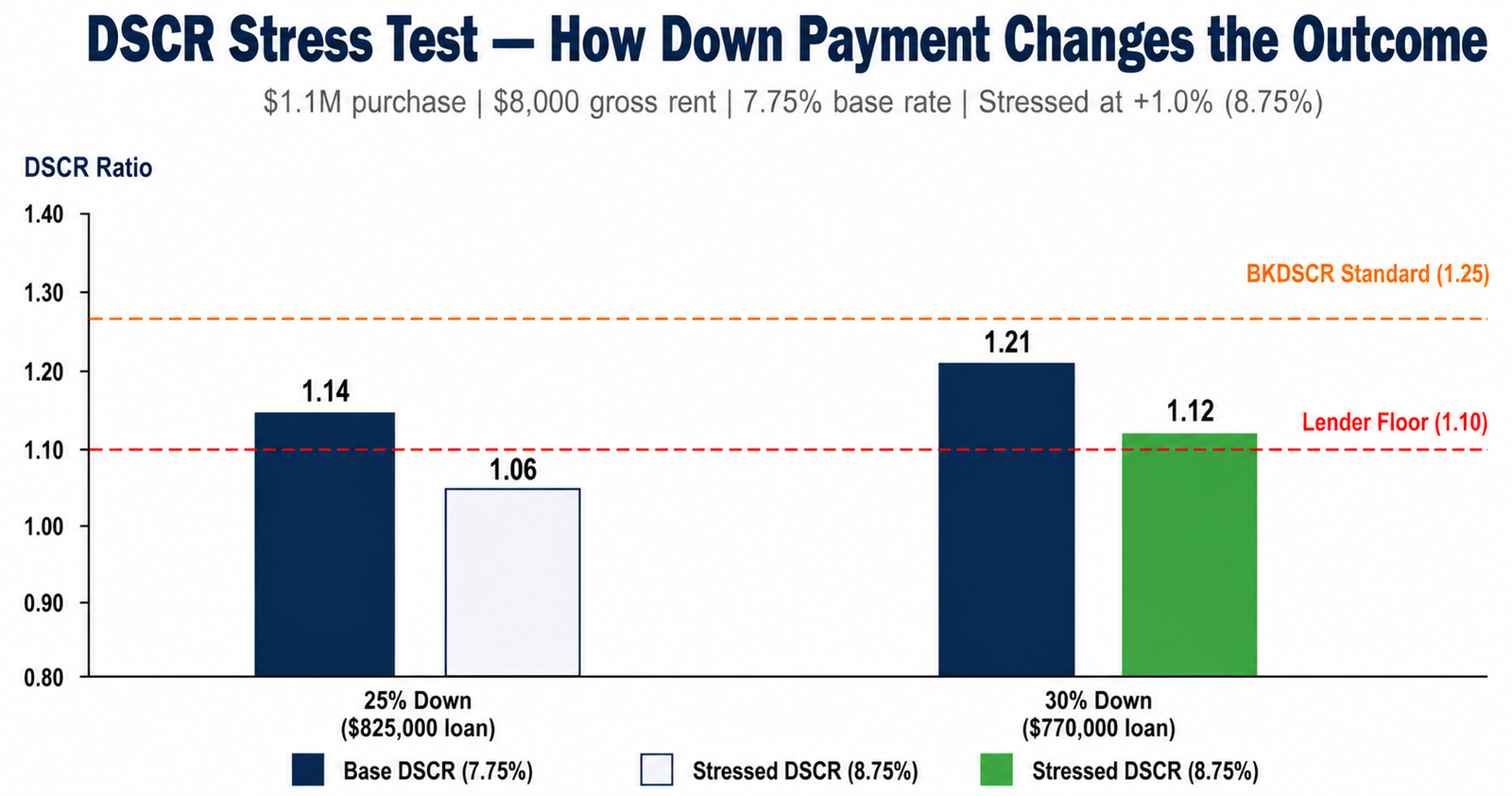
Base rate 7.75%: DSCR = 1.14 | Stressed rate 8.75%: P&I = $6,480, PITIA = $7,580 → DSCR = 1.056 → Passes the BKDSCR floor of 1.00
At $8,800 gross rent: stressed DSCR = 1.16 — a stronger cushion. Neither scenario reaches 1.25 stressed. That is the honest output. A 1.25 stressed result means the deal absorbs a full 100-basis-point rate move and still has margin. That requires either a larger down payment, rents above $2,200/unit, or a purchase price that produces a loan below $825,000.
The DSCR stress test Brooklyn calculation is not a pessimistic exercise. It is the realistic question: does this deal hold if rates stay elevated for another two years? For most outer-borough deals in 2026, the honest answer is: it depends on the down payment. Run it through the stress test calculator before the offer, not after the commitment.
What a Larger Down Payment Does to the Numbers
Increasing the down payment from 25% to 30% on a $1,100,000 purchase drops the loan from $825,000 to $770,000. P&I at 7.75% falls from $5,906 to $5,513. PITIA drops from $7,006 to $6,613. At $8,000 gross rent, DSCR rises from 1.14 to 1.21. Stressed at 8.75%: DSCR = 1.12 — now above the 1.10 lender floor even under stress. The 5% additional equity cost ($55,000) is the price of a deal that holds under pressure. Whether that trade is worth it depends on your return requirements and cash position — but understanding the math before you set your offer is the minimum standard.
What Investors Get Wrong About Rising Brooklyn Rents
Rising rents generate optimism, and optimism produces the same errors on repeat. The ones that surface most often on outer-borough deals where the Brooklyn rent 2026 DSCR impact looks positive on paper but fails in underwriting:
- Applying the borough median to a submarket deal. The $4,296 figure covers all of Brooklyn. Using it to model a Flatlands 3-family at $1,900/unit overstates gross rent by more than 100% and produces a DSCR that underwriting will not recognize.
- Running P&I only for PITIA. Property taxes and insurance add $1,000–$1,200/month on a typical outer-borough 4-unit. Omitting them inflates the ratio by 0.15–0.25 points — enough to turn a qualifying number into a failing one.
- Counting rent growth as underwriting credit. DSCR lenders use current rent — signed lease or appraised market rent, lower of the two. The trajectory of Brooklyn rent in 2026 is relevant to hold-period modeling, not to day-one qualification.
- Going under contract before running the stress test. A structural DSCR problem found after commitment is expensive. Found before the offer, it is free. The pre-submission checklist exists for exactly this reason.
- Ignoring the prepayment penalty structure. Most DSCR loans carry step-down prepayment penalties over three to five years. If a rate drop triggers a refinance before the penalty burns off, that cost belongs in the return model before you close.
- Not comparing lenders. The same deal at 7.50% versus 8.25% produces a materially different DSCR. A deal that fails at one lender may qualify cleanly at another. Rate shopping is part of the underwriting process on any deal near the floor.
Frequently Asked Questions
Does the $4,296 Brooklyn median rent apply to my deal?
Only if you are buying in a submarket where rents are at or above that level — Williamsburg, DUMBO, Park Slope, or similar prime-Brooklyn neighborhoods. For outer-borough investors buying 2-4 family properties in Canarsie, East Flatbush, Flatbush, or Flatlands, the relevant per-unit rents are in the $1,800–$2,400 range. The Brooklyn rent 2026 DSCR impact on your specific deal requires submarket-level rent data — not the borough headline.
What DSCR do I need to qualify for a loan in Brooklyn in 2026?
Most DSCR lenders set their floor at 1.00, with a working minimum of 1.10–1.20 for standard loan terms. The BKDSCR standard is 1.25 stressed — meaning the deal needs to stay above 1.00 when you add 1.0% to the purchase rate. Some lenders will go below 1.00 with a larger down payment or through specific programs, but those come with rate premiums. A deal sitting at 1.10–1.15 base DSCR is qualifying but marginal. Review full lender criteria before assuming your deal clears.
How much does Brooklyn rent growth improve my DSCR year over year?
At 2.5% annual rent growth on a 4-unit deal producing $8,000/month at entry (PITIA fixed at $7,006), each year adds approximately $200/month gross rent and 0.028 DSCR points. By year five, gross rent has grown to roughly $9,050 and DSCR has improved from 1.14 to 1.29 — assuming PITIA stays constant. In reality, property taxes may increase over that period, which compresses the gain. Modeling both the rent growth upside and the tax reassessment risk gives a realistic picture of the hold-period Brooklyn rent 2026 DSCR impact.
Bottom Line
The Brooklyn rent 2026 DSCR impact on active deals is real and it is directionally positive. Rents at $4,296 borough-wide median — an all-time high — reflect genuine demand compression from Manhattan’s inventory crisis. Brooklyn’s 5.6% year-over-year rent growth leads all NYC boroughs and runs at more than 3× the national rate. That pressure flows into outer-borough submarkets where most multifamily investors are buying, and it does improve gross rent figures on deals that were marginal six to twelve months ago.
The Brooklyn rent 2026 DSCR impact on lender underwriting is more constrained. DSCR lenders use current rent — the signed lease or the appraisal, whichever is lower — and today’s rate. A market trending upward does not move the ratio on day one. A deal that clears the lender floor but fails the stress test does not hold under rate pressure. A deal underwritten on the borough median instead of the submarket per-unit rent does not reflect reality.
What actually determines whether a Brooklyn deal works in 2026 is the spread between accurate per-unit rent at the submarket level, full PITIA including taxes and insurance, the specific lender rate you can actually access, and whether you ran the stress test before you made the offer. That is the complete Brooklyn rent 2026 DSCR impact analysis. Everything else is noise.
If you want a second set of eyes on a Brooklyn deal before you commit, book a 30-minute advisory call and we’ll run through the full Brooklyn rent 2026 DSCR impact analysis on your specific property together.