DSCR Strategy for Free-Market Multifamily Investors
Acquisition filtering, leverage optimization, refinance analysis, and lender-ready deal packaging before submission.
Free-market multifamily investors have a different problem than rent-stabilized owners. They usually are not trapped by restricted rent growth. Their challenge is deciding which deals deserve capital, how much leverage is safe, and whether the property will still work after lender stress, higher expenses, and real-world vacancy.
BKDSCR does not position itself as a magic approval shop. The real value is simpler and stronger: we help investors understand whether the deal actually works before submission. That means looking past the headline rent roll and applying disciplined DSCR deal analysis before the lender, appraiser, or credit committee finds the weak points.
For free-market owners and buyers, DSCR strategy is about growth with control. The goal is not just to buy more property. The goal is to build a portfolio that remains financeable, cash-flow durable, and lender-ready in a market where debt costs can change faster than investor expectations.
Free-Market Multifamily Is a Growth Opportunity — But Only If the Numbers Hold
Free-market buildings have one major advantage: rental flexibility. Rents can adjust with market demand, unit quality, location, and tenant turnover. That flexibility matters because the lender is not just looking at income today. The lender is asking whether the income is durable enough to support the proposed debt.
This is where many investors get too aggressive. They see rising rents and assume the deal is safe. But a building can have strong gross income and still fail lender math if taxes, insurance, maintenance, vacancy, or debt service absorb too much of the rent. Before relying on projected upside, investors should understand how the DSCR formula actually converts income into lender confidence.
Free-market assets reward clear underwriting. They punish lazy assumptions. A deal that works at 80% leverage on paper may only work at 70% once the lender applies vacancy, reserves, and conservative income treatment.
Acquisition Filtering: Stop Chasing Deals That Will Not Survive Underwriting
The first BKDSCR use case for free-market investors is acquisition filtering. Before ordering reports, submitting to lenders, or spending time negotiating terms, the investor needs to know whether the property has a realistic path to qualification.
Acquisition filtering should answer a few direct questions. Does the rent roll support the target loan amount? Does the deal still work after vacancy and expense stress? Is the purchase price too high for today’s debt market? Is the property strong enough to survive conservative lender criteria, or is the investor relying on best-case assumptions?
This is why the first step should be a quick filter, not a full emotional commitment. If the deal cannot pass the basic lender-style math, the investor should know that before wasting time, paying third parties, or taking a credit pull. Use the 60-Second Deal Filter when you need a fast first read.
Leverage Optimization: The Highest Loan Amount Is Not Always the Best Structure
Free-market investors often focus on maximum proceeds. That can be dangerous. The better question is not “How much can I borrow?” The better question is “What leverage level lets this deal stay strong after stress?”
A deal may technically qualify at higher leverage but become fragile under modest changes: a tax reassessment, insurance increase, vacancy, or repair cycle. It is also deeply vulnerable to rate fluctuations; tracking historical volatility against benchmarks like the Freddie Mac Primary Mortgage Market Survey helps reveal how quickly shifts in debt costs can squeeze cash flow. That fragility can become one of the hidden DSCR deal killers that only appears after the investor is already deep into the transaction.
BKDSCR helps investors compare leverage scenarios instead of treating the lender’s maximum offer as the correct answer. Sometimes the smarter structure is lower LTV, stronger DSCR, better terms, cleaner reserves, and more refinance optionality later.
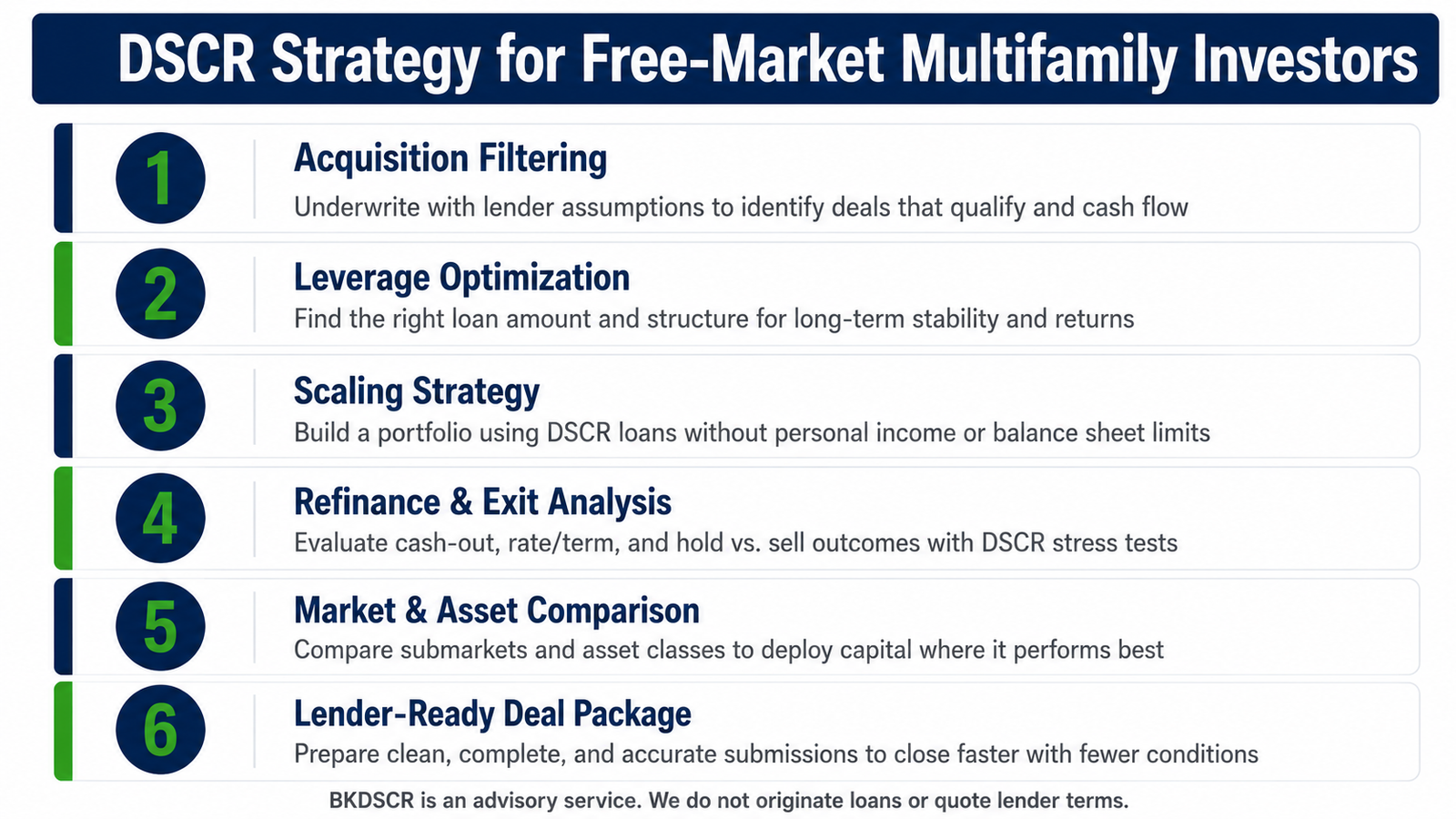
Scaling Strategy: Building a Portfolio Without Creating Debt Fragility
Buying one free-market building is one decision. Scaling into multiple properties is a different discipline. As the portfolio grows, investors need to think about liquidity, reserves, lender exposure limits, global cash flow, documentation quality, and whether each property can stand on its own numbers.
DSCR loans can help investors scale because the property income carries more weight than personal W-2 income. But scaling without discipline creates risk. A portfolio with five thin deals can be weaker than a portfolio with three durable deals that hold coverage under stress.
BKDSCR helps growth-focused investors compare deals across a portfolio lens: which asset deserves capital, which one should be refinanced, which one should be held, and which opportunity should be passed on because it weakens the overall debt picture.
Refinance Analysis: Cash-Out Is Not Always Wealth Creation
Free-market owners often have refinance opportunities, especially when rents have increased or values have improved. But cash-out refinancing should be modeled carefully. Pulling equity out of a building can help growth, but it can also weaken DSCR, increase payment risk, and reduce flexibility.
The right refinance question is not only whether there is equity. The right question is whether the new debt improves the investor’s overall position. That means comparing current loan terms, new payment, projected cash flow, prepayment penalties, reserves, and exit strategy. The Refi Analyzer helps frame that decision before an owner commits to new debt.
In a higher-rate market, some owners are better off waiting. Others may benefit from restructuring, partial cash-out, or using proceeds to fund a stronger acquisition. The answer depends on the numbers, not the urge to move capital quickly.
Market Comparisons: Same Loan, Different Market, Different Outcome
Free-market investors also need market comparison discipline. A Brooklyn property, a Florida small multifamily, and a Texas rental may use similar loan products, but the cost structure can be completely different. Taxes, insurance, rent growth, vacancy, repairs, and purchase price all change the final DSCR outcome.
This is where many investors misread opportunity. A cheaper purchase price does not automatically mean a better deal. A higher-rent market does not automatically mean stronger coverage. A lower-tax market may still fail if insurance, management, or vacancy assumptions are wrong.
BKDSCR helps investors compare markets through lender-style math instead of headline opinions. That is especially important for investors deciding whether to keep buying in NYC, look out of state, or split capital across multiple markets.
Lender-Ready Packaging: Good Deals Still Need to Be Presented Correctly
A strong free-market deal can still lose momentum if the file is messy. Lenders need clean documentation, realistic assumptions, accurate rent support, clear property details, borrower context, and a straightforward explanation of why the deal works.
This is where lender-ready packaging matters. The objective is not to decorate the deal. The objective is to organize the deal so the lender can quickly understand the income, the risk, the structure, and the investor’s plan. If the file needs deeper review, a full BKDSCR Deal Review can help identify issues before submission.
A lender-ready investor does not show up asking the lender to figure out the story. A lender-ready investor shows up with the math, assumptions, risks, and support already organized. That improves credibility, saves time, and reduces the chance of surprise conditions.
What BKDSCR Helps Free-Market Investors Understand
BKDSCR helps free-market multifamily investors answer the questions that matter before lender submission:
Does the deal work at the proposed purchase price? What loan amount is realistic? What DSCR does the lender likely see? What happens if the rate moves higher? What happens if rent is lower than expected? What structure protects the investor without choking growth?
The goal is not to force a yes. The goal is to know the truth early enough to make a better decision. Sometimes that means submit the deal. Sometimes it means renegotiate. Sometimes it means reduce leverage. Sometimes it means walk away. That is not weakness. That is disciplined investing.
Run the Deal Filter →
Get a quick first read on whether the property deserves deeper underwriting before you spend more time or money.
Start with the Deal FilterStress Test the Ratio →
See how the deal holds up if rates, rents, expenses, or vacancy move against your original assumptions.
Run the Stress TestAnalyze Before You Submit
Analyze Your Next Deal Before Submission →
BKDSCR helps investors understand whether a free-market multifamily deal actually works before the lender sees the file.
Need to pressure-test the numbers first?
No Hype. Just Real Numbers.