
NYC Class 2 Property Tax: The Brutal 6.9% DSCR Hit
Key Takeaways
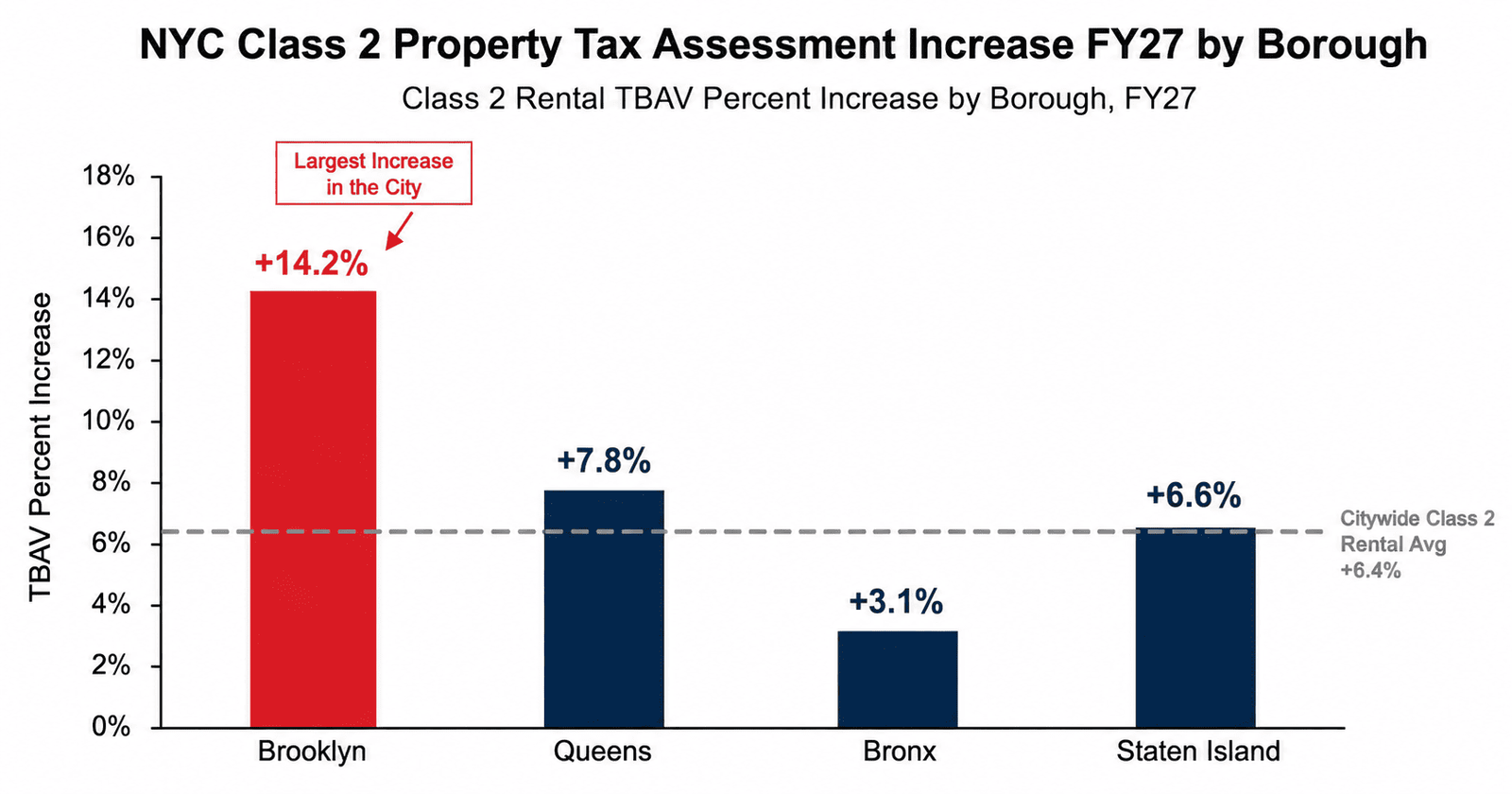
- The NYC DOF FY27 tentative assessment roll (released Jan 15, 2026) shows Class 2 multifamily market value up 6.9% citywide — Brooklyn Class 2 rental apartments saw the largest TBAV increase at 14.2%.
- Property tax is part of PITIA. A higher tax bill means a higher denominator in your DSCR calculation — and a lower ratio — even when your rent and loan terms are unchanged.
- For buildings with 10 or fewer units, annual assessed value increases are capped at 6% by state law. For 11+ unit buildings, the 5-year phase-in of the new assessed value applies — no annual cap.
- The most common error: using the seller’s FY26 tax bill to model PITIA. The FY27 Notice of Property Value (NOPV) at nyc.gov/finance is the correct input for deals closing in 2026.
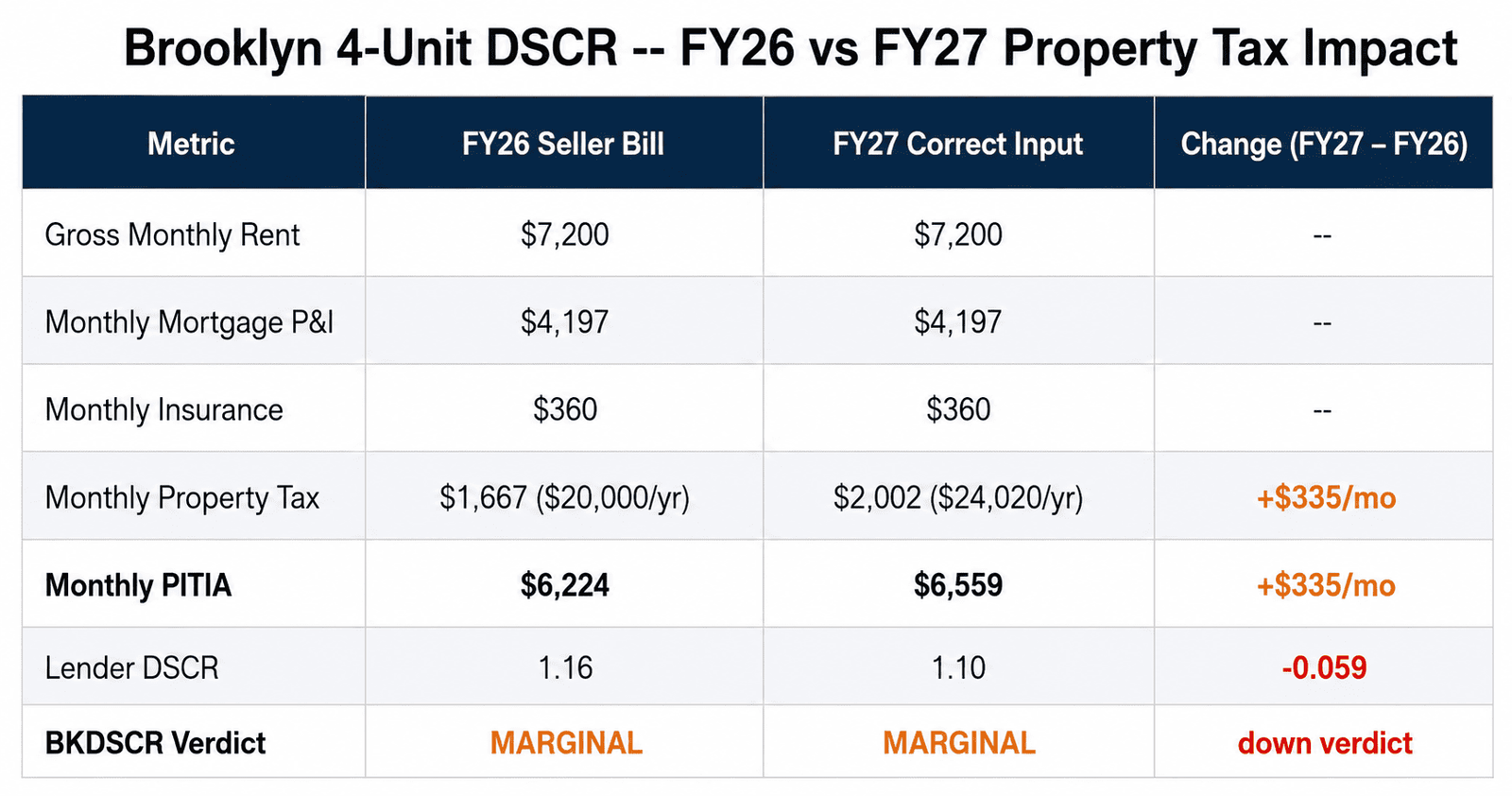
- A $335/month property tax increase on a Brooklyn 4-unit deal drops Lender DSCR from 1.16 to 1.10 — below the lender’s typical 1.20 minimum before stress testing begins.
- Brooklyn had the sharpest Class 2 rental assessment growth of any outer borough. Every Brooklyn multifamily deal closing in 2026 needs the FY27 NOPV confirmed before contracting.
Table of Contents
- NYC Class 2 Tax: What the FY27 Assessment Roll Actually Shows
- How NYC Class 2 Property Tax Is Calculated — and Why It Moves Differently Than You Expect
- NYC Class 2 Tax — The PITIA Math on a Brooklyn 4-Unit Deal
- The Seller’s Tax Bill vs. the FY27 NOPV — Where Investors Get the Number Wrong
- The Cumulative Cost Stack: Property Tax DSCR Impact Combined With Insurance
- What Investors With Deals Under Contract Should Do Right Now
- FAQ: NYC Class 2 Property Tax and DSCR
- What if the seller’s tax bill is already at FY27 levels?
- How does rent stabilization affect the tax impact on DSCR?
- The Number That Belongs in Your DSCR Model
The NYC Class 2 property tax increase for FY27 is a direct hit to DSCR ratios on outer-borough multifamily. This post breaks down exactly how a 6.9% assessment increase moves the denominator — and what it means for deals in Brooklyn, Queens, and the Bronx. Start with the Deal Filter — property type, rent roll, unit count, and PITIA in 60 seconds.
| MARKET SNAPSHOT — NYC Property Tax DSCR 2026, FY2026–27 | |
|---|---|
| Source: NYC Department of Finance FY27 Tentative Assessment Roll (Jan 15, 2026) | |
| Class 2 market value — citywide FY27 | +6.9% to $422.4 billion |
| Brooklyn Class 2 rental TBAV increase | +14.2% (highest of any borough/class) |
| Citywide Class 2 rental market value | +6.4% | Unregulated rentals: +4.29% | Regulated: +0.49% |
| Class 2 FY2026 tax rate (final, Oct 29 2025) | 12.439% |
| Annual assessed value cap (10 or fewer units) | 6% per year / 20% over 5 years |
| 11+ unit buildings | 5-year transitional phase-in applies |
| DSCR Rates (May 2026): | |
| 30-yr fixed | 6.5%–7.875% | Outer-borough 4-unit benchmark: 7.5% at 75% LTV, 700+ FICO |
NYC Class 2 Tax is driving the most significant PITIA increases outer-borough investors face right now. The NYC Department of Finance FY27 tentative assessment roll shows Class 2 multifamily market value up 6.9% citywide — with Brooklyn Class 2 rental apartments recording the largest taxable billable assessed value increase of any borough at 14.2%. That number belongs in your DSCR model. Most investors are not putting it there. See also: Brooklyn assessment increase.
NYC Class 2 Tax: What the FY27 Assessment Roll Actually Shows
The FY27 assessment roll uses market activity from January 6, 2025 through January 5, 2026, plus income and expense data for income-producing properties submitted to DOF during 2025. For Class 2 properties — which include all rental apartment buildings, co-ops, and condos with four or more units — the city values the building on its income-producing potential, not on comparable sales.
The citywide Class 2 market value increase of 6.9% breaks down differently by borough and by property type within Class 2. The numbers from the DOF press release are specific:
| Borough | Class 2 Market Value Δ | Class 2 TBAV Δ (Rentals) | Investor Impact |
|---|---|---|---|
| Brooklyn | +11.8% | +14.2% TBAV (rentals) | Highest in city — verify FY27 NOPV before contracting |
| Queens | +5.4% | Moderate increase | Check NOPV; co-op and condo owners most affected |
| Bronx | +3.9% | Lowest outer-borough | Smaller absolute dollar increase; still model correctly |
| Staten Island | +5.1% | Moderate increase | 1–3 family owners face steeper Class 1 increases |
| Citywide (Class 2) | +6.9% | +6.2% assessed value | Rental apartments: +6.4% market value |
The 14.2% TBAV increase for Brooklyn rental apartments is the number that should land hardest for outer-borough investors. TBAV is taxable billable assessed value — the number to which the tax rate is applied to produce your actual tax bill. For buildings with more than 10 units, DOF phases in changes to assessed value over a 5-year period (transitional assessed value), so the full 14.2% may phase in gradually.
For buildings with 10 or fewer units, assessed value increases are capped at 6% per year by state law — but that cap still means a real dollar increase that needs to be in your model.
The Class 2 tax rate for FY2026 is 12.439% (final rate per City Council resolution, October 29, 2025). The FY27 rate will be set by the City Council in mid-2026. The mayor’s office is forecasting property tax revenues to rise 3.7% in FY2026, bringing in $36.63 billion — approximately $1,171 in additional property tax from each of the city’s 1.11 million tax lots on average. For rental investors running DSCR deals, the question is not the average. It is the specific number for the specific building.
How NYC Class 2 Property Tax Is Calculated — and Why It Moves Differently Than You Expect
Understanding how the city calculates your Class 2 tax bill prevents the underwriting mistakes that show up in DSCR deals. The calculation runs in four steps:
- Step 1 — Market Value: DOF estimates market value using income-capitalization based on comparable rental properties. This is not the price you paid. It is the city’s estimate of what the building would earn as an income-producing asset, capitalized at a published cap rate. For a 4-unit Brooklyn rental, the DOF market value is typically lower than the actual sale price.
- Step 2 — Actual Assessed Value: DOF multiplies market value by 45% (the Class 2 assessment ratio). This produces the actual assessed value. For a building with DOF market value of $900,000, the actual assessed value is $405,000.
- Step 3 — Transitional or Capped Assessed Value: For buildings with more than 10 units, DOF phases in market value changes over 5 years — producing the transitional assessed value. For 10 or fewer units, the annual assessed value increase is capped at 6% (and 20% over 5 years). Your billable assessed value is the lower of the actual and transitional assessed values.
- Step 4 — Tax Bill: The billable assessed value is multiplied by the Class 2 tax rate (12.439% for FY2026). Exemptions and abatements — like 421-a for newer buildings — are subtracted from the billable amount before the rate is applied. Investors in buildings with expiring abatements should model the full unabated bill.
For DSCR underwriting purposes, the relevant number is the annual property tax as it will appear on the FY27 bill — not the FY26 final, not the seller’s most recent quarterly statement multiplied by four. Those numbers reflect last year’s assessment. The FY27 assessment is what the lender will see in the title report, and it is what will govern the actual tax escrow on the loan.
On a deal near the qualifying threshold, that is the difference between a PASS and a MARGINAL verdict.
NYC Class 2 Tax — The PITIA Math on a Brooklyn 4-Unit Deal
Here is what the math looks like on a representative Brooklyn 4-unit Class 2 rental building:
Deal parameters: Purchase price $800,000. Down payment 25% ($200,000). Loan amount $600,000 at 7.5%, 30-year fixed DSCR product. Monthly P&I: $4,197. Monthly gross rent: $7,200 ($1,800/unit × 4 units). Monthly insurance: $360.
| Line Item | FY26 (Seller’s Bill) | FY27 (Correct Input) | Change |
|---|---|---|---|
| Gross Monthly Rent | $7,200 | $7,200 | — |
| Monthly Mortgage (P&I) | $4,197 | $4,197 | — |
| Monthly Insurance | $360 | $360 | — |
| Monthly Property Tax | $1,667 ($20,000/yr) | $2,002 ($24,020/yr) | +$335/mo |
| Monthly PITIA | $6,224 | $6,559 | +$335/mo |
| Lender DSCR (rent ÷ PITIA) | 1.16 | 1.10 | –0.059 |
| BKDSCR Stress Test (1.25+ standard) | MARGINAL | FAIL | ↓ Verdict |
The seller’s bill scenario produces a Lender DSCR of 1.16 — it barely clears the lender’s floor of 1.20 on some programs, and already falls short of the BKDSCR stress test standard of 1.25+. Now add the correct FY27 tax input. The Lender DSCR drops to 1.10 — still technically above the 1.00 combined stress floor, but now failing the lender’s typical minimum of 1.20 on many DSCR programs before any stress has been applied.
The DSCR formula shows exactly how PITIA is assembled and how each component moves the ratio. The key discipline is to use the FY27 NOPV number for the annual tax line, not the seller’s current bill.
Get the DSCR Playbook — every input, threshold, and deal-killer for NYC outer-borough investors in one place.
The Seller’s Tax Bill vs. the FY27 NOPV — Where Investors Get the Number Wrong
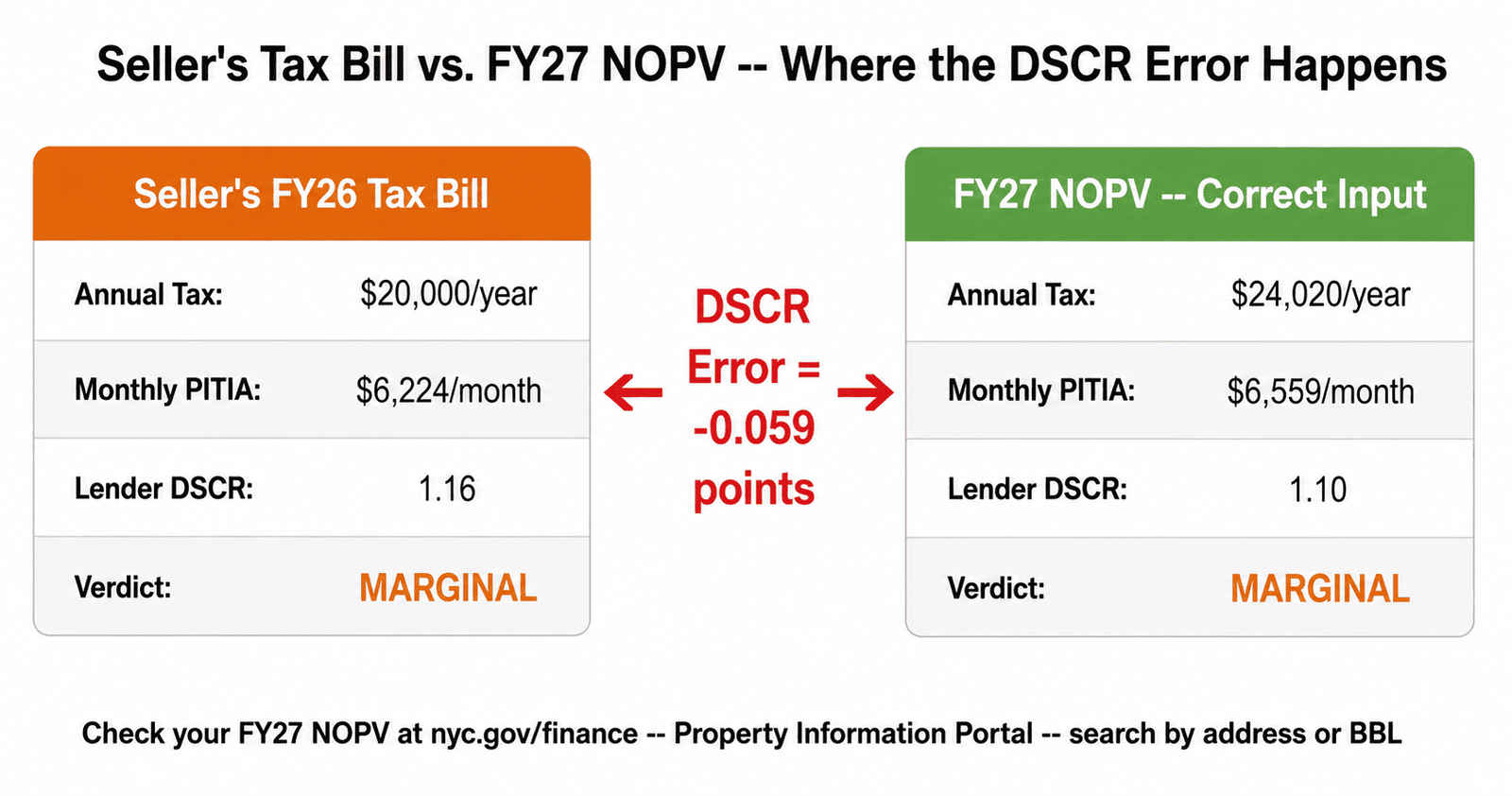
The property tax number that most investors bring to a deal analysis is the wrong one. Here is how that happens:
- The seller provides a recent property tax bill — usually a quarterly statement or the full-year FY26 bill. The investor multiplies by four (or uses the annual total) and enters it into the PITIA calculation.
- The FY26 bill reflects the FY26 tentative assessment from January 2025. It is based on market activity and income data from 2023–2024. It does not reflect the FY27 assessment.
- The FY27 tentative assessment roll was released January 15, 2026. For Brooklyn Class 2 rental apartments, the TBAV increased 14.2%. For buildings with 10 or fewer units, the 6% annual cap limits how fast the billable assessed value can grow — but the underlying assessed value is still moving up, and the tax bill will increase.
- The closing attorney will see the FY27 assessed value in the title search. The lender’s underwriter will see it in the tax certification. The investor’s DSCR model should see it before anyone else does.
How to find the FY27 NOPV: Go to nyc.gov/finance. Navigate to the Property Information Portal. Search by address or BBL (borough-block-lot). Under “Market Values & Assessments,” select 2026–2027 Tentative to view the FY27 values. Compare to the 2025–2026 Final to see the year-over-year change. The tentative roll was released January 15, 2026. Property owners had until March 2, 2026 to file a Tax Commission challenge for Class 2 and Class 4 properties.
The annual tax from the FY27 NOPV is the number that belongs in your PITIA calculation for any deal closing in 2026 or early 2027. If you are evaluating a deal today and the seller’s broker is giving you a tax bill, ask for the FY27 NOPV instead. If they do not have it, pull it yourself from the DOF portal before contracting.
The Cumulative Cost Stack: Property Tax DSCR Impact Combined With Insurance
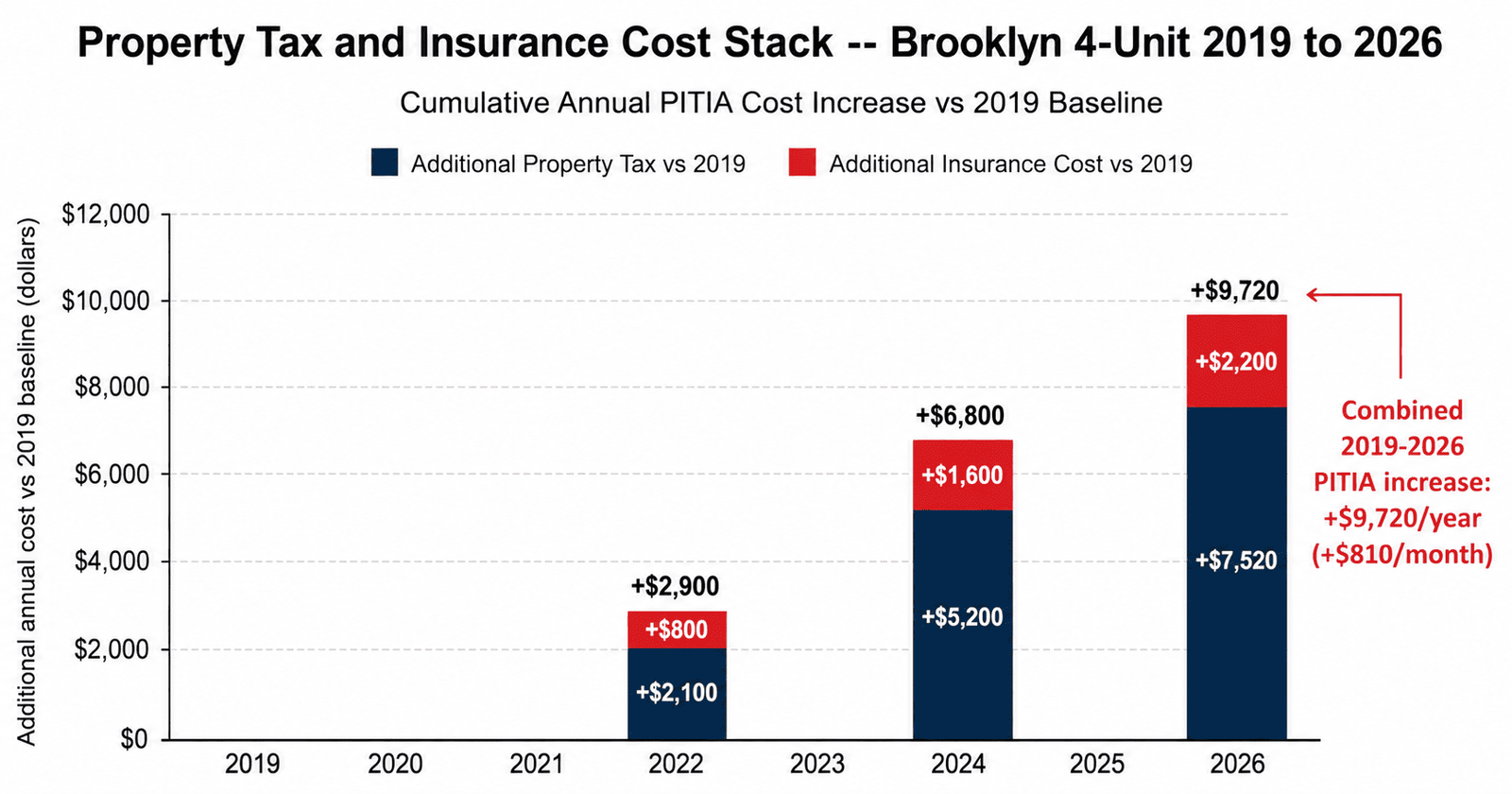
Property tax is not the only PITIA input that has risen since 2019. Outer-borough Brooklyn and Queens rental property insurance rates have increased substantially — 40–60% in many cases since 2022 — driven by carrier withdrawals from the NYC market, rising claims costs, and reinsurance pricing. When you combine the insurance increase with the FY27 property tax assessment increase, the cumulative effect on DSCR is significant.
A representative analysis for a Brooklyn 4-unit Class 2 rental from 2019 to 2026:
| Cost Component | Amount |
|---|---|
| FY19 Annual Property Tax (estimated) | $16,500 |
| FY27 Annual Property Tax (6% cap applied) | $24,020 |
| Annual Property Tax Increase 2019 → 2026 | +$7,520 |
| FY19 Annual Insurance (estimated) | $3,200 |
| FY26 Annual Insurance (current market estimate) | $5,400 |
| Annual Insurance Increase 2019 → 2026 | +$2,200 |
| Combined Annual PITIA Increase (tax + insurance) | +$9,720/year |
| Monthly PITIA Increase | +$810/month |
| DSCR Impact at $7,200/month rent (vs 2019 baseline) | –0.11 to –0.18 points |
The stress test applies both rate and vacancy pressure to the current PITIA number. The standard for NYC outer-borough multifamily is a stressed DSCR of 1.25+ under a single stress scenario. Combined stress (rate + 10% vacancy) must clear 1.00+. If your deal does not clear those thresholds at the FY27 tax input, the lender’s stress test will not be kinder.
What Investors With Deals Under Contract Should Do Right Now
If you have a deal currently under contract or in due diligence, here is the four-step tax input correction process:
- Step 1 — Pull the FY27 NOPV from the DOF Property Information Portal. Search by address at nyc.gov/finance. Under “Market Values & Assessments,” look at the 2026–2027 Tentative row. Note the tentative assessed value and compare it to the 2025–2026 Final value.
- Step 2 — Calculate the FY27 billable assessed value. For buildings with 10 or fewer units, apply the 6% annual cap: multiply the FY26 billable assessed value by 1.06. That is your FY27 billable assessed value. For 11+ unit buildings, use the transitional assessed value from the NOPV directly.
- Step 3 — Calculate the annual tax. Multiply the FY27 billable assessed value by 12.439% (FY2026 rate; FY27 rate is set mid-2026 — use 12.439% as a conservative estimate until the City Council acts). Subtract any confirmed exemptions or active abatements.
- Step 4 — Update your PITIA model and rerun the DSCR. If the ratio drops below your qualifying threshold, run the stress test to see the full floor. A deal that no longer passes the BKDSCR standard at FY27 taxes may still qualify for financing — but you need to know the real ratio before your lender does.
The lender criteria page covers what DSCR lenders actually look at during underwriting — including how tax documentation is handled in the title and escrow process. The deal analysis page walks through the full PITIA-to-DSCR pipeline in the same format BKDSCR uses on every deal review.
FAQ: NYC Class 2 Property Tax and DSCR
What if the seller’s tax bill is already at FY27 levels?
Some sellers have already updated their records based on the January 2026 tentative roll. If the seller is providing a bill dated after July 1, 2026, that bill reflects FY27 values and can be used directly. If the bill predates July 1, 2026, it reflects FY26 values. The safest approach regardless: pull the NOPV directly from the DOF portal and use the FY27 tentative assessed value as your input.
How does rent stabilization affect the tax impact on DSCR?
Two ways. First, rent-stabilized units contribute less to the DOF income estimate — since DOF values the building on income-producing potential, and regulated rents are lower than market rents. That can modestly suppress the assessed value compared to a fully market-rate building. Second, the rent growth on stabilized units is constrained by the Rent Guidelines Board — the 2025 order was 3% for one-year leases. If your assessed value increases 6% and your rents grow 3%, the NOI squeeze is real regardless of how the DOF income model weights it.
The Number That Belongs in Your DSCR Model
NYC Class 2 Property Tax is a straightforward problem with a straightforward fix. The FY27 tentative assessment roll released January 15, 2026 contains the correct input for every Class 2 rental property in the five boroughs. Brooklyn Class 2 rental apartments saw the sharpest increase — 14.2% in taxable billable assessed value — and that number has a direct, calculable effect on PITIA and therefore on DSCR.
The investor who uses the seller’s FY26 tax bill without checking the FY27 NOPV is underwriting to a ratio that overstates the deal’s true cash flow position. In a market where DSCR qualifying thresholds sit at 1.20–1.25, that gap determines whether a deal passes, goes to a marginal outcome, or fails stress testing before it ever reaches a lender.
The tax number that belongs in your DSCR model is the FY27 assessed value from the DOF’s Property Information Portal — not the seller’s current quarterly bill. The FY27 assessment for Brooklyn Class 2 rental apartments averaged 14.2% higher in TBAV. If you are closing a Brooklyn multifamily deal in 2026 and using the seller’s tax bill without checking the FY27 update, you are underwriting to a DSCR that is overstated — and you will find out at the title search, not in your deal model. Use the deal analysis framework to confirm which tax figure belongs in your specific deal model before going under contract.
The investor who confirms the FY27 assessed value before contracting, builds in a 4–5% annual tax growth assumption for years 2–5, and runs the deal through the stress test before submitting is the investor who knows what the deal actually costs — not what it costs at prior-year inputs.
Run a Deal Review — current DSCR, stressed DSCR, NOI, and updated tax assessment modeled at current inputs, delivered within 48–72 hours.