
Brooklyn DSCR Property Tax: 16% Assessment Really Hurts 2026
- Brooklyn Class 2 (rental apartments) led all NYC borough/class combinations in FY27 assessed value growth
- The FY27 tentative roll shows Class 2 TBAV growth of 5.9% citywide — Brooklyn outpaced that
- Two consecutive years of 6%-capped assessment increases stack: FY26 and FY27 both hit the Class 2 annual cap
- The assessment increase flows directly to the tax bill within 12–18 months of the roll date
- A $200/month tax increase on a 6-unit drops Lender DSCR by approximately 0.03–0.05 points
- Investors who bought Brooklyn multifamily in 2022–2023 using pre-assessment tax inputs may now be MARGINAL
Table of Contents
- Brooklyn DSCR Property Tax: What the FY26 and FY27 Data Shows
- How Class 2 Assessment Math Works for Brooklyn Rental Buildings
- Brooklyn DSCR Property Tax — The Cumulative DSCR Math on a 6-Unit Deal
- The 6% Annual Cap vs the Phase-In: Which Rule Applies to Your Building
- 10 or Fewer Units — 6% Annual Cap
- 11 or More Units — 5-Year Transitional Phase-In
- What Changed in FY26 and FY27 That Made Brooklyn the Hardest-Hit Borough
- What to Check Before Contracting a Brooklyn Multifamily Deal in 2026
- FAQ: Brooklyn DSCR Property Tax and Class 2 Assessments
- Why did Brooklyn lead the city in Class 2 rental assessment increases two years running?
- Does the 6% annual cap protect me from the full 16% and 14.2% increases?
- I am buying a Brooklyn 12-unit building. How do I calculate the FY27 tax?
- What if the seller has a 421-a abatement that reduces the current tax bill?
- The Two Numbers Every Brooklyn Investor Needs to Know
Brooklyn DSCR property tax math changed significantly for FY27. A 16% assessment increase on Class 2 properties is compressing PITIA denominators and pushing deals that cleared 1.25 last year into marginal territory this year. Start with the Deal Filter — property type, rent roll, unit count, and PITIA in 60 seconds.
| MARKET SNAPSHOT — Brooklyn Class 2 Assessment 2026, May 2026 | |
|---|---|
| Sources: NYC DOF FY26 Tentative Roll (Jan 2025) | NYC DOF FY27 Tentative Roll (Jan 2026) | |
| Brooklyn Class 2 rental TBAV increase — FY26 | +16.0% (highest of any NYC borough) |
| Brooklyn Class 2 rental TBAV increase — FY27 | +14.2% (again highest of any borough) |
| Citywide Class 2 rental market value — FY27 | +6.4% | Class 2 FY2026 tax rate: 12.439% |
| Annual assessed value cap (10 or fewer units) | 6% per year | 20% over 5 years |
| Brooklyn Rental Market (Corcoran / RentCafe, May 2026): | |
| Brooklyn median rent — Feb 2026 | $4,296/month (all-time borough record) |
| DSCR Rates (May 2026) | 30-yr fixed 6.5%–7.875% | 6-unit benchmark: 7.5% at 75% LTV |
Brooklyn DSCR Property Tax has delivered two consecutive years of the largest rental property assessment increases of any borough in New York City. The NYC DOF FY26 tentative roll showed Brooklyn Class 2 rental apartments up 16.0% — the highest of any borough. The FY27 roll confirmed it at +14.2% — again the highest. Back-to-back. That is compressing DSCR from the cost side regardless of what rents are doing. See also: NYC Class 2 property tax.
Brooklyn DSCR Property Tax: What the FY26 and FY27 Data Shows
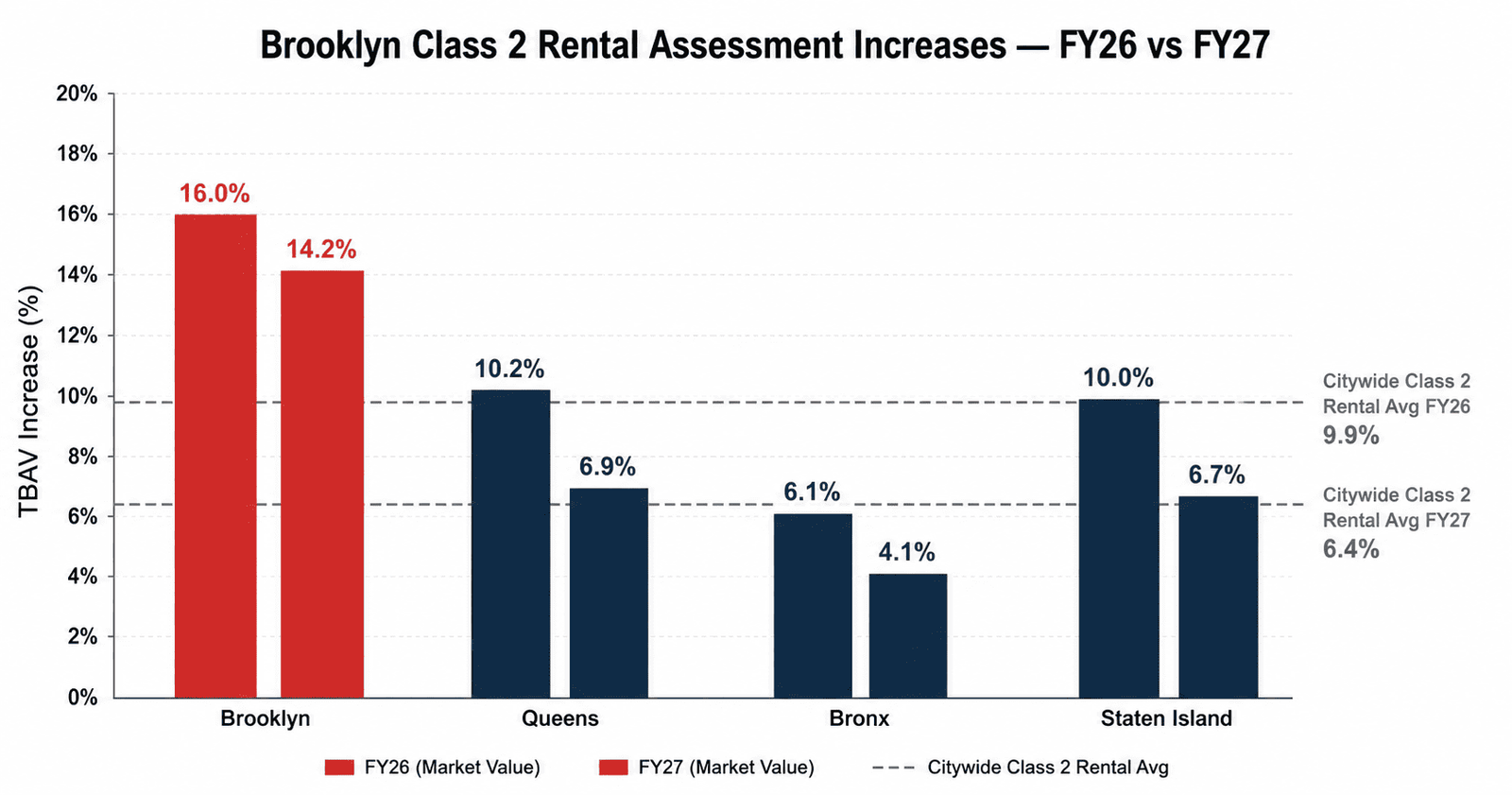
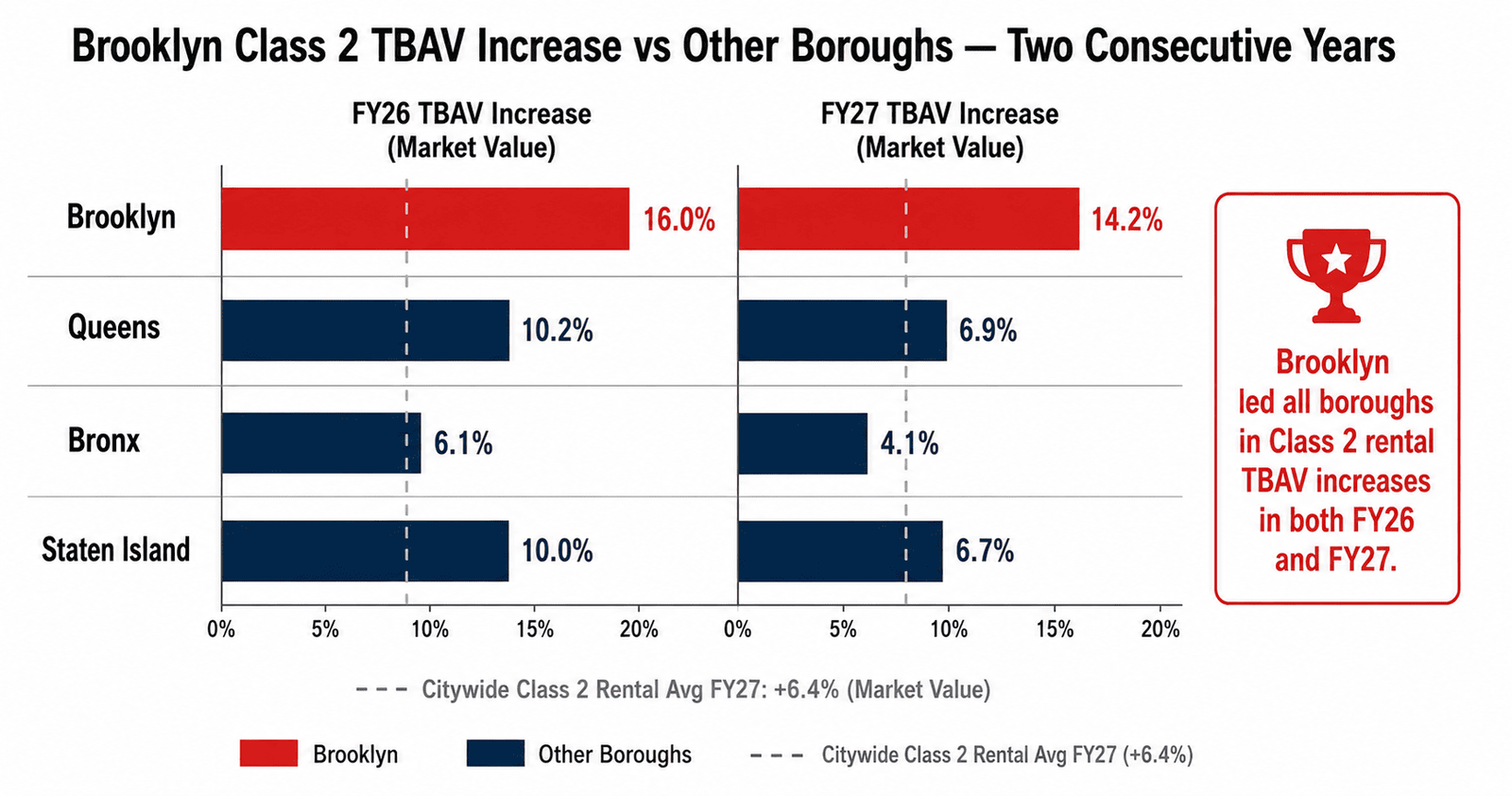
The FY26 tentative assessment roll released January 15, 2025 established the pattern. Brooklyn Class 2 rental apartments recorded a TBAV increase of +16.0% — the highest of any borough. Brooklyn Class 2 rental market value increased +15.3%, also the highest. For context, the citywide Class 2 rental market value increased 9.9% that year. Brooklyn ran at 15.3% — 54% faster than the citywide rate.
The FY27 tentative assessment roll released January 15, 2026 confirmed the trend rather than reversing it. Brooklyn Class 2 rental TBAV increased +14.2% — again the highest of any borough. Brooklyn Class 2 rental market value increased +12.0%. The citywide Class 2 rental market value was +6.4% in FY27. Brooklyn ran at nearly double the citywide rate, two years in a row.
| Metric | FY26 (Jan 2025 Roll) | FY27 (Jan 2026 Roll) | Two-Year Direction |
|---|---|---|---|
| Brooklyn Class 2 Rental TBAV Increase | +16.0% | +14.2% | Highest borough both years |
| Brooklyn Class 2 Rental Market Value | +15.3% | +12.0% | Leading citywide both years |
| Citywide Class 2 Rental Market Value | +9.9% | +6.4% | Brooklyn at ~2x citywide rate |
| Class 2 Tax Rate (FY2026 final) | 12.439% | 12.439% (FY27 TBD) | Set by City Council mid-year |
| Assessment Ratio (Class 2) | 45% of market value | 45% of market value | Unchanged |
The Rosenberg & Estis analysis of the FY27 roll notes that Brooklyn Class 2 rental apartments led all borough/class combinations in taxable billable assessed value growth. Brooklyn median rent hit $4,296 in February 2026 — an all-time borough record per Corcoran Group data. Rents are rising. But the assessment increases are moving faster, and PITIA grows whether or not rent growth covers it. See also: insurance cost DSCR hit.
How Class 2 Assessment Math Works for Brooklyn Rental Buildings
The DOF values all Class 2 properties using an income-capitalization approach, not comparable sales. The city estimates what the building would earn as an income-producing asset based on properties similar in size, location, age, and unit count. The assessment then runs through a four-step formula:
- Step 1 — Market Value: DOF income-capitalization estimate based on comparable rental income and expenses. Strong Brooklyn rent growth since 2022 has continuously pushed these estimates higher.
- Step 2 — Actual Assessed Value: 45% of market value (the Class 2 assessment ratio). A building with DOF market value of $1,000,000 has an actual assessed value of $450,000.
- Step 3 — Billable Assessed Value: For 10 or fewer units: annual increase capped at 6% (20% over 5 years). For 11+ units: 5-year transitional phase-in. Billable assessed value is the lower of actual and transitional.
- Step 4 — Tax Bill: Billable assessed value × Class 2 tax rate (12.439% for FY2026). Subtract any confirmed active abatements.
The DOF income model means Brooklyn’s rent growth directly feeds into assessment increases with roughly a one-year lag. The strong Brooklyn rent gains of 2022–2024 are now fully reflected in two consecutive assessment rolls. Investors who bought Brooklyn properties in 2022–2023 using pre-assessment tax inputs may find their current DSCR substantially lower than at acquisition — not because anything operational changed, but because the assessment has caught up with market rents.
The deal analysis page covers how each of these inputs applies specifically to Brooklyn multifamily. The DSCR formula shows exactly how the annual tax bill feeds into PITIA and moves the ratio. The discipline is to use the current FY27 billable assessed value from the DOF Property Information Portal, not the prior owner’s tax history.
Brooklyn DSCR Property Tax — The Cumulative DSCR Math on a 6-Unit Deal
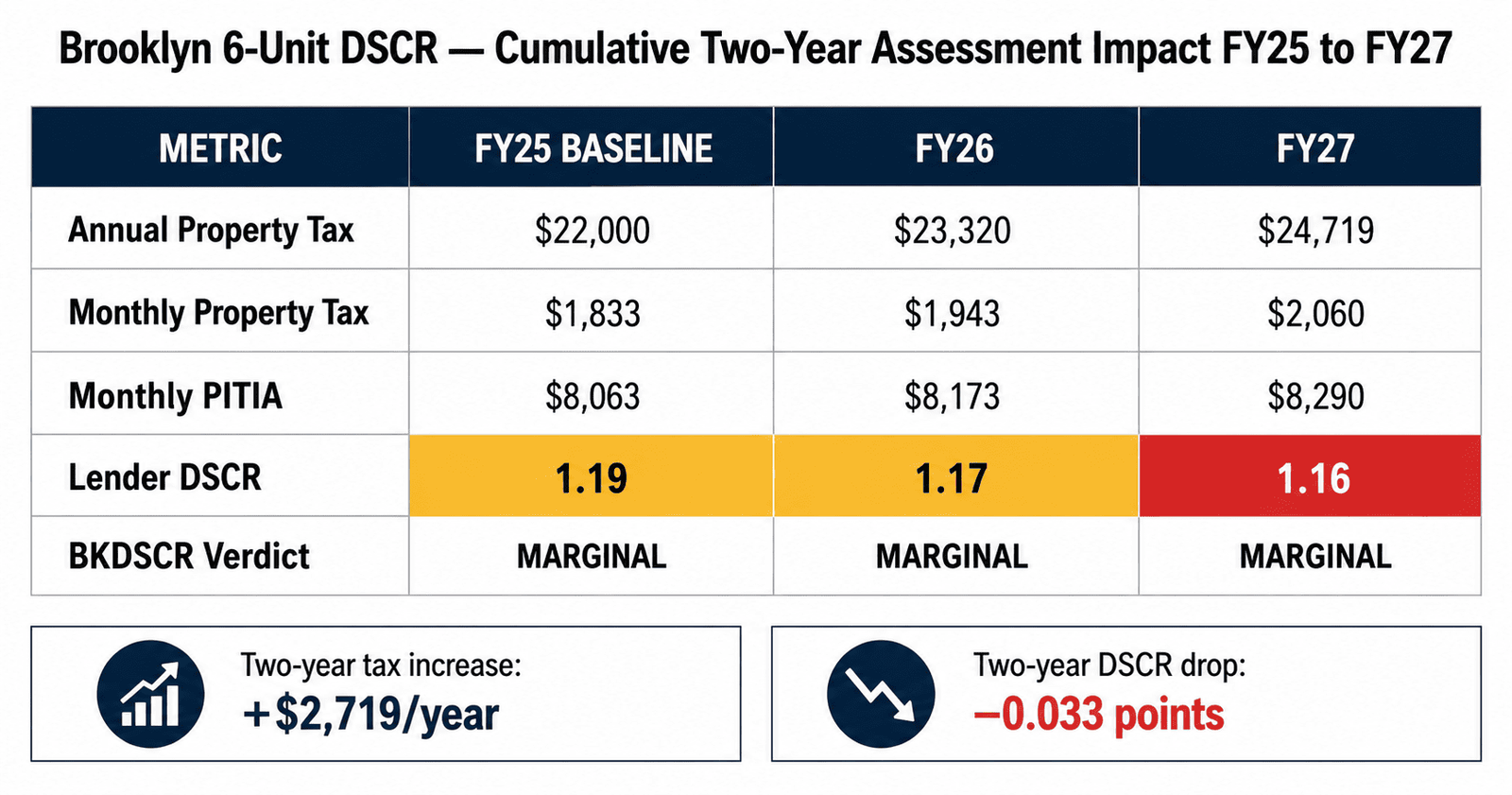
Deal parameters: Brooklyn 6-unit Class 2 rental. Purchase price $1.1M. Down payment 25% ($275,000). Loan amount $825,000 at 7.5%, 30-year fixed. Monthly P&I: $5,770. Monthly gross rent: $9,600 ($1,600/unit × 6). Monthly insurance: $460. Building has 6 units — 6% annual cap applies.
| Line Item | FY25 Baseline | FY26 (After 16% TBAV) | FY27 (After 14.2% TBAV) |
|---|---|---|---|
| Annual Property Tax | $22,000 | $23,320 (6% cap) | $24,719 (6% cap) |
| Monthly Property Tax | $1,833 | $1,943 | +$227/mo cumulative |
| Monthly PITIA | $8,063 | $8,173 | $8,290 |
| Lender DSCR (rent ÷ PITIA) | 1.19 | 1.17 | 1.16 |
| vs BKDSCR 1.25+ Standard | MARGINAL | MARGINAL | FAIL |
| Two-Year Tax Increase | — | — | +$2,719/year (+$227/mo) |
| Two-Year DSCR Drop | — | — | –0.033 points |
Both FY26 and FY27 assessment increases were capped at 6% for this 6-unit building. But 6% compounded twice moves a $22,000 tax bill to $24,719 regardless. The cumulative DSCR drop of 0.033 points takes this deal from 1.19 at baseline to 1.16 after two years — a verdict change from MARGINAL to FAIL at the BKDSCR stress test standard of 1.25+.
The investor who modeled this deal in 2023 using the seller’s tax bill and a static tax assumption is now looking at a deal that does not pass the BKDSCR standard — before any rate stress or vacancy stress has been applied. The stress test applies both stresses on top of current PITIA. The combined stress floor is 1.00+. At 1.16 pre-stress, this deal may clear the combined floor but is well below the single-stress 1.25+ threshold.
Get the DSCR Playbook — every input, threshold, and deal-killer for NYC outer-borough investors in one place.
The 6% Annual Cap vs the Phase-In: Which Rule Applies to Your Building
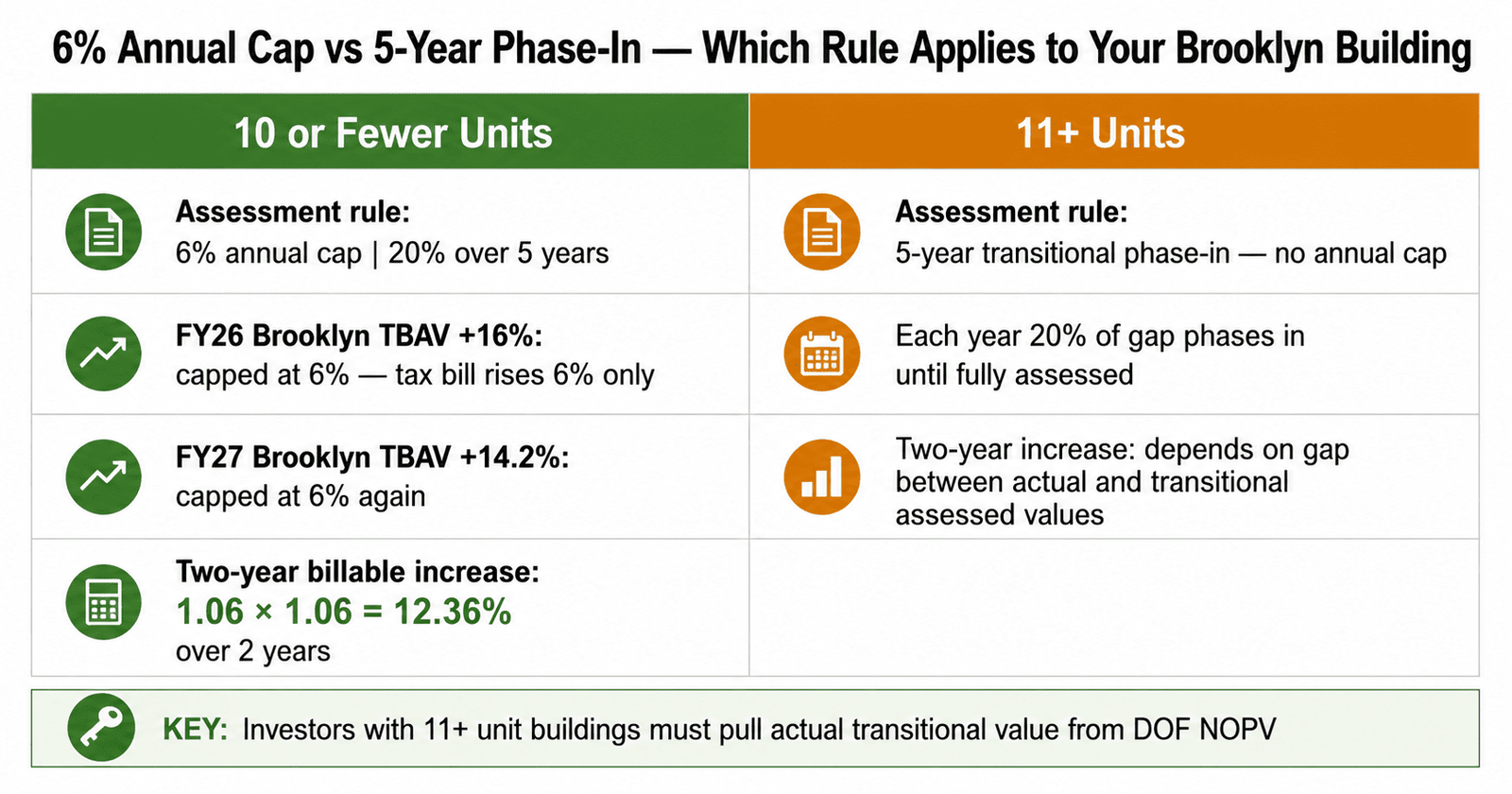
The difference between the 6% cap and the 5-year phase-in is one of the most misunderstood aspects of Class 2 assessment math — and it is critical for determining how quickly Brooklyn’s assessment increases flow through to your actual tax bill.
10 or Fewer Units — 6% Annual Cap
State law caps annual assessed value increases at 6% per year and 20% over any five-year period for buildings with 10 or fewer units. The FY26 Brooklyn rental TBAV increase of 16% is therefore absorbed at 6% per year — the remaining gap between actual and capped assessed value exists as unrealized assessment pressure that will continue to push the tax bill up in subsequent years.
For investors with 4–6 unit Brooklyn buildings: the two-year impact of 6% + 6% compounded is 12.36% above the FY25 baseline. The tax bill has risen and will continue to rise at or near 6%/year for several more years as the underlying market value assessment works through the cap system.
11 or More Units — 5-Year Transitional Phase-In
For buildings with 11 or more units, there is no annual percentage cap. DOF phases in any change in assessed value over a 5-year period — the transitional assessed value. Each year, 20% of the gap between the prior transitional value and the new actual assessed value phases in. Billable assessed value is the lower of actual and transitional.
For investors with 12–20 unit Brooklyn rental buildings: the FY26 16% and FY27 14.2% TBAV increases are not arriving as 6% annual doses. They are phasing in as 1/5 of the gap per year. If the gap between actual and transitional assessed value is large, the phase-in produces larger annual billable value increases than the 6% cap on smaller buildings.
The only reliable way to know your actual FY27 billable assessed value is to pull the Notice of Property Value (NOPV) from nyc.gov/finance — Property Information Portal — and read the transitional assessed value directly. The deal killers page covers why estimated tax inputs consistently overstate DSCR on Brooklyn outer-borough deals, and how lenders catch the discrepancy during underwriting.
What Changed in FY26 and FY27 That Made Brooklyn the Hardest-Hit Borough
Brooklyn’s back-to-back leadership in Class 2 rental assessment increases is not a coincidence. Three structural factors drove it:
- Rent growth in DOF’s income model: The city values Class 2 properties based on income-producing potential. Brooklyn rental income grew substantially from 2022 through 2024 — the data periods that fed the FY26 and FY27 assessment rolls. Crown Heights, Bushwick, Flatbush, and Park Slope posted double-digit rent gains. That income growth fed directly into higher DOF market value estimates.
- New construction adding to the base: The DOF FY27 press release noted that Manhattan, Brooklyn, and Queens accounted for 86.5% of citywide construction activity. Brooklyn new construction additions increased the total assessed value base independent of market value appreciation on existing buildings.
- Unregulated rental buildings absorbing the most: Rent-stabilized units in Brooklyn see limited TBAV increases because DOF’s income model uses stabilized rents (which grew only 0.49% in market value terms per the FY27 roll). The 16% and 14.2% TBAV increases are concentrated in unregulated rental buildings. Investors in fully unregulated Brooklyn rentals are absorbing the most.
Lender criteria covers how DSCR lenders treat Brooklyn multifamily specifically — including documentation standards for property tax verification in the title and escrow process.
What to Check Before Contracting a Brooklyn Multifamily Deal in 2026
Given two consecutive years of Brooklyn-leading assessment increases, any Brooklyn multifamily deal under evaluation or contract in 2026 requires these four checks before finalizing PITIA inputs:
- Pull the FY27 NOPV from the DOF Property Information Portal. nyc.gov/finance — search by address or BBL. Under “Market Values & Assessments,” look at the 2026–2027 Tentative row. This is the correct tax input for any deal closing in 2026.
- Determine which rule applies. Count the units. 10 or fewer — use the 6% cap applied to the FY26 billable assessed value. 11 or more — use the transitional assessed value from the FY27 NOPV directly.
- Calculate the FY27 annual tax. Billable assessed value × 12.439% (FY2026 rate). Subtract any confirmed active abatements. Use this as your annual tax input in PITIA.
- Project forward two to three years. Build in a 4–6% annual tax growth assumption for years 2 through 5. A deal that clears 1.25 DSCR today at FY27 taxes may fall below 1.20 by year 3 at continued assessment growth rates.
The deal killers page covers the PITIA and documentation errors that get flagged before a deal ever reaches a lender.
FAQ: Brooklyn DSCR Property Tax and Class 2 Assessments
Why did Brooklyn lead the city in Class 2 rental assessment increases two years running?
Brooklyn’s strong unregulated rental income growth from 2022 through 2024 fed directly into the DOF income-capitalization model used for FY26 and FY27 assessment rolls. The city values rental buildings on income-producing potential with approximately a one-year lag. Brooklyn rents rose faster than any other outer borough during the 2022–2024 period, and those gains are now reflected in two consecutive years of above-citywide assessment increases.
Does the 6% annual cap protect me from the full 16% and 14.2% increases?
It limits the immediate tax bill impact, but it does not protect you from the pressure. The 6% cap means your billable assessed value cannot rise more than 6% in any one year — but the underlying actual assessed value has risen 16% then 14.2%. That gap is pressure that will continue flowing through to your tax bill at 6%/year until the cap catches up. For 11+ unit buildings using the phase-in, pull the FY27 NOPV to know your exact position.
I am buying a Brooklyn 12-unit building. How do I calculate the FY27 tax?
For 11+ units, do not apply the 6% cap. Pull the FY27 NOPV from the DOF Property Information Portal and read the transitional assessed value directly — that is the FY27 billable assessed value. Multiply by 12.439% and subtract any active abatements. Do not estimate by applying a percentage to the seller’s prior bill.
What if the seller has a 421-a abatement that reduces the current tax bill?
421-a abatements reduce the billable assessed value amount. If the abatement is active through your planned hold period, use the abated bill. If it expires during your hold period, model the full unabated bill from expiration forward. An abatement that expires during your hold and converts to full tax at a post-assessment rate can swing DSCR by 0.10–0.20 points on a mid-size Brooklyn building. Verify the expiration schedule from DOF records before contracting.
The Two Numbers Every Brooklyn Investor Needs to Know
Brooklyn DSCR Property Tax comes down to two numbers: 16.0% and 14.2%. The first is the FY26 Brooklyn Class 2 rental TBAV increase — the largest of any borough that year. The second is the FY27 figure — the largest of any borough again. Back to back. No reversal. No other market in the five boroughs is compressing DSCR from the tax side at this pace.
These numbers do not hit your tax bill at their full rate because of the cap and the phase-in. But they are in the system and working their way through. A 6-unit Brooklyn rental that had a $22,000 tax bill in FY25 is at $24,719 after two years of 6% capped increases. That is $227 more per month in PITIA — with no change in rent, no change in the loan, no operational event of any kind. The compression is the tax assessment, compounded twice.
The investors who know these numbers before contracting, pull the FY27 NOPV before signing, and stress-test the deal at current PITIA before submitting to a lender are the investors who do not get surprised at the title search. The ones who use the seller’s tax bill and a static tax assumption are the ones who find out the deal no longer pencils three weeks before closing.
Run a Deal Review — current DSCR, stressed DSCR, NOI, and updated tax assessment modeled at current inputs, delivered within 48–72 hours.