
Distressed NYC DSCR Loan: The 123% Foreclosure Surge
- Staten Island recorded 58 first-time foreclosure filings in Q1 2026 — a 123% year-over-year increase
- Mid-Island zip 11314 had 12 filings — 1-in-5 of all Staten Island cases and tied for the city’s epicenter
- The distress is a household cash flow problem, not a property value problem — median price is still up 4.1% YoY
- At a 20% discount to market plus value-add rents, a Staten Island 2-family produces 1.30 DSCR — PASS
- A 30% discount produces a PASS even at current rents without a value-add assumption
- 191 pre-foreclosure (lis pendens) filings in Q1 2026 represent the pipeline for direct negotiation
Table of Contents
- Distressed NYC DSCR Loan: What the Q1 2026 Data Shows
- Why Staten Island’s Foreclosure Count Jumped 123%
- Distressed NYC DSCR Loan — The Math on a Distressed 2-Family Deal
- How Much of a Discount Do You Actually Need?
- The Mid-Island 11314 Hotspot and What It Means for Investors
- Distressed NYC DSCR Loan — Due Diligence Before You Bid
- What DSCR Lenders Look for on Distressed Staten Island Deals
- Property Condition
- Vacant Units and Underwriting
- Seasoning Requirements
- FAQ: Staten Island Foreclosures and DSCR Investing in 2026
- Is the 123% increase in Staten Island foreclosures a sign of a market collapse?
- Can I use a DSCR loan to buy a foreclosure at auction?
- What does the 191 pre-foreclosure (lis pendens) count mean for investors?
- The 20% Discount That Changes the DSCR Math
A distressed NYC DSCR loan is a deal category most outer-borough investors are not actively pursuing — which is exactly why the opportunity exists. According to PropertyShark, Staten Island recorded 58 first-time foreclosure filings in Q1 2026 — a 123% year-over-year increase, making it the fastest-growing foreclosure market in the city. At a 20% discount to the $762,000 Q1 median, the DSCR math on a Staten Island 2-family shifts from FAIL at market price to PASS with value-add rent upside. This post runs the exact numbers.
Start with the Deal Filter — property type, rent roll, unit count, and PITIA in 60 seconds.
| MARKET SNAPSHOT — Staten Island Foreclosure & DSCR Benchmarks, May 2026 | |
|---|---|
| Sources: PropertyShark Q1 2026 NYC Foreclosure Report (Apr 15, 2026) | Zumper | NYC DOF | |
| FORECLOSURE DATA — Q1 2026 | |
| Staten Island Q1 2026 first-time filings | 58 (+123% YoY) — fastest-growing borough |
| NYC Q1 2026 total filings | 399 (-3% YoY) |
| Queens | Bronx | Brooklyn | Manhattan | 167 | 67 | 62 | 45 |
| Mid-Island zip 11314 hotspot | 12 filings — 1-in-5 of all S.I. cases |
| S.I. pre-foreclosures (lis pendens) | 191 filings Q1 2026 |
| MARKET & DSCR CONTEXT — April–May 2026 | |
| S.I. median home price | $762,000 (+4.1% YoY) |
| Rental vacancy | <3.5% |
| 2-family rents (current) | $2,100–$2,500/unit | $2,700 achievable on updated units |
| DSCR 30-yr fixed rates (May 2026) | 6.5%–7.875% |
| Benchmark rate (75% LTV, 700+ FICO) | 7.5% |
Distressed NYC DSCR Loan: What the Q1 2026 Data Shows
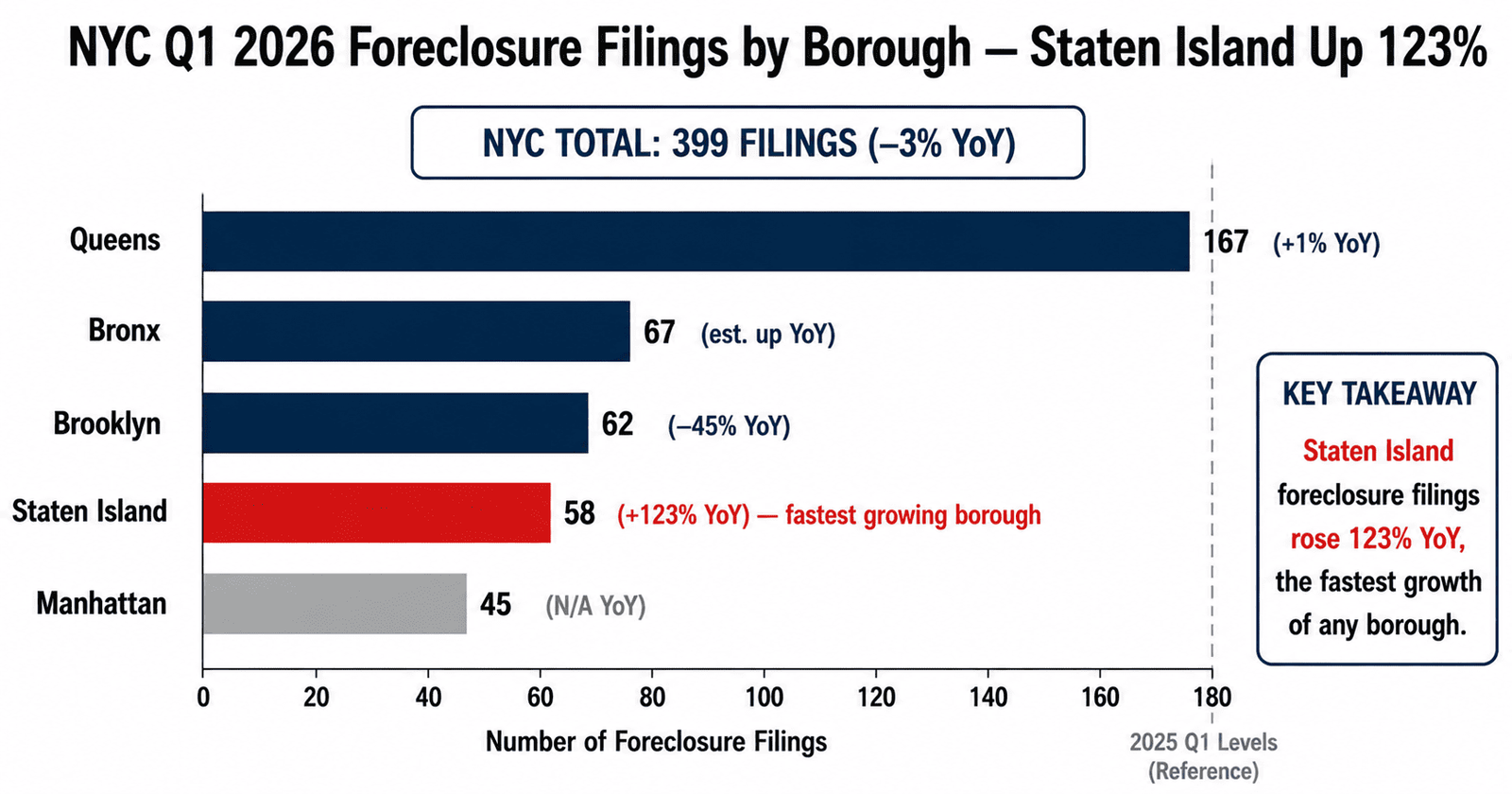
The PropertyShark Q1 2026 NYC Foreclosure Report documents sharp divergence at the borough level beneath a relatively calm city-wide headline. Total NYC Q1 2026 count: 399 first-time filings — a 3% decrease year-over-year and the slowest Q1 in three years.
| Borough | Q1 2026 Filings | YoY Change | Q1 2026 Share | Key Trend |
|---|---|---|---|---|
| Queens | 167 | +1% | 42% | Highest volume; nearly half of all NYC cases |
| Bronx | 67 | Est. up | 17% | Second highest; single-family and institutional activity |
| Brooklyn | 62 | -45% | 16% | Sharpest drop; lowest since mid-2022 |
| Staten Island | 58 | +123% | 15% | Fastest growing; led by single-family and 2-family |
| Manhattan | 45 | N/A | 11% | Moderated; still elevated vs pre-2022 |
| NYC Total | 399 | -3% | 100% | Slowest Q1 in 3 years — S.I./Bronx accelerating |
Single-family homes (164 filings) rose approximately 50% year-over-year and accounted for 41% of all NYC Q1 2026 cases — directly tied to Staten Island’s acceleration. The Mid-Island zip 11314 recorded 12 first-time filings — one in five of all Staten Island cases — tied with Queens’ 11412 and 11413 as the city’s foreclosure epicenter. The borough also recorded 191 lis pendens (pre-foreclosure filings) in Q1 — the early-warning pipeline signaling more formal foreclosures to follow.
Why Staten Island’s Foreclosure Count Jumped 123%
Staten Island’s acceleration is not a sign of collapsing property values. The borough median home price sits at approximately $762,000 as of Q1 2026 — up 4.1% year-over-year. Rental vacancy is under 3.5%. The foreclosures reflect a household cash flow squeeze building since 2022 across the middle-income, owner-occupied demographics that dominate the borough.
- Property tax and insurance compounding: Staten Island Class 1 assessed values have increased consistently since 2020. Combined with homeowner insurance rate increases of 40–60% since 2022 in the outer boroughs, monthly carrying costs have risen substantially with no change in the mortgage payment itself.
- 2020–2022 purchase vintage entering distress: Homeowners who bought at peak 2021–2022 prices with low down payments are now three to four years into ownership. Some financed with ARMs. Others bought at the limit of their qualification on fixed-rate mortgages and have been squeezed by cost inflation with no income growth relief.
- FAPA dynamics: The PropertyShark report notes Q1 2026 data may already reflect the recent New York Court of Appeals ruling on Foreclosure Abuse Prevention Act retroactivity, accelerating cases that were previously stalled in the court system.
- Mid-Island concentration: Zip 11314 reflects a specific neighborhood profile — moderate-price owner-occupied homes in the $550,000–$750,000 range, many purchased by working families at the limit of their budget. When insurance, property tax, and variable household expenses move simultaneously against those households, the math breaks faster than for higher-income households with more financial buffer.
For DSCR investors, the key takeaway is that Staten Island foreclosure distress is a household cash flow problem, not a property value problem. The homes are worth what the market says. The owners cannot service their debt. That means distressed properties are selling at discounts driven by seller urgency — not underlying asset impairment. See also: Brooklyn 4-unit DSCR fail.
Distressed NYC DSCR Loan — The Math on a Distressed 2-Family Deal
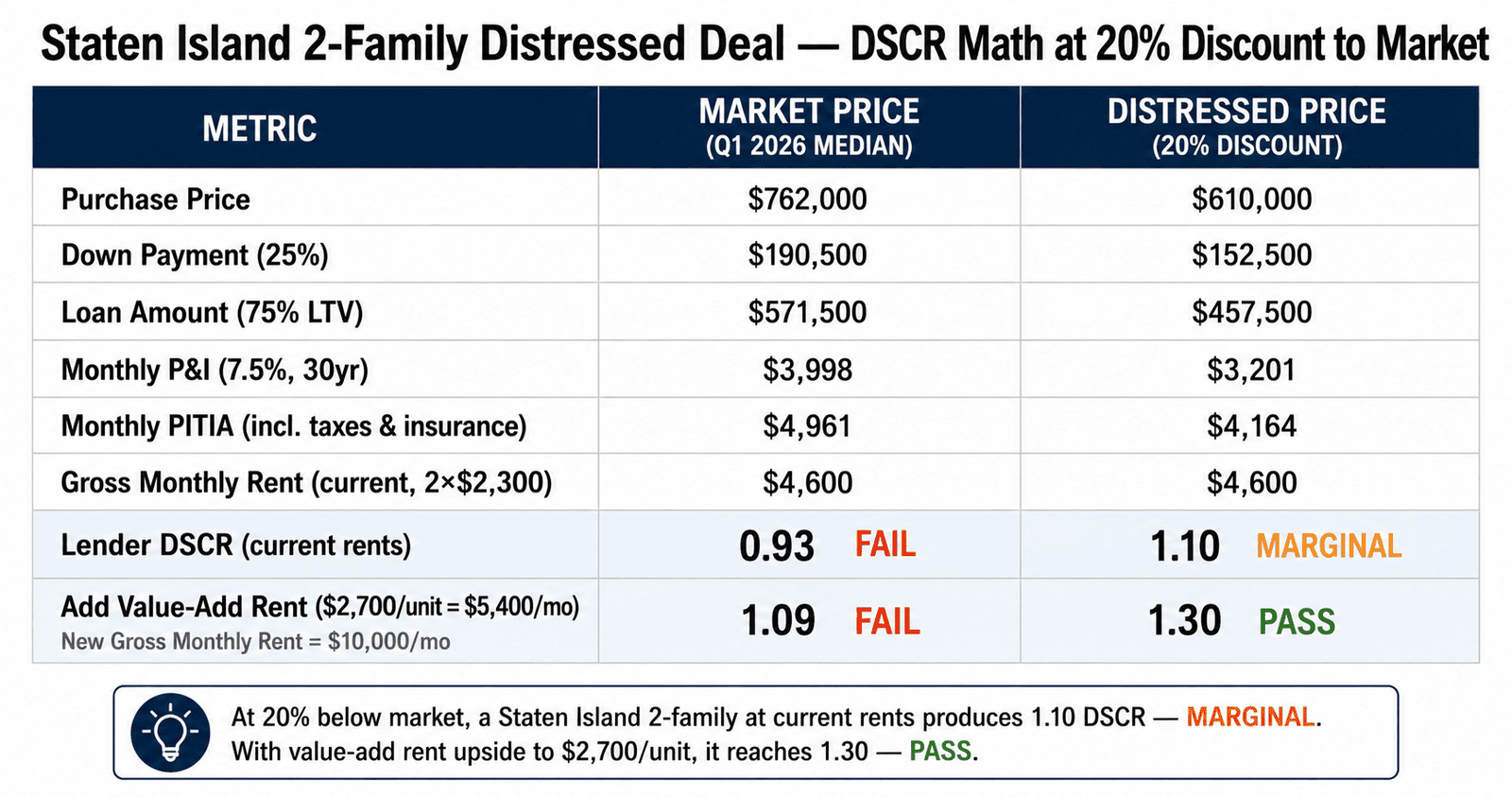
Base deal: Staten Island 2-family, two units. Borough median: $762,000. Distressed acquisition: $610,000 (20% below market). 75% LTV both scenarios. 7.5% rate, 30-year fixed. Current rents: $2,300/unit ($4,600/month gross). Value-add rents: $2,700/unit ($5,400/month gross).
| Line Item | Market Price ($762K) | Distressed ($610K, -20%) | Notes |
|---|---|---|---|
| Purchase Price | $762,000 | $610,000 | 20% below borough median |
| Loan Amount (75% LTV) | $571,500 | $457,500 | $114K lower on distressed deal |
| Monthly P&I (7.5%, 30yr) | $3,998 | $3,201 | $797/mo savings on debt service |
| Monthly PITIA (incl. tax + insurance) | $4,961 | $4,164 | $797/mo PITIA advantage |
| Gross Rent — current (2x $2,300) | $4,600/mo | $4,600/mo | Same property, same current rents |
| Lender DSCR — current rents | 0.93 FAIL | 1.10 MARGINAL | Neither clears lender minimum |
| Gross Rent — value-add (2x $2,700) | $5,400/mo | $5,400/mo | Post-vacancy re-lease at market |
| Lender DSCR — value-add rents | 1.09 FAIL | 1.30 PASS | Distressed + value-add = PASS |
The table reveals the structure of every viable Staten Island distressed DSCR deal in 2026: discount plus value-add. The market-price deal does not reach PASS even with value-add rent upside. The distressed deal at 20% below market crosses 1.25 DSCR when rents are brought to $2,700/unit after re-leasing. At 1.30, it clears the BKDSCR single-stress standard of 1.25+ under a +1.0% rate stress.
Staten Island median rent sits at $2,800–$2,900/month across all unit types as of May 2026 (Zumper). Two-bedroom units rent in the $2,100–$2,500/month range per unit, with $2,700 achievable in well-maintained Mid-Island buildings per active listings. The value-add assumption is the current market rent for updated units — achievable on first re-lease after acquisition. See also: NYC DSCR deal outcomes.
The DSCR formula shows exactly how each component — purchase price, loan amount, tax, insurance, rent — flows into the DSCR calculation. On a distressed deal, the purchase price and loan amount are the primary variables that create the path to a viable DSCR.
Get the DSCR Playbook — every input, threshold, and deal-killer for NYC outer-borough investors in one place.
How Much of a Discount Do You Actually Need?
| Purchase Price | Discount to Median | Monthly PITIA | DSCR at $4,600/mo Rent | DSCR at $5,400/mo Rent |
|---|---|---|---|---|
| $762,000 (market) | 0% | $4,961 | 0.93 FAIL | 1.09 FAIL |
| $686,000 | -10% | $4,681 | 0.98 FAIL | 1.15 MARGINAL |
| $610,000 | -20% | $4,164 | 1.10 MARGINAL | 1.30 PASS |
| $533,000 | -30% | $3,645 | 1.26 PASS | 1.48 PASS |
| $457,000 | -40% | $3,126 | 1.47 PASS | 1.73 PASS |
At current rents, a DSCR PASS at 1.25 requires a purchase price of approximately $530,000 or less — a 30% discount. That is achievable only in motivated auction scenarios or severely deferred-maintenance properties. At value-add rents, a 20% discount ($610,000) produces a PASS. That 20% threshold is realistic in the current Staten Island foreclosure environment for properties with motivated sellers or auction dynamics.
The required discount decreases as rent upside increases. A deal with strong value-add potential requires less discount to pass. A deal where current tenants are at market rent requires a deeper discount. Both variables belong in the analysis before you make an offer.
The Mid-Island 11314 Hotspot and What It Means for Investors
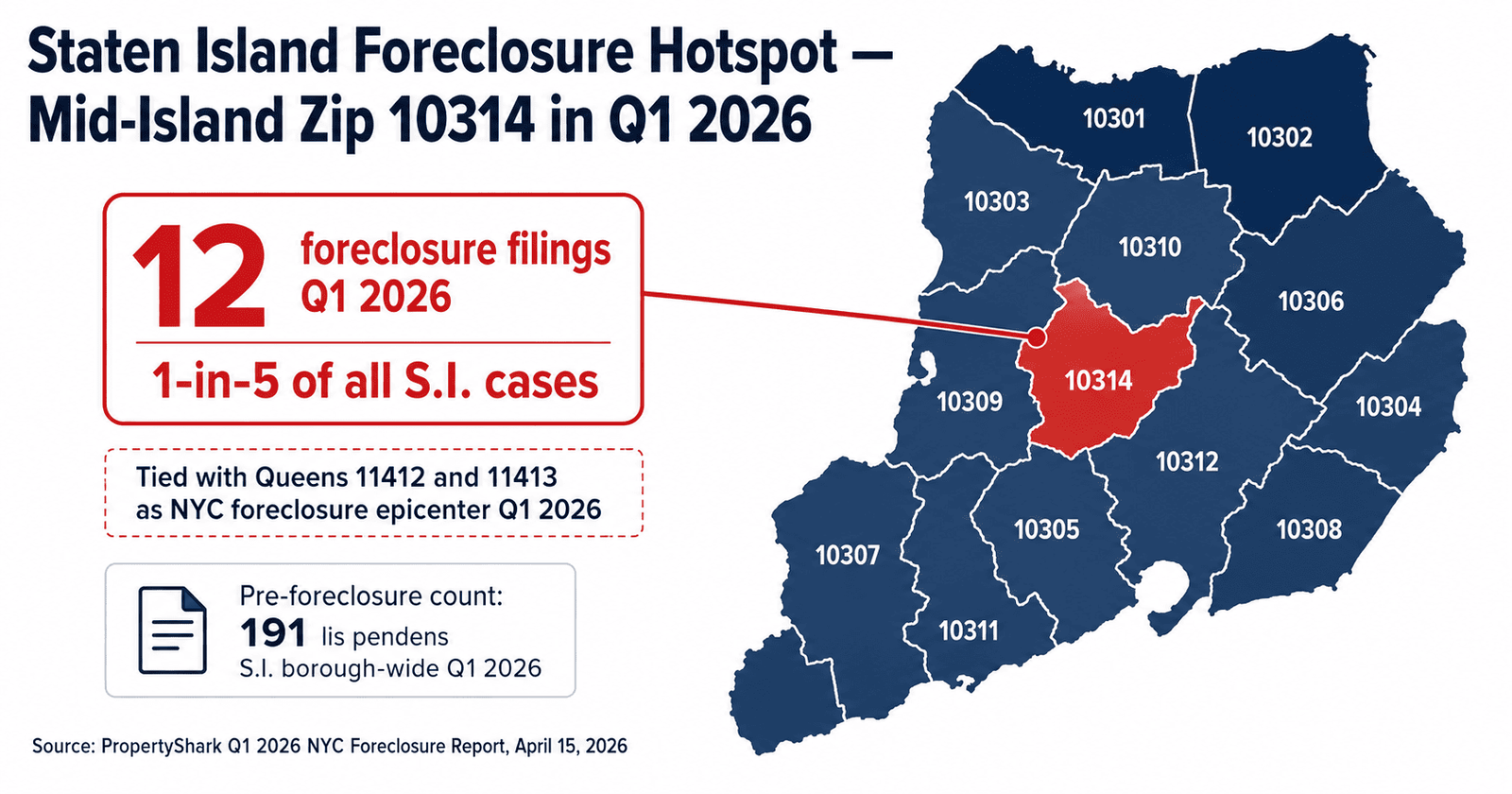
Zip code 11314 encompasses Westerleigh, Sunnyside, and Grant City — established residential areas with solid infrastructure and a characteristic mix of single-family colonials, split-levels, and 2-family frame buildings. Median values in the $650,000–$750,000 range make it Staten Island’s core middle-market.
Twelve first-time foreclosure filings in a single zip code over three months — one in every five new Staten Island cases — creates a visible distressed inventory pipeline. Pre-foreclosures (lis pendens) filed in 11314 represent additional properties currently in the 90-day default notice period before formal proceedings begin. New York State’s 90-day notice requirement provides a window for direct negotiation with distressed owners before the property reaches auction.
For DSCR investors, the 2-family properties in 11314 are the target asset. Two Family Frame (B2) and Two Family Brick (B3) building classes are what DSCR lenders underwrite for outer-borough rental income. A 2-family in 11314 acquired at a 20% discount to market, with vacant or below-market units, produces the structure the DSCR math above shows as viable at value-add rents.
Distressed NYC DSCR Loan — Due Diligence Before You Bid
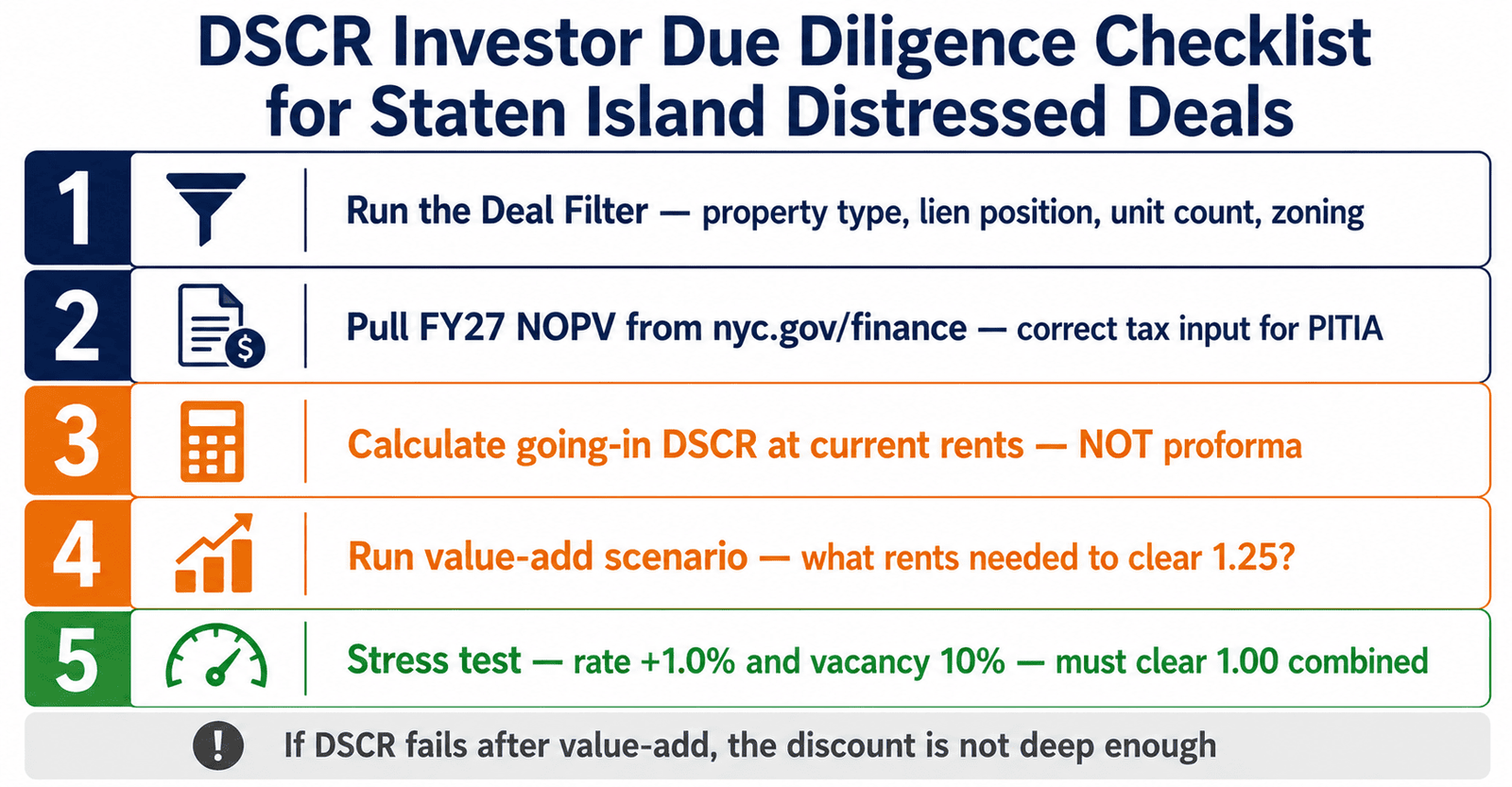
- Step 1 — Run the Deal Filter. Screen on property type (1–4 units), unit count (2-family ideal), current zoning (residential), lien position (first lien only), and estimated discount to market. The deal filter screens these variables before you spend time on a full analysis.
- Step 2 — Pull the FY27 NOPV and calculate the correct tax input. Go to nyc.gov/finance, Property Information Portal. For a 2-family (Class 1), apply the 6% annual cap to the FY26 billable assessed value. That is your FY27 annual tax. Do not use the distressed seller’s tax bill without verifying.
- Step 3 — Calculate going-in DSCR on current rents. Do not use proforma. Do not use market rents for occupied units. If units are vacant, underwrite at zero income — DSCR lenders do the same. A deal that fails DSCR on current rents needs the value-add case to work.
- Step 4 — Run the value-add scenario. What rents are needed to clear 1.25 DSCR at your purchase price? What is the realistic re-lease rent for this property in this zip code? If the required rent is above market, the discount is not deep enough.
- Step 5 — Stress test the value-add DSCR. Apply +1.0% rate stress and 10% vacancy stress simultaneously. Combined stressed DSCR must clear 1.00+. A deal that passes unstressed and drops below 1.00 combined stressed is not viable — it would not survive a refinance or a vacancy event.
The deal analysis runs all five steps with your specific inputs — built for outer-borough distressed and value-add deals.
What DSCR Lenders Look for on Distressed Staten Island Deals
Property Condition
Most DSCR lenders require the property to be in habitable condition at closing. A property requiring major structural repairs or lacking functioning mechanical systems may not qualify for standard DSCR financing. Lenders require a standard appraisal — not a distressed valuation — and the appraiser will flag properties in poor condition. A pre-offer inspection is non-negotiable on any distressed acquisition.
Vacant Units and Underwriting
For 2–4 unit properties, DSCR lenders underwrite on actual leases for occupied units and zero income for vacant units. A 2-family where both units are vacant is underwritten at zero gross income. The investor must be prepared to carry the full debt service during the lease-up period. Verify with the lender before contracting.
Seasoning Requirements
Some DSCR lenders impose title seasoning requirements on foreclosure purchases — requiring the property to be held for 6–12 months before serving as collateral for a new DSCR mortgage. Investors planning to purchase at auction and immediately place DSCR financing should verify there is no seasoning requirement with the intended lender. Bridge financing is sometimes used to close, with DSCR refinancing following after the seasoning period.
The most common DSCR pitfalls on distressed acquisitions — including PITIA errors that surface at underwriting — are covered on the deal killers page.
FAQ: Staten Island Foreclosures and DSCR Investing in 2026
Is the 123% increase in Staten Island foreclosures a sign of a market collapse?
No. The 123% increase is a year-over-year comparison on a small base — the prior year’s Q1 count was approximately 26 filings. At 58 filings in Q1 2026, Staten Island still had the second-fewest foreclosures of any borough (ahead of Manhattan’s 45). The percentage increase reflects acceleration from a low base, driven by household cash flow stress — not systemic asset value deterioration. The borough median home price is still up 4.1% year-over-year.
Can I use a DSCR loan to buy a foreclosure at auction?
DSCR loans require standard title insurance and a clear title at closing. Auction purchases in New York typically involve significant title risk — subordinate liens, unpaid taxes, mechanic’s liens. Most investors acquire distressed properties through the pre-foreclosure stage (direct seller negotiation during the lis pendens period), REO (bank-owned after completed foreclosure), or short sale. Each path is more compatible with DSCR financing than a courthouse-step auction purchase.
What does the 191 pre-foreclosure (lis pendens) count mean for investors?
The 191 lis pendens filed in Staten Island in Q1 2026 represent properties where the lender has filed the required 90-day pre-foreclosure notice but has not yet commenced formal proceedings. This is the most actionable stage for direct negotiation: the homeowner knows they are in default, has a defined timeline, and may be receptive to a short sale or discounted direct purchase. Investors who monitor the lis pendens filing database have the earliest access to these opportunities before they reach auction.
The 20% Discount That Changes the DSCR Math
A distressed NYC DSCR loan comes down to a simple framework: the discount is the variable that determines whether a deal passes. At market prices, the DSCR math on a Staten Island 2-family does not work at 75% LTV and 7.5% loan rates — even with value-add rent upside. At a 20% discount, the combination of lower debt service and value-add rents produces a PASS at the BKDSCR 1.25 standard. At a 30% discount, the deal passes even at current rents without a value-add assumption.
The 123% year-over-year spike in Q1 2026 filings is the data signal. The Mid-Island zip 11314 hotspot is the geographic focus. The 191 pre-foreclosure filings are the pipeline. Investors who understand the DSCR math — what discount is needed, what rent level is required, what stress test the deal must survive — have a framework for evaluating every Staten Island distressed opportunity that comes to market in 2026. Investors who approach these deals without running the numbers are bidding on a story, not a deal.
The property type, the discount, the rent upside, and the DSCR math need to be confirmed before you make an offer. The deal filter screens the basic variables. The deal analysis page runs the full PITIA-to-DSCR pipeline with your specific numbers.
Run a Deal Review — current DSCR, stressed DSCR, NOI, and updated tax assessment modeled at current inputs, delivered within 48–72 hours.