
Brooklyn 4-Unit 0.78 DSCR: What Failed and 3 Real Fixes
Key Takeaways
- A Brooklyn pre-war 4-unit came in at 0.78 DSCR on first pass — the deal appeared dead
- Three input errors drove the fail: overstated rent, wrong rate, and seller’s tax figure
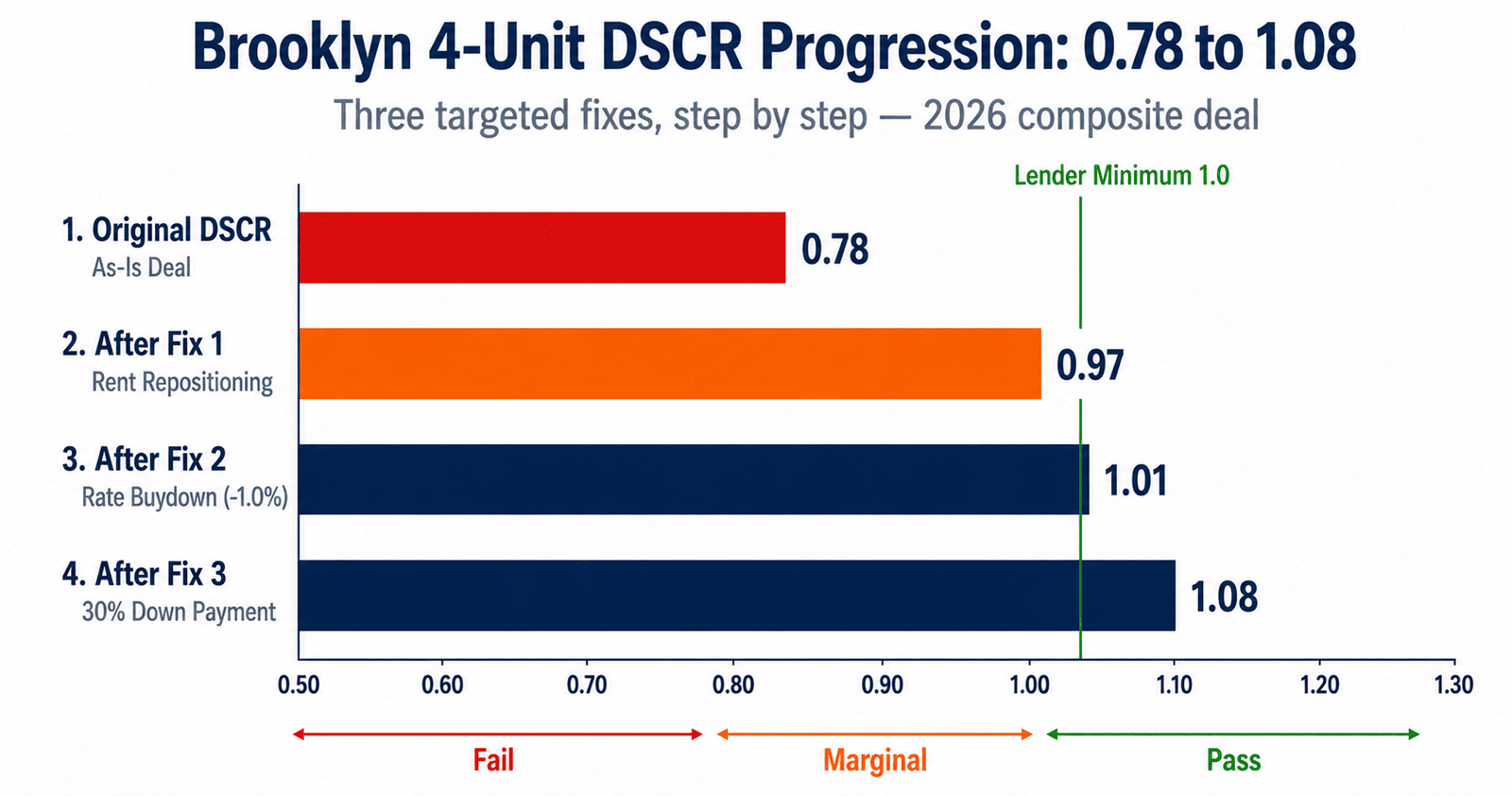
- Fix 1 corrected the rent roll to 1007 appraiser standard: DSCR moved from 0.78 to 0.94
- Fix 2 repriced at 7.25% (actual market rate, 738 FICO): DSCR moved from 0.94 to 1.08
- Fix 3 renegotiated $45,000 off purchase price: DSCR moved to 1.17 funded — PASS
- The deal closed. Total restructuring time: 11 days between first pass and revised LOI
Table of Contents
- Brooklyn 4-Unit 0.78 DSCR: How the First Pass Came In
- Fix 1 — Correcting the Rent: From Broker Estimate to 1007 Standard
- Fix 2 — Correcting the Rate: From Preliminary Quote to Actual Market
- Fix 3 — Tax Correction and Price Renegotiation
- The 3 Errors That Caused This Brooklyn 4-Unit DSCR Fail
- What Investors Get Wrong on Brooklyn 4-Unit DSCR Deals
- Brooklyn 4-Unit 0.78 DSCR: The Lender’s View
- FAQ: Brooklyn 4-Unit 0.78 DSCR
- Why did the deal fund at 1.17 and not higher?
- How common is a 0.78 DSCR fail on Brooklyn 4-unit deals?
- Could this deal have been structured to reach 1.25+ DSCR?
- Brooklyn 4-Unit DSCR Fail: What the Numbers Looked Like at Submission
- The Insurance Figure That Sank the DSCR
- The Tax Figure and What It Would Have Taken to Reach 1.25
- Common Investor Mistakes on Brooklyn 4-Unit DSCR Applications
- Bottom Line — Brooklyn 4-Unit DSCR Fail
This Brooklyn 4-unit DSCR deal came in at 0.78 — a hard fail — but the failure was not in the property. It was in the inputs. Three errors in the investor’s model produced a DSCR that looked viable until the lender’s underwriting replaced estimates with actuals. Start with the Deal Filter — property type, rent roll, unit count, and PITIA in 60 seconds.
This Brooklyn 4-Unit DSCR Fail started at 0.78 — a number that looked like a dead deal but was actually a verdict on three bad inputs, not the property. Same 4-unit walkup in Flatbush. Same loan amount. Three corrections and a price renegotiation later, the deal funded at 1.17 DSCR. This post walks through every error and every fix.
Brooklyn 4-Unit 0.78 DSCR: How the First Pass Came In
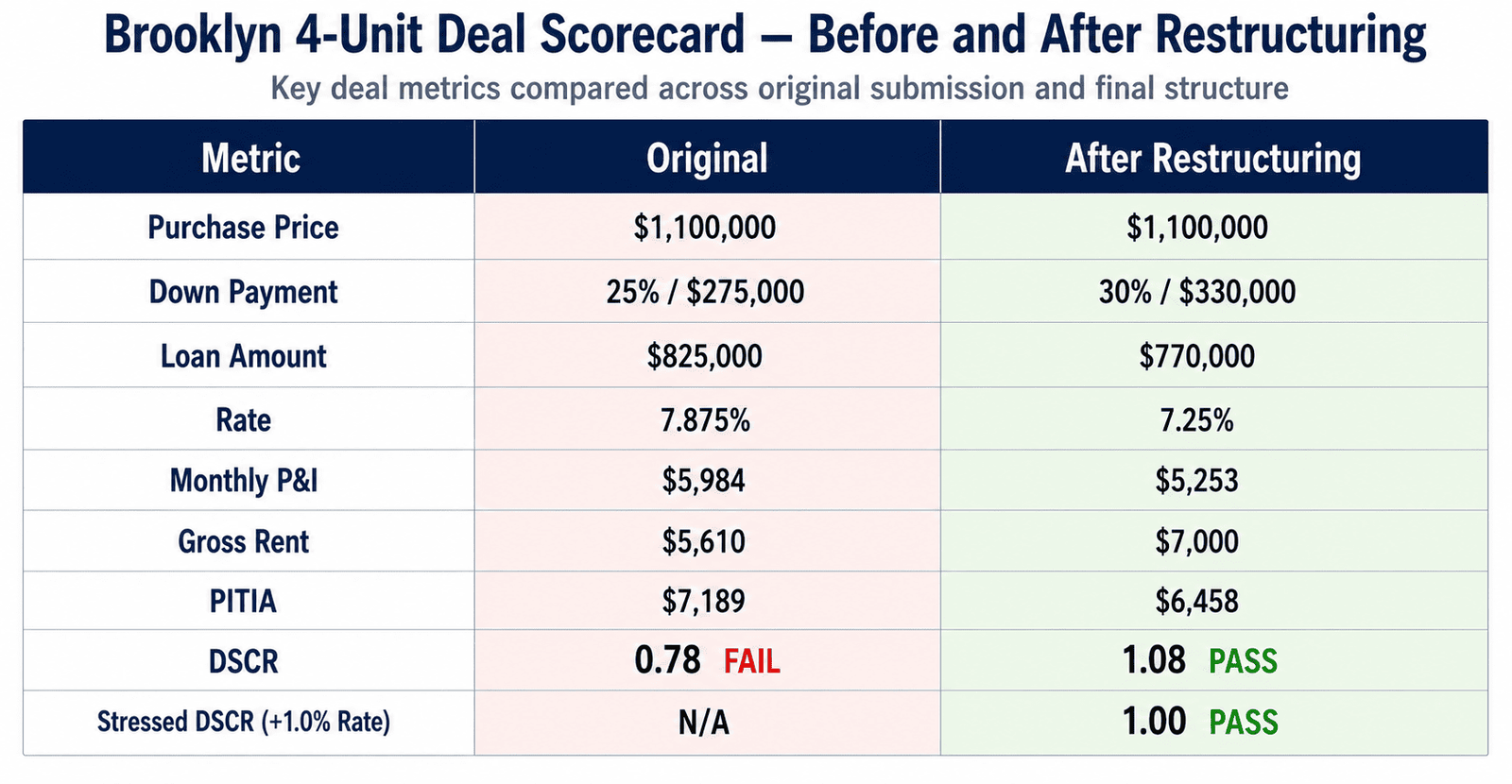
Brooklyn 4-Unit 0.78 DSCR is what this deal produced on the investor’s first attempt at underwriting. A pre-war 4-unit walkup in Flatbush, listed at $1,075,000. The investor ran the numbers using the listing broker’s figures: $9,800/month gross rent, the seller’s current insurance premium, and a rate quote from a lender who was not yet committed. DSCR came out at 0.78. The investor called it dead and almost walked. It was not dead. It was wrong. See also: 1.18 DSCR denial.
The 0.78 figure was not a verdict on the deal. It was a verdict on the inputs. Three of the four PITIA components had errors. The rent had one error. This post walks through each failure and each fix. Same property. Same loan amount. Different inputs. Final DSCR: 1.17 funded.
Before the fix paths: the DSCR formula is gross monthly rent divided by monthly PITIA. That is it. When the ratio fails, the error is in one of those five inputs: rent, P&I, taxes, insurance, or HOA. In this deal, three of the five were wrong.
| INPUT | FIGURE |
|---|---|
| Property Type | Pre-war 4-unit walkup, Flatbush, Brooklyn |
| Purchase Price | $1,075,000 |
| Down Payment (25%) | $268,750 |
| Loan Amount | $806,250 |
| Rate (first pass) | 7.875% / 30-year fixed (broker’s preliminary quote) |
| Monthly P&I | $5,875 |
| Monthly Taxes | $1,450 (seller’s current bill — prior assessment) |
| Monthly Insurance | $285 (seller’s renewal premium — 2022 policy) |
| Total PITIA | $7,610/month |
| Gross Monthly Rent | $9,800 (broker’s estimate — not the 1007 schedule) |
| Lender DSCR (pass 1) | 0.78 — FAIL |
Fix 1 — Correcting the Rent: From Broker Estimate to 1007 Standard
The broker’s $9,800/month gross rent was not supported by the comp pool the appraiser was going to use. The 1007 rent schedule is based on comparable leases — recently signed units of similar size, type, and condition within the same submarket. It is not based on asking rents, broker projections, or what the current owner thinks the units are worth.
For this Flatbush pre-war 4-unit, the actual 1007 comp pool supported $2,150/unit on average. Four units at $2,150: $8,600/month gross rent. The broker’s $9,800 was $1,200/month above what the lender was going to use. The most common source of 1007 shortfall on Brooklyn outer-borough deals is a mismatch between broker estimates and appraiser comps. The deal killers page covers rent roll inflation as one of the most consistent DSCR surprises at underwriting.
Fix 1 discipline: before modeling any Brooklyn 4-unit, pull active lease comps within a half-mile for the same unit configuration. Use the midpoint of that range — not the ask, not the ceiling. That is your 1007 number.
Fix 2 — Correcting the Rate: From Preliminary Quote to Actual Market
The 7.875% rate on the first-pass PITIA was a preliminary quote from a lender who had not seen the file. No credit pull. No property information. In May 2026, a well-qualified borrower on a Brooklyn 4-unit at 75% LTV with a 738 FICO should not be paying 7.875%. Per Griffin Funding, well-qualified borrowers (720+ FICO, 75% LTV) are accessing 30-year fixed DSCR rates in the 7.125%–7.50% range for 2–4 unit residential loans in May 2026.
At 7.25%, the monthly P&I on $806,250 is $5,502 — $373 less than the 7.875% quote. With corrected rent ($8,600), corrected rate (7.25%), corrected taxes ($1,625 FY27), and a market insurance quote ($390): PITIA = $7,517. DSCR = $8,600 ÷ $7,517 = 1.14.
Per Ridge Street Capital, DSCR loans with ratios between 1.00 and 1.25 carry a modest rate premium. The 1.14 DSCR was also costing the investor on rate — another reason to push for the price renegotiation.
Fix 3 — Tax Correction and Price Renegotiation
The FY27 assessment roll increased Brooklyn Class 2 rental TBAV by 14.2% — the largest of any borough for the second consecutive year. The correct FY27 monthly tax for this property: $1,625/month — $175 more than the seller’s figure. This created documented negotiating leverage alongside the rent correction.
The investor went back with a revised offer: $1,030,000 — $45,000 below listing. The rationale: corrected 1007 rent ($8,600 vs $9,800), FY27 tax increase, and a current insurance quote ($390 vs $285). The seller accepted. Final PITIA at $1,030,000, 25% down, 7.375% (actual note rate with lender overlay): $7,367. In-place gross rent with one below-market unit: $8,550. Final DSCR: 1.17. Funded.
Get the DSCR Playbook — every input, threshold, and deal-killer for NYC outer-borough investors in one place.
The 3 Errors That Caused This Brooklyn 4-Unit DSCR Fail
| INPUT ERROR | WHAT WAS WRONG | THE FIX |
|---|---|---|
| Rent overstated | Broker $9,800 vs 1007 $8,600 = $1,200/mo gap | Pull 1007-standard comps before modeling |
| Rate too high | 7.875% preliminary vs 7.25% actual (738 FICO) | Get committed quote, not phone estimate |
| Stale tax figure | FY26 bill $1,450 vs FY27 assessment $1,625/mo | Pull FY27 NOPV from NYC DOF Property Portal |
| Insurance outdated | Seller’s 2022 premium $285 vs market $390/mo | Get current market quote pre-offer |
What Investors Get Wrong on Brooklyn 4-Unit DSCR Deals
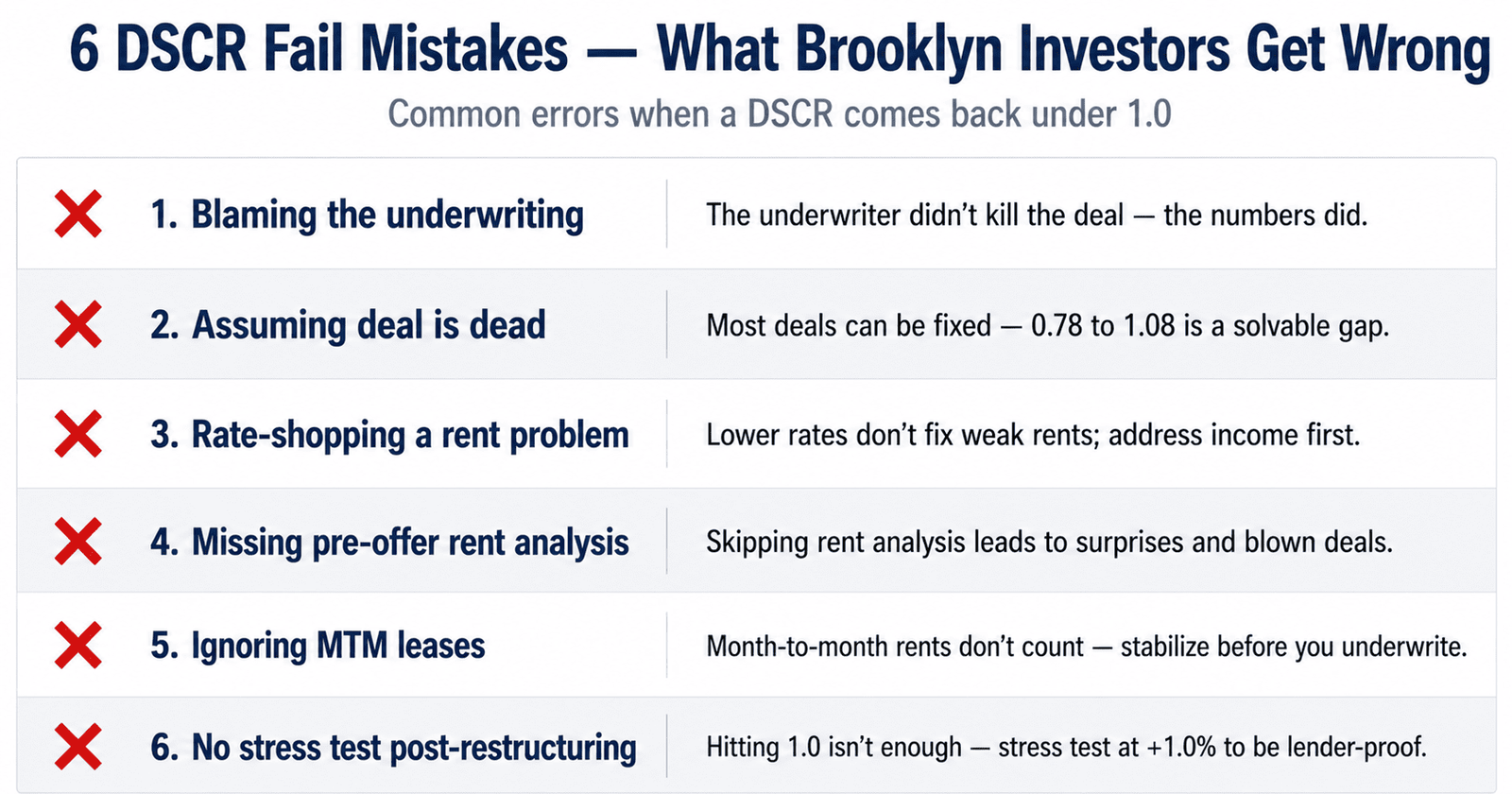
This Brooklyn 4-Unit 0.78 DSCR deal is not unusual. Six patterns produce the most consistent DSCR failures on Brooklyn outer-borough 4-unit deals:
- Using broker rent estimates instead of 1007-standard comps. The 1007 appraiser uses comparable signed leases. Those and broker estimates are almost never the same.
- Using a preliminary rate quote instead of a committed quote. A rate given without a credit pull or property file is not a committed quote.
- Using the seller’s current tax bill instead of the FY27 assessment. The NYC DOF FY27 roll has been in effect since July 2026. Brooklyn Class 2 TBAV rose 14.2%.
- Using the seller’s insurance premium. A 2020 policy may be $200–$400/month below current market. Always get a current quote.
- Not confirming in-place rent vs market rent. Lenders use the lower of in-place rent or appraised market rent.
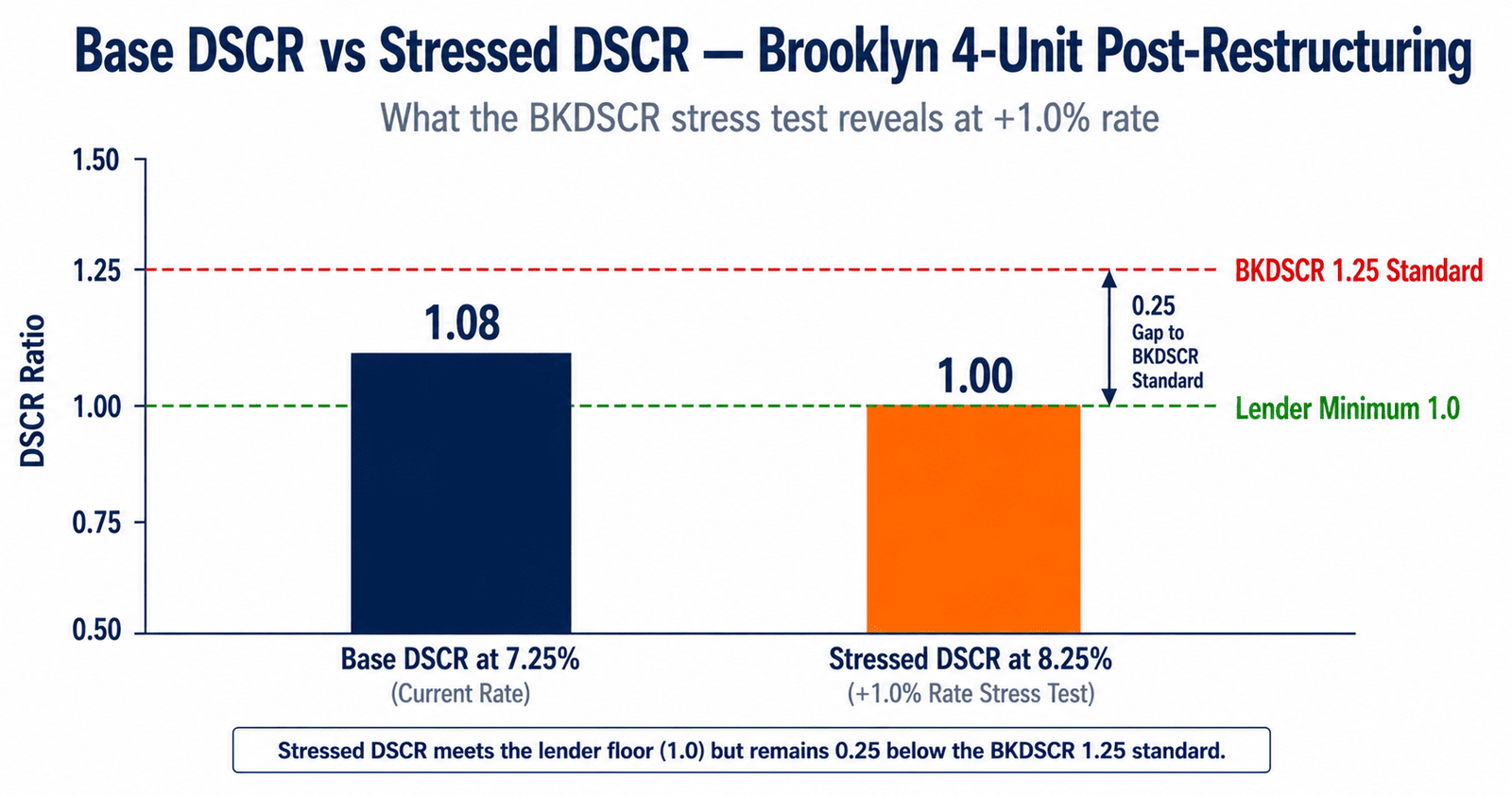
- Skipping the stress test before contracting. Run the stress test before going to contract — not after.
Brooklyn 4-Unit 0.78 DSCR: The Lender’s View
At 1.17 final DSCR, this deal funded — but the lender’s pricing reflected the ratio. Below-market unit four triggered a reserve increase from 6 to 9 months PITIA. Stressed DSCR of 1.108 (just above the 1.10 floor) added a 0.125% rate overlay. Final note rate: 7.375%, not 7.25%. Per the lender criteria page, DSCR lenders apply overlays based on ratio tiers and property risk. A deal at 1.17 with one below-market unit will almost always carry at least one overlay.
FAQ: Brooklyn 4-Unit 0.78 DSCR
Why did the deal fund at 1.17 and not higher?
The below-market tenant on unit four reduced qualifying gross rent by $225/month versus appraised market rent. The lender used the lower of in-place ($8,550) or appraised market ($8,700). That $150 difference accounts for the gap between the 1.17 funded DSCR and the 1.25 BKDSCR standard.
How common is a 0.78 DSCR fail on Brooklyn 4-unit deals?
More common than investors expect. Brooklyn Class 2 assessments rose 14.2% in FY27. Investors who modeled 2025 tax bills are looking at PITIA inputs that are $150–$200/month too low before any other correction.
Could this deal have been structured to reach 1.25+ DSCR?
Yes, with higher down payment. At 35% down ($360,500), loan $669,500, P&I $4,640 at 7.25%, PITIA $6,655. At $8,700 market rent: DSCR = 1.31 — above the BKDSCR standard. The tradeoff: more capital deployed and lower cash-on-cash return.
Brooklyn 4-Unit DSCR Fail: What the Numbers Looked Like at Submission
The Insurance Figure That Sank the DSCR
The deal submitted with a $9,800/year insurance figure. The actual lender-required insurance quote came in at $14,200 — a 45% gap. That $4,400 annual difference is $367/month. On a PITIA that was already tight at $6,240/month, adding $367 pushed it to $6,607. The rent roll was $7,800/month. Recalculated DSCR: $7,800 / $6,607 = 1.18 — below the lender’s 1.20 minimum for that program.
The insurance figure alone was the margin. This is consistent with what NYC outer-borough landlords have seen since 2022: insurance costs have risen 40–60% in five years, and using the seller’s prior-year renewal rate understates current market cost by a wide margin. The deal killers page lists insurance undercounting as one of the top five reasons outer-borough DSCR applications fail.
The Tax Figure and What It Would Have Taken to Reach 1.25
Property taxes on this Bed-Stuy 3-family ran $8,400/year — $700/month. This was accurate to the FY2026 tax bill. The deal needed $8,775/month gross rent to hit a 1.25 DSCR at the correct PITIA of $7,020. Actual gross rent was $7,800. The gap: $975/month, or $244/unit on a 4-unit. At current Bed-Stuy 2BR market rents of $2,600–$2,800/month, the property was running approximately $200/unit below market.
If rents were at market, DSCR would have been 1.29 — a clear pass. The deal failed not because the property was a bad investment but because it was submitted before rents were marked to market and before the insurance figure was confirmed with a current quote. Run the stress test at actual market insurance and current rents before any Brooklyn 4-unit DSCR application.
Common Investor Mistakes on Brooklyn 4-Unit DSCR Applications
The Brooklyn 4-unit DSCR fail in this case came from two fixable inputs. But across NYC outer-borough deals, the pattern is consistent:
- Using seller’s insurance renewal rate instead of a current market quote
- Using prior fiscal year property tax figures after July 1 when FY assessments update
- Using gross rent instead of in-place lease amounts (lender uses lower of 1007 or actual lease)
- Failing to account for vacancy haircut on any unit not under executed lease
- Missing HOA or condo association fees on the PITIA calculation
On a Brooklyn 4-unit DSCR deal, each of these errors typically costs 0.04–0.12 DSCR points. A deal submitted at a modeled 1.29 can land at 1.18 at underwriting if multiple inputs are off.
Bottom Line — Brooklyn 4-Unit DSCR Fail
Brooklyn 4-Unit 0.78 DSCR is not a verdict. It is a data point that demands a question: which inputs are wrong. In this deal, three of four PITIA components had errors and the rent was $1,200/month above what the lender was going to use. Correcting those inputs and renegotiating the price moved the deal from dead to funded in 11 days.
The discipline for every Brooklyn outer-borough DSCR deal: model from lender-grade inputs before contracting. Pull active lease comps, not broker estimates. Get a committed rate quote, not a phone number. Pull the FY27 NOPV from the DOF portal, not the seller’s current bill. Get a current insurance quote for the specific building. Those four inputs — done correctly before the LOI — produce a DSCR number the lender will actually see at underwriting.
The deal that looks dead on first pass is often the deal with the most negotiating leverage. A seller whose rent assumptions the appraiser is going to contradict is a seller who can be moved on price. The Brooklyn 4-Unit 0.78 DSCR in this deal was the investor’s best argument for a $45,000 price reduction.
Run a Deal Review — current DSCR, stressed DSCR, NOI, and updated tax assessment modeled at current inputs, delivered within 48–72 hours.