
Queens 6-Unit DSCR at 1.31: The Real Approval Math
Key Takeaways
- Queens 6-Unit DSCR Loan at 1.31: this Woodside deal closed at 1.31 Lender DSCR — 11 basis points above the lender’s 1.20 minimum
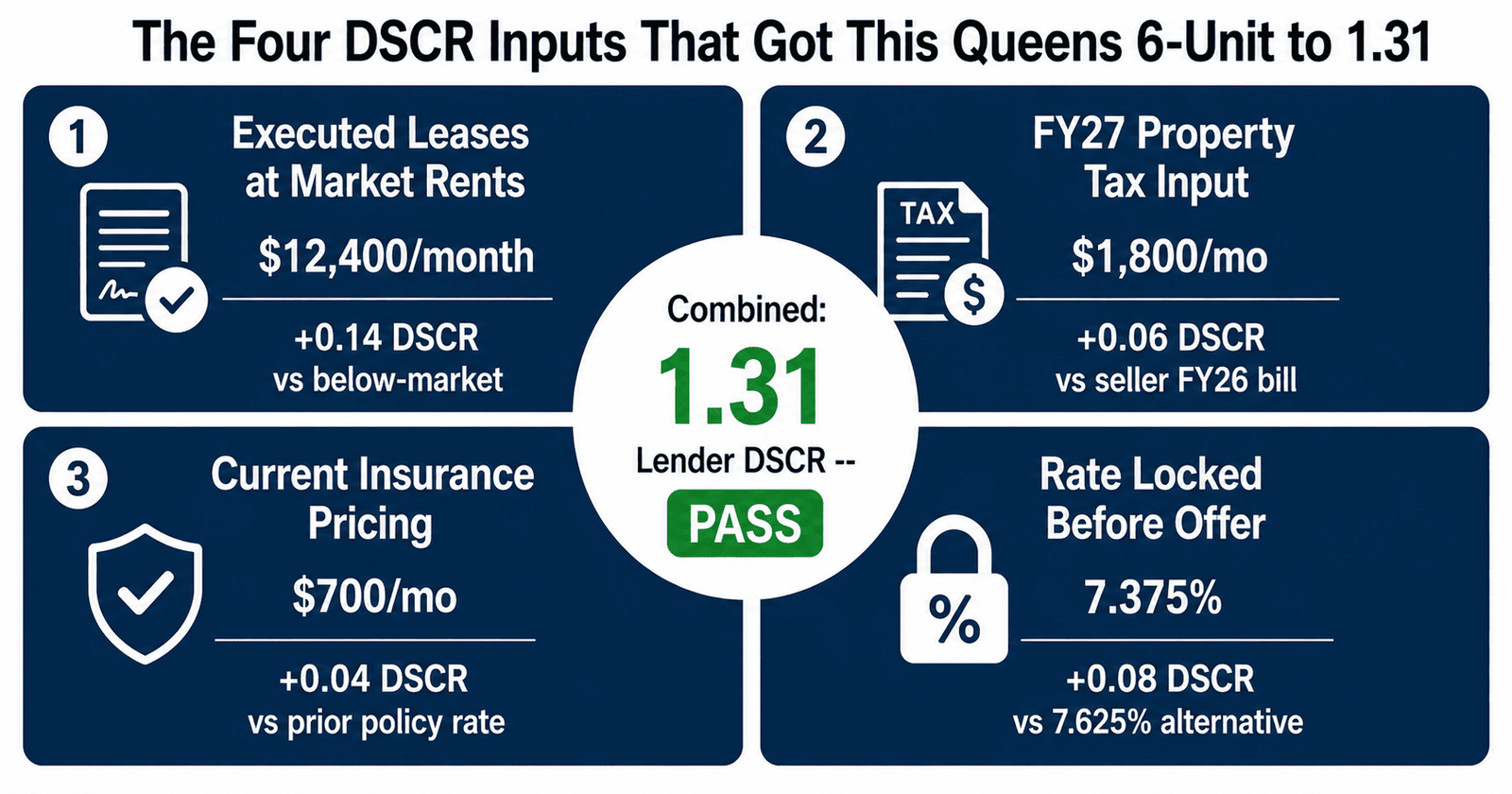
- Four correct inputs drove the pass: FY27 taxes ($1,800/mo), current insurance ($700/mo), executed leases at market rents, rate locked at 7.375% before offer
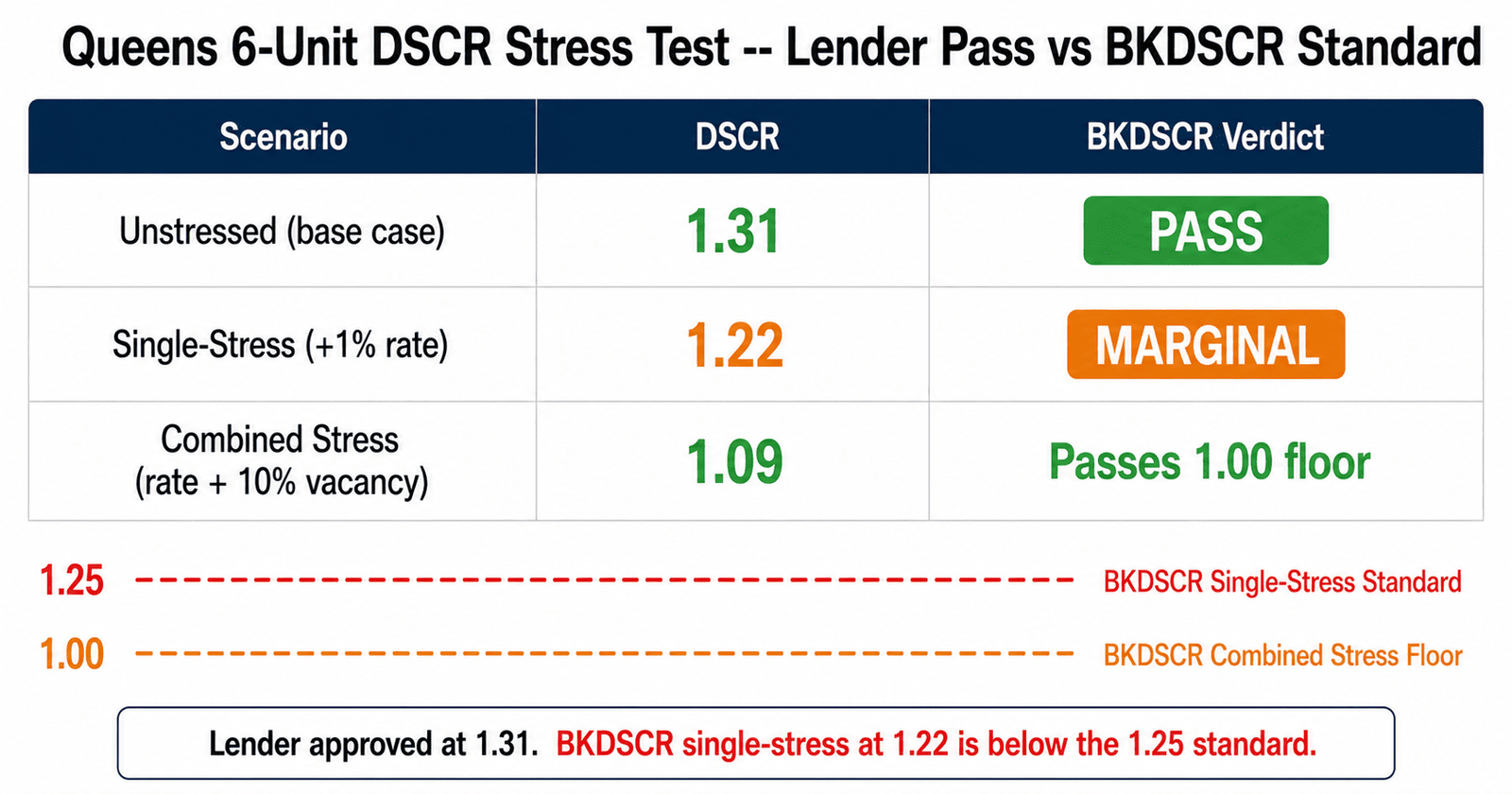
- Lender DSCR: 1.31 PASS | BKDSCR single-stress at +1% rate: 1.22 — below the BKDSCR 1.25 standard (MARGINAL)
- Combined stress (rate + 10% vacancy): 1.09 — above the BKDSCR 1.00 combined floor
- The deal is financeable and closed — but sits at MARGINAL on single stress. Rate increases of 1%+ reduce the cushion to a thin margin
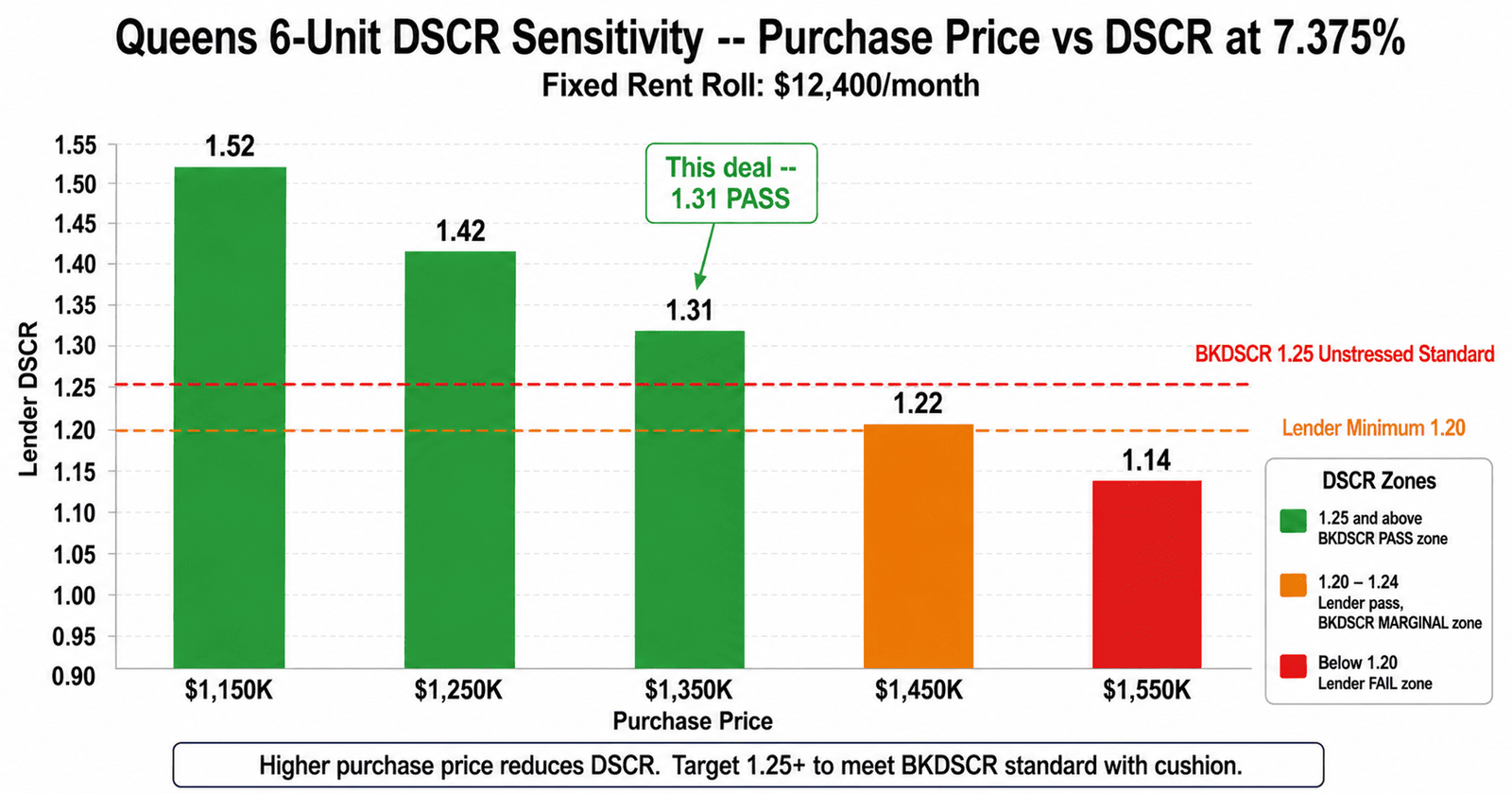
- Price sensitivity: at $1,350K this deal is 1.31. At $1,450K on the same rent roll it falls to 1.24 — MARGINAL at the lender level
Table of Contents
- Queens 6-Unit DSCR Loan at 1.31 — The Deal at a Glance
- The Four Inputs That Made This Queens 6-Unit DSCR Loan Pass
- Input 1 — Executed Leases at Current Queens Market Rents
- Input 2 — FY27 Property Tax, Not the Seller’s Bill
- Input 3 — Current Insurance Pricing
- Input 4 — Rate Locked Before Making the Offer
- The DSCR Calculation — Where the 1.31 Comes From
- Queens 6-Unit DSCR Loan at 1.31: What the Stress Test Shows
- Lender DSCR vs BKDSCR Conservative DSCR — Two Numbers, Two Purposes
- What This Queens 6-Unit DSCR Loan Looks Like at Different Purchase Prices
- What Investors Get Wrong on Queens 6-Unit DSCR Underwriting
- FAQ: Queens 6-Unit DSCR
- Can a Queens 6-unit qualify for a residential DSCR loan?
- What is the minimum DSCR for a Queens 6-unit purchase?
- How much does a $100K difference in purchase price move DSCR on a Queens 6-unit?
- Queens 6-Unit DSCR at 1.31: What Investors Often Get Wrong Running This Deal
- Queens 6-Unit DSCR Loan: The Stress Test Results That Matter
- The Bottom Line — Why 1.31 Passed This Lender Review
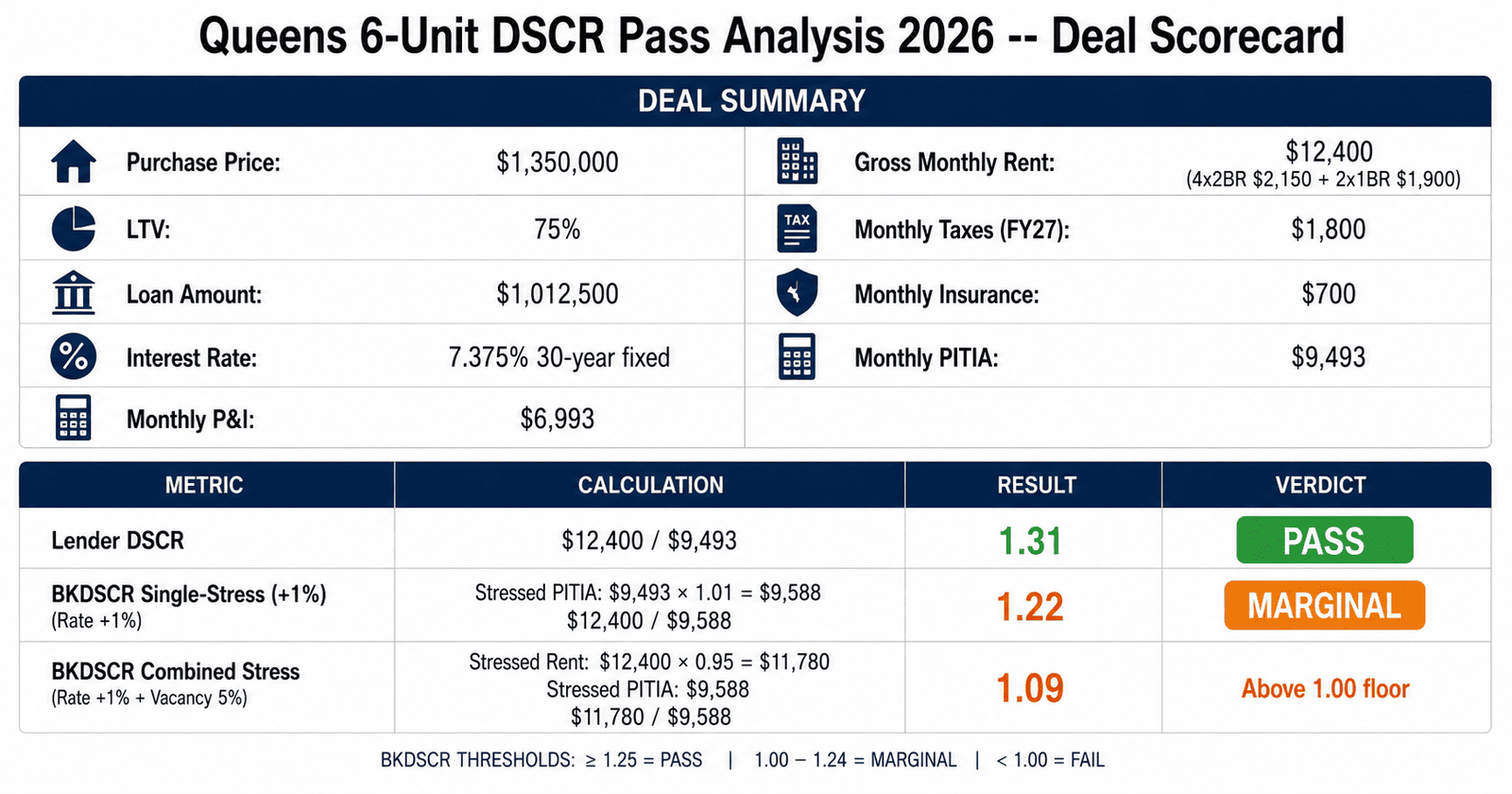
Queens 6-Unit DSCR Loan at 1.31 is the question worth asking: why did this deal close when so many Queens multifamily purchases at similar price points fail underwriting? A Woodside 6-unit listed at $1,350,000 — four two-bedrooms above two one-bedrooms — closed with a Lender DSCR of 1.31. The lender’s minimum was 1.20. The deal cleared it by 11 basis points. Not a wide margin. But it cleared it, and it cleared it because the investor got four inputs right.
Start with the Deal Filter — property type, rent roll, unit count, and PITIA in 60 seconds.
Queens 6-Unit DSCR Loan at 1.31 — The Deal at a Glance
The property is a five-story walk-up in Woodside, Queens. Four two-bedroom apartments and two one-bedroom apartments — all residential, no commercial component. The building traded at $1,350,000. The investor put 25% down ($337,500) and financed $1,012,500 on a 30-year fixed DSCR product at 7.375%. Queens rents grew 4.4% year-over-year through February 2026, with two-bedroom units in Woodside averaging $2,100–$2,300/month at current market. The investor’s rent roll reflected that market without projecting above it. See also: property taxes.
All six units had executed 12-month leases at closing. Total gross monthly rent: $12,400. bkdscr.com walks through DSCR formula from income to ratio — the numerator is gross rent, the denominator is PITIA. Get both right and the ratio reflects the deal. Get either one wrong and it reflects a story.
| Deal Input | Value | Notes |
|---|---|---|
| Location | Woodside, Queens | 5-story 6-unit Class 2 multifamily — all-residential |
| Purchase Price | $1,350,000 | Purchased at asking — no price reduction required |
| Down Payment (25%) | $337,500 | Standard 75% LTV for 5-8 unit DSCR program |
| Loan Amount | $1,012,500 | 5-8 unit DSCR product; some programs cap at 4 units |
| Rate / Term | 7.375% / 30-yr fixed | Pre-approved before offer; locked at application |
| Monthly P&I | $6,993 | On $1,012,500 at 7.375% |
| Monthly Taxes | $1,800 | Queens Class 2 FY27 NOPV — verified, not seller bill |
| Monthly Insurance | $700 | Current market quote obtained before underwriting |
| Monthly PITIA | $9,493 | Correct inputs — not seller figures |
| Unit Mix | 4×2BR + 2×1BR | Four 2-bedrooms at $2,150 | Two 1-bedrooms at $1,900 |
| Gross Monthly Rent | $12,400 | All 6 units on 12-month executed leases at closing |
| Lender DSCR | 1.31 | $12,400 / $9,493 — PASS above 1.20 lender minimum |
The Four Inputs That Made This Queens 6-Unit DSCR Loan Pass
Input 1 — Executed Leases at Current Queens Market Rents
Every unit had a 12-month executed lease at closing. No proforma rents. No below-market units the investor planned to raise after acquisition. The lender underwrote on $12,400/month of verified rental income from six executed leases at market rates for Woodside in May 2026. A rent roll with two below-market units at $1,700 when the market supports $2,150 would have reduced the numerator to $11,400 and dropped the DSCR to 1.20 — one rounding error from the lender’s minimum.
Input 2 — FY27 Property Tax, Not the Seller’s Bill
Input 3 — Current Insurance Pricing
The investor obtained a current insurance quote before underwriting — $700/month at current market rates for a Queens Class B multifamily 6-unit. NYC landlord insurance premiums for outer-borough multifamily have risen substantially since 2022. Using the prior owner’s renewal rate would have understated the monthly PITIA by $100–$200. The lender criteria page covers PITIA documentation — including why a current binder is required for every outer-borough deal.
Input 4 — Rate Locked Before Making the Offer
The investor completed a full DSCR pre-approval before submitting any offer. The pre-approval produced a rate lock commitment at 7.375% for a 5-8 unit DSCR program. According to Ridge Street, DSCR rates ranged from 6.0% to 7.99% depending on LTV, FICO, and property type. A 5+ unit multifamily product with 75% LTV and a 720 FICO produced 7.375%. Had the investor received 7.625% instead, the monthly P&I would have been $175/month higher and the DSCR would have dropped to 1.29 — still a pass, but even thinner.
Get the DSCR Playbook — every input, threshold, and deal-killer for NYC outer-borough investors in one place.
The DSCR Calculation — Where the 1.31 Comes From
The ratio is straightforward once the inputs are correct. Gross monthly rent ($12,400) divided by monthly PITIA ($9,493) equals 1.31, which rounds to 1.31. The lender’s minimum was 1.20. The deal cleared it with an 11-point margin. In absolute dollar terms, $12,400 monthly rent is $1,039/month more than $11,361 — the minimum income required to produce a 1.20 DSCR against this PITIA. One unit going vacant drops gross rent to $10,500–$11,200 depending on which unit, moving the DSCR to 1.11–1.18 — a technical breach of the lender minimum until re-leased.
This is the geometry of a 1.31 DSCR. It passes. But a single vacancy event technically breaches the lender’s minimum until the unit is re-leased. In a Queens market where vacancy is under 2%, that is a manageable risk — not a reason to avoid the deal, but a reason to understand the margin.
| DSCR Metric | Gross Income | PITIA / Denominator | DSCR | Verdict |
|---|---|---|---|---|
| Lender DSCR (unstressed) | $12,400 | $9,493 | 1.31 | PASS |
| Single-Stress (+1% rate) | $12,400 | $10,196 | 1.22 | MARGINAL |
| Combined Stress (+1% + 10% vacancy) | $11,160 | $10,196 | 1.09 | Passes 1.00 floor |
| BKDSCR 1.25 standard | — | — | 1.25+ | Required |
Queens 6-Unit DSCR Loan at 1.31: What the Stress Test Shows
The lender said yes. BKDSCR says MARGINAL. These are different verdicts on the same deal, and both are correct within their own frameworks.
The BKDSCR single-stress test adds one percentage point to the rate. At 8.375%, the monthly P&I on $1,012,500 rises to approximately $7,696. Stressed PITIA: $10,196. Stressed DSCR: $12,400 / $10,196 = 1.22 — below the BKDSCR 1.25 single-stress standard. The combined stress test applies both the rate stress and a 10% vacancy event. Stressed income: $11,160. Combined DSCR: 1.09 — above the BKDSCR 1.00 floor. Before submitting any deal this close to the margin, stress test so you know what the floor is before the lender tells you the answer.
Lender DSCR vs BKDSCR Conservative DSCR — Two Numbers, Two Purposes
The lender’s DSCR uses gross rent divided by PITIA only — no management fees, no maintenance reserves. BKDSCR Conservative DSCR adds both. For this building: management at 8% of $12,400 = $992/month, plus $400/month maintenance reserve. BKDSCR Conservative denominator: $9,493 + $992 + $400 = $10,885. BKDSCR Conservative DSCR: $12,400 / $10,885 = 1.14. The lender’s 1.31 is the financing verdict. The investor’s 1.14 is the operations verdict. The deal cash-flows above PITIA — but not widely after management.
What This Queens 6-Unit DSCR Loan Looks Like at Different Purchase Prices
Fixed rent roll ($12,400), fixed rate (7.375%), fixed taxes and insurance ($2,500/month combined). Only the purchase price changes:
| Purchase Price | Loan (75%) | P&I (7.375%) | PITIA | Lender DSCR | Verdict |
|---|---|---|---|---|---|
| $1,150,000 | $862,500 | $5,959 | $8,459 | 1.47 | PASS |
| $1,250,000 | $937,500 | $6,477 | $8,977 | 1.38 | PASS |
| $1,350,000 ← this deal | $1,012,500 | $6,993 | $9,493 | 1.31 | PASS |
| $1,450,000 | $1,087,500 | $7,511 | $10,011 | 1.24 | MARGINAL |
| $1,550,000 | $1,162,500 | $8,029 | $10,529 | 1.18 | MARGINAL |
The $100K price band separating a clean PASS from MARGINAL is the critical variable in any Queens 6-unit negotiation. Every counter-offer above $1,350,000 on this building was moving the deal from PASS to MARGINAL. The investor who knows that — before submitting, not after closing — negotiates differently. The deal killers page covers price creep that reduces DSCR below 1.20.
What Investors Get Wrong on Queens 6-Unit DSCR Underwriting
- Using seller tax bills instead of FY27 NOPV: FY27 assessments are higher in Queens Class 2 than the prior year’s bill suggests. Always verify the current NOPV at nyc.gov/finance before modeling PITIA
- Modeling at the residential DSCR rate: 5+ unit programs carry a rate premium over 1-4 unit residential products. Modeling at 7.0% when the actual quote is 7.375% understates P&I by $250–$350/month on a $1M loan
- Counting proforma rents instead of executed leases: DSCR lenders underwrite on current executed leases. Proforma rent assumptions that project above current market are excluded or reduced at underwriting
- Skipping pre-approval before making offers: Rate locks expire. A deal modeled at a rate that expired before closing is a different deal. Get the pre-approval and rate sheet before submitting an offer
- Missing the management fee in the investor DSCR: The lender’s 1.31 does not include management. The investor’s real cash flow DSCR is 1.14. Know both before closing
- Not running the stress test: A 1.31 DSCR that drops to 1.22 under a +1% rate stress is not the same risk profile as a 1.31 that holds at 1.28. The stress test tells you which one you have
FAQ: Queens 6-Unit DSCR
Can a Queens 6-unit qualify for a residential DSCR loan?
Some DSCR lenders cap programs at 4 units. A 6-unit falls into what is often called a 5-8 unit or small multifamily DSCR product. Expect higher rates (add 0.25–0.50% vs 1-4 unit), higher minimum DSCR thresholds (1.20–1.25 rather than 1.10–1.15), and a more detailed rent roll review. Not all DSCR lenders offer 5+ unit programs. Work with a lender that specifically handles 5-8 unit Queens multifamily before making an offer.
What is the minimum DSCR for a Queens 6-unit purchase?
At most 5-8 unit DSCR programs, the minimum is 1.20 to 1.25. The BKDSCR standard is 1.25+ unstressed and 1.00+ on combined stress. This deal cleared the lender minimum at 1.31 but sat below the BKDSCR single-stress standard at 1.22. Lender minimum and BKDSCR standard are two different thresholds. The lender minimum determines whether you get the loan. The BKDSCR standard determines whether you can absorb the deal going sideways.
How much does a $100K difference in purchase price move DSCR on a Queens 6-unit?
At a $1,012,500 loan amount (75% LTV on $1,350,000), a $100,000 increase in purchase price adds approximately $519/month to P&I and moves DSCR by approximately 0.09 points on this rent roll. So $1,350K is 1.31, $1,450K is 1.24, $1,250K is 1.38. The price-to-DSCR sensitivity is roughly 0.09 DSCR points per $100,000 at this rent roll and rate.
Queens 6-Unit DSCR at 1.31: What Investors Often Get Wrong Running This Deal
The Queens 6-unit DSCR loan at 1.31 looks like a clean pass — and it is. But most investors modeling a deal like this understate at least one PITIA input, which means their pre-submission DSCR looks better than the lender’s DSCR at closing. Three inputs get miscalculated most often on outer-borough 6-unit properties: insurance, taxes, and flood zone status. Each one can move the ratio by 0.05 to 0.12 points. Understanding deal killers specific to multifamily properties before submitting is what separates a 1.31 DSCR approval from a 1.18 denial on the same building.
Insurance on a 6-unit in Jackson Heights runs materially higher than on a 4-unit in a comparable neighborhood. The additional units, additional liability exposure, and in some cases older building systems push commercial landlord insurance to $18,000–$28,000/year on outer-borough 6-unit properties, based on 2025–2026 NYC market quotes. That translates to $1,500–$2,333/month added to PITIA. If the investor models $9,000/year — a number pulled from the seller’s prior policy — the PITIA is understated by $750–$1,333/month. On a 6-unit deal with $12,500/month gross rent and a 7.5% DSCR loan, that insurance error alone can drop DSCR from 1.31 to 1.19.
Property taxes on Queens 6-unit Class 2 buildings carry the same FY27 assessment risk as any outer-borough rental property. The NYC DOF FY2027 assessments took effect July 1, 2026. Any deal modeled before that date using FY2026 tax figures may be understating annual PITIA by $2,000–$6,000, depending on the borough and the building’s assessed value trajectory. Pulling the actual NYC DOF property detail — not the listing sheet tax figure — before building any DSCR model is the standard. The lender criteria page covers what documentation lenders require for tax verification at underwriting.
The 1.31 DSCR on this Queens 6-unit cleared the BKDSCR 1.25 standard and the lender’s 1.20 minimum. The deal closed. But the margin required verified inputs at every line of the PITIA stack. A single unverified input — insurance, taxes, or a misclassified unit type — narrows that margin and can turn a pass into a decline. The stress test at +1% rate and one vacancy confirms that this deal holds at 1.12 stressed, above the 1.00 floor for combined stress.
Queens 6-Unit DSCR Loan: The Stress Test Results That Matter
At 1.31 Lender DSCR on a Queens 6-unit, the stress test at +1% rate produces 1.22 DSCR — still above the lender floor but below the BKDSCR 1.25 standard. At one vacancy on a 6-unit ($2,000/unit x 5 units = $10,000 vs $12,000 full occupancy), stressed DSCR is 1.12. Combined stress — rate +1% and one vacancy — produces approximately 1.04. The deal holds under combined stress. That combined stress result — 1.04 — means the Queens 6-unit at 1.31 is a properly underwritten deal: it does not go negative even under two simultaneous stresses. Use the stress test to verify this before any 6-unit submission.
The Bottom Line — Why 1.31 Passed This Lender Review
This Queens 6-Unit DSCR Loan at 1.31 tells a simple story: the deal passed because four inputs were correct. FY27 taxes. Current insurance. Executed leases at market rents. Rate locked before offer. None of those four inputs required special knowledge or inside access. They required discipline — doing the work before submitting the application rather than assuming the seller’s numbers were right.
The BKDSCR verdict is MARGINAL on the single-stress test. That is not a reason to avoid the deal — the combined stress holds above the 1.00 floor, and the Queens vacancy rate under 2% means the rent roll is defensible. It is a reason to understand what this deal’s margin actually is: 1.31 Lender DSCR, 1.22 stressed, 1.09 combined. Knowing them is not the same as avoiding them. It is the difference between a deal made with eyes open and a deal made on assumptions.
The price sensitivity analysis is the most useful takeaway for investors actively looking at Queens 6-units in 2026. At $1,350,000 and a $12,400 rent roll, you have 1.31. At $1,450,000 on the same rent roll, you have 1.24 — MARGINAL before any stress is applied. Every counter-offer above $1,350,000 on this building was moving the deal from PASS to MARGINAL. The investor who knows that — before submitting, not after closing — negotiates differently. See also: Queens rental.
Run a Deal Review — current DSCR, stressed DSCR, NOI, and updated tax assessment modeled at current inputs, delivered within 48–72 hours.