
Brooklyn DSCR Cash-Out Refi: The Brutal 1.28 to 0.91
Key Takeaways
- Brooklyn DSCR cash-out refi impact 2026: Bed-Stuy 3-unit went from 1.28 PASS on original loan to 0.91 FAIL on $200K cash-out refi
- Original: $520K at 6.75%, PITIA $4,548, rent $5,825, DSCR 1.28 PASS. Refi: $720K at 7.625%, PITIA $6,421, same rent, DSCR 0.91 FAIL
- Cash-out rate premium (+0.25–0.50% over purchase/rate-term) plus larger loan = +$1,873/month PITIA on the same rent roll
- LTV sensitivity: no cash-out LTV produces a 1.25 DSCR on this rent roll at current 7.625% rates — even 55% LTV yields only 1.15
- Max cash-out at lender 1.10 floor: $40,898 — providing almost no practical equity
- The fix: rate-and-term refi only (DSCR 1.22 MARGINAL) — this property cannot support a material cash-out at current rates
Table of Contents
- Brooklyn DSCR Cash-Out Refi Impact 2026 — The Deal
- Why the Brooklyn DSCR Cash-Out Refi Collapsed
- The Rate Premium on Cash-Out Refis
- The Compound Effect: More Loan at a Higher Rate
- The LTV Sensitivity Table — No Safe Cash-Out Exists on This Deal
- The Rate Environment Made the Cash-Out Impossible
- What the Investor Should Have Done Instead
- Option 1: Rate-and-Term Refi Only
- Option 2: Raise Rents Before Any Refi Attempt
- What Investors Get Wrong on Brooklyn DSCR Cash-Out Refis
- FAQ: Brooklyn DSCR Cash-Out Refinance
- Can I do a cash-out DSCR refi on a Brooklyn 3-unit?
- Why did my DSCR drop so much when I pulled equity?
- Is there any way to pull equity from a Brooklyn rental without destroying the DSCR?
- Brooklyn DSCR Cash-Out Refi: The Real Cost Stack and Break-Even Math
- The Bottom Line — Why This Denial Was Avoidable
This Brooklyn DSCR cash-out refi is the clearest example of how pulling equity changes the math — and why 1.28 going in became 0.91 coming out. The property didn’t change. The loan amount did. This post shows exactly what happened and what it means for every investor modeling a Brooklyn equity pull.
This is not a story about a bad property or a bad investor. It is a story about the relationship between loan size, rate environment, and rent capacity — and how pulling equity at today’s rates on a Brooklyn 3-unit can mathematically destroy a DSCR that looked healthy for years. The rent did not change. The building did not change. What changed was the loan. Understanding lender criteria for cash-out refinances — specifically max LTV and DSCR minimums — before pulling equity is the difference between a clean approval and a declined file.
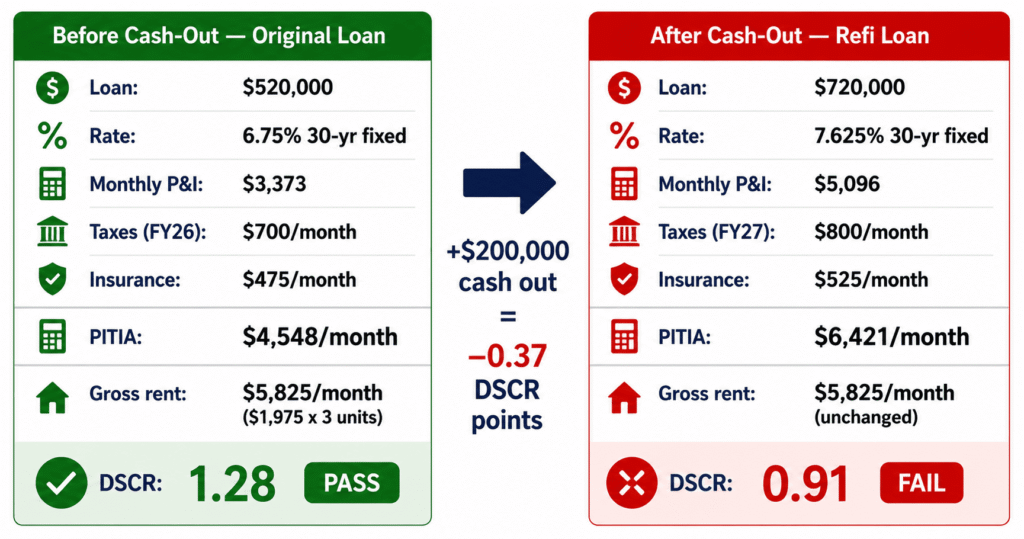
Brooklyn DSCR cash-out refi impact 2026 is best explained with a single deal. A Bed-Stuy 3-unit was carrying a 1.28 DSCR on its original 6.75% purchase loan — a clean PASS by any standard. The investor wanted $200,000 in equity to fund a second acquisition. They took a 75% LTV cash-out refi at 7.625%. The new Lender DSCR: 0.91 — FAIL. The loan was denied. The deal that had been a PASS for four years became unfundable the moment the investor tried to pull equity from it.
Before spending time on a full analysis of your Brooklyn deal, Deal Filter — property type, rent roll, unit count, and PITIA in one pass to see where it lands before you go further.
Brooklyn DSCR Cash-Out Refi Impact 2026 — The Deal
The property is a three-unit walk-up in Bed-Stuy, Brooklyn. The investor purchased it in 2021 at $820,000 with a DSCR purchase loan at 6.75%, putting 25% down and borrowing $615,000. After four years of amortization, the outstanding balance had paid down to approximately $520,000 by mid-2025. By 2026, the Bed-Stuy market had pushed the appraised value to $960,000. The three units generated a total gross monthly rent of $5,825 on current executed leases — $1,975/month average.
The original DSCR was comfortable: $5,825 / $4,548 PITIA = 1.28 — PASS. The investor identified a second Brooklyn building and needed $200,000 for the down payment. A 75% LTV cash-out refi would produce $720,000 — paying off the $520,000 balance and delivering $200,000 in proceeds. The investor applied. The DSCR came back at 0.91. The loan was denied.
| Item | Before Cash-Out (Original Loan) | After Cash-Out (Refi Loan) |
|---|---|---|
| Loan balance | $520,000 | $720,000 |
| Interest rate | 6.75% (purchase rate) | 7.625% (cash-out premium) |
| Monthly P&I | $3,373 | $5,096 |
| Monthly taxes | $700 | $800 |
| Monthly insurance | $475 | $525 |
| Monthly PITIA | $4,548 | $6,421 |
| Gross monthly rent | $5,825 | $5,825 (unchanged) |
| Lender DSCR | 1.28 | 0.91 |
| BKDSCR verdict | PASS | FAIL |
| Cash equity pulled | — | $200,000 |
Why the Brooklyn DSCR Cash-Out Refi Collapsed
The Rate Premium on Cash-Out Refis
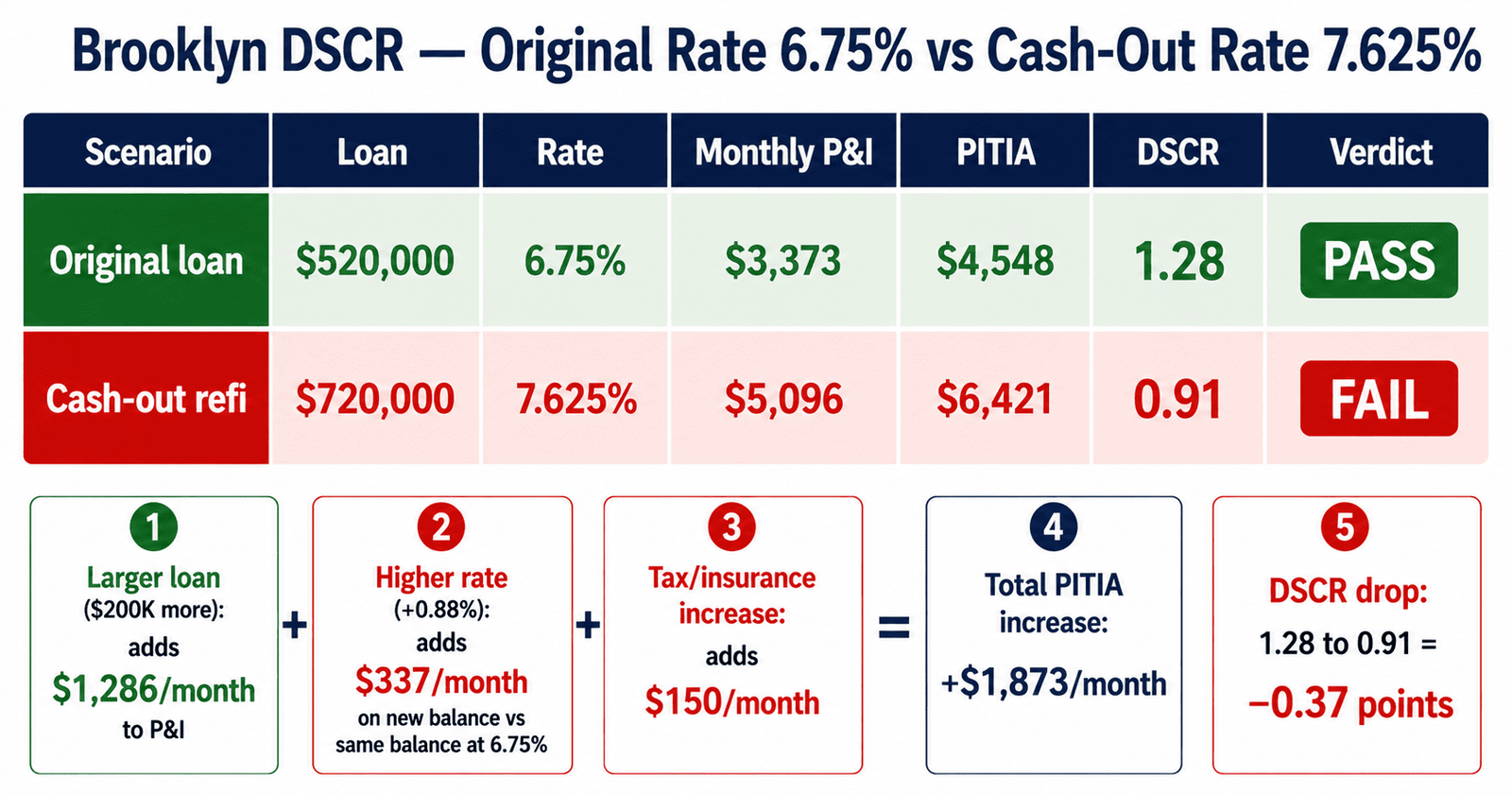
DSCR cash-out refinances price higher than purchases or rate-and-term refis. Per Ridge Street, cash-out refis run 0.25–0.50% higher in rate than purchase or rate-and-term transactions at the same LTV. For this investor, the cash-out rate was 7.625% — approximately 0.88% above the original 6.75% purchase rate. On a $720,000 balance, that 0.88% rate difference translates to approximately $628/month in additional P&I.
The Compound Effect: More Loan at a Higher Rate
The cash-out refi creates two simultaneous adverse effects: a larger loan and a higher rate. The original loan was $520,000. The new loan is $720,000 — $200,000 more. At 6.75%, that additional $200,000 in balance would have produced $1,296/month in additional P&I. At 7.625%, the total new P&I on $720,000 is $5,096 — compared to $3,373 on the original $520,000. The PITIA increase: +$1,873/month. The rent roll stayed at $5,825. The result: $5,825 / $6,421 = 0.91 FAIL.
The DSCR formula breaks down exactly how each component of PITIA interacts with gross rent. Every dollar added to the loan or rate adds to the denominator. When the rent roll is fixed, every denominator increase is a direct DSCR reduction. There is no offsetting numerator increase from pulling equity.
The LTV Sensitivity Table — No Safe Cash-Out Exists on This Deal
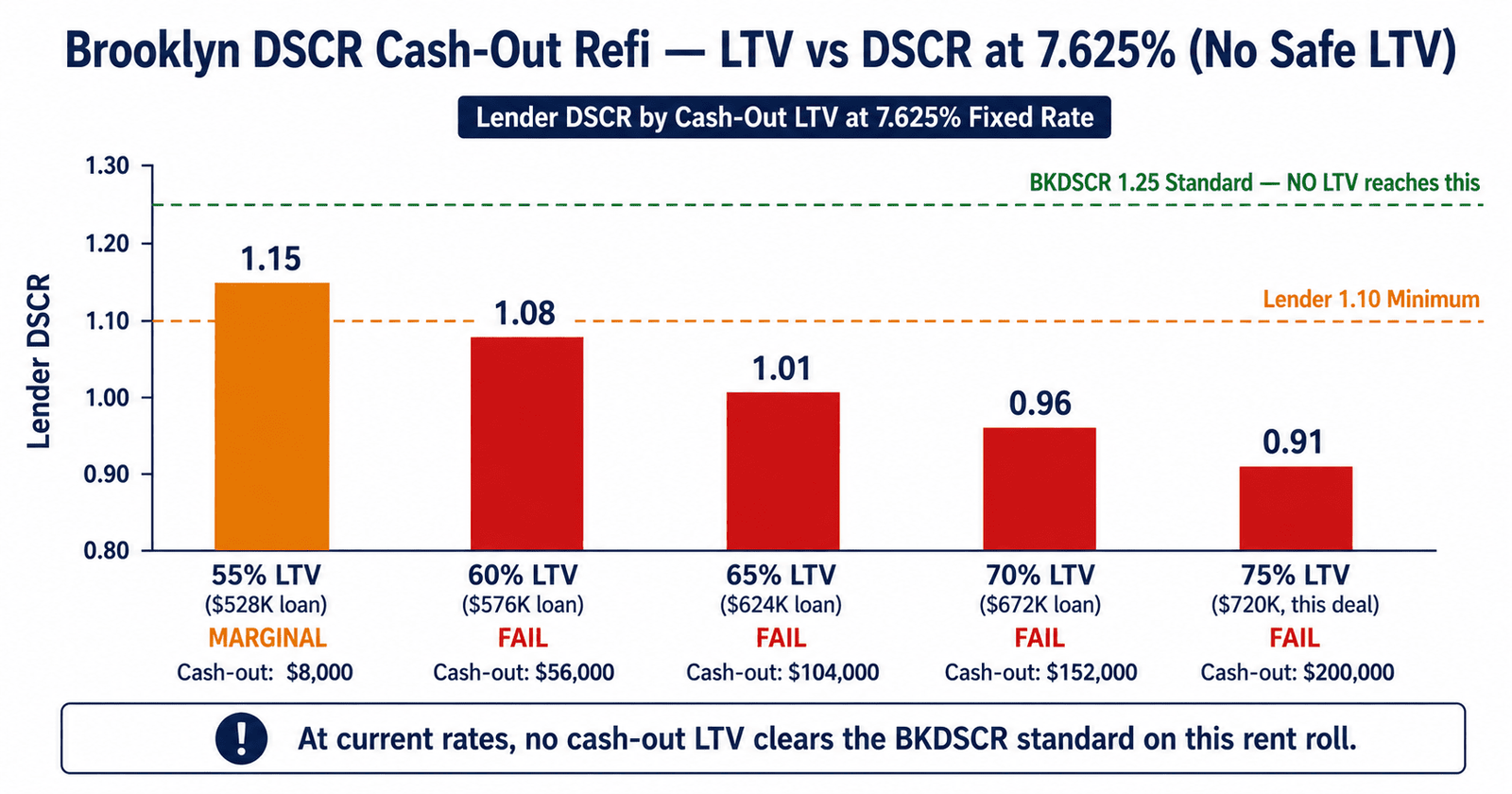
The core problem is not the 75% LTV choice. The core problem is the relationship between this property’s rent roll and the current rate environment. No cash-out LTV produces a 1.25 DSCR on $5,825/month gross rent at 7.625%:
| Cash-Out LTV | Loan Amount | P&I | PITIA | Lender DSCR | Verdict | Cash Proceeds |
|---|---|---|---|---|---|---|
| 55% LTV | $528,000 | $3,737 | $5,062 | 1.15 | MARGINAL | $8,000 |
| 60% LTV | $576,000 | $4,077 | $5,402 | 1.08 | FAIL | $56,000 |
| 65% LTV | $624,000 | $4,417 | $5,742 | 1.01 | FAIL | $104,000 |
| 70% LTV | $672,000 | $4,756 | $6,081 | 0.96 | FAIL | $152,000 |
| 75% LTV ← this deal | $720,000 | $5,096 | $6,421 | 0.91 | FAIL | $200,000 |
The maximum cash-out that clears the lender’s 1.10 floor requires a loan of approximately $561,000 — meaning the investor could pull at most $41,000 above the original balance. That is not a meaningful equity pull for a $960,000 building. According to Stacking Capital’s April 2026 DSCR investor loan guide, the DSCR loan is a long-term financing product that the property must carry on its own income. Equity does not pay the mortgage. Rent does.
The Rate Environment Made the Cash-Out Impossible
This deal is a direct consequence of the rate environment between 2021 and 2026. The investor bought at 6.75% in 2021. By May 2026, the cash-out refi rate for a Bed-Stuy 3-unit at 75% LTV is 7.625%. That +0.88% gap on $720,000 adds $628/month in P&I versus the original rate. The investor was effectively applying a 14% rate premium on their equity pull without realizing it.
The bkdscr.com refi analyzer lets investors model the post-refi DSCR before submitting. Had the investor run this scenario at the actual cash-out rate, they would have seen the 0.91 before the application. The loan denial came after the appraisal was paid, the title search was ordered, and the lender reviewed the package. The marginal refi showed a deal that cleared 1.25 by 0.02 points — this deal failed by 0.34 points. The gap between those two outcomes is the cash-out amount.
What the Investor Should Have Done Instead
Option 1: Rate-and-Term Refi Only
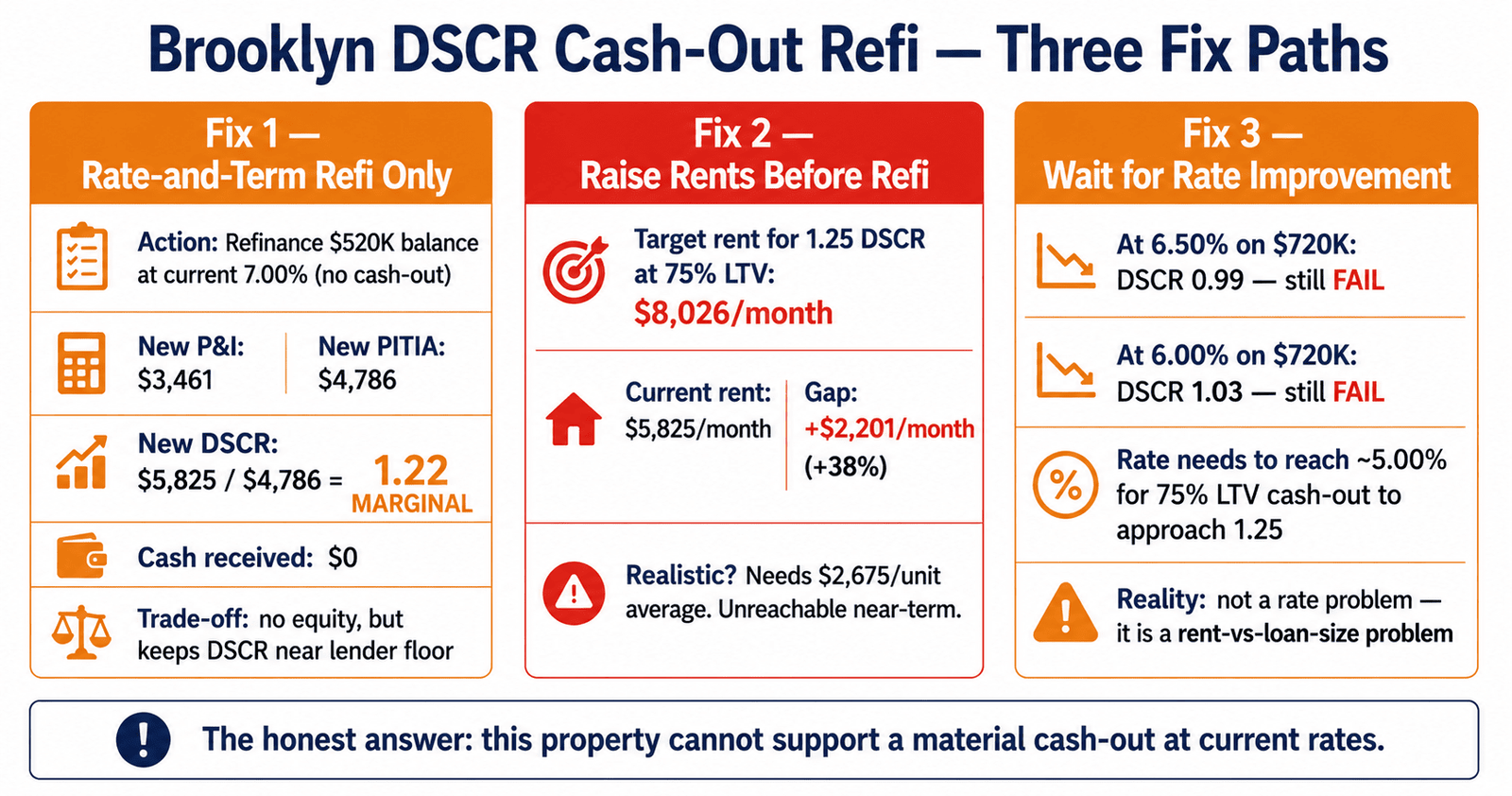
A rate-and-term refi on the existing $520,000 balance at 7.00% (no cash-out premium) produces: P&I $3,461, PITIA $4,786, DSCR $5,825 / $4,786 = 1.22 — MARGINAL. Not a PASS by the BKDSCR standard, but it clears the lender’s 1.20 floor. The investor keeps the building on long-term fixed debt. No cash proceeds, but no denial either.
Option 2: Raise Rents Before Any Refi Attempt
The rent needed to produce a 1.25 DSCR at 75% LTV and 7.625% is $8,026/month. The current rent is $5,825/month — a $2,201/month gap. That requires each unit to average $2,675/month, versus the current $1,975/month average. Brooklyn 3-unit rents do not support that gap at this unit mix in Bed-Stuy in 2026. This is not a near-term fix.
Option 3: Wait for Rate Improvement
Even at 6.50%, the 75% LTV cash-out on this deal produces a DSCR of 0.99 — still FAIL. At 6.00%, the DSCR is 1.03 — still FAIL. The rate would need to reach approximately 5.00% before a 75% LTV cash-out clears 1.25 on $5,825/month rent. bkdscr.com covers deal killers — equity pull without a supporting rent roll is on that list. The 4-unit DSCR fail shows a similar dynamic at the purchase stage.
What Investors Get Wrong on Brooklyn DSCR Cash-Out Refis
- Modeling the cash-out at the purchase rate, not the cash-out rate: Cash-out refis run 0.25–0.50% higher. At $720K that adds $300–600/month to P&I before the first calculation
- Treating appraised equity as liquid: Equity in a DSCR property is accessible only if the new loan the equity creates can be serviced by the rent roll at the new rate
- Assuming the cash-out refi produces the same DSCR as the original loan: A larger loan at a higher rate produces a completely different DSCR. The building did not get better — the debt got worse
- Not running the LTV sensitivity table before choosing a cash-out amount: Start at 65% LTV and work up. Not start at 75% and be surprised by the result
- Skipping the refi analyzer before the appraisal: The appraisal is paid before the DSCR is calculated in a typical application flow. Running the math first saves the fee and the time
- Conflating rate-and-term refi DSCR with cash-out refi DSCR: Rate-and-term refis on the same balance at a lower rate can improve DSCR. Cash-out refis on a larger balance at a higher rate almost always reduce DSCR. They are different transactions with opposite effects
FAQ: Brooklyn DSCR Cash-Out Refinance
Can I do a cash-out DSCR refi on a Brooklyn 3-unit?
Yes — if the rent roll supports the new PITIA at a minimum DSCR of 1.00 (lender floor) or 1.25 (BKDSCR standard). Most programs cap cash-out LTV at 70–75% for 2–4 unit properties. The DSCR is calculated on the new loan at the new rate. If gross monthly rent divided by new monthly PITIA is below the lender’s minimum, the loan is denied regardless of appraised value or prior DSCR.
Why did my DSCR drop so much when I pulled equity?
Two reasons: larger loan and higher rate. Cash-out refis price 0.25–0.50% higher than purchase or rate-and-term refis. Both the increased loan balance and the higher rate increase monthly P&I. Combined with FY27 tax and insurance increases, the PITIA on a cash-out refi is significantly higher than on the original loan. The rent roll does not increase when you pull equity.
Is there any way to pull equity from a Brooklyn rental without destroying the DSCR?
Yes — but the amount is limited by the rent roll. The maximum cash-out that keeps DSCR above the lender floor is determined by: maximum DSCR loan amount at the floor rate minus the current balance. On this Bed-Stuy 3-unit, that amount is approximately $41,000 at current rates. For larger equity pulls, the options are: wait for the rent roll to grow, wait for rates to improve, or sell the property. There is no way to extract more equity than the rent roll will support.
Brooklyn DSCR Cash-Out Refi: The Real Cost Stack and Break-Even Math
Brooklyn DSCR cash-out refi transactions carry higher all-in costs than rate-and-term refis. At a $900,000 ARV with 70% LTV cash-out, the new loan is $630,000. The existing loan balance (assuming a 3-year-old purchase loan at 75% LTV on an $800,000 acquisition) is approximately $600,000. Cash-out proceeds: $630,000 minus $600,000 = $30,000. NYC mortgage recording tax on the new $630,000 loan: $630,000 x 1.925% = $12,128.
Lender fees (1 point): $6,300. Title and appraisal: approximately $5,500. Total friction cost: $23,928. To extract $30,000 in cash-out proceeds, the investor pays $23,928 in transaction costs — recovering only $6,072 net. A Brooklyn DSCR cash-out refi that produces minimal net cash-out is usually not worth the transaction cost.
The break-even improves significantly at higher appraised values. A Brooklyn 4-unit that has appreciated from $800,000 to $1,100,000 over 5 years — modest for central Brooklyn at historical appreciation rates — produces a 70% LTV cash-out loan of $770,000. Existing loan balance at 5 years: approximately $562,000 (principal paydown on a $600,000 loan at 7.5% over 5 years).
Cash-out proceeds: $770,000 minus $562,000 = $208,000. NYC recording tax: $770,000 x 1.925% = $14,823. Total friction cost: approximately $26,500. Net proceeds: $181,500. That is a meaningful cash-out refi — the transaction cost is 12.8% of the gross proceeds, which is acceptable for the scale of capital extracted.
The Brooklyn DSCR cash-out refi therefore works at scale — large equity extraction justifies the friction cost — and does not work at small scale, where the recording tax and lender fees consume most of the available equity. Use the Refi Analyzer at the specific appraised value, existing loan balance, and target LTV to determine whether the Brooklyn DSCR cash-out refi pencils for a specific property before committing to the application process.
The DSCR Test at Cash-Out: Why the New Loan Amount Matters
Every Brooklyn DSCR cash-out refi must clear the lender’s DSCR minimum on the new, larger loan amount. At $770,000 on a 30-year term at 7.5%, new monthly P+I is $5,389. If property taxes are $1,100/month and insurance is $900/month, new PITIA is $7,389/month. If current gross rent is $9,600/month, cash-out DSCR is $9,600 / $7,389 = 1.30 — a clear pass. If current gross rent is $8,400/month, cash-out DSCR is 1.14 —
fails the BKDSCR 1.25 standard and may fail some lender programs. The critical check: confirm the cash-out DSCR on the new, larger loan before ordering the appraisal. A property that runs 1.35 DSCR on the existing loan may run 1.12 DSCR on the larger cash-out loan. The DSCR calculator shows this difference at any loan amount combination.
The Bottom Line — Why This Denial Was Avoidable
Brooklyn DSCR cash-out refi impact 2026 is not abstract. This Bed-Stuy 3-unit produced a 1.28 DSCR for four years on its original loan. The investor had a real business reason for pulling equity — a second acquisition that needed $200,000 in down payment capital. The decision to use the Bed-Stuy building as the equity source was rational. The execution was not.
The investor did not model the post-refi DSCR at the cash-out rate before applying. The denial came after the appraisal was paid, after the title work was done, and after several weeks of the application process. The $200,000 they were trying to pull is still locked in the building. The second acquisition did not happen.
The math on this deal is not complicated. Gross rent: $5,825. New PITIA at 75% LTV cash-out: $6,421. The rent does not cover the debt service. That calculation takes ten minutes with a refi analyzer. Running it before the application costs nothing. Not running it cost the investor the appraisal fee, the title search, several weeks, and the second acquisition they were trying to fund.
If you have a Brooklyn property with equity and want to know whether a cash-out refi is viable at current rates, Deal Review — pre-refi DSCR, post-refi DSCR, stress test, and fix paths within 48–72 hours.