
DSCR Interest-Only Loans: The Real 10-Year IO Trade-Off
Key Takeaways
- DSCR interest-only loan NYC strategy 2026: IO adds +0.10 DSCR points on a thin deal, changing 1.18 MARGINAL to 1.28 PASS
- IO rate premium: +0.125-0.25% over full amortization — small upfront, but compounds to real cost over the IO period
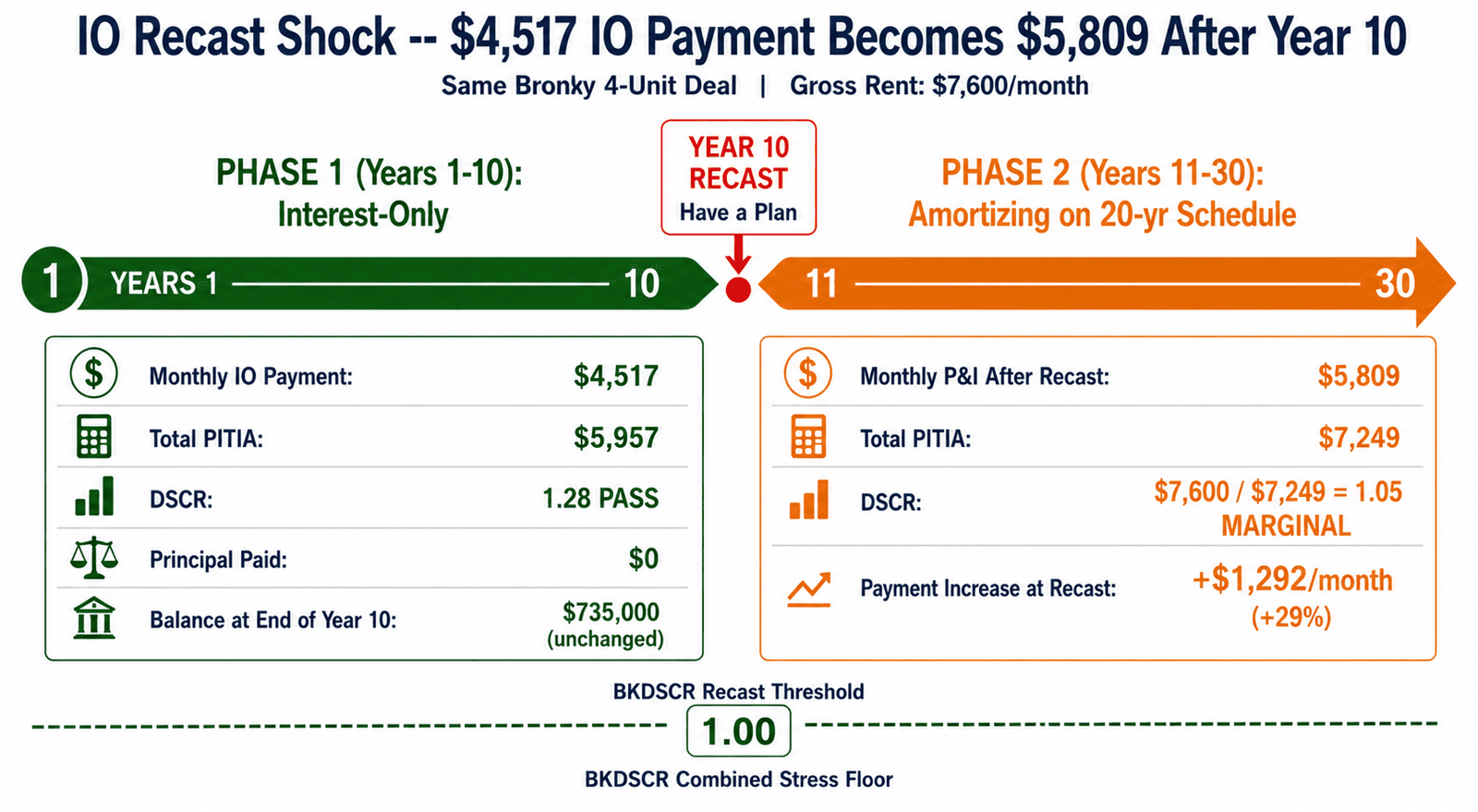
- IO recast shock: 10-yr IO on $735K recasts to 20-yr P&I amortization — payment jumps from $4,517 to $5,809 (+29%) at year 10
- DSCR at recast: drops from 1.28 PASS to 1.05 MARGINAL on the same rent roll — must have exit plan
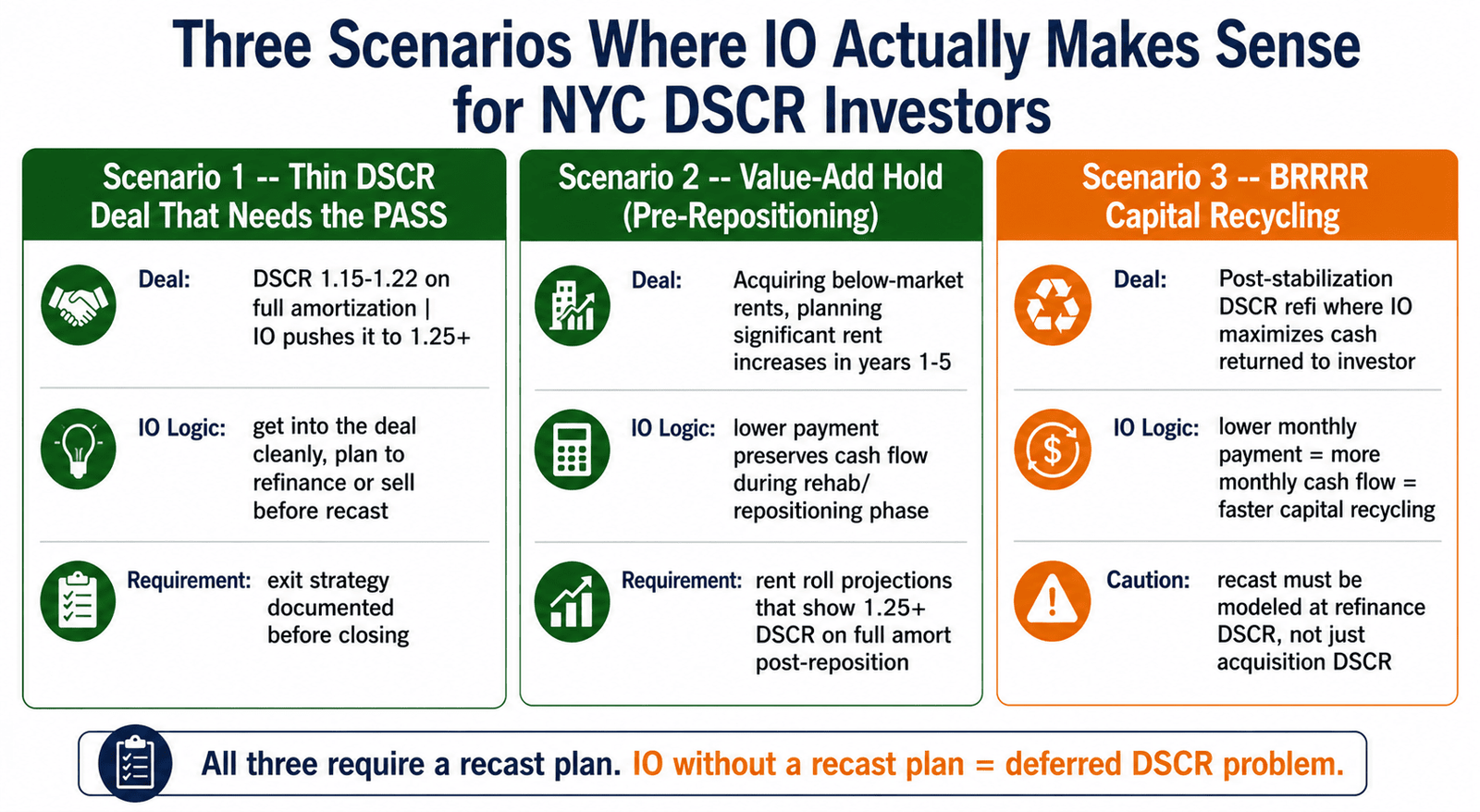
- IO makes sense: thin DSCR deal (1.15-1.24) needing a PASS; value-add hold; BRRRR capital recycling
- IO does not make sense: strong DSCR (1.35+) that already passes; long-term hold without exit strategy
Table of Contents
- DSCR Interest-Only Loan NYC Strategy — The Math on Both Deals
- The IO Recast — The Number Most Investors Don’t Run
- When IO Makes Sense — The Three Legitimate Scenarios
- Scenario 1: The DSCR Interest-Only Loan on a Thin Deal
- Scenario 2: Value-Add Hold Before Repositioning
- Scenario 3: BRRRR Capital Recycling
- When IO Does Not Make Sense
- What DSCR Lenders Require on IO Submissions
- What Investors Get Wrong on DSCR Interest-Only Loans
- DSCR Interest-Only Loans: The Five Questions to Answer Before Choosing IO
- Does IO Change the Deal Verdict or Just the Margin?
- The Recast Risk at Year 10
- DSCR Interest-Only Loan NYC: The Rate Premium and When It Is Worth Paying
- DSCR Interest-Only Loan NYC: The Most Common Mistakes Investors Make
- The Bottom Line — IO Is a Tool, Not a Strategy
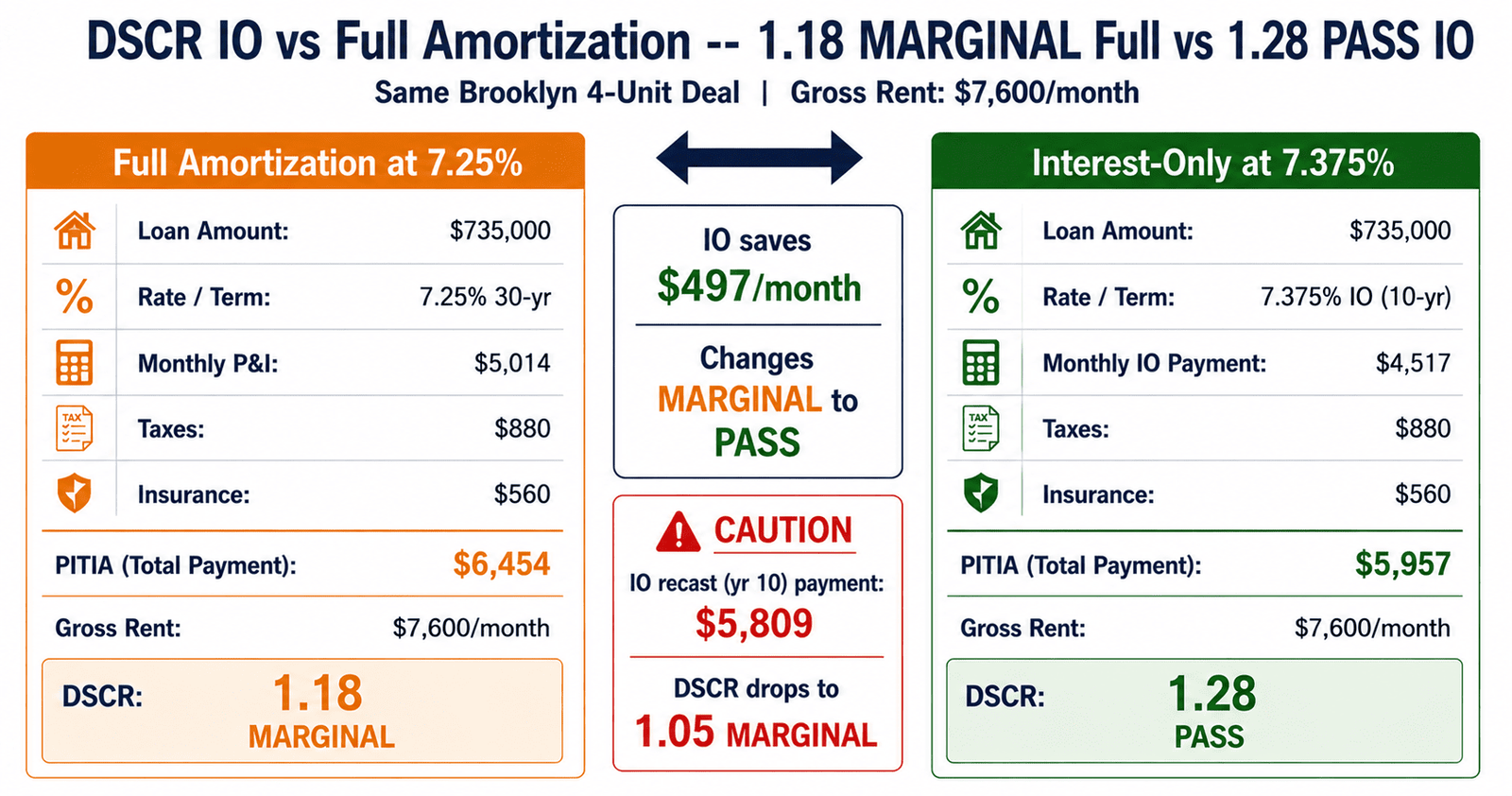
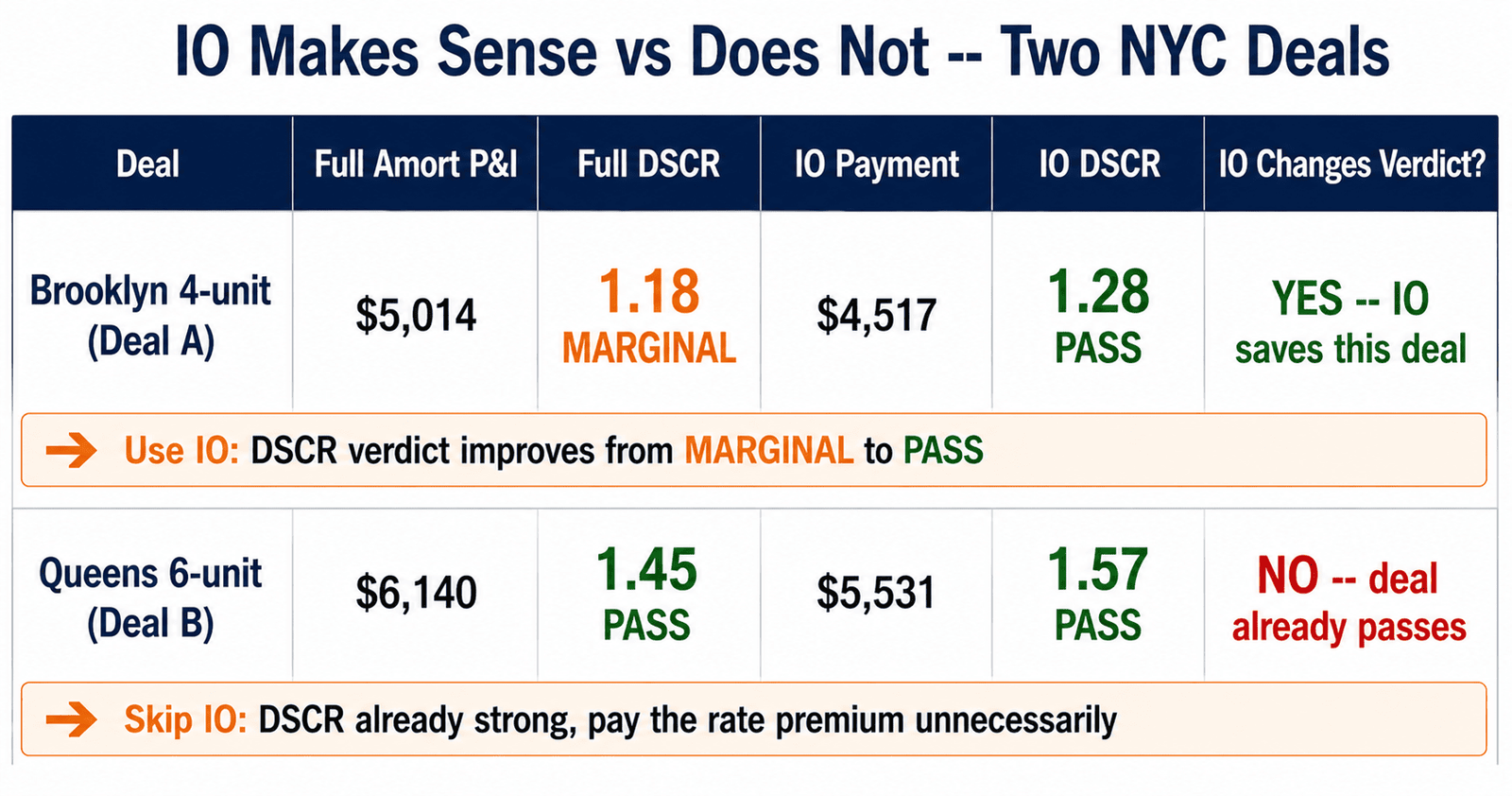
DSCR interest-only loan NYC strategy 2026 starts with one question: does IO change your verdict or just improve a number that was already fine? On a Brooklyn 4-unit at 7.25%, full amortization produces a DSCR of 1.18 — MARGINAL. The same loan at 7.375% interest-only produces 1.28 — PASS. IO saves $497/month and moves the verdict. On a Queens 6-unit, full amortization produces 1.45 — already a PASS. IO on that deal produces 1.57. The verdict does not change. The investor just pays a rate premium and takes on recast risk for no additional DSCR benefit.
| MARKET SNAPSHOT — DSCR Interest-Only Loans, May 2026 | |
|---|---|
| Sources: Griffin Funding (May 2026) | Stacking Capital (April 2026) | HonestCasa | BKDSCR Research | |
| IO LOAN RATES & STRUCTURE | |
| DSCR 30-yr fixed rates (May 2026) | 6.125%–7.50% |
| IO premium over full amortization | +0.125%–0.25% in rate |
| IO structure (standard) | 10-year IO period, resets to 20-yr P&I amortization |
| Payment shock at recast (10-yr IO) | 25%–55% higher monthly payment — 29% on standard deal |
| IO DSCR IMPACT | |
| IO DSCR advantage | IO payments are lower — improves DSCR vs amortizing |
| IO vs amortizing DSCR on $750K loan at 7.5% | IO: $4,688/mo | Amortizing: $5,247/mo |
| BKDSCR standard | 1.25+ unstressed | 1.00+ combined stress |
Before deciding between IO and full-amortization on a NYC deal, deal filter — current loan inputs, IO vs full P&I comparison, and DSCR under both structures in one pass.
DSCR Interest-Only Loan NYC Strategy — The Math on Both Deals
The two-deal comparison shows IO’s role clearly. Deal A is a Brooklyn 4-unit purchased at $980,000 with $735,000 borrowed. At 7.25% full amortization, P&I is $5,014/month. PITIA: $6,454. Gross rent: $7,600/month. DSCR: 1.18 — MARGINAL. The IO alternative at 7.375%: IO payment $4,517, PITIA $5,957, DSCR: 1.28 — PASS. IO moves the verdict. Running both scenarios through the DSCR calculator before committing to an IO structure takes the guesswork out of the DSCR delta.
| Item | Full Amortization (7.25%) | Interest-Only (7.375%) |
|---|---|---|
| Loan amount | $735,000 | $735,000 |
| Monthly P&I / IO payment | $5,014 | $4,517 |
| Monthly PITIA | $6,454 | $5,957 |
| Lender DSCR | 1.18 | 1.28 |
| BKDSCR verdict | MARGINAL | PASS |
| Monthly savings vs full amort | — | $497 |
| Principal paid (Yrs 1–10) | ~$83,000 equity built | $0 (interest only) |
| P&I at Year 10 recast (20-yr) | N/A | $5,809 |
| DSCR at Year 10 recast | N/A | 1.05 |
The IO Recast — The Number Most Investors Don’t Run
An IO DSCR loan defers principal, not debt. The standard IO structure in 2026 is a 10-year IO period followed by 20-year amortization on the unchanged balance. At year 10 on Deal A, the balance is still $735,000. P&I on $735,000 at 7.375% over 20 years: $5,809/month. The IO payment was $4,517. The recast adds $1,292/month — a 29% payment increase. New PITIA: $7,249. Recast DSCR on the same rent roll: $7,600 / $7,249 = 1.05 — MARGINAL.
According to Griffin Funding, IO periods carry a 0.125–0.25% rate premium and recast to 20-year amortization — producing payment shock ranging from 25% to 55%. Before any IO deal closes, stress test — the year 10 DSCR must be part of the underwriting, not a surprise.
When IO Makes Sense — The Three Legitimate Scenarios
Scenario 1: The DSCR Interest-Only Loan on a Thin Deal
Scenario 2: Value-Add Hold Before Repositioning
A building acquired with below-market rents and a near-term rehab plan is a legitimate IO candidate. During the rehab period, cash flow is compressed. IO preserves monthly cash flow during that window. The critical requirement: the investor must model the post-repositioning DSCR on full amortization. If the repositioned rent roll produces 1.35+ on full amortization, the IO structure is justified. If the repositioned rent roll still requires IO to produce 1.25, the deal has a structural problem IO is hiding. See also: marginal refi.
Scenario 3: BRRRR Capital Recycling
According to Stacking Capital’s April 2026 DSCR investor loan guide, the BRRRR refinance from hard money to DSCR benefits from IO when the investor’s primary goal is capital velocity — maximizing monthly cash flow to redeploy into the next acquisition. IO lowers the monthly PITIA on the refinance, increasing the net cash flow available for recycling. The recast must be modeled at the refinance LTV and rate before closing.
To understand how IO affects your stressed DSCR at recast and whether your deal survives the IO-to-P&I transition, DSCR Playbook.
When IO Does Not Make Sense
Deal B is the counter-example. A Queens 6-unit at 7.25% full amortization produces a DSCR of 1.45 — a clean PASS. IO on that deal produces 1.57. The verdict does not change. The IO rate premium adds approximately $609/month in additional interest cost over the 10-year IO period. The investor builds no equity during that period. And at year 10, the recast produces payment shock that requires active management. If the full amortization DSCR is 1.35 or above, skip IO. Take the lower full-amortization rate and build equity.
| Scenario | IO Makes Sense? | Reason |
|---|---|---|
| Full amort DSCR 1.15–1.24 (MARGINAL) | YES | IO pushes DSCR above 1.25 — changes verdict from MARGINAL to PASS |
| Full amort DSCR 1.25–1.35 (PASS) | MAYBE | Deal passes either way; IO adds rate premium and recast risk without changing verdict |
| Full amort DSCR 1.35+ (strong PASS) | NO | Deal strong on full amort; IO adds rate premium and recast risk with no DSCR benefit |
| Value-add hold, rents below market | YES — if exit plan exists | IO preserves cash flow during repositioning; recast must be modeled at target rent |
| BRRRR refi, capital recycling focus | YES — with recast plan | IO maximizes monthly cash flow and speeds capital recycling; model recast before closing |
| Long-term hold, no exit strategy | NO | Without a refinance or sale plan before recast, payment shock creates DSCR risk in year 10 |
What DSCR Lenders Require on IO Submissions
IO programs typically require stronger borrower profiles than standard fully amortizing DSCR loans. lender criteria on IO submissions, and the refi analyzer lets you model the recast DSCR before closing. Most IO programs require 700+ FICO, 6–12 months of reserves, and explicit documentation of the exit strategy or recast plan. Lenders who offer IO want to see that the borrower has modeled the year 10 scenario — not just the IO-period payment. The cash-out refi shows what happens when equity matters — having $0 in principal built after 10 years of IO narrows cash-out options significantly at recast.
What Investors Get Wrong on DSCR Interest-Only Loans
- Using IO to qualify a deal without modeling the recast: A deal that passes at 1.28 IO and drops to 1.05 at recast has a 10-year countdown on its financing structure
- Not accounting for the IO rate premium in the DSCR calculation: IO rates run +0.125–0.25% higher. At a $735K loan, that adds $77–$154/month. Use the actual IO rate in the DSCR comparison
- Assuming IO builds the same equity as full amortization: IO builds zero equity. The loan balance at year 10 is identical to day one
- Applying IO on deals that already pass: If full amortization DSCR is already 1.35+, IO adds rate premium and recast risk with no verdict benefit
- Not stress-testing the recast: The BKDSCR standard requires the deal to survive not just the IO period but the recast period. Model the year 10 scenario before closing
- Conflating IO payment savings with cash flow improvement: IO lowers the monthly payment but does not improve the underlying rent roll. The saved principal is deferred debt, not freed equity
DSCR Interest-Only Loans: The Five Questions to Answer Before Choosing IO
Does IO Change the Deal Verdict or Just the Margin?
The first question on any DSCR interest-only loan decision is whether IO changes whether the deal qualifies at all, or just changes the cushion. On a Brooklyn 4-unit at $950,000, 75% LTV, 7.5% rate: full amortization P+I is $4,989/month; IO payment is $4,453/month. The difference is $536/month. If PITIA with taxes and insurance is $6,489 (full amort) vs $5,953 (IO), and gross rent is $8,100/month, DSCR is 1.25 vs 1.36.
Both pass. IO improved the margin but did not change the verdict. If gross rent is $7,500/month, full amort DSCR is 1.15 (fail) and IO DSCR is 1.26 (pass). Here, IO is not a margin play — it is the difference between a deal that qualifies and one that does not. Understanding which category the deal falls into determines how much IO matters.
The Recast Risk at Year 10
DSCR IO loans typically run a 10-year interest-only period before recasting to a 20-year amortizing schedule. The payment shock at year 10 is substantial. At 7.5% on a $712,500 loan (75% of $950,000), IO payment is $4,453/month. After recast to 20-year amortization, the payment becomes approximately $5,750/month — a 29% increase. If rents have grown 3% annually over 10 years (a conservative projection for NYC outer-borough), monthly gross rent has grown from $8,100 to $10,886.
PITIA at the new P+I level is $7,250/month including taxes and insurance growth. DSCR at recast: $10,886 / $7,250 = 1.50. The deal still works at recast — but the investor needs to model it, not assume it.
The IO recast risk is most acute on deals that barely clear 1.25 DSCR with IO. If the deal only works at IO and rents do not grow to cover the amortizing payment at year 10, the investor either needs to refinance before recast, sell the property, or accept negative cash flow at the higher payment. Model the year 10 recast scenario before choosing IO. The Refi Analyzer at that future point — projected loan balance after 10 years of IO, projected rents, projected rates — shows whether the exit path is viable.
DSCR Interest-Only Loan NYC: The Rate Premium and When It Is Worth Paying
IO comes with a rate premium of 0.125%–0.25% at most DSCR lenders in 2026. On a $712,500 loan, 0.25% in rate is approximately $147/month in additional P+I interest cost on a full amortization loan. On an IO loan, that same 0.25% premium costs $148/month in interest — identical. The IO premium is paid in the present tense (higher rate) in exchange for lower current monthly payment (no principal). Whether that trade is worth it depends on the specific deal math and the investor’s capital deployment plans.
Use IO when: the deal only qualifies with IO, or when the capital freed by the lower IO payment can be deployed into value-add improvements that raise rents before recast. Do not use IO when: the deal already clears 1.25 at full amortization and the rate premium costs more than the margin improvement is worth. The stress test at IO versus full amortization, run at current rents and +1% rate, shows exactly where each structure holds and where it breaks.
DSCR Interest-Only Loan NYC: The Most Common Mistakes Investors Make
Three errors appear consistently when NYC investors choose IO on DSCR loans:
- Choosing IO to barely qualify, without modeling the recast at year 10. If the deal only works at IO and the investor does not have a clear refi or exit plan before year 10, the recast creates a payment shock that was never modeled.
- Not comparing IO vs full amort at the current rate spread. The IO premium of 0.125%–0.25% is small but real. On a $700,000 loan at 0.25% premium, IO costs $147/month more in rate before the amort savings offset it. If the full amort deal also qualifies, the rate premium is a cost with no benefit.
- Assuming the IO payment is the same as the amortizing payment. IO P+I is lower than fully amortizing P+I on the same loan. The DSCR on an IO loan is calculated using the IO payment — which produces a higher DSCR than the same loan on full amortization. Some investors discover at application that the lender underwrites IO DSCR loans using the fully amortizing payment equivalent — which eliminates the IO DSCR benefit.
Confirm with the lender at pre-qualification: does the program underwrite DSCR using the IO payment or the fully amortizing payment equivalent? If the lender uses the fully amortizing equivalent, the IO DSCR improvement disappears. The lower rate programs at this lender may then be more attractive than IO. Use the DSCR calculator at both the IO payment and the fully amortizing equivalent to confirm which the lender will use before choosing the structure.
The Bottom Line — IO Is a Tool, Not a Strategy
DSCR interest-only loan NYC strategy 2026 is simple: use IO when it changes a verdict, not when it improves a number that was already fine. Deal A goes from MARGINAL to PASS with IO. That is a legitimate use. Deal B goes from 1.45 to 1.57. The verdict is the same. The IO is noise.
The recast is the thing most investors do not run. On a $735,000 loan, the IO payment of $4,517 becomes a P&I payment of $5,809 at year 10 — $1,292 more per month on the same rent roll, DSCR drops from 1.28 to 1.05. The investors who use IO well have a year 10 plan: rates improve enough to refinance, or the deal cash flows at the recast P&I, or the exit has already been executed. IO without a recast plan is just a deferred DSCR problem waiting for year 10.
If you have a NYC deal where the IO decision is live and you want BKDSCR verdict, recast analysis, and fix paths, Deal Review — PASS/MARGINAL/FAIL within 48–72 hours.