
DSCR Prepay Penalty: The Real 5-4-3-2-1 vs 3-2-1 Cost
- DSCR prepay penalty comparison 5-4-3-2-1 2026: on a $650K loan, 3-2-1 wins in every exit scenario under 5 years
- Rate spread (5-4-3-2-1 vs 3-2-1): typically 0.25% — saves $110/month on $650K | $3,948 over 36 months
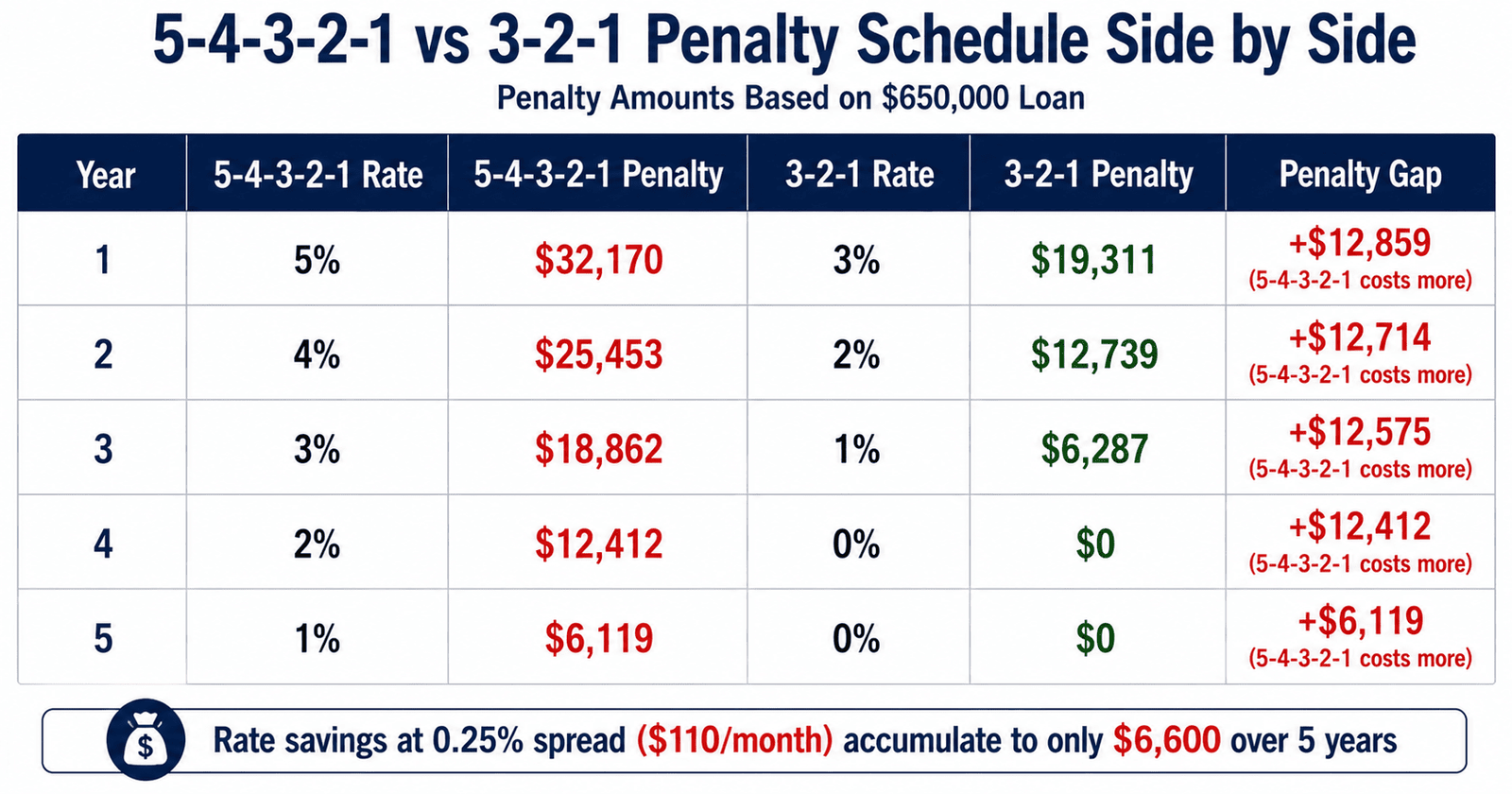
- Year 3 exit penalty gap: $18,862 (5-4-3-2-1) vs $6,287 (3-2-1) = $12,575 more in penalty
- Net at year 3 exit: 3-2-1 wins by $8,627 even after all rate savings are credited
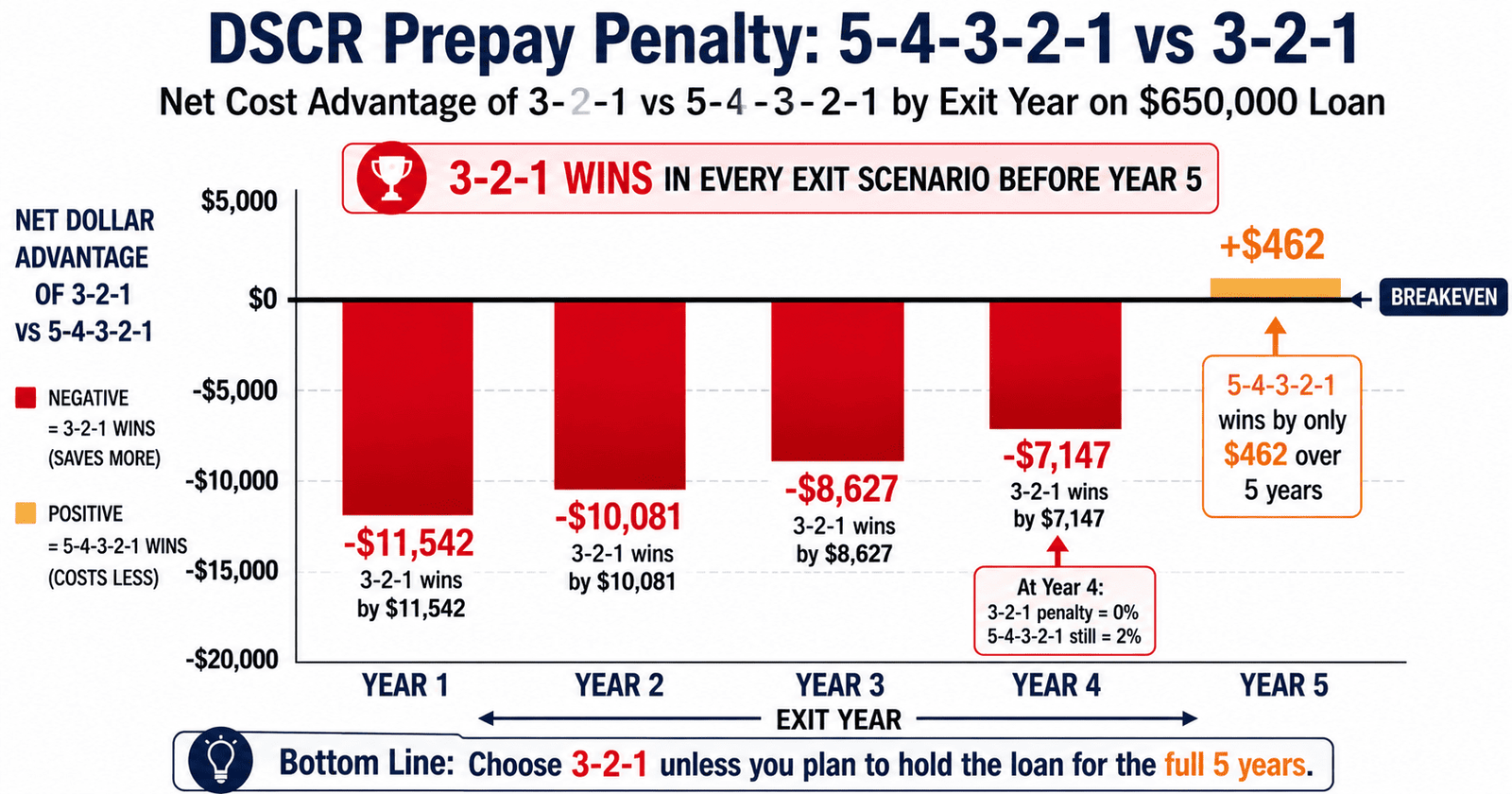
- Year 4: 3-2-1 penalty drops to 0% | 5-4-3-2-1 still at 2% ($12,412) — 3-2-1 wins by $7,147
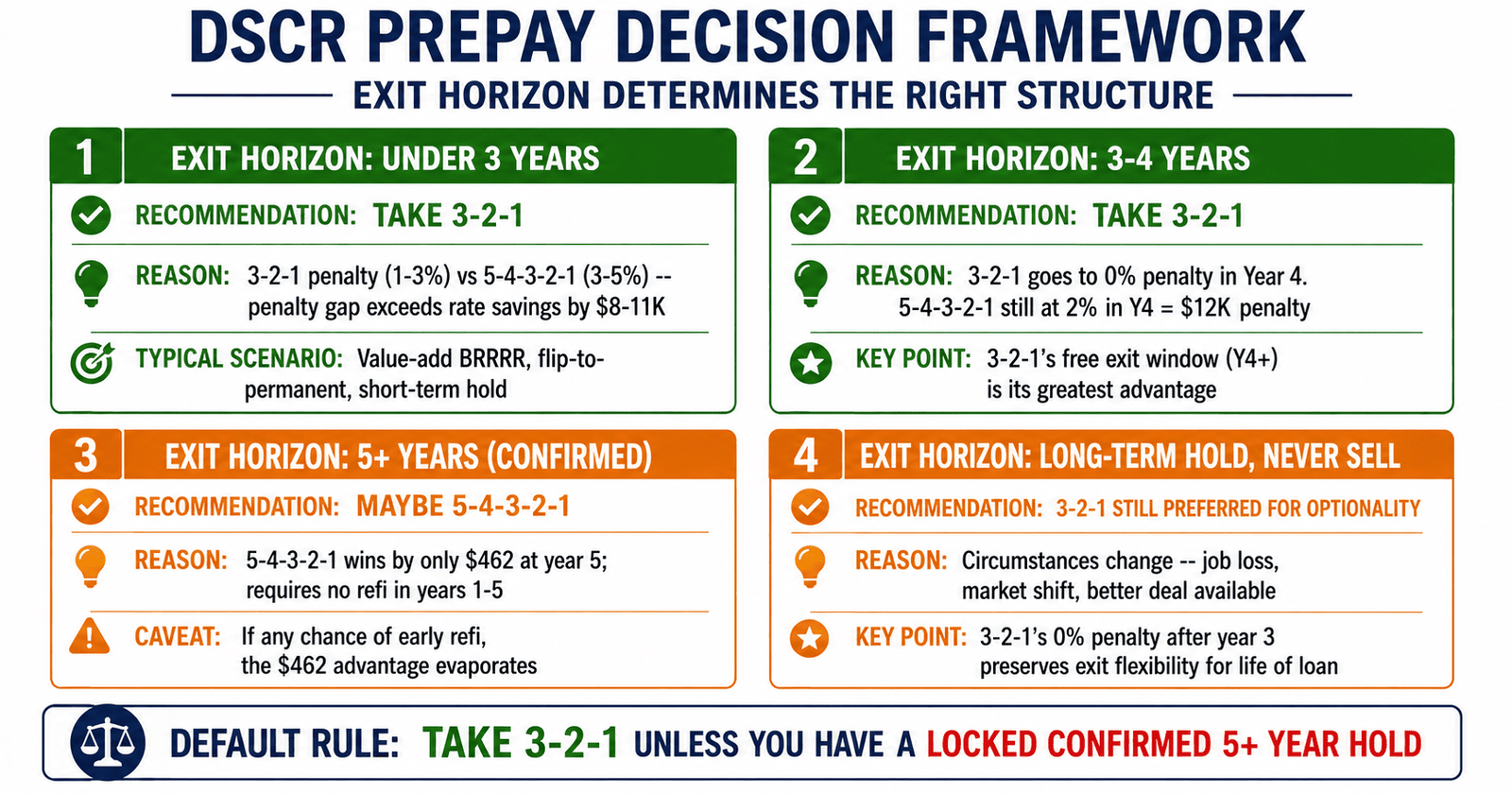
- Default rule: take 3-2-1 unless you have a locked confirmed 5+ year hold with no refinance
Table of Contents
- DSCR Prepay Penalty Comparison — The Deal
- The Year-by-Year Math
- Year 3: The DSCR Prepay Penalty Math That Matters Most
- Year 4: 3-2-1’s Hidden Superpower
- The Rate Spread That Would Make 5-4-3-2-1 Win Earlier
- When 5-4-3-2-1 Actually Makes Sense
- The Confirmed Long-Term Hold
- When the Rate Spread is Meaningfully Higher
- The Decision Framework
- What Investors Get Wrong on DSCR Prepay Penalty Decisions
- DSCR Prepay Penalty: The Complete Cost Table Across All NYC Exit Scenarios
- DSCR Prepay Penalty: The NYC-Specific Variables That Change the Calculation
- DSCR Prepay Penalty: The Decision Framework for NYC Investors
- DSCR Prepay Penalty Comparison: What to Ask the Lender Before Locking
- The Bottom Line — $462 Over 5 Years
DSCR prepay penalty comparison 5-4-3-2-1 2026 comes down to a single number: $462. That is the total advantage of the 5-4-3-2-1 prepay structure over 3-2-1 across the full 5-year hold period on a $650,000 DSCR loan at a 0.25% rate spread. In years 1 through 4, the 3-2-1 structure wins — by as much as $11,542 in year 1 and $7,147 in year 4. At year 5, 5-4-3-2-1 finally pulls ahead. By $462.
| MARKET SNAPSHOT — DSCR Prepay Penalties, May 2026 | |
|---|---|
| Sources: Ridge Street Capital | Stacking Capital (April 2026) | DSCR Capital Partners | BKDSCR Research | |
| PREPAY STRUCTURES & RATE SPREADS | |
| Common DSCR prepay structures (2026) | 5-4-3-2-1 | 3-2-1 | No prepay (+0.50–0.75% rate) |
| Rate spread (5-4-3-2-1 vs 3-2-1) | Typically 0.25% — occasional 0.375% on larger loans |
| Rate spread (3-2-1 vs no prepay) | Typically 0.25%–0.50% |
| PREPAY PENALTY COST EXAMPLES | |
| 5-4-3-2-1 penalty at Year 3 exit | 3% on outstanding balance (approx $18,862 on $628K) |
| 5-4-3-2-1 penalty at Year 4 exit | 2% (~$12,560 on $628K) |
| 5-4-3-2-1 penalty at Year 5 exit | 1% (~$6,280 on $628K) |
| BKDSCR standard | 1.25+ unstressed | 1.00+ combined stress |
Before choosing a prepay structure on any NYC deal, filter it — loan amount, rate options, and exit horizon in one pass to model the total prepay cost under each scenario.
DSCR Prepay Penalty Comparison — The Deal
The comparison uses a Brooklyn 4-unit at $980,000, 25% down, $650,000 DSCR loan. Two prepay options: Option A is 5-4-3-2-1 at 7.00%. Option B is 3-2-1 at 7.25%. Monthly P&I on Option A: $4,324. Monthly P&I on Option B: $4,434. Monthly savings with 5-4-3-2-1: $110. Run the same loan amount through the DSCR calculator to confirm DSCR at each LTV before locking a prepay structure.
Per Ridge Street Capital, prepay structure is one of the primary rate drivers — accepting a longer step-down earns a lower base rate because the lender has yield protection for a longer period. The question is whether that rate savings ever overcomes the penalty exposure difference. Running the deal through the stress test at the no-PPP rate versus the 5-year rate shows whether the DSCR delta changes the verdict.
| Year | 5-4-3-2-1 Penalty | 3-2-1 Penalty | Rate Savings (cumulative) | Net: 3-2-1 vs 5-4-3-2-1 | Winner |
|---|---|---|---|---|---|
| Year 1 | $32,170 (5%) | $19,311 (3%) | $1,316 | 3-2-1 saves $11,542 | 3-2-1 wins |
| Year 2 | $25,453 (4%) | $12,739 (2%) | $2,632 | 3-2-1 saves $10,081 | 3-2-1 wins |
| Year 3 | $18,862 (3%) | $6,287 (1%) | $3,948 | 3-2-1 saves $8,627 | 3-2-1 wins |
| Year 4 | $12,412 (2%) | $0 (0%) | $5,265 | 3-2-1 saves $7,147 | 3-2-1 wins |
| Year 5 | $6,119 (1%) | $0 (0%) | $6,581 | +$462 for 5-4-3-2-1 | 5-4-3-2-1 wins (barely) |
The Year-by-Year Math
Year 3: The DSCR Prepay Penalty Math That Matters Most
Year 3 is the most common exit horizon for NYC value-add and BRRRR deals. At year 3, the outstanding balance is approximately $629,000. The 5-4-3-2-1 penalty: 3% = $18,862. The 3-2-1 penalty: 1% = $6,287. Penalty gap: $12,575. Rate savings accumulated over 36 months: $3,948. Net advantage of 3-2-1: $8,627.
Year 4: 3-2-1’s Hidden Superpower
Starting at month 37, the 3-2-1 investor has zero prepay exposure — sell, refi, cash-out at any time with no penalty. The 5-4-3-2-1 investor in year 4 is still at 2% = $12,420 on a $621,000 balance. The optionality value of 3-2-1 after year 3 is real and has no dollar equivalent on a spreadsheet — but it is why most experienced NYC investors default to 3-2-1.
The DSCR Playbook walks through prepay penalty structures, hold period math, and refi timing in one framework. Get it free: DSCR Playbook
The Rate Spread That Would Make 5-4-3-2-1 Win Earlier
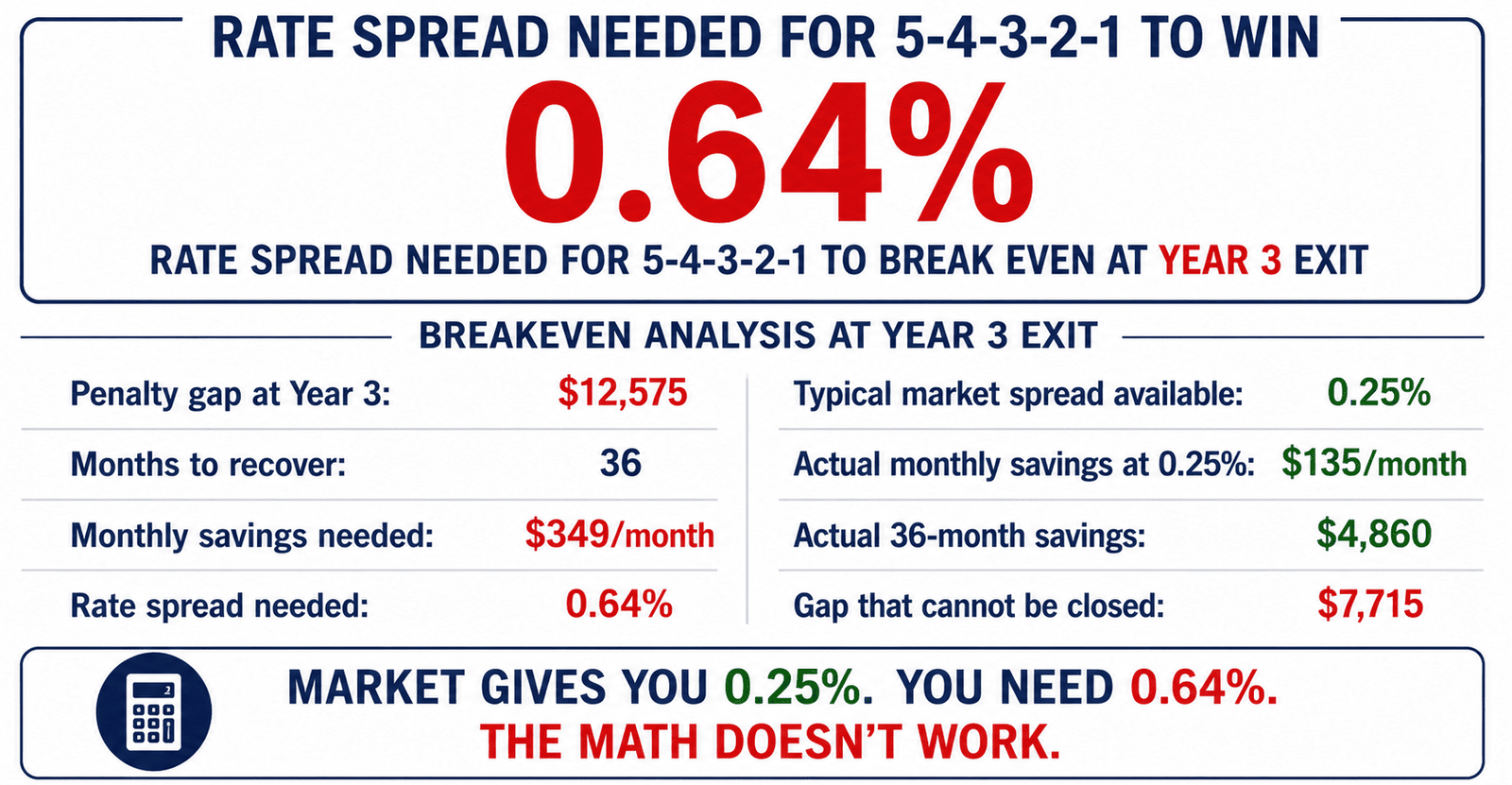
The 5-4-3-2-1 structure would win at a year 3 exit if the rate spread were 0.64% instead of 0.25%. At that spread on $650,000, monthly savings would be $347 — enough to accumulate $12,492 over 36 months and overcome the $12,575 penalty gap. The typical market spread is 0.25%. It almost never reaches 0.64% at any loan size in the current market. See also: marginal refi.
According to Stacking Capital’s April 2026 DSCR investor loan guide, prepay structure is one of the most negotiated elements of DSCR loan terms. The investors who benefit most from 5-4-3-2-1 are genuinely certain of their hold period and willing to accept penalty exposure in exchange for rate reduction. lender criteria in prepay structuring, including which lenders offer the best rate improvement per prepay tier.
When 5-4-3-2-1 Actually Makes Sense
The Confirmed Long-Term Hold
The 5-4-3-2-1 structure is advantageous in one scenario: a confirmed buy-and-hold where the investor has no intention of selling or refinancing in the first five years. After 10 years at $110/month, accumulated rate savings reach $13,200 — well ahead of the year 5 penalty of $6,119. After year 5, 5-4-3-2-1 drops to 0% and the rate advantage continues for the remainder of the hold.
When the Rate Spread is Meaningfully Higher
If a specific lender offers a 0.50% rate spread — which occurs occasionally on jumbo loans or through portfolio lenders — the math shifts. At 0.50% on $650,000: monthly savings $270, 36-month savings $9,720. The year 3 penalty gap remains $12,575. 3-2-1 still wins by $2,855 at year 3, but the 5-4-3-2-1 breakeven moves to approximately month 46. Investors with high confidence in a 4+ year hold might reasonably take 5-4-3-2-1 at that spread. Use the refi analyzer to model your specific spread and hold period before deciding.
The Decision Framework
| Exit Horizon | Recommendation | Reason |
|---|---|---|
| Under 3 years | Take 3-2-1 | Penalty gap overwhelms rate savings by $8,600–$11,500 |
| 3–4 years | Take 3-2-1 | 3-2-1 goes to 0% in Y4 | 5-4-3-2-1 still at 2% = $12,412 |
| 5 years (confirmed) | Take 5-4-3-2-1 | 5-4-3-2-1 wins by $462 — requires no refi in years 1–5 |
| 5+ years, no refi | Take 5-4-3-2-1 | Rate savings compound; penalty-free after Y5 |
| Uncertain horizon | Take 3-2-1 | 0% after Y3 = optionality with no additional cost |
What Investors Get Wrong on DSCR Prepay Penalty Decisions
- Choosing prepay structure based on rate alone: The lower rate on 5-4-3-2-1 is real, but the penalty exposure in years 1–4 is also real and larger. Run the exit math at your realistic hold horizon before choosing
- Underestimating exit timing optionality: Most NYC investors think they will hold 5+ years and exit in 3. Life changes, better deals appear. The 3-2-1’s 0% penalty after year 3 has real option value
- Applying national hold-period assumptions to NYC outer-borough deals: National data skews toward long-hold SFR Sun Belt investors. NYC outer-borough BRRRR and value-add deals turn faster — year 3 exits are common
- Not modeling the prepay penalty on the refi: The IO strategy shows how refi timing affects total cost. A year 4 refi on 5-4-3-2-1 costs $12,412 — that needs to appear in the refi underwriting
- Assuming the rate spread is fixed: Rate spreads between prepay structures are negotiable, especially on larger loans. At 0.50% spread on $1M+, the math shifts meaningfully
DSCR Prepay Penalty: The Complete Cost Table Across All NYC Exit Scenarios
The prepay penalty cost depends on three variables: loan balance at exit, year of exit, and the structure selected at origination. The table below shows total penalty cost on a $650,000 loan balance across the most common NYC DSCR exit windows:
| Exit Year | 5-4-3-2-1 Penalty | 3-2-1 Penalty | No-PPP Penalty |
|---|---|---|---|
| Year 1 | $32,500 (5%) | $19,500 (3%) | $0 |
| Year 2 | $26,000 (4%) | $13,000 (2%) | $0 |
| Year 3 | $19,500 (3%) | $6,500 (1%) | $0 |
| Year 4 | $13,000 (2%) | $0 | $0 |
| Year 5 | $6,500 (1%) | $0 | $0 |
The rate spread between 5-4-3-2-1 and no-PPP is typically 0.50%–0.75%. On a $650,000 loan, 0.50% in rate costs $270/month in additional interest. To recover $19,500 in Year 3 penalty savings (the cost difference between 5-4-3-2-1 and no-PPP at Year 3 exit), you would need 72 months at $270/month savings — but you exit in year 3. The no-PPP loan costs $270/month more and saves $19,500 at exit.
The break-even is 19,500 / 270 = 72 months — 6 years. If you exit in year 3, no-PPP saves you money despite the higher rate. If you hold 7+ years, no-PPP costs you money relative to the 5-4-3-2-1 loan. The Refi Analyzer runs this break-even calculation at your specific loan amount and rate spread.
DSCR Prepay Penalty: The NYC-Specific Variables That Change the Calculation
NYC adds a cost layer that most markets do not have: the mortgage recording tax. At 1.925% on loans over $500,000, every refinance of a NYC DSCR loan above that threshold triggers an additional cost of 1.925% of the new loan balance. On a $650,000 refi loan, that is $12,513. This NYC-specific cost must be added to the prepay penalty calculation for any refi-driven exit.
A Year 3 refi of the 5-4-3-2-1 loan costs $19,500 in penalty plus $12,513 in recording tax — $32,013 total friction cost. At no-PPP (same rate spread assumption): $0 penalty plus $12,513 recording tax — $12,513 total. The spread is $19,500. That spread needs to be recovered in rate savings or equity extracted to make the no-PPP premium worthwhile. Run the full NYC cost stack — penalty plus recording tax plus closing costs — before choosing a prepay structure.
The deal killers that surface at NYC DSCR refi are often prepay-related. Investors who modeled a Year 3 exit under a 5-4-3-2-1 structure without factoring the penalty end up with a refi that does not pencil. The penalty is disclosed at origination — it is in the note — but investors working with limited-service originators often do not see the true cost of early exit until they run the refi numbers. Model the penalty before signing the note, not at the time of refi.
DSCR Prepay Penalty: The Decision Framework for NYC Investors
Choosing the right prepay structure before signing requires answering four questions:
- What is the most likely exit window? If the deal is a 7-year hold, the 5-4-3-2-1 structure burns off before exit and the rate savings over 7 years outweigh the penalty exposure. If the deal is a BRRRR with a 2-year exit window, the 5-4-3-2-1 structure costs 5% of loan balance at year 1 exit — potentially $30,000+.
- What is the rate spread between the stepped structure and no-PPP? If the lender offers only 0.125% difference, the accumulated interest savings over 3 years on a $650,000 loan is $2,438. That is not enough to justify significant penalty exposure.
- Is the NYC mortgage recording tax included in the break-even? Every NYC refi triggers 1.925% recording tax on loans over $500,000. That fixed cost must be included in any prepay vs rate break-even calculation.
- What does the deal’s hold period require structurally? A rate-and-term refi strategy needs a different prepay window than a sell-and-repeat strategy. Match the prepay burn-off period to the expected exit timeline.
The practical answer for most NYC outer-borough DSCR investors: the 3-2-1 prepay structure offers a reasonable middle ground — meaningful rate discount relative to no-PPP (typically 0.25%+), penalty-free exit from Year 4 forward, and manageable early-exit cost at Year 3 (1% of loan balance). The 5-4-3-2-1 structure only makes sense for investors with a confirmed 7+ year hold strategy and a rate spread of 0.375% or more.
No-PPP makes sense for investors with a planned exit within 3 years. The deal analysis framework includes prepay structure as a hold period planning variable — because the wrong prepay structure is a deal cost that was entirely avoidable.
DSCR Prepay Penalty Comparison: What to Ask the Lender Before Locking
Before locking any DSCR rate, ask the lender four specific questions about the prepay structure:
- What is the exact rate difference between 5-4-3-2-1, 3-2-1, and no-PPP at this loan amount and LTV?
- Does the prepay penalty apply to a refinance with the same lender, or only third-party refis?
- Does the penalty apply if the property is sold outright, or only on refinances?
- Can the prepay structure be modified at locking, or is it locked in at application?
These questions determine the real cost of each structure and whether any lender-specific exceptions apply. Some DSCR lenders waive the prepay penalty on same-lender refis — which changes the calculus entirely. A 5-4-3-2-1 structure with a same-lender refi waiver is not a true stepped prepay for refi exits; it is only a prepay for sale exits. Knowing that before choosing the structure is the difference between a costly mistake and an informed decision. Use the lender criteria page to identify which programs offer same-lender refi waivers.
The Bottom Line — $462 Over 5 Years
DSCR prepay penalty comparison 5-4-3-2-1 2026 produces an uncomfortable conclusion: the 5-4-3-2-1 structure wins by $462 over a full 5-year hold at typical market rate spreads. In exchange for that $462, the investor accepts $12,412 in penalty exposure in year 4 and $18,862 in year 1. The 3-2-1 structure eliminates all penalty exposure after year 3 and saves $8,627 in aggregate over a 3-year hold compared to 5-4-3-2-1.
The default recommendation for NYC outer-borough investors is 3-2-1 — unless the investor has a documented plan to hold for 5+ years with no refinance and no sale. Run the exit math before you choose the prepay structure. At $110/month in rate savings on a $650,000 loan, you are choosing your penalty exposure for the next 5 years. Make that choice with the actual numbers in front of you, not the rate on the term sheet.
If you have a live NYC deal and need prepay structure advice — which penalty serves your exit horizon, what the refi costs are under each — Deal Review — PASS/MARGINAL/FAIL with prepay recommendation within 48–72 hours.