
LLC vs Personal DSCR Loan: The Real Rate Differential 2026
Key Takeaways
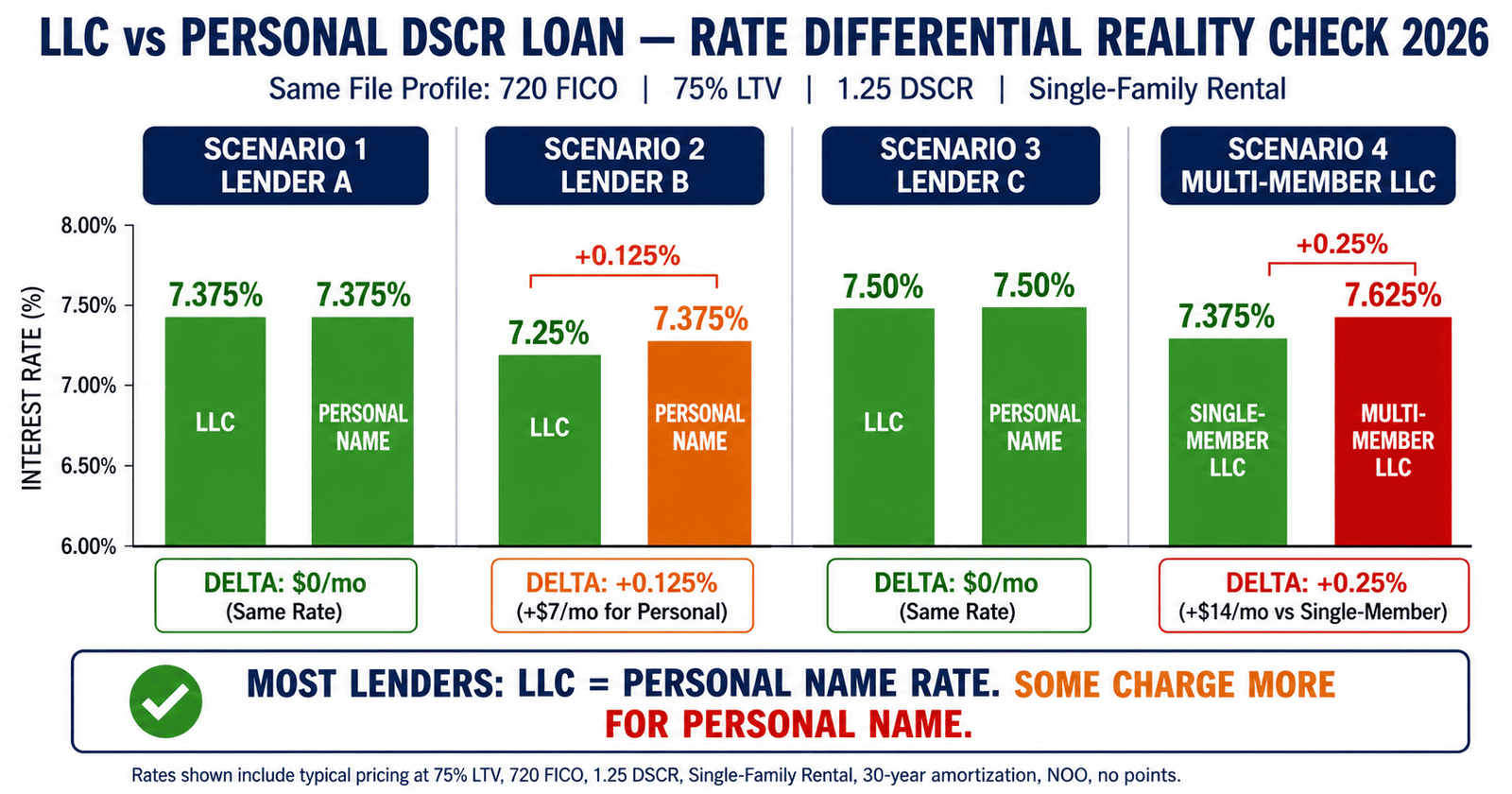
- Most DSCR lenders price LLC and personal-name loans identically at the same file profile
- Some lenders charge +0.125% for personal-name borrowers because LLC is their standard book
- Multi-member LLCs carry a +0.125% to +0.25% premium at many lenders — single-member does not
- New LLCs under 6 months old are the actual rate risk — not the LLC vs. personal distinction
- LLC DSCR loans do not report to personal credit; personal-name loans do — this is the real differential
- DSCR ratio below 1.25, sub-720 credit, and cash-out purpose move rates far more than entity structure
Table of Contents
- LLC vs Personal DSCR Loan: What the Rate Grid Actually Shows
- The Real LLC vs Personal DSCR Loan Rate Drivers in 2026
- DSCR Ratio: The Single Largest Rate Variable
- Credit Score Tier: 720 Is the Threshold, Not 700
- Loan Purpose: Cash-Out Costs More Than Purchase
- New LLC Seasoning: The Actual Entity Structure Risk
- LLC vs Personal DSCR Loan: The Non-Rate Differentials That Actually Matter
- How NYC Investors Should Think About Entity Structure on a DSCR Loan
- NYC-Specific Considerations: NY LLC vs Delaware LLC on a DSCR Loan
- Frequently Asked Questions
- LLC vs Personal DSCR Loan: Is the Rate Always the Same?
- Can I transfer a personal-name DSCR loan to my LLC after closing?
- Does the LLC need its own bank account and operating history for DSCR?
- Does an LLC DSCR loan require a personal guarantee?
- The Rate Differential Is Not the Story
LLC vs personal DSCR loan is one of the most searched questions in the NYC outer-borough investor market — and the answer most investors expect is wrong. The assumption is that closing a DSCR loan in an LLC costs you more in rate. At most lenders in 2026, that is not true. The rate on a clean file is identical whether you close in a single-member LLC or in your personal name.
At some lenders, closing in personal name actually costs you more, because LLC is their standard book and personal-name closings require additional complexity. See also: LLC vs personal DSCR basics.
This post covers the actual rate pricing on LLC vs. personal DSCR loans in 2026, where the real premiums sit, and the non-rate implications — credit reporting, DTI, and portfolio scaling — that make entity structure a meaningful strategic decision even when rates are equal.
| MARKET SNAPSHOT — DSCR Loan Rates, May/June 2026 | |
|---|---|
| Sources: Griffin Funding (May 2026) | HonestCasa (Apr 2026) | Ridge Street Capital (Jun 2026) | |
| RATE TIERS & LLC DIFFERENTIALS | |
| 30-yr fixed DSCR rates (Jun 2026) | 6.125% to 7.5% |
| Best-execution tier (720+ FICO, 75% LTV, 1.25+ DSCR) | 7.125%–7.50% |
| LLC vs personal name rate difference | $0 at most lenders; +0.125% for personal at some |
| Multi-member LLC premium | +0.125% to +0.25% vs single-member (varies by lender) |
| New LLC < 6 months | +0.25% or declined — largest LLC-related rate risk |
| DSCR OVERLAYS | |
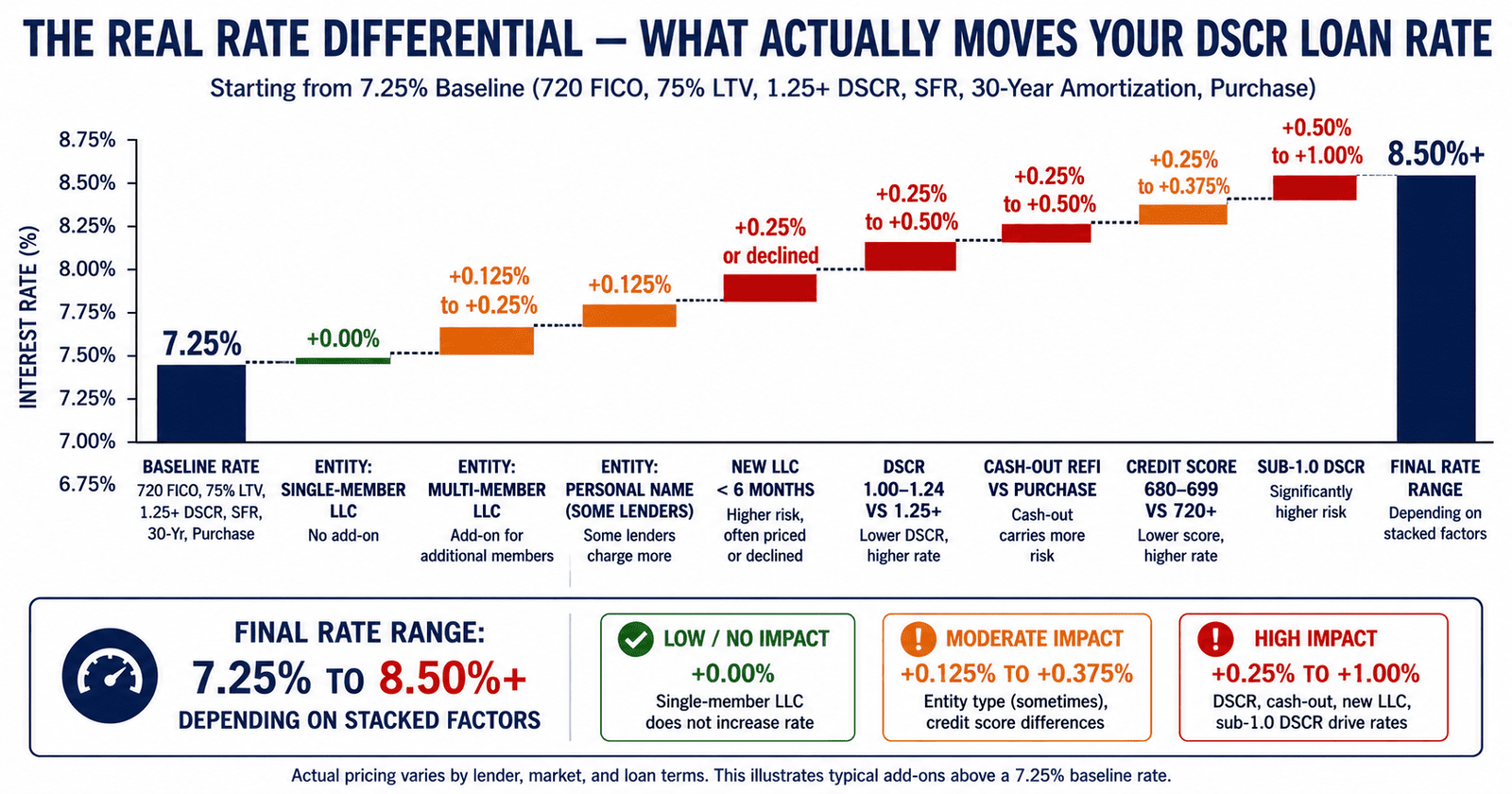
| DSCR < 1.25 (1.00–1.24) | +0.25% to +0.50% over best-execution tier |
| Cash-out refi vs purchase | +0.25% to +0.50% add-on |
| Personal credit reporting | LLC DSCR loans do NOT report to personal bureaus |
Before structuring any DSCR loan, run your specific deal inputs through the DSCR calculator — rate, LTV, PITIA, and ratio in one pass.
LLC vs Personal DSCR Loan: What the Rate Grid Actually Shows
The LLC vs personal DSCR loan question starts with how DSCR lenders set rates. Unlike conventional financing, DSCR pricing does not run through the Fannie/Freddie loan-level price adjustment grid. It runs through the lender’s own non-QM rate sheet, which prices each file based on a combination of FICO tier, LTV, DSCR ratio, property type, loan purpose, and entity structure. Entity structure is the last variable on that list — and for most lenders, it produces no adjustment at all on a standard single-member LLC file.
According to Ledger TC, DSCR loans are the standard structure for LLC-vested investment property ownership in New York. Because most DSCR lenders have built their programs around LLC borrowers, the single-member LLC has become the baseline — not a premium tier. What costs money is anything that deviates from that baseline.
| Rate Factor | LLC Borrower | Personal Name | BKDSCR Notes |
|---|---|---|---|
| Base rate (720 FICO, 75% LTV, 1.25+ DSCR) | 7.25%–7.50% | 7.25%–7.50% | Identical at most lenders |
| Entity: single-member LLC | +0% | N/A | Standard; no rate add-on |
| Entity: multi-member LLC | +0.125% to +0.25% | N/A | Varies by lender; not universal |
| Closing in personal name (some lenders) | N/A | +0.125% | LLC is their standard; personal adds complexity |
| New LLC < 6 months old | +0.25% or declined | N/A | Seasoning required; use personal name or existing LLC |
| NY LLC vs Delaware LLC | No rate diff; more docs | N/A | NY LLCs require more filing docs at closing |
The inversion at some lenders — personal-name borrowers paying more — is real and documented. One current DSCR rate guide notes that some lenders charge +0.125% for individual-name borrowers because most of their book is LLC-vested. For NYC outer-borough investors who have been avoiding LLC structure to save on rate, this data should prompt a reassessment.
The Real LLC vs Personal DSCR Loan Rate Drivers in 2026
If entity structure rarely moves the rate, what does? The actual rate differential on a DSCR loan is driven by four variables, each of which produces a larger impact than LLC vs. personal name at the same lender. Understanding the grid is what separates investors who get best-execution pricing from investors who overpay. See also: prepay penalty comparison.
DSCR Ratio: The Single Largest Rate Variable
A DSCR ratio of 1.25 or above unlocks the best rate tier at most lenders. A ratio between 1.00 and 1.24 typically adds 0.25% to 0.50% to the rate on the same loan. Sub-1.0 DSCR adds 0.50% to 1.00% and requires additional down payment. On a $400,000 loan, a 0.50% rate increase costs approximately $132 per month in additional debt service. Check your ratio with the lender criteria page before assuming any rate quote represents your best available number.
Credit Score Tier: 720 Is the Threshold, Not 700
DSCR lenders price at 740+ FICO, 720–739, 700–719, 680–699, and 660–679 tiers. The difference between 720+ and 700–719 is typically 0.25% to 0.375% on the rate. An investor with a 710 FICO who assumes the LLC structure is costing them 0.125% is missing the 0.375% they could recover by moving their credit score above 720 before application. Entity structure choice will not fix a credit score problem.
Loan Purpose: Cash-Out Costs More Than Purchase
Purchase loans and rate-and-term refinances price similarly on most DSCR programs. Cash-out refinances add 0.25% to 0.50% on top. Most lenders cap cash-out refinance LTV at 70–75%, further reducing the available equity. The LLC structure on a cash-out refi produces no additional rate premium at most lenders.
New LLC Seasoning: The Actual Entity Structure Risk
The one scenario where entity structure does produce a meaningful rate problem is a new LLC — one formed less than 6 months before closing. Many DSCR lenders require the LLC to have a minimum operating history. A new LLC created specifically for the acquisition may trigger a +0.25% add-on or an outright decline. Investors who intend to hold in an LLC should form the entity at least 6 months before they plan to close.
If the deal cannot wait, close in personal name first and transfer to the LLC after seasoning — but verify with the lender that this will not trigger the due-on-sale clause.
LLC vs Personal DSCR Loan: The Non-Rate Differentials That Actually Matter
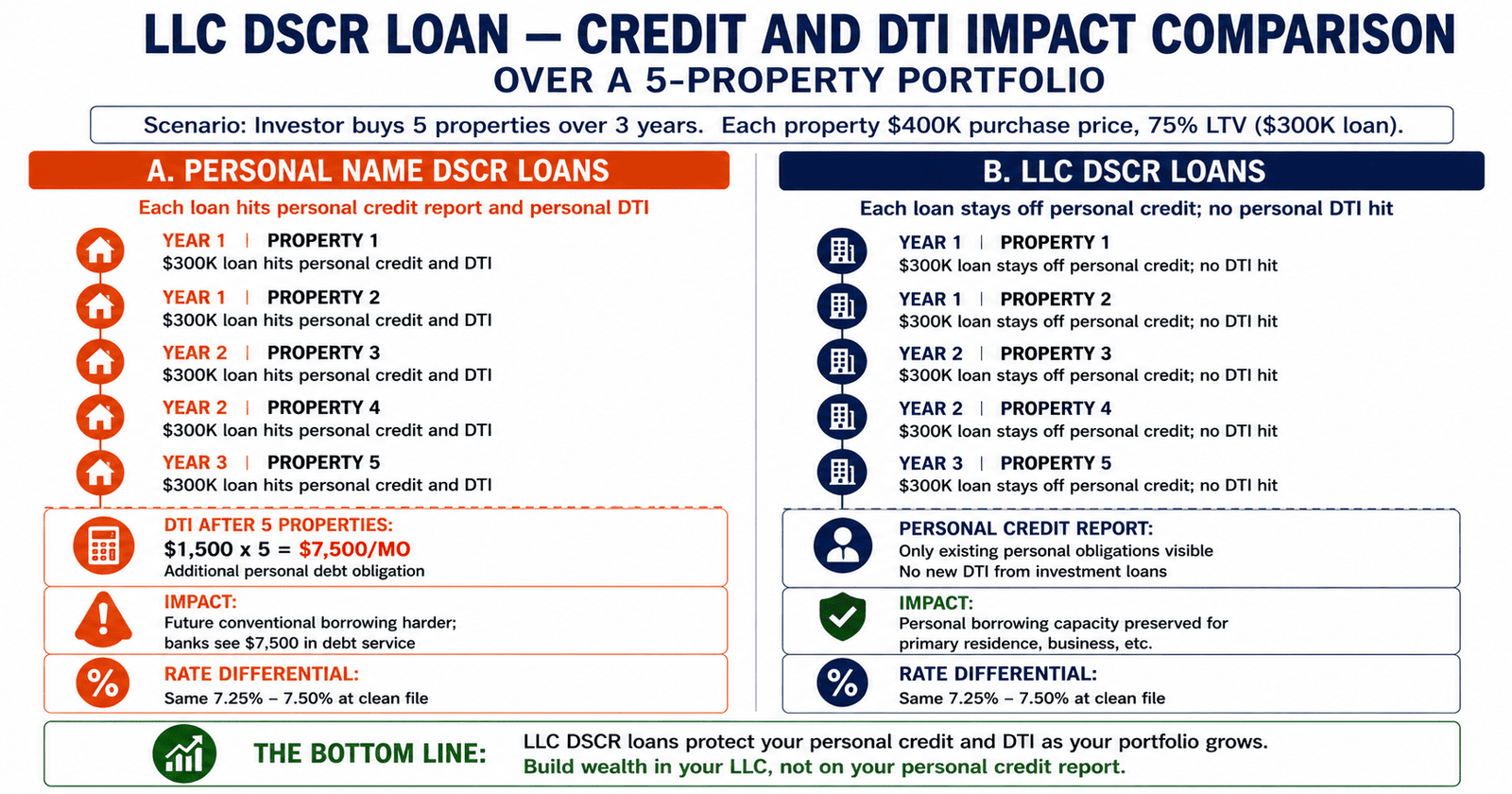
For investors choosing between LLC and personal-name DSCR loans in 2026, the rate is often not the deciding factor. Two non-rate consequences of the entity choice have larger long-term implications than a 0.125% spread: credit reporting and DTI accumulation.
| Factor | LLC Borrower | Personal Name |
|---|---|---|
| Rate (typical, same file) | 7.25%–7.50% | 7.25%–7.50% |
| Reports to personal credit | No | Yes |
| Affects personal DTI | No | Yes |
| Fannie 10-property cap applies | No | Yes (conventional only) |
| Asset protection | Yes — liability stays in entity | No |
| Due-on-sale clause risk | Lender is aware at origination | N/A — titled in personal name |
| Docs required at closing | Articles, Op Agreement, EIN, Good Standing | Standard personal docs only |
The credit reporting difference is permanent and cumulative. Every DSCR loan closed in personal name appears on the investor’s personal credit report as a debt obligation. Five $300,000 DSCR loans in personal name generate $7,500 per month in reported monthly debt obligations — even if the rental income fully covers the payments. An investor scaling to five properties in personal name may find their personal borrowing capacity materially constrained by the accumulated DSCR debt on their report.
Five identical properties financed in single-member LLCs via DSCR produce zero personal credit impact. The same $1.5 million in loan balances exists, but at the entity level. The investor’s personal credit file remains clean for future personal borrowing. For NYC outer-borough investors who own properties both personally and in entities, understanding this separation is one of the most important structural decisions they make early in a portfolio build.
The DTI implication flows from the same logic. Personal-name DSCR loans show up in conventional lender DTI calculations. An investor with multiple personal-name DSCR loans who later wants a conventional loan will find those obligations factored into their qualifying DTI. LLC DSCR loans are invisible to conventional DTI underwriting in most cases. This changes the investor’s capacity to execute future deals outside the DSCR product.
How NYC Investors Should Think About Entity Structure on a DSCR Loan
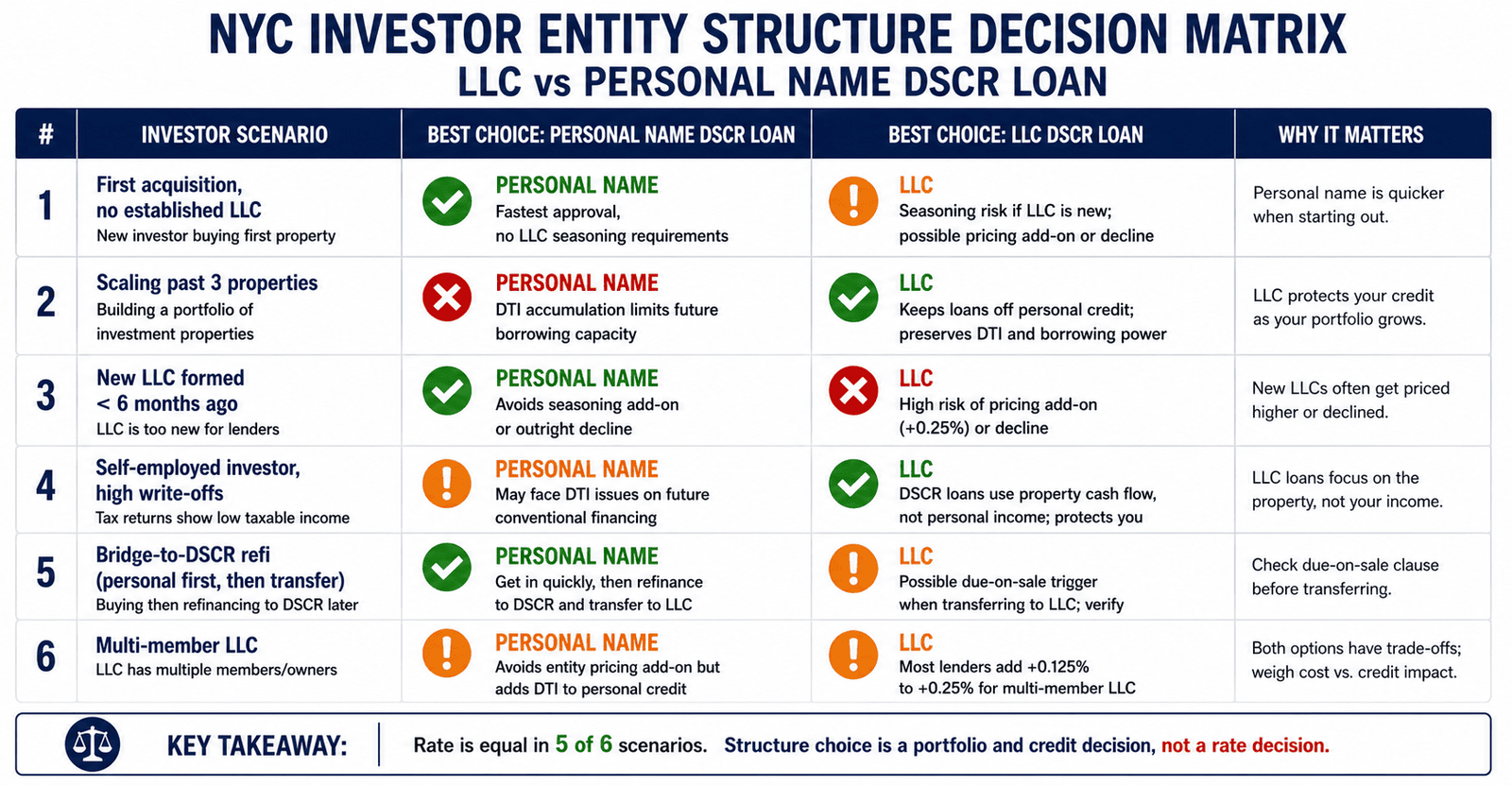
The LLC vs personal decision on a DSCR loan is not primarily a rate question. It is a portfolio architecture question. The right structure depends on where the investor is in their portfolio build, what their personal credit situation looks like, and how many more acquisitions they expect to make in the next three to five years.
LLC DSCR Loan: When It Makes Sense
Single-member LLC structure makes the most sense for investors who are past their first acquisition and actively scaling. Once an investor has more than two or three rental properties, the DTI accumulation and credit reporting consequences of personal-name DSCR loans begin to constrain future capacity. The LLC structure preserves optionality and provides liability separation. For self-employed investors whose tax returns show minimal W-2 income due to legitimate business write-offs, the LLC structure also maintains consistency: the property is owned by the entity, financed by the entity, and the entity’s obligations are ring-fenced from the personal picture banks scrutinize.
Personal Name DSCR Loan: When It Makes Sense
Personal-name DSCR loans make the most sense for first-time rental property investors who do not yet have an established LLC. Forming an LLC less than 6 months before closing can trigger seasoning issues at some lenders. According to Hard Money Man, NYC investors using bridge-to-DSCR structures frequently close initial acquisitions in personal name before stabilizing and refinancing into LLC-vested DSCR.
Get the complete NYC outer-borough DSCR underwriting framework. DSCR Playbook covers every input, threshold, and deal structure for outer-borough investors.
NYC-Specific Considerations: NY LLC vs Delaware LLC on a DSCR Loan
New York investors frequently ask whether forming a Delaware LLC instead of a New York LLC produces a better rate outcome on a DSCR loan. The short answer: no. The rate does not change based on state of LLC formation. A New York LLC closing on a NYC property requires Articles of Organization, Operating Agreement, EIN, Certificate of Good Standing, and compliance with New York’s publication requirement (newly formed LLCs must publish in two local newspapers for 6 consecutive weeks, at a cost of $1,200–$1,500 in most NY counties). Neither structure produces a rate advantage.
See the DSCR loans page for a full overview of how DSCR programs structure LLC and personal-name closings.
Frequently Asked Questions
LLC vs Personal DSCR Loan: Is the Rate Always the Same?
At most lenders in 2026, yes — single-member LLC and personal-name DSCR loans price identically at the same file profile. The variables that move rates are DSCR ratio, credit score tier, loan purpose, LTV, and property type. Multi-member LLCs carry a +0.125% to +0.25% add-on at many — but not all — lenders. Rate-shop at least three lenders and ask each one specifically for their LLC vs. personal pricing sheet before assuming any differential exists.
Can I transfer a personal-name DSCR loan to my LLC after closing?
Potentially, but it requires explicit lender approval. DSCR loans contain a due-on-sale clause that technically allows the lender to call the loan if the title transfers to an entity. Some lenders routinely approve quit-claim deed transfers to single-member LLCs without triggering the clause; others do not. The time to ask about post-closing transfer is before origination, not after. A surprise due-on-sale call is among the most serious deal killers on a leveraged rental.
Does the LLC need its own bank account and operating history for DSCR?
Most DSCR lenders require a business bank statement for the LLC, and some require the LLC to show at least minimal operating history. The practical standard is: form the LLC at least 90 to 180 days before the expected closing date, open a business checking account, and have at least one or two months of bank statements available. The LLC does not need rental income history — DSCR underwriting qualifies on the subject property’s cash flow, not the entity’s prior operating results.
Does an LLC DSCR loan require a personal guarantee?
Yes, in almost all cases. DSCR loans closed in LLC name require a personal guarantee from the principal members of the LLC. This is standard practice — the LLC structure provides liability protection at the property ownership level, not loan recourse protection. Non-recourse DSCR programs exist but carry significant rate premiums (typically 0.50%–1.00% above standard) and are not widely available for 1–4 unit properties.
The Rate Differential Is Not the Story
LLC vs personal DSCR loan comes down to this: the rate differential is smaller than most investors assume, and for single-member LLCs it is often zero. The real decision criteria are credit reporting, DTI accumulation, LLC seasoning, and portfolio architecture.
The practical approach for NYC outer-borough investors scaling past one or two properties: form the LLC at least six months before the expected close, open a business bank account, confirm the lender’s LLC documentation requirements and seasoning policy before going under contract, and run the stress test on the actual DSCR ratio that will determine your rate tier — not your entity structure.
The variables that actually move your DSCR loan rate in 2026 are the DSCR ratio (1.25+ for best tier), credit score (720+ threshold), loan purpose (purchase pricing below cash-out), and LTV (75% standard). Entity structure is last. For most single-member LLC files, it costs exactly zero.
If you have a deal and want to know the full picture — rate tier, DSCR verdict, entity structure, and lender match position — Deal Review delivers the written analysis within 48–72 hours.