
BRRRR DSCR Refi Timing: The Critical 6-Month Decision
- BRRRR DSCR refi timing determines whether the lender values the property at cost basis or after-rehab value — and the difference on a NYC deal can exceed $200,000 in available equity
- Most DSCR lenders require 6 months of seasoning from the purchase date before using the appraised ARV for a cash-out refi. Before 6 months, the loan is capped at cost basis
- A rate-and-term refi from hard money to DSCR requires 0–3 months seasoning at most lenders — no cash-out, just a rate and term improvement
- Every month of delay on an 11% hard money loan costs $6,417 in interest on a $700,000 balance — the carrying cost is the invisible penalty of bad BRRRR DSCR refi timing
- The optimal path for NYC outer-borough BRRRR deals: complete rehab by month 3, stabilize by month 4, apply for DSCR refi at month 4, close at month 6
Table of Contents
- The 6-Month Seasoning Rule: Why BRRRR DSCR Refi Timing Starts at Purchase
- Rate-and-Term vs Cash-Out: Two Different BRRRR DSCR Refi Timing Windows
- The Hard Money Carrying Cost: What Every Month of Delay Costs
- What Has to Be True Before the BRRRR DSCR Refi Application
- The DSCR Math at Refi: Why the Numbers Change
- The Optimal BRRRR DSCR Refi Timing Sequence for NYC Deals
- The NYC Mortgage Recording Tax: How It Affects BRRRR DSCR Refi Timing
- The BRRRR DSCR Refi Decision: When to Use ARV vs Cost Basis
- What NYC Investors Get Wrong About BRRRR DSCR Refi Timing
- FAQ: BRRRR DSCR Refi Timing
- How Does BRRRR DSCR Refi Timing Work for an Immediate Refi?
- What DSCR do I need for the BRRRR refi?
- Does the BRRRR stress test differ from a purchase stress test?
- Bottom Line — BRRRR DSCR Refi Timing
BRRRR DSCR refi timing determines whether the investor recaptures the rehab capital or leaves it trapped in the deal. On a Brooklyn 3-family purchased for $700,000 with $120,000 in rehab, the cost basis is $820,000. The after-rehab value (ARV) is $1,050,000. A DSCR cash-out refi at 75% of ARV produces a $787,500 loan — enough to pay off the hard money, recover the rehab capital, and exit with a stabilized rental at a 30-year fixed rate.
But if the investor applies before the 6-month seasoning window, most lenders cap the valuation at cost basis: 75% of $820,000 = $615,000. See also: DSCR seasoning requirements.
The investor loses access to $172,500 in equity. That is the cost of getting the BRRRR DSCR refi timing wrong — not a rate difference, not a fee, but $172,500 in capital that stays locked in the deal instead of funding the next acquisition. Running the stabilized deal through the stress test before timing the refi confirms whether the post-refi DSCR holds at the BKDSCR 1.25 standard.
| MARKET SNAPSHOT — BRRRR DSCR Refi Timing, June 2026 | |
|---|---|
| Sources: Griffin Funding | HomeAbroad | Ridge Street Capital | BKDSCR Research | |
| DSCR REFI SEASONING (June 2026) | |
| Rate-and-term refi (hard money → DSCR) | 0–3 months seasoning |
| Cash-out refi (cost basis cap) | 0–6 months seasoning |
| Cash-out refi (ARV-based) | 6+ months seasoning |
| Most lenders for ARV cash-out | 12 months preferred |
| DSCR BRRRR BENCHMARKS | |
| DSCR 30-yr fixed rates (Jun 2026) | 6.125%–7.5% |
| BRRRR refi DSCR minimum (most lenders) | 1.20 | BKDSCR standard: 1.25+ |
| NYC mortgage recording tax (loans >$500K) | 1.925% — applies to each DSCR refi |
| Typical BRRRR DSCR closing costs | $22,000–$35,000 (incl. recording tax on $750K+ loan) |
| BKDSCR standard | 1.25+ unstressed | 1.00+ combined stress |
Before timing your BRRRR refi, Deal Filter — property type, rent roll, unit count, and PITIA in one pass to see whether the deal qualifies for DSCR financing at stabilization.
The 6-Month Seasoning Rule: Why BRRRR DSCR Refi Timing Starts at Purchase
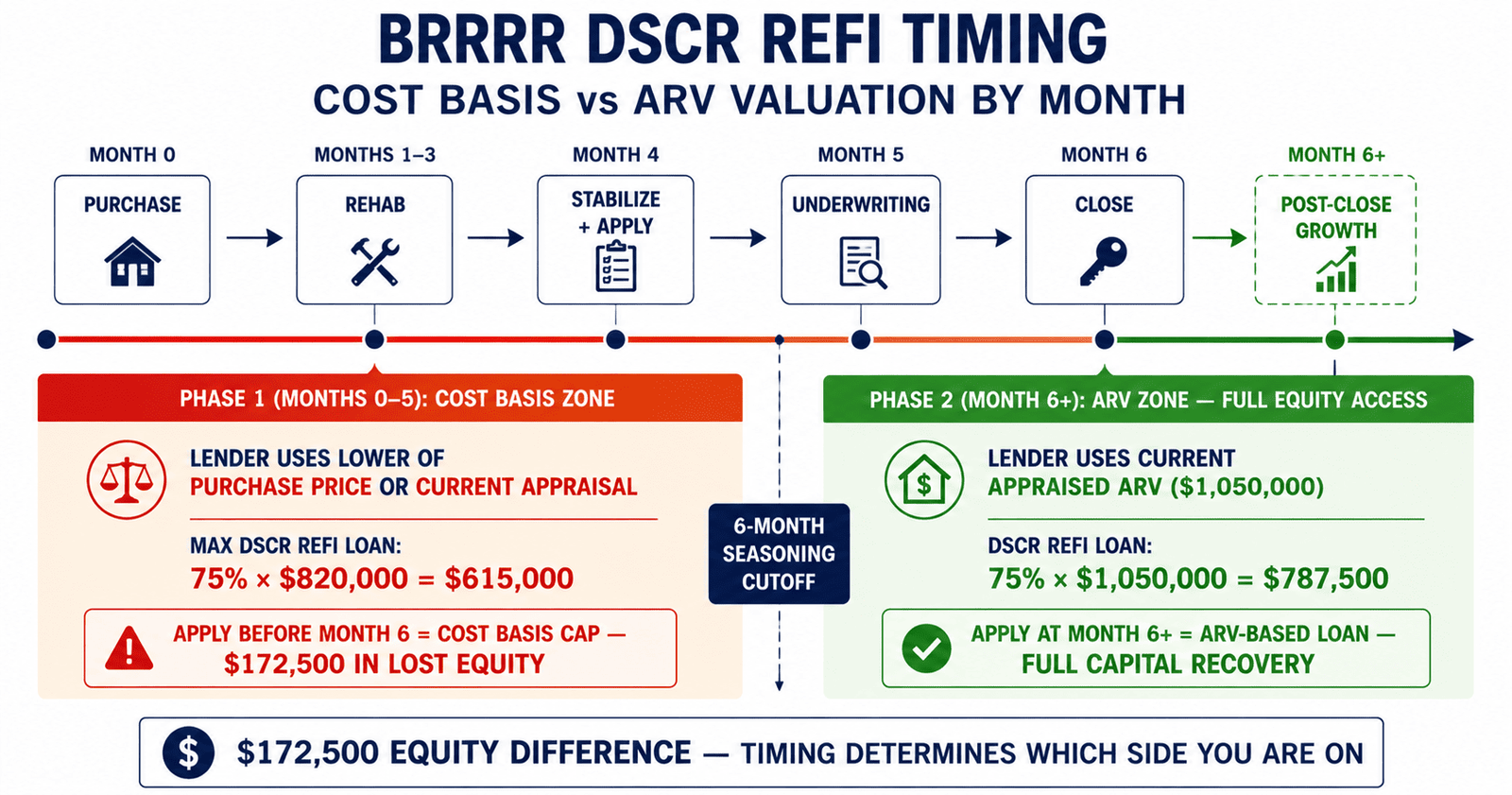
The 6-month seasoning rule is the single most important variable in BRRRR DSCR refi timing. Before 6 months from the purchase recording date, most DSCR lenders value the property at the lower of purchase price or current appraisal — effectively capping the loan at cost basis. After 6 months, lenders use the current appraised value, which reflects the completed rehab and market conditions. The difference is the entire value-add equity the investor created through the rehab.
On the sample deal, the investor purchased a Brooklyn 3-family for $700,000, spent $120,000 on a gut renovation of all three units, and stabilized the building with three tenants at $2,500 each. The ARV appraisal comes in at $1,050,000. At 75% LTV on the ARV, the DSCR refi loan is $787,500 — enough to pay off the $700,000 hard money loan, reimburse $87,500 of the $120,000 rehab cost, and leave $32,500 of investor capital in the deal. That is a successful BRRRR exit.
Run the numbers through the BRRRR analyzer to see your capital recovery at different LTV and ARV scenarios.
If the same investor applies at month 4, the lender caps the valuation at cost basis: $820,000. At 75% LTV, the loan is $615,000. The hard money balance is $700,000 plus 4 months of interest ($25,668). The investor cannot pay off the hard money with the DSCR refi proceeds — the deal requires an additional $110,668 in cash to close the gap. The BRRRR fails. Not because the deal is bad, but because the BRRRR DSCR refi timing was wrong.
Rate-and-Term vs Cash-Out: Two Different BRRRR DSCR Refi Timing Windows
DSCR lenders distinguish between rate-and-term refinances and cash-out refinances — and the seasoning requirements are different for each. A rate-and-term refi replaces the existing hard money loan with a DSCR loan at the same or lower balance. No cash comes out. The investor is simply swapping the 11% hard money rate for a 7.375% DSCR rate and extending the term from 12 months to 30 years. Most DSCR lenders allow rate-and-term refis with 0–3 months seasoning.
A cash-out refi produces a new loan balance that exceeds the existing payoff. The excess cash goes to the investor — recovering rehab capital and funding the next acquisition. This is the BRRRR exit. Cash-out refis require 6 months seasoning at most lenders to access ARV-based valuation. Some lenders allow cash-out before 6 months but cap the loan at cost basis — which defeats the purpose of the BRRRR because the investor cannot recover rehab capital.
The strategic BRRRR DSCR refi timing decision: if the hard money rate is destroying cash flow, a rate-and-term refi at month 2–3 stops the bleeding by swapping to a DSCR rate. The investor then does a cash-out refi at month 6+ to recover capital. Two refis, two sets of closing costs — but the math works when the hard money carrying cost exceeds the additional closing friction.
The Hard Money Carrying Cost: What Every Month of Delay Costs
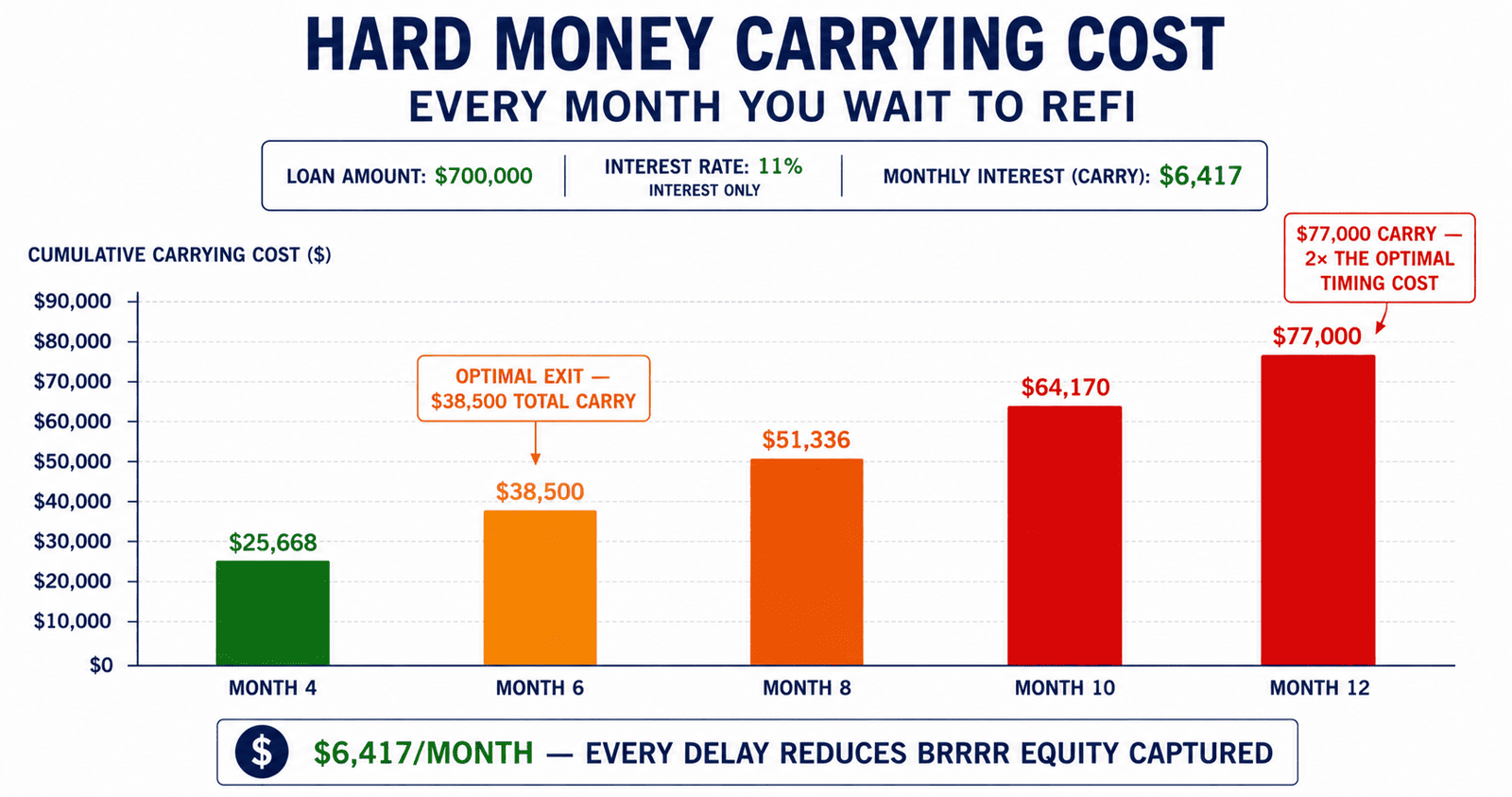
The other side of BRRRR DSCR refi timing is the carrying cost of the bridge or hard money loan. On a $700,000 hard money loan at 11% interest-only, the monthly carry is $6,417. Every month the investor delays the DSCR refi adds $6,417 to the total deal cost. Over a 6-month rehab and seasoning period, the carrying cost is $38,500. Over 9 months, it is $57,750. Over 12 months, it is $77,000.
The carrying cost is the invisible expense that kills BRRRR returns. An investor who budgeted $120,000 for rehab and assumed a 6-month timeline actually spent $158,500 ($120,000 rehab + $38,500 carrying). If the rehab takes 8 months instead of 4, the carrying cost grows to $51,336 and the total project cost hits $171,336. The investor who gets the BRRRR DSCR refi timing wrong by 2 months loses $12,834 in additional carrying — money that comes directly out of the equity captured by the BRRRR. See also: DSCR refi break-even math.
What Has to Be True Before the BRRRR DSCR Refi Application
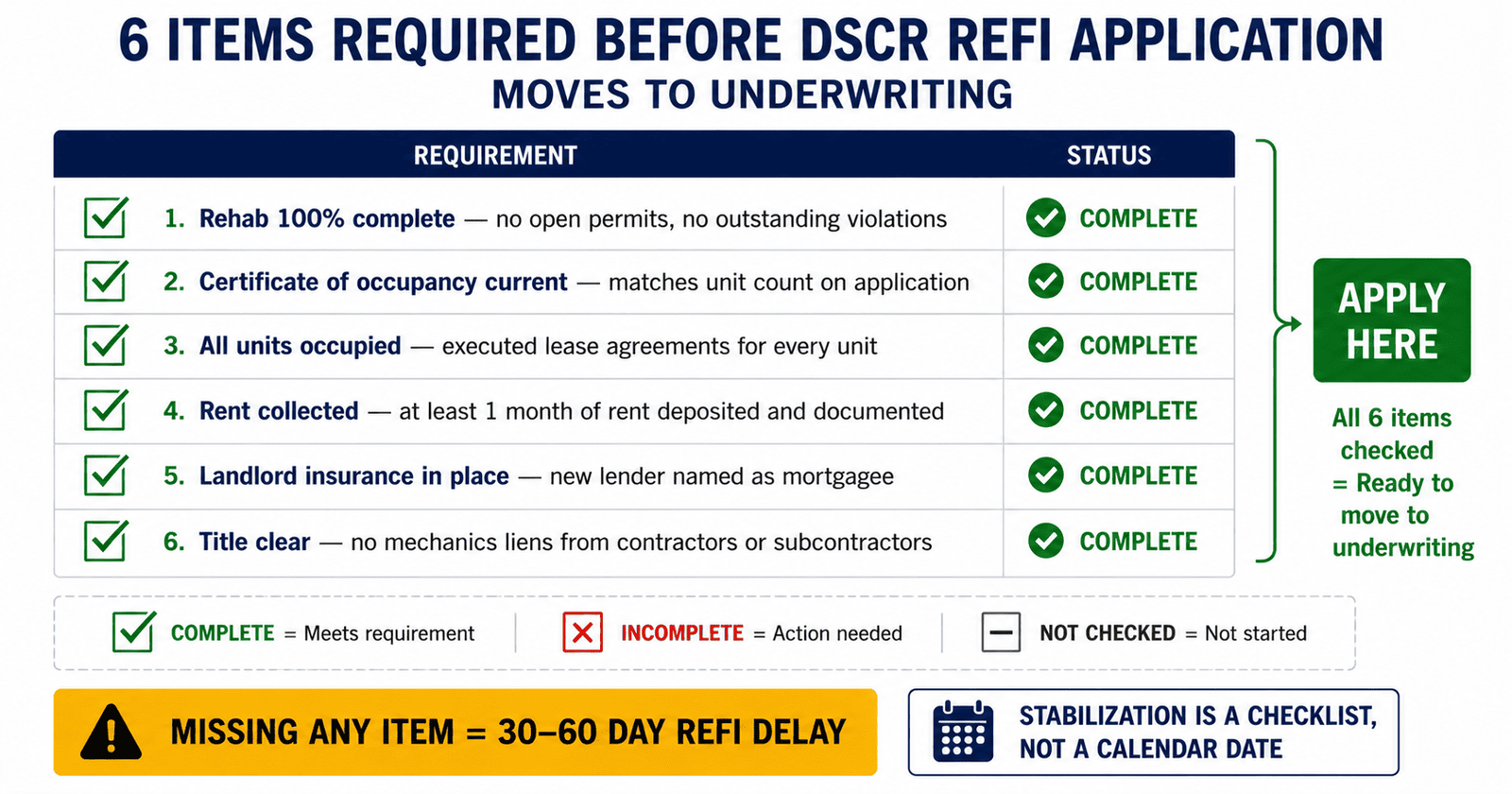
Stabilization is not a date on the calendar. It is a checklist. The DSCR lender requires all of the following before the refi application moves to underwriting: rehab is 100% complete with no outstanding permits or violations. The certificate of occupancy is current and matches the unit count. All units are occupied with executed lease agreements. At least one month of rent has been collected and deposited. The property is insured with a landlord policy naming the new lender as mortgagee. The title is clear with no mechanics liens from contractors.
Missing any one of these items delays the refi. A contractor lien from an unpaid subcontractor can hold up the title search for 30–60 days. An open building permit can prevent the appraiser from completing the inspection. A vacant unit means the lender uses zero income for that unit — dropping the DSCR below the qualifying threshold. The BRRRR DSCR refi timing plan should work backward from the target closing date to ensure every stabilization item is complete before the appraisal order. The deal killers checklist identifies the most common items that delay or kill BRRRR refi closings.
The DSCR Math at Refi: Why the Numbers Change
The DSCR math at refi is different from the DSCR math at purchase — and the difference catches investors off guard. At purchase, the investor uses the purchase price to calculate LTV and the purchase rate to calculate PITIA. At refi, the investor uses the ARV to calculate LTV and the refi rate to calculate PITIA. The refi rate may be lower than the hard money rate but higher than expected if the investor’s FICO, LTV, or DSCR ratio triggers pricing adjustments.
On the sample deal, the DSCR refi loan is $787,500 at 7.375% on a 30-year fixed. Monthly P&I: $5,439. Property taxes (FY27): $700/month. Insurance: $480/month. Monthly PITIA: $6,619. Gross rent: 3 units at $2,500 = $7,500/month. Lender DSCR: $7,500 / $6,619 = 1.13. That is MARGINAL — below the BKDSCR 1.25 standard. The deal qualifies at most lenders’ 1.00 minimum, but the investor carries thin margins and fails the BKDSCR stress test.
The investor who assumed the BRRRR would produce a strong DSCR at refi needs to run the actual numbers before application — not the proforma from the acquisition worksheet.
Closing the DSCR gap at refi requires the same tools as any other deal: higher rents, more capital left in the deal to reduce LTV, or a rate buydown. If the investor leaves $100,000 in the deal instead of pulling maximum cash out, the refi loan drops to $687,500, PITIA drops to $6,078, and the DSCR rises to 1.23 — closer to the 1.25 standard but still MARGINAL. If rents are $2,700/unit instead of $2,500, gross income is $8,100 and the DSCR at the original $787,500 loan is $8,100 / $6,619 = 1.22.
The BRRRR DSCR refi timing decision is not just when to refi — it is how much capital to recover and at what rent level the refi DSCR clears the threshold.
If you want the complete framework for underwriting BRRRR exits and DSCR refi timing, DSCR Playbook covers every input, every threshold, and every stabilization requirement.
The Optimal BRRRR DSCR Refi Timing Sequence for NYC Deals
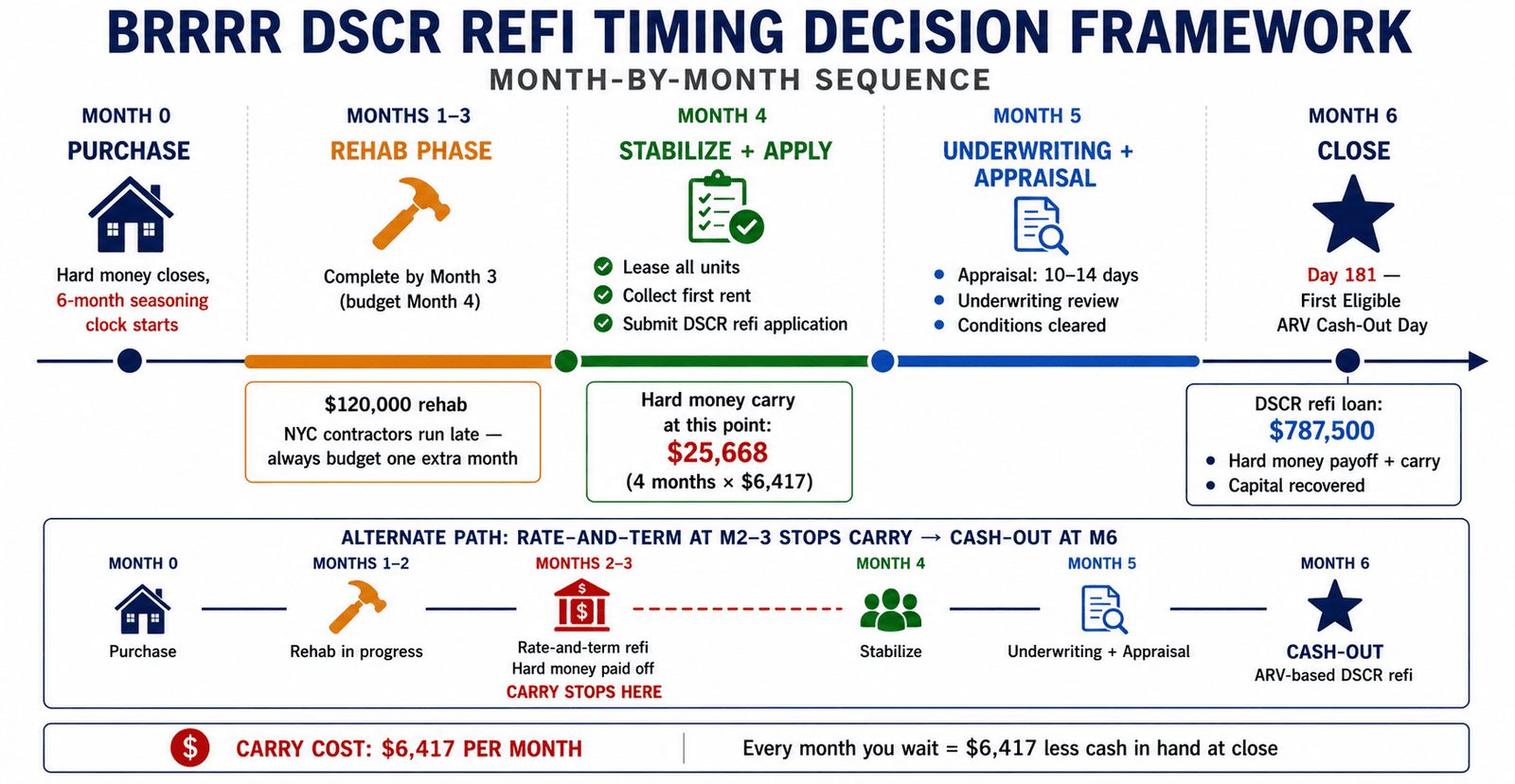
The target timeline for a NYC outer-borough BRRRR: purchase at month 0. Complete rehab by month 3. Lease all units and collect first rent by month 4. Submit the DSCR refi application at month 4. The lender orders the appraisal, runs underwriting, and processes the file during months 4–5. Close the DSCR refi at month 6 — the first day the 6-month seasoning window opens for ARV-based cash-out. This timeline requires the rehab to finish on schedule and the units to lease within 30 days of completion.
In Brooklyn, the leasing timeline is typically favorable. Vacancy rates in Bed-Stuy, Crown Heights, Flatbush, and East New York run below 3% for renovated units at market rent. A gut-renovated 2BR in Crown Heights at $2,400/month should lease within 2–4 weeks of listing. The constraint is not demand — it is the rehab timeline. NYC contractors run behind schedule consistently. The investor who budgets 3 months for rehab should plan for 4. Budget 4, plan for 5.
According to Ridge Street, DSCR cash-out seasoning requires 6 months when the loan amount exceeds original cost basis — and most BRRRR deals by definition exceed cost basis. The refi analyzer models the full refi scenario including seasoning, ARV, and DSCR at exit.
The NYC Mortgage Recording Tax: How It Affects BRRRR DSCR Refi Timing
On every NYC BRRRR DSCR refi, the mortgage recording tax applies: 1.925% on loans above $500,000, 1.8% on loans $500,000 and under, plus the MTA surcharge. On a $750,000 DSCR refi loan, the recording tax is $14,438. This cost is separate from lender fees and title costs. For a BRRRR investor who did a $600,000 hard money loan to acquire and renovate, then refinances into a $750,000 DSCR loan (75% of $1,000,000 ARV), the recording tax on the DSCR refi is unavoidable.
Timing the refi for maximum ARV — to pull the most capital out while staying at 75% LTV — is the only way to optimize this fixed cost.
The BRRRR DSCR Refi Decision: When to Use ARV vs Cost Basis
Under 6 months of ownership, most lenders cap the DSCR refi at the lower of cost basis or appraised value. Over 6 months, most lenders use appraised value. This seasoning threshold is the single most important timing variable for a BRRRR DSCR refi. An investor who refinances at month 4 with a $1,000,000 ARV but a $700,000 cost basis (acquisition + renovation) gets a loan based on $700,000 —
maximum $525,000 at 75% LTV. The same investor who waits until month 7 gets the loan based on the $1,000,000 appraisal — maximum $750,000 at 75% LTV. The additional capital available by waiting 3 months: $225,000. Run the Refi Analyzer at both timing scenarios before deciding when to submit the DSCR refi application.
What NYC Investors Get Wrong About BRRRR DSCR Refi Timing
- Starting rehab without confirming seasoning policy. Not all lenders use 6 months. Some use 3, some 12. Identify the refi lender before purchasing — not after rehab is complete.
- Using projected rents to calculate the refi DSCR. The lender uses actual lease amounts from executed agreements. Projected rents are not qualifying income. The DSCR at refi is based on rents the property is collecting, not rents it could collect.
- Ignoring the hard money extension fee. Most hard money loans have a 6–12 month term with an extension option. The extension typically costs 1–2 points ($7,000–$14,000 on a $700,000 loan). If the BRRRR DSCR refi timing slips past the initial hard money term, the extension fee adds to the project cost.
- Underestimating the time from application to closing. DSCR refis take 30–45 days from application to closing. The appraisal alone takes 10–14 days in NYC. The investor who applies at month 5 and expects to close at month 6 is cutting it tight. Apply at month 4 for a month 6 closing.
- Not budgeting for two closings. The hard money closing costs money. The DSCR refi closing costs money. Title insurance, attorney fees, recording fees, and lender origination fees apply to both transactions. Budget 3%–4% of the loan amount for each closing.
FAQ: BRRRR DSCR Refi Timing
How Does BRRRR DSCR Refi Timing Work for an Immediate Refi?
A rate-and-term refi — replacing hard money with a DSCR loan at the same balance, no cash out — requires 0–3 months seasoning at most lenders. A cash-out refi that exceeds cost basis requires 6 months. If the purchase was all-cash with no financing, delayed financing rules allow an immediate cash-out refi capped at the original purchase price plus closing costs.
What DSCR do I need for the BRRRR refi?
Most lenders require a minimum 1.00 DSCR for cash-out refis. The BKDSCR standard is 1.25+ unstressed and 1.00+ under combined stress. Deals between 1.00 and 1.24 may qualify at some lenders but carry pricing adjustments — higher rates, lower LTV caps, or additional reserve requirements. The higher the DSCR at refi, the better the rate and terms.
Does the BRRRR stress test differ from a purchase stress test?
Yes. The BKDSCR stress test uses +0.50% on a fixed-rate refi (compared to +1.00% on a purchase). This reflects the lower rate risk on a refi where the investor already owns the property and has demonstrated cash flow. The combined stress test (rate + 10% vacancy) still applies, with a 1.00+ floor.
Bottom Line — BRRRR DSCR Refi Timing
BRRRR DSCR refi timing is not about patience. It is about sequencing. The investor who purchases at month 0, completes rehab by month 3, stabilizes by month 4, applies for the DSCR refi at month 4, and closes at month 6 captures the maximum equity, minimizes the hard money carrying cost, and exits into a 30-year fixed rate at the earliest possible moment. Every deviation from this sequence costs money — either in carrying cost (waiting too long) or in lost equity (applying too early).
The 6-month seasoning rule is not flexible. It is not negotiable at most lenders. It is not waivable for strong borrowers or strong deals. It is a hard cutoff that determines whether the lender uses cost basis or ARV. The entire BRRRR capital recovery depends on which side of that line the closing falls on. Plan the rehab, plan the stabilization, plan the application — and close on day 181.
If you have a BRRRR deal in progress and want to know your exact refi DSCR, capital recovery, and optimal exit timing, Deal Review delivers the full analysis within 48–72 hours.