
DSCR Refi Break-Even: The Real Math on a 1% Rate Drop
Key Takeaways
- The DSCR refi break-even formula is: Total refi cost ÷ Monthly payment savings = Break-even months
- A 1.0% rate drop on a $750K DSCR loan saves ~$519/month; break-even is 27 months with no PPP
- A 5-4-3-2-1 prepayment penalty in Year 3 adds $22,500 to total refi cost — stretching break-even to 70 months
- NYC mortgage recording tax (1.925%) adds ~$14,438 to total refi cost — most investors miss this
- A rate drop under 0.50% almost never pencils when closing costs and PPP are included
- The refi only makes sense if remaining hold period exceeds the break-even month count
Table of Contents
- DSCR Refi Break-Even Math: The Formula
- DSCR Refi Break-Even Math: The Full Matrix
- The DSCR Refi Break-Even and Prepayment Penalty Timing
- How a Rate Drop Moves the DSCR Ratio
- The NYC Mortgage Recording Tax: The Biggest Variable Investors Miss
- FAQ: DSCR Refi Break-Even Math
- DSCR Refi Break-Even: What Rate Drop Is the Minimum to Justify a Refi in NYC?
- Does a DSCR refi require a new DSCR underwrite?
- Can I do a cash-out refi instead of a rate-and-term refi to improve the economics?
- What happens to my DSCR stress test after the refi?
- All-In Closing Costs on a NYC DSCR Refinance
- When a NYC DSCR Refi Actually Pencils in 2026
DSCR refi break-even is the calculation most investors skip before deciding to refinance. They see that rates have dropped, assume lower monthly payments mean a good outcome, and start the process without running the number that matters: how many months of savings it takes to recover the total cost of the transaction. On a DSCR loan with a prepayment penalty, that cost is often $30,000–$50,000 in the NYC market — and a 0.50% rate drop at $260/month in savings takes years to recover.
The break-even math determines whether a rate drop is an opportunity or a distraction. See also: Ridge Street.
| MARKET SNAPSHOT — DSCR Refi Rates & Conditions, June 2026 | |
|---|---|
| Sources: Ridge Street Capital (Jun 2026) | COR Advisors (Apr 2026) | Griffin Funding (Jun 2026) | |
| CURRENT RATES & REFI TERMS | |
| 30-yr fixed DSCR rates (Jun 2026) | 6.125%–7.5% |
| Best-execution refi tier (720+ FICO, 1.25+ DSCR) | 7.125%–7.375% |
| Rate-and-term refi max LTV | 75% |
| Cash-out refi max LTV | 70%–75% |
| Most common PPP structure | 5-4-3-2-1 step-down |
| Typical closing costs | 1.5%–2.5% of loan |
| NYC mortgage recording tax | 1.925% on loans over $500K (~$14,438 on $750K loan) |
| REFI ENVIRONMENT (NYC Outer-Borough) | |
| 2023 DSCR purchase rates (peak vintage) | 8.0%–9.5% |
| Current rate vs 2023 peak | Approx 1.0%–1.5% lower for clean files |
| DSCR minimum for rate-and-term refi | 1.20 (most lenders) | 1.25 (BKDSCR standard) |
Before committing to a DSCR refi, run your current loan through the Refi Analyzer — rate drop, PPP cost, closing costs, and break-even months in one pass.
DSCR Refi Break-Even Math: The Formula
The DSCR refi break-even calculation has three inputs: monthly payment savings, total refi cost, and remaining hold period.
- Monthly payment savings = Old P&I − New P&I (taxes and insurance do not change in a rate-and-term refi)
- Total refi cost = Closing costs + Prepayment penalty (if applicable) + NYC mortgage recording tax
- Break-even months = Total refi cost ÷ Monthly payment savings
- Decision rule: If break-even months < remaining hold period, the refi is economically justified
The decision rule is mechanical. An investor planning a 10-year hold who reaches break-even at month 27 has 117 months of net savings after that point. An investor planning to sell in 3 years who reaches break-even at month 27 saves $5,577 over the hold period — barely positive and not worth the risk of a full refi transaction.
| Deal Parameter | Figure |
|---|---|
| Original loan amount | $750,000 |
| Original rate | 8.50% / 30-year fixed |
| Original P&I | $5,764/month |
| Taxes + Insurance | $2,150/month (Brooklyn 4-unit) |
| Original PITIA | $7,914/month |
| Gross rent (4 units @ $2,475/unit) | $9,900/month |
| Original DSCR | 1.25 (pass at BKDSCR standard) |
| Closing costs (rate-and-term refi) | ~$14,000 (excl. NYC mortgage recording tax) |
| NYC mortgage recording tax (1.925%) | $14,438 |
| Total closing costs (NYC) | ~$28,438 |
| PPP in Year 3 (3% step-down) | $22,500 |
| Total refi cost WITH PPP in Year 3 | ~$50,938 |
The composite deal is a Brooklyn 4-unit purchased in 2023 at the rate peak. The original loan of $750,000 at 8.50% produces P&I of $5,764/month and PITIA of $7,914/month. With gross rent of $9,900/month, the original DSCR is exactly 1.25. According to COR Advisors, most DSCR lenders in 2026 require a minimum DSCR of 1.20–1.25 to qualify for a rate-and-term refinance. The Refi Analyzer runs the break-even calculation on any NYC outer-borough deal — month-by-month payment savings versus closing cost payback.
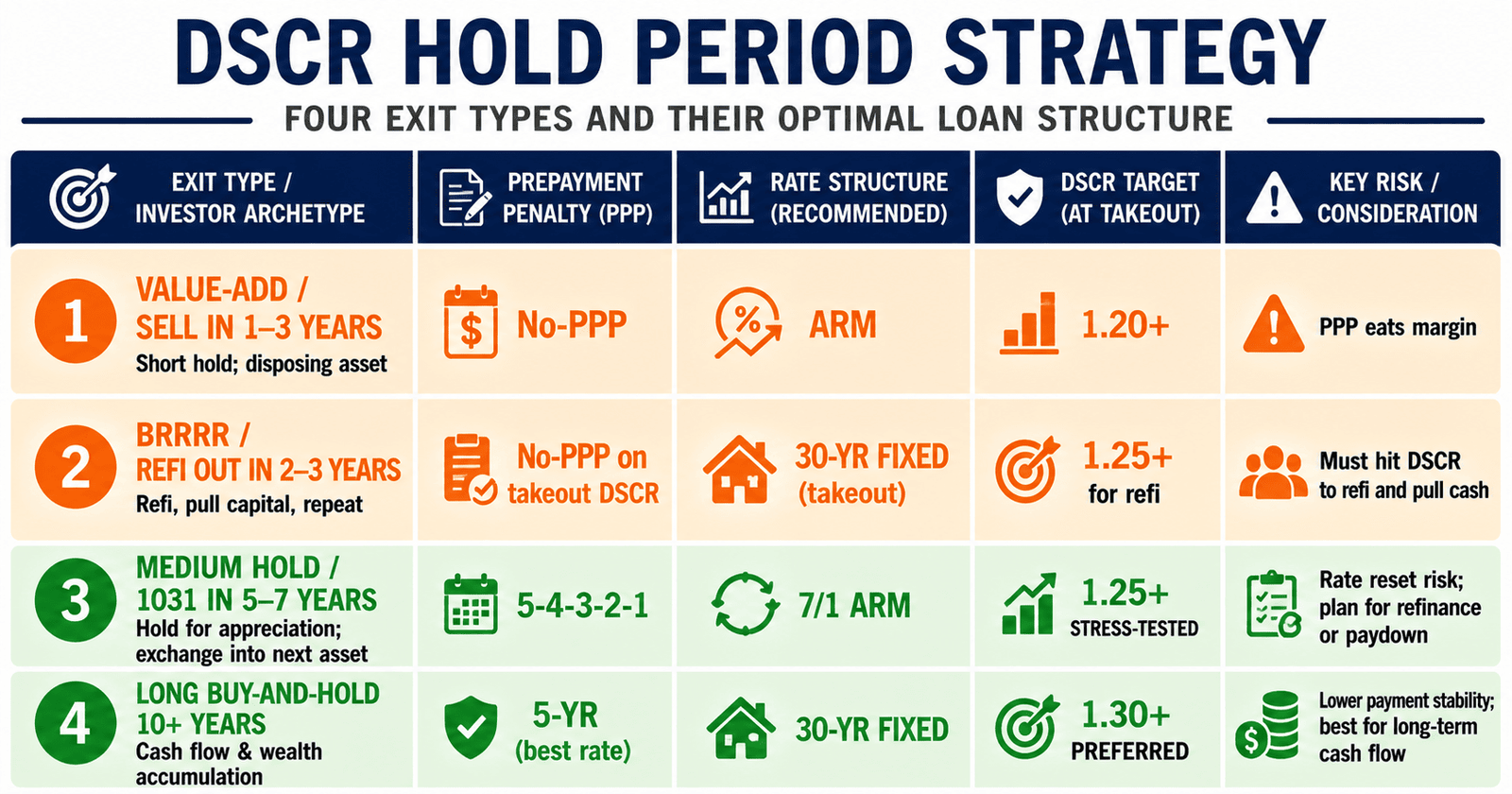
DSCR Refi Break-Even Math: The Full Matrix
The break-even matrix shows six rate-drop scenarios from 0.25% to 1.50% on the composite deal. The “No PPP” column uses $14,000 in closing costs (national average, excluding NYC mortgage recording tax). For NYC investors, add $14,438 in recording tax — making the no-PPP total approximately $28,438.
| Rate Drop | Monthly Savings | Break-Even (No PPP) | Break-Even (PPP Yr 3) | Verdict |
|---|---|---|---|---|
| 0.25% | $130/mo | 108 mo (9 yrs) | 281 mo (23 yrs) | RARELY |
| 0.50% | $260/mo | 54 mo (4.5 yrs) | 140 mo (12 yrs) | MARGINAL |
| 0.75% | $389/mo | 36 mo (3 yrs) | 94 mo (7.8 yrs) | MAYBE |
| 1.00% | $519/mo | 27 mo (2.25 yrs) | 70 mo (5.8 yrs) | YES (no PPP) |
| 1.25% | $649/mo | 22 mo (1.8 yrs) | 56 mo (4.7 yrs) | YES (no PPP) |
| 1.50% | $774/mo | 18 mo (1.5 yrs) | 47 mo (3.9 yrs) | YES |
The matrix makes the decision calculus clear. A 0.25% rate drop at $130/month takes 108 months (9 years) to break even even without a PPP. A 0.50% drop at $260/month takes 54 months (4.5 years). The 1.00% rate-drop threshold is where the economics shift. At $519/month in savings and $14,000 in standard closing costs, break-even is 27 months. Add NYC recording tax and break-even stretches to 55 months — still rational for a 7+ year hold, but not a no-brainer.
The DSCR Refi Break-Even and Prepayment Penalty Timing
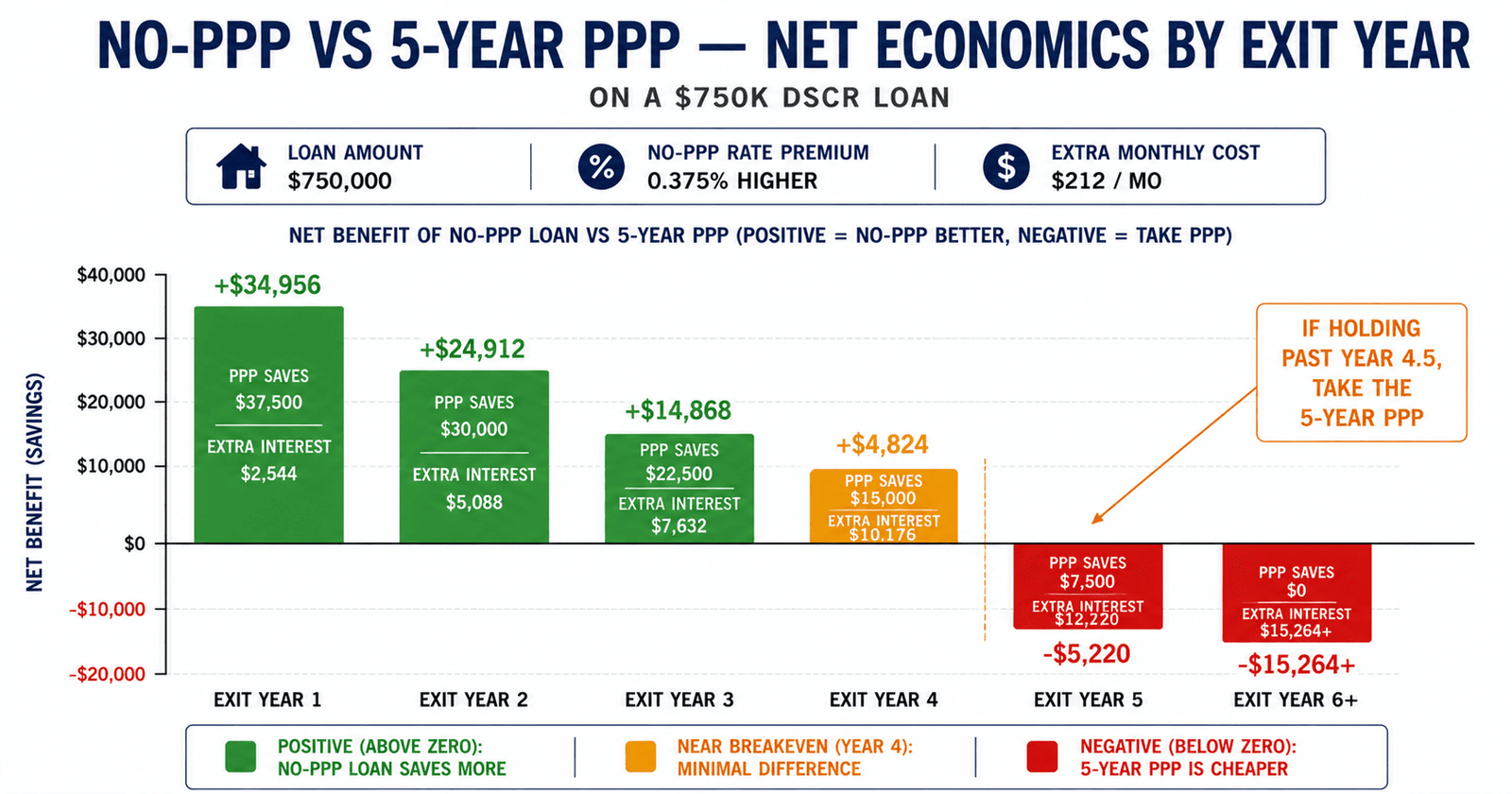
Prepayment penalty timing is the most controllable variable in the break-even calculation. The 5-4-3-2-1 step-down structure means the penalty declines each year. For an investor in Year 3 today, waiting 12 months to Year 4 reduces the penalty from 3% ($22,500) to 2% ($15,000) — a $7,500 improvement at no cost. Waiting to Year 5 reduces it to $7,500. Past Year 5, there is no penalty. See deal killers for how PPP structures affect exit and refinance flexibility.
Investors who negotiated a shorter PPP at origination — 3-year terms are available — face a different calculation. A 3-year flat structure expires entirely at month 37. Investors who accepted a slightly higher rate in exchange for a shorter PPP window are better positioned to execute rate-drop refis. The PPP structure choice at origination is a refi-timing decision made years in advance.
How a Rate Drop Moves the DSCR Ratio
The break-even analysis focuses on cash economics. There is a second benefit for investors whose DSCR is near the qualification floor: a lower rate improves the DSCR ratio by reducing PITIA while gross rent stays constant.
| New Rate | New PITIA | New DSCR | Note |
|---|---|---|---|
| 8.50% (current) | $7,914 | 1.25 | Baseline |
| 8.00% | $7,627 | 1.30 | Modest gain; savings modest vs refi cost |
| 7.50% | $7,395 | 1.34 | 1.0% drop — meaningful DSCR gain |
| 7.00% | $7,140 | 1.39 | 1.5% drop — strong case post-PPP |
| 6.50% | $6,892 | 1.44 | 2.0% drop — historically significant |
| 6.00% | $6,645 | 1.49 | 2.5% drop — strongest case |
For an investor at 1.25 DSCR today, a refinance to 7.50% moves the ratio to 1.34. That opens better rate tiers, reduces stress-test exposure, and provides more buffer against rent interruption or insurance increases. The stress test shows how the new DSCR holds after a +0.5% rate stress (refi standard) and 10% vacancy stress combined.
Get the complete DSCR refi underwriting framework. DSCR Playbook covers every refi threshold, PPP structure, and lender requirement.
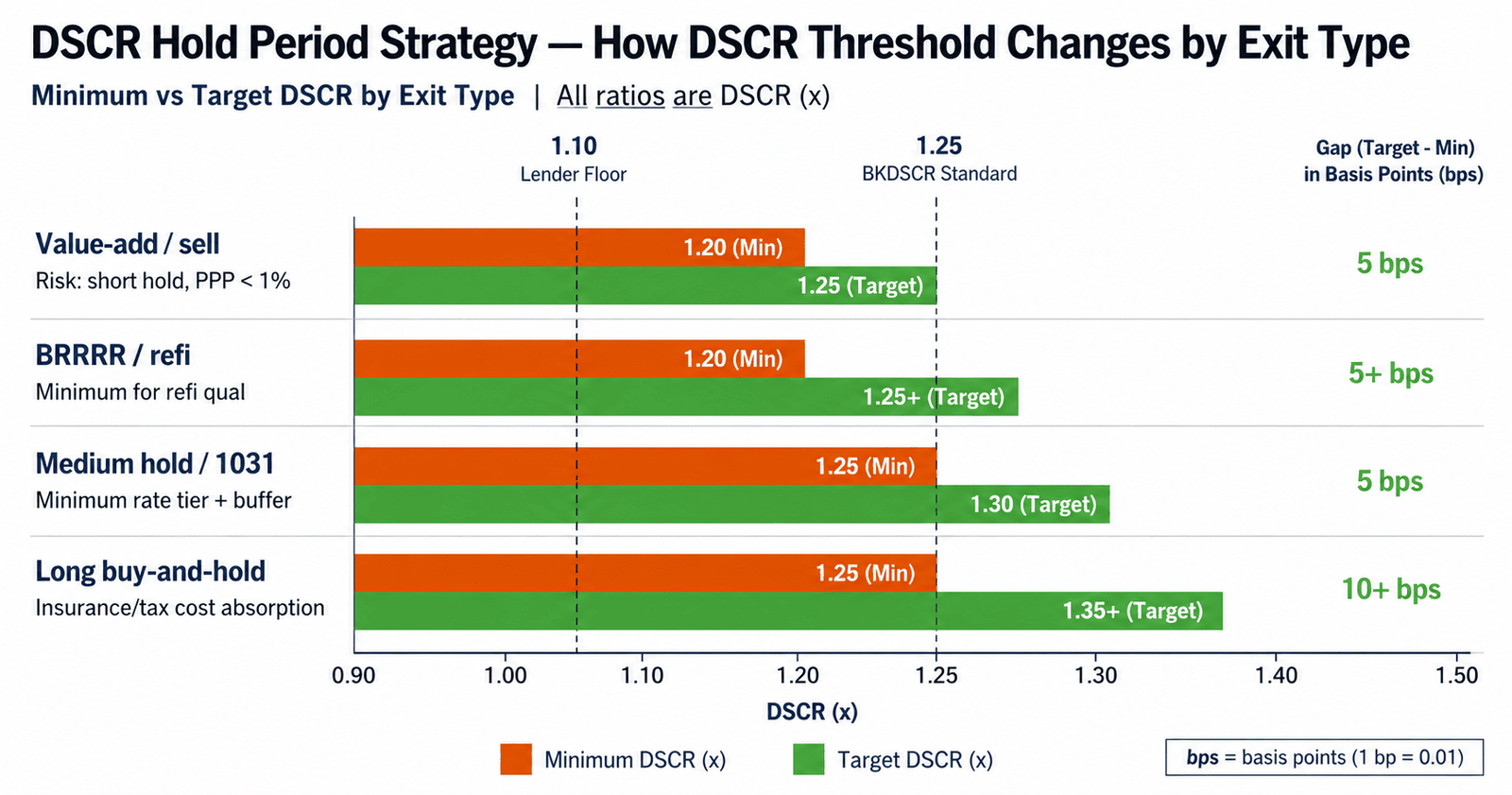
The NYC Mortgage Recording Tax: The Biggest Variable Investors Miss
The NYC mortgage recording tax changes the break-even math dramatically. On loans over $500,000, the rate is 1.925% of the loan amount. On a $750,000 loan, that is $14,438 — roughly equal to all other closing costs combined. Most national DSCR refi guides and calculators use $5,000–$8,000 in closing costs as their benchmark. That number is wrong for NYC investors by a factor of three.
NYC investors must include the recording tax in the total refi cost before evaluating the break-even. At a 1.0% rate drop with no PPP and full NYC closing costs (~$28,438), break-even is 55 months — not 27 months. That changes the minimum required rate drop to justify a refi. See lender criteria for how DSCR lenders handle NYC-specific costs in refi underwriting.
FAQ: DSCR Refi Break-Even Math
DSCR Refi Break-Even: What Rate Drop Is the Minimum to Justify a Refi in NYC?
For NYC investors including the mortgage recording tax, the minimum rate drop for a rational refi is 1.25%–1.50% at a 5+ year remaining hold, with no prepayment penalty in effect. A 1.0% drop with the recording tax reaches break-even at 55 months without PPP — requiring a 5+ year hold. With a Year 3 PPP, even a 1.50% drop reaches break-even at approximately 79 months.
Does a DSCR refi require a new DSCR underwrite?
Yes. Every DSCR refinance is a new underwrite. The lender evaluates current rent roll, current appraisal, current DSCR, current credit score, and current LTV. The fact that the existing loan was originated at 1.25 DSCR does not guarantee the refi qualifies. Verify current qualifying DSCR before committing to the refi timeline.
Can I do a cash-out refi instead of a rate-and-term refi to improve the economics?
Cash-out refis are a different product. Most DSCR lenders cap cash-out at 70–75% LTV (lower than the 75–80% available for rate-and-term). The cash-out refi rate is typically 0.25%–0.50% higher — which reduces monthly savings and extends break-even. A cash-out refi makes sense when the investor has a specific productive use for extracted equity, not as a mechanism to improve economics on a rate reduction that doesn’t pencil as rate-and-term.
What happens to my DSCR stress test after the refi?
Rate-and-term refis use a +0.5% rate stress (vs +1.0% for new purchases). A refi from 8.50% to 7.50% produces a stressed rate of 8.00%. Stressed PITIA is approximately $7,748. Stressed DSCR = $9,900 / $7,748 = 1.28 — above the BKDSCR 1.25 single-stress standard. Run the stress test on the new rate before committing to the refi to confirm the deal passes on both unstressed and stressed basis.
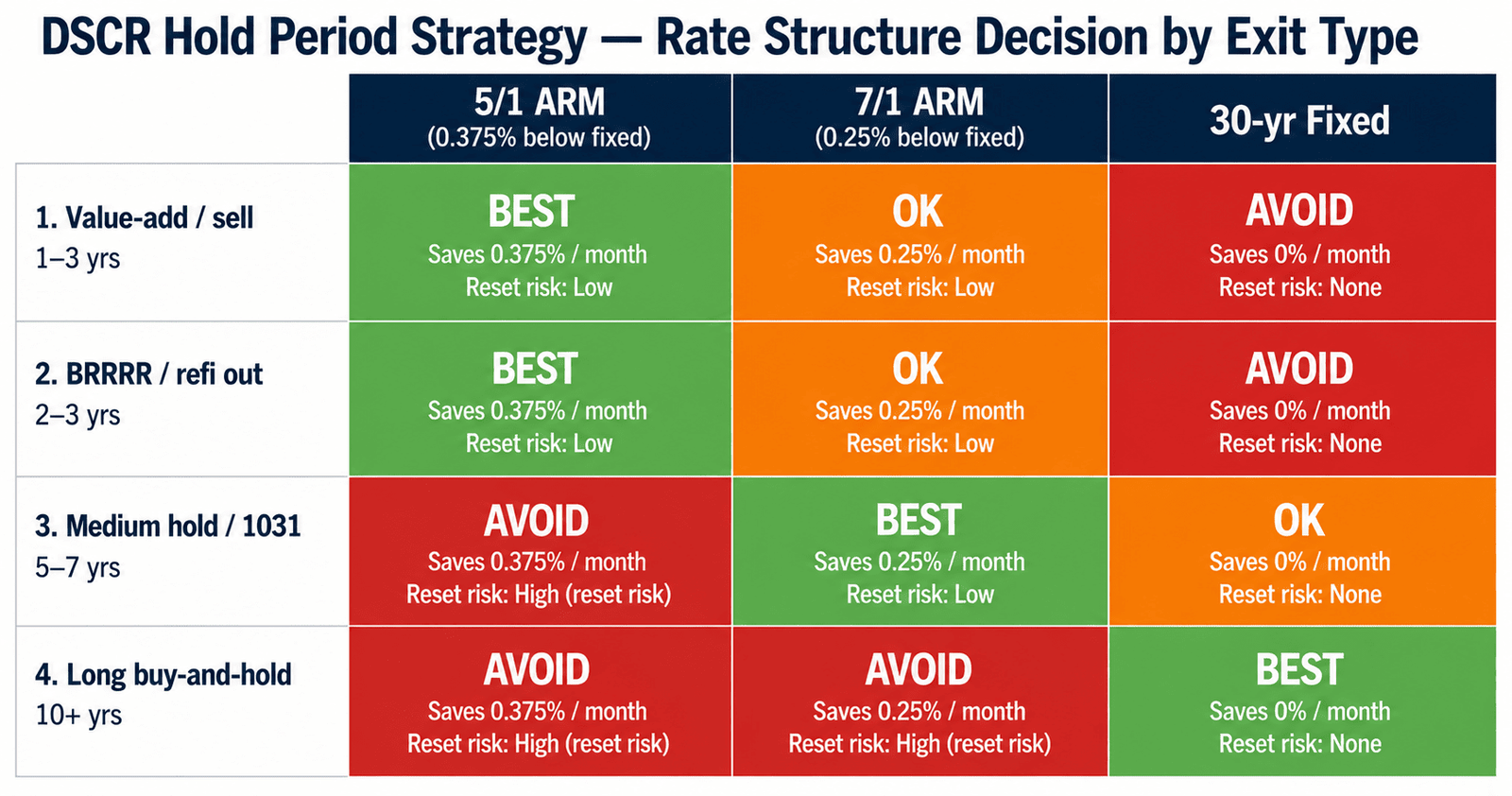
One break-even shortcut that applies to all NYC DSCR refis: the recording tax alone — $14,438 on a $750,000 loan — requires $601/month in payment savings to break even in 24 months. If the rate reduction does not produce at least $601/month in P+I savings, the refi does not pay back within 2 years even before factoring in lender fees, title, and appraisal.
At 7.5% on a $750,000 loan, P+I is approximately $5,243/month. To generate $601/month savings from rate reduction alone requires dropping to approximately 7.00% — a 50-basis-point reduction. Most NYC investors refinancing in 2026 are not coming from a rate above 8.0%; they originated in the 7.0%–8.5% range in 2022–2024. The refi math does not work yet for most of that cohort. The Refi Analyzer shows exactly where the break-even sits on any existing loan.
DSCR Refi Break-Even: The Complete NYC Cost Stack
All-In Closing Costs on a NYC DSCR Refinance
The DSCR refi break-even calculation requires the full NYC cost stack, not just lender fees. On a $750,000 NYC DSCR refi, the total cost stack includes: lender origination (typically 1–2 points, $7,500–$15,000); title insurance (owner’s and lender’s, approximately $3,500–$5,500 combined); appraisal ($750–$1,200 for 1–4 unit residential); NYC mortgage recording tax (1.925% on loans above $500K = $14,438 on $750K loan); title search and recording fees ($800–$1,200); attorney fee ($1,500–$2,500 for NYC residential).
Total all-in: approximately $28,500–$39,800. Using $34,000 as a midpoint, the monthly payment savings required to break even in 24 months is $34,000 / 24 = $1,417/month. That requires a rate reduction of approximately 1.5%–2.0% on a $750,000 loan to generate that much monthly savings. Most NYC DSCR refis in 2026 are not generating that spread.
When a NYC DSCR Refi Actually Pencils in 2026
The NYC DSCR refi break-even math currently favors investors who originated DSCR loans in 2022–2023 at peak rates of 8.0%–9.5%. A deal originated at 8.5% in mid-2023 with a $750,000 loan carries monthly P+I of approximately $5,767. At a 2026 rate of 7.25%, monthly P+I is $5,118 — savings of $649/month.
All-in refi cost of $34,000 divided by $649/month savings equals a break-even of 52 months — 4.3 years. Not compelling unless the investor plans to hold long-term. At a 2026 rate of 6.5%, monthly P+I is $4,742 — savings of $1,025/month. Break-even: $34,000 / $1,025 = 33 months — 2.75 years. Reasonable for a hold-period over 5 years.
The break-even math shifts dramatically when rate buydowns are available or when the investor has accumulated enough equity to lower the LTV and improve the DSCR on the new loan simultaneously. An investor who was at 75% LTV at origination and has property appreciation that puts them at 65% LTV on refinance can access a lower rate tier — typically 0.25%–0.50% below the 75% rate — which improves the monthly savings and shortens the break-even period. The Refi Analyzer runs the full break-even at any current and target rate, with NYC recording tax included in the cost stack.
The Only Rate Drop That Justifies the Transaction
DSCR refi break-even math comes down to one number: break-even months. Every other consideration — lower rate, better DSCR, freed-up monthly cash flow — is downstream of whether the economics of the transaction are rational. Run the break-even. Include the NYC mortgage recording tax. Include the prepayment penalty at its actual year-specific percentage. Divide total cost by monthly savings.
At a 1.0% rate drop with no PPP in an NYC deal and full recording tax, break-even is 55 months. That is a rational refi at a 6+ year remaining hold. At a 1.50% drop post-PPP with recording tax, break-even is approximately 37 months — rational even at a 4-year horizon. A 0.50% rate drop almost never pencils for an NYC investor when total costs are calculated correctly.
The investors who refinance at the right time are those who ran the break-even before the rate dropped — and knew exactly what rate drop they needed. That number belongs in every DSCR deal file from the day of origination.
If you have a DSCR loan and want to know whether a refi actually pencils — break-even months, stressed DSCR, and lender match position — Deal Review delivers the full written analysis within 48–72 hours.