Raise DSCR Ratio 2026: 6 Proven Moves Before Applying
Key Takeaways
- DSCR is gross rent divided by PITIA — improving either side of that ratio improves the number
- The fastest lever is the denominator: lower LTV, lower purchase price, or better rate
- The most common numerator error: using below-market or projected rents instead of actual lease amounts
- FY27 property tax inputs are the most common PITIA error in 2026 NYC outer-borough underwriting
- Insurance pricing has risen 40-60% since 2022 — using the seller’s renewal rate understates PITIA
- A deal that fails at 75% LTV may pass at 70% LTV — run LTV sensitivity before offering
Table of Contents
- Why 1.25 Is the Target, Not Just 1.0
- How to Raise DSCR Ratio 2026: The 2 Levers
- Move 1 — Execute Market-Rate Leases Before Applying
- What Counts as Qualifying Rent
- Move 2 — Verify the Appraiser’s Rent Comp Range Before Contract
- Move 3 — Increase the Down Payment to Reduce Debt Service
- Move 4 — Negotiate a Seller-Funded Rate Buydown
- Move 5 — Use an Interest-Only Structure for the DSCR Calculation
- The Tradeoff: Amortization Restarts After the I/O Period
- Move 6 — Shop Landlord Insurance Before Binding to Reduce PITIA
- Before the 6 Moves: Calculate Your Actual DSCR Correctly
- Frequently Asked Questions
- How much can I raise my DSCR ratio before applying?
- Does increasing the down payment always improve DSCR?
- Can I use an interest-only structure on any DSCR deal?
- The 6 Moves: Summary Reference
- Bottom Line — Raise DSCR Ratio 2026 Before You Apply
Raise DSCR ratio 2026 starts with the formula. DSCR is gross monthly rent divided by monthly PITIA. Every move that raises the ratio works on one of those two levers: increase the numerator (income), or decrease the denominator (debt service). Most investors either do nothing before applying or focus exclusively on finding a lender who will accept a lower ratio. The better move is to run the six adjustments in this guide before the application goes in — because a deal at 1.25 gets better rates, fewer reserve requirements, and cleaner approval than the same deal at 1.14.
— bkdscr.com: DSCR formula.
| MARKET SNAPSHOT — DSCR Ratio Levers, June 2026 | |
|---|---|
| Sources: Griffin Funding (Jun 2026) | Zumper (May 2026) | BKDSCR Research | |
| DSCR RATES & THRESHOLDS (June 2026) | |
| DSCR 30-yr fixed rates (Jun 2026) | 6.125%–7.5% |
| DSCR minimum (most lenders) | 1.00–1.20 |
| BKDSCR standard | 1.25+ unstressed | 1.00+ combined stress |
| RATIO SENSITIVITY — $700K LOAN AT 7.5% | |
| Monthly P&I at 75% LTV ($700K loan) | ~$4,895/month |
| LTV to 70% — P&I reduction | ~$392/month — improves DSCR ~0.06–0.08 pts |
| Rate drop of 0.5% (7.5% → 7.0%) | ~$233/month reduction — improves DSCR ~0.03–0.05 pts |
| NYC OUTER-BOROUGH INSURANCE CONTEXT | |
| Insurance cost increase since 2022 | +40–60% — most common PITIA error source |
| FY27 property tax inputs | Most common PITIA error in 2026 NYC outer-borough underwriting |
Before spending time on a full analysis, bkdscr.com lets you Deal Filter — property type, rent roll, unit count, and PITIA in one pass.
Before running any of the six moves below, model the deal first. The DSCR calculator lets you input your rent, loan amount, taxes, and insurance and see the ratio before you talk to a lender. Know your starting DSCR before deciding which moves apply to your deal.
Why 1.25 Is the Target, Not Just 1.0
The minimum DSCR floor for most programs in 2026 is 1.0 to 1.10. Most investors aim for the floor: clear the minimum and apply. That is the wrong target. Clearing the floor gets you into underwriting. Clearing 1.25 gets you into the preferred tier — where the best rates, the highest LTV access, and the shortest reserve requirements live. A January 2026 lender memo raised internal minimums from 1.20x to 1.25x for stabilized assets, reflecting a broader market shift toward risk-adjusted underwriting that prices every basis point of DSCR cushion.
A 1.14 deal and a 1.26 deal may both technically pass the published floor. They do not receive the same rates, the same LTV options, or the same reserve requirements. The BKDSCR single-stress standard reinforces this: a deal at 1.14 unstressed typically stresses to 1.05–1.08 at +1.0% rate. A deal at 1.26 unstressed stresses to 1.17–1.19. The stressed DSCR is what determines how much rate risk the deal can absorb.
How to Raise DSCR Ratio 2026: The 2 Levers
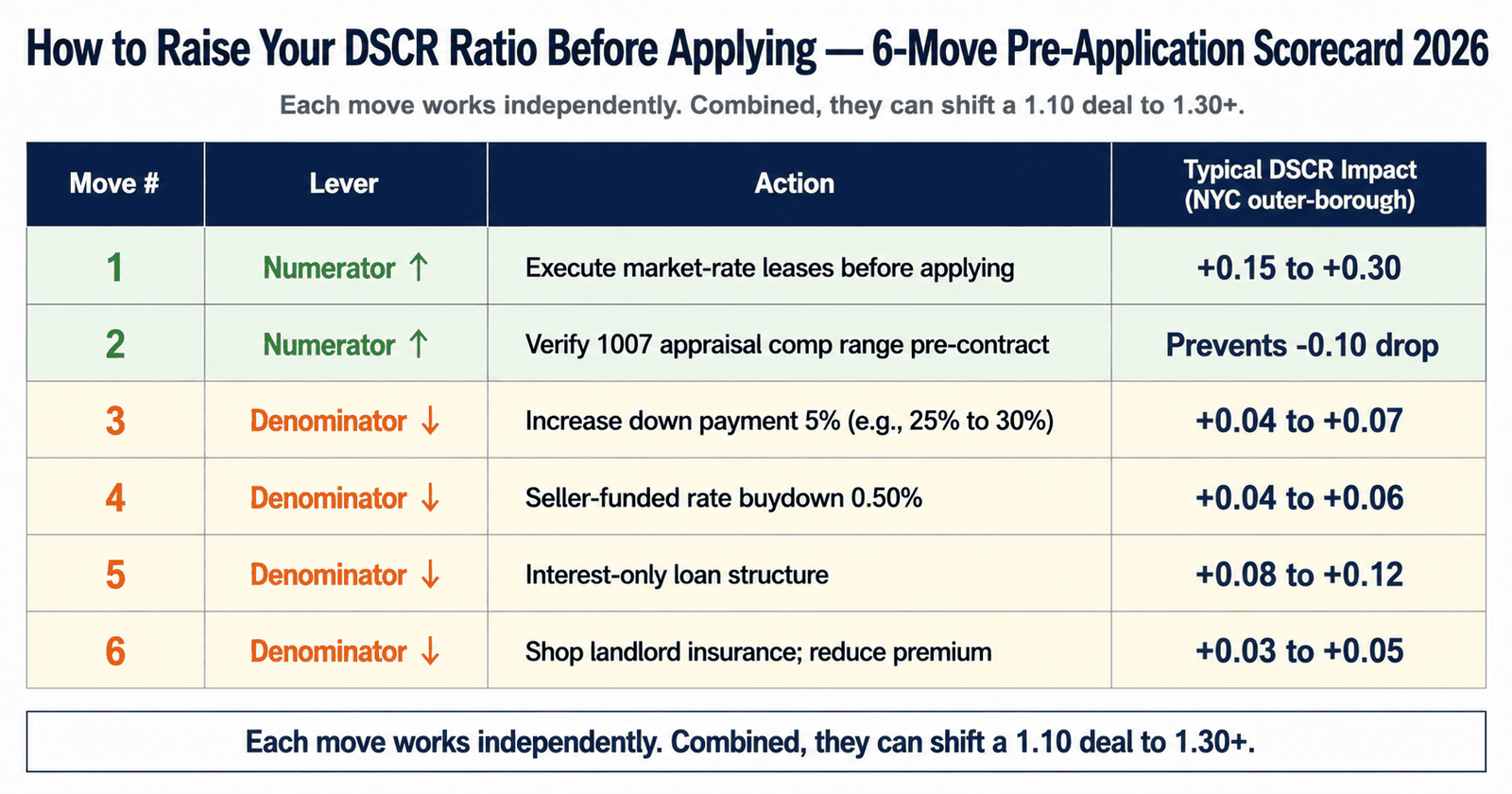
Every DSCR improvement move works on one of two variables in the formula. The income side (gross monthly rent) is the numerator. The cost side (monthly PITIA) is the denominator. Moves 1 and 2 work on the numerator. Moves 3 through 6 work on the denominator. The best pre-application strategy runs both.
Move 1 — Execute Market-Rate Leases Before Applying
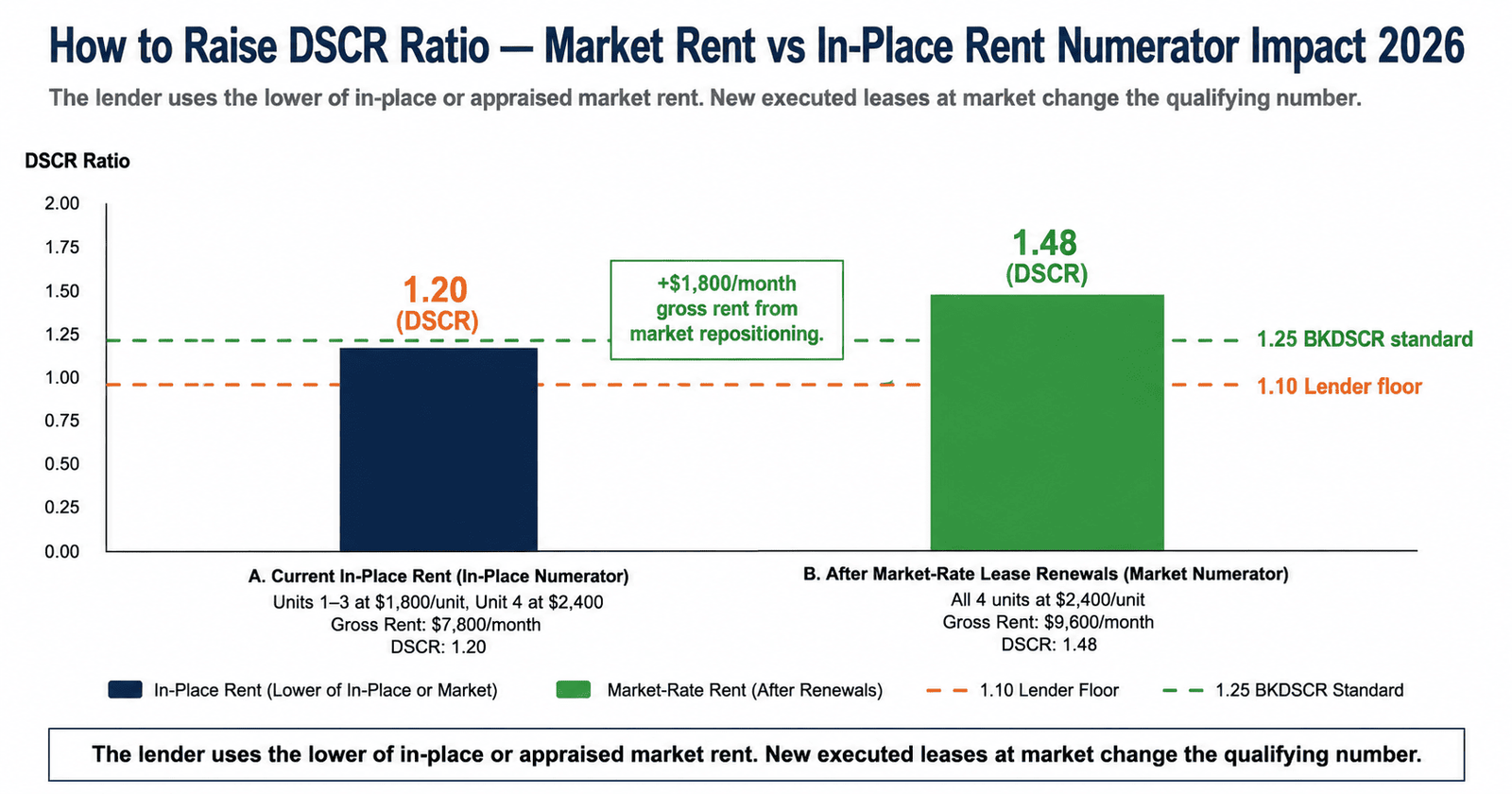
Lenders use the lower of in-place rent or appraised market rent to calculate qualifying DSCR. If your units are leased below market — month-to-month at old rates, or long-term leases signed before rent growth — the lender uses those lower numbers even if the 1007 appraisal shows the market will support more. If you execute new leases at market rates before applying, the in-place rent and market rent align, and the lender uses the full current income.
On a composite NYC outer-borough 4-unit where three of four units are at $1,800/month on month-to-month tenancies against a market of $2,400, the current qualifying rent is $7,800. After renewing or re-leasing those three units at $2,400 — with executed leases signed before the application date — qualifying rent rises to $9,600. On a $6,500 PITIA, that moves the DSCR from $7,800/$6,500 = 1.20 to $9,600/$6,500 = 1.48. A 28-point DSCR improvement without changing the loan structure, the property, or the purchase price.
The practical constraint is time. Executing new leases or negotiating renewals at current market rates typically requires 30–60 days notice. This is pre-application work, not closing-table work. Investors who plan the application 60–90 days out and use that window to bring rents to market arrive with a substantially stronger file.
What Counts as Qualifying Rent
The lender’s appraiser completes a 1007 rent schedule for 1-4 unit properties, which establishes what the appraiser believes the units would rent for at current market. The lender uses the lower of that appraised figure or the actual lease amount. New leases at or above the appraiser’s market estimate use the full lease amount. Confirm your lender’s policy on month-to-month tenancies before structuring the timeline.
Move 2 — Verify the Appraiser’s Rent Comp Range Before Contract
The second income-side move is not about increasing rent — it is about protecting the rent you are counting on. If the appraiser’s 1007 rent schedule comes in 8% below your submitted roll, your DSCR drops correspondingly before the underwriter ever reviews the file. The most common sources of appraisal shortfalls are documented under deal killers: thin comp pools, rent stabilization caps in mixed buildings, and above-market asking rents submitted without comp support.
The pre-contract verification is straightforward: search active rental listings and recent lease comps within a half-mile radius of the subject property, targeting the same unit configuration. If comparable market rentals consistently support $2,400 per unit and your submitted roll assumes $2,400, the 1007 is likely to confirm. If comparable market rentals are running $2,100 and you submitted $2,400, expect the appraisal to produce a lower qualifying income — and a lower DSCR — than the deal analysis showed. Do this work before you go to contract.
Move 3 — Increase the Down Payment to Reduce Debt Service
Move 4 — Negotiate a Seller-Funded Rate Buydown
A seller-funded rate buydown is a closing concession in which the seller credits the buyer a lump sum that the buyer uses to purchase discount points, permanently reducing the interest rate. One discount point typically costs 1% of the loan amount and reduces the rate by approximately 0.25%. On a $750,000 loan, a 0.50% permanent buydown costs approximately $15,000 — a seller concession, not additional buyer capital.
At 7.50%, P&I on $750,000 is $5,246 per month. At 7.00%, P&I drops to $4,992 — a $254 monthly reduction. With taxes and insurance at $2,200, the PITIA moves from $7,446 to $7,192. On $8,200 gross rent, DSCR moves from 1.10 to 1.14. A $15,000 seller credit applied to rate buydown can produce a larger effective benefit than a $15,000 price reduction — because the buydown works permanently through the DSCR calculation.
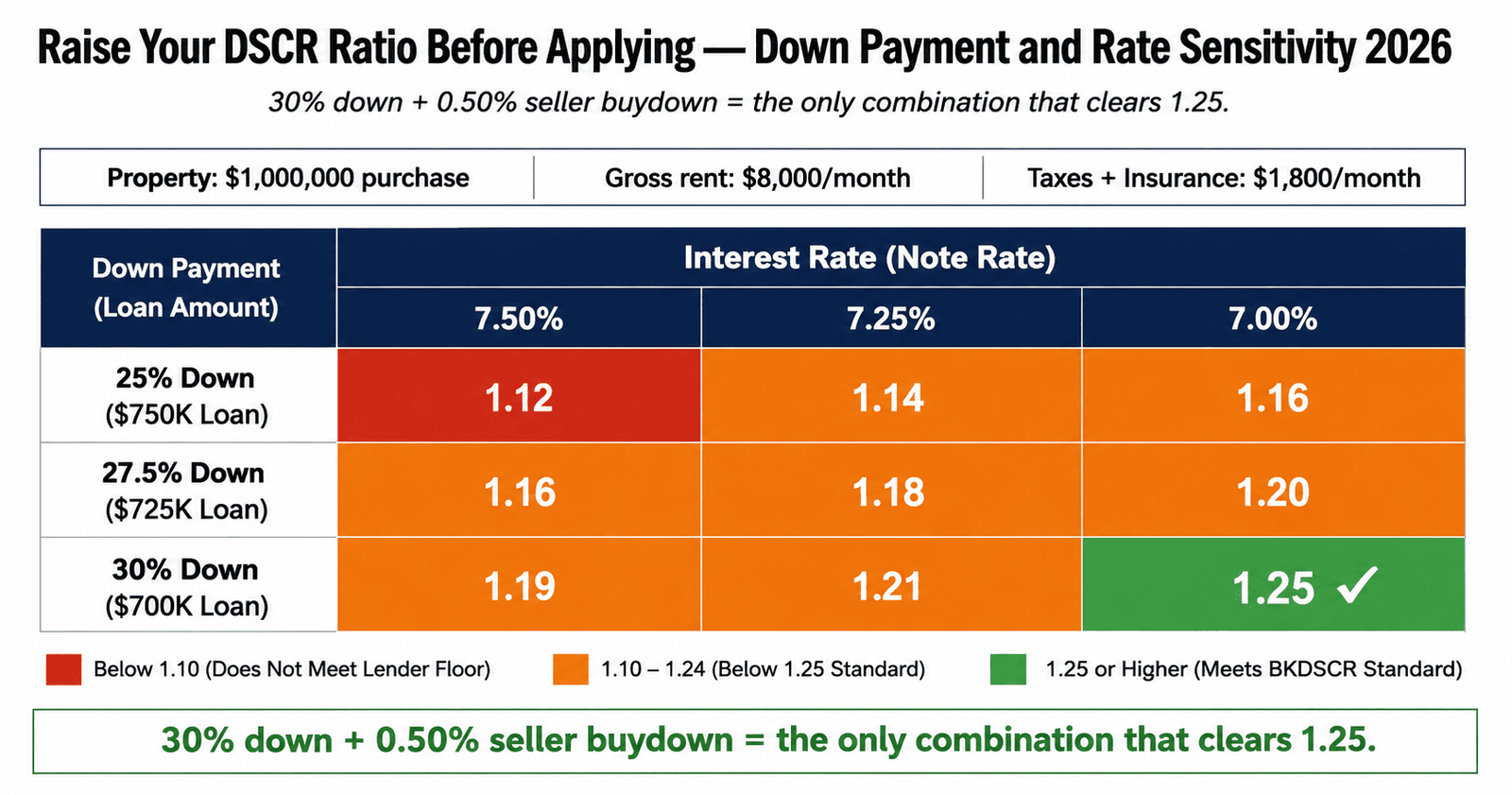
After modeling the down payment and rate scenarios, test the stressed DSCR for each combination. The stress test applies the +1.0% purchase rate stress and shows you both the unstressed and stressed DSCR for any combination of inputs — so you can see which combination gets the deal above both the lender floor and the BKDSCR 1.25 stressed standard.
If you want the complete framework for underwriting NYC outer-borough deals the way lenders do, DSCR Playbookevery input, every threshold, and every deal-killer explained.
Move 5 — Use an Interest-Only Structure for the DSCR Calculation
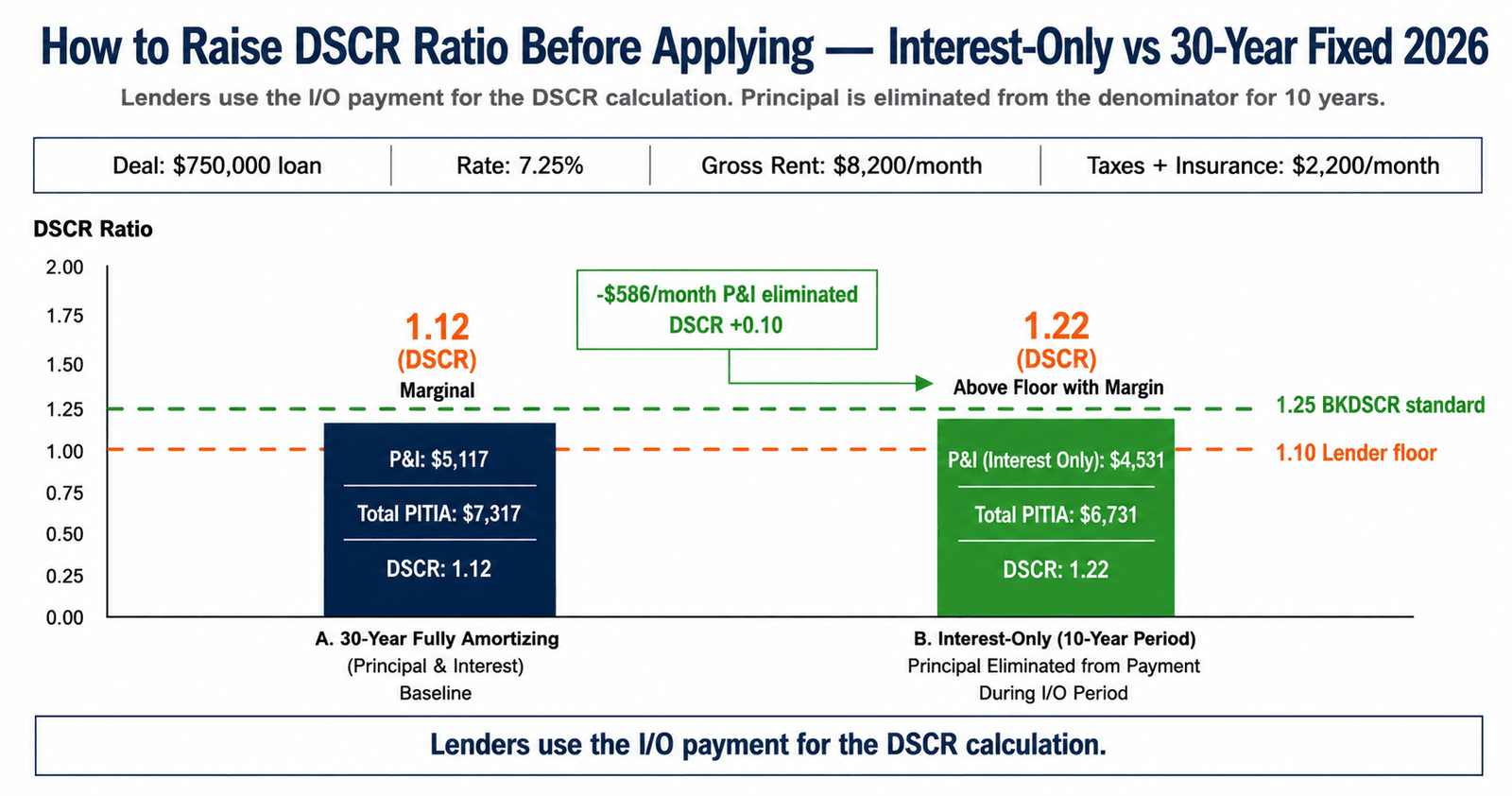
Interest-only DSCR loans are a standard product at most non-QM lenders in 2026. The typical structure is a 10-year interest-only period followed by a 20-year amortizing period. During the I/O period, the monthly payment consists entirely of interest — no principal reduction. The DSCR lender uses the interest-only payment for the ratio calculation, not the fully amortizing payment. This eliminates principal from the PITIA denominator for qualifying purposes.
On a $750,000 loan at 7.25%, the fully amortizing 30-year P&I payment is $5,117 per month. The interest-only payment is $4,531 per month — a $586 monthly difference. With taxes and insurance adding $2,200 to both structures, the PITIA comparison is $7,317 (amortizing) vs $6,731 (I/O). On $8,200 gross monthly rent, the DSCR moves from 1.12 to 1.22 — a 10-point improvement from a structural choice that changes nothing about the property, the purchase price, or the equity required.
The Tradeoff: Amortization Restarts After the I/O Period
Interest-only structures provide a DSCR improvement during the I/O period. They do not eliminate the principal. After the I/O period ends — typically at year 10 — the remaining balance amortizes over the remaining 20 years, producing a higher payment than a standard 30-year amortizing schedule at the same point. Investors who plan to hold beyond the I/O period need to model the year-11 payment and confirm the deal still cash flows at the higher rate. Investors who plan to sell or refinance before the I/O period ends benefit from the lower payment without carrying the amortization risk.
Move 6 — Shop Landlord Insurance Before Binding to Reduce PITIA
Insurance is the most overlooked lever in the DSCR denominator. NYC outer-borough landlord insurance premiums vary by $200 to $400 per month between carriers on comparable coverage for the same property. On a deal where qualifying PITIA sits at $7,400 (P&I $4,900 + taxes $1,800 + insurance $700), a carrier change that reduces the monthly premium from $700 to $450 drops PITIA to $7,150. On $8,400 gross rent, DSCR moves from 1.14 to 1.18 — a 4-point improvement from shopping a single line item that the lender criteria require you to have anyway.
The coverage requirements are specific: most DSCR lenders require a DP-3 landlord policy with dwelling coverage at replacement cost, liability coverage at $300,000 or higher, and loss of rental income coverage. Within those requirements, premiums vary. The difference between the lowest compliant quote and the first quote received can be 30% to 50% on some NYC outer-borough properties. Get the quotes before applying, bind the lowest compliant premium, and use that number as the insurance input in your DSCR calculation.
Before the 6 Moves: Calculate Your Actual DSCR Correctly
Many investors who think they need to raise their DSCR ratio before applying are actually miscalculating it. Four systematic errors inflate the self-calculated DSCR relative to what the lender will see:
- Using P&I only instead of full PITIA. Taxes and insurance are part of the denominator. On a deal with $800/month taxes and $550/month insurance, that omission understates the denominator by $1,350 and inflates the DSCR by 0.15–0.20 on a typical NYC deal.
- Using asking rent instead of appraised market rent. If your units are above market, the lender uses the lower appraised market rent, not the lease amount. Know which direction the 1007 is likely to go before modeling your qualifying DSCR.
- Forgetting HOA or condo fees. Any HOA, condominium association, or co-op maintenance dues add to PITIA. On properties with monthly fees of $200–$500, omitting this line item can shift the DSCR by 0.03–0.08.
- Using the wrong interest rate. Model DSCR at the actual rate you will qualify for at your credit score and LTV, not the best-case rate advertised in program materials. A DSCR model built on 6.5% that closes at 7.25% can fail the lender’s floor at closing.
Frequently Asked Questions
How much can I raise my DSCR ratio before applying?
The range depends on which moves apply to your specific deal. Bringing three below-market units to market rate on a 4-unit property can add 0.20–0.30 to the ratio. Increasing the down payment by 5% adds 0.04–0.07. A 0.50% rate buydown adds 0.04–0.06. Interest-only structure adds 0.08–0.12. Insurance shopping adds 0.03–0.05. Applied together to a deal that starts at 1.10, these six moves can reasonably produce a final DSCR of 1.30–1.40 — a deal that goes from floor-clearance to preferred tier without any change to the property or the purchase price.
Does increasing the down payment always improve DSCR?
Yes, directly. A larger down payment reduces the loan amount, which reduces monthly P&I, which reduces PITIA. The DSCR formula puts PITIA in the denominator, so any reduction in PITIA — at constant rent — raises the ratio. The compounding effect from rate tier improvement (larger down payment sometimes unlocks a lower rate) adds further DSCR improvement beyond the principal reduction alone. See also: Blog 38.
Can I use an interest-only structure on any DSCR deal?
Most DSCR lenders offer interest-only options as a standard product in 2026, typically as a 10-year I/O period on a 30-year note. Confirm the lender’s I/O availability before building your deal analysis around it. For current lender program requirements, see Ridge Street. The important constraint to model: after year 10, the payment recalculates on the full amortizing balance over the remaining 20 years. The year-11 payment is approximately 30–35% higher than the I/O payment.
The 6 Moves: Summary Reference
| # | Lever | Move | Typical DSCR Impact |
|---|---|---|---|
| 1 | Numerator ↑ | Execute market-rate leases before applying | +0.15 to +0.30 |
| 2 | Numerator ↑ | Verify 1007 appraisal comp range pre-contract | Prevents −0.10 drop |
| 3 | Denominator ↓ | Increase down payment by 5% (e.g., 25% to 30%) | +0.04 to +0.07 |
| 4 | Denominator ↓ | Seller-funded rate buydown 0.50% | +0.04 to +0.06 |
| 5 | Denominator ↓ | Interest-only loan structure (10-yr I/O period) | +0.08 to +0.12 |
| 6 | Denominator ↓ | Shop landlord insurance; bind lowest compliant premium | +0.03 to +0.05 |
Bottom Line — Raise DSCR Ratio 2026 Before You Apply
Raising your DSCR ratio 2026 before applying is not about finding a lender who will accept a lower number. It is about arriving at the application with a number that clears the preferred tier, not just the published floor. The six moves in this guide work on two variables: gross qualifying rent and total monthly PITIA. Applied in combination, they can shift a deal from 1.10 to 1.28 without changing the property, the purchase price, or the fundamental economics of the investment.
The sequence matters. Start with the income side: confirm the rent roll and verify what the 1007 appraisal will support. If units are below market, execute new leases before applying. Then work the denominator: model the DSCR improvement from each additional 5% of down payment, price the rate buydown with the seller, confirm I/O availability at your target lender, and get insurance quotes before binding a policy. Each move is quantifiable. Each one adds a specific number of DSCR points.
The alternative is submitting at 1.12 and hoping the lender’s overlay accommodates it. In 2026, after overlays tightened and lenders shifted internal floors upward, that approach produces more denials, longer timelines, and worse rates than the same deal structured with pre-application intent. The six moves take 30–90 days of planning. The outcome of that planning determines the deal’s financing cost for the next 30 years.
If you have a specific deal and want to run the full pre-application analysis — current DSCR, which of the six moves apply, the stressed ratio after optimization, and the lender tier the restructured deal targets — the deal review delivers that analysis with move-by-move DSCR recalculations for your deal.