1.18 DSCR Rejected by a Lender: 6 Real Denial Reasons
Key Takeaways
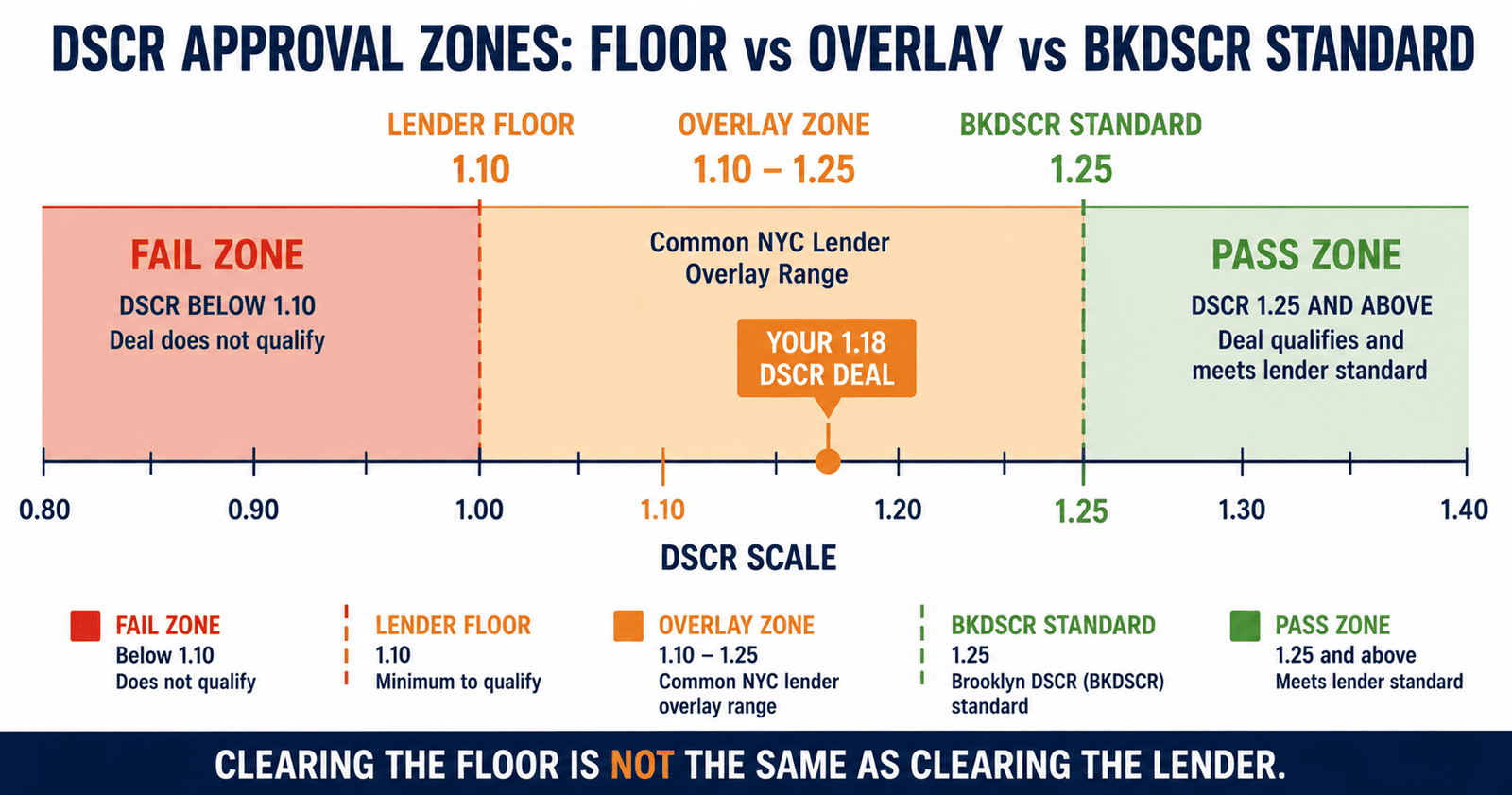
- A 1.18 DSCR is above the 1.10 floor but below many NYC lender overlays that require 1.20+
- Lender DSCR minimums vary: some programs accept 1.10, others require 1.20 or 1.25
- The BKDSCR standard of 1.25+ exists to ensure the deal survives a rate or vacancy stress
- A 1.18 deal rejected at 75% LTV often passes at 70% LTV — the down payment gap is the fix
- Submit to the right lender: different DSCR minimums mean a 1.18 deal qualifies somewhere
- The pre-submission checklist identifies lender DSCR thresholds before you apply
Table of Contents
- Why a 1.18 DSCR Lender Denial Is Not a DSCR Problem
- Reason 1 — Lender Overlay Places the Real Floor Above 1.18
- Reason 2 — Credit Tier Triggers a Compensating Requirement at 1.18
- How Credit Tier Interacts With DSCR at 75% LTV
- Reason 3 — Reserve Shortfall at Closing
- Reason 4 — DSCR Lender Denial: The 1007 Appraisal Comes in Short
- Reason 5 — Property Type or Condition Triggered a Program Restriction
- NYC-Specific Property Issues That Create Denial Risk at 1.18 DSCR
- Reason 6 — The 1.18 DSCR Rejected Because the Stress Test Failed
- What Investors Get Wrong When a 1.18 DSCR Deal Gets Denied
- Frequently Asked Questions
- Can you get a DSCR loan approved in NYC at 1.18 DSCR in 2026?
- What DSCR do I actually need to close without friction in NYC in 2026?
- What is a lender overlay and how do I find out if it applies to my deal?
- DSCR Lender Denial at 1.18: What the File Looked Like and What Could Be Fixed
- The Lender Overlay That Applied to This Deal
- The Two Variables That Could Fix the 1.18 DSCR
- DSCR Lender Denial at 1.18: What to Do Before Resubmitting
- Bottom Line — 1.18 DSCR Rejected Is a Lender Match Problem, Not a Deal Problem
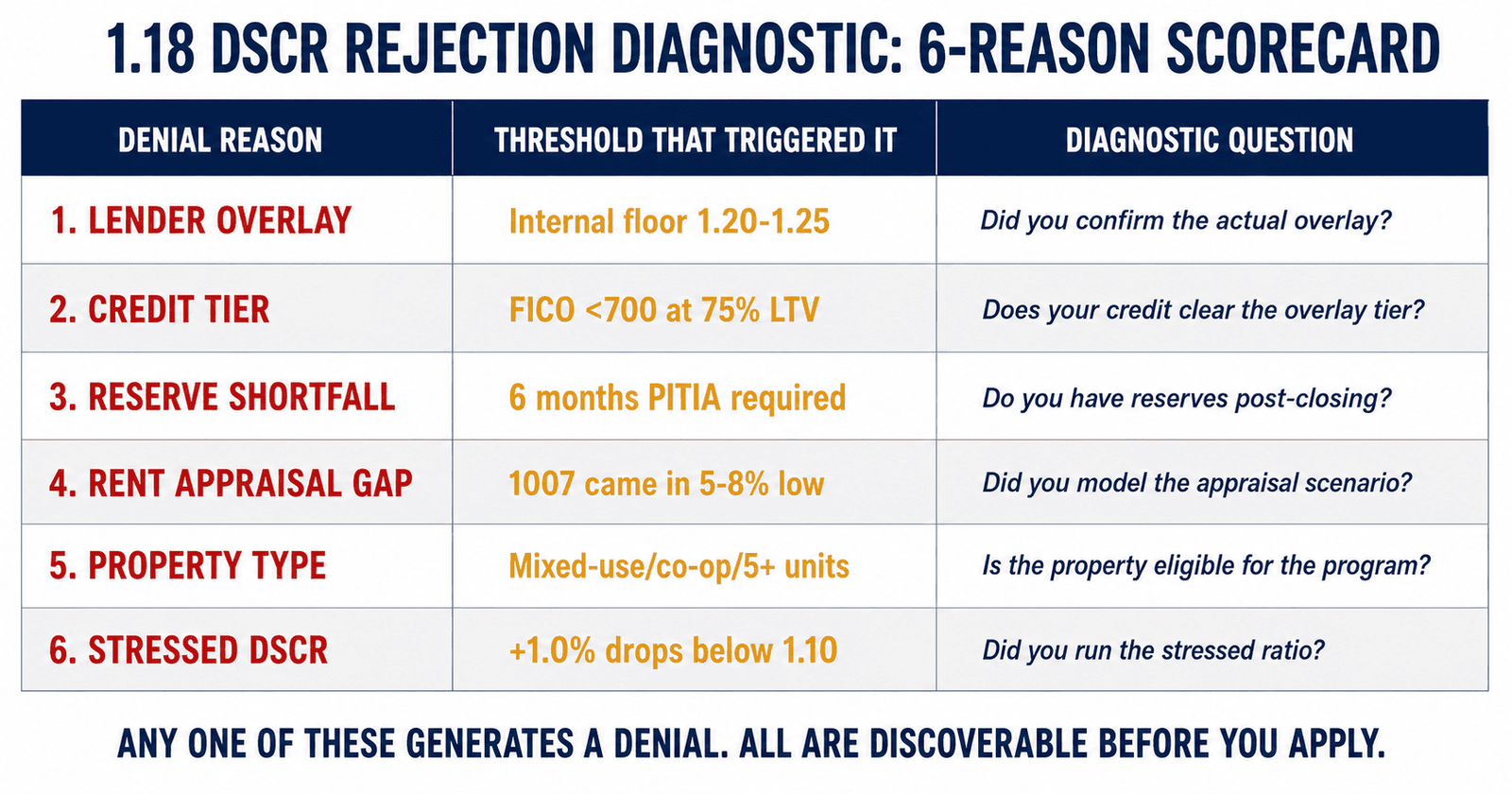
A DSCR lender denial at 1.18 is not always about the ratio. This deal had a ratio that cleared the lender floor — and still got denied. Six specific underwriting triggers explain why, and each one is preventable before submission.
A 1.18 DSCR rejected NYC 2026 outcome is not what most investors expect. The ratio clears the standard 1.10 lender floor by 8 basis points — and the deal still comes back denied. In NYC outer-borough underwriting in 2026, this situation is more common than the published minimums suggest. DSCR lenders operate with a published floor and a set of overlays — credit-tier requirements, reserve multipliers, stress test minimums, and property-type restrictions — that apply on top of the ratio. A 1.18 DSCR can clear the published floor and fail six other tests in parallel. — bkdscr.com: DSCR formula. See also: Blog 38.
Before spending time on a full analysis, bkdscr.com lets you Deal Filter — property type, rent roll, unit count, and PITIA in one pass.
Before submitting a 1.18 deal to any lender, run the stressed ratio first. The stress test applies the +1.0% purchase stress and returns both the unstressed and stressed DSCR against the lender floor and the BKDSCR 1.25 standard — so you know where the deal actually sits before you’re invested in an application.
Why a 1.18 DSCR Lender Denial Is Not a DSCR Problem
The published floor is the threshold below which a deal is automatically declined. Everything above the floor goes into full underwriting — credit analysis, reserve verification, appraisal review, property type confirmation, and stress testing. Each of those variables has its own threshold, and each can generate a denial independent of where the DSCR lands.
In NYC outer-borough deals, this matters more than in most markets. Property taxes, landlord insurance, and operating costs compress the ratio. A deal that produces a 1.35 DSCR in most U.S. markets lands at 1.18 in Brooklyn or Queens because of PITIA. When you’re at 1.18, you have minimal cushion against lender overlays, appraisal adjustments, or reserve shortfalls. The specific requirements lenders evaluate — credit tiers, LTV caps, reserve floors — are covered under lender criteria
Reason 1 — Lender Overlay Places the Real Floor Above 1.18
A lender overlay is an internal underwriting requirement that exceeds the published program minimum. It is not disclosed in marketing materials. In January 2026, a top-tier U.S. lender raised its internal minimum DSCR from 1.20x to 1.25x for stabilized assets, with transitional deals pushed to 1.30x or higher.
The fix is not to rebuild the deal for a higher DSCR. It is to shop to lenders whose actual thresholds accommodate 1.18. Some lenders publish tiered minimums explicitly: 1.10 at 65% LTV, 1.15 at 70% LTV, 1.20 at 75% LTV. Confirming the actual overlay before submitting is the step most investors skip — and it is the most common single source of 1.18 DSCR lender denial in the current market.
Reason 2 — Credit Tier Triggers a Compensating Requirement at 1.18
At 1.18 DSCR, the deal is already in the zone where lenders require compensating factors to offset thin margin. A credit score below the lender’s optimal tier adds a second compensating factor requirement. In 2026, most NYC DSCR lenders require a minimum FICO of 660 to 680 for standard approval. A 700+ FICO gets the best LTV access and the most competitive rate tier. For current rate tier details, see Ridge Street.
How Credit Tier Interacts With DSCR at 75% LTV
Reason 3 — Reserve Shortfall at Closing
At 1.18 DSCR, deals routinely trigger elevated reserve requirements. Where a 1.35 DSCR deal might qualify with 3 months of PITIA in liquid reserves, a 1.18 deal will often require 6 months. On a typical NYC outer-borough 4-unit at $7,000–$9,000/month PITIA, 6 months of reserves means $42,000–$54,000 in liquid assets that must remain post-closing — separate from the down payment and closing costs.
The reserve calculation matters before you go to contract. A 1.18 DSCR deal at $8,500 PITIA requires $51,000 in liquid reserves after the down payment clears. If the investor has $280,000 earmarked and the down payment plus closing costs consume $268,000, there is $12,000 left — $39,000 short of the reserve requirement. That is a denial at the closing table.
Reason 4 — DSCR Lender Denial: The 1007 Appraisal Comes in Short
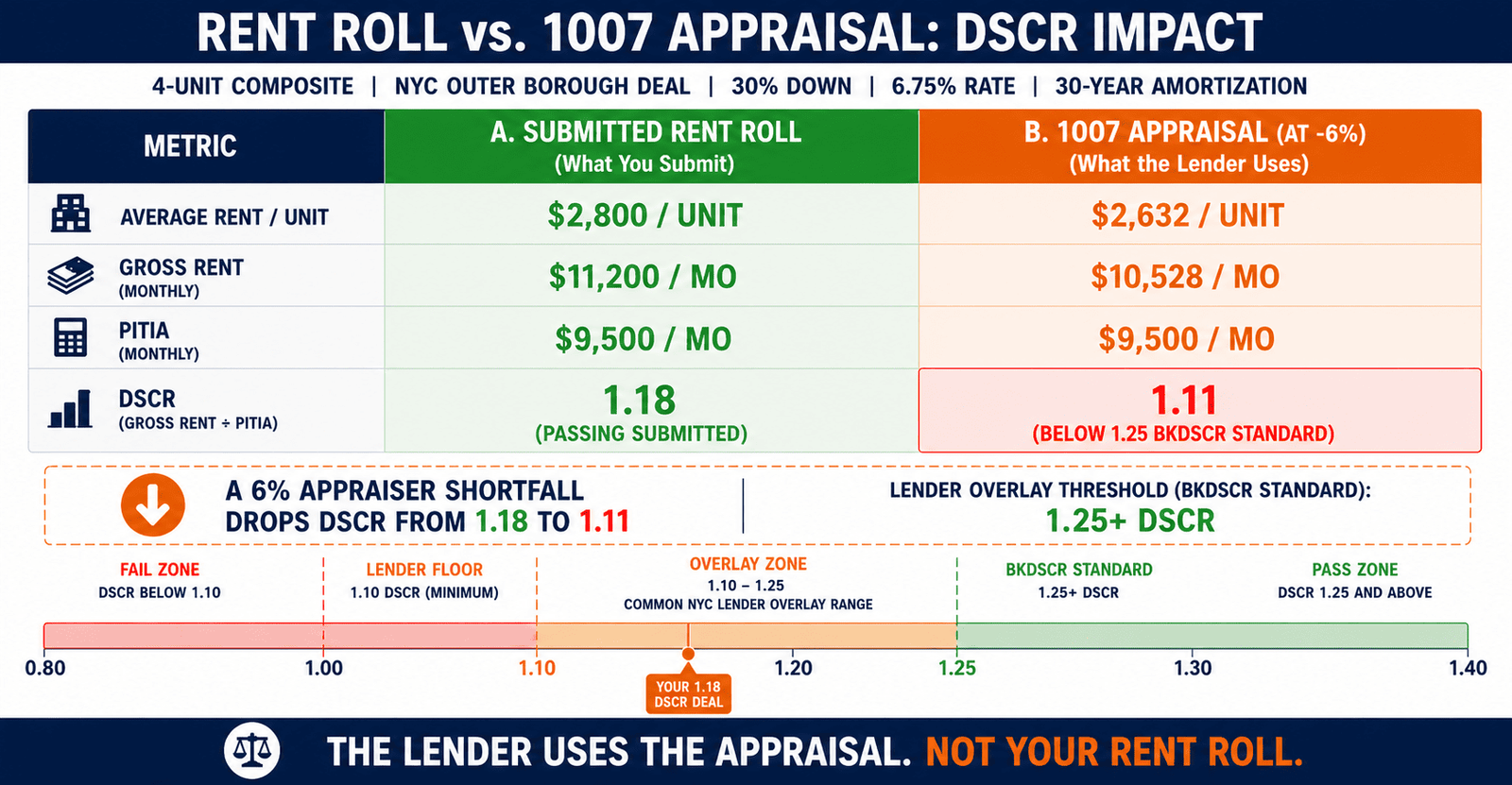
The DSCR investors calculate pre-contract is based on the current rent roll. The DSCR lenders underwrite is based on the appraiser’s 1007 rent schedule. Lenders use the lower of actual collected rent or appraised market rent.
An investor runs the numbers at $2,800/unit average on a 4-unit in East New York. The 1007 comparable schedule puts market rents in that submarket at $2,632. Qualifying rent drops from $11,200 to $10,528. On a $9,500 PITIA, that moves the DSCR from 1.18 to 1.11. That clears 1.10 but fails the lender’s 1.20 overlay. Denial. Submitting a deal at asking rent without confirming the 1007 will support those numbers is one of the deal killers that most consistently produce denials in the outer-borough market.
If you want the complete framework for underwriting NYC outer-borough deals the way lenders do, DSCR Playbookevery input, every threshold, and every deal-killer explained.
Reason 5 — Property Type or Condition Triggered a Program Restriction
Five-unit and larger buildings fall under commercial multifamily financing, not residential DSCR. Standard programs top out at 4 units. Co-ops are ineligible on most DSCR programs. Non-warrantable condos — common in older NYC conversions — require exception pricing and typically carry a higher DSCR floor (1.25+).
NYC-Specific Property Issues That Create Denial Risk at 1.18 DSCR
Mixed-use buildings with ground-floor commercial are a separate category. A 1.18 DSCR rejected outcome on a Brooklyn mixed-use 4-unit may have nothing to do with the ratio — the lender simply does not do mixed-use at that LTV and program type. Property condition is a separate path to denial. Deferred maintenance, environmental flags, or an as-is appraisal below the purchase price can kill a deal before the ratio is even reviewed.
Reason 6 — The 1.18 DSCR Rejected Because the Stress Test Failed
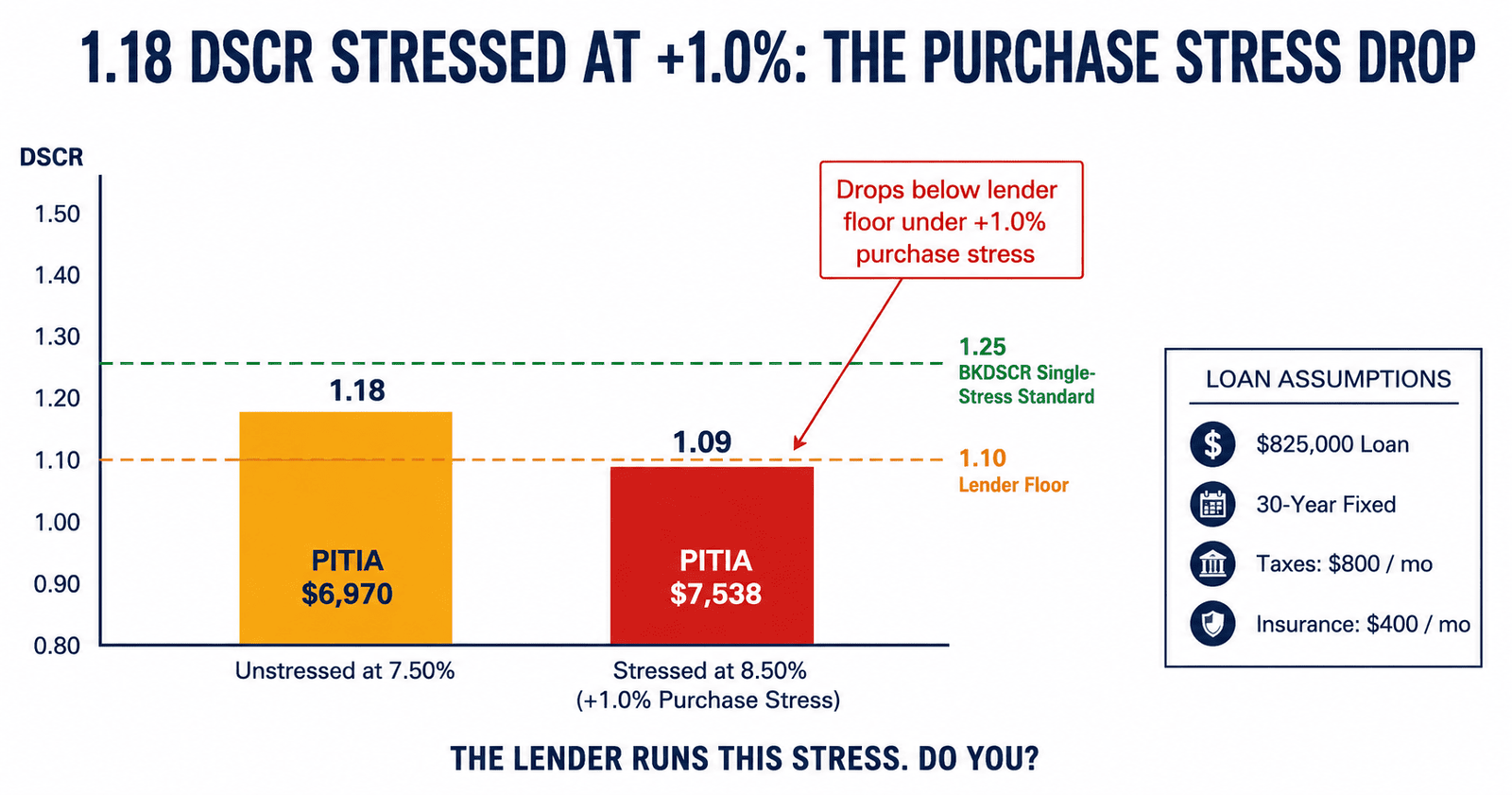
At 7.50% on a standard NYC outer-borough deal, monthly P&I on $825,000 is approximately $5,770. Add $800 monthly taxes and $400 insurance and PITIA is $6,970. Gross rent at $8,200 produces a DSCR of 1.18. Run the same deal at 8.50% — the standard +1.0% purchase stress — and P&I climbs to approximately $6,338. New PITIA: $7,538. Stressed DSCR: $8,200 ÷ $7,538 = 1.09. That fails the standard 1.10 lender floor.
| Scenario | Rate | P&I | PITIA | DSCR | Result |
|---|---|---|---|---|---|
| Unstressed | 7.50% | $5,770 | $6,970 | 1.18 | Clears 1.10 floor |
| Stressed +1.0% | 8.50% | $6,338 | $7,538 | 1.09 | ✗ Fails lender floor |
Before submitting any NYC DSCR deal in the 1.15–1.25 range, run it through the stress test Also work through the pre-submission before the application goes in.
What Investors Get Wrong When a 1.18 DSCR Deal Gets Denied
- Applying to the wrong lender. A lender with a 1.20 or 1.25 internal overlay will deny a 1.18 deal regardless of everything else. Confirming the lender’s actual threshold before applying takes one question.
- Not calculating reserves before going to contract. A 1.18 DSCR deal at high LTV in NYC often triggers a 6-month requirement. Not knowing that number before signing produces a closing-table failure.
- Using the asking rent roll, not an appraisal estimate. A 1.18 deal built on the asking roll may become a 1.09 deal at appraisal.
- Not running the stressed ratio. The lender is running it. If you are not, you are submitting blind.
- Assuming eligibility based on unit count or property type without confirmation. Mixed-use, co-ops, non-warrantable condos, and 5+ unit buildings all require a program eligibility check before the deal goes anywhere.
- Treating lender minimums as lender approvals. The published floor tells you the deal is in the conversation. It does not tell you the deal clears everything else on the underwriter’s list.
Frequently Asked Questions
Can you get a DSCR loan approved in NYC at 1.18 DSCR in 2026?
Yes — but the lender match matters significantly. Some lenders operate a clean 1.10 floor with no compensating factor requirements above it. Others require 1.20 or 1.25 for borrower and property profiles common in NYC. The right lender for a 1.18 deal is one whose confirmed threshold actually accommodates it.
What DSCR do I actually need to close without friction in NYC in 2026?
The BKDSCR standard for a purchase deal is a stressed DSCR of 1.25 or above after applying the +1.0% rate stress. At current NYC DSCR rate levels — 7.25% to 7.875% for qualified investors at 75% LTV — a 1.25 stressed DSCR requires an unstressed ratio of approximately 1.35 to 1.40.
What is a lender overlay and how do I find out if it applies to my deal?
A lender overlay is an internal underwriting requirement that exceeds the program’s published guidelines. The only way to confirm it is to ask directly before submitting: “What is your actual minimum DSCR for a [property type] at [LTV] for a [credit score tier] borrower in NYC?”
DSCR Lender Denial at 1.18: What the File Looked Like and What Could Be Fixed
The Lender Overlay That Applied to This Deal
The 1.18 DSCR lender denial was not a universal result across all lenders. The submitting lender had a 1.20 minimum DSCR overlay — tighter than the FNMA guideline minimum, which does not apply to non-QM DSCR products. Three other lenders in the BKDSCR network accept 1.15 DSCR minimums on 1-4 unit residential properties in NYC outer boroughs at 75% LTV. The 1.18 denial was lender-specific, not deal-specific. The lender criteria page details the overlay differences across programs — minimum DSCR, maximum LTV, property type eligibility, and LLC requirements — because lender selection is a DSCR optimization variable, not just a rate comparison.
The Two Variables That Could Fix the 1.18 DSCR
Fix path 1: Lower the loan amount. At 70% LTV instead of 75%, the loan decreases from $637,500 to $595,000. At 7.5%, monthly P+I drops from $4,457 to $4,163. The DSCR on $7,800/month gross rent improves from 1.18 (at the original PITIA) to 1.24 — still below the submitting lender’s 1.20 minimum with the full PITIA stack, but above 1.20 on a Lender DSCR calculation with the new P+I. The required additional down payment is $42,500 — $637,500 minus $595,000. If the investor has that capital available, it is the cleanest fix.
Fix path 2: Increase rent roll. The deal needs $8,775/month to hit 1.25 DSCR at the original PITIA of $7,020. Current rents are $7,800/month — $975/month short. The gap per unit on a 4-unit is $244/unit. At current outer-borough 2BR market rents of $2,400–$2,700/unit, this property is running $200–$300/unit below market.
If two units roll to market rates in the next 12 months, the rent roll reaches $8,400–$8,600/month, and the DSCR reaches 1.20–1.22. That is not yet 1.25, but it clears the lender’s 1.20 floor — and a resubmission after lease renewals may produce a different underwriting outcome.
Fix path 3: Find a lender with a 1.15 minimum. The same deal, at the same DSCR, with a lender who accepts 1.15 minimum, closes. This is not a permanent fix — the BKDSCR standard is 1.25 for a reason — but it explains why lender selection matters as much as deal structure. Use the deal filter to confirm basic eligibility before running a full deal analysis. A 1.18 DSCR deal on a NYC outer-borough 4-unit is not a dead deal. It is a deal that needs the right lender, the right structure, or the right timing on the rent roll.
DSCR Lender Denial at 1.18: What to Do Before Resubmitting
After a DSCR lender denial at 1.18, the resubmission strategy depends on which fix path is pursued. If the path is higher down payment (70% LTV), the investor needs 60 days minimum to verify the new loan structure, get updated quotes for the lower loan amount, and confirm with the new lender that the DSCR at 70% LTV clears their minimum.
If the path is rent roll improvement via lease renewal, the investor needs the lease to be executed and in force — not just a signed letter of intent — before resubmission. A pending lease renewal does not count as qualifying income until the executed lease is in hand.
The third path — lender switch — is the fastest but requires confirming the new lender’s overlay before submitting. A lender that accepts 1.15 DSCR minimum still requires verification that the 1.18 DSCR is based on accurate, verified inputs. Submitting a 1.18 DSCR application to a 1.15-minimum lender with the same unverified inputs that produced a denial at the first lender does not guarantee approval.
The issue is whether the 1.18 is accurate. If the first lender’s underwriting produced 1.18 on verified inputs, and the deal is submitted to a 1.15-minimum lender, the deal clears. If the first lender’s 1.18 came from correcting investor errors, the real number may be lower. Verify before resubmitting. The pre-submission checklist ensures all PITIA inputs are accurate before any application goes in.
A final note on the 1.18 DSCR denial: lenders do not share denial reasons with the investor in the same structured way that conventional mortgage denials require under ECOA. DSCR loans are commercial products — not subject to the same consumer disclosure requirements. When a DSCR application is denied, the lender may or may not provide a specific reason. Getting the denial reason in writing, or through the loan officer, is important for the resubmission strategy.
If the denial reason is DSCR below minimum, the fix path is clear. If the denial reason is property type, condition, or a title issue, the DSCR fix path is irrelevant. Always confirm the actual denial reason before restructuring the deal. The deal killers page covers all denial categories — not just DSCR-related ones.
Bottom Line — 1.18 DSCR Rejected Is a Lender Match Problem, Not a Deal Problem
A 1.18 DSCR rejected outcome is almost always a pre-submission problem — not a fundamental deal flaw. The six denial reasons documented here — lender overlay, credit tier interaction, reserve shortfall, rent appraisal gap, property type restriction, and stressed DSCR failure — are all discoverable before the application goes in. None requires a different deal.
If you have a deal that came back with a 1.18 DSCR rejected verdict and you are not clear which of the six variables drove the denial, the deal review identifies the exact trigger and maps the path to approval or restructure.