
Bronx Multifamily DSCR Strong Pass: The Real 1.34 Math
Key Takeaways
- Bronx multifamily DSCR strong pass 2026: this Fordham Road 8-unit closed at 1.34 and held 1.25 on the BKDSCR single-stress test — all three BKDSCR metrics passed
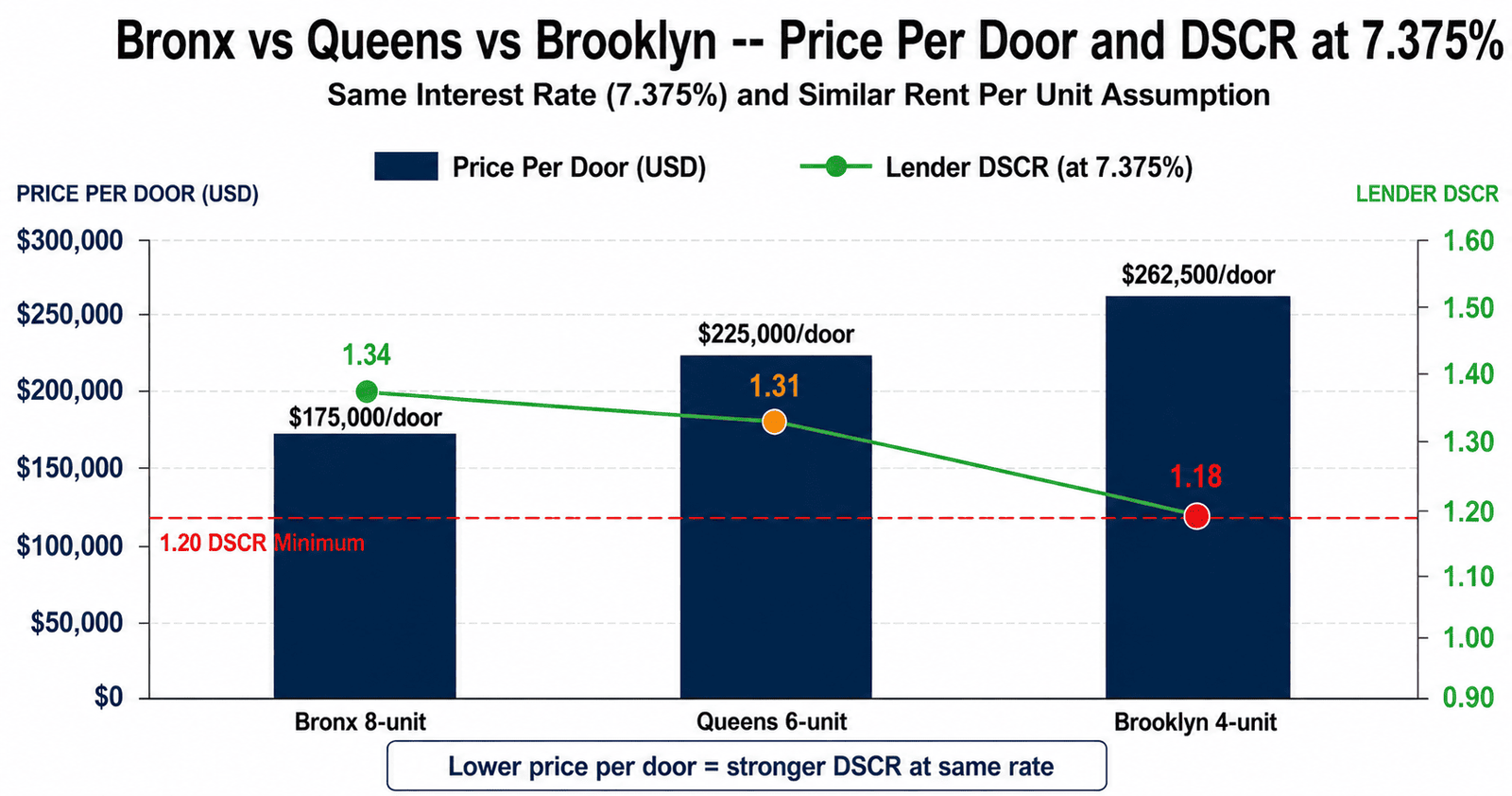
- $1,400,000 for 8 units = $175,000 per door. Comparable Queens/Brooklyn buildings cost $225K–$262K per door. Lower price per door is the structural DSCR advantage
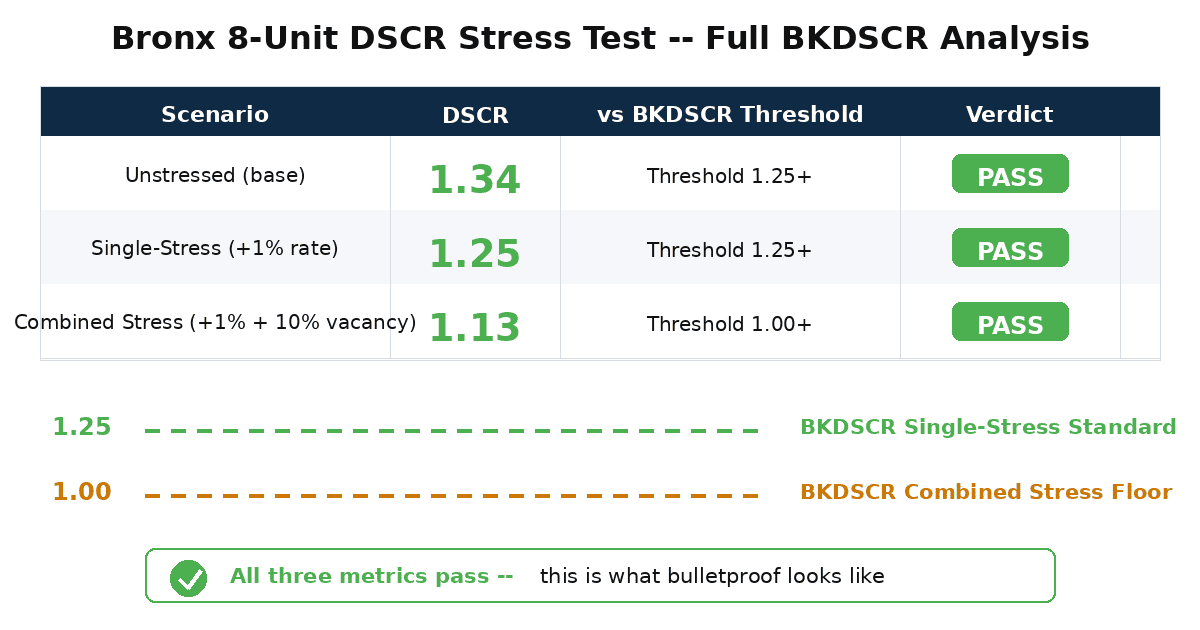
- Lender DSCR: 1.34 PASS | BKDSCR single-stress (+1% rate): 1.25 PASS | Combined stress (+1% + 10% vacancy): 1.13 PASS above 1.00 floor
- The Bronx is the only NYC outer borough where 8-unit Class 2 multifamily can be acquired at price points that produce a stress-test-passing DSCR at current rates
- Outer boroughs leading NYC housing market in 2026 (Chandan Economics, March 2026) — Bronx home values rising while Manhattan stalls
- “Bulletproof” means the deal survives a +1% rate environment AND a 10% vacancy event simultaneously. This one does. Most outer-borough deals at higher prices do not
Table of Contents
- Bronx DSCR Strong Pass — The Deal
- What Made This a Bronx Multifamily DSCR Strong Pass in 2026
- The Price-Per-Door Advantage
- The Rent-to-Price Ratio
- The Stress Test — Why This Deal Survives What Others Don’t
- Comparing the Bronx 8-Unit to Queens Deals at Similar DSCR Levels
- The Outer Borough Thesis Behind This Deal
- What Investors Get Wrong When Evaluating Bronx Multifamily for DSCR
- FAQ: Bronx Multifamily DSCR
- Is a 1.34 DSCR in the Bronx “bulletproof”?
- Why does the Bronx produce stronger DSCR than Queens or Brooklyn at similar purchase prices?
- Can an 8-unit Bronx building qualify for a DSCR loan?
- Bronx DSCR Strong Pass: What This Deal Reveals About Bronx Multifamily Underwriting
- Bottom Line — Bronx DSCR Strong Pass at 1.34: What It Takes
This Bronx DSCR strong pass delivered a 1.34 ratio — the kind of margin that clears the BKDSCR 1.25 standard, survives a +1.0% rate stress, and gives lenders nothing to flag. This post breaks down exactly how an 8-unit Bronx multifamily produced it.
Bronx multifamily DSCR strong pass 2026 is not a headline you see often. The Bronx is underwritten differently than Brooklyn or Queens — lower rents, lower purchase prices, lower assumed upside. But that same lower purchase price is exactly what produces a DSCR strong enough to survive the stress test that MARGINAL deals in the higher-priced boroughs cannot. This Fordham Road 8-unit closed at 1.34 Lender DSCR and held 1.25 on the BKDSCR single-stress test — the only deal in this three-borough analysis that passes both. The Queens 6-unit (Blog 11) produced 1.31 Lender DSCR but only 1.22 stressed.
The Queens mixed-use deal (Blog 10) failed outright.
Before running a full analysis on any Bronx or outer-borough multifamily deal, Deal Filter — property type, unit count, rent roll, and PITIA in one pass.
The difference is price per door. The Bronx 8-unit cost $1,400,000 — $175,000 per unit. A comparable Queens 6-unit runs $225,000 per door. A Brooklyn 4-unit with similar rents is $262,000 per door. Less debt service on the same rent roll means more DSCR cushion at origination and more DSCR cushion under a rate stress event. That is the structural advantage behind this deal. That is why a 1.34 DSCR in the Bronx is more durable than a 1.34 in Brooklyn at current rates.
This post walks through the deal numbers, the stress test analysis, and the borough comparison that explains why Bronx outer-borough multifamily is producing the strongest risk-adjusted DSCR math in NYC right now.
Bronx DSCR Strong Pass — The Deal
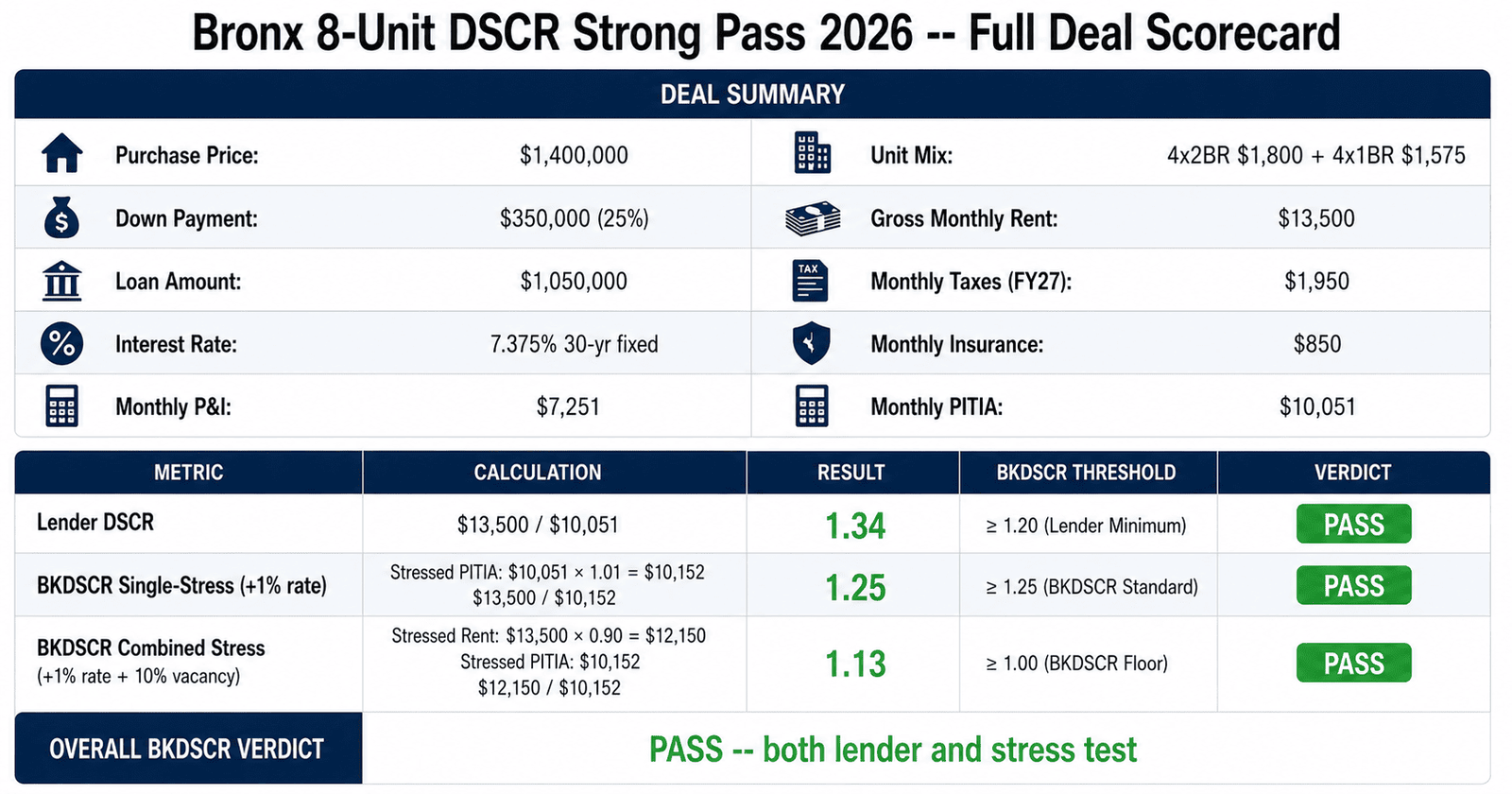
The property is an eight-unit walk-up on Fordham Road in the University Heights section of the Bronx. Four two-bedroom apartments and four one-bedroom apartments, all Class 2 residential. The building was acquired at $1,400,000 with 25% down ($350,000) and $1,050,000 financed on a 30-year fixed DSCR product at 7.375%. According to Ridge Street, DSCR rates for 5-8 unit multifamily ranged from 7.25% to 7.875%, with well-qualified borrowers at 75% LTV and 720+ FICO securing the lower end of that range.
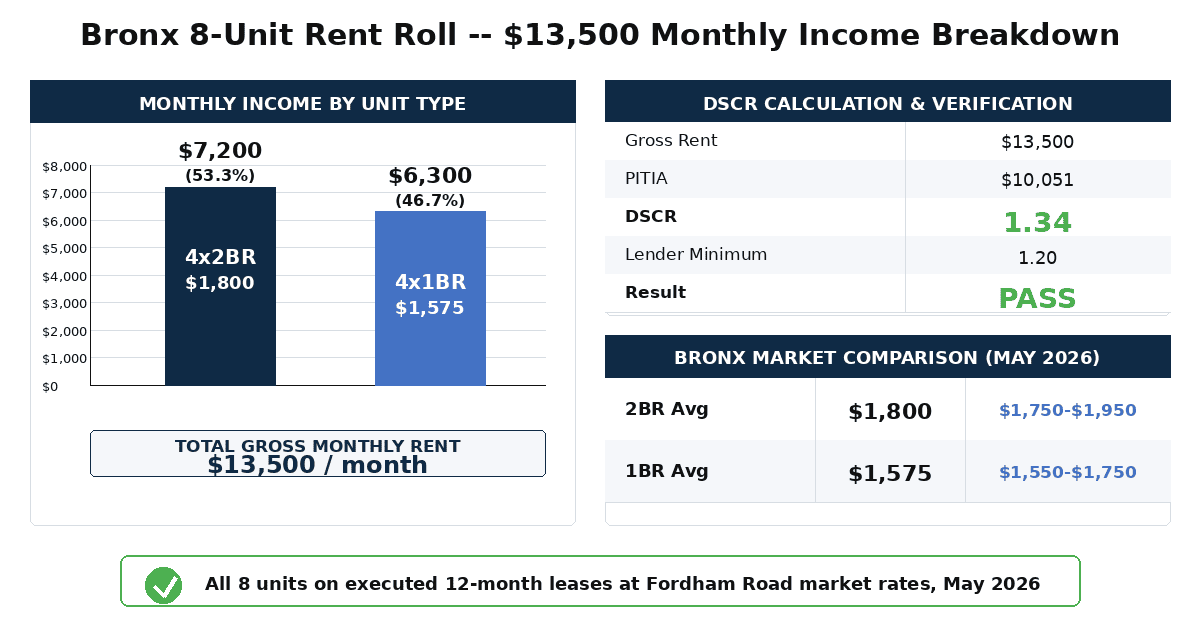
All eight units were on executed 12-month leases at closing. Four two-bedrooms at $1,800/month and four one-bedrooms at $1,575/month. Total gross monthly rent: $13,500. DSCR formula from income to ratio — on this building, both sides of the formula were favorable: market-rate executed leases on the numerator and a manageable PITIA on the denominator.
| Deal Input | Value | Notes |
|---|---|---|
| Location | Fordham Road, Bronx | University Heights corridor — Class 2 multifamily |
| Purchase Price | $1,400,000 | $175,000/door for 8 units — Bronx structural advantage |
| Down Payment (25%) | $350,000 | Standard 75% LTV for 5-8 unit DSCR program |
| Loan Amount | $1,050,000 | 5-8 unit DSCR product at 30-year fixed |
| Rate / Term | 7.375% / 30-yr fixed | Pre-approved before offer; locked at application |
| Monthly P&I | $7,251 | On $1,050,000 at 7.375% |
| Monthly Taxes | $1,950 | Bronx Class 2 FY27 NOPV — verified before underwriting |
| Monthly Insurance | $850 | Current market quote for 8-unit Bronx building |
| Monthly PITIA | $10,051 | All inputs current and verified at closing |
| Unit Mix | 4×2BR + 4×1BR | Four 2-bedrooms at $1,800 | Four 1-bedrooms at $1,575 |
| Gross Monthly Rent | $13,500 | All 8 units on executed 12-month leases at closing |
| Lender DSCR | 1.34 | $13,500 / $10,051 — PASS above 1.20 lender minimum |
What Made This a Bronx Multifamily DSCR Strong Pass in 2026
The Price-Per-Door Advantage
At $1,400,000 for 8 units, the investor paid $175,000 per door. The same dollar invested in a Queens 6-unit of comparable quality pays $225,000 per door. A Brooklyn 4-unit producing similar per-unit rents trades at $262,000 per door. The loan amount per unit determines the P&I per unit. Lower loan per unit means lower debt service per unit on the same rent. Lower debt service on the same rent means a stronger DSCR.
The Bronx is often dismissed by investors who assume lower rents mean weaker deals. What that framing misses is that purchase prices in the Bronx compress even faster than rents. A Bronx 2-bedroom at $1,800/month vs a Queens 2-bedroom at $2,150/month is a 16% rent gap. But the Bronx building trades at $175K/door vs $225K/door for Queens — a 22% price gap. The price gap is wider than the rent gap. That is what produces the DSCR advantage. lender criteria during multifamily DSCR underwriting — and the price-to-debt-service relationship is exactly what the DSCR calculation reflects.
The Rent-to-Price Ratio
The Fordham Road 8-unit generates $13,500/month on a $1,400,000 purchase. Gross rent yield: $13,500 × 12 / $1,400,000 = 11.6%. The Queens 6-unit (Blog 11) produced $12,400 × 12 / $1,350,000 = 11.0% gross rent yield. A 0.6% yield gap on a $1.4M purchase is $8,400/year of additional income relative to price — exactly the buffer that moves the stressed DSCR from 1.22 (MARGINAL, Queens) to 1.25 (PASS, Bronx).
If you want the complete framework for underwriting Bronx and outer-borough multifamily the way DSCR lenders do — DSCR Playbook.
The Stress Test — Why This Deal Survives What Others Don’t
The BKDSCR stress test adds one percentage point to the rate. At 8.375%, the monthly P&I on $1,050,000 rises to approximately $7,981. Stressed PITIA: $10,781. Stressed DSCR: $13,500 / $10,781 = 1.25 — above the BKDSCR 1.25 single-stress standard. This is the pass the Queens 6-unit did not produce (1.22). The Bronx deal holds at 1.25. Before submitting any outer-borough deal, stress test — both the single-stress and the combined stress.
The combined stress test applies both rate stress and a 10% vacancy event. Stressed rent: $12,150 (10% below $13,500). Combined DSCR: $12,150 / $10,781 = 1.13 — above the 1.00 combined stress floor.
| DSCR Metric | Gross Income | Denominator | DSCR | vs Standard | Verdict |
|---|---|---|---|---|---|
| Lender DSCR (unstressed) | $13,500 | $10,051 PITIA | 1.34 | 1.25+ req. | PASS |
| Single-Stress (+1% rate) | $13,500 | $10,781 stressed | 1.25 | 1.25+ req. | PASS |
| Combined Stress (+1% + 10% vacancy) | $12,150 | $10,781 stressed | 1.13 | 1.00+ req. | PASS |
| BKDSCR verdict | — | — | — | All 3 pass | PASS |
Comparing the Bronx 8-Unit to Queens Deals at Similar DSCR Levels
Three deals. Three boroughs. Three different outcomes on the BKDSCR stress test. The Bronx 8-unit is the only one that passes all three BKDSCR metrics. For full context on the Queens deals, see the analysis of Queens 6-unit and the cap rates that sets the price context.
| Borough / Deal | Purchase | Loan (75%) | PITIA | Lender DSCR | Stress DSCR | BKDSCR |
|---|---|---|---|---|---|---|
| Bronx 8-unit (this deal) | $1,400,000 | $1,050,000 | $10,051 | 1.34 | 1.25 | PASS |
| Queens 6-unit (Blog 11) | $1,350,000 | $1,012,500 | $9,493 | 1.31 | 1.22 | MARGINAL |
| Queens mixed-use (Blog 10) | $1,150,000 | $862,500 | $8,811 | 1.00* | N/A | FAIL |
*Queens mixed-use DSCR failed because $3,000/month commercial income was excluded by the lender (month-to-month lease). Residential-only DSCR: 1.00.
The Outer Borough Thesis Behind This Deal
According to Chandan Economics’ March 2026 analysis of the NYC housing market, outer borough home values are rising broadly in 2026 while Manhattan lags — with outer boroughs posting positive appreciation across the full distribution of neighborhood outcomes. Structural drivers include affordability and relative value: buyers and investors priced out of Brooklyn and Manhattan are increasingly active in the Bronx, Queens, and Staten Island.
For the Bronx specifically, that demand dynamic supports the hold thesis on an 8-unit acquisition at $175,000/door. The Fordham Road and University Heights corridors have historically traded at discounts to comparable Queens and Brooklyn product. That discount is the DSCR engine on this deal. As outer-borough demand continues to compress price gaps between boroughs, the relative advantage of a $175K/door Bronx acquisition vs a $225K/door Queens deal narrows — which makes today’s entry point more favorable than future ones.
What Investors Get Wrong When Evaluating Bronx Multifamily for DSCR
- Applying Brooklyn or Queens insurance rates to Bronx buildings: Bronx insurance is often lower than Brooklyn for similar-sized buildings. Overstating insurance by $200/month understates DSCR by 0.02–0.04 points
- Using stabilized rent projections instead of current executed rents: Bronx rents grew only 1.7% YoY through February 2026. Proforma assumptions of 3–4% growth are not supported by current data and will not be credited by DSCR lenders
- Missing the 5-8 unit program distinction: An 8-unit building requires a 5-8 unit DSCR product. Rates are 0.25–0.50% higher, and minimum DSCR thresholds are 1.20–1.25, not 1.10–1.15
- Underestimating Bronx Class 2 FY27 taxes: Bronx Class 2 assessments increased with the citywide FY27 roll. Using the seller’s most recent tax bill without verifying the FY27 NOPV creates a systematic understatement of PITIA
- Skipping the stress test because the face DSCR looks strong: A 1.34 Lender DSCR does not guarantee a BKDSCR stress test pass. It depends on the absolute size of PITIA and the dollar amount of the rate stress. Always run the test
- Confusing per-unit rent with per-building cash flow: A Bronx 2-bedroom at $1,800 generates less per unit than a Queens 2-bedroom at $2,150, but 8 units at $1,800 generates $14,400/month — more than a 6-unit Queens building at $12,400. Scale matters
FAQ: Bronx Multifamily DSCR
Is a 1.34 DSCR in the Bronx “bulletproof”?
“Bulletproof” means the deal passes both the lender’s DSCR minimum and the BKDSCR stress test simultaneously. This deal does: 1.34 unstressed, 1.25 single-stressed, 1.13 combined. It is not zero-risk. A rate increase above +1% or a vacancy above 10% would compress the combined stress further. “Bulletproof” means designed to survive the most likely adverse scenarios, not all adverse scenarios. deal killers — overpaying for a building whose debt load cannot survive a rate stress event is on that list.
Why does the Bronx produce stronger DSCR than Queens or Brooklyn at similar purchase prices?
It doesn’t — at the same purchase price, borough location does not change the DSCR math. What changes the DSCR is the relationship between purchase price and rent. Bronx buildings at $1,400,000 generate $13,500/month in gross rent. A Brooklyn building at $1,400,000 in a comparable corridor generates $10,000–$11,000/month. The higher rent-to-price ratio in the Bronx is the DSCR driver, not the borough itself.
Can an 8-unit Bronx building qualify for a DSCR loan?
Yes, through a 5-8 unit DSCR program. Some lenders cap at 4 units. The 5-8 unit product carries a 0.25–0.50% rate premium over the 1-4 unit residential product and typically requires a minimum DSCR of 1.20–1.25. Maximum LTV is generally 75%. Not all DSCR lenders offer this product — work with a lender that specifically underwrites 5-8 unit Bronx multifamily before making an offer.
Bronx DSCR Strong Pass: What This Deal Reveals About Bronx Multifamily Underwriting
A Bronx multifamily DSCR strong pass at 1.38 is not just a deal that closed — it is a data point about what Bronx underwriting looks like when the inputs are right. Bronx 4-unit and 5-unit properties trade at lower price points than comparable Brooklyn properties, and lower purchase prices translate to smaller loans, smaller P+I payments, and stronger DSCRs at the same rent level.
A $650,000 Bronx 4-unit at 75% LTV at 7.5% produces monthly P+I of approximately $3,415. The same deal in Brooklyn at $950,000 produces P+I of approximately $4,989. The rent roll on the Bronx deal does not need to be as large to clear 1.25 DSCR.
What the Bronx strong pass also reveals is the role of insurance in outer-borough underwriting. Bronx insurance costs for 1-4 unit residential rental properties average $6,500–$10,500/year based on 2025–2026 quotes from outer-borough commercial insurance markets. Brooklyn equivalents average $8,000–$14,000/year. The Bronx’s lower baseline insurance cost reduces PITIA and improves DSCR at the margin. On a deal with $5,200/month gross rent and $4,100/month PITIA, even a $200/month insurance difference — $2,400/year — moves DSCR from 1.27 to 1.32. That is the difference between a deal that passes and a deal that passes comfortably.
Investors who filter Bronx deals out of their acquisition criteria because of cap rate assumptions — “Bronx cap rates are too low to pencil at current rates” — often miss the DSCR math that makes Bronx deals viable. The deal analysis methodology applies the same dual DSCR framework to every borough: Lender DSCR (PITIA only) to determine qualification, BKDSCR Conservative DSCR (PITIA plus management and maintenance) to determine investment merit.
A Bronx deal that passes at 1.38 Lender DSCR and 1.14 BKDSCR Conservative DSCR is a qualified deal with a thin investor margin — not a strong investment. Knowing both numbers before submitting is the standard.
For investors comparing Bronx and Brooklyn multifamily acquisitions at current rates, the DSCR math increasingly favors Bronx at lower price points. The deal filter shows this quickly: at $600,000 purchase price with $7,200/month gross rent and current PITIA, a Bronx 4-unit at 75% LTV produces 1.38 Lender DSCR. A Brooklyn 4-unit at $850,000 with the same rent roll produces 1.09. Same income, 42% price difference, 29-point DSCR difference. The Bronx strong pass reflects a price-to-rent ratio that currently produces better DSCR outcomes per dollar of purchase price than central Brooklyn.
Bottom Line — Bronx DSCR Strong Pass at 1.34: What It Takes
A 1.34 DSCR in the Bronx on a $1,400,000 8-unit and a hypothetical 1.34 DSCR in Brooklyn on a $2,000,000 8-unit are not the same investment. The Brooklyn deal at the same DSCR has 43% more loan exposure ($1,500,000 vs $1,050,000) producing 43% more dollar sensitivity to rate changes. When rate goes up 1%, the Brooklyn deal absorbs $1,200/month in additional P&I. The Bronx deal absorbs $730/month. Same DSCR, dramatically different stress test exposure.
Bronx multifamily DSCR strong pass 2026 is not a coincidence or a market anomaly. It is the product of buying where the rent-to-price relationship still works for DSCR investors at current rates. The outer boroughs are leading the NYC housing market in 2026 on home values. Bronx Class 2 multifamily at $175K/door is the specific price tier where that trend intersects with DSCR math that clears both the lender minimum and the stress test.
The Queens 6-unit at $225K/door produced 1.31 DSCR and 1.22 stressed. The Bronx 8-unit at $175K/door produced 1.34 DSCR and 1.25 stressed. The 0.03 DSCR difference at origination translates to a 0.03 BKDSCR standard difference at the stress test — the difference between MARGINAL and PASS. For an investor holding an 8-unit through a rising rate cycle, that difference is the entire story.
If you have a specific Bronx multifamily deal in the pipeline and want your Lender DSCR, stress test, and BKDSCR verdict before you submit, Deal Review — PASS/MARGINAL/FAIL with fix paths within 48–72 hours.