
Brooklyn DSCR Qualifying Rent: The Exact Number in 2026
Key Takeaways
- On a $975,000 Brooklyn 4-unit at 75% LTV and 7.5%, PITIA is $7,279/month
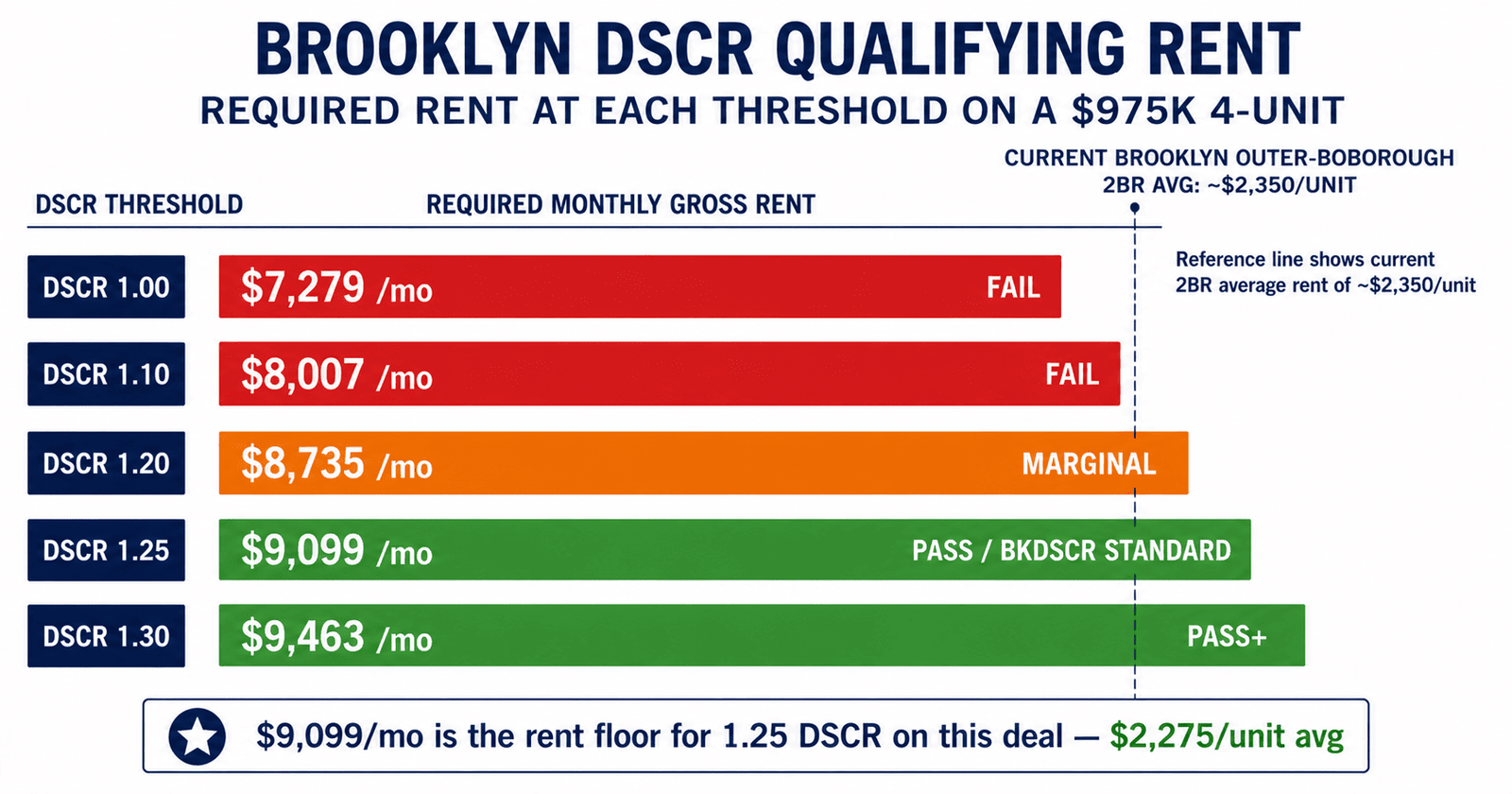
- 1.25 DSCR — the BKDSCR standard — requires $9,099/month in gross rent, or $2,275/unit average
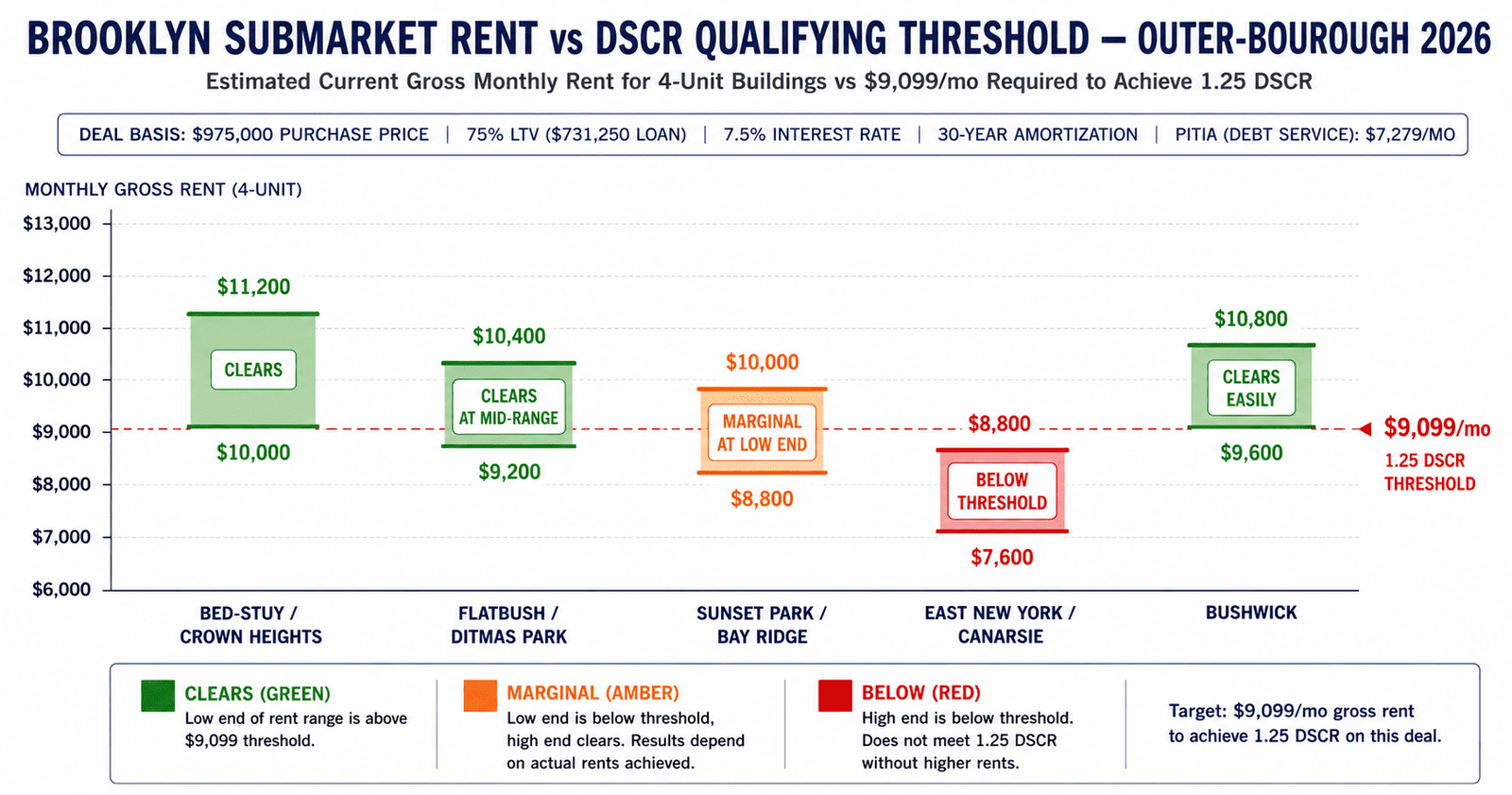
- Bed-Stuy, Crown Heights, Flatbush, and Bushwick 4-units clear that threshold at current market rents
- East New York and Canarsie fall short at current rents — value-add or price reduction required
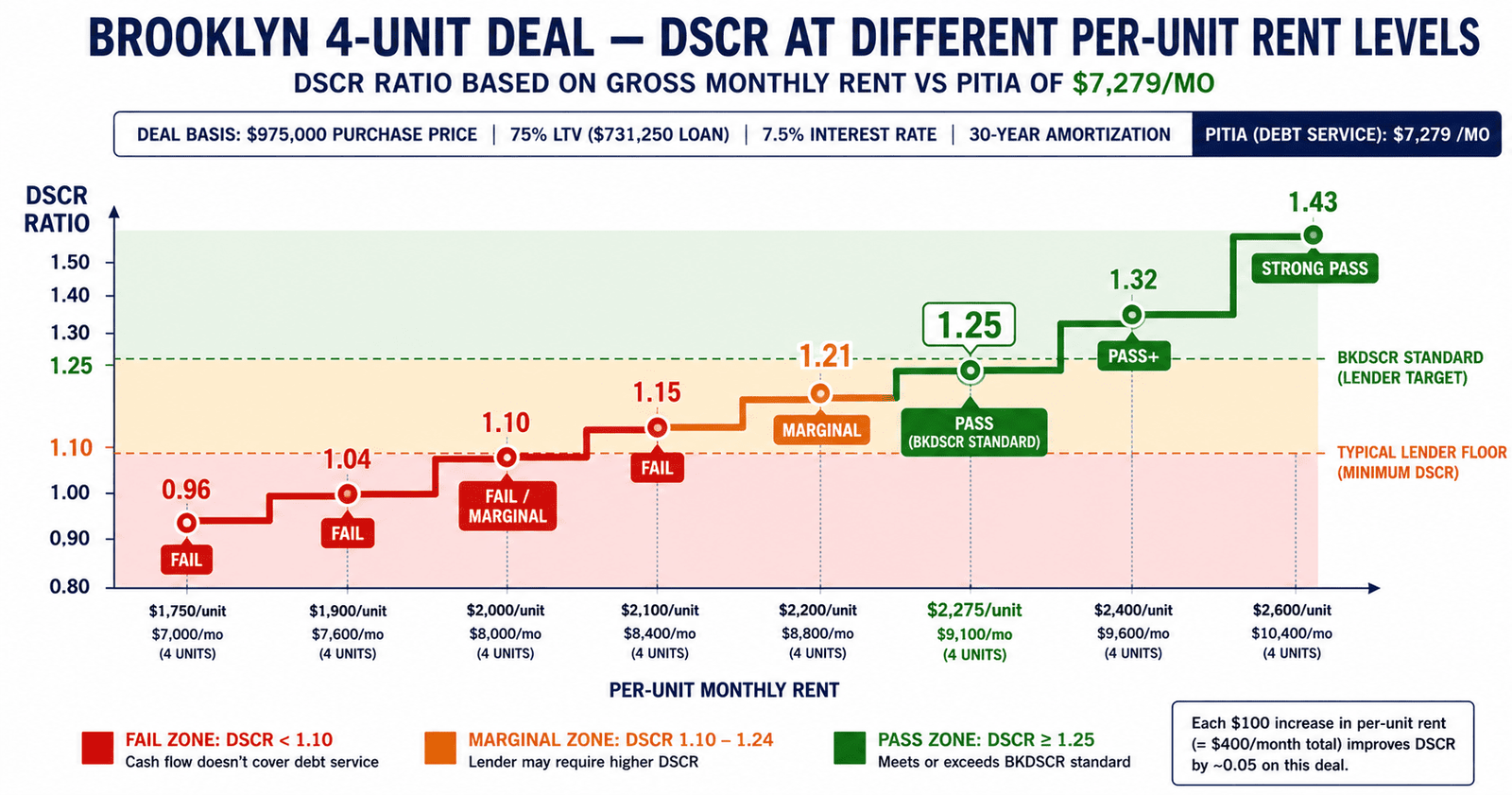
- Every $100 more per unit adds $400/month gross rent and approximately 0.05 DSCR points
- The 1.00 DSCR lender floor requires only $1,820/unit — but clears no program with a stress test
Table of Contents
- Brooklyn DSCR Qualifying Rent: The Formula and What Drives It
- Brooklyn DSCR Qualifying Rent: At What Threshold Does This Deal Pass
- Brooklyn DSCR Qualifying Rent by Submarket: Where the Numbers Work
- How to Solve the Brooklyn DSCR Qualifying Rent Gap
- Path A: Submarket Selection — Find a Deal Where the Market Rent Already Clears
- Path B: Value-Add — Buy Below-Market Rents, Re-Lease to Market
- Path C: Purchase Price Reduction — Change the PITIA, Not the Rent
- How the Appraisal Comp Pool Affects Your Qualifying Rent
- FAQ: Brooklyn DSCR Loan Qualifying Rent
- Brooklyn DSCR Qualifying Rent: Does Every Lender Use 1.25 as the Minimum?
- How does rent stabilization affect the Brooklyn DSCR qualifying rent calculation?
- Can I use projected rents after renovation to qualify for a Brooklyn DSCR loan?
- How much does a $25K price reduction improve DSCR on a Brooklyn 4-unit?
- Why the Same DSCR Loan Qualifies in One Brooklyn Neighborhood and Fails in Another
Brooklyn DSCR qualifying rent is not a number most investors calculate before they go under contract. They look at the gross rent, divide by an estimated PITIA, see a ratio close to 1.0, and assume the deal qualifies. The problem is “close to 1.0” and “qualifying” are not the same thing. At the BKDSCR standard of 1.25+, the deal actually clears the threshold that matters for rate tier, lender access, and stress test survival.
This post runs the exact math on a composite Brooklyn 4-unit at current prices and rates, shows the required rent at every qualifying threshold, maps those numbers against current outer-borough submarket rents, and explains what to do when the numbers fall short.
| MARKET SNAPSHOT — Brooklyn Rents & DSCR Rates, June 2026 | |
|---|---|
| Sources: Corcoran Group March 2026 | Zumper May 2026 | Griffin Funding June 2026 | |
| BROOKLYN RENT DATA | |
| Brooklyn median rent — all units (Zumper, May 2026) | $3,650/month |
| Brooklyn 1BR avg (Corcoran March 2026) | $4,504/month |
| Brooklyn 2BR avg (Corcoran March 2026) | $5,866/month |
| Outer-borough 4-unit 2BR range | $1,900–$2,800/unit (submarket-dependent) |
| Brooklyn YoY rent growth | +4% (Corcoran March 2026) |
| DSCR RATES & QUALIFYING MATH | |
| 30-yr fixed (Griffin Funding) | 6.125%–7.5% |
| Outer-borough 4-unit benchmark | 7.5% at 75% LTV, 700+ FICO |
| PITIA on $975K at 75% LTV, 7.5% | $7,279/month |
| 1.25 DSCR qualifying rent | $9,099/month ($2,275/unit) |
Before running numbers on any Brooklyn deal, Deal Filter — property type, purchase price, rent roll, and DSCR in one pass.
Brooklyn DSCR Qualifying Rent: The Formula and What Drives It
Brooklyn DSCR qualifying rent is the gross monthly rent that, divided by the total monthly PITIA, produces the target DSCR ratio. The qualifying rent formula is: Target DSCR × Monthly PITIA = Required Gross Monthly Rent. On the composite deal in this post, PITIA is $7,279 per month. Multiply by 1.25 and the required rent is $9,099. The DSCR calculator works from either direction: give it the rent and get the DSCR, or give it the target DSCR and get the required rent.
| Deal Input | Figure |
|---|---|
| Property Type | 4-unit walkup, pre-war, Brooklyn outer-borough |
| Purchase Price | $975,000 |
| Down Payment (25%) | $243,750 |
| Loan Amount (75% LTV) | $731,250 |
| Rate / Term | 7.5% / 30-year fixed |
| Monthly P&I | $5,129 |
| Monthly Property Tax | $1,600 (Brooklyn Class 2, FY27 NOPV) |
| Monthly Insurance | $550 (pre-war 4-unit, current market) |
| Total Monthly PITIA | $7,279 |
According to Ridge Street, 30-yr fixed DSCR rates for outer-borough 4-unit deals are running 6.125%–7.5% in June 2026, with the benchmark at 7.5% for 700+ FICO at 75% LTV. At that rate, $731,250 in debt produces $5,129 per month in P&I. Add FY27 assessed taxes and current market insurance and the PITIA lands at $7,279. Brooklyn rent benchmarks are tracked monthly — Zumper May 2026 NYC rental data shows submarket-level figures useful for stress-testing rent assumptions before going under contract.
Brooklyn DSCR Qualifying Rent: At What Threshold Does This Deal Pass
The qualifying rent number is not one figure — it depends on which DSCR threshold the lender requires, and which threshold you are targeting.
| DSCR | Required Gross Rent | Per Unit | Verdict | What This Means |
|---|---|---|---|---|
| 1.00 | $7,279/mo | $1,820/unit | FAIL | Most programs: lender floor |
| 1.10 | $8,007/mo | $2,002/unit | FAIL | Some programs: soft minimum |
| 1.20 | $8,735/mo | $2,184/unit | MARGINAL | Most programs: standard minimum |
| 1.25 | $9,099/mo | $2,275/unit | PASS | BKDSCR standard — required |
| 1.30 | $9,463/mo | $2,366/unit | PASS+ | Strong pass — best rate tier |
The 1.00 DSCR floor is technically the lender’s minimum on many programs — but clearing 1.00 exactly is not a viable deal position. A +1.0% rate stress drops a 1.01 DSCR to approximately 0.92. The stress test shows exactly where the deal lands. The 1.25 DSCR tier is where rate pricing improves, best programs open, and the BKDSCR single-stress standard kicks in.
Brooklyn DSCR Qualifying Rent by Submarket: Where the Numbers Work
The $9,099 qualifying gross rent is achievable in specific submarkets at current market rents — and not achievable in others without a value-add strategy or price reduction. Knowing which submarkets produce passing DSCRs at current rents is the filter that should precede every deal search.
| Submarket | Avg 2BR/Unit | 4-Unit Monthly | vs $9,099 Required |
|---|---|---|---|
| Bed-Stuy / Crown Heights | $2,500–$2,800 | $10,000–$11,200 | Clears 1.25 at mid-range; strong pass at current market rents |
| Flatbush / Ditmas Park | $2,300–$2,600 | $9,200–$10,400 | Clears 1.25 at low end; value-add pushes further above |
| Sunset Park / Bay Ridge | $2,200–$2,500 | $8,800–$10,000 | Low end MARGINAL; mid-range clears with updated units |
| East New York / Canarsie | $1,900–$2,200 | $7,600–$8,800 | Below threshold at current rents; price cut or value-add required |
| Bushwick (market-rate) | $2,400–$2,700 | $9,600–$10,800 | Clears easily; strong 1007 comp pool |
Two important caveats. First, the appraiser’s 1007 market rent schedule determines what the lender uses — not the current asking rent. Second, rent-stabilized units are underwritten at their legal rent. The deal killers page documents how lenders treat mixed rent rolls and why the per-unit composition matters at underwriting.
How to Solve the Brooklyn DSCR Qualifying Rent Gap
If the submarket rent falls short of the qualifying threshold, three structural paths close the gap.
Path A: Submarket Selection — Find a Deal Where the Market Rent Already Clears
The most direct path is targeting submarkets where current 2BR market rents produce a passing DSCR at the target purchase price. Bed-Stuy, Crown Heights, Flatbush, and Bushwick all produce 4-unit gross rents above $9,099 at current market rates when units are market-rate, updated, and rented at current levels. No assumptions. No projections. No value-add execution risk.
Path B: Value-Add — Buy Below-Market Rents, Re-Lease to Market
A building with below-market or vacant units may qualify on a value-add basis. DSCR lenders use the appraiser’s 1007 market rent estimate for occupied units where the current rent is below market — but only if the appraiser supports the higher figure. Vacant units are underwritten at zero. The path to using post-renovation rents is to buy with bridge or cash, stabilize, then do a rate-and-term DSCR refinance once the 1007 supports the higher rent level.
Path C: Purchase Price Reduction — Change the PITIA, Not the Rent
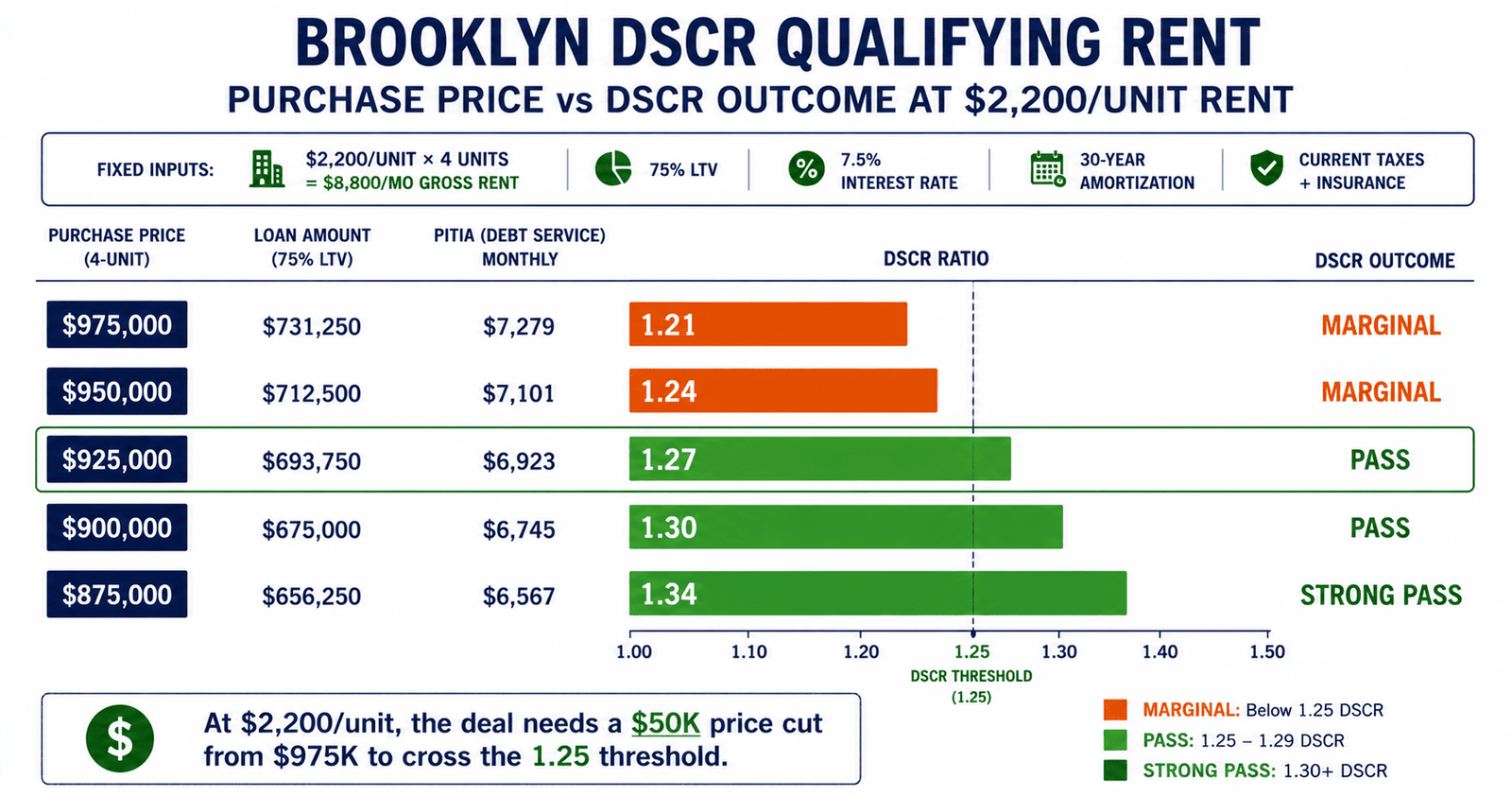
Every $50,000 reduction in purchase price reduces the loan by $37,500 at 75% LTV and P&I by approximately $263/month. To go from a 1.21 DSCR (at $2,200/unit) to 1.25 DSCR without changing rents, the purchase price needs to drop to approximately $900,000. That is a $75,000 price reduction — a legitimate negotiating position in a market where deals are taking longer to close.
Get the complete DSCR underwriting framework for Brooklyn outer-borough deals. DSCR Playbook covers every input, threshold, and deal structure explained.
How the Appraisal Comp Pool Affects Your Qualifying Rent
The qualifying rent is not what the seller claims. It is the lower of actual lease rents for occupied units or the appraiser’s estimated market rent from the 1007 schedule. Brooklyn rents rose 4% year-over-year through March 2026. An appraiser pulling comps from leases signed 9–12 months ago will use rents 4% below current asking. On a deal modeled at $2,400/unit, the 1007 might come back at $2,300/unit — reducing qualifying gross rent from $9,600 to $9,200. See lender criteria for how DSCR lenders specify appraisal requirements. See also: Brick Underground.
FAQ: Brooklyn DSCR Loan Qualifying Rent
Brooklyn DSCR Qualifying Rent: Does Every Lender Use 1.25 as the Minimum?
No. DSCR minimum ratios vary by lender and program. Some lenders will fund at 1.0. Others require 1.20. The 1.25 threshold is the BKDSCR standard — the ratio at which a deal has enough margin to survive a +1.0% rate stress and still clear 1.00+ combined stress.
How does rent stabilization affect the Brooklyn DSCR qualifying rent calculation?
Rent-stabilized units are underwritten at their legal rent — not market rate. On a 4-unit where one unit is stabilized at $1,100 and three are market-rate at $2,400, qualifying gross rent is $1,100 + ($2,400 × 3) = $8,300 — not $9,600. At $7,279 PITIA, that produces a DSCR of 1.14 — below the BKDSCR 1.25 standard.
Can I use projected rents after renovation to qualify for a Brooklyn DSCR loan?
No, on a standard purchase DSCR loan. Lenders underwrite on current actual rents (occupied units) or the appraiser’s market rent estimate. Future rents after planned improvements are not accepted. The path is to buy with cash or bridge financing, complete the renovation, place tenants at market rents, then refinance into DSCR once the rent roll is established.
How much does a $25K price reduction improve DSCR on a Brooklyn 4-unit?
At 75% LTV and 7.5%, a $25,000 purchase price reduction reduces the loan by $18,750 and monthly P&I by approximately $131. At $7,279 PITIA and $9,100 gross rent, that moves DSCR from approximately 1.25 to 1.27. Closing the gap from 1.10 to 1.25 requires roughly $107,000 in price reduction. Run your specific inputs through the DSCR calculator to find the exact price where your target threshold clears.
The rent threshold required for a Brooklyn DSCR loan is a moving target — it shifts with every rate change, every assessment cycle, and every insurance renewal. The $2,275/unit threshold on a $975,000 4-unit at 7.5% becomes $2,441/unit if rates move to 8.0%. That is $166/unit more required from the same market. In Brooklyn submarkets where achievable rents are running $2,300–$2,400/unit, a 50-basis-point rate increase flips a marginal pass into a clear fail.
Investors modeling Brooklyn deals in a rate-sensitive environment should run the DSCR at current rates and at +0.5% to confirm the deal holds across the likely rate range between offer and closing. The DSCR calculator runs this sensitivity in under a minute on any Brooklyn 4-unit deal inputs.
Brooklyn DSCR Qualifying Rent: The Submarket Gap and What It Means for Deal Selection
Why the Same DSCR Loan Qualifies in One Brooklyn Neighborhood and Fails in Another
Brooklyn DSCR qualifying rent is a neighborhood variable, not a borough average. The $9,099/month required rent on a $975,000 4-unit at 75% LTV and 7.5% rate — $2,275/unit — is achievable in Crown Heights, Bushwick, or Bed-Stuy at current market rents. It is not achievable in East New York, Canarsie, or Brownsville at current market rents on in-place leases.
The difference is not the property or the loan — it is the local rent level relative to the purchase price and PITIA stack. Investors who evaluate Brooklyn deals as a single market instead of a set of distinct submarkets underestimate how much submarket selection drives DSCR viability.
The 1007 Rent Schedule and What the Appraiser Will Actually Use
The qualifying rent figure the lender uses is not the market rent an investor projects — it is the lower of the 1007 appraisal rent schedule or the in-place executed lease amounts. In a market where rents are rising, the 1007 comp pool may lag current market by 6–12 months. An investor who models $2,400/unit based on current asking rents may find the 1007 rent schedule produces $2,200/unit based on leases signed in the prior year.
That $200/unit difference on a 4-unit is $800/month — enough to move DSCR from 1.28 to 1.17 on a tight deal. Always confirm with the appraiser what comp pool they expect to use before relying on projected market rent.
The practical verification step: pull the 3 most recent signed leases on comparable units in the specific submarket from StreetEasy or NYC DOF ACRIS. If those signed lease rents match or exceed the qualifying rent threshold, the 1007 rent schedule is likely to support the deal. If recent signed leases are below the threshold, the deal may fail at appraisal even if asking rents are higher. The deal analysis methodology builds this rent verification step into the pre-submission process because the 1007 outcome is the single largest unknown in Brooklyn DSCR underwriting.
For Brooklyn outer-borough 4-units specifically, the $2,275/unit qualifying rent threshold at the $975,000 price point and current rates is a reasonable hurdle in most of central Brooklyn but a stretch in the southeast boroughs. Investors who are working with a narrower rent-to-price ratio should run the stress test at the 1007-adjusted rent, not the market asking rent, to confirm the deal holds before going under contract.
The Rent Number That Determines Whether the Deal Closes
Brooklyn DSCR qualifying rent is the most important number in any Brooklyn outer-borough deal analysis — and the one most often skipped until the lender runs it at underwriting. At $975,000 and 75% LTV, the 1.25 qualifying rent is $9,099 per month. That is $2,275 per unit on a 4-unit building. It is achievable in Bed-Stuy, Crown Heights, Flatbush, and Bushwick at current market rents. It is not achievable in East New York or Canarsie without a price reduction or value-add strategy.
The calculation is arithmetic, not judgment. PITIA is fixed once the deal is structured. The required rent follows directly from the target DSCR. The only variables the investor controls are the purchase price and the submarket selection. Both decisions are made before the offer is submitted — not after the appraisal comes back.
Run the rent requirement calculation on every Brooklyn deal before going under contract. Solve for the required gross rent at 1.25 DSCR. Check whether current submarket rents support that number. If they do not, identify which path closes the gap.
If you have a Brooklyn deal and want to know the exact qualifying rent, stressed DSCR, and lender match position — Deal Review delivers the full written analysis within 48–72 hours.