
Brooklyn DSCR Refi Marginal: The Brutal 1.19 Risk
Key Takeaways
- Brooklyn DSCR refi marginal analysis 2026: this Flatbush 4-unit funded at 1.19 DSCR — four basis points above the lender’s 1.15 floor
- BKDSCR verdict: MARGINAL — 1.19 fails the 1.25 unstressed standard and the 1.25 single-stress standard
- Stress test: single-stress (+1% rate) drops DSCR to 1.10 — MARGINAL. Combined stress (rate + 10% vacancy): 0.99 — FAIL below the 1.00 floor
- The LTV decision is where this deal broke. At 65% LTV instead of 70%, DSCR would have been 1.26 — PASS
- Cash-out refis carry a 0.25–0.50% rate premium over purchase loans — pushing PITIA higher and DSCR lower before underwriting begins
- Top-tier lenders raised minimum DSCR from 1.20 to 1.25 for stabilized assets in January 2026 (Cor Advisors, April 2026) — this deal would not qualify at those programs
Table of Contents
- Brooklyn DSCR Refi Marginal Analysis — The Deal
- Why 1.19 DSCR Earns a MARGINAL Verdict on a Brooklyn DSCR Refi
- The Lender Floor Is Not the BKDSCR Standard
- The Cash-Out Rate Premium Compounds the Problem
- Brooklyn DSCR Refi Stress Test — What 1.19 Actually Means
- The LTV Decision That Made This a Marginal Brooklyn DSCR Refi
- Brooklyn DSCR Refi: Lender Approval vs BKDSCR Verdict
- What Investors Get Wrong on Brooklyn DSCR Cash-Out Refis
- FAQ: Brooklyn DSCR Cash-Out Refi
- Does a 1.19 DSCR on a cash-out refi mean the deal is wrong?
- What is the minimum DSCR for a Brooklyn cash-out refi?
- How much does LTV affect DSCR on a Brooklyn cash-out refi?
- Can I use projected rent increases to qualify for a higher cash-out amount?
- Bottom Line — Brooklyn DSCR Refi Marginal: The 1.19 Verdict
This Brooklyn DSCR refi marginal case is about what happens when a ratio clears the lender floor but fails the BKDSCR standard — and why 1.19 is not the same as safe. The deal funded. But the lender priced it, restricted it, and flagged it at every stage.
Approved and MARGINAL are not contradictory. They measure different things. The lender’s 1.15 minimum tests whether the loan repays under current conditions. The BKDSCR 1.25 standard tests whether the deal survives when conditions change. At 1.19, this refi passes the first test and fails the second. The stress test result tells the rest of the story: at +1% rate pressure, DSCR drops to 1.10. On the combined stress (rate plus vacancy), it falls to 0.99 — below the 1.00 combined floor.
This post breaks down the deal, the refinancing math, why a 1.19 that clears the lender’s floor still earns a MARGINAL verdict from BKDSCR, and what the investor should have done differently at the LTV decision point.
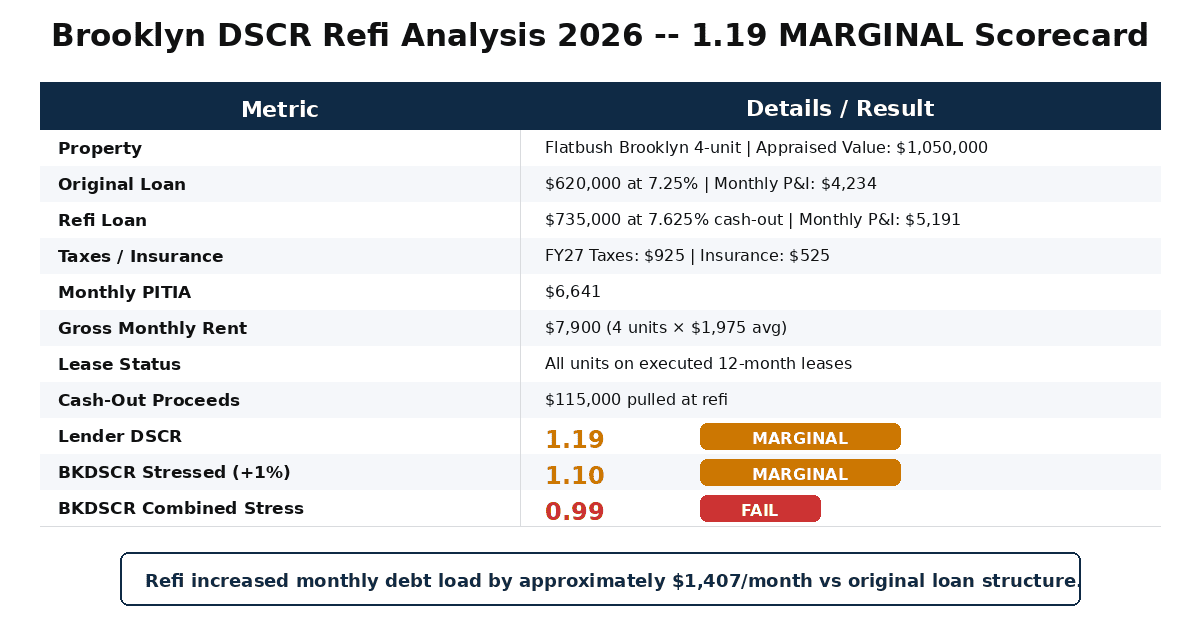
Brooklyn DSCR refi marginal analysis 2026 begins with a number the lender approved and BKDSCR flagged: 1.19. A Flatbush 4-unit owner refinanced in 2026 to pull $115,000 in equity. The lender’s minimum DSCR for cash-out refi was 1.15. The deal came in at 1.19 — four basis points above the floor. The loan funded. The investor collected the cash. And the BKDSCR verdict was MARGINAL from the first underwriting pass to the last.
Before spending time on a full Brooklyn refi analysis, Deal Filter — property type, current loan, rent roll, and PITIA in one pass.
Brooklyn DSCR Refi Marginal Analysis — The Deal
The property is a four-unit walk-up in Flatbush, Brooklyn. The investor acquired it in 2021 at $950,000 with a DSCR purchase loan at 7.25%. By 2026, the Flatbush market had pushed values to approximately $1,050,000 on a current appraisal. Five years of Flatbush rent growth had moved the four 2-bedroom units from $1,600–$1,700/month at acquisition to $1,900–$2,050/month at current market — all on executed 12-month leases. Total gross monthly rent at the time of the refi: $7,900.
The investor wanted to pull equity to fund a second acquisition. The refi plan: cash-out at 70% LTV on the $1,050,000 appraised value, producing a $735,000 new loan and approximately $115,000 in cash proceeds after the $620,000 payoff. The rate on the new loan: 7.625% — the cash-out premium over purchase rates in May 2026. The PITIA on the new loan came to $6,641/month — $285 more than the original $6,356 from the 2021 purchase loan. refi analyzer for modeling LTV scenarios before you commit. Use the refi analyzer to model LTV scenarios before you commit.
The rent roll grew meaningfully since acquisition. But so did the costs. The FY27 property tax bill on the Flatbush building reflected Brooklyn Class 2 assessment increases that have now compounded across two consecutive years, pushing the monthly tax impound from $810 at purchase to $925 at the refi date. Insurance moved from $465 to $525 on the same trajectory that has affected most NYC outer-borough landlords since 2022.
| Deal Input | Value | Notes |
|---|---|---|
| Property | Flatbush, Brooklyn — 4-unit | Original purchase 2021; refinancing 2026 to pull equity |
| Appraised Value | $1,050,000 | Current 2026 appraisal — $950K original purchase price |
| Original Loan | $620,000 at 7.25% | 2021 DSCR purchase loan | monthly P&I: $4,234 |
| New Refi Loan | $735,000 at 7.625% | 70% LTV cash-out | monthly P&I: $5,191 |
| Cash-Out Proceeds | ~$115,000 | $735,000 new loan minus $620,000 payoff |
| Monthly Taxes (FY27) | $925 | Brooklyn Class 2 FY27 — up from $810 at purchase |
| Monthly Insurance | $525 | Current market quote — up from $465 at purchase |
| Monthly PITIA (refi) | $6,641 | $285/month higher than original PITIA of $6,356 |
| Gross Monthly Rent | $7,900 | 4 units at avg $1,975 | all 12-month executed leases |
| Lender DSCR | 1.19 | $7,900 / $6,641 — MARGINAL | clears lender 1.15 minimum |
Why 1.19 DSCR Earns a MARGINAL Verdict on a Brooklyn DSCR Refi
The Lender Floor Is Not the BKDSCR Standard
The lender’s minimum DSCR for this cash-out refi program was 1.15. The deal came in at 1.19. The lender approved it. The BKDSCR analysis flagged it MARGINAL from the first number entered. A 1.19 Lender DSCR is four basis points above the lender floor and six basis points below the BKDSCR 1.25 unstressed standard. Those six basis points represent $474/month in gross rent the property would need to generate to reach 1.25 at the same PITIA. The current rent roll does not produce that.
According to Cor Advisors, a top-tier U.S. commercial real estate lender raised its minimum DSCR threshold from 1.20 to 1.25 for stabilized assets in January 2026. This deal — approved at 1.19 by one lender — would not qualify at that program at all. lender criteria on DSCR cash-out refi submissions, including which programs require 1.20 and which now require 1.25.
The Cash-Out Rate Premium Compounds the Problem
Cash-out DSCR refinances price higher than purchase loans or rate-and-term refis — typically 0.25–0.50% in rate. For this deal, the effective cash-out premium added approximately 0.25% to the rate. At $735,000 balance, that 0.25% rate premium translates to approximately $154/month in additional P&I — which is $154/month of reduced DSCR before a single underwriting overlay is applied.
The investor modeled the cash-out at 7.25% (the purchase rate) before seeing the actual cash-out quote. At 7.25%, the $735,000 loan produces DSCR 1.22. The actual 7.625% cash-out rate drops that to 1.19. Modeling at the wrong rate understated the risk before submission.
If you want the complete framework for underwriting Brooklyn refis the way lenders do — including LTV sensitivity, rate premiums, and stress test standards — DSCR Playbook.
Brooklyn DSCR Refi Stress Test — What 1.19 Actually Means
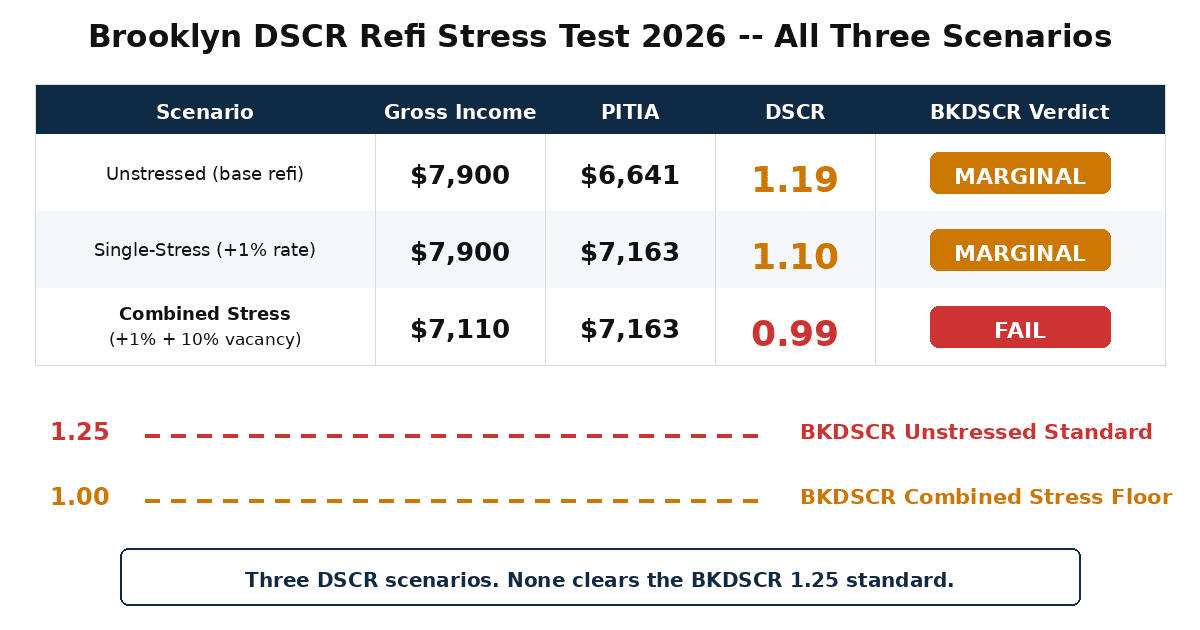
The BKDSCR stress test applies one percentage point of additional rate to the refinance scenario. At 8.625%, the monthly P&I on $735,000 rises to approximately $5,713. New stressed PITIA: $7,163. Stressed DSCR: $7,900 / $7,163 = 1.10 — MARGINAL. This Brooklyn refi starts at 1.19 and drops to 1.10 under stress. Compare this to the Queens 6-unit — that deal started at 1.31 unstressed and dropped to 1.22 stressed. The Brooklyn refi’s starting point is lower and the stress floor is lower.
The combined stress test result is the number that matters most on this deal. Before submitting, stress test. At combined stress (rate +1% and 10% vacancy): stressed rent = $7,110, stressed PITIA = $7,163. Combined DSCR: $7,110 / $7,163 = 0.99 — FAIL. The deal is approved but it cannot absorb a simultaneous rate increase and a single unit going vacant for more than a few weeks.
| Scenario | Gross Income | PITIA | DSCR | BKDSCR Verdict |
|---|---|---|---|---|
| Original loan (2021 at 7.25%) | $7,900 | $6,356 | 1.24 | MARGINAL |
| Refi base (7.625% cash-out) | $7,900 | $6,641 | 1.19 | MARGINAL |
| Single-Stress (+1% refi rate) | $7,900 | $7,163 | 1.10 | MARGINAL |
| Combined Stress (+1% + 10% vacancy) | $7,110 | $7,163 | 0.99 | FAIL |
| BKDSCR standard | — | — | 1.25+ | Required |
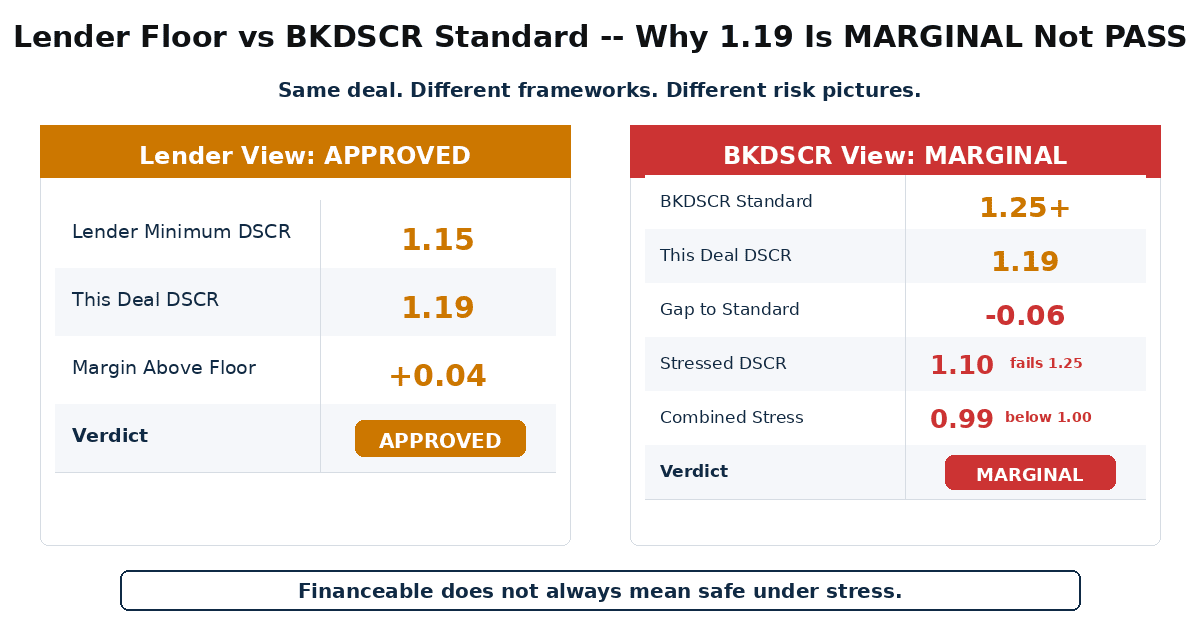
CAPTION: Lender approved at 1.19 (above 1.15 floor). BKDSCR standard requires 1.25+ unstressed. Stressed DSCR: 1.10. Combined stress: 0.99. Approved does not mean safe.
The LTV Decision That Made This a Marginal Brooklyn DSCR Refi
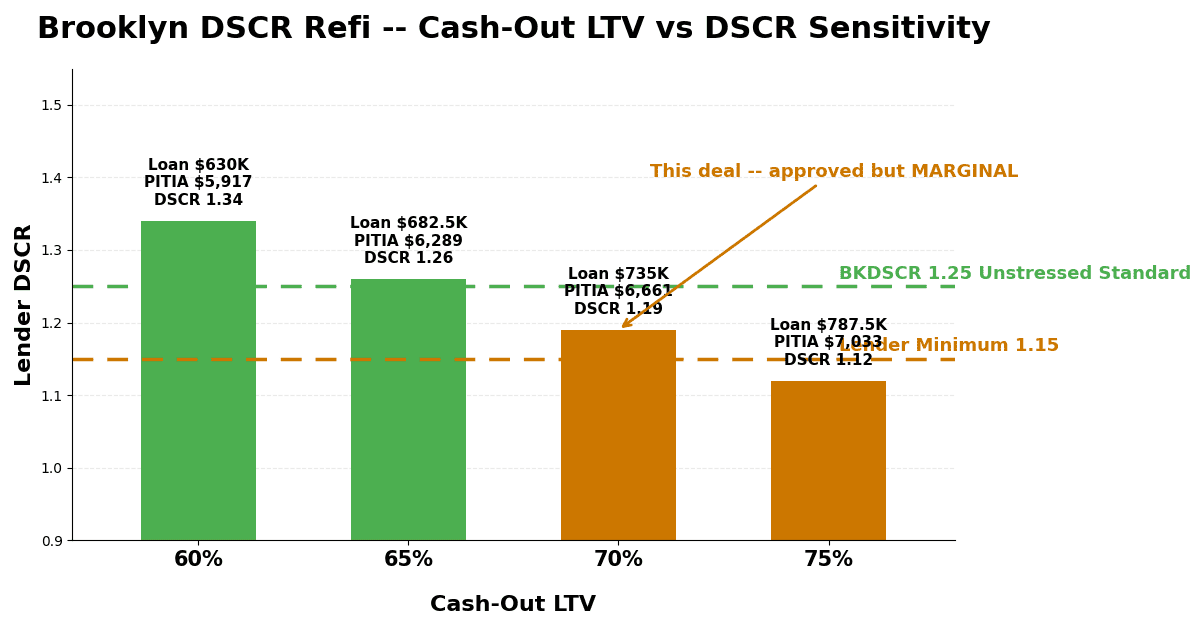
The single most consequential decision in this deal was the choice of 70% LTV. At 65% LTV — a loan of $682,500 instead of $735,000 — the monthly P&I at 7.625% drops to $4,839 and the PITIA to $6,289. DSCR: $7,900 / $6,289 = 1.26 — PASS. The stressed DSCR at 65% LTV: 1.16 — still MARGINAL stressed, but the unstressed figure clears the 1.25 standard. The combined stress at 65% LTV: $7,110 / $6,811 = 1.04 — above the 1.00 floor.
At 65% LTV, the investor pulls approximately $62,500 in cash proceeds instead of $115,000. The $52,500 difference in proceeds is the cost of moving from a MARGINAL to a PASS verdict — and from a combined stress of 0.99 (FAIL) to 1.04 (above floor). deal killers — and LTV creep that drops DSCR below the safe threshold is on that list specifically for cash-out refi submissions.
| Cash-Out LTV | Loan Amount | P&I (7.625%) | PITIA | Lender DSCR | Verdict |
|---|---|---|---|---|---|
| 60% LTV | $630,000 | $4,467 | $5,917 | 1.34 | PASS |
| 65% LTV | $682,500 | $4,839 | $6,289 | 1.26 | PASS |
| 70% LTV ← this deal | $735,000 | $5,191 | $6,641 | 1.19 | MARGINAL |
| 75% LTV | $787,500 | $5,563 | $7,013 | 1.13 | MARGINAL |
Brooklyn DSCR Refi: Lender Approval vs BKDSCR Verdict
The lender approved this deal because it met the lender’s criteria. The lender is not managing the investor’s risk — it is managing its own. A 1.19 DSCR on a 30-year fixed cash-out refi means the lender gets paid as long as the rent roll stays intact and rates do not move. The BKDSCR standard exists to serve the investor’s risk management, not the lender’s.
The BKDSCR analysis on this Brooklyn refi also compared it against the original 2021 purchase loan structure. At purchase, the gross rent was approximately $6,700/month, the PITIA was $5,460, and the Lender DSCR was approximately 1.23 — also MARGINAL at origination. The investor was MARGINAL at purchase and MARGINAL at refi. The rent growth over five years ($6,700 to $7,900) produced $1,200/month in additional income, but the PITIA also rose by $1,181/month through the combination of the higher refi rate, tax increases, and insurance increases. Net DSCR change over five years: -0.04 points.
What Investors Get Wrong on Brooklyn DSCR Cash-Out Refis
- Modeling the refi at the purchase rate: Cash-out refis carry a 0.25–0.50% rate premium over purchase loans. A deal that modeled at 7.25% and funds at 7.625% is 0.04–0.07 DSCR points worse than expected before submission
- Using the original purchase PITIA to estimate refi PITIA: FY27 taxes and current insurance are higher than at purchase for most Brooklyn properties closed in 2020–2022. The refi PITIA needs current inputs, not 2021 inputs
- Targeting cash proceeds without stress-testing the LTV: The LTV that produces the target cash amount is not necessarily the LTV that produces a safe DSCR. Running the LTV sensitivity table before committing to an LTV target is the correct order of operations
- Submitting to the first lender that offers approval: Different lenders have different DSCR minimums for cash-out refi — 1.15, 1.20, and 1.25 are all active thresholds in May 2026. A deal approved at 1.19 by a 1.15-floor lender would be denied at a 1.25-floor lender
- Not accounting for the rent growth capture effect: Five years of Brooklyn rent growth sounds like pure upside. But FY27 tax increases and insurance inflation have absorbed most of the income gain on pre-2022 acquisitions. Net DSCR improvement may be close to zero
- Skipping the combined stress test: A deal that passes the single-stress test at 1.10 but fails the combined stress at 0.99 is a materially different risk profile. The combined stress is where the real operating risk lives
FAQ: Brooklyn DSCR Cash-Out Refi
Does a 1.19 DSCR on a cash-out refi mean the deal is wrong?
No — it means the investor should hold it with a specific risk posture. A MARGINAL verdict from BKDSCR describes the margin available to absorb adverse conditions, not a binary right/wrong judgment. A 1.19 DSCR that funds at the lender’s terms is a legitimate transaction. What changes is how the asset should be managed: six-month operating reserve, aggressive vacancy response, and awareness that a single adverse event compresses the margin to near zero on the combined stress.
What is the minimum DSCR for a Brooklyn cash-out refi?
Lender minimums range from 1.15 to 1.25 depending on program and lender in May 2026. Top-tier lenders are migrating toward 1.25 as the minimum for stabilized assets. The BKDSCR standard is 1.25+ unstressed for any outer-borough refi, with 1.00+ on combined stress. A deal that clears the lender floor at 1.15 but fails the BKDSCR standard should be evaluated against the stress test before the cash proceeds are spent on the next acquisition.
How much does LTV affect DSCR on a Brooklyn cash-out refi?
Significantly. On this deal at 7.625% and a $1,050,000 appraised value, every 5% of additional LTV adds approximately $52,500 to the loan balance and roughly $372/month to P&I, moving the DSCR by approximately 0.06–0.07 points at a $7,900 monthly rent roll. The difference between 65% LTV (DSCR 1.26 PASS) and 70% LTV (DSCR 1.19 MARGINAL) is $52,500 in cash proceeds. Whether that capital is worth the additional risk depends on what it funds next.
Can I use projected rent increases to qualify for a higher cash-out amount?
No. DSCR lenders underwrite on current executed leases, not projected rents or planned increases. This applies equally to purchase and refinance transactions. If your units are below market, the lender credits the current lease amount. Future income after re-leasing does not count toward the qualifying DSCR. The refi amount is determined by what the property generates today.
Bottom Line — Brooklyn DSCR Refi Marginal: The 1.19 Verdict
The Brooklyn DSCR refi marginal analysis 2026 on this Flatbush 4-unit delivers one clear conclusion: lender approval is not the same as investor safety. The deal funded at 1.19. The lender’s criteria were satisfied. The investor collected $115,000 in cash proceeds. And the BKDSCR stress test confirmed that a +1% rate environment drops that 1.19 to 1.10, and a combined rate-plus-vacancy scenario drops it to 0.99 — below the combined stress floor.
The fix was available before the refi closed. At 65% LTV, the DSCR was 1.26 — a PASS. The trade-off was $52,500 less in cash proceeds. Whether that trade-off was correct depends on what the investor did with the $115,000. If the second acquisition produced a 1.35 DSCR PASS on its own, the combined portfolio risk is manageable even with the Flatbush building sitting at MARGINAL. If the second deal is also MARGINAL, the investor now has two thin-margin assets in the same rate-sensitive position.
The BKDSCR verdict on this Brooklyn refi is MARGINAL because the numbers warrant it — not as a recommendation against the deal, but as an accurate description of what the numbers show. A 1.19 that drops to 0.99 on combined stress has one unit of vacancy away from negative coverage at a rate one point above today’s market. That is not a reason to cancel the refi. It is a reason to hold six months of reserves, re-lease vacancies immediately, and not take the next cash-out at 70% LTV on the same building. See also: DSCR fail.
If you have a specific Brooklyn refi in the pipeline and want to know your real DSCR, stress test results, and BKDSCR verdict before you submit, Deal Review — PASS/MARGINAL/FAIL with fix paths within 48–72 hours.