
Brooklyn Rent DSCR: The Brutal Truth Behind $4,296 in 2026
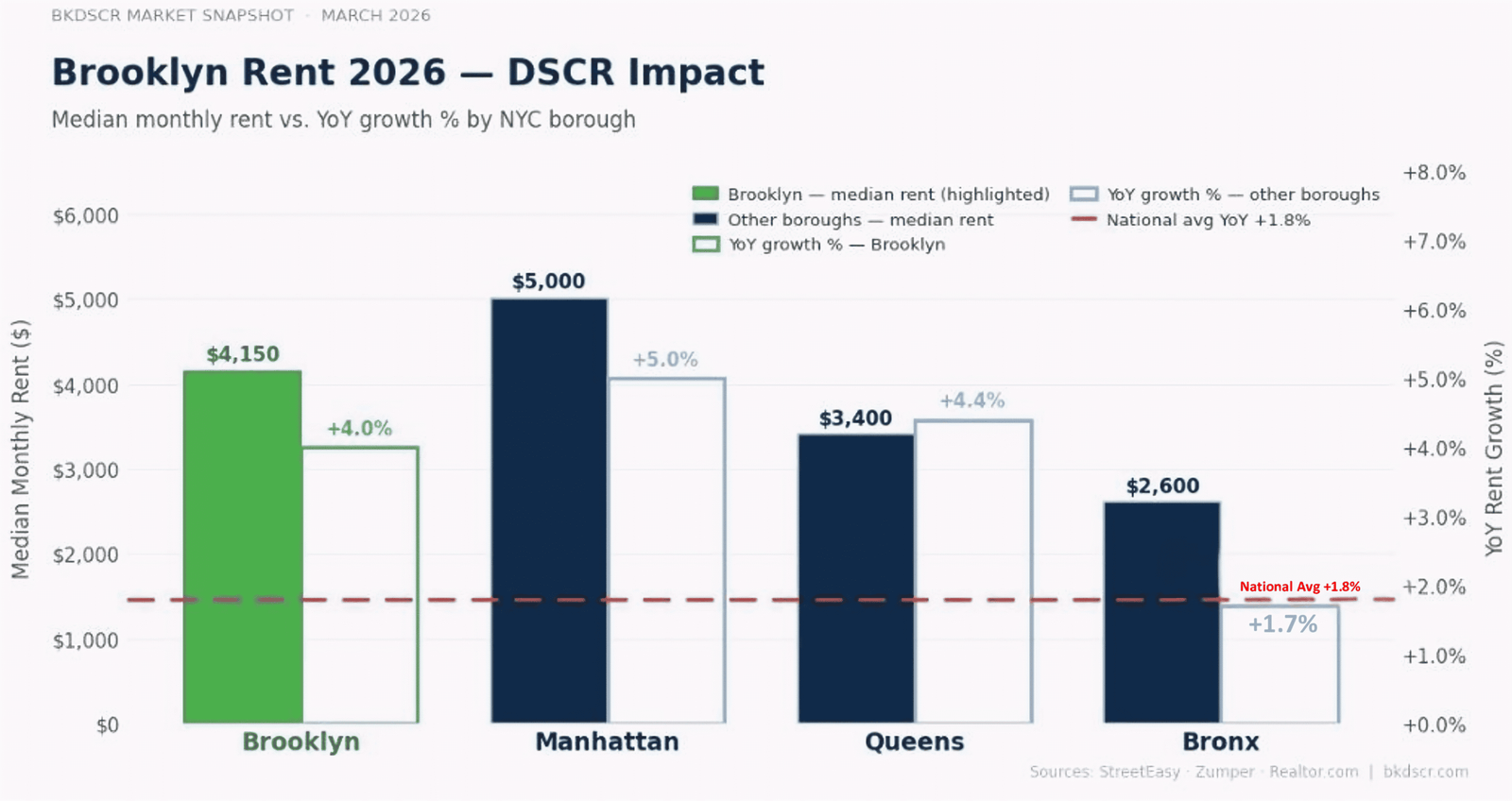
- Brooklyn median rent hit $4,296/month in February 2026 — an all-time high
- A 4% rent increase moves Lender DSCR on a 4-unit from approximately 1.29 to 1.34 at 75% LTV
- The rent increase is necessary but not sufficient — insurance and tax increases absorb most of the gain
- DSCR lenders underwrite on actual current rents — not projected or stabilized rents
- A deal that barely passes at today’s rents fails the BKDSCR stress test at +1% rate or 10% vacancy
Table of Contents
- Brooklyn Rent DSCR: What the Corcoran Data Actually Shows
- Brooklyn Rent DSCR: What the 4% YoY Growth Rate Actually Means
- Brooklyn Median Rent 2026 DSCR Impact: The Deal Math
- Brooklyn Rent 2026 DSCR Impact: Submarket Differences That Matter
- Crown Heights: Brooklyn Rental Market DSCR and Insurance Exposure
- Flatbush: Rent Growth Plus Pre-War Insurance Risk
- Bushwick: Fastest Submarket Rent Growth, Thinnest Comp Pool
- The DSCR Offset: Outer-Borough Rent DSCR vs Rising Insurance Costs
- What the Brooklyn Rent Record Means for Investors Evaluating Deals Now
- FAQ: Brooklyn Rent 2026 DSCR Impact
- Does the Brooklyn rent record automatically improve DSCR on my deal?
- How does the 4% Brooklyn rent growth translate to a specific DSCR improvement?
- What Brooklyn neighborhoods have the strongest rent growth for DSCR purposes in 2026?
- Bottom Line — Brooklyn Rent DSCR in 2026
Brooklyn Rent DSCR is exactly what the numbers say it is: a rent increase that moves ratios in the right direction on most deals — and a market snapshot that still leaves most Brooklyn outer-borough 4-units short of the BKDSCR 1.25 single-stress standard unless the purchase structure is right. The February 2026 all-time high of $4,296 and March’s record-for-the-month $4,150 are not just headlines. They are PITIA math. Every dollar of rent growth that flows through to the lender’s 1007 appraisal schedule is a dollar that improves your DSCR.
| MARKET SNAPSHOT — Brooklyn Investor Submarket Rents, April/May 2026 | |
|---|---|
| Sources: MNS April 2026 (mns.com) | Zumper May 2026 (zumper.com) | Corcoran March 2026 (corcoran.com) | |
| SUBMARKET RENTS — Where 1–4 unit investors buy | Studio | 1BR | 2BR |
| East New York (Zumper, May 2026) | n/a | $2,700 | $2,800 |
| Bed-Stuy (MNS, April 2026) | $2,624 | $2,592 | $3,451 |
| PLG / Flatbush (MNS, April 2026) | $1,980 | n/a | $3,696 |
| Crown Heights (MNS, April 2026) | $3,112 | $4,265 | $5,311 |
| BOROUGH CONTEXT — All neighborhoods, all building types | |
| Brooklyn borough median (Corcoran, March 2026) | $4,150 — includes Williamsburg, DUMBO, luxury stock |
| Active listings — March 2026 | 3,315 (-8% YoY) |
| Signed leases — March 2026 | ~1,320 (+5% YoY; strongest March since 2021) |
| Days on market — March 2026 | 49 days (-11% YoY) |
| DSCR 30-yr fixed rates (May 2026) | 6.125%–7.5% (Griffin Funding / Ridge Street Capital) |
| Brooklyn 4-unit benchmark rate | 7.25% at 75% LTV, 720+ FICO |
Start with the Deal Filter — property type, rent roll, unit count, and PITIA in 60 seconds.
Brooklyn Rent DSCR: What the Corcoran Data Actually Shows
The February 2026 Brooklyn median rent of $4,296 represents the all-time borough record according to the Corcoran Group’s February 2026 Rental Market Report. March pulled back 3% to $4,150 — still a record for the month of March — with year-over-year growth of 4%. Brooklyn had the strongest March for signed leases since 2021, with active listings falling 8% year-over-year and days on market declining 11% annually. Before modeling your specific deal at current Brooklyn rent levels, the DSCR formula shows exactly how each input — gross rent, P&I, taxes, insurance — moves the ratio in either direction.
The demand signal is clear. Inventory at four-year lows. Lease volume up. Days on market down. Renters still find relative value in Brooklyn, but conditions are becoming increasingly competitive, per Corcoran COO Gary Malin, who noted that a lack of listings will likely push rents for new leases higher in the summer. For DSCR investors, the practical implication is straightforward: rent comps the appraiser will find in 2026 are materially stronger than rent comps from 2023 or 2024.
Brooklyn Rent DSCR: What the 4% YoY Growth Rate Actually Means
Note the qualifier: rent comps the appraiser will find. The 4% growth figure is a median across all signed leases in Brooklyn. The lender uses the lower of the appraiser’s 1007 market rent estimate or in-place lease amounts. If the appraiser’s comp pool reflects leases signed in the prior 6–12 months rather than the current record-level market, the qualifying DSCR may not fully capture the rent growth. This is why confirming the appraisal comp pool in the specific submarket before going to contract matters.
Brooklyn Median Rent 2026 DSCR Impact: The Deal Math
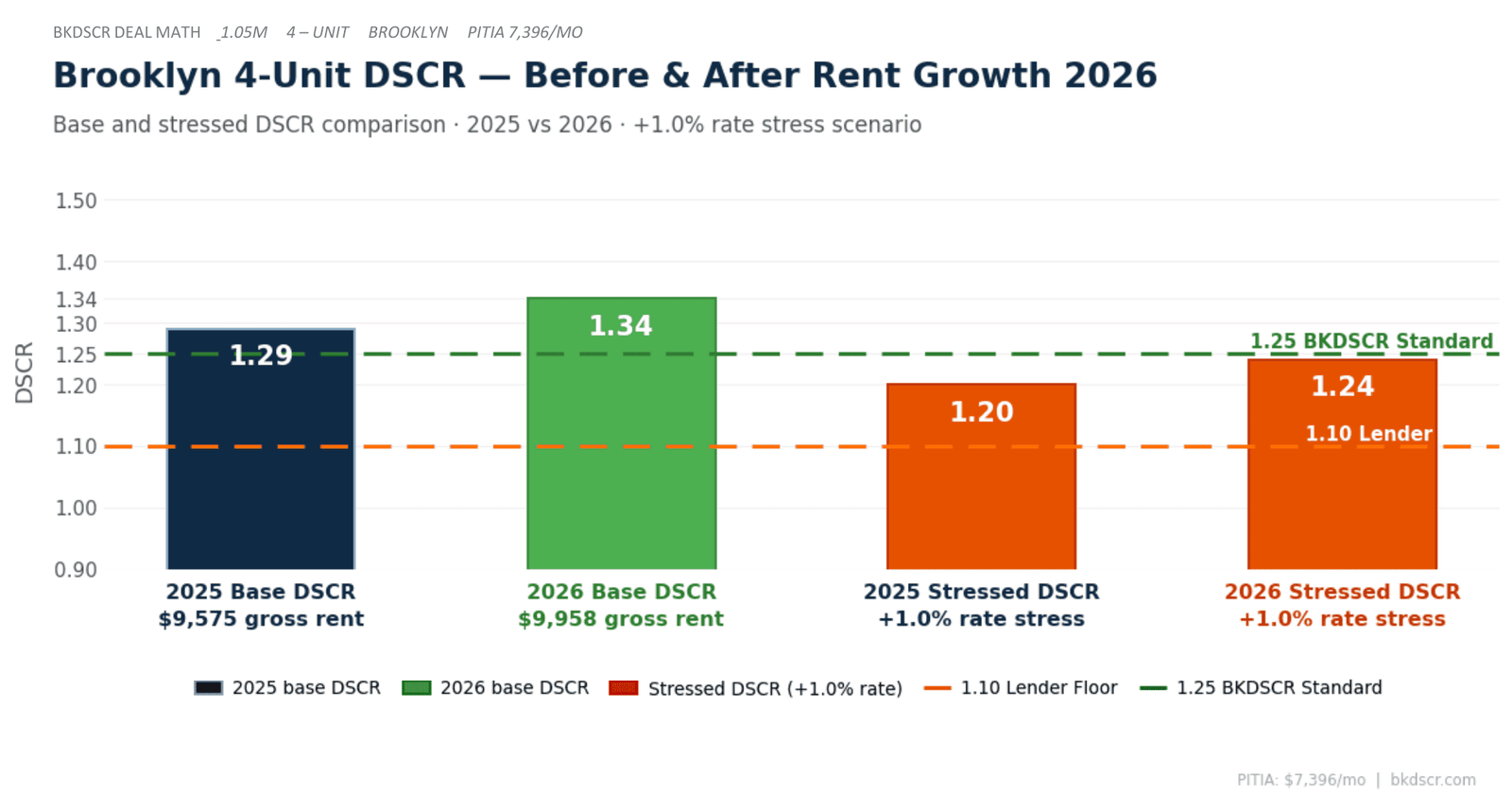
The following composite deal models a Brooklyn 4-unit in the Crown Heights / Flatbush submarket — a typical investor price point in 2026 — and shows what the 4% rent growth does to the DSCR at current rates.
| DEAL INPUT | FIGURE |
|---|---|
| Property Type | 4-unit walkup, market-rate, Crown Heights/Flatbush Brooklyn |
| Purchase Price | $1,050,000 |
| Down Payment (25%) | $262,500 |
| Loan Amount | $787,500 |
| Rate / Term | 7.25% / 30-year fixed (May 2026, Griffin Funding range) |
| Monthly P&I | $5,371 |
| Monthly Taxes | $1,450 (Brooklyn Class 2, 2026–27 assessment) |
| Monthly Insurance | $575 (post-war building, clean claims) |
| Total PITIA | $7,396 |
Now run the DSCR at two rent levels — 2025 market rents and 2026 market rents at the 4% YoY growth rate:
| 2025 Rents | 2026 Rents (+4%) | |
|---|---|---|
| Avg rent / unit | $2,394/unit | $2,490/unit |
| Gross monthly rent | $9,575 | $9,958 |
| Monthly PITIA | $7,396 | $7,396 |
| Lender DSCR | 1.29 | 1.34 |
| Stressed DSCR +1.0% | 1.20 (below 1.25 std) | 1.24 (below 1.25 std) |
Get the DSCR Playbook — every input, threshold, and deal-killer for NYC outer-borough investors in one place.
The 4% rent growth added 0.05 to the lender DSCR — from 1.29 to 1.34. The stressed DSCR improved from 1.20 to 1.24 — still below the BKDSCR 1.25 single-stress standard, but materially closer. This composite deal with 2026 market rents is a strong lender-pass but still requires precise structuring to clear the conservative stressed standard. Run your specific inputs through the stress test before going to contract.
LTV matters here as much as rent. The same $1,050,000 deal at 70% LTV reduces the loan to $735,000, dropping monthly P&I from $5,371 to $4,849 and moving PITIA from $7,396 to $7,039. That PITIA reduction brings the 2026 lender DSCR from 1.34 to 1.41 and the stressed DSCR from 1.24 to 1.31 — above the BKDSCR 1.25 single-stress standard. For investors who have the capital, the 30% down structure is the cleanest path to clearing the stress standard on a Brooklyn 4-unit at current price levels.
Brooklyn Rent 2026 DSCR Impact: Submarket Differences That Matter
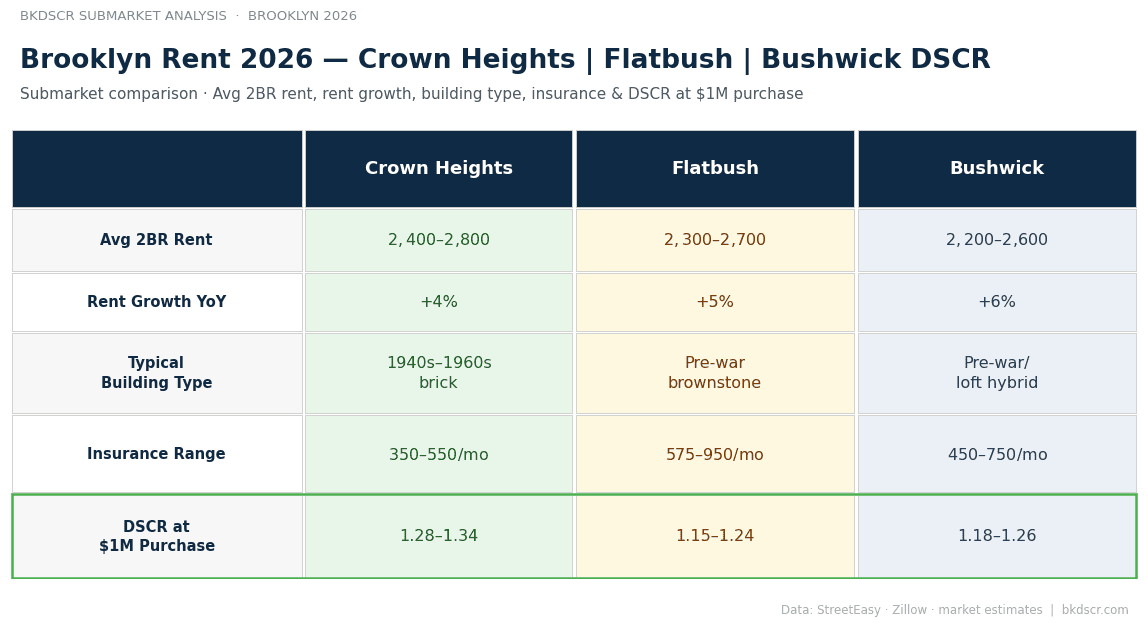
The $4,296 borough-wide median is a blended average across all Brooklyn unit types and all submarkets. For DSCR investors underwriting specific outer-borough deals, the submarket rent level — not the borough median — determines what the appraiser’s 1007 schedule will support. Three submarkets that account for a significant share of outer-borough 4-unit investment activity:
Crown Heights: Brooklyn Rental Market DSCR and Insurance Exposure
Crown Heights 2BR market-rate rents are running in the $2,400–$2,800 range in Q1 2026. A stabilized 4-unit at the $2,500 average produces $10,000/month in gross rent — strong enough to support DSCR on deals up to approximately $1,100,000 at current rates and 25% down. The tax exposure in Crown Heights is consistent with Brooklyn Class 2: the 2026–27 assessment increase of approximately 16% on Class 2 properties added $150–$200/month to PITIA across the board. Lender criteria explains why investors must model the post-assessment tax figure, not the prior-year number. See also: Class 2.
Flatbush: Rent Growth Plus Pre-War Insurance Risk
Flatbush is one of the neighborhoods driving Brooklyn’s record lease activity. Average rents for 1–2BR units in Flatbush are in the $2,300–$2,700 range. For DSCR investors, the Flatbush opportunity and the Flatbush risk are the same building type: pre-war brownstones and walkups with strong rent potential but materially higher insurance costs. A Flatbush 3-family with a 2019 insurance premium of $350/month may be renewing at $700–$950/month in 2026. That insurance increase eats into the DSCR benefit from rent growth.
The deal killers page documents insurance cost creep as one of the most consistent DSCR surprises investors encounter between pro forma and lender underwriting.
Bushwick: Fastest Submarket Rent Growth, Thinnest Comp Pool
Bushwick has posted among the fastest rent growth in Brooklyn over the past 18 months. Average 1BR rents in Bushwick are in the $2,200–$2,600 range. The DSCR challenge in Bushwick is not the rent level — it is the appraisal comp pool. The submarket has seen significant volatility in both asking rents and concession patterns, and the appraiser’s 1007 comparable rent schedule may lag current asking rents by a quarter or two. Investors who model Bushwick deals at current market rates need to confirm the 1007 will support those numbers before going to contract.
The DSCR Offset: Outer-Borough Rent DSCR vs Rising Insurance Costs
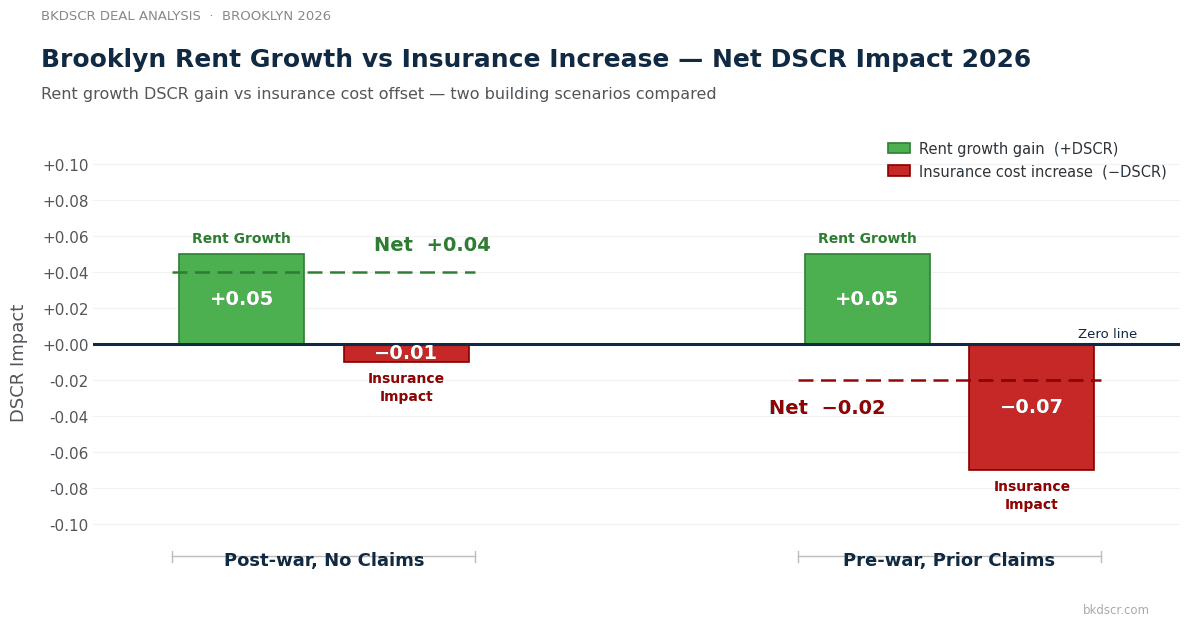
The rent growth headline is real — $4,296 median, +4% YoY, record lease volume. But the DSCR net impact in 2026 is not purely additive. Rent went up on the income side. Insurance went up on the cost side. The net effect depends on which building you own.
On a post-war Brooklyn 4-unit with modest insurance premiums, the net DSCR movement in 2026 is positive. Rent growth added approximately +0.05 to the DSCR. Insurance on post-war construction increased by $50–$100/month in 2026 — roughly -0.01 to -0.02 DSCR impact. Net improvement: approximately +0.03 to +0.04.
On a pre-war Brooklyn 4-unit with a prior claims history, the calculus is different. Rent growth added the same +0.05. But insurance on that building increased by $300–$500/month — a DSCR impact of -0.05 to -0.08. Net impact: approximately -0.00 to -0.03. Rent growth may have been entirely offset by insurance increases on the specific building.
| Post-War Building | Pre-War w/ Prior Claims | |
|---|---|---|
| Rent growth DSCR impact | +0.05 | +0.05 |
| Insurance increase DSCR impact | -0.01 to -0.02 | -0.05 to -0.08 |
| Net DSCR change 2025–2026 | +0.03 to +0.04 | 0.00 to -0.03 |
| Verdict | Positive net improvement | Rent growth offset by insurance |
The math is worth running precisely. A 2-unit pre-war building in Flatbush carrying $1,400/month in 2026 insurance (versus $350/month in 2019) has absorbed $1,050/month in additional annual cost. At a $7,000 PITIA, that increase represents a 15% rise in the denominator alone. Gross rent on that same building may have increased from $4,200 to $4,900/month over the same period — a 16.7% gain. The net DSCR impact is nearly flat despite years of rent growth, because insurance absorbed the entire gain.
Investors who bought pre-war Brooklyn stock between 2015 and 2020 and are evaluating a refi need to model the current insurance figure, not the 2019 number. The 2019 insurance cost will not appear on any lender underwriting sheet in 2026.
This is why the borough-wide rent headline cannot be applied uniformly to every Brooklyn investment deal. The net DSCR impact in 2026 is building-specific — and for pre-war buildings with any claims history, it may be flat or negative despite record rents.
What the Brooklyn Rent Record Means for Investors Evaluating Deals Now
The record rent data creates two practical adjustments for investors underwriting Brooklyn 4-unit deals in 2026. First, the 1007 appraisal comp pool is the strongest it has been in years. Comparable leases signed in the prior 6–12 months support current market rents — which means the appraiser is less likely to produce a 1007 that comes in materially below a well-supported current rent roll. That reduces appraisal gap risk on deals where the in-place rents reflect current market. Run the deal filter first to confirm your deal clears the basic DSCR threshold before commissioning a full appraisal.
Second, the inventory constraint is real. Active listings were down 8% year-over-year in March 2026, and days on market were down 11%. Sellers in Brooklyn’s investment property market have less pressure to concede on price than they did 12–18 months ago. Investors negotiating seller concessions — including rate buydowns or price reductions to improve DSCR — are operating in a tighter market than recent experience might suggest.
Rate buydowns are worth modeling specifically. A seller-funded 1-point buydown on the $787,500 loan costs approximately $7,875 and reduces the rate from 7.25% to 6.25%. That drops monthly P&I from $5,371 to $4,849 — a $522/month PITIA reduction that moves the lender DSCR from 1.34 to 1.46 at 2026 rents and the stressed DSCR from 1.24 to 1.35, clearing the BKDSCR 1.25 single-stress standard with room to spare.
In a market where sellers have pricing power, a buydown concession is often more achievable than a price reduction — and delivers more DSCR improvement per dollar than almost any other structural adjustment.
The practical implication: use the current rent data to confirm the deal works at market rents, not to assume the deal will always work. Run the numbers at the appraiser’s likely 1007 range — not the top of the asking rent market. Then stress test that number at +1.0% rate before submitting. If the deal clears 1.25 stressed on conservative rent assumptions, it is a clean deal. If it only clears 1.25 stressed on optimistic rent assumptions, it requires more scrutiny before closing.
FAQ: Brooklyn Rent 2026 DSCR Impact
Does the Brooklyn rent record automatically improve DSCR on my deal?
Not automatically. The DSCR improvement depends on whether the rent growth has actually flowed into the in-place lease on the specific property, and whether the appraiser’s 1007 comparable rent schedule reflects current market conditions. A property with long-term tenants at below-market rents does not benefit from the borough-wide rent record until those leases are renegotiated at market. There is also a timing factor: the lender uses the lower of the appraiser’s 1007 market rent estimate or the in-place lease amount.
If the in-place leases were signed 18 months ago at rents that predate the current run-up, the lender’s qualifying income may be lower than the current asking market. Investors purchasing properties with 2022 or 2023 vintage leases should model the deal at in-place rents, not at what the market is doing today — and then run the scenario where those leases come up for renewal at current market rates to understand the upside case.
How does the 4% Brooklyn rent growth translate to a specific DSCR improvement?
On a typical Brooklyn 4-unit where all four units capture the 4% growth, the gross monthly rent increase is approximately 4% of the prior rent roll. At $9,575/month prior rent, that is +$383/month. On a $7,396 PITIA, $383 more rent moves DSCR by approximately 0.05 points. The improvement is proportional — the same 4% growth on a larger rent roll produces a larger dollar increase and a similar DSCR improvement in points, all else equal.
What Brooklyn neighborhoods have the strongest rent growth for DSCR purposes in 2026?
Flatbush and Bushwick are tracking above the borough-wide 4% average in year-over-year growth based on Q1 2026 data. Crown Heights is tracking close to the borough average. For DSCR purposes, what matters is not just the growth rate but the absolute rent level relative to the purchase price. Crown Heights 2BR rents at $2,400–$2,800 on a $1,000,000–$1,100,000 purchase price produce DSCRs in the 1.28–1.35 range before stress — a more useful metric for underwriting decisions than the growth rate alone.
Bottom Line — Brooklyn Rent DSCR in 2026
Brooklyn rent 2026 DSCR impact is positive — modestly and specifically. The $4,296 February median and $4,150 March record represent real rent growth that flows through to DSCR on market-rate properties with current leases. The 4% YoY growth adds approximately 0.05 points to the ratio on a typical $1,050,000 Brooklyn 4-unit, improving the stressed DSCR from 1.20 to 1.24. That is meaningful. It does not make the deal’s margin of safety comfortable on its own — both numbers remain below the BKDSCR 1.25 single-stress standard.
The offset is real too. Insurance increases on pre-war buildings are running at multiples of the rent growth rate on a percentage basis. A pre-war Brooklyn building that saw $350/month insurance in 2019 and is renewing at $800/month today has absorbed a DSCR cost that exceeds the DSCR benefit from 4% rent growth. The net analysis is building-specific — and it requires modeling both lines, not just the rent headline.
Brooklyn investors who run the full DSCR picture in 2026 — current market rents, post-assessment taxes, 2026 insurance quotes, and the +1.0% rate stress — will find deals in this market. Deals that clear the stress standard cleanly are relatively rare at current price levels. But they exist, and the record rent environment makes them more accessible than they were at 2024 rent levels.
Run a Deal Review — current DSCR, stressed DSCR, NOI, and updated tax assessment modeled at current inputs, delivered within 48–72 hours.