
DSCR 1.10 Threshold: What It Means in Real Dollars of Debt
Key Takeaways
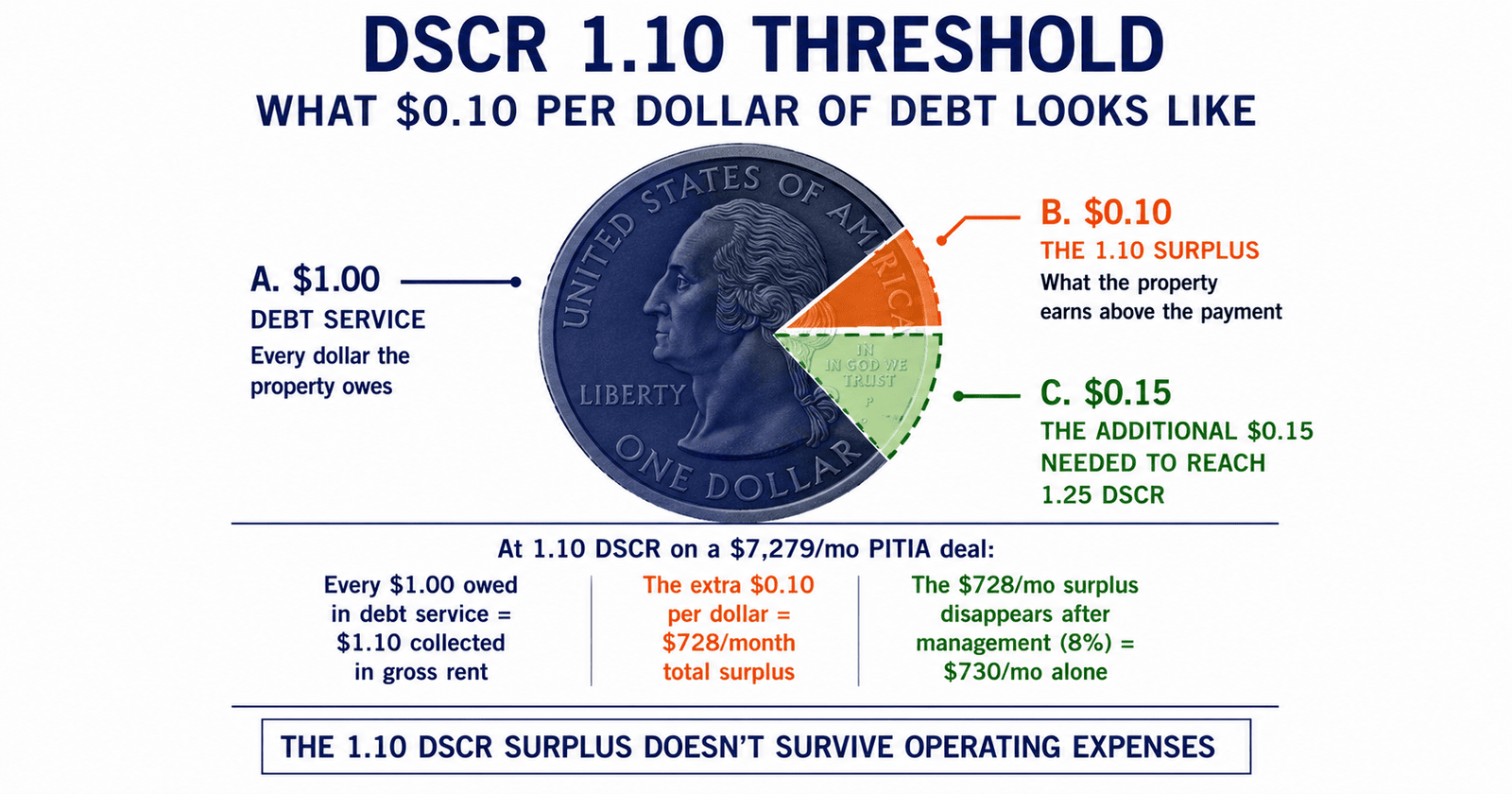
- 1.10 DSCR = $1.10 in gross rent for every $1.00 of PITIA. The $0.10 surplus = $728/month on a $7,279 PITIA deal
- That $728 monthly surplus disappears under one operating expense — property management alone costs $728–$910/month
- A 1.10 DSCR deal carries a rate premium of +0.125%–0.25%, costing $88–$177/month more than a 1.25 DSCR deal on $750K
- A +1.0% rate stress on a 1.10 DSCR deal drops the stressed ratio to 1.01 — one point above the lender’s absolute floor
- 1.10 is the lender’s floor on many programs — not the investor’s viable minimum. The BKDSCR standard is 1.25+
- Moving from 1.10 to 1.25 requires $1,092/month more in gross rent or roughly $126K in purchase price reduction
Table of Contents
- DSCR 1.10 Threshold: What It Means Per Dollar
- DSCR 1.10 Threshold and the Rate Premium
- DSCR 1.10 Threshold and the Stress Test
- Why 1.10 DSCR Is the Lender’s Floor, Not the Investor’s Target
- How to Move from 1.10 to 1.25 DSCR
- DSCR 1.10 Threshold: Path A — Increase Gross Rent
- DSCR 1.10 Threshold: Path B — Lower the Purchase Price
- Path C — Increase the Down Payment
- FAQ: DSCR 1.10 Threshold
- DSCR 1.10 Threshold: Will every lender approve a 1.10 DSCR deal?
- How much does interest-only improve a 1.10 DSCR?
- Is 1.10 DSCR better or worse than 1.0 from the lender’s perspective?
- DSCR 1.10 Threshold: The Three Scenarios Where It Becomes a Problem
- Scenario 1: Rate Increases After Origination
- DSCR 1.10 Threshold: How to Move From 1.10 to 1.25 on an Existing Deal
The DSCR 1.10 threshold is the most common lender minimum — and the most dangerous place for an outer-borough investor to land. At 1.10, the property covers its debt service by ten cents per dollar. A single rate increase, tax assessment, or insurance renewal can erase that margin entirely.
The DSCR 1.10 threshold is the number where many NYC outer-borough deals land when the investor has the right property but not quite enough rent or purchase price to clear 1.25. At 1.10, the deal may qualify. But understanding what 1.10 means in real dollars per dollar of debt reveals why it is a lender’s floor, not an investor’s destination. According to COR Advisors, the 2026 lending environment has made the 1.25 threshold more consequential as lenders enforce tighter pricing tiers below that mark.
Before evaluating any deal below 1.25 DSCR, understand what each tier means for rate, LTV, and stress-test exposure. Lender criteria covers every threshold with 2026 program specifics.
DSCR 1.10 Threshold: What It Means Per Dollar
Every DSCR ratio translates directly into dollars per dollar of debt service. According to Commercial Loan, the DSCR threshold determines both qualification and pricing in the 2026 DSCR lending environment — with the 1.25 tier acting as the dividing line between best-tier and premium-priced programs. See also: what DSCR actually means.
| DSCR | Gross Rent | Surplus/mo | Verdict | Real-Dollar Meaning (PITIA $7,279) |
|---|---|---|---|---|
| 1.00 | $7,279 | +$0/mo | FLOOR | Rent exactly covers PITIA. No buffer. Any cost increase = shortfall. |
| 1.05 | $7,643 | +$364/mo | FAIL | 5 cents/dollar. One missed payment eats 19 months of surplus. |
| 1.10 | $8,007 | +$728/mo | MARGINAL | 10 cents/dollar. Rate premium. Fails +1.0% stress test. |
| 1.20 | $8,735 | +$1,456/mo | MARGINAL | 20 cents/dollar. Most programs accept. Tight on stress test. |
| 1.25 | $9,099 | +$1,820/mo | PASS | 25 cents/dollar. Best rate tier. Clears +1.0% stress at 1.14–1.16. |
| 1.30 | $9,463 | +$2,184/mo | STRONG | 30 cents/dollar. Absorbs T+I increases. Clears combined stress. |
The 1.10 position is concrete: $728/month above PITIA. That sounds like a cushion until you realize property management at 9% of $8,007 gross rent costs $721/month — almost exactly equal to the entire surplus. After one management fee, $7/month remains above PITIA. The 1.25 position produces $1,820/month above PITIA — enough to absorb management ($721), a 5% vacancy allowance ($450), and still leave $649/month of surplus. The gap between 1.10 and 1.25 is also where most deal killers surface — insurance undercounting, stale tax figures, and vacancy assumptions that do not survive lender scrutiny.
DSCR 1.10 Threshold and the Rate Premium
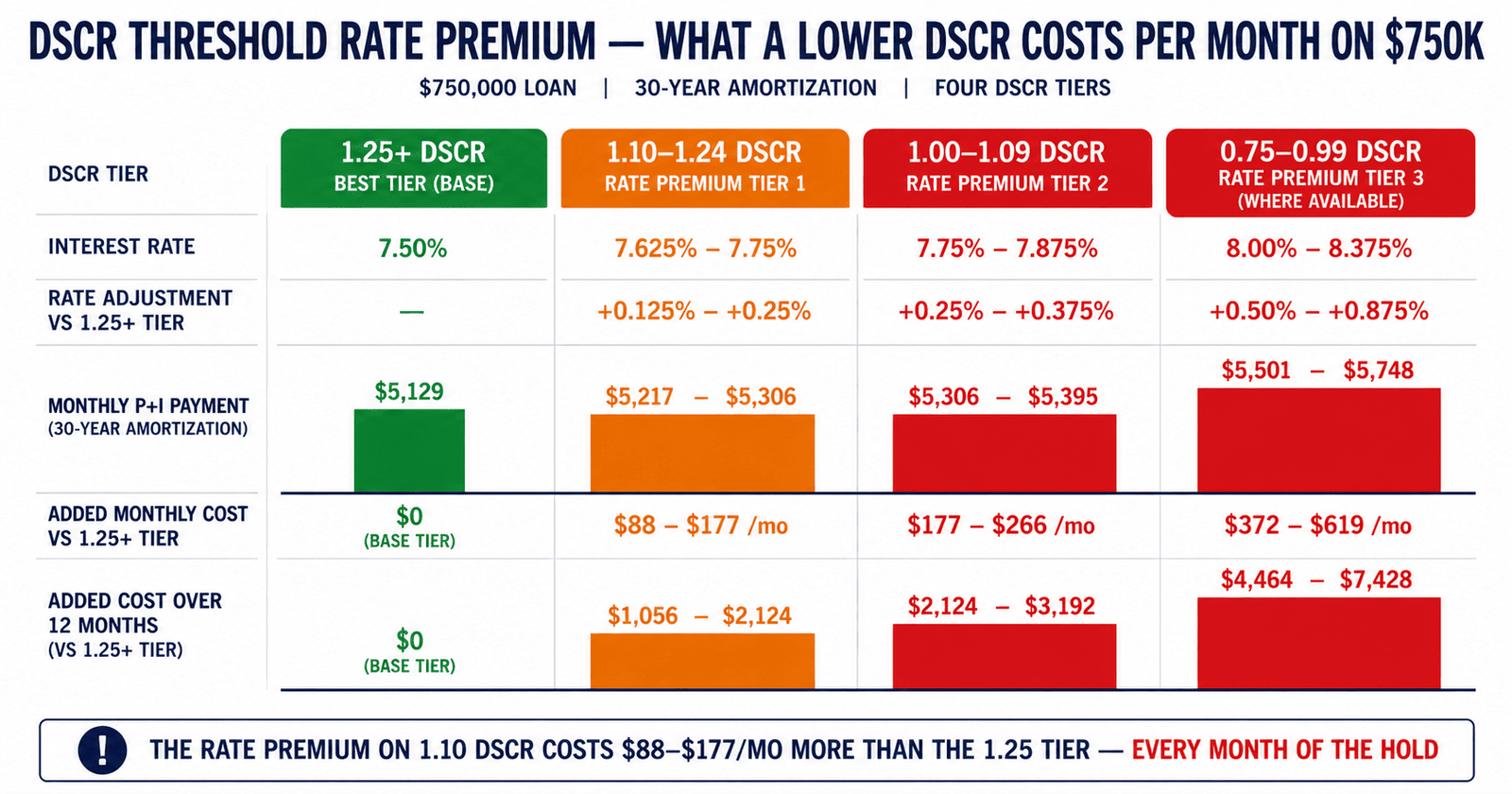
The rate premium is the first concrete cost of operating at 1.10 vs 1.25. DSCR lenders price the 1.10–1.24 tier at +0.125%–0.25% above the 1.25+ best-tier rate. On a $750,000 loan, that premium adds $88–$177/month to P&I — and compounds over every month of the hold period.
| DSCR | Rate (7.5% base) | Rate Adj. | Monthly P&I on $750K / Added Cost vs 1.25 |
|---|---|---|---|
| 1.25+ | 7.50% | Base rate | $5,129/mo — best-tier pricing, no adjustment |
| 1.10–1.24 | 7.625–7.75% | +0.125–0.25% | $5,217–$5,306/mo — $88–$177/mo more than 1.25 tier |
| 1.00–1.09 | 7.75–7.875% | +0.25–0.375% | $5,306–$5,395/mo — $177–$266/mo more than 1.25 tier |
| 0.75–0.99 | 8.00–8.375% | +0.50–0.875% | $5,501–$5,748/mo — $372–$619/mo more (where available) |
The premium has a secondary effect: it makes the DSCR worse on the same property. A deal modeled at 1.10 DSCR with a 7.5% quote will have a DSCR of approximately 1.07–1.08 at the actual 7.75% rate the 1.10 tier receives. The rate premium further erodes the already-thin buffer.
DSCR 1.10 Threshold and the Stress Test
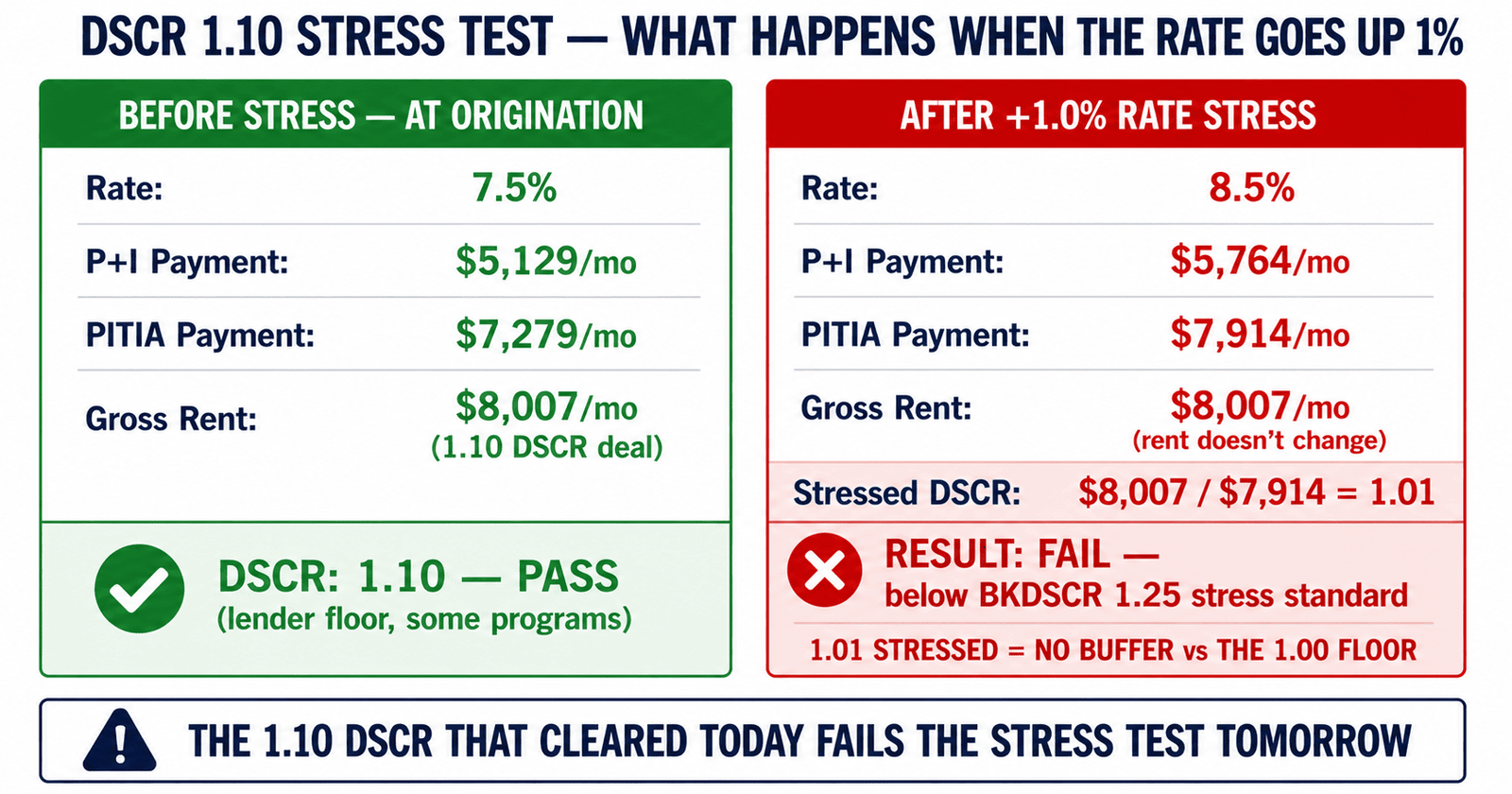
The BKDSCR single-stress standard requires 1.25+ DSCR after +1.0% rate stress. Here is what happens to a 1.10 DSCR deal at +1.0%:
- Original: 7.5% rate | P+I $5,129/mo | PITIA $7,279/mo
- Stressed: 8.5% rate | P+I $5,764/mo | PITIA $7,914/mo
- Gross rent stays at $8,007/mo (rent does not change with rate stress)
- Stressed DSCR: $8,007 ÷ $7,914 = 1.01 — FAIL on BKDSCR standard
A stressed DSCR of 1.01 is one point above the absolute floor. Any additional cost increase — a $200 insurance renewal, a $150 tax increase — pushes below 1.00. The combined stress (+1.0% rate and 10% vacancy): gross rent at 10% vacancy = $7,206; stressed PITIA = $7,914; combined DSCR = 0.91 — deep fail. Run the stress test on every deal before closing.
Run the stress test on any deal before committing — rate, vacancy, and combined. Stress test shows the exact DSCR at each scenario against BKDSCR standards.
Why 1.10 DSCR Is the Lender’s Floor, Not the Investor’s Target
Many programs accept 1.10 because the lender’s stress scenario is less stringent than the BKDSCR standard. That does not make 1.10 a viable investor position over a multi-year hold. The $728 monthly surplus does not survive operating expenses, provides no rate reset buffer, absorbs no tax or insurance increases, and still carries a rate premium. See lender criteria for how specific DSCR lenders handle 1.10 deals: which programs accept it, which add LTV restrictions, and which require additional reserves.
How to Move from 1.10 to 1.25 DSCR
DSCR 1.10 Threshold: Path A — Increase Gross Rent
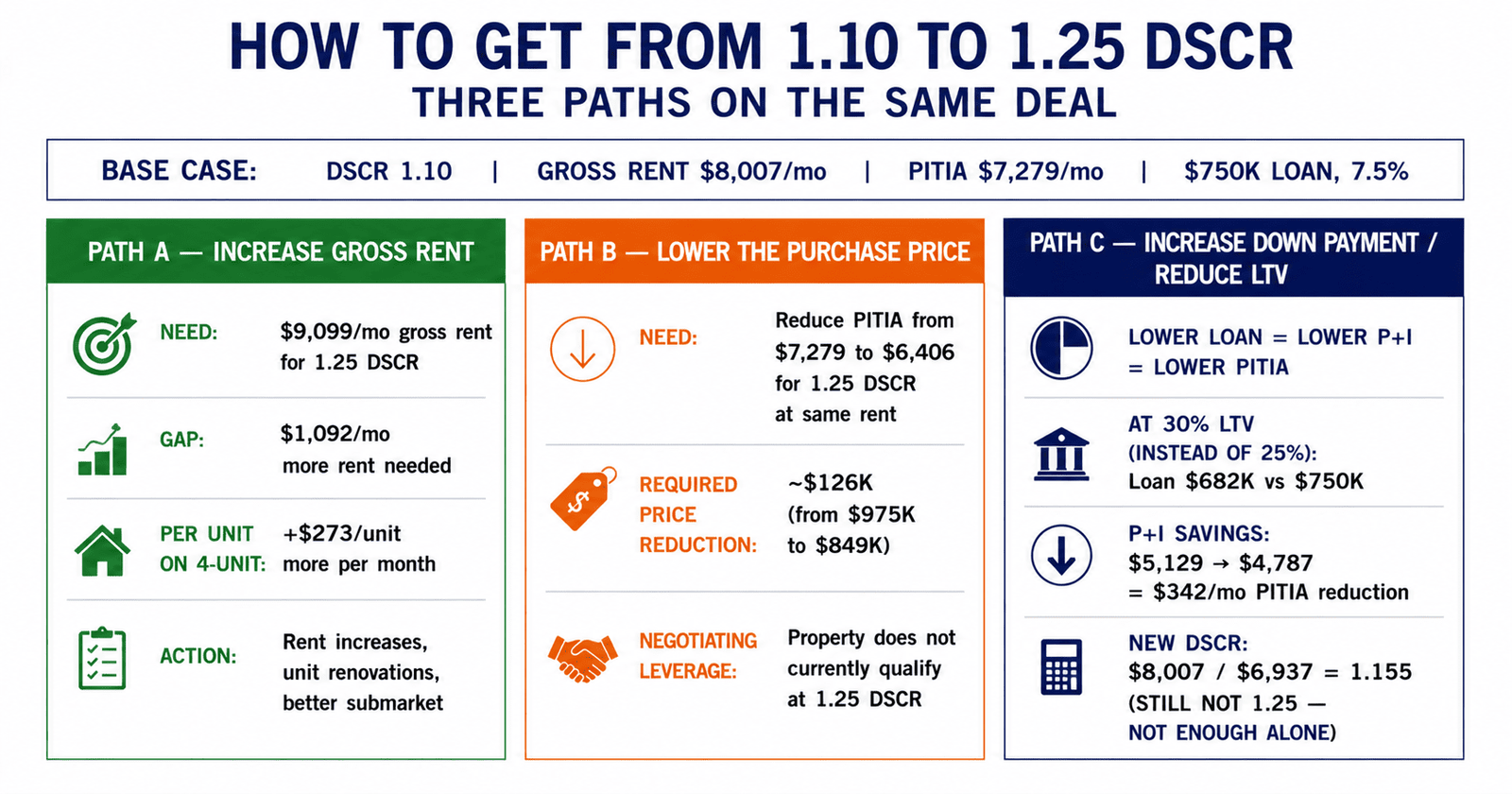
The cleanest path: find a property where current market rents support $9,099/month gross rent. This is a submarket selection decision. Bed-Stuy, Crown Heights, Bushwick, and Flatbush 4-units at market rents produce gross rent that clears 1.25 on the $7,279 PITIA benchmark. East New York and Canarsie at current rents do not.
DSCR 1.10 Threshold: Path B — Lower the Purchase Price
If market rent is capped at $2,000/unit, the path to 1.25 runs through price reduction. The 1.25 DSCR-qualifying PITIA at $8,007 gross rent = $6,406/month. Required PITIA reduction = $873/month. Since T+I are fixed, the entire reduction must come from lower P&I — requiring approximately $124,400 less in loan amount, or a $166,000 price reduction at 75% LTV. Use the DSCR calculator to find the exact price where the deal clears 1.25.
Path C — Increase the Down Payment
Increasing from 25% to 30% down reduces the loan from $731,250 to $682,500 and P+I from $5,129 to $4,787 — a $342/month PITIA reduction. New DSCR at $8,007 gross rent: 1.155. The down payment increase alone does not close the gap to 1.25. It reduces PITIA but not enough to bridge the full 0.15-point gap without combined rent improvement or price reduction.
FAQ: DSCR 1.10 Threshold
DSCR 1.10 Threshold: Will every lender approve a 1.10 DSCR deal?
No. Some programs set 1.20 as their minimum. Even programs that accept 1.10 apply rate premiums and may impose additional LTV restrictions (capping at 70–75%), reserve requirements (6+ months PITIA), or other conditions not applied at 1.25. Confirm program-specific requirements before modeling a deal at 1.10.
How much does interest-only improve a 1.10 DSCR?
On $750,000 at 7.5%, interest-only payment = $4,688/mo vs $5,129/mo amortizing. PITIA at IO: $6,838. DSCR on $8,007 gross rent: 1.17 — better than 1.10 but still below 1.25. Interest-only can lift a 1.05 deal to 1.10 or a 1.10 to 1.17. It cannot bridge the full 1.10 to 1.25 gap in isolation.
Is 1.10 DSCR better or worse than 1.0 from the lender’s perspective?
1.10 is better than 1.0 but both are below the 1.25 best tier and both carry rate premiums. Both fail the BKDSCR +1.0% stress standard. A 1.0 stressed at +1.0% produces ~0.92; a 1.10 stressed produces 1.01. The difference is one of degree, not kind.
DSCR 1.10 Threshold: The Three Scenarios Where It Becomes a Problem
Scenario 1: Rate Increases After Origination
A 5/1 ARM DSCR loan originated at 6.75% produces a different DSCR than the same deal at the reset rate. If the deal was underwritten at 1.18 DSCR with a 6.75% rate, and resets to 8.5% at year 5, the monthly P+I increases from approximately $4,122 to $5,073 on a $637,500 loan. Adding $951/month to PITIA drops DSCR from 1.18 to 0.95 —
below any lender’s floor. The investor either refinances before the reset (requiring a qualifying DSCR on the new loan at current rates), sells, or absorbs negative cash flow. A 1.18 DSCR at a fixed rate is a stable deal. A 1.18 DSCR at a 5/1 ARM rate is a 5-year bet on rate stability. The stress test at the projected reset rate is the verification step that most ARM borrowers skip.
Scenario 2: Insurance Increase at Renewal
NYC outer-borough landlord insurance has been repricing significantly at renewal since 2022. A 4-unit with $7,200/year insurance in 2023 may renew at $11,500 in 2026 — a $4,300 annual increase, or $358/month. On a deal where PITIA was $6,200/month and DSCR was 1.16, adding $358 to PITIA raises it to $6,558. DSCR drops to 1.10 —
exactly at the lender’s most common floor. One more insurance increase at the next renewal takes the deal below 1.10. This is not a theoretical risk — it is the actual pattern observed in NYC outer-borough insurance markets since 2022. A deal underwritten at 1.16 DSCR in 2023 may be a lender-minimum deal in 2026 solely because of insurance repricing.
The implication is not to avoid deals at 1.18 DSCR — it is to model the deals with stress-tested insurance costs, not locked-in renewal rates. Use a 15–20% insurance increase assumption as a stress scenario. If the deal holds at 1.10 with a 20% insurance increase, it is a manageable deal. If it drops below 1.10, the deal is more fragile than the opening DSCR suggests. The deal killers list consistently shows insurance underestimation as a top driver of post-origination DSCR deterioration on NYC outer-borough rental properties.
DSCR 1.10 Threshold: How to Move From 1.10 to 1.25 on an Existing Deal
If a deal is producing 1.10–1.18 DSCR at current verified inputs, the path to 1.25 runs through one or more of four levers: lower purchase price, higher down payment, rent roll improvement, or rate buydown. The math on each lever at a representative $850,000 Brooklyn 4-unit deal with $7,500/month gross rent and 1.13 current Lender DSCR:
- Lower price by $50,000 (to $800,000): loan at 75% drops by $37,500. P+I savings: $262/month. DSCR improvement: 0.04 points (1.13 to 1.17). Not enough alone.
- Higher down payment to 70% LTV: loan decreases by $42,500. P+I savings: $297/month. DSCR improvement: 0.04 points. Not enough alone.
- Raise rent roll by $300/month (one unit to market): qualifying income increases $300/month. DSCR improvement: 0.05 points (1.13 to 1.18). Closer but still short.
- Rate buydown of 0.50%: P+I savings on $637,500 loan: $216/month. DSCR improvement: 0.03 points. Requires upfront buydown cost.
- Combine price reduction + rent increase: $50K price cut + $300 rent improvement. DSCR improvement: 0.09 points (1.13 to 1.22). Getting close.
- Combine 70% LTV + rent increase: DSCR improvement: 0.09 points. Same result.
The 1.10 to 1.25 gap is 0.15 points — typically requiring two or three lever pulls in combination, not a single variable fix. Use the deal analysis framework to identify which combination of levers is available for a specific deal at its specific price point and rent level.
DSCR 1.10 Threshold vs 1.25 Standard: The Real Difference in Dollar Terms
The difference between a 1.10 DSCR deal and a 1.25 DSCR deal is not just a Rank Math compliance number — it is a monthly cash buffer. On a deal with $6,200/month PITIA, a 1.10 DSCR requires $6,820/month gross rent. A 1.25 DSCR requires $7,750/month. The $930/month difference is the cushion available to absorb a vacancy, an insurance increase, a tax increase, or a maintenance emergency without the deal going cash-flow negative.
At 1.10, a single month of one vacant unit on a 4-unit building drops effective rent from $6,820 to $5,115 — a 25% drop below PITIA. At 1.25, the same vacancy drops rent to $5,813 — still 6% below PITIA but requiring only one month of reserve to cover. Lender minimums tell you what qualifies. The BKDSCR standard tells you what holds.
The Threshold That Qualifies vs the Threshold That Performs
The DSCR 1.10 threshold is the clearest example of the gap between the lender’s qualification standard and the investor’s performance standard. At 1.10, the lender can close the deal. The investor is holding a property whose entire DSCR surplus is consumed by one management fee, whose rate is 0.25% higher than the best tier, and whose stress-test DSCR is 1.01 — one point above the absolute floor.
The BKDSCR 1.25 standard is set at 1.25 because that is where rate stress produces a 1.14–1.16 stressed DSCR — above the lender floor with actual margin. The difference between 1.10 and 1.25 is not 15 basis points. It is $1,092/month in income buffer and the structural difference between a deal that absorbs adverse events and one that does not. See also: DSCR stress test method.
Run any deal through the filter to check whether it clears 1.25 DSCR before going deeper. Deal Filter screens property type, rent roll, and qualifying DSCR in one pass.