DSCR Down Payment Impact 2026: The Critical 5% Math
- An extra 5% down on a DSCR deal has two effects: it reduces the loan balance (lowering P&I) and can trigger a rate tier improvement (lowering PITIA further). Most investors only model the first.
- Moving from 75% LTV to 70% LTV typically improves your DSCR loan rate by 0.125-0.25% in 2026, per published lender pricing matrices. That rate savings compounds with the lower balance.
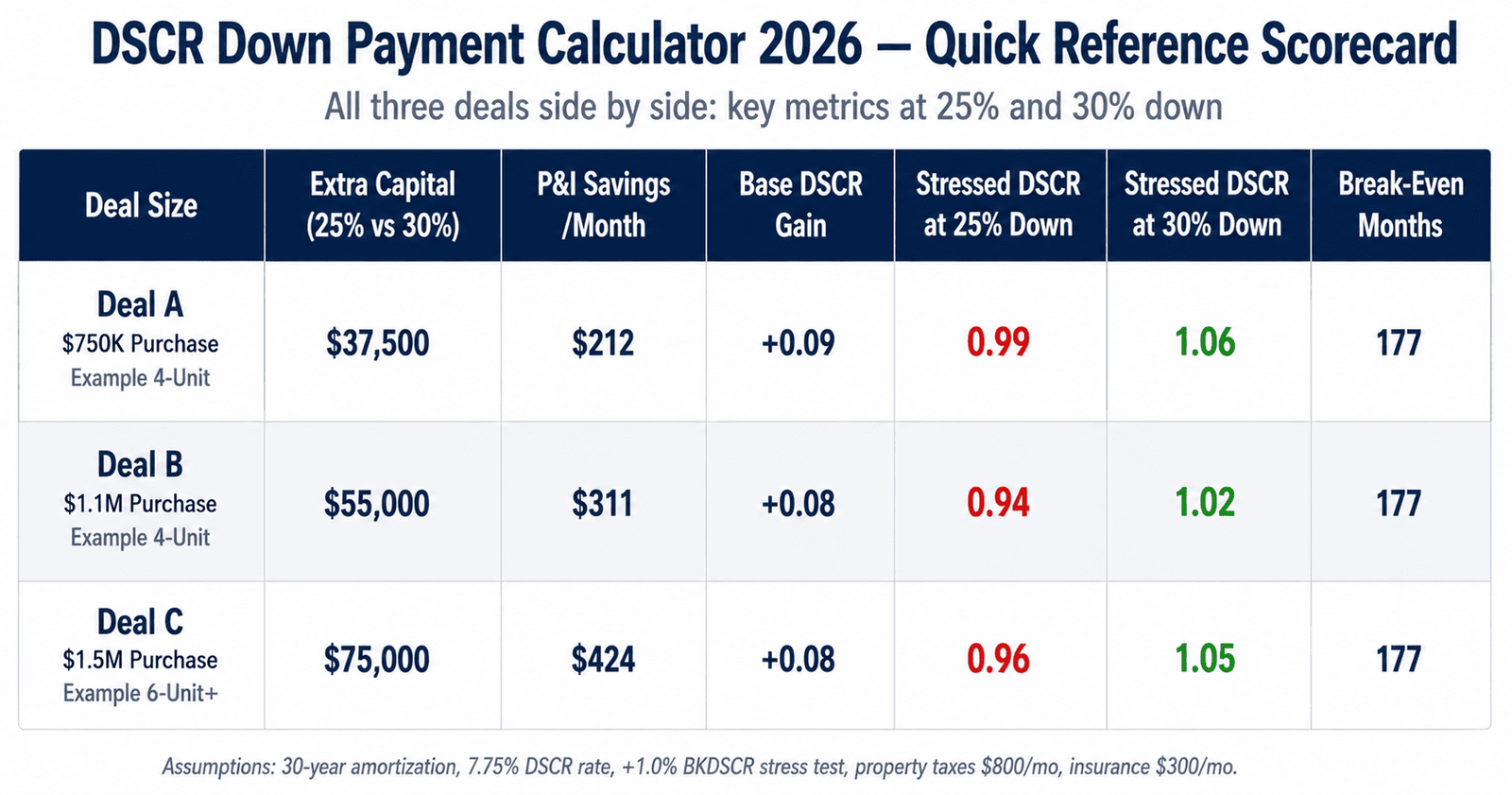
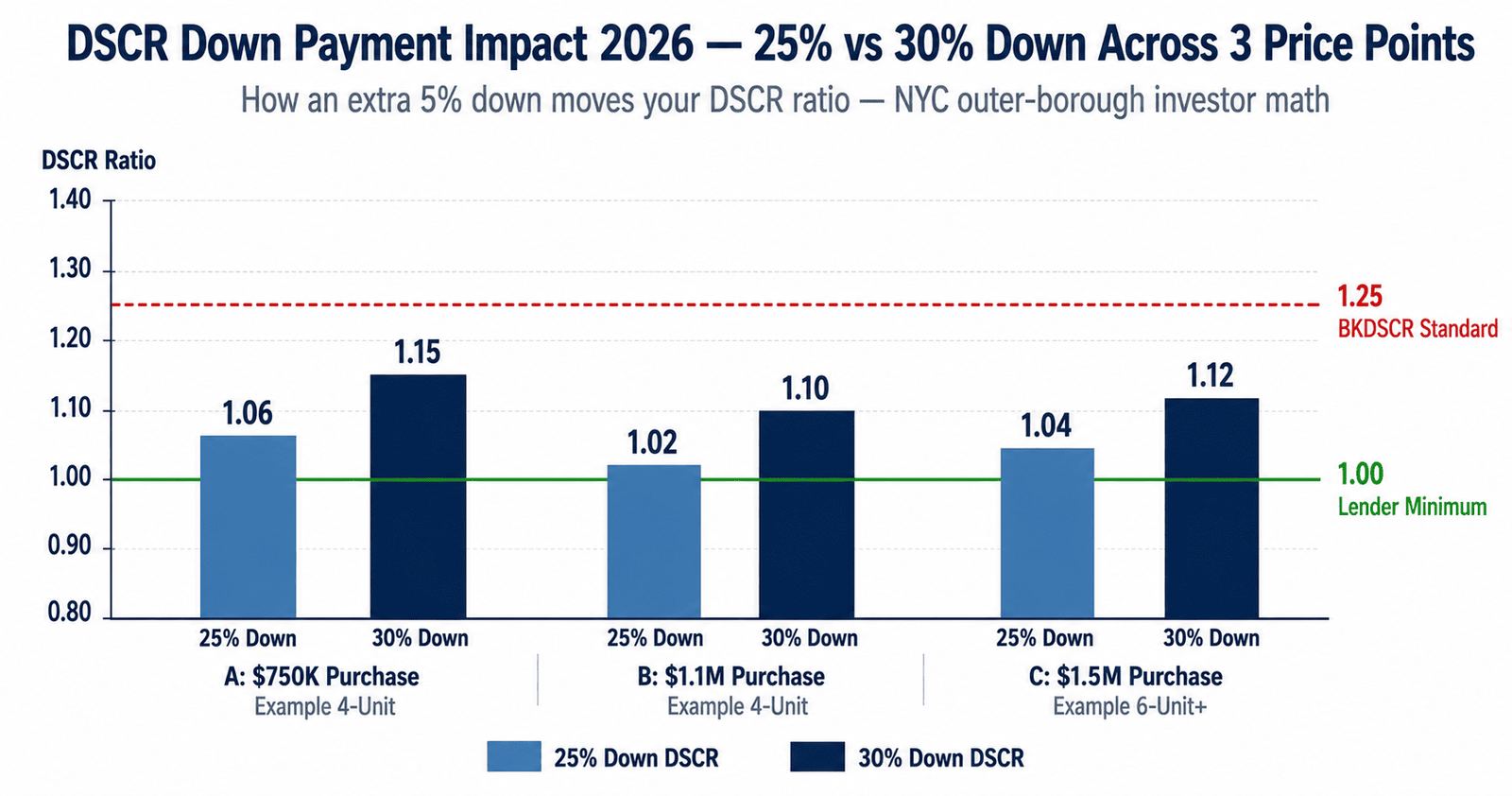
- Across three NYC outer-borough price points ($750K, $1.1M, $1.5M), the DSCR improvement from 25% to 30% down ranges from +0.08 to +0.09 points — enough to move a marginal deal to a comfortable pass.
- The stress test difference is more significant. At +1.0% rate stress, the same 5% extra down can be the difference between a stressed DSCR below 1.0 and one that clears the lender floor.
- Break-even on the extra capital runs approximately 8-9 years at current rates. For long-hold investors, the math often justifies it. For BRRRR or short-hold strategies, it usually does not.
- If the extra capital depletes reserves or kills a second acquisition, 25% down and keeping the cash is the better move. — bkdscr.com: what kills deals at underwriting.
Table of Contents
- DSCR Down Payment Impact 2026: The Two-Variable Effect
- The Loan Balance Effect
- The Rate Tier Effect
- DSCR Down Payment Impact 2026: Three Price Points, Real Numbers
- Deal A — $750,000 Purchase Price
- Deal B — $1,100,000 Purchase Price
- What the 2026 LTV Rate Matrix Actually Looks Like
- The Break-Even Question — When Does the Extra 5% Down Make Sense
- The Stress Test Dimension — What Extra Down Payment Does to Risk Margin
- When the Extra 5% Down Is NOT the Right Move
- What Brooklyn and Outer-Borough Investors Get Wrong About Down Payments
- Frequently Asked Questions
- Does DSCR Down Payment Impact Always Improve With Larger Down?
- What LTV gets the best DSCR loan rate in 2026?
- Can 5% more down move you into a different rate tier?
- DSCR Down Payment Impact: The Complete Sensitivity Table for NYC Outer-Borough Deals
- Bottom Line — DSCR Down Payment Impact 2026
DSCR down payment impact 2026 comes down to two mechanisms that work together, and most investors running DSCR calculations only model one of them. An extra 5% down has two effects: it reduces the loan balance, and it can trigger a rate tier improvement. This post works through the math at three outer-borough NYC price points so you can see exactly what an extra 5% does to your ratio, your rate, and your monthly debt service before you decide how much to put down. See also: DSCR fail.
| MARKET SNAPSHOT — DSCR Down Payment Impact, May 2026 | |
|---|---|
| Sources: Ridge Street Capital | Zumper (May 2026) | AAA Lending | BKDSCR Research | |
| DSCR LOAN RATES & LTV CONTEXT | |
| DSCR 30-yr fixed (May 2026) | 6.5%–7.875% | 75% LTV benchmark: ~7.5% |
| Standard DSCR down payment | 25% (75% LTV) — minimum for most programs |
| Lower LTV impact on DSCR | Each 5% more down reduces P&I by ~8–10% on $700K loan |
| LTV SENSITIVITY | |
| DSCR at 75% LTV (7.5% rate) | Lower — more debt service to cover |
| DSCR at 65% LTV (7.5% rate) | Higher — same rent, less debt service |
| Down payment example | $1M purchase: 25% down DSCR 1.18 | 35% down DSCR 1.35 |
| BKDSCR standard | 1.25+ unstressed | 1.00+ combined stress |
The fastest way to run your specific DSCR down payment numbers is the DSCR calculator. Plug in both scenarios — 25% and 30% down — and the tool shows you the ratio difference in real time before you finalize your offer.
DSCR Down Payment Impact 2026: The Two-Variable Effect
The Loan Balance Effect
On a $1,100,000 purchase, the difference between 25% down ($275,000) and 30% down ($330,000) is $55,000 of additional equity deployed. The loan drops from $825,000 to $770,000. At a 30-year fixed rate of 7.50%, that $55,000 reduction in loan balance cuts monthly P&I by approximately $385. That translates directly to a lower PITIA and a higher DSCR — before you factor in any rate change. The loan balance effect is linear and always works in the same direction.
The Rate Tier Effect
Lenders price DSCR loans by LTV tier, and moving from 75% to 70% LTV frequently crosses a pricing boundary. Per 2026 lender pricing data, the LTV pricing stack shows: 65% LTV gets the best tier, 70–75% LTV adds 0.125–0.25%, and 80% LTV adds 0.25–0.50% above that. Moving from 75% to 70% LTV can reduce your rate by 0.125–0.25% — which further reduces P&I on top of what the smaller balance already saved. For current LTV rate detail, see DSCR loan.
These two effects compound. The DSCR improvement from 5% extra down is not just the loan balance math. It is the loan balance math plus the rate improvement math. Neither shows up if you only run one scenario in your calculator.
DSCR Down Payment Impact 2026: Three Price Points, Real Numbers
Deal A — $750,000 Purchase Price
| Deal A — $750K | 25% Down (75% LTV) | 30% Down (70% LTV) |
|---|---|---|
| Down Payment | $187,500 | $225,000 |
| Loan Amount | $562,500 | $525,000 |
| Rate (30-yr fixed) | 7.50% | 7.25% |
| Monthly P&I | $3,934 | $3,581 |
| Taxes + Insurance | $950/mo | $950/mo |
| PITIA | $4,884 | $4,531 |
| Gross Rent | $5,200 | $5,200 |
| DSCR | 1.06 | 1.15 (+0.09) |
| P&I Savings/Month | — | $353 |
| Extra Capital Deployed | — | $37,500 |
Deal B — $1,100,000 Purchase Price
| Deal B — $1.1M | 25% Down (75% LTV) | 30% Down (70% LTV) |
|---|---|---|
| Down Payment | $275,000 | $330,000 |
| Loan Amount | $825,000 | $770,000 |
| Rate (30-yr fixed) | 7.50% | 7.25% |
| Monthly P&I | $5,769 | $5,253 |
| Taxes + Insurance | $1,300/mo | $1,300/mo |
| PITIA | $7,069 | $6,553 |
| Gross Rent | $7,200 | $7,200 |
| DSCR | 1.02 | 1.10 (+0.08) |
| P&I Savings/Month | — | $516 |
| Extra Capital Deployed | — | $55,000 |
Deal C — $1,500,000 Purchase Price
| Deal C — $1.5M | 25% Down (75% LTV) | 30% Down (70% LTV) |
|---|---|---|
| Down Payment | $375,000 | $450,000 |
| Loan Amount | $1,125,000 | $1,050,000 |
| Rate (30-yr fixed) | 7.50% | 7.25% |
| Monthly P&I | $7,867 | $7,163 |
| Taxes + Insurance | $1,750/mo | $1,750/mo |
| PITIA | $9,617 | $8,913 |
| Gross Rent | $10,000 | $10,000 |
| DSCR | 1.04 | 1.12 (+0.08) |
| P&I Savings/Month | — | $704 |
| Extra Capital Deployed | — | $75,000 |
The DSCR improvement is consistent — +0.08 to +0.09 points regardless of property size. Deal B at 25% down produces a 1.02 DSCR — lender-approvable but barely. At 30% down it reads 1.10 — still not the BKDSCR 1.25 conservative standard, but meaningfully more stable.
What the 2026 LTV Rate Matrix Actually Looks Like
Most investors look at headline rates, but those rates apply only to a specific profile. The LTV pricing stack from 2026 lender data breaks down by tier: 65% LTV gets the best pricing, 70–75% LTV adds 0.125–0.25% above that floor, and 80% LTV adds 0.25–0.50% more. The rate improvement alone at 0.25% on a $770,000 loan (Deal B, 30% down) saves approximately $58,300 over the full 30-year term.
Not every deal will clear a rate tier at exactly the 70% LTV boundary. Always request a lender’s rate matrix before you structure your down payment decision.
The Break-Even Question — When Does the Extra 5% Down Make Sense
The DSCR down payment impact has a cost: the extra capital committed at closing. The break-even calculation is straightforward — divide the extra capital deployed by the monthly PITIA savings:
| Deal | Break-Even Calculation |
|---|---|
| Deal A ($750K) | $37,500 ÷ $353/month = 106 months (~8.9 years) |
| Deal B ($1.1M) | $55,000 ÷ $516/month = 107 months (~8.9 years) |
| Deal C ($1.5M) | $75,000 ÷ $704/month = 107 months (~8.9 years) |
| Conclusion | ~9-year break-even at current rates, regardless of property size |
The nine-year break-even is consistent across deal sizes because the math is proportional. For a long-hold investor planning to own for 15–20 years, a nine-year break-even is compelling. For a BRRRR investor planning to refi out in 18–24 months, the break-even does not matter — the extra capital comes back at refinance and the long-term savings never materialize.
The harder case is the investor one acquisition away from exhausting liquid capital. If putting 30% down depletes the reserve account or prevents a second closing in the next 12 months, the DSCR improvement is not worth it. The deal analysis covers how to model this trade-off before you make the down payment decision. Before you finalize, run both scenarios through the stress test.
If you want the complete framework for underwriting NYC outer-borough deals the way lenders do, get the DSCR Playbook — every input, every threshold, and every deal-killer explained.
The Stress Test Dimension — What Extra Down Payment Does to Risk Margin
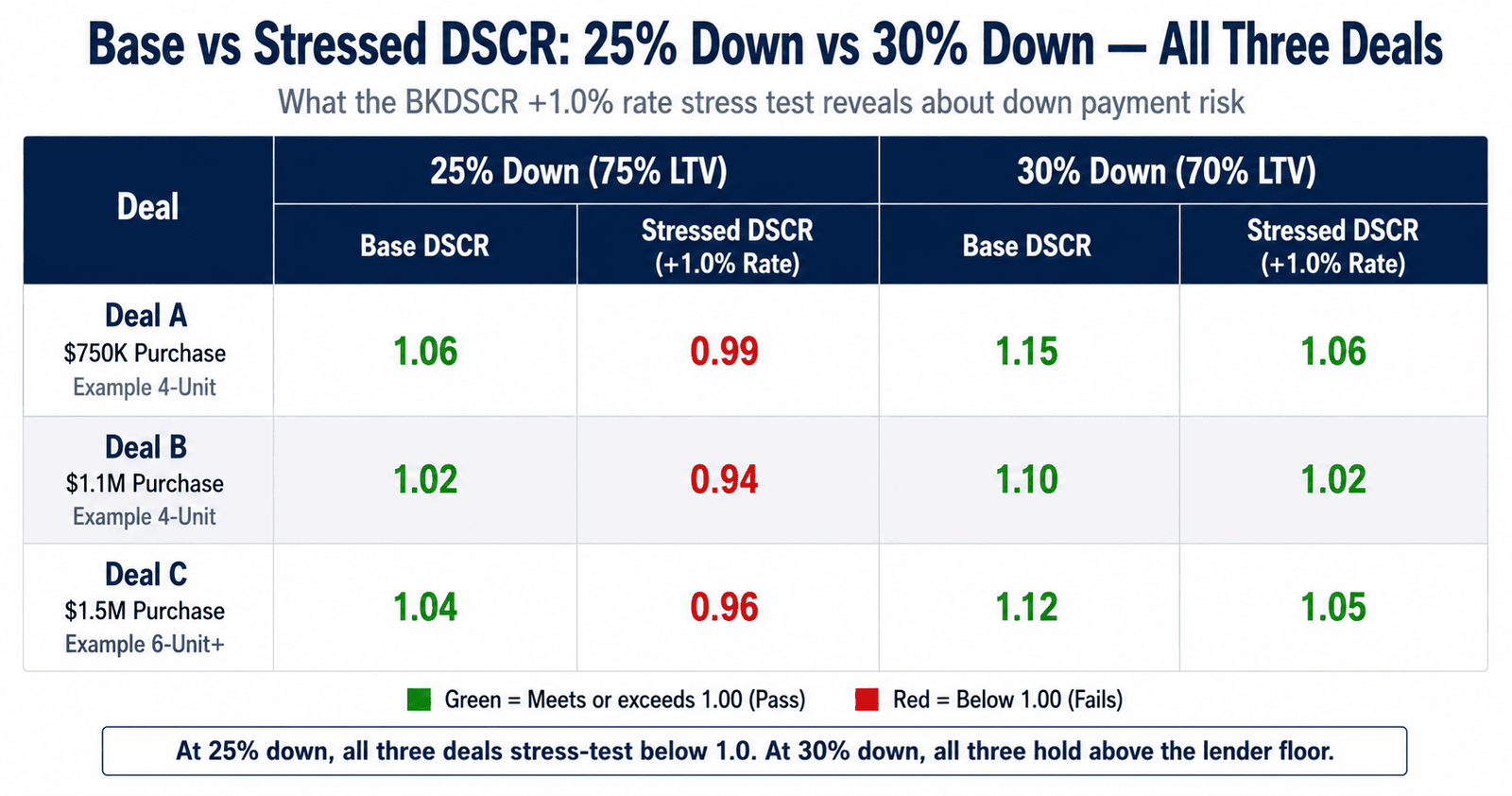
The base DSCR comparison tells part of the story. The stress test tells the rest. When you apply the BKDSCR +1.0% rate stress to the 25% vs 30% down comparison, the difference becomes more pronounced:
| Deal | 25% Base | 25% Stressed | 30% Base | 30% Stressed |
|---|---|---|---|---|
| Deal A | 1.06 | 0.99 — fail | 1.15 | 1.06 — pass |
| Deal B | 1.02 | 0.94 — fail | 1.10 | 1.02 — pass |
| Deal C | 1.04 | 0.96 — fail | 1.12 | 1.05 — pass |
Every 25%-down scenario stress-tests below 1.0. Every 30%-down scenario holds above the lender floor under the same stress. The difference between 0.94 stressed (Deal B at 25% down) and 1.02 stressed (Deal B at 30% down) is the difference between a deal that requires active management of vacancy and rate risk, and one that has at least a thin cushion on both. For more on reading stress test results, see the lender criteria.
When the Extra 5% Down Is NOT the Right Move
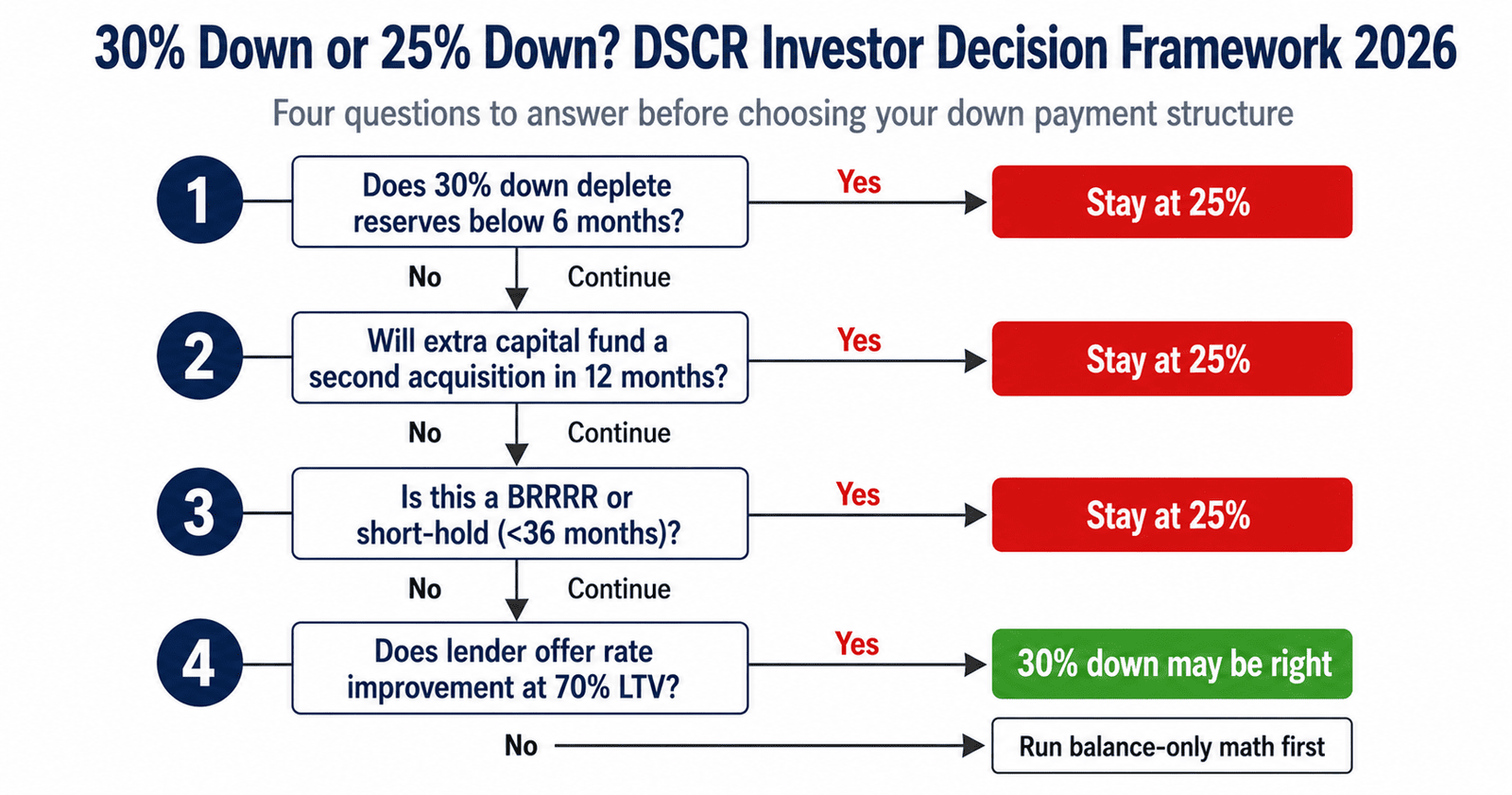
- Reserve depletion. If putting an additional 5% down drops your post-closing liquidity below six months of PITIA on this property and your existing portfolio, do not do it. A marginally better DSCR is not worth the operating vulnerability of running thin reserves.
- Second acquisition opportunity. If the extra $37,500–$75,000 can fund a down payment on a second deal in the next 12 months, the math often favors keeping it liquid. One acquisition at 25% down plus a second acquisition is nearly always a better portfolio outcome than one acquisition at 30% down with nothing left for the next deal.
- BRRRR or short-hold structure. If you plan to refinance within 24–36 months, the break-even does not materialize. Put 25% down, execute the value-add, and use the seasoned equity in the refinance to reset your LTV anyway.
- Rate tier boundary does not apply. If your lender’s matrix does not include a rate benefit for moving from 75% to 70% LTV, only the loan balance effect applies. Run the math without the rate improvement assumption and see if the DSCR gain justifies the extra capital on the balance effect alone.
What Brooklyn and Outer-Borough Investors Get Wrong About Down Payments
The most common mistake is treating the down payment as a fixed variable. The DSCR down payment impact 2026 analysis is actually a strategic decision that interacts with rate structure, reserve levels, deal velocity, and stress-test outcomes. Most investors who end up with a 1.02 DSCR would have been better served running both scenarios before going under contract. The DSCR formula walks through how each input variable — including loan amount and rate — moves the ratio.
The second mistake is conflating lender approval with deal quality. A 1.02 DSCR clears the lender’s 1.0 floor. It does not mean the deal is positioned well. At 1.02, a single vacancy month drops the rolling DSCR below 1.0 during that quarter. The lender approved the deal on today’s numbers. You manage the deal through whatever happens over the next five to ten years.
Frequently Asked Questions
Does DSCR Down Payment Impact Always Improve With Larger Down?
Yes — by definition. A larger down payment reduces the loan amount, which reduces monthly P&I, which reduces PITIA (the denominator). With the same gross rent in the numerator, a lower denominator produces a higher ratio every time. An additional 5% down on a $750,000 purchase moves DSCR by approximately +0.09 points in current market conditions. If the down payment also triggers a rate tier benefit, the improvement is larger.
What LTV gets the best DSCR loan rate in 2026?
Based on current lender pricing matrices, 65% LTV consistently produces the lowest rate tier. The practical best-available tier for most borrowers is 70% LTV (30% down), which typically runs 0.125–0.25% below 75% LTV pricing. The 70% LTV level is generally the most efficient stopping point on the LTV rate curve for outer-borough NYC investors.
Can 5% more down move you into a different rate tier?
Yes, in many cases. The standard DSCR pricing break points are at 65%, 70%, and 75% LTV for most lenders. Moving from 75% LTV (25% down) to 70% LTV (30% down) crosses one of those boundaries. The rate improvement is typically 0.125–0.25%. Always ask the lender for their rate sheet by LTV tier before you decide on a down payment amount.
DSCR Down Payment Impact: The Complete Sensitivity Table for NYC Outer-Borough Deals
The DSCR down payment impact runs through four LTV scenarios on a representative NYC outer-borough 4-unit purchase at $850,000 to show the full range:
| LTV | Loan | P+I (7.5%) | PITIA Est. | Req. Rent (1.25x) |
|---|---|---|---|---|
| 80% | $680,000 | $4,755 | $6,255 | $7,819/mo |
| 75% | $637,500 | $4,457 | $5,957 | $7,446/mo |
| 70% | $595,000 | $4,163 | $5,663 | $7,079/mo |
| 65% | $552,500 | $3,868 | $5,368 | $6,710/mo |
PITIA estimate assumes $1,250/month taxes and $550/month insurance — representative for a Brooklyn or Queens 4-unit at this price point. The table shows that moving from 75% to 70% LTV reduces required rent by $367/month — about $92/unit on a 4-unit. That is a meaningful threshold in markets where the spread between achievable rent and required qualifying rent is tight.
One constraint: most DSCR lenders require a 75% LTV maximum for 1-4 unit investment properties. Programs at 80% LTV exist but carry higher rates and tighter credit overlays. Programs at 70% or 65% LTV are available from most lenders but require additional capital. The lender criteria overview lists which programs offer sub-75% LTV products and what the rate differential typically looks like at each tier.
The other dimension of the DSCR down payment impact is reserve requirements. Most DSCR lenders require 6 months of PITIA in reserves at closing, in addition to the down payment and closing costs. On a $850,000 purchase at 75% LTV with $6,000/month PITIA, the reserve requirement is $36,000. At 70% LTV with $5,700/month PITIA, the reserve drops to $34,200.
The reserve difference between LTV tiers is smaller than the down payment difference — but the total capital required at each tier compounds: 75% LTV requires $212,500 down + $36,000 reserves + $25,000–$35,000 closing costs = approximately $273,500–$283,500 all-in. The 70% LTV tier requires $255,000 down + $34,200 reserves + $25,000–$35,000 closing costs = approximately $314,200–$324,200 all-in. The additional $40,000+ in total capital at 70% LTV buys a 0.09 DSCR improvement and a lower rate. Confirm available capital covers the full all-in requirement at each tier before deciding which down payment structure to pursue.
One more variable: some DSCR lenders allow gift funds or cross-collateralization of another property’s equity as part of the down payment. These program-specific features can change the capital requirement at each LTV tier. Confirm the down payment sourcing requirements with the target lender before modeling the deal. The lender criteria page covers down payment sourcing rules by program type.
Bottom Line — DSCR Down Payment Impact 2026
The DSCR down payment impact 2026 question has a consistent answer across deal sizes: 5% more down improves your ratio by 0.08–0.09 points, reduces monthly PITIA by $353–$704 depending on purchase price, and in most cases triggers a rate improvement that compounds the savings. The break-even on the extra capital is approximately nine years at current rates — a reasonable trade-off for long-hold investors, a non-starter for BRRRR operators or short-hold strategies.
What the stress test reveals is more important than the base DSCR numbers alone. At 25% down, all three modeled deals stress-test below 1.0 when rates move up 1.0%. At 30% down, all three hold above the lender floor under the same stress. For investors underwriting an outer-borough acquisition in 2026, that difference in stress margin is real.
The right down payment structure depends on what that extra capital would otherwise do. If it funds reserves, a second deal, or a capital improvement, keep it liquid and put 25% down. If the deal is a long-hold acquisition and reserves remain intact after closing at 30% down — that structure often makes sense. Run both numbers before you make the offer.
If you want a structured walkthrough of your specific deal at both down payment levels — including the stress test at each structure — a full Deal Review covers exactly that.