
DSCR Loan Denied Cash Flow: 7 Real Reasons
- A DSCR loan denial on cash flow grounds means gross rent does not cover PITIA at the lender’s minimum
- The most common cause: PITIA was underestimated — stale property tax or below-market insurance input
- DSCR lenders underwrite on actual current rents — proforma or projected rents are not accepted
- A deal denied at 75% LTV may qualify at 65-70% LTV if the cash flow gap is small
- Property condition denials are separate — the property must be habitable at closing
- The fix path depends on which side of the DSCR ratio broke — numerator or denominator
Table of Contents
- Why a DSCR Loan Denied Cash Flow Outcome Happens
- Reason 1 — DSCR Loan Denied Cash Flow: Two Different Formulas
- Reason 2 — The Appraiser’s 1007 Rent Schedule Came in Below the Submitted Roll
- Reason 3 — Credit Score Below the Lender’s Actual Threshold
- Reason 4 — Reserve Shortfall at Closing
- Reason 5 — Property Type Ineligibility or Condition Issues
- NYC Property Types That Generate DSCR Loan Denials
- Reason 6 — Unseasoned or Undocumented Down Payment Funds
- Reason 7 — The DSCR Loan Denied When the Stress Test Fails
- How DSCR Underwriting Differs From Conventional Loan Review
- Frequently Asked Questions
- Can a property have positive cash flow and still fail DSCR underwriting?
- What is the most common reason a DSCR loan gets denied in 2026?
- Does DSCR underwriting require a stress test?
- Bottom Line — DSCR Loan Denied Cash Flow Positive: What It Actually Means
DSCR loan denied cash flow outcomes are one of the most disorienting results an investor can face in 2026 underwriting. The rent covers the payment. The numbers work in the investor’s spreadsheet. And the lender says no. The explanation is almost always one of seven variables — none of which is the investor’s cash flow analysis.
DSCR underwriting does not use the same calculation the investor uses. It does not account for the same inputs, the same expenses, or the same assumptions. The gap between “the property cash flows” and “the deal clears DSCR underwriting” is where most denials live.
Before spending time on a full analysis, bkdscr.com lets you Deal Filter — property type, rent roll, unit count, and PITIA in one pass. Use the deal filter to confirm the basic eligibility of any deal before running the full DSCR analysis.
Before submitting any DSCR application, confirm the deal clears every variable — not just the ratio. See lender criteria for the full set of underwriting requirements that apply to NYC outer-borough deals: credit tiers, reserve floors, LTV limits, and property type eligibility by program.
Why a DSCR Loan Denied Cash Flow Outcome Happens
The core of the confusion is definitional. When an investor says “the property cash flows,” they typically mean: gross rent minus all operating expenses, including property management fees (typically 8–10% of gross rent), maintenance and repairs (typically 5–7%), vacancy allowance (5–8%), taxes, insurance, and debt service. When a lender calculates DSCR, they divide gross rent by PITIA only — principal, interest, taxes, insurance, and HOA. Management, maintenance, and vacancy are not in the DSCR denominator.
This means DSCR is not a cash flow calculation. It is a debt coverage calculation. The two numbers answer different questions: the investor’s cash flow analysis answers “what does this property actually return after all costs?” and the DSCR calculation answers “can the property’s gross rent cover the debt service?” They can both show positive results on the same property, or they can diverge sharply.
The second direction of divergence matters too: a property can have a solid DSCR above 1.25 but produce weak or negative investor cash flow once management, vacancy, and capital reserves are factored in. The lender approves the loan. The investor is subsidizing the property from their own pocket within 12 months. The DSCR calculation is a financing tool, not an investment underwriting tool.
Reason 1 — DSCR Loan Denied Cash Flow: Two Different Formulas
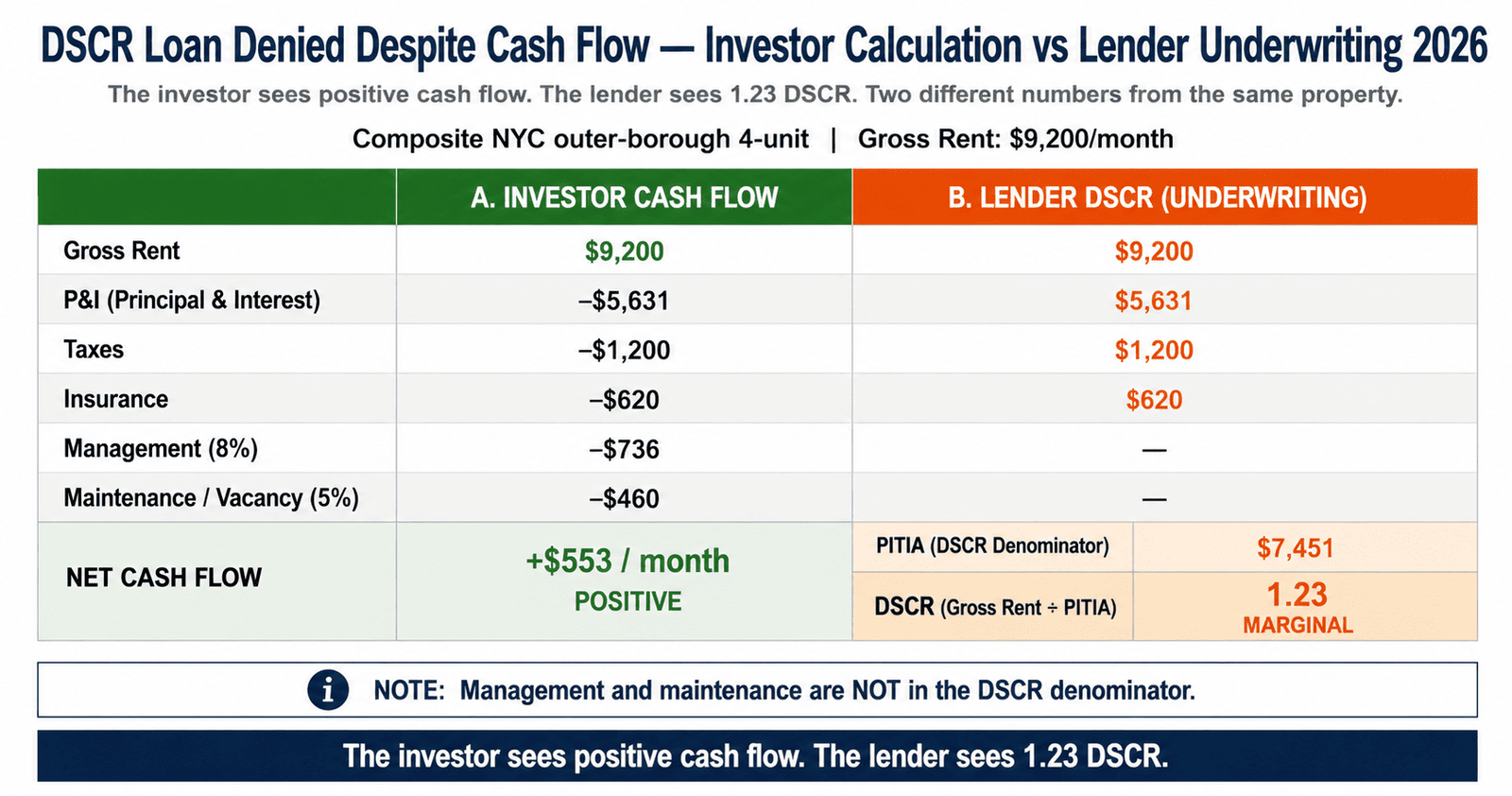
| Investor Cash Flow | Lender DSCR | |
|---|---|---|
| Gross Rent | $9,200 | $9,200 |
| P&I (7.25%, $825K) | −$5,631 | $5,631 |
| Taxes | −$1,200 | $1,200 |
| Insurance | −$620 | $620 |
| Management (8%) | −$736 | Not in formula |
| Maintenance/Vacancy | −$460 | Not in formula |
| PITIA Total | — | $7,451 |
| Result | +$553/month (POSITIVE) | $9,200 ÷ $7,451 = 1.23 (MARGINAL) |
On this composite NYC outer-borough 4-unit deal, the investor sees $553 per month in positive cash flow. The lender sees a 1.23 DSCR — marginal, below many lender overlays at 75% LTV, and below the BKDSCR 1.25 standard. Both numbers are correct. They are answering different questions. The most common version of this error is investors calculating DSCR using P&I only and excluding taxes and insurance, which inflates the self-calculated DSCR by 15–25 points on a typical NYC deal. The deal killers page documents this as one of the most common pre-submission calculation errors.
Reason 2 — The Appraiser’s 1007 Rent Schedule Came in Below the Submitted Roll
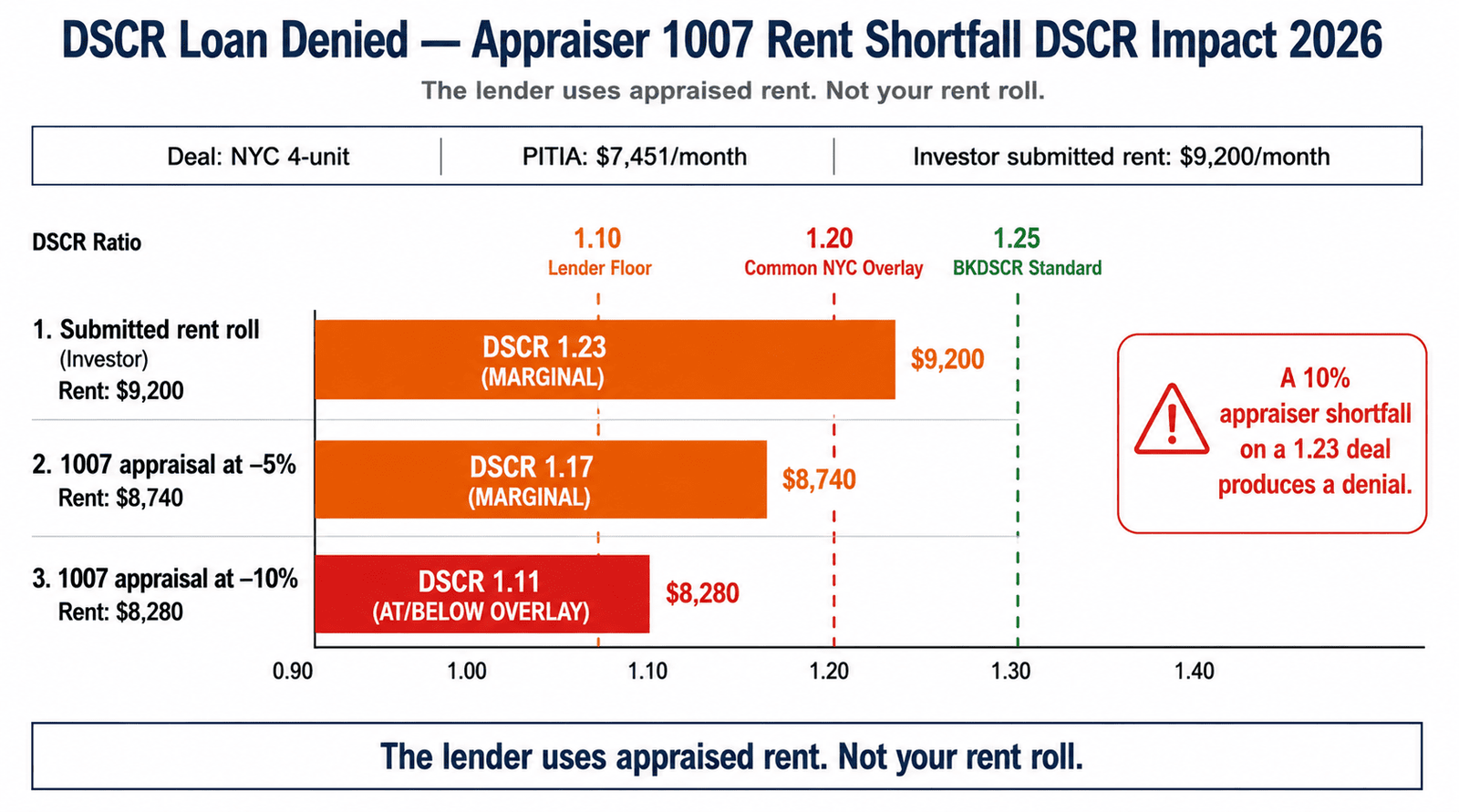
Even when the investor calculates DSCR correctly — using gross rent divided by full PITIA — the rent figure they use may not be the rent figure the lender uses. DSCR lenders use the lower of in-place rent or appraised market rent as the qualifying income. The appraiser’s 1007 rent schedule establishes the market rate for the units based on comparable rental properties within the appraiser’s selected radius. If the appraiser’s comparables produce a lower estimate than the investor’s submitted roll, the qualifying DSCR drops.
A 10% shortfall on a $9,200 monthly rent roll reduces qualifying income to $8,280. On a $7,451 PITIA, the DSCR drops from 1.23 to 1.11. With a lender overlay at 1.20 for this LTV and credit profile, that is a denial. Overstated NOI remains one of the most common sources of DSCR loan rejections in 2026, particularly when rent projections exceed what market comparables actually support.
The pre-application control point is understanding what the 1007 will likely show before going to contract. If the submarket has thin rental comp activity, older units that rent at a premium to comps, or any above-market lease that won’t be confirmed by the appraiser’s methodology, model the DSCR at the appraised range, not the submitted roll. The 1007 is not a formality.
Reason 3 — Credit Score Below the Lender’s Actual Threshold
DSCR lenders publish program minimums. Most programs in 2026 publish a minimum FICO of 620. Most programs in 2026 operate with internal overlays for specific deal profiles that place the actual floor at 660 to 680. The gap between the published minimum and the actual threshold is the source of a significant number of DSCR loan denials on deals that appear to qualify.
A borrower at 660 FICO on a 75% LTV deal with a 1.22 DSCR represents a combination of moderate credit risk, thin ratio margin, and high leverage. A 680+ FICO borrower on the same deal may qualify cleanly. A 660 FICO borrower may need to bring the deal to 65% LTV, reduce PITIA by taking less loan, or find a lender whose overlay accommodates the credit profile. Lender overlays have tightened across the board in 2026, with credit floors moving up across many programs. For current rate tier details, see Ridge Street.
Reason 4 — Reserve Shortfall at Closing
Reserve requirements are the most common source of closing-table surprises on DSCR deals. Investors plan meticulously for the down payment and estimate closing costs, then arrive at closing short on reserves — the liquid assets that must remain in the borrower’s account after all closing funds have cleared. The lender does not fund the loan until reserves are confirmed. See also: DSCR fail.
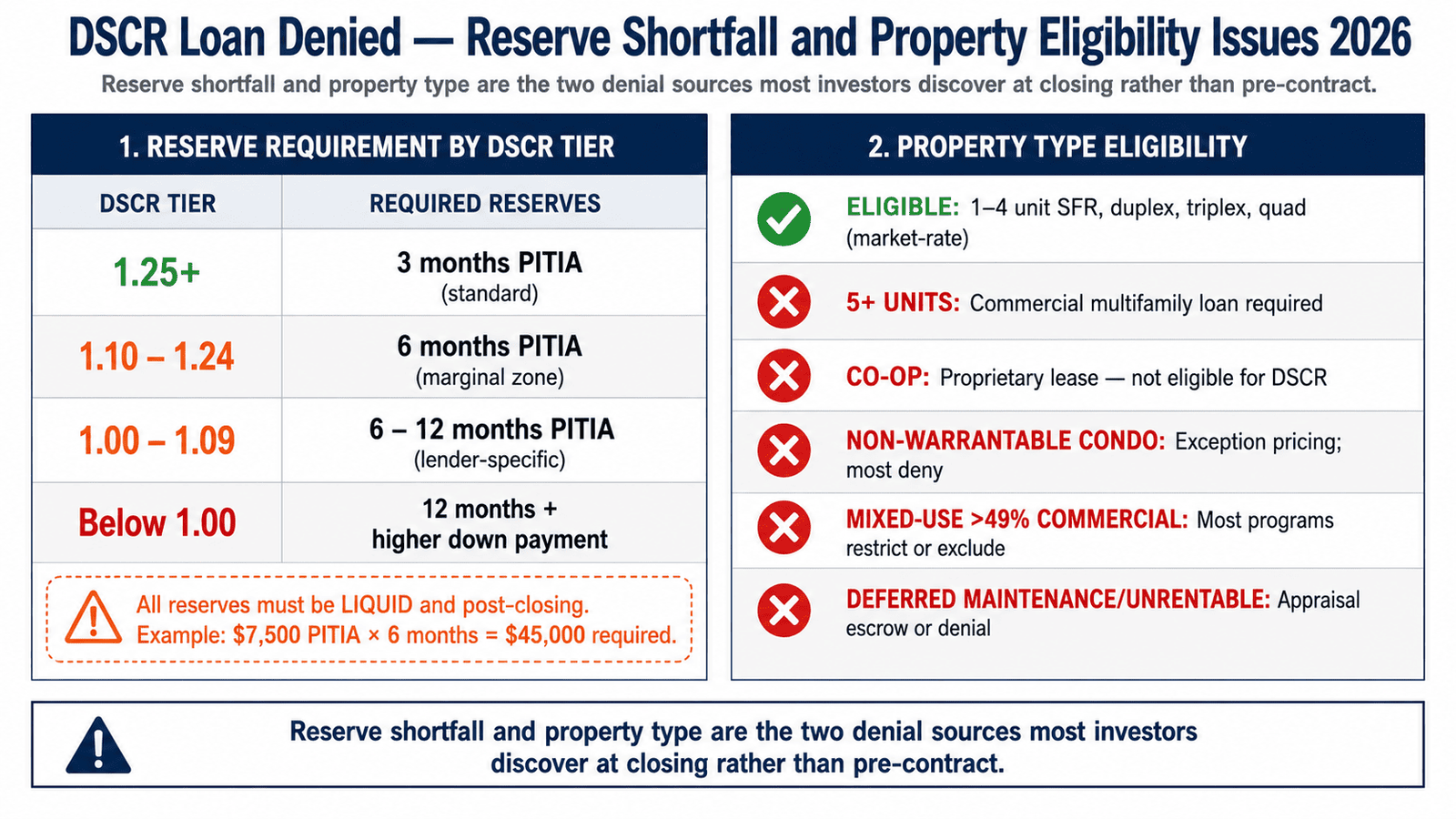
In 2026, standard DSCR programs require 3–6 months of PITIA in liquid post-closing reserves. Deals with DSCR below 1.20 frequently trigger the 6-month requirement. On a deal with $7,500 monthly PITIA, 6 months of reserves is $45,000 in liquid assets that must remain in the borrower’s account after the down payment wire, closing costs, and any prepaid taxes or insurance are funded.
The reserve calculation belongs in the deal analysis, not the closing disclosure review. An investor who has $120,000 available, puts $75,000 toward a 25% down payment, and allocates $15,000 toward closing costs is left with $30,000. If the lender requires 6 months at $4,200 PITIA, the reserve requirement is $25,200. That deal clears with $4,800 to spare — but any appraisal gap or closing cost adjustment that consumes more than $4,800 produces a reserve shortfall and a denial.
If you want the complete framework for underwriting NYC outer-borough deals the way lenders do, DSCR Playbookevery input, every threshold, and every deal-killer explained.
Reason 5 — Property Type Ineligibility or Condition Issues
A DSCR loan gets denied on a cash-flow-positive deal when the property itself is not eligible for the program, regardless of the ratio. Property type eligibility is a binary gate in DSCR underwriting: the property qualifies for the program or it does not, and the ratio has no bearing on that determination.
NYC Property Types That Generate DSCR Loan Denials
Co-operative apartments (co-ops) are structurally ineligible for residential DSCR programs at virtually all lenders. The proprietary lease structure means the borrower does not hold title to real property, which eliminates the standard collateral basis for a mortgage. NYC’s outer boroughs have a substantial co-op inventory, and investors who do not confirm co-op status before modeling a deal often discover the ineligibility only after going to contract.
Five-unit and larger residential buildings are commercial multifamily properties under standard DSCR program definitions. Residential DSCR programs cap at 1-4 units. Mixed-use properties with commercial space exceeding 49% of total square footage trigger similar restrictions. Property condition is a separate denial pathway — deferred maintenance, structural issues, or properties that fail the appraiser’s habitability review generate conditions or outright denials. These failure points are documented on the deal killers page
Reason 6 — Unseasoned or Undocumented Down Payment Funds
DSCR loans are classified as business-purpose mortgages, which means they are exempt from many consumer mortgage regulations. However, lenders still require that the borrower’s funds for the down payment, closing costs, and reserves be documented as to their source and seasoned — meaning they have been in the borrower’s account long enough to establish that they represent legitimate, stable assets and not borrowed funds or undisclosed liabilities.
Most DSCR lenders review 30–60 days of bank statements. Any large deposit that appears in that window and cannot be sourced to a documented transaction — sale of an asset, transfer from another account with a clear paper trail, documented gift with a signed letter from the donor — triggers an underwriting condition. If the documentation is not available or takes too long to produce, the closing is delayed or the deal is denied.
Pre-application review of bank statements — identifying any large unexplained deposits in the prior 60 days — is a standard pre-submission step that keeps these issues from becoming closing-table emergencies.
Reason 7 — The DSCR Loan Denied When the Stress Test Fails
The seventh source of a DSCR loan denied on a deal that appears to qualify is the stress test. The investor submits a 1.18 DSCR. The lender’s underwriter runs an internal stress scenario at +1.0% over the application rate. The stressed P&I is approximately 8–10% higher than the application-rate P&I. The stressed DSCR may land at 1.05–1.09 — below the lender’s internal stressed minimum. The investor receives a denial on a deal that appeared to clear the published 1.10 floor.
A January 2026 lender memo raised the internal stressed DSCR requirement from 1.20x to 1.25x for stabilized assets, with transitional deals pushed to 1.30x or higher. This denial reason is the most preventable of the seven because the stress calculation is straightforward: increase the application rate by 1.0% for purchase deals, recalculate P&I, recalculate PITIA, and recalculate DSCR. Run the stress test before applying — it applies both purchase and refinance stress scenarios to any set of deal inputs and returns both the unstressed and stressed DSCR against the lender floor and the BKDSCR 1.25 standard.
How DSCR Underwriting Differs From Conventional Loan Review
Most investors who receive a DSCR loan denied cash flow positive decision expect the outcome to match how they’ve been evaluated by banks or conventional lenders — DTI-first, credit-first. DSCR underwriting is property-first. The lender’s cash flow analysis focuses on the property’s income divided by PITIA, not on the borrower’s W-2 income or debt-to-income ratio. When the property fails the DSCR test, the denial reason is the property’s economics —
not the borrower’s creditworthiness. This distinction matters for the fix path. A denial driven by DSCR math is fixed by improving the deal structure: lower purchase price, higher rent roll, or lower PITIA. A denial driven by personal credit or DTI is a different problem entirely. The deal qualification page explains the full underwriting criteria so investors know which category any denial falls into before attempting a resubmission.
Why DSCR Underwriting Denial Reasons 2026 Are Different From What Investors Expect
The mental model most investors bring to DSCR underwriting is inherited from conventional mortgage underwriting, where the primary question is “can the borrower afford the payment?” DSCR underwriting flips this: the property’s income is the qualifying basis and personal income is not reviewed. But the shift to property-based qualification does not mean underwriting is simpler. It means the underwriting risks have moved from the borrower’s income statement to the property’s income, the appraisal, the reserves, and the deal structure.
Investors who understand conventional underwriting often assume DSCR is more flexible because it does not require tax returns or employment verification. It is more flexible on the income side. It is not more flexible on reserves, property type eligibility, credit tiers, or structural deal requirements. The deal analysis framework applies the full underwriting sequence to any deal: ratio, stressed ratio, credit tier, reserve requirement, property eligibility, and lender match.
Frequently Asked Questions
Can a property have positive cash flow and still fail DSCR underwriting?
Yes, and it happens regularly. The investor’s cash flow model and the lender’s DSCR calculation use different formulas. The investor deducts management, maintenance, and vacancy. The lender does not. A property that produces positive investor cash flow after all expenses can produce a marginal or failing DSCR if the PITIA is high relative to gross rent, or if the appraiser’s rent schedule reduces qualifying income below what the investor submitted.
What is the most common reason a DSCR loan gets denied in 2026?
In NYC outer-borough markets specifically, the most common DSCR loan denial reason in 2026 is a combination of thin DSCR margin and lender overlay. The deal’s calculated DSCR passes the published 1.10 floor but falls below the lender’s internal 1.20 or 1.25 overlay for the specific credit profile and LTV. The second most common denial source is a 1007 rent appraisal that comes in below the submitted rent roll. Both are discoverable before the application goes in.
Does DSCR underwriting require a stress test?
Most lenders apply an internal stress scenario to DSCR deals, though this is not a published program requirement at most lenders the way the ratio floor is. The stress methodology typically applies a 50–100 basis point rate increase to the application rate and recalculates PITIA at the higher rate. The BKDSCR standard applies a +1.0% purchase stress and requires the stressed DSCR to clear 1.25 before a deal is considered to have adequate margin.
Bottom Line — DSCR Loan Denied Cash Flow Positive: What It Actually Means
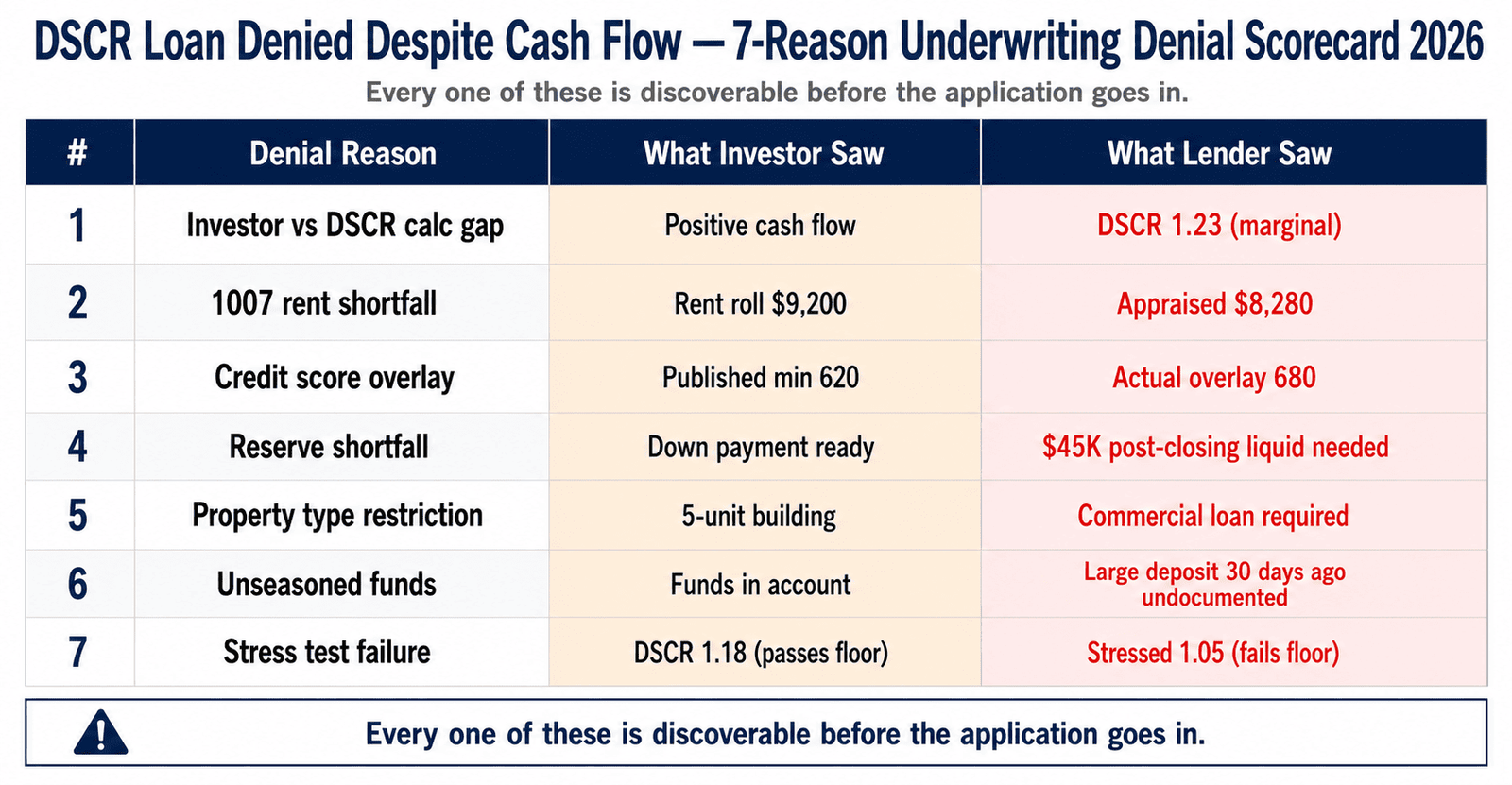
A DSCR loan denied cash flow positive outcome is almost always a pre-application analysis failure — not a lender problem and not a deal problem. Seven variables drive underwriting decisions on DSCR files: the correct DSCR calculation (not the investor’s cash flow model), the appraised qualifying rent, the credit score relative to the lender’s actual overlay, the post-closing reserve level, the property type eligibility, the sourcing and seasoning of the down payment funds, and the stressed DSCR under the lender’s rate scenario. Any one of them can produce a denial independent of what the others show.
If your DSCR loan was denied and you want to know exactly where the number broke and what the fix path is, deal reviewPASS/MARGINAL/FAIL with fix paths within 48–72 hours.
The deals that close cleanly in 2026 are the ones where the investor confirmed all seven before submitting. The deals that get denied are the ones where the investor confirmed one — typically the gross rent to PITIA ratio — and assumed the rest would follow. The underwriting sequence has a logic, and understanding it changes your behavior at the deal level.
The seven denial reasons in this guide are all discoverable before the application goes in. None requires a different deal. All require a complete analysis rather than a partial one. Do the full underwriting sequence — correct DSCR, correct qualifying rent, credit tier, reserve requirement, property eligibility, fund sourcing, and stress test — before the first lender call.
Run your deal through the full screening sequence before it goes anywhere. The Deal Filter screens for all seven variables and returns a clear go/no-go before you commit to a lender or a contract.