
DSCR Hold Period: The Critical 3-Exit Loan Structure
Key Takeaways
- DSCR hold period strategy determines three loan decisions: PPP structure, rate type (ARM vs fixed), and DSCR target
- If exiting before Year 4.5, no-PPP at higher rate is cheaper; after Year 4.5, the 5-year PPP at lower rate wins
- A 5/1 ARM saves $251/month vs 30-year fixed for the first 5 years — $15,060 in savings on a 3–5 year hold
- BRRRR investors need no-PPP on the DSCR takeout and 1.25+ DSCR on the stabilized rent roll to qualify
- Long-hold investors should target 1.30+ DSCR at origination to absorb property tax and insurance increases over time
- 1031 exchange timing must account for PPP: a live penalty is a closing cost that reduces exchangeable equity
Table of Contents
- DSCR Hold vs Sell: The Four Exit Archetypes
- DSCR Hold vs Sell: PPP vs No-PPP Trade-Off
- DSCR Hold Period Strategy: ARM vs Fixed by Exit Type
- 5/1 ARM for Short to Medium Holds
- 30-Year Fixed for Long Holds
- DSCR Hold Period Strategy: How the Target DSCR Changes by Exit Type
- Short-Hold DSCR Target: 1.20 Minimum, 1.25 Preferred
- BRRRR DSCR Target: 1.25+ on the Takeout, Not the Acquisition
- DSCR Hold Period Strategy and the 1031 Exchange
- FAQ: DSCR Hold Period Strategy
- DSCR Hold Period Strategy: Can I change my exit plan after origination?
- Does the DSCR requirement change for a cash-out refi vs rate-and-term refi?
- What if I plan to sell but the market drops?
- Can I negotiate the PPP structure with the lender?
DSCR hold vs sell is the decision that connects your exit plan to three loan choices: which prepayment penalty to accept, whether to use a 30-year fixed or ARM, and what DSCR threshold you need at origination. Most investors treat these as separate rate-shopping questions. They are not. The investor who plans to sell in two years and takes a 5-year step-down PPP has made a structurally wrong loan choice — regardless of the rate.
The investor who plans to hold for ten years and pays a premium for no-PPP has spent money on flexibility they will never use. See also: DSCR refi break-even math.
According to Stacking Capital, aligning the PPP term with the investment timeline is one of the most impactful but least-discussed aspects of DSCR loan structuring in 2026. This post covers four exit archetypes, the optimal loan structure for each, and the math behind the PPP vs no-PPP trade-off at every exit year.
| MARKET SNAPSHOT — DSCR Loan Structures, June 2026 | |
|---|---|
| Sources: Stacking Capital (Apr 2026) | Ridge Street Capital (Jun 2026) | Griffin Funding (Jun 2026) | |
| LOAN STRUCTURE OPTIONS | |
| 30-yr fixed DSCR rates (Jun 2026) | 6.125%–7.5% |
| 7/1 ARM vs 30-yr fixed | 0.125%–0.25% below fixed |
| 5/1 ARM vs 30-yr fixed | 0.25%–0.50% below fixed |
| No-PPP vs 5-yr PPP rate premium | 0.25%–0.50% higher for no-PPP |
| PREPAY & HOLD CONTEXT | |
| Most common PPP structures | 5-4-3-2-1 | 3-2-1 | 3-year flat | no-PPP |
| Crossover point (no-PPP vs 5-yr PPP) | ~4.5 years (0.375% rate premium on $750K loan) |
| Rate-and-term refi max LTV | 75% | Cash-out max LTV: 70%–75% |
| DSCR refi minimum | 1.20 (most lenders) | 1.25 (BKDSCR standard) |
| Typical NYC DSCR closing costs | $22,000–$32,000 (incl. 1.925% recording tax) |
Deal Filter — property type, rent roll, unit count, and PITIA in 60 seconds.
DSCR Hold vs Sell: The Four Exit Archetypes
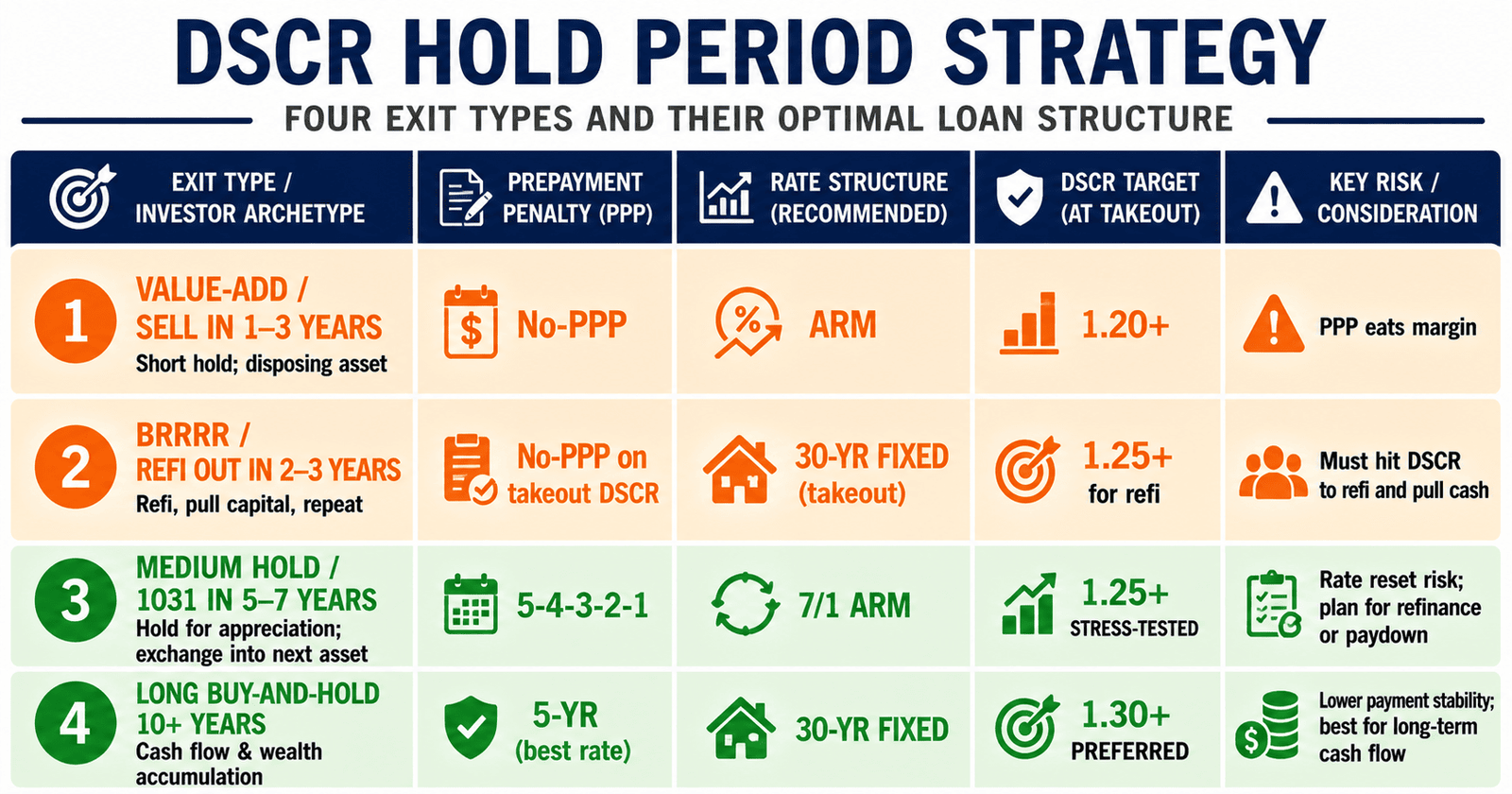
Every DSCR loan structure decision flows from the exit. There are four primary exit types in the NYC outer-borough investment market:
| Exit Type | Hold Period | Optimal PPP | Rate Structure | Target DSCR / Notes |
|---|---|---|---|---|
| Value-add / sell | 1–3 yrs | No-PPP or 3-yr | 5/1 ARM or fixed | 1.20+ min; exit before PPP bites |
| BRRRR / refi out | 2–3 yrs | No-PPP on takeout | 30-yr fixed (takeout) | 1.25+ on DSCR refi; 1.20 lender min |
| Medium hold / 1031 | 5–7 yrs | 5-4-3-2-1 | 5/1 or 7/1 ARM | 1.25+ BKDSCR standard; stress test |
| Long buy-and-hold | 10+ yrs | 5-4-3-2-1 (best rate) | 30-yr fixed | 1.30+ preferred; max rate buffer |
According to Ridge Street, DSCR loans close in the name of an entity and do not report to the borrower’s personal credit bureaus — a structure that applies regardless of exit type. The directional logic of the matrix is consistent: short holds need flexibility, long holds need low rates, and BRRRR investors need to structure the takeout DSCR before they acquire the asset.
DSCR Hold vs Sell: PPP vs No-PPP Trade-Off
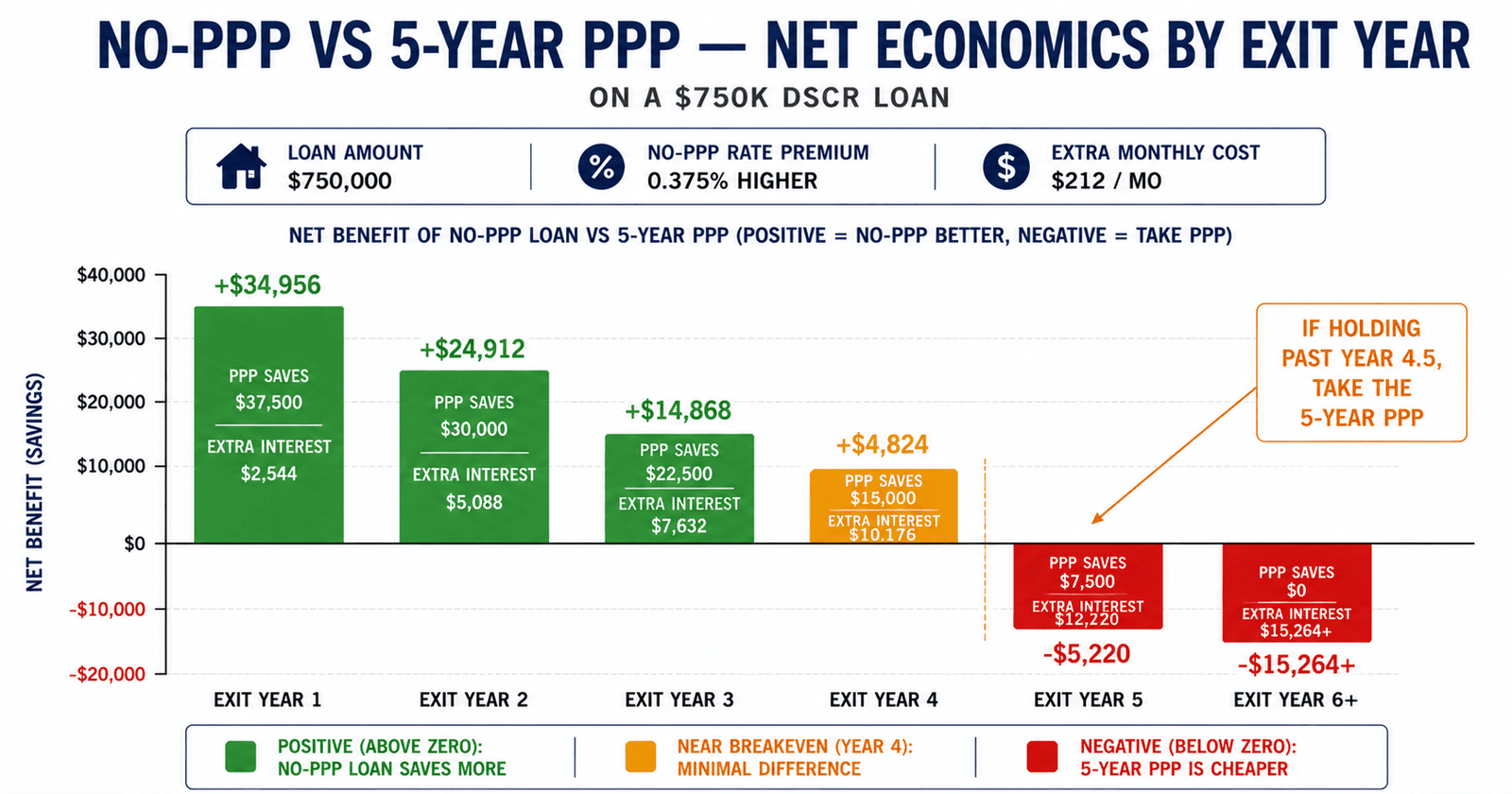
The prepayment penalty vs no-PPP decision is math, not preference. Most DSCR lenders charge 0.25%–0.50% more in rate for no-PPP. On a $750,000 loan at 0.375% rate premium, the additional monthly P&I is $212. That extra $212/month accumulates as the cost of flexibility you bought. The 5-year PPP structure costs money only if you trigger it. The no-PPP structure costs $212/month whether you sell in Year 1 or hold for Year 20. See also: prepay penalty comparison.
| Exit Year | PPP Cost (5-4-3-2-1) | Extra Interest (No-PPP) | Net: No-PPP Saves | Verdict |
|---|---|---|---|---|
| Year 1 | $37,500 (5%) | $2,544 | +$34,956 | Take No-PPP |
| Year 2 | $30,000 (4%) | $5,088 | +$24,912 | Take No-PPP |
| Year 3 | $22,500 (3%) | $7,632 | +$14,868 | Take No-PPP |
| Year 4 | $15,000 (2%) | $10,176 | +$4,824 | Marginal |
| Year 5 | $7,500 (1%) | $12,720 | -$5,220 | Take PPP |
| Year 6+ | $0 (expired) | $15,264+ | -$15,264+ | Strongly take PPP |
The crossover is at Year 4.5: exit before Year 4.5 and the no-PPP structure saves money. Exit after Year 4.5 and the 5-year PPP at the lower rate has saved more in monthly payments than the penalty would have cost. See the deal analysis page for how to model this trade-off on your specific loan amount and rate spread.
DSCR Hold Period Strategy: ARM vs Fixed by Exit Type
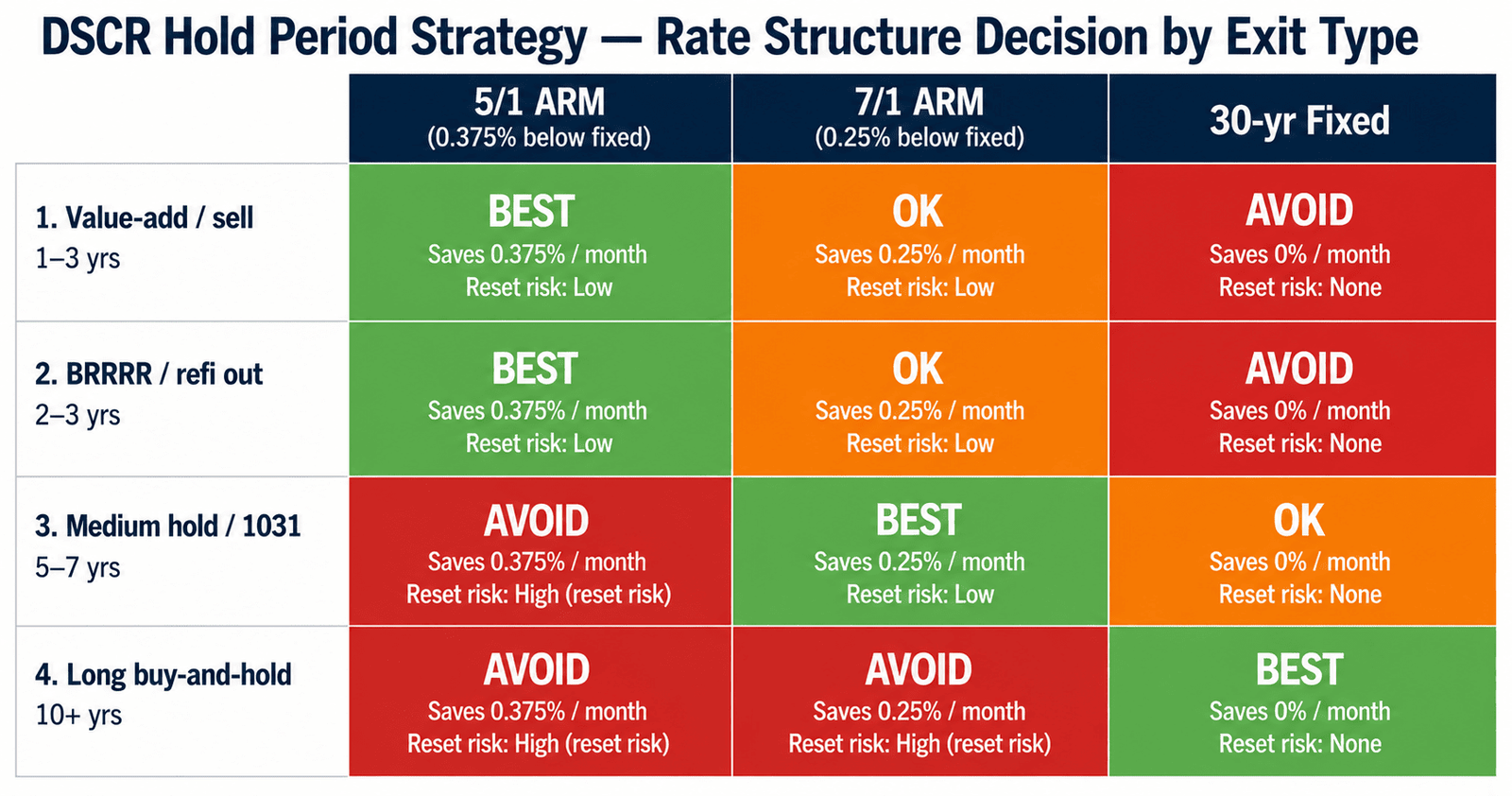
The rate structure decision follows the same logic as the PPP decision: align the fixed-rate period with the planned hold period.
5/1 ARM for Short to Medium Holds
A 5/1 ARM on a DSCR loan fixes the rate for 5 years, then adjusts annually. On a $750,000 loan, a 5/1 ARM at 7.00% produces P&I of $4,994/month vs $5,245 on a 30-year fixed at 7.50% — a $251/month savings. Over a 5-year hold, that is $15,060 in payment savings. The reset risk is real: most DSCR ARM products have 2% periodic caps and 5% lifetime caps. An investor who takes a 7.00% 5/1 ARM and holds 8 years in a rising rate environment could be paying 12%.
Plan for the ARM to reset if the exit does not execute on schedule. See deal killers for how ARM resets affect DSCR qualification at refinance.
30-Year Fixed for Long Holds
For a 10+ year hold, the 30-year fixed is the correct structure. The certainty of fixed monthly debt service matters when insurance costs, property taxes, and vacancy patterns are all variable and unpredictable over a decade. The deal analysis page shows how to model debt service over the planned hold period — not just at origination.
A deal with 1.30 DSCR at origination that absorbs annual 6% property tax increases will be at 1.21 DSCR in Year 5 without rent growth. A 30-year fixed keeps the P&I constant. An ARM that resets higher in Year 6 compounds the assessment pressure.
Get the complete DSCR underwriting framework for each hold type and exit strategy. DSCR Playbook covers PPP structures, ARM vs fixed math, and requirements by lender type.
DSCR Hold Period Strategy: How the Target DSCR Changes by Exit Type
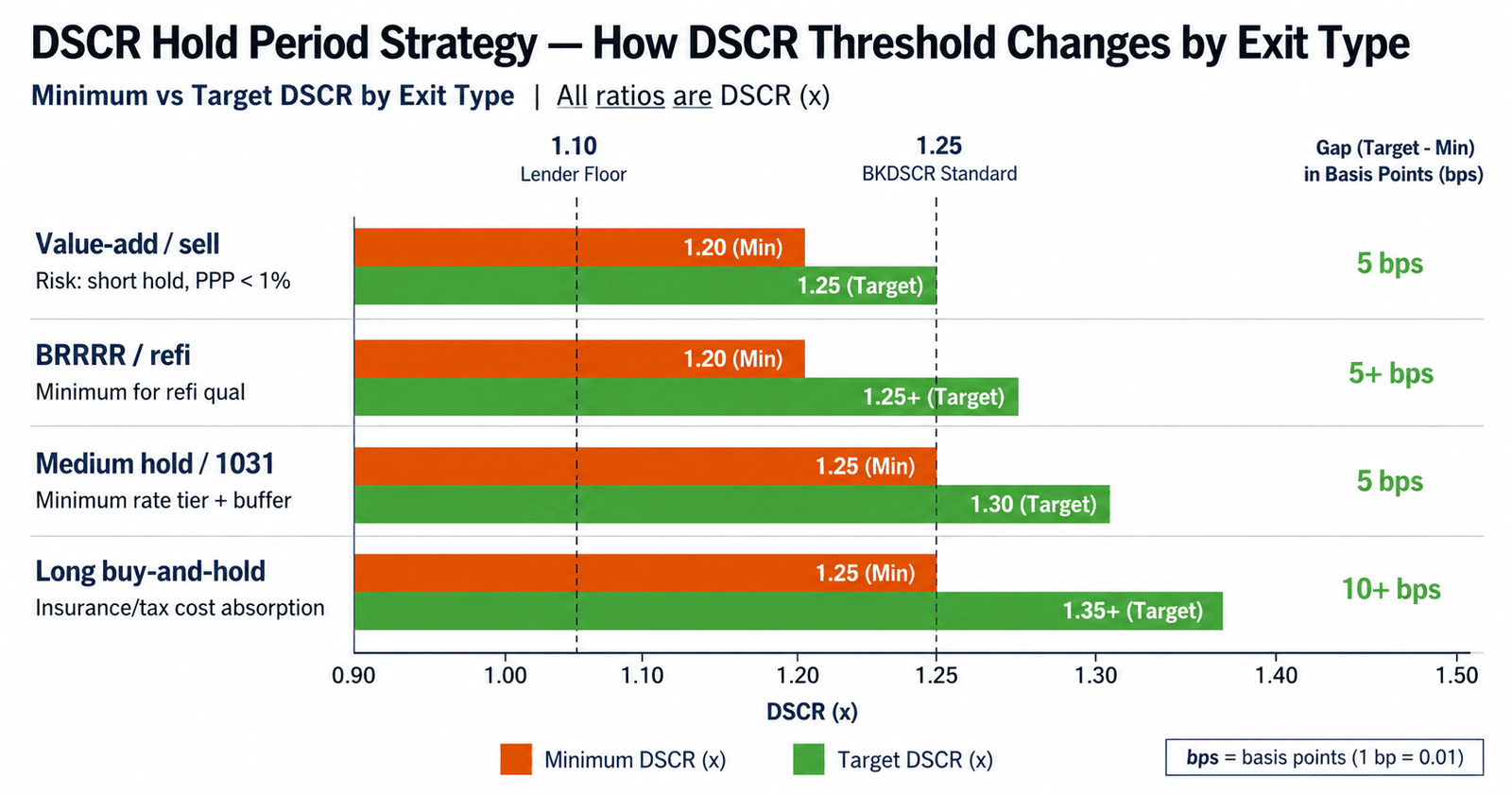
The DSCR threshold you need at origination is not the same for every exit type.
Short-Hold DSCR Target: 1.20 Minimum, 1.25 Preferred
For value-add investors selling in 1–3 years, DSCR at origination needs to clear the lender’s 1.20 minimum and ideally reach 1.25 for the best rate tier. The stress test is still relevant because the lender applies it — but the investor’s risk horizon is short.
BRRRR DSCR Target: 1.25+ on the Takeout, Not the Acquisition
The BRRRR investor’s DSCR target is set on the stabilized property at the time of the DSCR refinance — not at acquisition. The acquisition may use bridge financing with no DSCR requirement. The DSCR requirement kicks in at the takeout refi. Most lenders require 1.20 minimum; 1.25+ to access the best programs. The deal analysis page models both the acquisition and the stabilized takeout as a single connected underwriting exercise.
Long-Hold DSCR Target: 1.30+ to Absorb Cost Increases
Long-hold investors should target 1.30+ at origination. Brooklyn Class 2 property taxes have increased for three consecutive years. Outer-borough multifamily insurance is up 40–60% since 2022. An investor acquiring a 4-unit at exactly 1.25 DSCR will be at 1.15–1.18 within three years if taxes and insurance continue their current trajectory. The stress test on any long-hold deal should include a conservative tax and insurance projection for Years 3–5.
DSCR Hold Period Strategy and the 1031 Exchange
The 1031 exchange creates unique PPP timing requirements. A 1031 requires identifying a replacement property within 45 days of selling the relinquished property and closing within 180 days. If a prepayment penalty is in effect at the time of sale, it reduces net proceeds and therefore available equity for the exchange. An investor planning a 1031 exchange should map the PPP schedule against the planned sale date before originating the loan. See lender criteria for how DSCR lenders handle 1031 exchange documentation and title transfer requirements.
FAQ: DSCR Hold Period Strategy
DSCR Hold Period Strategy: Can I change my exit plan after origination?
Yes, but the loan structure does not change with your plan. If you originate with a 5-year PPP intending to hold for 10 years and then decide to sell in Year 2, you face a 4% penalty. The hold period strategy decision is made once — at the loan application stage.
Does the DSCR requirement change for a cash-out refi vs rate-and-term refi?
Yes. Most DSCR lenders cap cash-out at 70–75% LTV vs 75–80% for rate-and-term, and apply the same or higher DSCR minimums. Cash-out refis carry a 0.25%–0.50% rate premium above rate-and-term — which reduces monthly savings and extends break-even.
What if I plan to sell but the market drops?
This is the core hold-period risk. Ensure the property produces positive cash flow at origination DSCR so that extending the hold is economically viable, not distressed. A 1.20 DSCR generates positive cash flow in a hold-extension scenario. A 1.02 DSCR consumes cash if held past the planned exit.
Can I negotiate the PPP structure with the lender?
Yes, within the lender’s program menu. Most DSCR lenders offer 5-year, 3-year, 1-year, and no-PPP structures with corresponding rate adjustments. Rate-shop across at least three lenders because PPP pricing varies. Use the DSCR calculator to verify the new monthly payment is still viable at a higher rate before accepting a shorter PPP.
The DSCR hold period strategy is also influenced by the NYC Good Cause Eviction law, which took effect April 2024 for buildings built before 2009 with 10+ units. For smaller outer-borough portfolios — 1-4 unit buildings outside the Good Cause threshold — the hold period strategy does not currently face Good Cause rent increase limitations. But investors building toward 10-unit thresholds need to factor Good Cause into the 5–10 year hold period model: once a building crosses the Good Cause threshold, rent increases are limited to the lower of 5% or CPI + 5%.
A portfolio strategy that depends on market-rate rent growth to justify a long hold period needs to account for Good Cause eligibility at the portfolio level. The deal killers page covers regulatory risk factors including Good Cause applicability.
DSCR Hold Period Strategy: The Three Exit Paths and What Each Requires
Every DSCR hold period strategy maps to one of three exit paths: sell at market, refi and hold, or refi and buy-down debt. Each path has different implications for the loan structure chosen at origination. The DSCR hold period decision is not just about how long to keep the property — it is about what the property needs to be worth, what the rates need to be, and what the DSCR needs to support for each exit to work.
Exit path 1: sell at market. The hold period strategy for a sale exit prioritizes minimizing prepay penalty cost and maximizing net proceeds. A 3-2-1 prepay structure allows penalty-free sale at Year 4 and beyond. A 5-4-3-2-1 structure allows penalty-free sale at Year 6. In a market where appreciation is expected in years 4–7, the 5-4-3-2-1 structure’s lower rate saves enough in monthly cost to justify the extended penalty window — but only if the sale happens after the penalty burns off.
Exit path 2: rate-and-term refi. The investor holds for 5–7 years, rates decline, and the property is refinanced into a lower-rate DSCR loan at the same LTV. The NYC recording tax applies on every refi: 1.925% on loans above $500,000. For this exit to pencil, the rate reduction must generate enough monthly savings to recover the recording tax plus lender fees within the remaining hold period. The Refi Analyzer models the full break-even including the NYC recording tax — a step most refi calculators outside NYC skip.
Exit path 3: cash-out refi and portfolio expansion. The investor holds for 5–10 years, the property appreciates, and a cash-out refi at the new higher value generates equity for the next acquisition. Cash-out DSCR refis are capped at 70%–75% LTV at most lenders. The DSCR on the new, larger loan must meet the lender’s minimum — typically 1.20. If the rent roll has grown to support the higher loan amount, the exit works.
If rents have been flat and the loan amount increases materially, the DSCR at cash-out may fall below 1.20. Model the cash-out DSCR at the projected higher loan balance — not just the current DSCR — before committing to this exit path. The deal analysis framework includes a cash-out refi scenario as part of the standard hold period analysis.
The Loan Structure Your Exit Plan Requires
DSCR hold period strategy reduces to a single discipline: structure the loan at origination for the exit you actually plan. The default DSCR product — 30-year fixed with 5-year step-down PPP at the lowest available rate — is right for a long-term buy-and-hold investor. It is wrong for a BRRRR investor who plans to refi in 18 months.
If your planned exit is before Year 4.5, no-PPP at the higher rate saves money. After Year 4.5, the 5-year PPP saves money. If your planned hold is 7+ years, the 30-year fixed protects against rate reset risk. If your planned hold is 3–5 years, the 5/1 ARM generates $15,060 in savings before the reset risk becomes relevant.
Map your exit plan to the three loan decisions before you apply: PPP structure, rate type, and DSCR target. The loan that fits your exit plan is the one that maximizes your net position at the time you actually close it.
If you have a deal and want to know the right structure for your specific exit plan — PPP type, DSCR target, rate structure, and lender match position — Deal Review delivers the full written analysis within 48–72 hours.