
DSCR LTV Down Payment: The Real Impact at 70% vs 75%
Key Takeaways
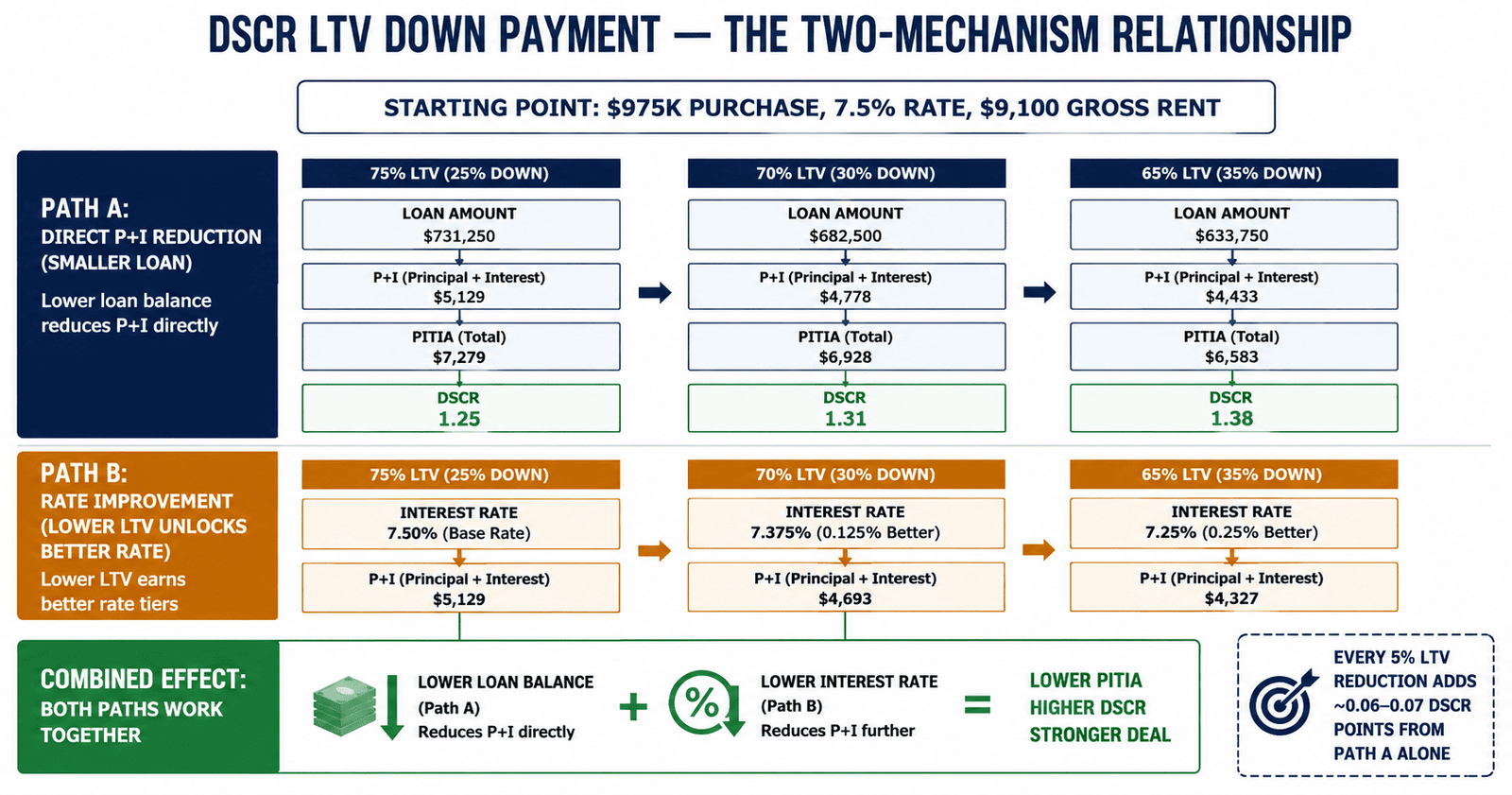
- Every 5% LTV reduction (~$48,750 more down on a $975K deal) adds ~0.06–0.07 DSCR points on the benchmark Brooklyn 4-unit
- Lower LTV improves DSCR through two simultaneous paths: smaller loan reduces P+I directly, and lower LTV often unlocks a better rate tier
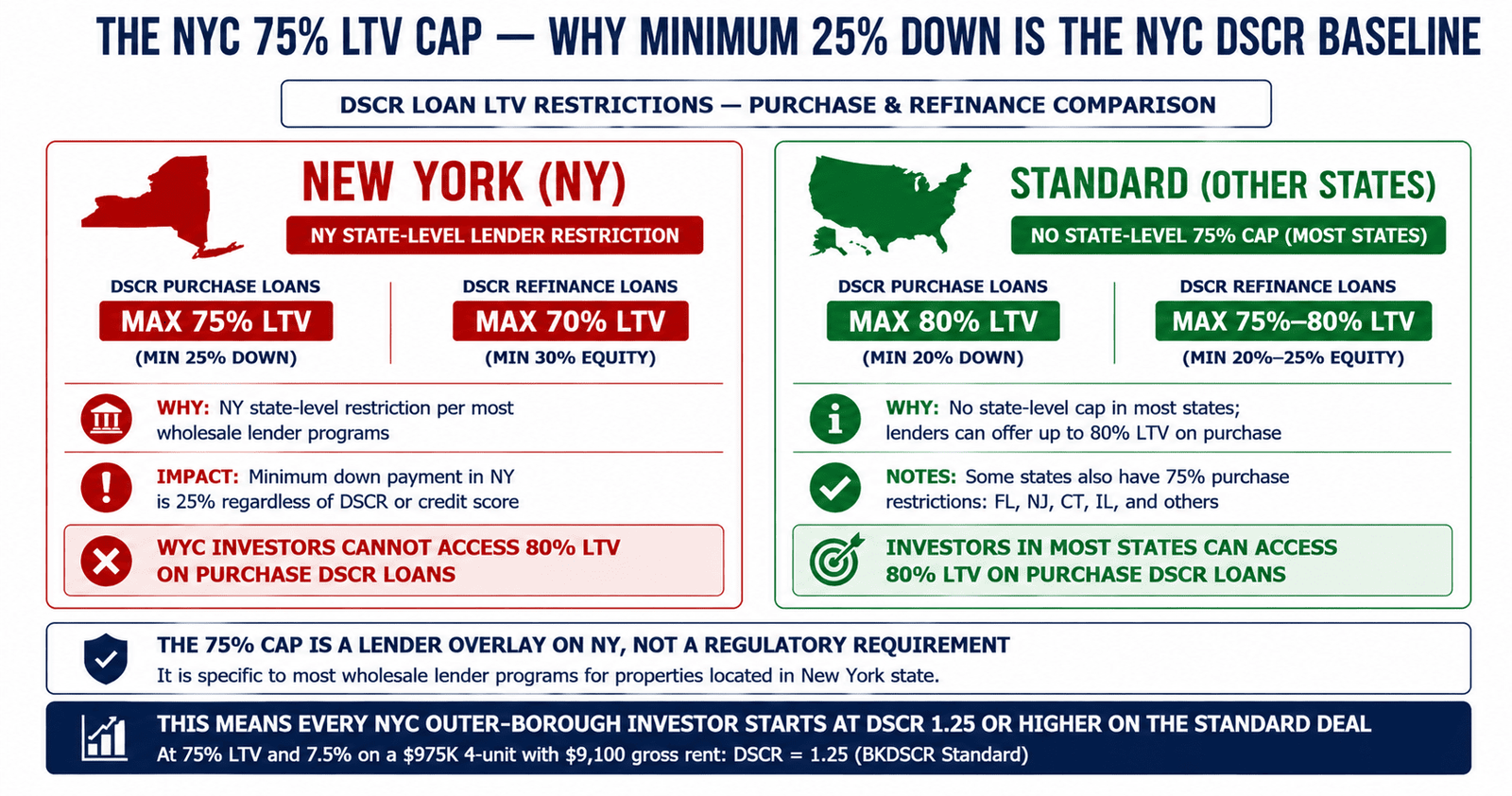
- Most DSCR programs cap New York state purchases at 75% LTV — making 25% the effective minimum down payment for NYC outer-borough investors
- NYC DSCR refinances are typically capped at 70% LTV, requiring 30% equity in the property at refinance
- At 75% LTV and 7.5% on a $975K Brooklyn 4-unit with $9,100 gross rent: DSCR = 1.25 exactly — the BKDSCR standard with no margin to spare
- Capital efficiency question: each $48,750 of extra down payment adds ~0.06 DSCR points on this deal; the same capital at 25% down buys into a $195K additional asset
Table of Contents
- Mechanism 1: Smaller Loan Reduces P+I Directly
- Mechanism 2: Lower LTV Unlocks Better Rate Tiers
- The LTV/DSCR Matrix: Exact Numbers at Each Down Payment Level
- The NYC 75% LTV Cap: Why NYC Investors Cannot Go to 80%
- The Rate Benefit at Lower LTV: Combined Effect on DSCR
- The Capital Efficiency Question: Extra Down Payment vs New Acquisition
- How LTV Affects the DSCR Stress Test
- FAQ: DSCR LTV Down Payment
- DSCR LTV Down Payment: Does every 5% of additional down payment improve DSCR by the same amount?
- DSCR LTV Down Payment: Is the 75% LTV cap on New York purchases hard or are there exceptions?
- Does the down payment amount affect the DSCR calculation directly?
- Can I use a second mortgage to fund the down payment?
DSCR LTV down payment math is one of the most underutilized levers available to NYC outer-borough investors. Most investors know that a larger down payment means a lower monthly payment — but the two-mechanism relationship between LTV and DSCR is more powerful and more NYC-specific than that. Lower LTV improves DSCR through two simultaneous paths: a smaller loan directly reduces P+I, and lower LTV often unlocks a better interest rate, reducing P+I further. According to Ridge Street, every 5% LTV reduction on a typical outer-borough deal produces a measurable and consistent DSCR improvement.
Before modeling any LTV scenario, use the Deal Filter — property type, down payment, and PITIA confirmed in 60 seconds.
DSCR LTV Down Payment: The Two-Mechanism Relationship
Mechanism 1: Smaller Loan Reduces P+I Directly
The largest component of PITIA is P+I. Lower LTV means a smaller loan and a lower P+I payment. On a $975,000 purchase at 75% LTV ($731,250 loan, 7.5%), P+I is $5,129/month. At 65% LTV ($633,750 loan, same rate), P+I falls to $4,433/month — a $696/month reduction from loan size alone.
Each 5% LTV reduction on the benchmark deal produces approximately $340–$345/month in P+I reduction and approximately 0.06–0.07 additional DSCR points. The DSCR formula shows exactly how each point of LTV reduction flows through to the ratio — and at what LTV the deal crosses the 1.25 threshold.
Mechanism 2: Lower LTV Unlocks Better Rate Tiers
DSCR lenders price risk based on LTV. At 75% or below: best available rate. From 75.01–80% LTV: most programs add +0.125–0.25%. At 80.01–85% LTV: +0.50–1.00% (rarely available in NY). Moving from 75% to 65% LTV can simultaneously reduce the loan amount AND unlock a 0.125–0.25% rate improvement. Both savings apply to the same P+I calculation.
The LTV/DSCR Matrix: Exact Numbers at Each Down Payment Level
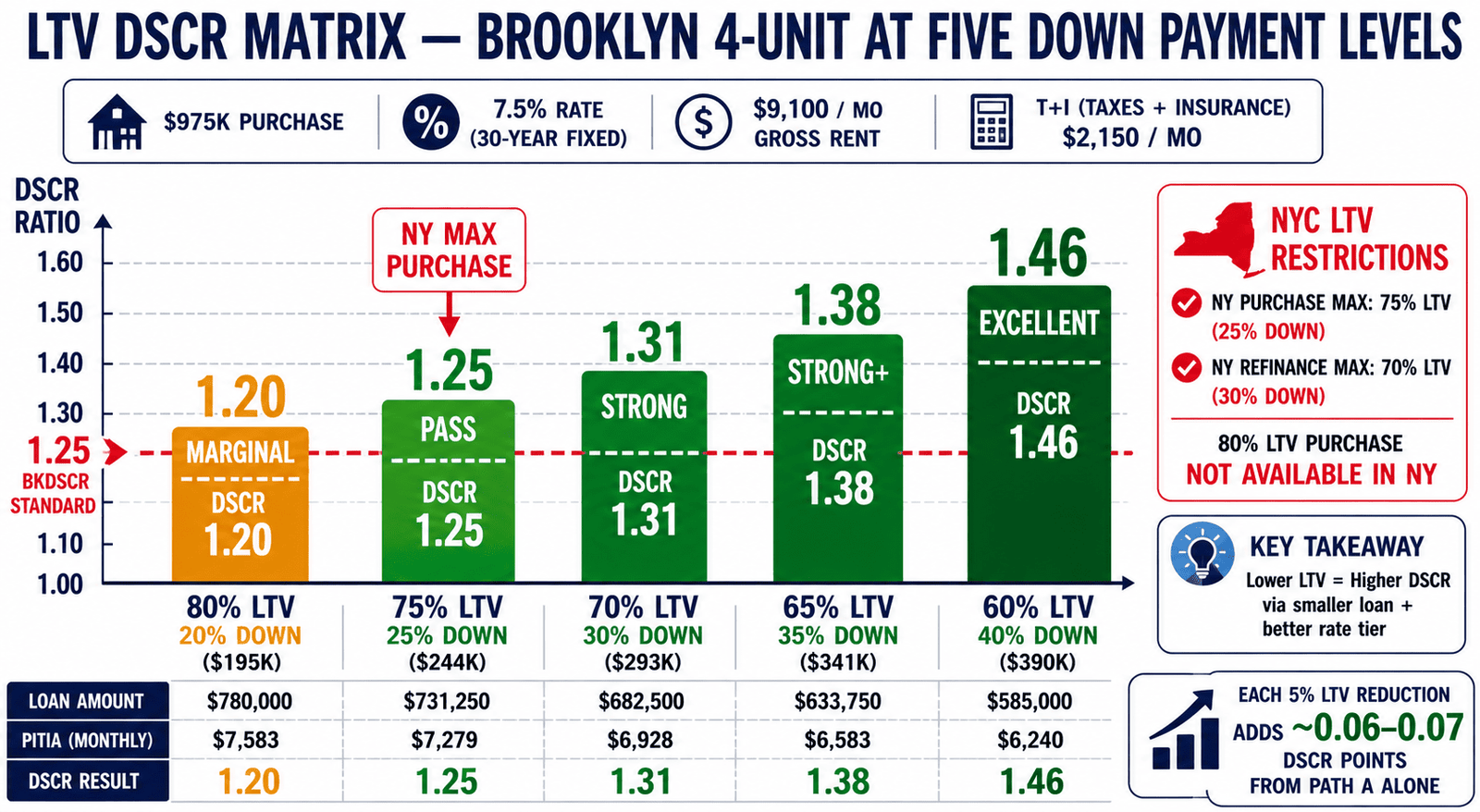
The matrix below shows the complete DSCR calculation at five LTV levels. $975K purchase | 7.5% rate | $9,100 gross monthly rent | $2,150 T+I. According to Stacking Capital, the 1.25 threshold is where DSCR pricing tiers shift and where strongest program eligibility opens — making the 75% LTV/1.25 DSCR intersection the baseline starting point. See also: 1.10 DSCR floor.
| LTV | Down Pmt | Loan Amt | Monthly P+I | Total PITIA | DSCR | Verdict / NYC |
|---|---|---|---|---|---|---|
| 80% | $195,000 | $780,000 | $5,454 | $7,604 | 1.20 | MARGINAL (N/A in NY*) |
| 75% | $243,750 | $731,250 | $5,129 | $7,279 | 1.25 | PASS (NY max purchase) |
| 70% | $292,500 | $682,500 | $4,778 | $6,928 | 1.31 | STRONG (NY max refi) |
| 65% | $341,250 | $633,750 | $4,433 | $6,583 | 1.38 | STRONG+ |
| 60% | $390,000 | $585,000 | $4,090 | $6,240 | 1.46 | EXCELLENT |
| * Most NY DSCR programs cap purchase LTV at 75%. 80% LTV is not available for NYC outer-borough DSCR purchases on most programs. Gross rent $9,100/mo | Rate 7.5% 30yr | T+I $2,150/mo | ||||||
The 80% LTV row is included for reference but is not available on most DSCR programs in New York state. The operative range for NYC outer-borough investors on a purchase is 75% LTV (the state maximum) down to whatever leverage the investor chooses below that. The 75% LTV row produces exactly 1.25 DSCR on this deal — the BKDSCR standard, with no margin to spare.
The NYC 75% LTV Cap: Why NYC Investors Cannot Go to 80%
New York state DSCR purchase loans are capped at 75% LTV on most wholesale lender programs. This is a lender overlay — not a regulatory requirement — reflecting elevated default risk in New York. The practical implication: every NYC outer-borough DSCR investor starts at a minimum 25% down payment on a purchase loan, regardless of credit score, DSCR ratio, or property quality. For refinances, the cap is typically 70% LTV, meaning 30% equity is required. See lender criteria for which programs apply the 75% NY cap and what exceptions exist.
The Rate Benefit at Lower LTV: Combined Effect on DSCR
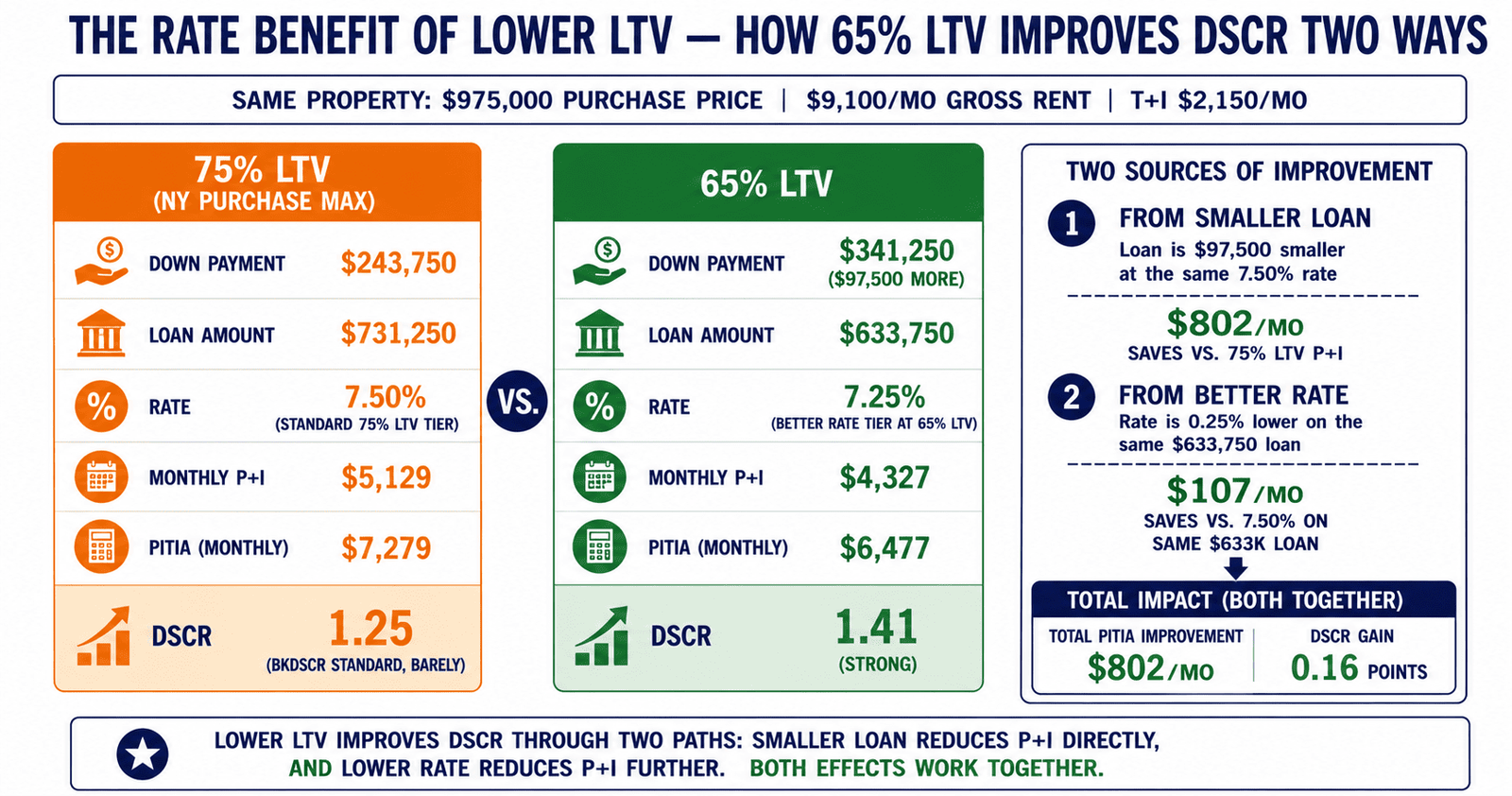
At 75% LTV and 7.5%, P+I is $5,129/month and DSCR is 1.25. At 65% LTV, two changes occur simultaneously: the loan drops to $633,750 (reducing P+I by $696 from smaller loan), and the rate may improve to 7.25% at the better LTV tier (reducing P+I by a further $107). Combined: $803/month lower P+I, PITIA drops to $6,476, and DSCR rises to 1.41. The 0.16 DSCR point improvement costs $97,500 in additional down payment. Run the stress test to verify how each LTV choice holds under combined stress before finalizing. See also: DSCR stress test.
The Capital Efficiency Question: Extra Down Payment vs New Acquisition
| LTV Move | Extra Down Pmt | DSCR Gain | What This Means for the Investor |
|---|---|---|---|
| 80%→75% | $48,750 | 1.20→1.25 | Moves from MARGINAL to PASS. Unlocks BKDSCR standard. Rate tier may improve. |
| 75%→70% | $48,750 | 1.25→1.31 | Adds 0.06 DSCR points. Provides buffer for T+I increases and combined stress test. |
| 70%→65% | $48,750 | 1.31→1.38 | Adds another 0.07 points. Diminishing returns on DSCR per dollar of down payment. |
| 65%→60% | $48,750 | 1.38→1.46 | Strong improvement. But $48K deployed on another deal at 25% down = new $195K property. |
The bottom row reveals the core tension. At 60% LTV, the investor has deployed $97,500 more than the NYC purchase minimum. That $97,500 at 25% down on a second property buys into an additional income-generating asset rather than incrementally better DSCR on the first deal. Use the DSCR calculator to model the exact DSCR at different LTV levels on any specific deal before making the down payment decision.
For the complete LTV, rate tier, and DSCR sensitivity framework, download the DSCR Playbook.
How LTV Affects the DSCR Stress Test
- At 75% LTV (DSCR 1.25): Combined stress (+1.0% rate + 10% vacancy) → stressed DSCR ~1.02–1.04. Passes the 1.00 floor but with almost no margin.
- At 70% LTV (DSCR 1.31): Combined stress → stressed DSCR ~1.08–1.10. Absorbs a second adverse event without breaching the floor.
- At 65% LTV (DSCR 1.38): Combined stress → stressed DSCR ~1.14–1.17. Survives combined stress with real margin.
For investors planning a 5–10 year hold in the NYC market — where Brooklyn Class 2 taxes have increased 14–16% in each of the last two years and insurance is up 40–60% since 2022 — the stressed DSCR position matters as much as the origination DSCR. A deal starting at 1.38 DSCR has a 130-basis-point buffer before approaching the 1.25 BKDSCR standard under rising operating costs.
FAQ: DSCR LTV Down Payment
DSCR LTV Down Payment: Does every 5% of additional down payment improve DSCR by the same amount?
Approximately, but the improvement diminishes slightly at very low LTV levels. As the loan amount decreases, the absolute dollar reduction in P+I per 5% LTV step decreases. The DSCR improvement per LTV step is approximately 0.06–0.07 points throughout the typical investor range (60–75% LTV), making it a fairly consistent relationship over that range.
DSCR LTV Down Payment: Is the 75% LTV cap on New York purchases hard or are there exceptions?
The 75% cap is a lender overlay that varies by wholesale program. Most major non-QM lenders apply a 75% purchase cap on New York state properties. Some lenders will go to 80% on properties in less contested markets (upstate New York) or on specific property types. For NYC outer-borough 1–4 unit DSCR purchases, the 75% cap applies on virtually all programs.
Does the down payment amount affect the DSCR calculation directly?
Not directly — the down payment affects the loan amount, which affects P+I, which is a component of PITIA, which is the DSCR denominator. The down payment itself does not appear in the DSCR formula. The relationship is indirect but mechanical. Use the DSCR calculator to find the exact down payment where your target DSCR clears on a specific deal.
Can I use a second mortgage to fund the down payment?
No. DSCR programs require the down payment to be sourced from the borrower’s own funds or permitted gift sources. Second mortgages, hard money bridge loans on the equity portion, or seller financing that reduces the effective down payment are not accepted by standard DSCR programs.
One additional variable that investors often overlook when comparing LTV tiers is the reserve requirement. Most DSCR lenders require 6 months of PITIA in reserves at closing — separate from the down payment and closing costs. At 75% LTV on a $900,000 deal with $6,200/month PITIA, the reserve requirement is $37,200. At 70% LTV with $5,900/month PITIA, the reserve drops to $35,400. The difference is modest — $1,800 — but the total capital required at each tier is the number that matters for planning. Confirm the full all-in capital requirement at each LTV tier before deciding which structure to pursue. Use the deal analysis framework to model the complete capital stack at each tier.
The DSCR LTV down payment decision should also account for the NYC mortgage recording tax. At 1.925% on loans above $500,000, every dollar of loan amount carries a recording tax cost at origination and again at any future refinance. Moving from 75% to 70% LTV on a $900,000 purchase reduces the loan by $45,000 — saving $866 in recording tax at origination and again at each refi. Over a 10-year hold with one refi, that is $1,732 in cumulative recording tax savings from the LTV reduction alone. Not decisive, but real. The DSCR calculator models each LTV tier with the correct PITIA for that tier so investors can see the full cost comparison side by side before deciding.
Have a deal where LTV or down payment is the margin variable? The Deal Review runs the DSCR at each LTV tier with verified inputs.
DSCR LTV Down Payment: When to Use Each Tier and Why
The practical decision framework for NYC DSCR investors on LTV selection:
- Use 75% LTV when: the deal clearly passes 1.25 DSCR at 75% LTV, capital is limited, and the rate premium at 80% LTV produces a sub-1.25 DSCR.
- Use 70% LTV when: the deal only passes 1.25 DSCR with the LTV reduction, the investor has sufficient capital, and the rate discount at 70% is meaningful (0.25%+).
- Use 80% LTV when: the deal passes 1.25 DSCR even at the higher rate and lower down payment, and capital preservation is the priority — but confirm the 80% program exists at the target lender at an acceptable rate.
- Avoid 80% LTV when: it is the only way to make the deal work and the DSCR is below 1.20 at 80% — this is a deal that should not close at any LTV tier.
The LTV decision should be made at the same time as the lender selection, not separately. Some lenders offer 80% LTV DSCR products; most cap at 75%. The rate spread between tiers varies by lender — what is 0.25% at one lender may be 0.50% at another. Confirm the specific rate and LTV availability at the target lender before modeling the LTV sensitivity. Use the DSCR calculator at the confirmed lender rate for each tier to get accurate sensitivity numbers, not estimated rate spreads.
DSCR LTV Down Payment: The Total Capital Required at Each Tier
The DSCR LTV down payment comparison is incomplete without the total capital required at closing — not just the down payment. At each LTV tier on a $900,000 NYC outer-borough purchase:
| LTV | Down Payment | Recording Tax | Closing Costs | 6-Mo Reserve | Total All-In |
|---|---|---|---|---|---|
| 80% | $180,000 | $13,860 | $12,000 | $40,698 | ~$246,558 |
| 75% | $225,000 | $12,994 | $12,000 | $37,326 | ~$287,320 |
| 70% | $270,000 | $12,128 | $12,000 | $35,124 | ~$329,252 |
Reserve calculated at 6 months of PITIA at each tier’s estimated PITIA. Recording tax at 1.925% on loans above $500,000. Closing costs estimated at $12,000 (title, appraisal, attorney — not including origination points). The jump from 75% to 70% LTV requires $41,932 more in total capital — not just the $45,000 down payment difference. The additional reserve and rate differential savings partially offset this, but the total capital requirement is the binding constraint for most NYC investors.
The DSCR calculator models each LTV tier with the correct PITIA for that tier, so investors can see both the DSCR improvement and the capital requirement side by side.
DSCR LTV Down Payment: The Full Sensitivity Table at Current NYC Rates
The DSCR LTV down payment relationship at a $900,000 NYC outer-borough purchase across all available LTV tiers in 2026:
| LTV | Down Payment | Loan | Rate | P+I/mo | DSCR (at $9,000 rent) |
|---|---|---|---|---|---|
| 80% | $180,000 | $720,000 | 8.00% | $5,283 | 1.21 (at $6,783 PITIA) |
| 75% | $225,000 | $675,000 | 7.50% | $4,721 | 1.32 (at $6,221 PITIA) |
| 70% | $270,000 | $630,000 | 7.375% | $4,354 | 1.41 (at $5,854 PITIA) |
PITIA estimated with $1,000/month taxes and $500/month insurance throughout. The table shows three results: the 80% LTV scenario with a program rate premium produces a 1.21 DSCR — which passes most lender minimums but fails the BKDSCR 1.25 standard. The 75% LTV scenario at standard rate produces 1.32 — a clear pass. The 70% LTV scenario at the sub-75% rate discount produces 1.41 —
comfortable cushion. The down payment required to move from 75% to 70% LTV at this price point: $270,000 minus $225,000 = $45,000 additional capital. That $45,000 buys a DSCR improvement of 0.09 points and access to a 0.125% rate discount. Whether it is worth it depends on the investor’s available capital and the specific deal margin.
The critical insight from the DSCR LTV down payment table: going from 75% to 80% LTV does not just lower the down payment — it changes the program tier, which changes the rate, which changes the DSCR more than the LTV change alone would suggest. On this deal, the move from 75% to 80% saves $45,000 in down payment but costs 0.50% in rate and 0.11 points of DSCR.
Depending on the investor’s capital constraint, that trade may or may not make sense. Use the DSCR calculator at each LTV tier with the current rate quote for that tier — not a blended rate assumption — to see the true impact.
LTV Is Not Just Leverage — It’s a DSCR Variable
DSCR LTV down payment math reveals that leverage decisions on DSCR loans are simultaneously DSCR decisions. In the NYC outer-borough market, the 75% purchase LTV cap forces investors to start at 25% down, making the practical DSCR minimum on the benchmark deal exactly 1.25 — the BKDSCR standard with no margin for error. Investors who bring additional equity to 70% or 65% LTV are buying DSCR buffer, rate improvement, and stress-test resilience simultaneously.
The capital efficiency question has no universal answer. It depends on whether the deal clears BKDSCR standard at minimum required LTV, the planned hold period, and how much margin the stress test shows at the lower leverage level. Run the numbers at both the minimum and optimal LTV before going under contract.