
DSCR Market Rent vs Actual Rent: The Real 1007 Rule
Key Takeaways
- DSCR lenders use the LOWER of actual lease rent or the appraiser’s 1007 market rent estimate — always, no exceptions
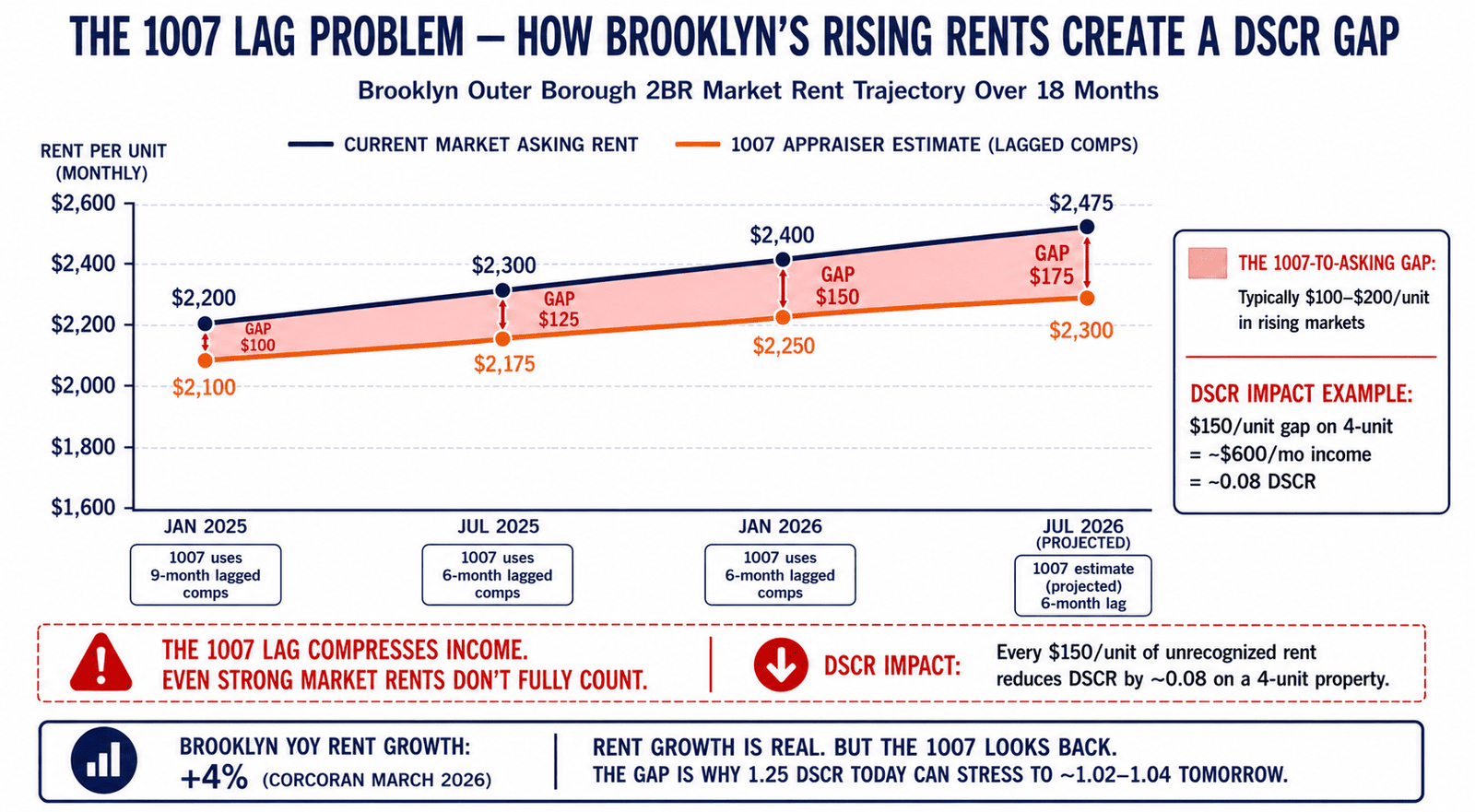
- In Brooklyn’s rising-rent market, 1007 estimates lag current asking rents by 3–6 months, typically $100–$200/unit below actual asking
- An investor who models $2,400/unit but the 1007 comes back at $2,200 loses $800/month on a 4-unit and 0.11 DSCR points
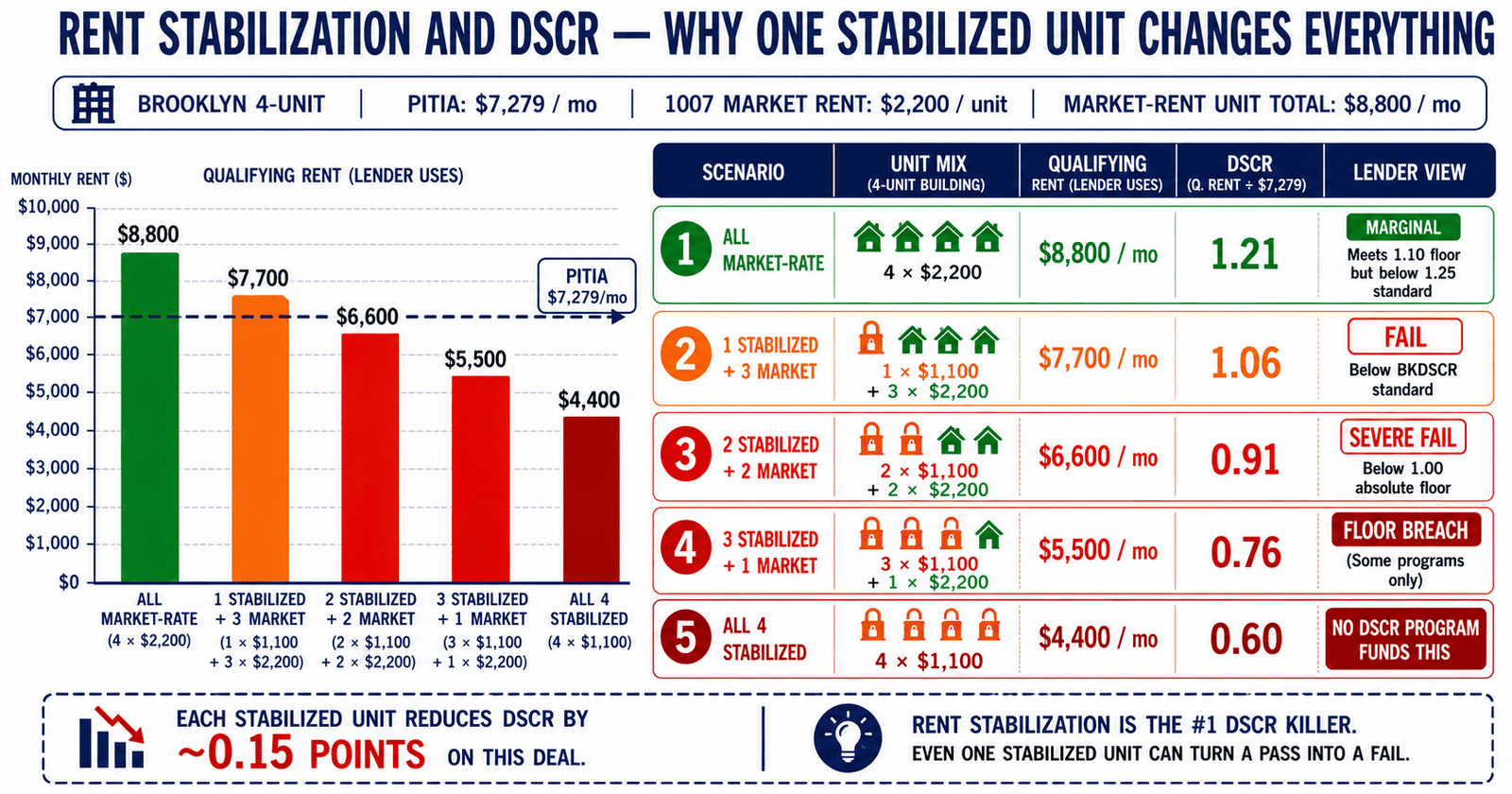
- Rent-stabilized units are underwritten at the DHCR legal registered rent — not market rent, not the 1007 estimate
- Vacant units produce $0 income in the DSCR numerator — not the 1007 market rent, regardless of the appraisal
- One stabilized unit at $1,100 on a 4-unit drops DSCR from 1.21 to 1.06, eliminating qualification on most programs
Table of Contents
- DSCR Market Rent: How the Form 1007 and 1025 Work
- Five Rent Roll Scenarios: How the Lender Reads Each One
- Rent Stabilization: How the DHCR Legal Rent Governs
- Rent Roll Documentation: What Lenders Verify
- Occupied market-rate units
- DSCR Market Rent: Rent-stabilized units
- Vacant units
- Month-to-month tenants
- FAQ: DSCR Market Rent vs Actual Rent
- DSCR Market Rent: If my tenants pay above market, does that help my DSCR?
- Can I dispute the 1007 market rent estimate if it’s too low?
- Does a newly signed market-rate lease help me avoid the 1007 lag problem?
- DSCR Market Rent: How do I verify rent stabilization status before contract?
DSCR market rent analysis is where investor models and lender underwriting diverge most consistently. Investors model rent using asking prices, broker estimates, or Zillow comparables. DSCR lenders use a specific, non-negotiable rule: the lower of two verified figures. Understanding that rule — and the conditions under which the lender’s figure comes in below the investor’s assumption — is the difference between a deal that qualifies on modeled terms and one that gets re-underwritten to a lower DSCR at the appraisal stage. See also: lender NOI calculation.
According to Ridge Street, the qualifying rent is calculated using the lower of the actual in-place rent or the appraiser’s market rent estimate, ensuring qualification is based on a conservative income figure.
Before modeling any deal on market rent vs in-place lease, use the Deal Filter to confirm the rent roll and PITIA clear basic eligibility in 60 seconds.
DSCR Market Rent: The Lower-Of Rule
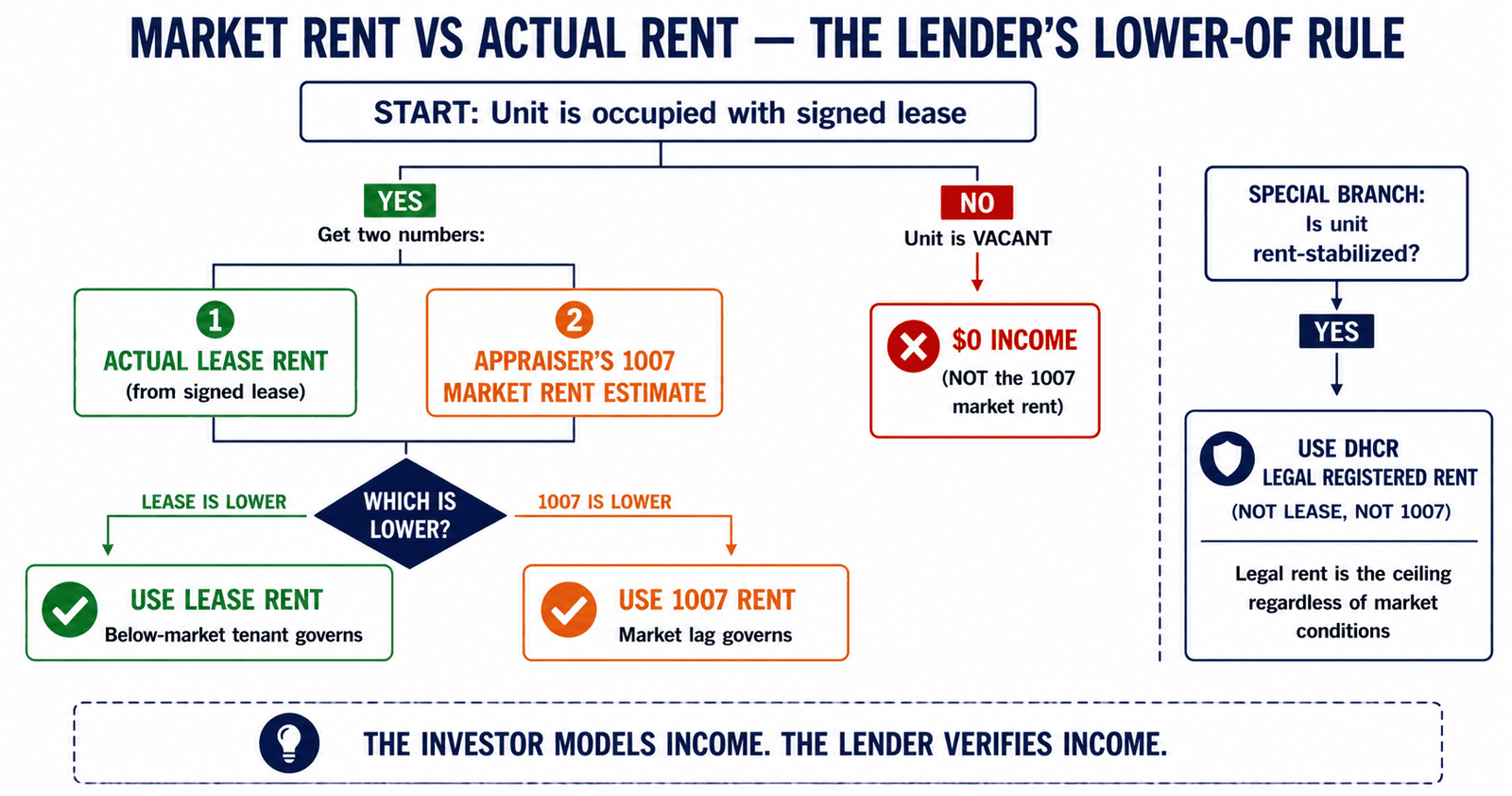
The DSCR lender’s income determination for each unit follows one rule: use the lower of the actual lease rent or the appraiser’s 1007 market rent estimate. No exceptions.
- Lease $2,400/unit, 1007 says $2,200: lender uses $2,200. Investor is above-market rented. 1007 is the ceiling.
- Lease $2,000/unit, 1007 says $2,200: lender uses $2,000. Investor is below-market rented. Lease is the ceiling.
- Unit is vacant: lender uses $0, regardless of what the 1007 says market rent is.
- Unit is rent-stabilized: lender uses the DHCR-registered legal rent, regardless of what either the lease or the 1007 says.
The rule applies per unit, not to the total rent roll. A building with two units above market and two below market has each unit evaluated separately. The investor who models all four units at the same average market rent and finds two below that average loses income on the below-market units without gaining credit on the above-market ones.
DSCR Market Rent: How the Form 1007 and 1025 Work
The Form 1007 (Single-Family Comparable Rent Schedule) and Form 1025 (Small Residential Income Property Appraisal) produce the market rent estimate the lender uses. They are completed by the licensed appraiser, not the investor or broker. The appraiser identifies three to six comparable rental properties that leased within the prior 6–12 months and uses those comps to establish the market rent range.
The critical limitation: the 1007 is backward-looking. Comparable leases reflect rent levels from months prior. In Brooklyn’s 4% annual growth environment, a 1007 completed in June 2026 using October 2025–January 2026 lease comps will produce an estimate approximately 1.5–2.5% below current asking rents — or $35–60 per unit per month on a $2,200 comp base. On a 4-unit, that “lag gap” is $140–$240/month in qualifying income and 0.02–0.03 DSCR points.
Five Rent Roll Scenarios: How the Lender Reads Each One
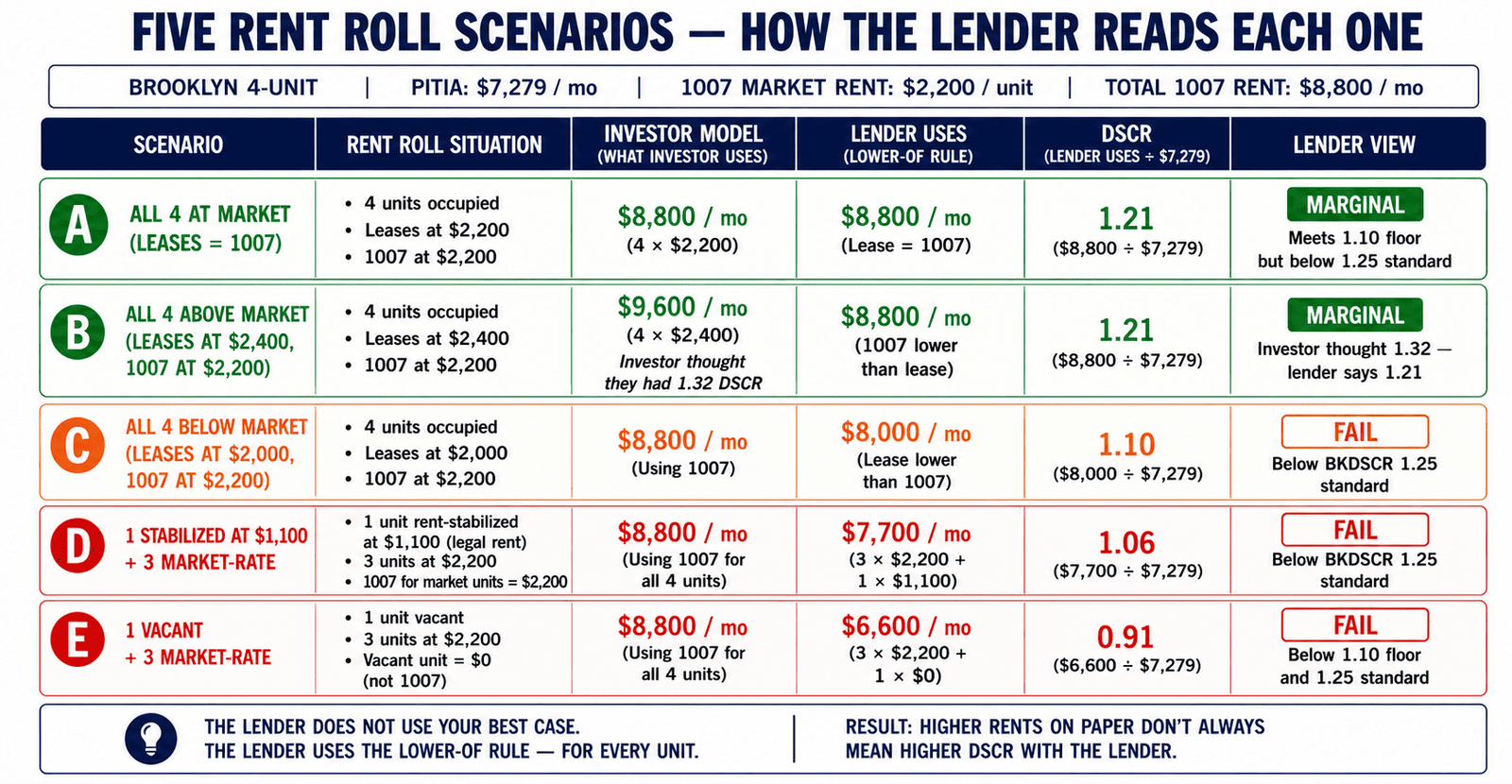
Five scenarios, same building: Brooklyn 4-unit, PITIA $7,279, 1007 market rent $2,200/unit ($8,800 total). The investor’s model varies; the lender’s income follows the lower-of rule.
| Scenario (4-unit, PITIA $7,279) | Lease Rent | 1007 Market Rent | Lender Uses | DSCR / Verdict |
|---|---|---|---|---|
| A: All 4 at-market, leases = 1007 | $8,800/mo | $8,800/mo | $8,800 | DSCR 1.21 |
| MARGINAL — no lag, no above-market buffer | ||||
| B: All 4 above market, 1007 lags | $9,600/mo | ▼$8,800/mo | $8,800 | DSCR 1.21 |
| MARGINAL — investor modeled 1.32; lender says 1.21 | ||||
| C: All 4 below market (value-add) | $8,000/mo | ▲$8,800/mo | $8,000 | DSCR 1.10 |
| FAIL — lease governs; 1007 not used when higher | ||||
| D: 1 stabilized ($1,100) + 3 market | $7,900/mo | $7,700/mo | $7,700 | DSCR 1.06 |
| FAIL — stabilized unit at legal rent collapses DSCR | ||||
| E: 1 vacant + 3 market-rate | $6,825/mo | $8,800/mo | $6,825 | DSCR 0.94 |
| FAIL — vacant unit = $0; 1007 not used for vacant | ||||
| All scenarios: PITIA $7,279/mo. 1007 market rent $2,200/unit ($8,800 total). Stabilized legal rent $1,100. Lender always uses the lower of actual lease or 1007 market rent per unit. | ||||
Scenario B is the most common surprise: the investor models $2,400/unit ($9,600 gross) based on current asking rents. The 1007 comes back at $2,200 because the appraiser’s comps reflect rents from 6 months ago. Investor modeled 1.32 DSCR; lender underwrites 1.21. The investor cannot challenge the 1007 by citing current asking rents. Scenario C shows the below-market trap: current tenants at $2,000/unit produce a 1.10 DSCR even though the 1007 says $2,200. The lender uses $2,000. See deal killers for how below-market lease rolls are evaluated on purchase DSCR loans.
| Rent Roll Situation | Lender DSCR | Investor Implication |
|---|---|---|
| Investor model: 4 × $2,400 = $9,600 | 1.32 (investor model) | What the investor thinks the deal is |
| 1007 comes back at $2,200/unit | 1.21 (lender DSCR) | 1007 lag reduces qualifying income by $800/mo |
| 1 unit lease $2,000 (below market) | 1.18 (lender DSCR) | Below-market lease governs; no credit for gap to 1007 |
| 1 unit stabilized at $1,100 | 1.06 (lender DSCR) | Stabilization collapses DSCR — lender uses legal rent |
| 1 unit vacant at closing | 0.94 (lender DSCR) | Vacant unit = $0; deal fails lender floor |
Rent Stabilization: How the DHCR Legal Rent Governs
For rent-stabilized units, the income the DSCR lender accepts is the DHCR-registered legal rent — not market rent, not the 1007 estimate. According to the DHCR, rent stabilization applies to most apartments in buildings with six or more units built before 1974, as well as units in post-1974 buildings that received J-51, 421-a, or other tax benefit programs. For most 1–4 unit outer-borough buildings, units are NOT automatically rent-stabilized. But investors must verify every unit in every building, particularly pre-war buildings where prior tax benefit coverage may have brought specific units into stabilization.
For the complete framework on how lenders verify market rent, the 1007 form, and qualifying income, download the DSCR Playbook.
A stabilized unit registered at $1,100/month that the market would rent at $2,200 contributes $1,100 — not $2,200 — to the DSCR numerator. On a 4-unit, one such unit reduces qualifying gross rent by $1,100/month. At $7,279 PITIA, that drops DSCR from 1.21 to 1.06 — below the BKDSCR 1.25 standard and near or below many programs’ 1.10 minimum.
Rent Roll Documentation: What Lenders Verify
Occupied market-rate units
Required documentation: signed current lease (all pages), security deposit evidence, and most recent 12 months of rent payment history. The lender compares lease rent against the 1007 and uses the lower figure. Some programs also require executed estoppel certificates.
DSCR Market Rent: Rent-stabilized units
Required documentation: current signed lease, DHCR rent history printout (available at hcr.ny.gov), and current apartment registration. The legal registered rent is the ceiling regardless of lease amount. If the tenant pays above the legal rent, the lender uses the legal rent. If below, the lender uses what is actually paid.
Vacant units
For vacant units on a purchase loan, most programs underwrite at $0. The 1007 market rent estimate is produced but not used in the DSCR calculation. The investor carries full PITIA from reserves until the unit leases. Confirm with the specific lender before modeling any vacant unit income.
Month-to-month tenants
Treatment varies by program. Standard programs accept month-to-month tenants with 12+ months of history, current payments, and 1007 support. Some programs apply a 5–10% discount; a few require a new 12-month lease as a condition of approval. Verify before modeling more than one month-to-month unit.
FAQ: DSCR Market Rent vs Actual Rent
DSCR Market Rent: If my tenants pay above market, does that help my DSCR?
No. If the 1007 comes in below your lease rent, the lender uses the 1007 figure. Above-market rents above the 1007 do not produce a DSCR credit. The lower-of rule is a ceiling on lender income, not a floor.
Can I dispute the 1007 market rent estimate if it’s too low?
Yes, through the appraisal review process — if the appraiser used inappropriate comparables (wrong unit type, wrong submarket, outdated transactions). Challenging on the grounds that it lags current asking rents is difficult because the use of recent-closed comparables is standard methodology, not an error. The most productive approach: research closed comparable leases in the specific zip code and unit type in the prior 6 months before ordering the appraisal.
Does a newly signed market-rate lease help me avoid the 1007 lag problem?
Partially. A recently signed lease at or slightly above the 1007 estimate means the lease becomes the lower figure and the 1007 cap doesn’t apply. But a newly signed lease at well above the 1007 doesn’t override the 1007. The ideal: a lease signed recently at a rent that the appraiser’s comparable pool will support in the 1007.
DSCR Market Rent: How do I verify rent stabilization status before contract?
Three sources: (1) DHCR Apartment Search tool at hcr.ny.gov — search by address and unit number for registered rent history. (2) NYC Housing Court records for prior proceedings. (3) NYC Rent Regulations database on NYC Open Data. Verify before making any offer. Do not rely on the seller’s representation without independent verification.
Have a deal where the rent roll or 1007 market rent is the deciding variable? The Deal Review runs the qualifying income analysis with verified inputs.
The rent verification step is also the right moment to confirm that the appraiser’s comp pool will support the 1007 rent estimate. In submarkets where recent signed leases are scarce — outer Bronx, parts of Staten Island, East New York — appraisers sometimes pull comps from adjacent neighborhoods that may not reflect the subject property’s actual market. Confirming with the lender which appraiser they will order and what comp pool that appraiser typically uses can prevent a 1007 rent estimate that comes in below what the investor modeled. The deal analysis framework builds this verification step into the standard pre-submission process on every NYC outer-borough deal.
One additional variable on the DSCR market rent question for NYC outer-borough properties: the 1007 form uses residential rental comps, not commercial rental comps. For mixed-use properties, the appraiser uses a separate commercial rent schedule (typically a 1007C form or commercial appraisal addendum) for the commercial unit. The two rent schedules are treated differently at underwriting —
the residential 1007 is credited per the standard program rules, and the commercial income is subject to the lender’s mixed-use haircut. Investors modeling a mixed-use DSCR deal need to know both forms and what credit each receives. The lender criteria page specifies how each program handles the mixed-use rent schedule documentation requirement.
DSCR Market Rent vs Actual Rent: How to Use the 1007 Form Strategically
The DSCR market rent rule — lender uses lower of 1007 or executed lease — works in the investor’s favor when rents are rising. If the subject property’s in-place leases are below market (signed 18 months ago at $1,900/unit when current market is $2,300/unit), the appraiser’s 1007 market rent schedule may actually support a higher qualifying rent than the in-place leases.
In this case, the lender uses the 1007 figure — the lower of 1007 or lease — but the 1007 could be $2,300 and the lease could be $1,900. The 1007 is lower here only if the comp pool supports $2,300. If it does, the investor gets qualifying income credit for market rent rather than below-market in-place leases.
The implication: investors who acquire buildings with below-market rents — often from long-term landlords who have not raised rents — may qualify for higher DSCR qualifying income than their actual lease roll suggests, if the appraiser’s 1007 market rent comp pool reflects current asking rents in the submarket. This is not always guaranteed — appraisers use recent signed leases, not asking rents, for comp pools —
but in a market with rapidly rising rents and limited turnover, the 1007 can reflect higher rents than in-place leases on older buildings. Confirming the appraiser’s expected comp pool before ordering the appraisal is a step that can determine whether the qualifying income supports the deal or not.
The opposite scenario applies when rents have softened or when the subject building has above-market leases expiring soon. If the in-place leases run $2,400/unit but current market comps support only $2,100/unit, the 1007 schedule will produce $2,100 — and the lender will use $2,100. Modeling the deal at the in-place $2,400/unit and then getting an appraisal that uses $2,100/unit market rent produces a DSCR gap of $1,200/month on a 4-unit —
the difference between a 1.31 model and a 1.14 underwritten result. The deal analysis framework always runs income at both the in-place lease roll and the expected 1007 market rent to identify which one controls and by how much.
The Number the Lender Uses Is Not the Number You Modeled
DSCR market rent analysis is where investor models and lender reality diverge most frequently and most expensively. Investors model asking prices; lenders use the backward-looking 1007. In a rising market with 4% annual rent growth and a 6-month lag, every unit is potentially 2% below what the investor assumed. On a 4-unit building, that gap is $44/unit per month — small but cumulative with other factors. See also: DSCR vacancy factor.
The investor who verifies the likely 1007 outcome before going under contract — by researching closed comparable leases in the specific zip code from the prior 6 months — is modeling the same income the lender will use at underwriting. See the DSCR formula page for how to build a pre-offer DSCR model using conservative 1007-realistic income assumptions rather than optimistic asking rent projections.
Verify the rent roll before the offer. Pull the DHCR database before the offer. Check lease terms and month-to-month status before the offer. The income the lender uses at underwriting is fixed by the lease agreements and the appraiser’s 1007. Every other income figure is the investor’s assumption, not the lender’s calculation.
Run it through the BKDSCR Deal Filter — property type, rent roll, and estimated DSCR in one pass.
Download the free BKDSCR DSCR Playbook at bkdscr.com/get-playbook — the NYC investor’s guide to understanding how DSCR lenders actually evaluate your deal before you submit.
Get a free BKDSCR deal review at bkdscr.com/deal-review — find out how your NYC property’s rent roll stacks up against what the lender will actually use for DSCR.