
SCR Stress Test: The Real 1.25 Standard Lenders Use
Key Takeaways
- DSCR lenders run three stress scenarios before approving any deal: rate stress (+1.0%), vacancy stress (10%), and combined stress (both simultaneously)
- A 1.25 DSCR deal produces: 1.15 after rate stress | 1.13 after vacancy stress | 1.035 after combined — all three pass BKDSCR thresholds
- A 1.10 DSCR deal fails all three scenarios: rate stress 1.01 (barely above lender floor), vacancy 0.99 (below floor), combined 0.91 (deep fail)
- Some lenders apply a qualifying rate 50–100bps above the note rate — an investor’s 1.25 model DSCR may show 1.13–1.15 at the lender’s qualifying rate
- BKDSCR stress thresholds: rate stress ≥ 1.10 (lender floor) | combined stress ≥ 1.00 (absolute floor)
- The investor who runs these three scenarios before submitting avoids the last-minute restructure conversation at underwriting
Table of Contents
- DSCR Stress Test: The Three Standard Scenarios
- Scenario 1: Rate Stress
- DSCR Stress Test: Scenario 2 — Vacancy Stress
- DSCR Stress Test: Scenario 3 — Combined Stress
- DSCR Stress Test Matrix: All Origination Levels, All Scenarios
- The Qualifying Rate vs Note Rate: A Lender-Specific Variable
- What Happens When a Deal Fails the Stress Test
- How to Run Your Own Pre-Submission Stress Test
- FAQ: DSCR Stress Test
- DSCR Stress Test: Do all DSCR lenders run the same stress scenarios?
- DSCR Stress Test: If I lock my rate, does the rate stress still apply?
- Does the DSCR stress test apply to refinances differently than purchases?
- DSCR Stress Test: Can strong reserves compensate for a stress test failure?
- DSCR Stress Test: Running Both Single and Combined Scenarios Before Submission
- The Single Stress Test: Rate Increase Scenario
DSCR stress test analysis is the step in lender underwriting most investors never see — because it happens after application submission and before the approval decision comes back. The lender does not simply accept the DSCR ratio the investor calculated. They apply standardized stress scenarios to verify the deal can service its debt not just at today’s rent and rate, but under conditions that are worse. See also: LTV and DSCR coverage.
A deal at 1.25 DSCR on the investor’s model may still fail at underwriting if stress scenarios reveal that a 1% rate increase or a 10% vacancy event would push the ratio below the lender’s floor. According to COR Advisors, lenders in 2026 frequently underwrite fixed-rate loans at a higher stress rate — often 50 to 100 basis points above the actual note rate — to ensure the DSCR remains viable if market conditions shift. See also: 1.10 DSCR threshold.
Before submitting any NYC deal, use the Deal Filter to confirm basic eligibility — then run the stress test.
Why DSCR Lenders Stress Test Before Closing
The DSCR at origination is a point-in-time calculation. The lender is making a 30-year lending decision on it. Stress testing evaluates whether the deal’s cash flow is durable — not just adequate today, but adequate under conditions the property will actually face. According to Commercial Loan, lender underwriting in 2026 focuses on durable cash flow: vacancy rates are increased, operating costs inflated, and rent growth assumptions reduced before approving any transaction.
DSCR Stress Test: The Three Standard Scenarios
Scenario 1: Rate Stress
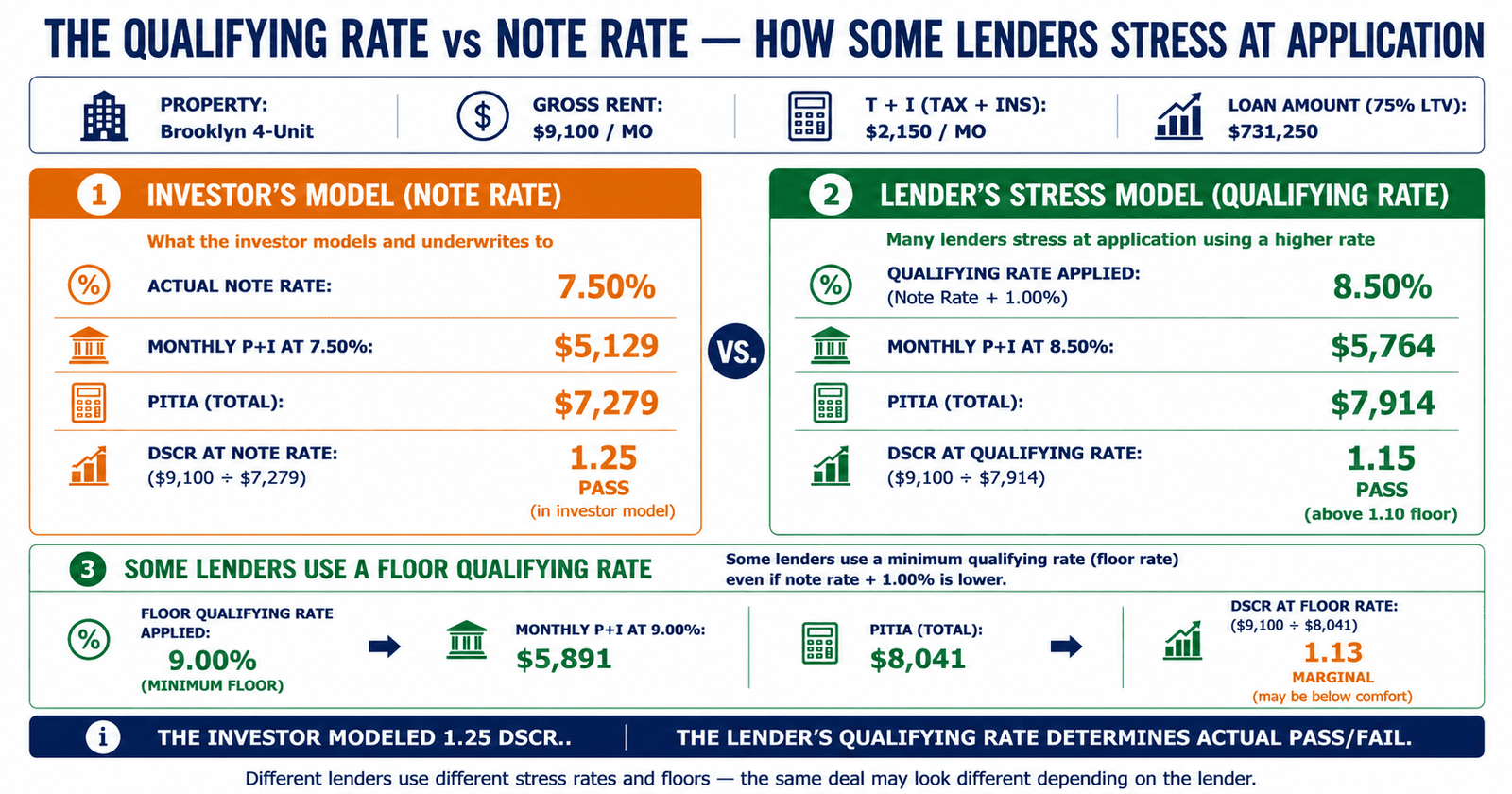
The rate stress recalculates P+I at a higher rate while holding gross rent constant. For purchase loans: +1.0% (100bps). For rate-and-term refis: +0.5% (50bps). On the benchmark Brooklyn 4-unit: note rate 7.5%, origination DSCR 1.25, gross rent $9,100, PITIA $7,279. At rate stress 8.5%: new P+I = $5,764, new PITIA = $7,914. Rate-stressed DSCR = $9,100 ÷ $7,914 = 1.15. Passes the BKDSCR 1.10 rate-stress floor.
DSCR Stress Test: Scenario 2 — Vacancy Stress
Vacancy stress reduces gross rent by 10% while holding PITIA constant. Benchmark deal: gross rent drops from $9,100 to $8,190. PITIA stays at $7,279. Vacancy-stressed DSCR = $8,190 ÷ $7,279 = 1.13. Passes the 1.10 lender floor.
DSCR Stress Test: Scenario 3 — Combined Stress
Combined stress applies both simultaneously: rate-stressed PITIA ($7,914) and vacancy-reduced gross rent ($8,190). Combined DSCR = $8,190 ÷ $7,914 = 1.035. Clears the BKDSCR 1.00 combined-stress floor. Deals below 1.00 in combined stress are declined on virtually all programs.
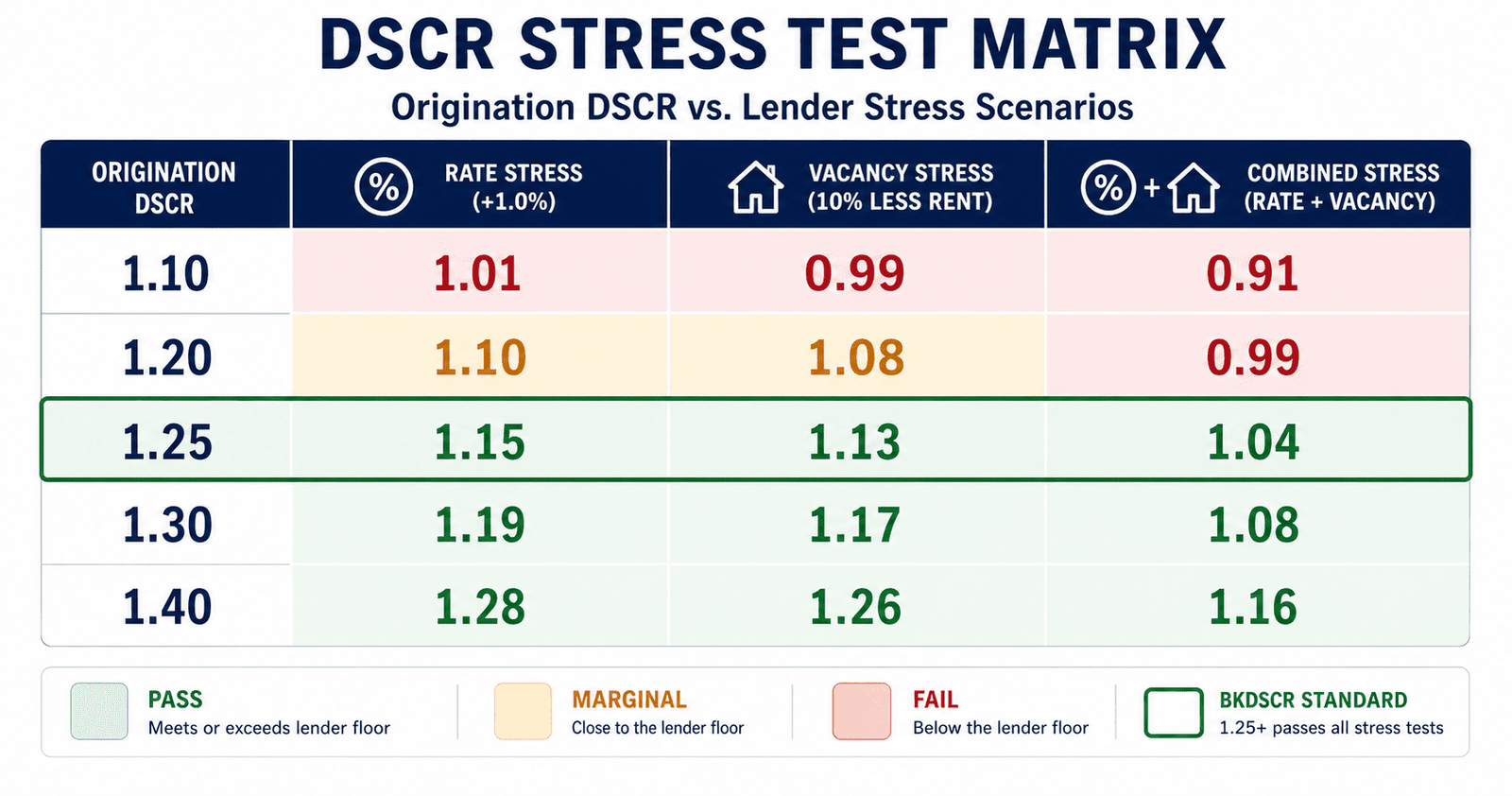
DSCR Stress Test Matrix: All Origination Levels, All Scenarios
The matrix below shows stressed DSCR at three scenarios for five origination DSCR levels. The structural difference between a 1.10 DSCR deal and a 1.25 DSCR deal is visible across every scenario:
| Orig. DSCR | +1.0% Rate Stressed | Rate Stress % | 10% Vacancy Stressed | Combined Stressed | BKDSCR Verdict |
|---|---|---|---|---|---|
| 1.10 | 1.01 | -8.2% | 0.99 | 0.91 | FAIL — all three |
| 1.20 | 1.10 | -8.3% | 1.08 | 0.99 | MARGINAL — rate passes lender floor; combined fails |
| 1.25 | 1.15 | -8.0% | 1.13 | 1.04 | PASS — rate clears 1.10; combined clears 1.00 |
| 1.30 | 1.19 | -8.5% | 1.17 | 1.08 | PASS — rate well above 1.10; solid combined |
| 1.40 | 1.28 | -8.6% | 1.26 | 1.16 | STRONG — rate above 1.25; combined well clear |
| Base: $9,100 gross rent / $7,279 PITIA (7.5% rate, $731,250 loan, $2,150 T+I). Rate stress = DSCR at 8.5%. Vacancy stress = DSCR at 90% gross rent. Combined = 8.5% rate + 90% gross rent. BKDSCR standards: rate stress ≥ 1.10 (lender floor); combined stress ≥ 1.00. | |||||
The 1.20 DSCR row is the most instructive: rate stress hits exactly 1.10 (lender floor, no margin) and combined stress produces 0.99 (just below the 1.00 floor). A 1.20 DSCR deal passes the minimum origination test but fails the combined stress scenario. The 1.25 row clears all three. This is why the BKDSCR 1.25 origination standard exists — it is the lowest origination DSCR that produces passing results across all three standard stress scenarios. Use the stress test to verify any deal against all three before application.
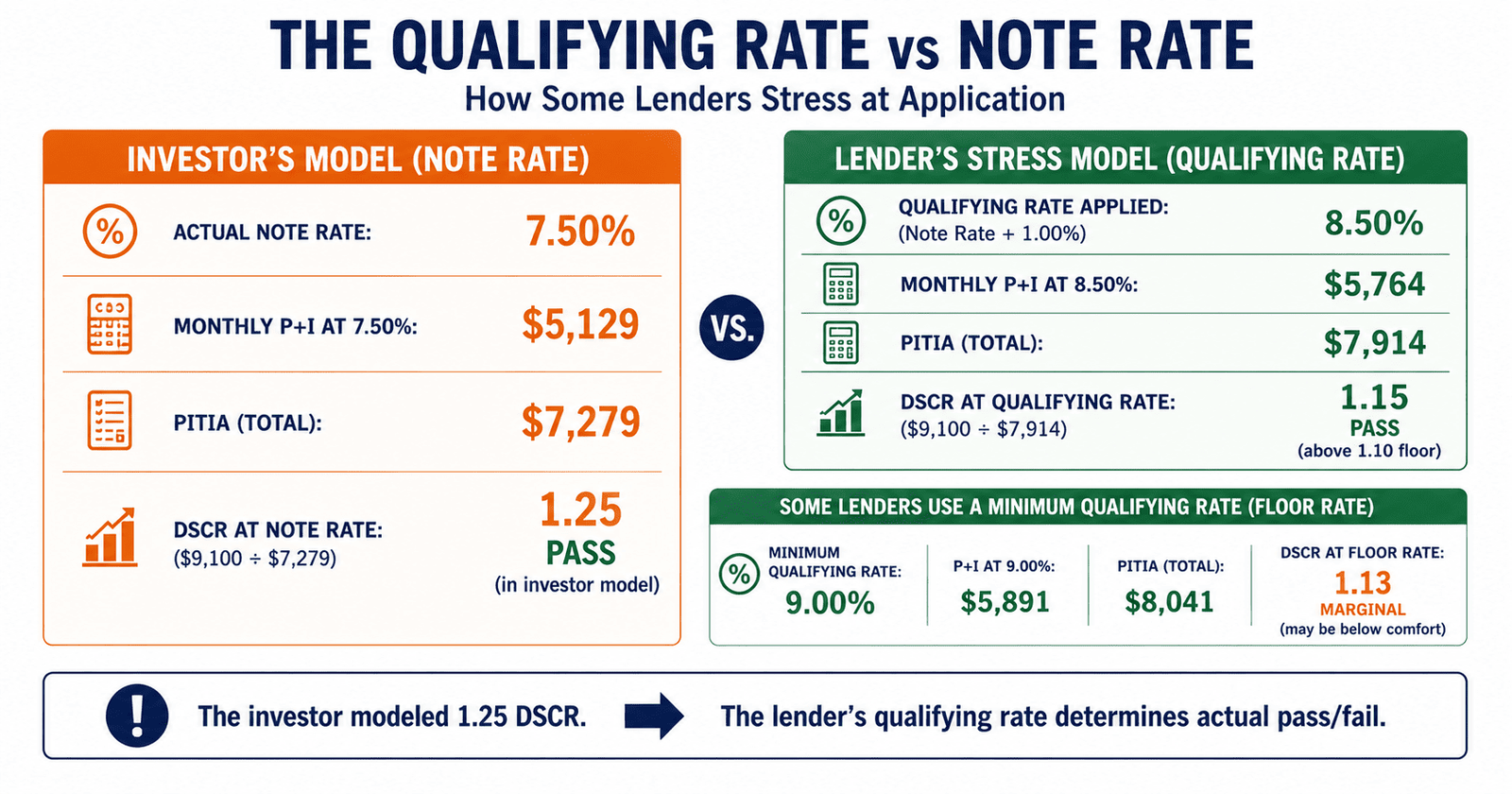
The Qualifying Rate vs Note Rate: A Lender-Specific Variable
Some DSCR lenders apply a qualifying rate higher than the actual note rate for qualification — standard practice, not an exception. A lender may use 8.5% when the actual note rate is 7.5%, or apply a minimum floor of 9.0%+ regardless of market rate. The investor who models DSCR at the actual note rate: their 1.25 DSCR at 7.5% becomes 1.15 at 8.5%, or 1.13 at 9.0%.
If origination DSCR was 1.10, the qualifying rate pushes the lender’s number below 1.00 — a decline. See lender criteria for which programs apply a qualifying rate and what the typical spread is.
What Happens When a Deal Fails the Stress Test
| Stress Outcome | Lender Response | Investor Options |
|---|---|---|
| Fails rate stress (below 1.10) | Decline OR require additional down payment to reduce loan and PITIA | Lower purchase price | Increase down payment | Find lender with lower qualifying rate |
| Fails combined stress (below 1.00) | Decline on most programs; possible exception with 6+ month reserves and low LTV | Materially reduce purchase price | Re-evaluate submarket | Walk away if math doesn’t close |
| Marginal: 1.00–1.10 rate stressed | May approve with exceptions: higher reserves (12 mo), lower LTV (70%), co-borrower | Reduce leverage | Improve DSCR to 1.30+ before resubmitting |
| Passes both; DSCR 1.25+ | Approve at best rate tier with standard reserve requirements (6 months) | No action needed; submit with current structure |
| Passes; DSCR 1.40+ | Approve at best rate tier; may unlock higher LTV or fewer reserves | Negotiate for better rate pricing at strong DSCR |
The most common failure is combined stress: a 1.20 DSCR deal that passes rate and vacancy stress individually fails the combined. Lenders typically decline or require 12 months reserves, lower LTV (65%+), and 720–740+ FICO as compensating factors. The investor who runs the stress test before submitting has time to restructure. Use the DSCR formula to find the origination DSCR that clears all three scenarios before going under contract.
For the complete stress test framework — single stress, combined stress, and reserve requirements — download the DSCR Playbook.
How to Run Your Own Pre-Submission Stress Test
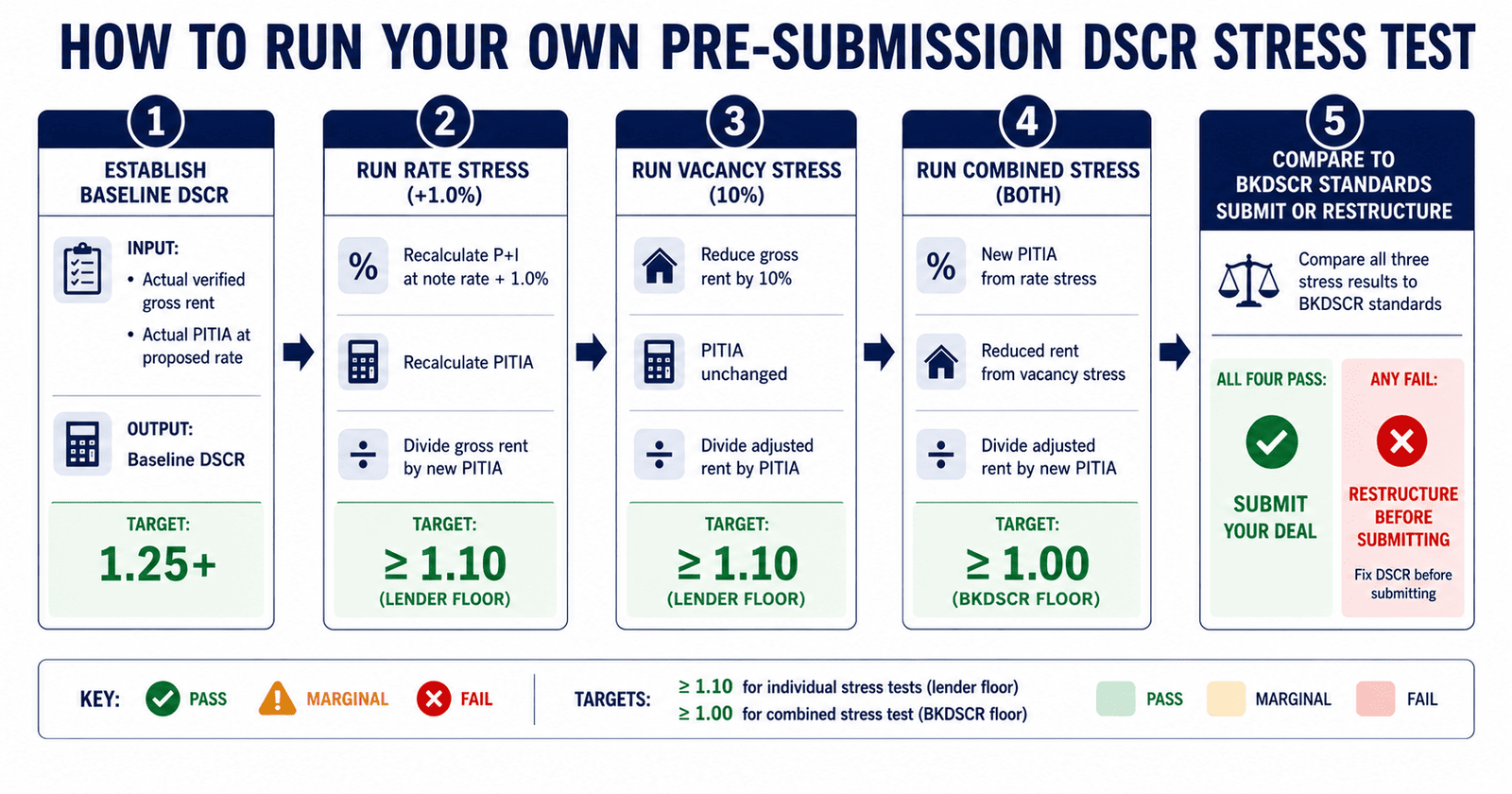
- Step 1 (Baseline DSCR): Use verified gross rent from current lease roll or 1007 market rent estimate. Use actual PITIA at proposed rate and LTV. Calculate: Gross Rent ÷ PITIA. Target: 1.25+.
- Step 2 (Rate stress): Recalculate P+I at note rate +1.0% (purchase) or +0.5% (rate-and-term refi). Recalculate PITIA with new P+I. Divide original gross rent by new PITIA. Target: 1.10+.
- Step 3 (Vacancy stress): Reduce gross rent by 10%. Keep PITIA at original. Divide reduced rent by PITIA. Target: 1.10+.
- Step 4 (Combined stress): Use rate-stressed PITIA from Step 2. Use vacancy-reduced rent from Step 3. Divide reduced rent by stressed PITIA. Target: 1.00+.
- Step 5 (Decision): All four pass? Submit. Any fail? Restructure before submitting. Use the DSCR calculator to handle Steps 2–4 automatically.
FAQ: DSCR Stress Test
DSCR Stress Test: Do all DSCR lenders run the same stress scenarios?
No. Specific stress amounts and passing thresholds vary by program. Some apply +1.0% rate stress; others use +0.5% or a minimum qualifying rate floor of 9.0%+. Some apply 10% vacancy; others use 5% or 15%. The BKDSCR standards in this post are conservative reference standards, not universal lender requirements. Verify the specific program’s stress test methodology before submitting any application.
DSCR Stress Test: If I lock my rate, does the rate stress still apply?
Yes. A rate lock freezes the rate for the closing timeline but does not eliminate the lender’s stress test. The stress test evaluates forward-looking cash flow durability — not the current locked rate.
Does the DSCR stress test apply to refinances differently than purchases?
Yes. Rate-and-term refinances typically use +0.5% rate stress vs +1.0% for purchases. Cash-out refinances may apply the full +1.0% or a higher qualifying rate because cash-out increases the loan balance and debt service. Confirm with the lender before modeling the refi DSCR.
DSCR Stress Test: Can strong reserves compensate for a stress test failure?
Sometimes, on exception basis. Some lenders will approve a combined stress failure with compensating factors: 12+ months PITIA in liquid reserves, 65% or lower LTV, and 720–740+ FICO. Exceptions are not guaranteed on any program and typically carry rate premiums. The reliable path is a deal that clears all scenarios at origination without exceptions.
DSCR Stress Test: Running Both Single and Combined Scenarios Before Submission
The Single Stress Test: Rate Increase Scenario
The DSCR stress test at +1% rate is the most common single-variable stress for 30-year fixed DSCR loans. The logic: the investor’s current rate is locked, but rates at the time of a future refi may be higher. On a Brooklyn 4-unit at $975,000 with a $731,250 loan at 7.5%, monthly P+I is $5,115. Stressed at 8.5%, P+I rises to $5,621.
Adding $506/month to PITIA drops DSCR from 1.25 (at $7,125/month PITIA + $8,906/month rent for 1.25x) to 1.18 — below the BKDSCR standard of 1.25 but above most lender floors of 1.10. This deal passes single-stress: it does not fail at +1% rate. The single-stress result — 1.18 — is the number to check against 1.10 (lender floor) rather than 1.25 (BKDSCR standard).
The Combined Stress Test: Rate and Vacancy
The BKDSCR combined stress scenario applies two simultaneous stresses: +1% rate AND one vacant unit. On the same Brooklyn 4-unit at 4 units x $2,225/unit = $8,900/month gross rent, stressed at one vacancy: 3 units x $2,225 = $6,675/month. Stressed PITIA at 8.5% rate: $6,575/month (PITIA after rate stress). Combined stress DSCR: $6,675 / $6,575 = 1.015.
The deal barely holds at 1.00 under combined stress — above the combined stress floor but with very little margin. This is a marginal result. A deal that runs 1.015 under combined stress holds technically but has no cushion for additional insurance or tax increases during the stress period.
The BKDSCR standard requires 1.00+ under combined stress. The framing: 1.10 is the lender floor at origination. 1.25 is the BKDSCR standard at origination. 1.00 is the combined stress floor — meaning the deal should not go negative cash flow even under rate increase AND a single vacancy simultaneously. A deal that fails this test is more fragile than its origination DSCR suggests. Run the stress test at both single and combined scenarios before every NYC DSCR submission. A deal that clears 1.25 at origination and 1.00 at combined stress is a properly underwritten investment property — not just a qualifying loan.
Have a deal where the stress test result is the deciding factor? The Deal Review runs both the unstressed and combined stress DSCR with verified inputs.
DSCR Stress Test: The Lender’s Version vs the BKDSCR Investor Version
The stress test result also informs the reserve conversation. A deal that holds at 1.00 under combined stress but only barely has a thin cushion even with reserves. Most DSCR lenders require 6 months of PITIA in reserves — but that reserve is consumed in 6 months of vacancy. A deal where the vacancy scenario produces 0.98 DSCR is a deal where one sustained vacancy drains the reserve entirely within 6 months and then goes cash-flow negative.
The BKDSCR standard accounts for this: 1.00+ under combined stress means the deal does not need to draw on reserves to service debt under both stresses simultaneously. Reserves are for unexpected events — not for covering a structural DSCR weakness. Run the stress test before every submission to confirm the deal holds without reserve draws under both scenarios.
Lenders run stress tests too — but not the same one the BKDSCR framework uses. Most DSCR lenders apply a rate stress at application: they underwrite the DSCR at the note rate, confirm it meets their minimum (typically 1.10–1.20), and that is the extent of their stress test. They do not test vacancy. They do not test insurance increases. They do not test the combined scenario. The lender’s job is to determine whether the deal qualifies at origination. The investor’s job is to determine whether the deal survives over the hold period.
The BKDSCR stress test framework adds two layers the lender does not: the vacancy scenario and the combined scenario. These layers exist because the lender is protected by the collateral and the note — if the deal deteriorates, the lender has recourse to the property. The investor has no such protection on their equity and cash flow.
A deal that qualifies at 1.18 Lender DSCR and produces negative cash flow under a single vacancy scenario is a qualifying loan and a losing investment. The stress test distinguishes between the two outcomes before closing, not after. The stress test runs both the lender version and the BKDSCR investor version on any deal inputs.
DSCR Stress Test Results: What Each Outcome Tells You
The four possible stress test outcome combinations and what each means for the deal:
- 1.25+ unstressed AND 1.00+ combined stress: clean deal — submit. This is the BKDSCR standard. Lender-ready and investor-ready.
- 1.20–1.24 unstressed AND 1.00+ combined stress: lender-ready but below BKDSCR standard. Qualifies at most programs. Consider whether the thin unstressed margin is acceptable for the investment hold period.
- 1.25+ unstressed AND below 1.00 combined stress: qualifies but fragile. The deal only holds if everything goes right. One vacancy or one rate increase breaks it. This is a structure-or-price problem, not a pass.
- Below 1.20 unstressed: does not qualify at most lenders. Run fix paths — LTV reduction, rent verification, insurance correction — before submitting.
The stress test result maps directly to the submission decision. Use the deal filter for a fast initial screen, then the stress test for the full scenario analysis before any application goes in.
The Stress Test the Lender Runs Is the Test You Should Run First
DSCR stress testing is not a post-approval risk assessment. It is an underwriting step that happens before approval and determines whether the loan proceeds. The math is not complex: rate stress requires one P+I recalculation at a higher rate, vacancy stress requires reducing gross rent by 10%, combined applies both at once. A 1.25 DSCR deal passes all three. A 1.10 DSCR deal fails all three. A 1.20 DSCR deal passes two and fails the combined. The BKDSCR 1.25 origination standard is calibrated specifically because 1.25 is the threshold that produces passing results across all three standard scenarios.