
DSCR Vacancy: Why Lenders Apply It to Fully Occupied Buildings
Key Takeaways
- Standard residential DSCR loans (1–4 unit) use gross rent with no vacancy deduction in the DSCR ratio — but vacancy risk still appears in five other places
- Some programs apply a 5–8% vacancy haircut to effective gross income, reducing DSCR by 0.06–0.09 even on a fully occupied building
- The BKDSCR combined stress applies 10% vacancy + 1.0% rate simultaneously — a 1.25 DSCR deal produces ~1.02–1.04 stressed
- NYC market vacancy is sub-3%, but individual 4-unit buildings experience 1–3 turnover events over 5 years, each producing 30–60 days vacancy per unit
- The 6-month PITIA reserve ($43,674 on $7,279/mo) is the structural backstop that covers vacancy income loss during hold periods
- Month-to-month tenants may be treated as partially vacant by some lenders regardless of current payment status
Table of Contents
- The Five Mechanisms: How DSCR Lenders Apply Vacancy Risk
- DSCR Vacancy: The Impact at Each Vacancy Level
- DSCR Vacancy and the Stress Test
- How Reserves Function as the Vacancy Safety Net
- NYC-Specific Vacancy Considerations for DSCR Underwriting
- Good Cause Eviction and Vacancy Risk
- Rent Stabilization and Vacancy
- FAQ: DSCR Vacancy
- DSCR Vacancy: Does every DSCR program apply a vacancy haircut?
- DSCR Vacancy: Does the reserve requirement apply even if my building has never had a vacancy?
- How does a month-to-month tenant affect DSCR qualification?
- Does the NYC sub-3% vacancy rate help me qualify for a higher DSCR?
- DSCR Vacancy: What Happens at Each Threshold in Real Numbers
- DSCR Vacancy and the NYC Rent Stabilization Overlay
DSCR vacancy is one of the most common investor objections to the underwriting process: the building is 100% occupied, all tenants are paying, and the lender is still applying vacancy risk somewhere in the analysis. The standard residential DSCR formula — Gross Rent ÷ PITIA — does not explicitly deduct vacancy from the income numerator.
But vacancy risk still shows up in five other mechanisms, and understanding where it appears explains why lenders are right to apply it even at full occupancy. According to Ridge Street, DSCR qualification is based on current rental income, but responsible underwriting also evaluates forward-looking cash flow durability.
| MARKET SNAPSHOT — NYC Vacancy and DSCR Context, June 2026 Sources: Ridge Street Capital (Jun 2026) | Mofin Loans NYC Guide | HonestCasa (2026) DSCR Vacancy Treatment by Program (2026): |
Before structuring any NYC deal, use the Deal Filter — property type, rent roll, unit count, and PITIA confirmed in 60 seconds.
DSCR Vacancy: Why Full Occupancy Today Doesn’t Mean Zero Vacancy Tomorrow
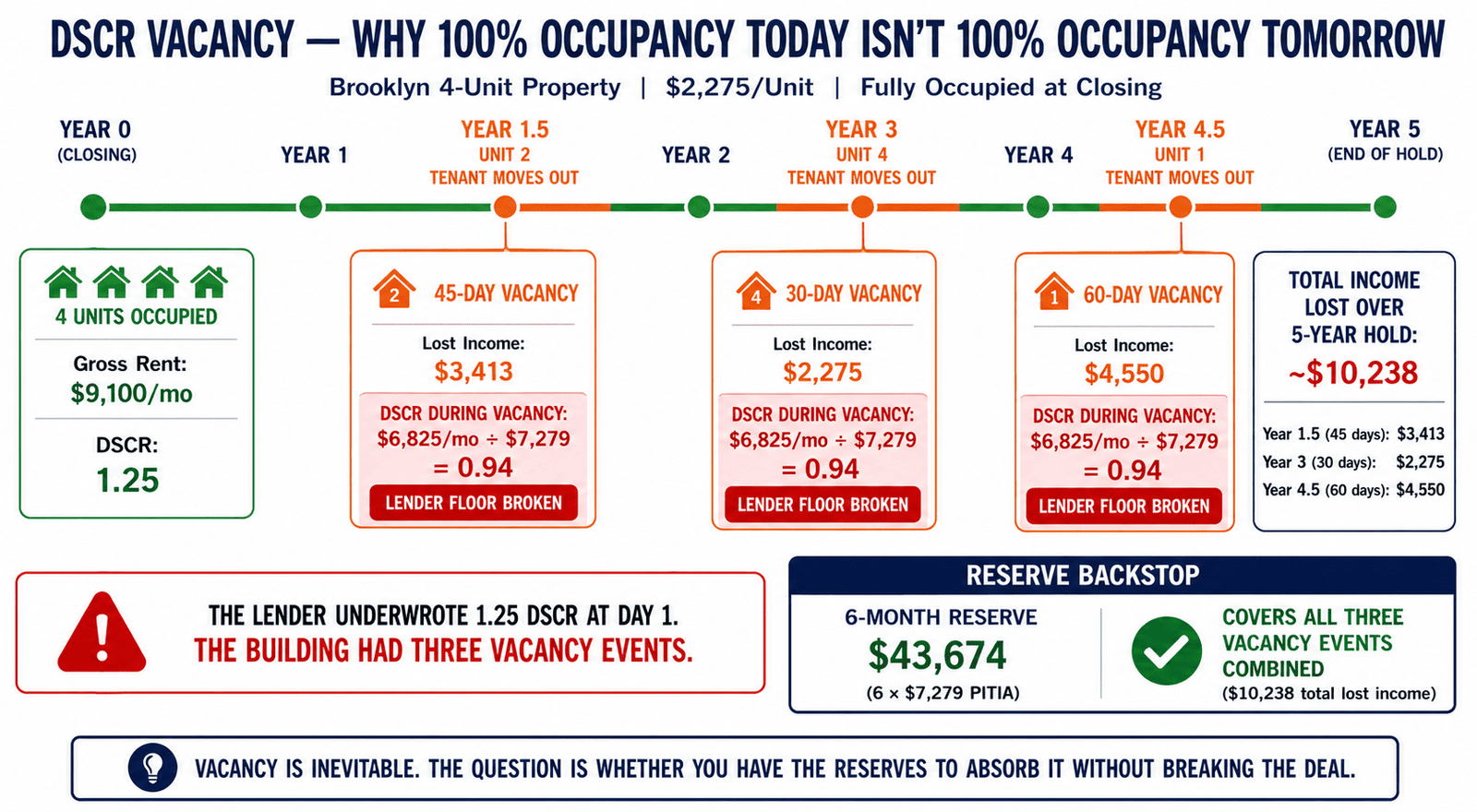
The investor closing on a 100% occupied Brooklyn 4-unit has verified the current state of the property. The lender is underwriting that property over the next 30 years. NYC’s market-wide vacancy is sub-3% for market-rate apartments. But individual 4-unit buildings experience unit turnover every 2–3 years regardless of the borough-wide rate.
A tenant who has lived in a unit for three years moves out. The investor needs 30–60 days to re-lease. During that window, the unit produces $0 income while the $7,279 PITIA continues. According to Mofin Loans, NYC DSCR underwriting focuses on stabilized income rather than peak-occupancy projections.
| Turnover Scenario | Events (5-yr) | Income Lost | Eff. Annual Vacancy |
|---|---|---|---|
| 1 unit turns every 5 years (best case) | 1 turnover | ~$4,550 | ~0.8%/year |
| 1 unit turns every 3 years (typical) | 1–2 turnovers | ~$6,825–$9,100 | ~1.5–2%/year |
| 1 unit turns every 2 years (active) | 2–3 turnovers | ~$9,100–$13,650 | ~2–3%/year |
| 1 unit turns every year (high churn) | 4–5 turnovers | ~$13,650–$18,200 | ~3–4%/year |
| 2 units turn simultaneously (worst) | 2–3 events | ~$18,200–$27,300 | ~4–6%/year |
On any given month when a unit is vacant, the real DSCR is not 1.25. Three of four units at $2,275 = $6,825 gross rent ÷ $7,279 PITIA = 0.94. Below the lender floor. The lender’s vacancy risk mechanism is forward-looking, not overcautious.
The Five Mechanisms: How DSCR Lenders Apply Vacancy Risk
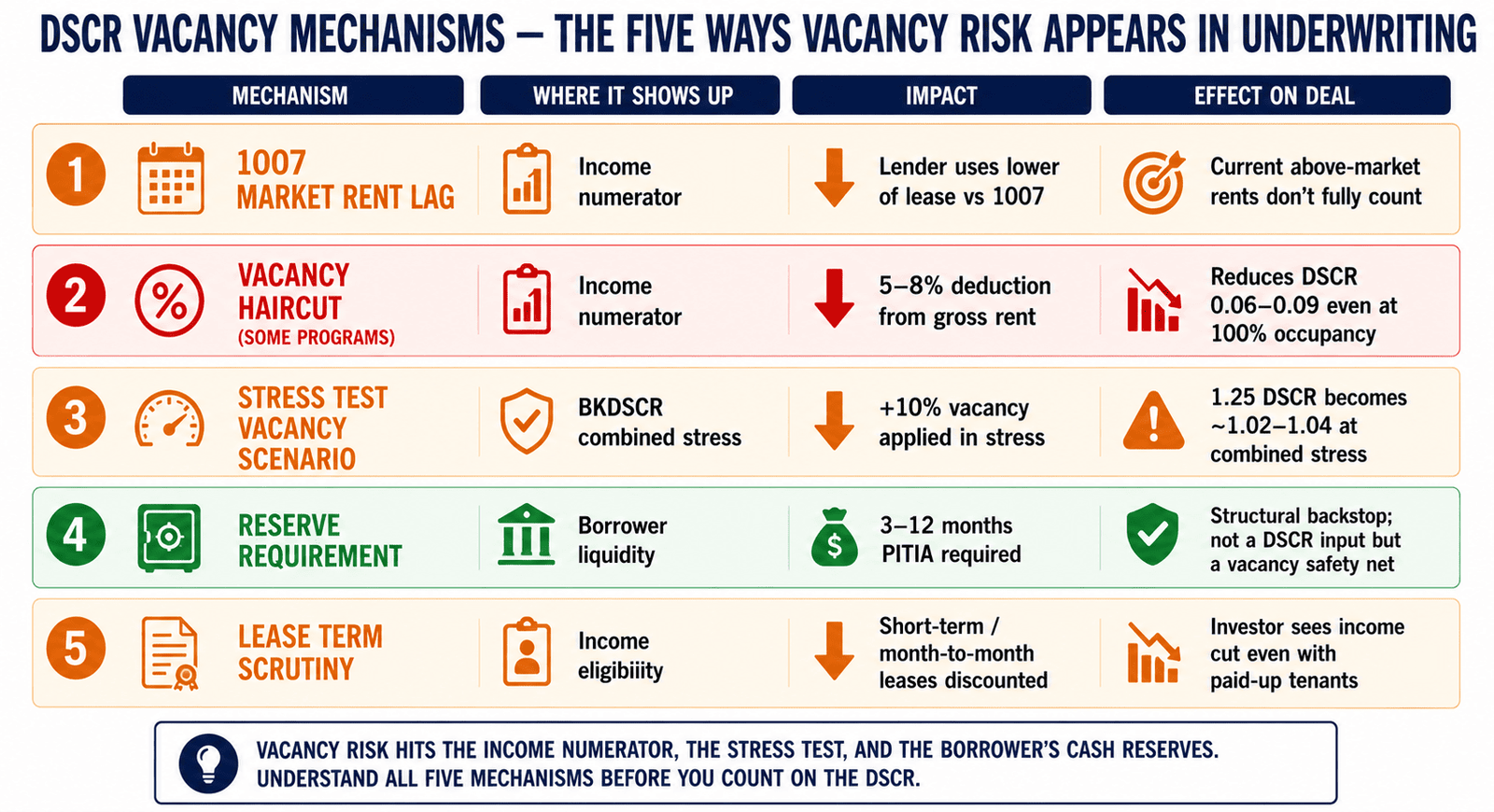
DSCR vacancy risk appears in five distinct mechanisms, each operating on a different part of the analysis:
| Mechanism | Where It Shows Up | How It Works / Investor Impact |
|---|---|---|
| 1007 Market Rent Lag | Income numerator | Lender uses LOWER of lease rent or appraiser’s 1007 estimate. In rising-rent markets, 1007 lags 3–6 months. Current above-market rents don’t fully flow into the DSCR numerator. |
| Vacancy Haircut (some programs) | Income numerator | “Effective gross income” programs apply 5–8% vacancy deduction to gross rent before dividing by PITIA. Applies even at 100% occupancy. Reduces DSCR by 0.06–0.09 on a 1.25 deal. |
| Stress Test — Vacancy Scenario | Stress-test analysis | BKDSCR combined stress: +1.0% rate AND 10% vacancy simultaneously. A 1.25 DSCR deal stressed at both = ~1.02–1.04. Reveals forward-looking risk even at full occupancy. |
| Reserve Requirement | Borrower liquidity | 3–12 months PITIA in liquid reserves required at closing. Six months at $7,279/mo = $43,674. Capital backstop during vacancy periods; not a DSCR input. |
| Lease Term Scrutiny | Income eligibility | Leases expiring within 12 months may receive reduced income credit. Month-to-month tenants may be treated as partially vacant regardless of payment status. |
Not all five apply to every program. The most common combination for standard 1–4 unit residential: 1007 market rent discipline (mechanism 1) + reserve requirement (mechanism 4) + stress test (mechanism 3). Some programs add the vacancy haircut (mechanism 2).
DSCR Vacancy: The Impact at Each Vacancy Level
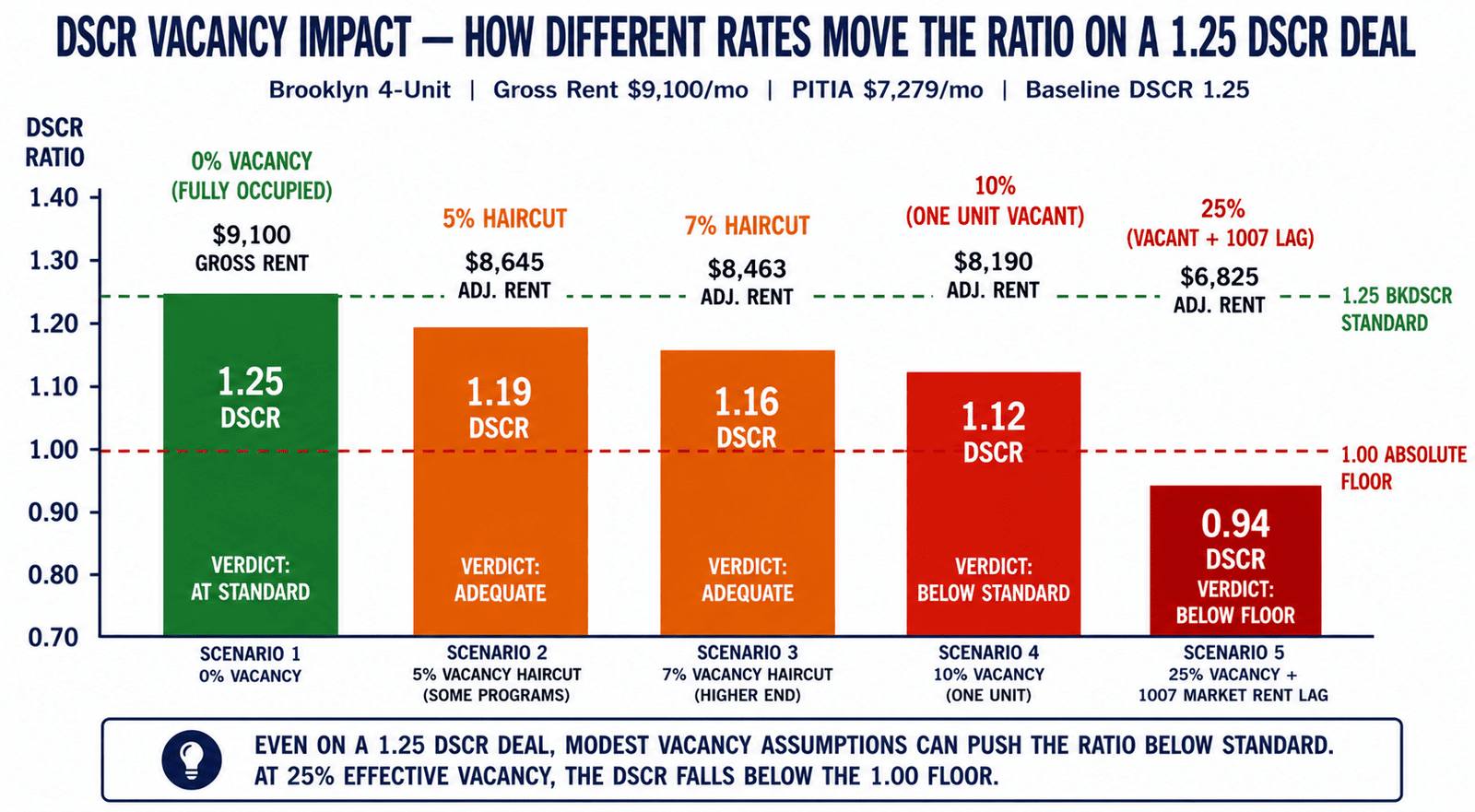
The concrete impact of vacancy on DSCR depends on how the lender applies the factor. Here is what each vacancy level does to the benchmark Brooklyn 4-unit at $9,100 gross rent and $7,279 PITIA:
| Vacancy Rate | Adj. Gross Rent | DSCR | What This Means |
|---|---|---|---|
| 0% (fully occupied) | $9,100 | 1.25 | Lender’s underwritten income — current state only. |
| 5% haircut | $8,645 | 1.19 | Some programs apply 5% effective gross income deduction. |
| 7% haircut | $8,463 | 1.16 | Conservative program standard. 1.25 gross becomes 1.16 effective. |
| 10% (one unit vacant) | $8,190 | 1.12 | One of four units vacant. DSCR drops to 1.12 — BKDSCR: FAIL. |
| 25% (vacant + 1007 lag) | $6,825 | 0.94 | Vacant unit + 1007 lag on occupied. Deal fails lender floor. |
The 5% haircut row is critical: a deal modeled at 1.25 gross DSCR qualifies as 1.19 effective DSCR under that program — below the BKDSCR 1.25 standard. Confirm with the specific lender whether their program applies an effective gross income deduction before modeling any deal at exactly 1.25. See lender criteria for which programs apply vacancy haircuts.
DSCR Vacancy and the Stress Test
The BKDSCR combined stress test applies 10% vacancy simultaneously with a +1.0% rate stress. This captures what happens when one of four units is vacant during a higher-rate environment — the most common stress combination an outer-borough investor will face over a 5–10 year hold.
- Baseline DSCR: 1.25 | Gross rent $9,100 | PITIA $7,279
- Rate stress (+1.0%): New PITIA = $7,914
- Vacancy stress (10%): Adjusted gross rent = $8,190
- Combined stressed DSCR: $8,190 ÷ $7,914 = 1.035
A 1.035 combined stressed DSCR is technically above the 1.00 floor but provides almost no margin. Run the stress test to verify where a specific deal lands at combined stress before finalizing any acquisition decision.
How Reserves Function as the Vacancy Safety Net
The reserve requirement addresses the single-unit vacancy scenario every investor will encounter. At $7,279/month PITIA, six months of reserves = $43,674. That is the vacancy backstop — the capital to cover PITIA during periods when gross rent falls below the payment due to unit turnover.
For the complete framework on how lenders underwrite vacancy risk, stress testing, and reserve requirements, download the DSCR Playbook.
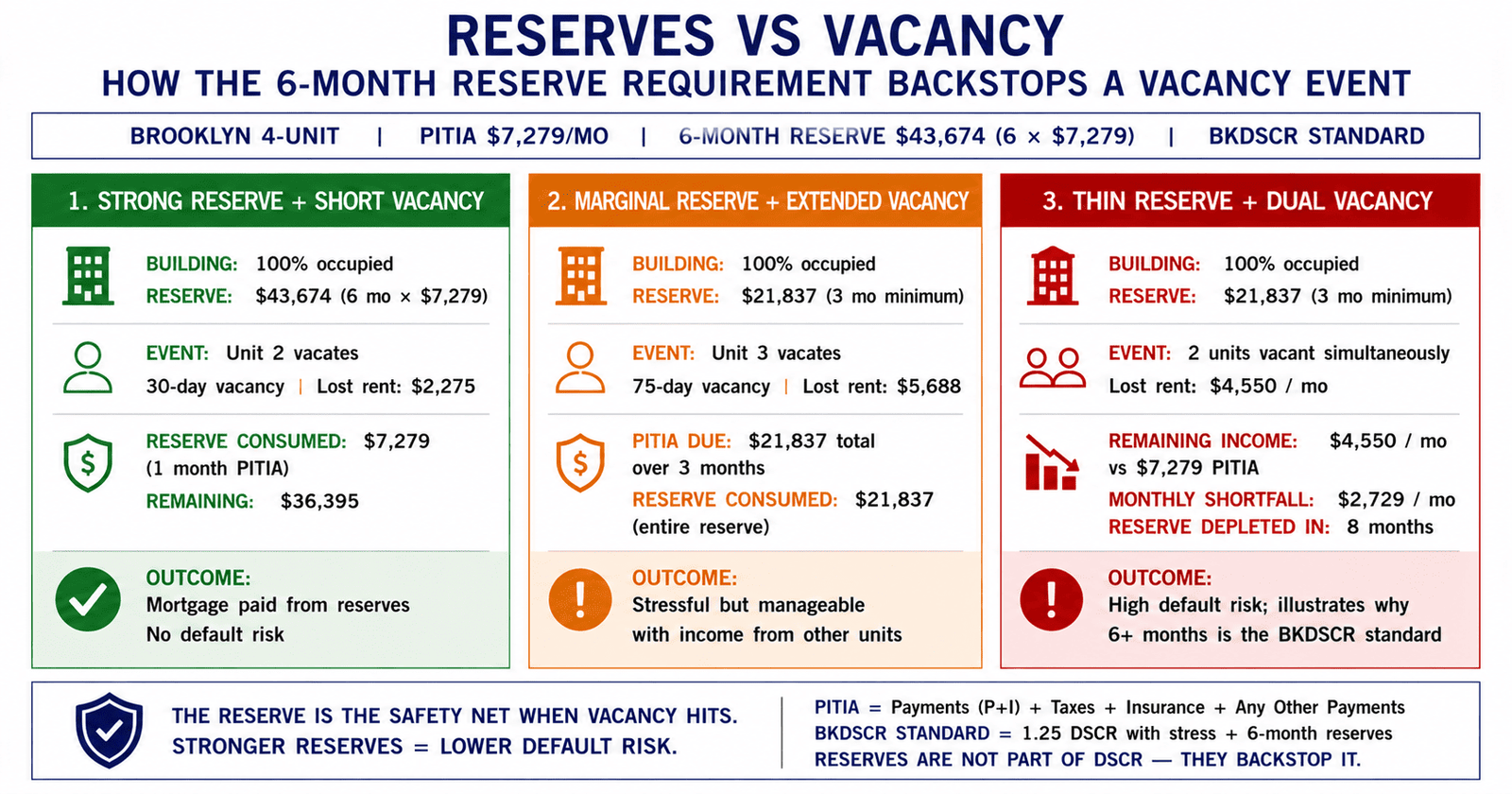
A dual-vacancy event on a 4-unit (two units empty for 60 days) consumes approximately $29,116 of reserves. A 3-month reserve ($21,837) is consumed entirely. A 6-month reserve ($43,674) survives with $14,558 remaining. That remaining buffer is what separates a temporarily stressful period from a default risk.
NYC-Specific Vacancy Considerations for DSCR Underwriting
Good Cause Eviction and Vacancy Risk
NYC’s Good Cause Eviction law (2024) limits non-renewal without stated cause and imposes renewal caps tied to CPI for covered units. Good Cause reduces voluntary tenant departures, which lowers actual vacancy — but also limits the investor’s ability to re-lease at market rates following a departure. See deal killers for how Good Cause coverage is evaluated in DSCR underwriting and which property types are exempt.
Rent Stabilization and Vacancy
Rent-stabilized units re-lease at the prior tenant’s legal rent plus permitted increases — not at market rent. A vacancy event does not produce a rent reset that improves DSCR over time the way a market-rate turnover does. On stabilized buildings, vacancy produces only income interruption with no offsetting rent improvement.
FAQ: DSCR Vacancy
DSCR Vacancy: Does every DSCR program apply a vacancy haircut?
No. Standard residential DSCR programs (1–4 unit) generally use gross actual rent without a vacancy deduction. Vacancy risk is addressed through reserves and the stress test. Some programs — particularly those with more conservative underwriting standards — apply a 5–8% effective gross income deduction. Confirm with the specific lender before modeling at exactly 1.25 DSCR.
DSCR Vacancy: Does the reserve requirement apply even if my building has never had a vacancy?
Yes. The reserve requirement is program-standard regardless of vacancy history. A building with zero historical vacancy still requires 3–6 months of PITIA in liquid reserves at closing. The lender is underwriting forward-looking risk.
How does a month-to-month tenant affect DSCR qualification?
Month-to-month treatment varies by lender. Some accept month-to-month income at full value if the lease has been active 12+ months. Others discount it or require a new 12-month lease as a condition of loan approval. On a 4-unit where two units are month-to-month, the income treatment can materially change the qualifying DSCR.
Does the NYC sub-3% vacancy rate help me qualify for a higher DSCR?
Not directly. The lender uses verified lease rent or the appraiser’s 1007 market rent — not a market vacancy adjustment. The tight vacancy market helps indirectly by supporting higher 1007 estimates and reducing turnover duration. But the market vacancy rate does not produce a mechanical DSCR improvement in the lender’s formula.
DSCR Vacancy: What Happens at Each Threshold in Real Numbers
The vacancy scenario plays out differently depending on where the deal’s unstressed DSCR sits. A deal at 1.35 DSCR unstressed has significant vacancy cushion. A deal at 1.12 DSCR unstressed has almost none. Here is what one vacancy does to DSCR across three representative deal structures:
| Deal Type | Unstressed DSCR | DSCR at 1 Vacancy | Verdict |
| Brooklyn 4-unit, $2,400/unit, $7,200 PITIA | 1.33 | 1.00 | At lender floor |
| Queens 3-unit, $2,200/unit, $5,400 PITIA | 1.22 | 0.81 | Cash flow negative |
| Bronx 4-unit, $2,000/unit, $5,200 PITIA | 1.54 | 1.15 | Holds above floor |
The Brooklyn 4-unit at 1.33 unstressed drops exactly to 1.00 at one vacancy — it sits at the lender floor with no cushion. The Queens 3-unit at 1.22 goes cash-flow negative at one vacancy. The Bronx 4-unit at 1.54 holds at 1.15 — above the lender floor with margin to spare. This is why the BKDSCR standard is 1.25+ unstressed: a deal at 1.25 on a 4-unit drops to approximately 0.94 at one vacancy. It does not survive vacancy without reserve draws. A deal at 1.35+ on a 4-unit survives one vacancy at 1.00 or above.
DSCR Vacancy and the NYC Rent Stabilization Overlay
For NYC rent-stabilized properties, vacancy has an additional dimension that free-market buildings do not face. Under rent stabilization, a vacant unit must be re-leased at the prior legal regulated rent plus any applicable RGB increase — not at current market rent. On a building where the stabilized rent is $1,400/unit and market rent is $2,200/unit, a vacancy creates both the income loss and a permanent constraint on the replacement rent level.
This means vacancy on a stabilized building produces a more severe long-term DSCR impact than vacancy on a free-market building. The lender’s vacancy underwriting is the same for both — $0 income on the vacant unit — but the recovery trajectory differs materially. Free-market vacancy recovers at market rent. Stabilized vacancy recovers at the regulated rent. Investors modeling DSCR on stabilized properties should run the stress test at one vacancy and model the recovery at the stabilized replacement rent, not the market rent. The deal killers page covers rent stabilization as a DSCR underwriting variable including its vacancy recovery implications.
The practical implication for pre-submission analysis: a rent-stabilized 4-unit with two units at $1,400/month stabilized rent and two at $2,400/month free-market produces a blended DSCR that reflects both. At one vacancy on a stabilized unit, the income drops from $7,600/month to $6,200/month. At one vacancy on a free-market unit, it drops from $7,600/month to $5,200/month. The lender treats both as $0 for the vacant unit — but the investor’s recovery path from each vacancy is fundamentally different. Use the stress test at each vacancy scenario to see the full range of outcomes.
The pre-submission standard for any NYC DSCR deal: run the vacancy stress test at one unit vacant before going under contract, not after. On a 4-unit building, that means modeling three units at full rent and one at zero. If the result stays above 1.00, the deal has the vacancy buffer the BKDSCR combined stress standard requires. If it falls below 1.00, the deal needs restructuring —
lower purchase price, higher rents, or a different unit mix — before it is submission-ready. A fully occupied building at the time of contract can have a vacancy at any point between contract and closing. The lender underwrites that reality regardless of current occupancy. As Investopedia’s DSCR definition notes, the ratio measures the property’s ability to cover debt service — which inherently includes the possibility of income interruption from vacancy. The investor should too. Use the deal analysis framework to run both the unstressed and vacancy-stressed DSCR on every deal before committing capital.
Have a live deal where vacancy is the margin question? The Deal Review runs both the unstressed and vacancy-stressed DSCR with verified PITIA inputs before you submit.
Vacancy Risk Is Forward-Looking, Not Current-State
DSCR vacancy risk in underwriting is not a question about what the building looks like today. It is a question about what the building’s income profile will look like over the next 5–10 years. Every residential rental property experiences unit turnover. Every turnover produces a vacancy period. The reserve requirement acknowledges this reality while allowing the loan to close on the current occupancy state.
The investor who understands vacancy risk as forward-looking — not as a criticism of the current rent roll — understands why lenders apply it even to fully occupied buildings. Reserves answer the question of whether the deal is structured to survive turnover events. The stress test confirms the answer holds under adverse conditions. Both mechanisms exist because vacancy is not if, but when.