
DSCR vs Conventional Loans: The Real 25% Down Decision
Key Takeaways
- DSCR optimizes for scalability, documentation simplicity, LLC ownership, and property-as-qualifier; conventional optimizes for rate, no PPP, and first-10-property builds
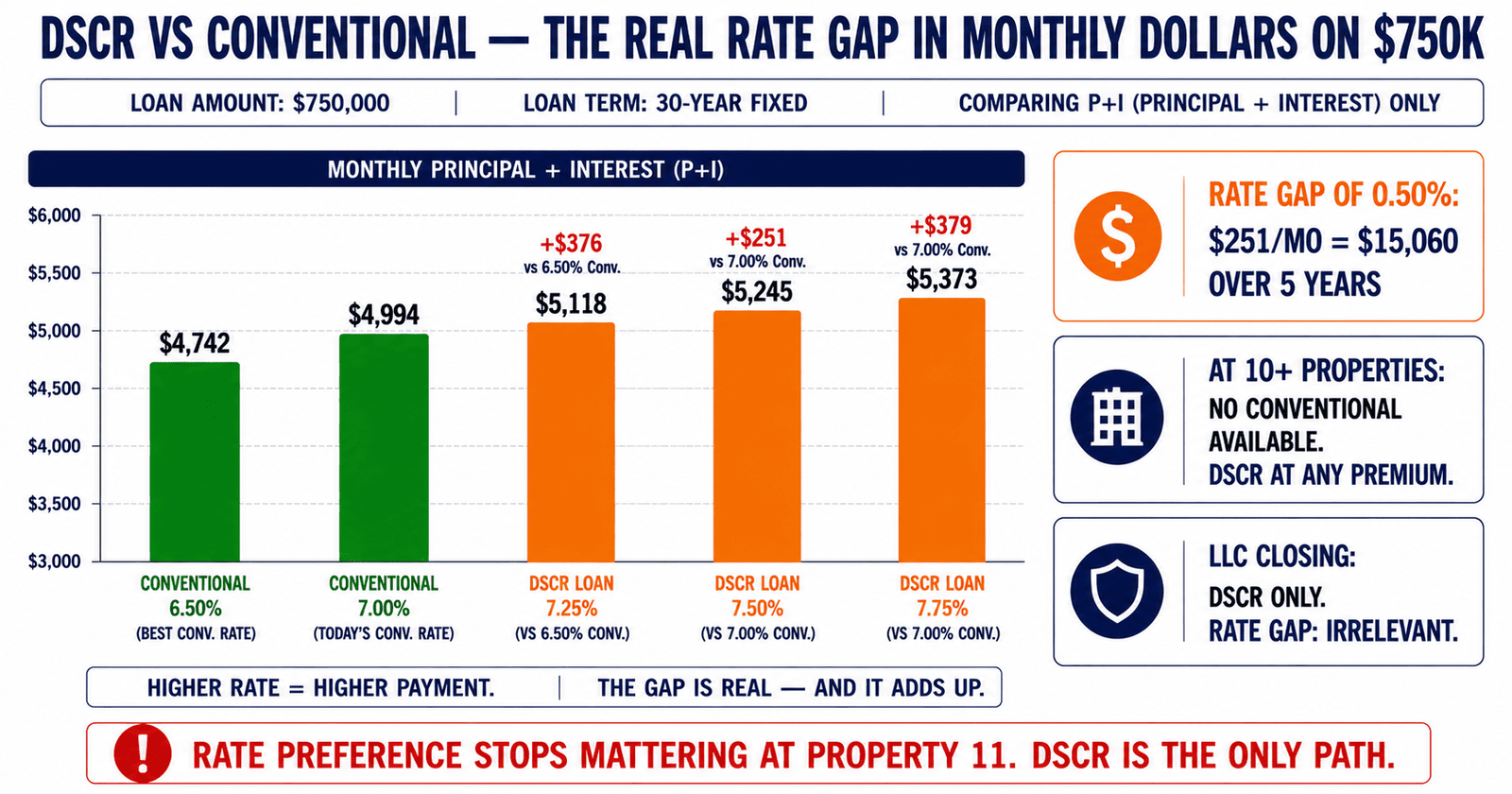
- The DSCR rate premium in 2026 is ~0.25%–0.75% vs conventional; on $750K, a 0.50% gap = $251/month = $15,060 over 5 years
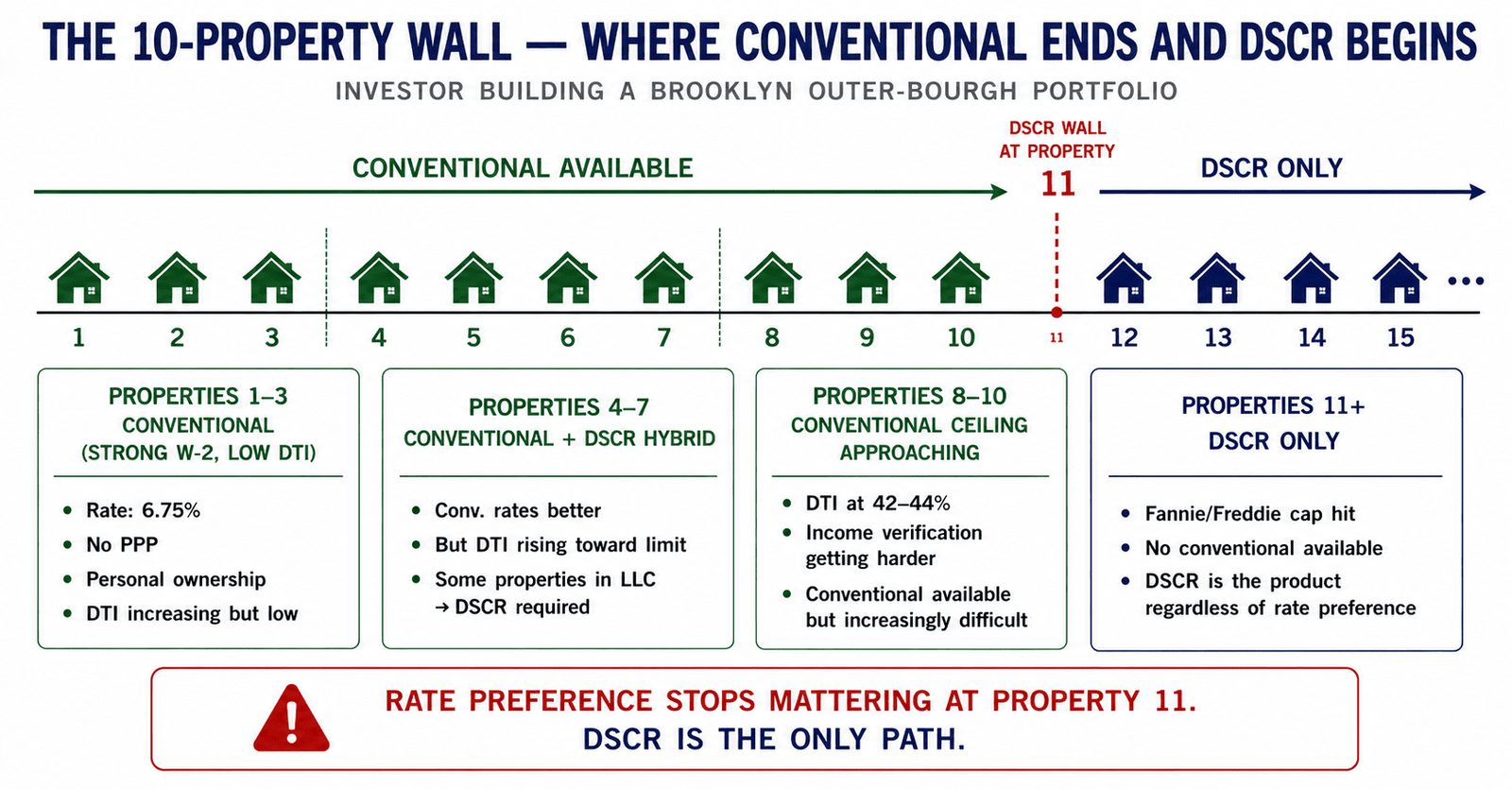
- Fannie Mae and Freddie Mac cap conventional investment financing at 10 financed properties; at property 11, DSCR is the only path
- Conventional investment loans cannot close in an LLC; DSCR can; for NYC investors holding in entities, this is often the deciding factor
- Self-employed investors whose Schedule E write-offs reduce taxable income cannot qualify conventionally; DSCR eliminates income verification
- Sophisticated investors use both: conventional for early properties where rate matters, DSCR for scaling past the cap or requiring LLC ownership
Table of Contents
- DSCR vs Conventional Loan: What Conventional Investment Loans Optimize For
- The Rate Gap: What It Actually Costs
- The Three NYC Investor Conditions That Make DSCR the Correct Choice
- Condition 1: LLC Ownership
- Condition 2: Self-Employment and Schedule E Losses
- Condition 3: Portfolio Scale Past the 10-Property Cap
- Head-to-Head Comparison: DSCR vs Conventional Investment Loan
- FAQ: DSCR vs Conventional Investment Loan
- DSCR vs Conventional Loan: If I can qualify for both, which should I choose?
- DSCR vs Conventional Loan: Has the rate gap narrowed in 2026?
- Can I refinance from conventional to DSCR later?
- Does my credit score matter for DSCR vs conventional?
- The Self-Employed and LLC Investor: DSCR Is the Default Choice
DSCR vs conventional loan is not a question of which is better — it is a question of which income source qualifies you. Conventional investment loans underwrite on your personal income. DSCR loans underwrite on the property’s rental income. Same property, same borrower, different qualification path.
DSCR vs conventional investment loans is the most common financing comparison question NYC outer-borough investors ask — and the answer that matters most is not which product has the lower rate. It is which product was built to solve the problem the investor actually has. Both can finance the same 4-unit Brooklyn building. They cannot both finance the same investor under the same conditions. According to Stacking Capital, DSCR loans qualify on property cash flow rather than personal income — and that single mechanical difference drives every advantage and limitation that follows. See also: how DSCR loans work.
Not sure whether DSCR or conventional is the right product for your deal? Use the Deal Filter to confirm DSCR eligibility before going deeper.
What DSCR vs Conventional Loan: What DSCR Optimizes For
DSCR loans optimize for the investor whose barrier is documentation complexity, income profile, entity structure, or portfolio scale. Six specific situations:
- Scale without caps: Conventional caps at 10 financed properties. DSCR has no limit. At property 11, DSCR is the only available product.
- Self-employed income complexity: An investor who earns $250K gross but shows $60K taxable after depreciation cannot conventionally qualify. DSCR ignores personal income entirely. The property qualifies itself.
- LLC entity closing: Conventional investment loans must close in the borrower’s personal name. DSCR loans can close in an LLC. For NYC investors who hold property in entities for liability protection, this is often the non-negotiable structural requirement.
- Documentation speed: DSCR underwriting involves no income verification, employer verification, or Schedule E analysis. Closing in 10–25 days vs 30–45 for conventional. In competitive NYC markets, speed differentiates offers.
- Multiple simultaneous closings: Each property qualifies independently on its DSCR without adding to the investor’s personal DTI ratio.
- High write-off situations: Real estate investors who deploy cost segregation or accelerated depreciation may show paper losses against significant actual income. DSCR does not open the tax return.
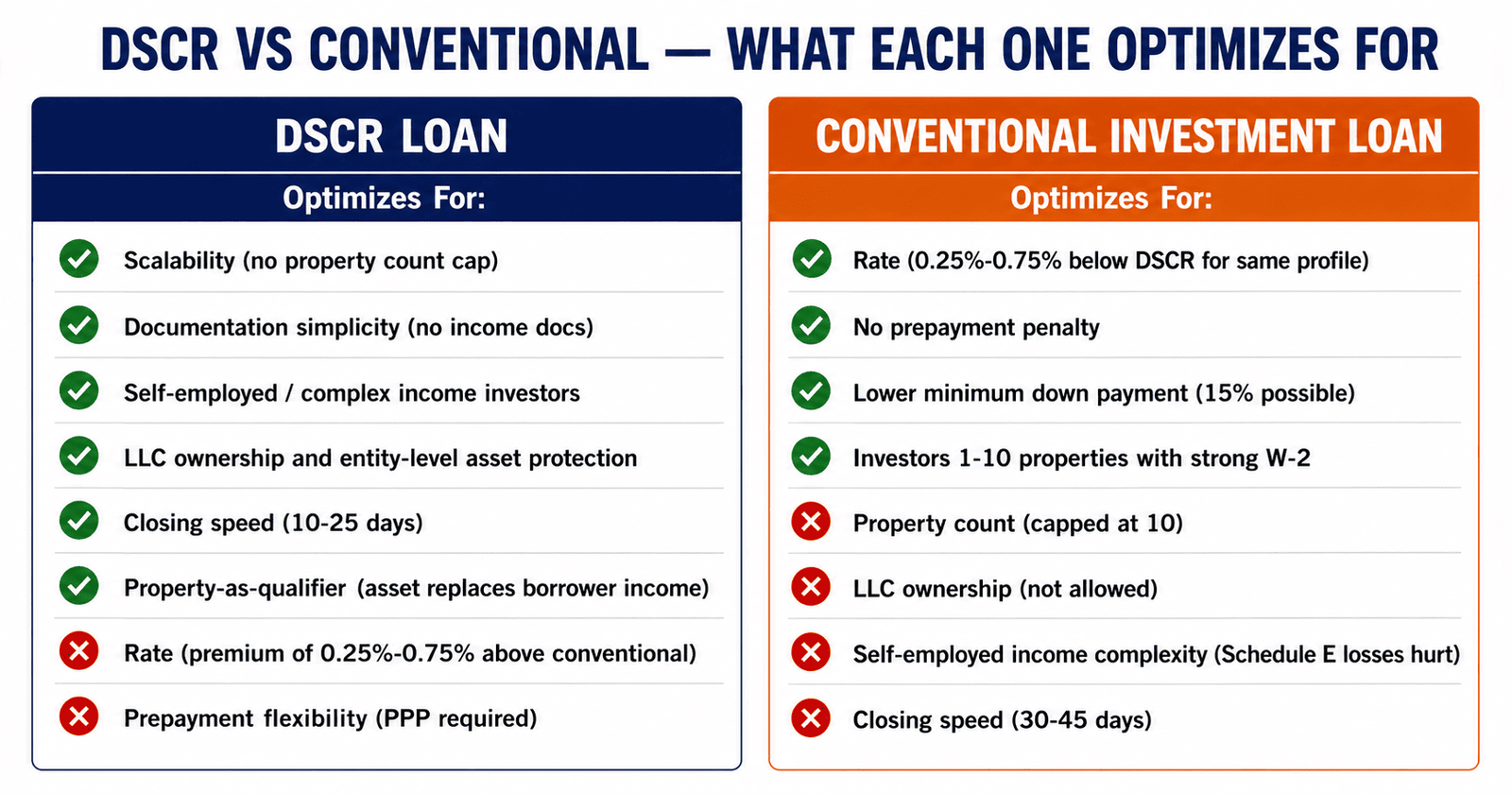
DSCR vs Conventional Loan: What Conventional Investment Loans Optimize For
Conventional investment loans optimize for the borrower who can qualify on personal income documentation and has fewer than 10 financed properties. According to Ridge Street, both products are available to most investment property buyers but solve for fundamentally different investor profiles.
- Rate: Conventional investment loans for well-qualified borrowers price 0.25%–0.75% below comparable DSCR programs. On $750K, that gap is $125–$376/month. Over a 10-year hold: $15,000–$45,000 in extra interest. For investors who can qualify, the rate difference is real money.
- No prepayment penalty: Conventional has no PPP. DSCR almost universally carries step-down penalties. For investors with shorter hold periods or uncertain timelines, the no-PPP structure is a meaningful advantage.
- Lower minimum down payment: Some conventional programs allow 15% down on SFRs vs 20–25% for DSCR. On $750K, the difference between 15% and 25% is $75,000 in capital.
- Clean W-2 qualification: An investor with steady W-2 income, low debt, and two clean tax years qualifies conventionally without complexity. For this profile, conventional is the right product for the first several properties.
The Rate Gap: What It Actually Costs
The rate gap between DSCR and conventional investment loans has narrowed in 2026. Fannie Mae and Freddie Mac raised LLPAs on conventional investment property loans multiple times since 2022, pushing conventional investment rates higher. For well-qualified borrowers in 2026, the gap is 0.25%–0.75% rather than the 1.0%+ premium that characterized 2020–2022. See also: LTV DSCR relationship.
| Period / Scenario | Monthly Gap | Cumulative Cost / Context |
|---|---|---|
| DSCR at 7.5% vs Conv. at 7.0% | $251/mo more | $3,012/year in extra interest on $750K |
| 5-year hold | $251/mo × 60 mo | $15,060 in extra interest (pre-PPP) |
| 10-year hold | $251/mo × 120 mo | $30,120 in extra interest (post-PPP period) |
| At Fannie cap (10+ properties) | No alternative | DSCR is the only path; rate premium is moot |
| Self-employed (large write-offs) | Conventional unavailable | DSCR rate premium is the cost of income complexity |
| LLC closing required | Conventional unavailable | DSCR is the product; rate comparison irrelevant |
The table shows the real monthly cost of the DSCR rate premium — and the three situations where the rate comparison becomes irrelevant. At property 11, the investor cannot access conventional financing regardless of rate preference. In an LLC closing, conventional is unavailable. Use lender criteria to understand how DSCR lenders price your specific scenario.
The Three NYC Investor Conditions That Make DSCR the Correct Choice
Condition 1: LLC Ownership
NYC real estate investors disproportionately hold property in LLCs for liability protection, estate planning, and partnership structures. Conventional investment financing cannot close in an LLC name. For any investor who intends entity ownership — whether on the first property or the fifteenth — DSCR is the only product available in the residential investment space. The rate comparison does not apply because the alternative does not exist.
For the complete comparison of DSCR vs conventional loan programs — rate, LTV, property eligibility, and income documentation — download the DSCR Playbook.
Condition 2: Self-Employment and Schedule E Losses
A real estate attorney or business owner who earns $300,000 gross but reports $80,000 in taxable income after business expenses, depreciation, and real estate losses cannot conventionally qualify on a deal requiring $120,000 documented income. DSCR does not read the tax return. The self-employed investor who has built a rental portfolio with consistently positive property cash flow qualifies on the property, not on the personal income profile that tax strategy has structured to minimize.
Condition 3: Portfolio Scale Past the 10-Property Cap
The Fannie/Freddie limit of 10 financed properties is a hard cap. At property 11, no conventional investment financing is available regardless of income strength or credit score. DSCR has no such limit. The hybrid approach — conventional for the first several properties, DSCR for LLC structures and scaling — is the most common among experienced portfolio builders.
Head-to-Head Comparison: DSCR vs Conventional Investment Loan
| Factor | DSCR Loan | Conventional Investment Loan |
|---|---|---|
| Qualification basis | Property rental income (DSCR ratio) | Borrower personal income (W-2, tax returns, DTI) |
| Income docs required | None — no W-2, no tax returns, no DTI | 2 years tax returns, W-2s, DTI under 43–45% |
| Entity ownership (LLC) | Yes — property can close in LLC name | No — must close in personal name |
| Property count limit | None — unlimited portfolio scaling | 10 financed properties (Fannie/Freddie cap) |
| Interest rate (2026) | 7.125%–7.5% (1.25+ DSCR, 720+ FICO) | 6.5%–7.0% (well-qualified, investment) |
| Prepayment penalty | Yes — 5-4-3-2-1 step-down or shorter | No prepayment penalty |
| Down payment (minimum) | 20–25% (some programs: 15%) | 15–20% (investment); 3.5% if owner-occupied |
| Closing timeline | 10–25 days (streamlined) | 30–45 days (full income verification) |
| Self-employed qualification | Full income even with large write-offs | Limited by taxable income on Schedule C/E |
| Refinance at property 11+ | Yes — no limit | No — at cap; must use non-QM alternative |
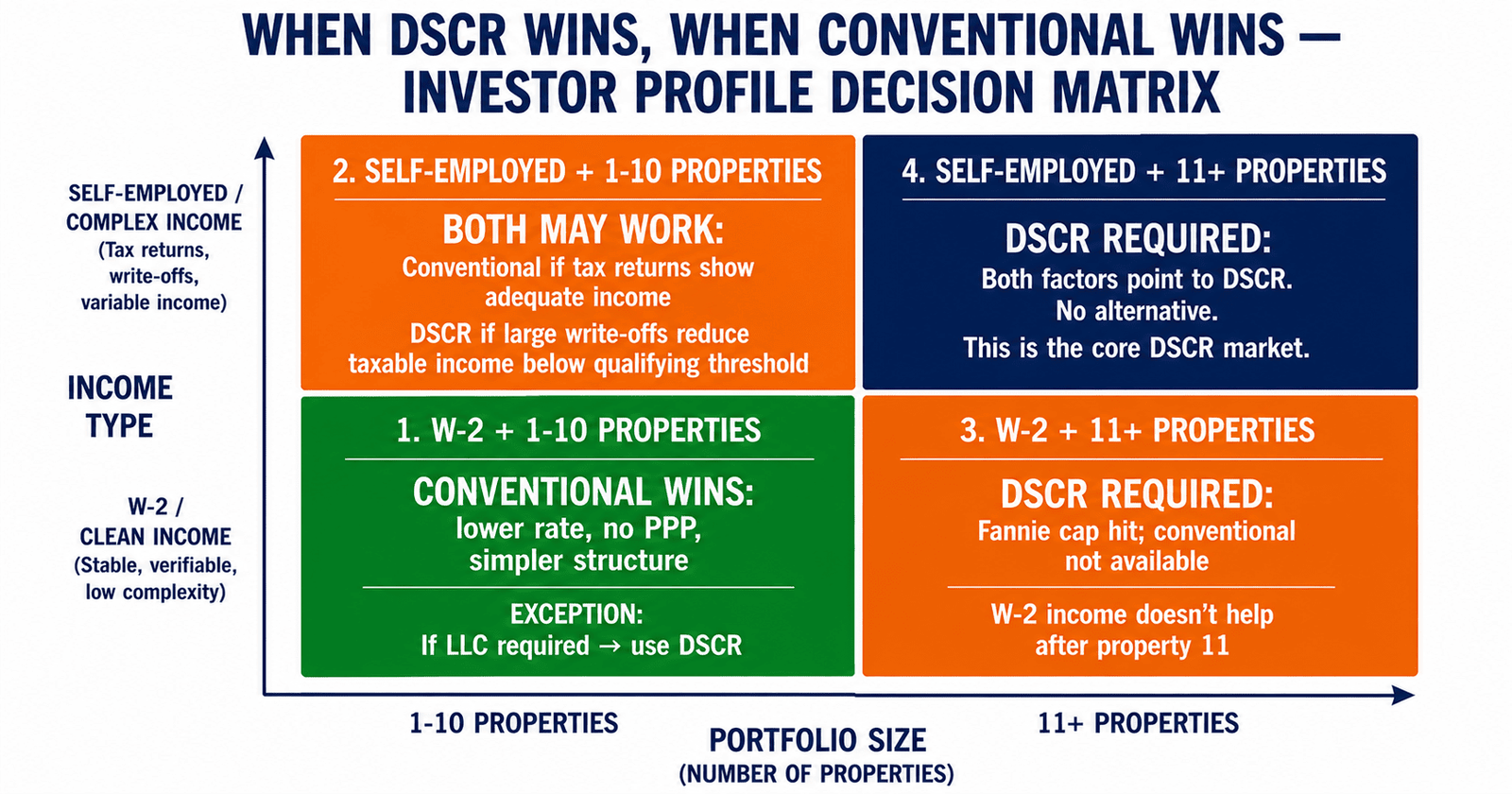
The comparison table does not produce a clear winner. It produces a map of which product is right for which situation. A W-2 investor with fewer than 10 properties, no LLC requirement, and a 7+ year hold should use conventional if they can qualify. An investor who is self-employed with Schedule E losses, holds 10+ properties, wants LLC ownership, or needs to close in 15 days should use DSCR. The product was built for that profile.
FAQ: DSCR vs Conventional Investment Loan
DSCR vs Conventional Loan: If I can qualify for both, which should I choose?
Use conventional for properties 1–10 if you are W-2 employed, do not need LLC ownership, and plan a 7+ year hold. Transition to DSCR when you need LLC ownership, approach the 10-property cap, or when income documentation complexity makes conventional qualification unreliable. Many experienced investors use both products simultaneously.
DSCR vs Conventional Loan: Has the rate gap narrowed in 2026?
Yes. Fannie Mae and Freddie Mac have raised LLPAs on investment properties multiple times since 2022, pushing conventional investment rates higher. The gap narrowed from ~1.0–1.5% in 2022–2023 to ~0.25–0.75% in 2026 for well-qualified borrowers. This makes DSCR more competitive on rate grounds, though the primary reasons to use it remain: scalability, LLC ownership, and income documentation flexibility.
Can I refinance from conventional to DSCR later?
Yes. Rate-and-term refinancing from conventional to DSCR is available and common. Investors refinance to DSCR to move property into an LLC, pull cash out beyond conventional LTV ceilings, or simplify income documentation. Note that moving property from personal ownership to an LLC while refinancing may trigger the due-on-sale clause in the existing conventional loan, making a simultaneous refi-and-transfer the most common execution path.
Does my credit score matter for DSCR vs conventional?
Yes, in both products but differently. Conventional uses credit score as one of multiple personal-profile factors. DSCR uses it primarily for rate-tier pricing: 740+ unlocks the best tier; each tier below adds 0.125%–0.50%. A strong credit score benefits both products. Below 680, DSCR pricing deteriorates significantly and conventional may be unavailable altogether.
Have a specific deal and need to know which loan product it qualifies for? The Deal Review confirms the right product and the verified DSCR.
Have a specific deal and need to know which loan product it qualifies for? The Deal Review confirms the right product and the verified DSCR.
For investors who have used conventional investment loans in the past and are considering DSCR for the first time, the documentation difference is significant. Conventional investment loans require personal tax returns, W-2s or 1099s, bank statements, and a full debt-to-income analysis. DSCR loans require the property rent roll, executed leases, insurance quote, and tax bill — the property’s income story, not the investor’s personal income history.
For investors with strong rental portfolios but complex personal tax situations, this documentation difference alone makes DSCR the default choice. The deal killers page covers the documentation errors that cause both DSCR and conventional investment loan applications to fail at underwriting.
One factor that consistently shifts the DSCR vs conventional decision for NYC outer-borough investors is the property condition requirement. Conventional investment loans — Fannie Mae and Freddie Mac backed — require the property to be in habitable condition with no deferred maintenance. NYC outer-borough properties, particularly in transitional neighborhoods, often have condition issues that prevent conventional financing: roof age, boiler condition, electrical panel upgrades, pest or mold remediation.
DSCR programs have materially more flexible condition requirements — many programs accept properties with deferred maintenance that would disqualify conventional financing, as long as the property is habitable and generating rental income. For investors acquiring value-add or transitional properties, DSCR is often the only institutional financing option regardless of the rate comparison. The deal qualification page covers property condition requirements by loan program.
DSCR vs Conventional Investment Loan: When Each Product Actually Makes Sense in 2026
The Self-Employed and LLC Investor: DSCR Is the Default Choice
For self-employed investors or investors holding properties in an LLC, DSCR versus conventional is not a close decision — DSCR is typically the only viable path. Conventional investment loans require personal income documentation: two years of tax returns, W-2s or 1099s, and a debt-to-income ratio that accounts for all personal obligations. Self-employed investors with write-off-heavy tax returns often show insufficient qualifying income on the conventional DTI calculation, even when cash flow is strong.
DSCR bypasses personal income entirely — the property’s rent divided by PITIA is the underwriting standard. This is the core reason DSCR exists as a product category: it finances income properties based on the income they generate, not the income the borrower reports after deductions.
The W-2 Investor With Strong Income: When Conventional Might Win
For a W-2 investor with clean personal income, low existing debt, and a strong FICO score, conventional investment loan rates can be 0.25%–0.75% below DSCR rates on a comparable property. At a $700,000 loan, 0.50% in rate saves approximately $291/month — $3,492/year. Over a 5-year hold, that is $17,460 in cumulative interest savings. But conventional investment loans have stricter property condition requirements (habitability and no deferred maintenance), more restrictive property type rules (no 5-unit or mixed-use properties), and impose the investor’s personal financial picture on the underwriting.
A borrower with multiple investment properties may hit the Fannie Mae 10-property limit on conventional loans before hitting any DSCR limit. The rate advantage is real but does not survive every comparison.
The practical decision tree: if the investor is self-employed, LLC-vesting, or carries W-2 income that is reduced by existing debt obligations, DSCR is the right product. If the investor is W-2 with a clean financial profile and the property is a 1-4 unit residential in good condition, run the conventional comparison. The rate difference and the qualification likelihood both factor into the calculation. The lender criteria page covers both product types and the eligibility criteria for each, so investors can identify which path applies before spending time on an application that may not qualify.
Choose the Product That Fits the Problem
DSCR vs conventional investment loan is not a debate about which product is better. It is a question about which product solves the investor’s specific problem. Conventional financing solves for the investor who can document personal income, does not need entity ownership, and has room under the 10-property cap. DSCR financing solves for the investor who needs to qualify on property cash flow, hold in an LLC, or scale past conventional limits.
In the NYC outer-borough market, LLC ownership, self-employed income complexity, and portfolio scale are disproportionately common conditions. The investor who understands why those conditions exist and which product addresses them chooses correctly on the first application. Use the DSCR loans page for a complete overview of how DSCR programs work in the NYC outer-borough market, including which lenders work with LLC structures and what DSCR thresholds unlock the best rate tiers.
Find out which loan structure works for your NYC deal. Run it through the BKDSCR Deal Filter.
Download the free BKDSCR DSCR Playbook at bkdscr.com/get-playbook — the NYC investor’s guide to understanding how DSCR lenders actually evaluate your deal before you submit.
Get a free BKDSCR deal review at bkdscr.com/deal-review — find out which financing structure works for your specific NYC deal.