
LLC DSCR Loan vs Individual Name: The Critical Choice
Key Takeaways
- Both LLC and personal name vesting are compatible with DSCR loans; ~60% of DSCR lenders accept LLC borrowers, and DSCR products are designed as business-purpose loans that accommodate entity ownership
- Virtually every DSCR lender requires a personal guarantee from LLC principal owners — the LLC protects you from tenant lawsuits but does NOT remove personal liability to the lender
- Rate difference between LLC and personal name is usually zero or +0.125% at most; lenders price DSCR loans on the guarantor’s personal credit regardless of entity structure
- LLC DSCR loans do not report to the guarantor’s personal credit bureaus; this credit reporting difference is a strong practical reason to hold rentals in LLC as the portfolio scales
- Transferring a $975,000 property from personal to LLC after closing costs $17,794 minimum in NYC RPTT and NYS transfer taxes; with a new loan and active PPP, costs reach $53,809 — set up the LLC before closing
- The LLC’s operating agreement must contain explicit borrowing authority language; generic online formation services often lack this and cause closing delays
Table of Contents
- The Critical LLC DSCR Loan vs Operational Liability Distinction
- LLC DSCR Loan: The Hidden Credit Reporting Benefit
- The Real Rate Difference Between LLC and Personal Name DSCR
- The Costly Transfer Trap When You Skip the LLC DSCR Loan Setup
- The Smart Case for an LLC DSCR Loan in NYC
- The Essential Documentation for an LLC DSCR Loan Application
- The Critical Operating Agreement Language DSCR Lenders Require
- Critical FAQ: LLC DSCR Loan Answered
- LLC DSCR Loan: The Smart Single-Member LLC Option Explained
LLC DSCR loan vs personal name — every NYC outer-borough investor hits this decision — and most get the answer partially wrong. Both LLC and personal name vesting work for DSCR loans, and approximately 60% of DSCR lenders accept LLC borrowers. But the entity decision has real financial consequences in New York City that go beyond the loan structure itself. According to Ledger TC, NYC investors face specific entity structure costs that make the sequence of decisions — LLC first, then loan, not loan first, then LLC — materially important. See also: LLC rate differential.
This post explains the structural difference between LLC and personal name DSCR loans, the personal guarantee misconception most investors carry into the decision, the credit reporting benefit that makes LLC ownership compelling for portfolio scalers, the NYC transfer cost trap that makes post-close entity changes expensive, and the six-step sequence for setting up the LLC correctly before the DSCR loan closes.
According to Hard Money, NYC investors who close deals in personal name using short-term bridge financing and want to transfer ownership to an LLC before taking out a long-term DSCR loan face a more complex sequence than investors who set up the LLC before the first close. A full overview of DSCR loan programs — including which programs accept new LLCs and which require 6+ months of formation history — is the starting point before structuring any LLC acquisition.
Deciding between LLC and personal name on your next DSCR deal? Use the Deal Filter to confirm program eligibility under each vesting structure.
LLC DSCR Loan: The Hidden Personal Guarantee Most Investors Miss
The single most misunderstood aspect of LLC DSCR loans is the personal guarantee requirement. Taking out a DSCR loan in an LLC name does not remove the borrower’s personal liability for the loan. According to Stacking Capital (2026), virtually every DSCR lender requires a personal guarantee from the LLC’s principal owners — and frequently from every owner with 20% or more membership interest.
If the LLC defaults and the foreclosure sale proceeds do not cover the outstanding loan balance, the lender can pursue the personal guarantor’s assets directly. Reviewing lender criteria for LLC documentation requirements — operating agreement, EIN, articles of organization — before submitting prevents the most common LLC-related delays.
The LLC and personal name structures are equivalent in terms of loan liability. The LLC provides protection from a separate category of risk: operational liability. Tenant lawsuits, slip-and-fall claims, property damage suits — these claims can only reach the LLC’s assets. Personal assets are shielded from operational claims. But the lender’s personal guarantee bypasses the LLC entirely.
| Feature | LLC Vesting | Personal Name | What It Means |
|---|---|---|---|
| Tenant lawsuit protection | YES ✓ | NO ✓ | LLC limits liability to entity assets. Personal name exposes all personal assets to tenant claims. |
| Personal guarantee on loan | REQUIRED | REQUIRED | Both structures require personal guarantee. LLC does NOT remove personal liability to the lender. |
| Rate premium | $0–+0.125% | Baseline | Most DSCR lenders price identically. Some charge +0.125% for LLC. |
| Reports to personal credit | NO ✓ | VARIES | LLC DSCR loans don’t report to personal bureaus. Key benefit for portfolio scalers. |
| LLC docs required at close | YES — 4 docs | N/A | LLC needs: Articles of Org, Operating Agreement, EIN, Certificate of Good Standing. |
| Transfer cost if changed later | N/A | $17,794+ in taxes | Moving from personal to LLC post-close: NYC RPTT (1.425%) + NYS (0.4%) on $975K = $17,794. |
| Portfolio scaling clarity | Cleaner structure | Blended exposure | Separate LLCs per property isolates liability and simplifies bookkeeping. |
| Benchmark: $975,000 Brooklyn 4-unit. NYC RPTT residential >$500K: 1.425%. NYS transfer tax: 0.4%. Credit reporting per Ridge Street Capital (2026). ~60% of DSCR lenders accept LLC vesting (HonestCasa, Jun 2026). | |||
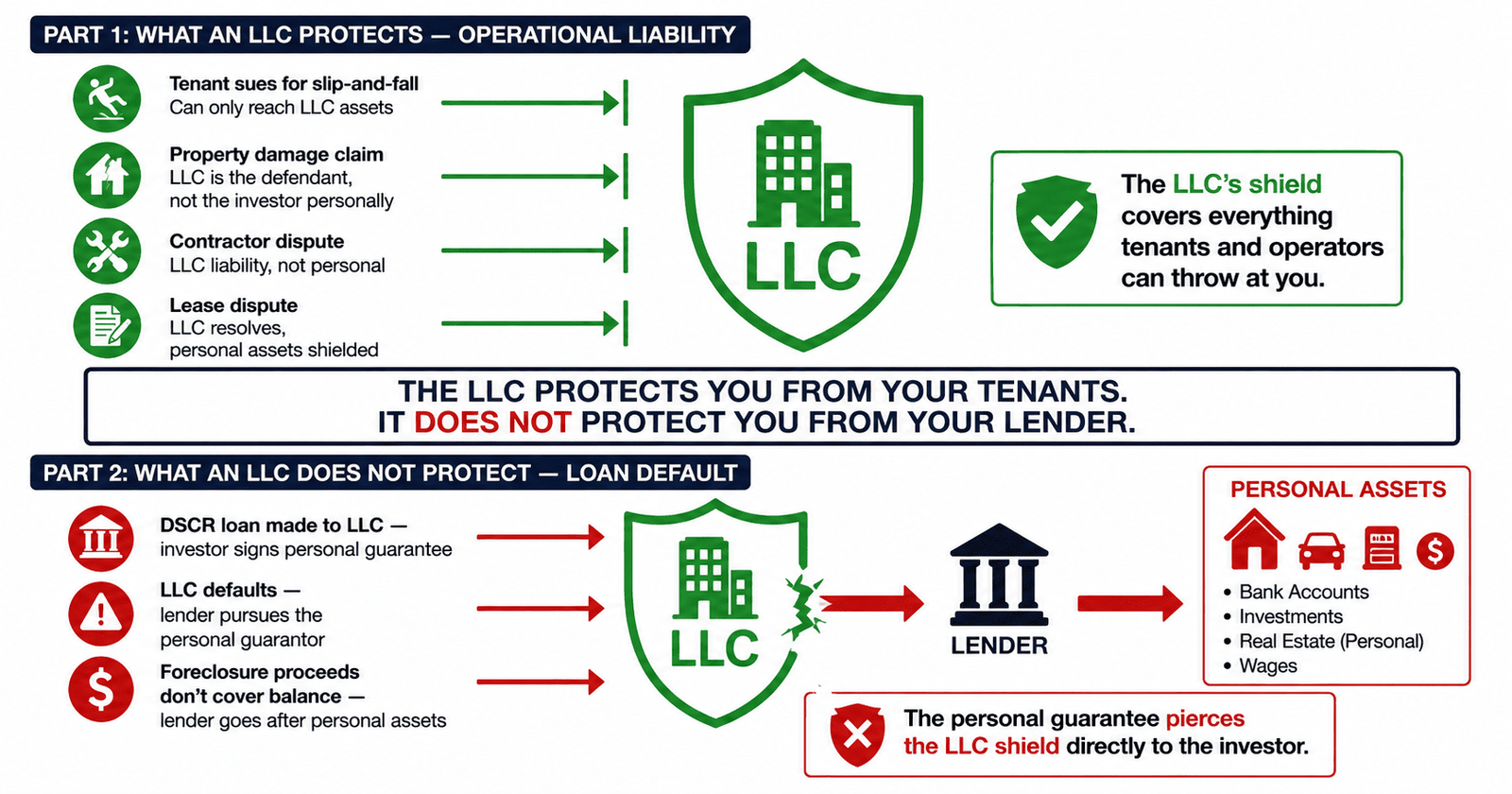
The Critical LLC DSCR Loan vs Operational Liability Distinction
LLC DSCR Loan: The Hidden Credit Reporting Benefit
Per Ridge Street Capital’s 2026 DSCR guide: LLC DSCR loans do not report to the guarantor’s personal credit bureaus. Conventional investment property mortgages do report to personal credit and affect the borrower’s FICO score and debt-to-income ratio. This becomes significant when scaling beyond 4–6 properties. Each conventional loan on the personal credit report reduces available DTI capacity for future conventional borrowing.
LLC-titled DSCR loans do not carry this credit penalty. Use the DSCR calculator to model each deal’s cash flow independently per entity — the LLC structure also simplifies the property-level accounting each DSCR deal requires.
The Real Rate Difference Between LLC and Personal Name DSCR
The rate difference between LLC and personal name DSCR loans is smaller than most investors expect. Many DSCR lenders charge identical rates for both structures because pricing is driven by the personal guarantor’s credit score — not by the entity type. Per The Lender’s 2026 program documentation: the rate for a qualified borrower is identical whether the property is held individually or in an LLC, because both use the guarantor’s personal FICO for pricing. Some lenders add +0.125% for LLC to cover additional documentation review.
On the benchmark $731,250 loan that adds $91/month — minimal relative to the operational and portfolio benefits.
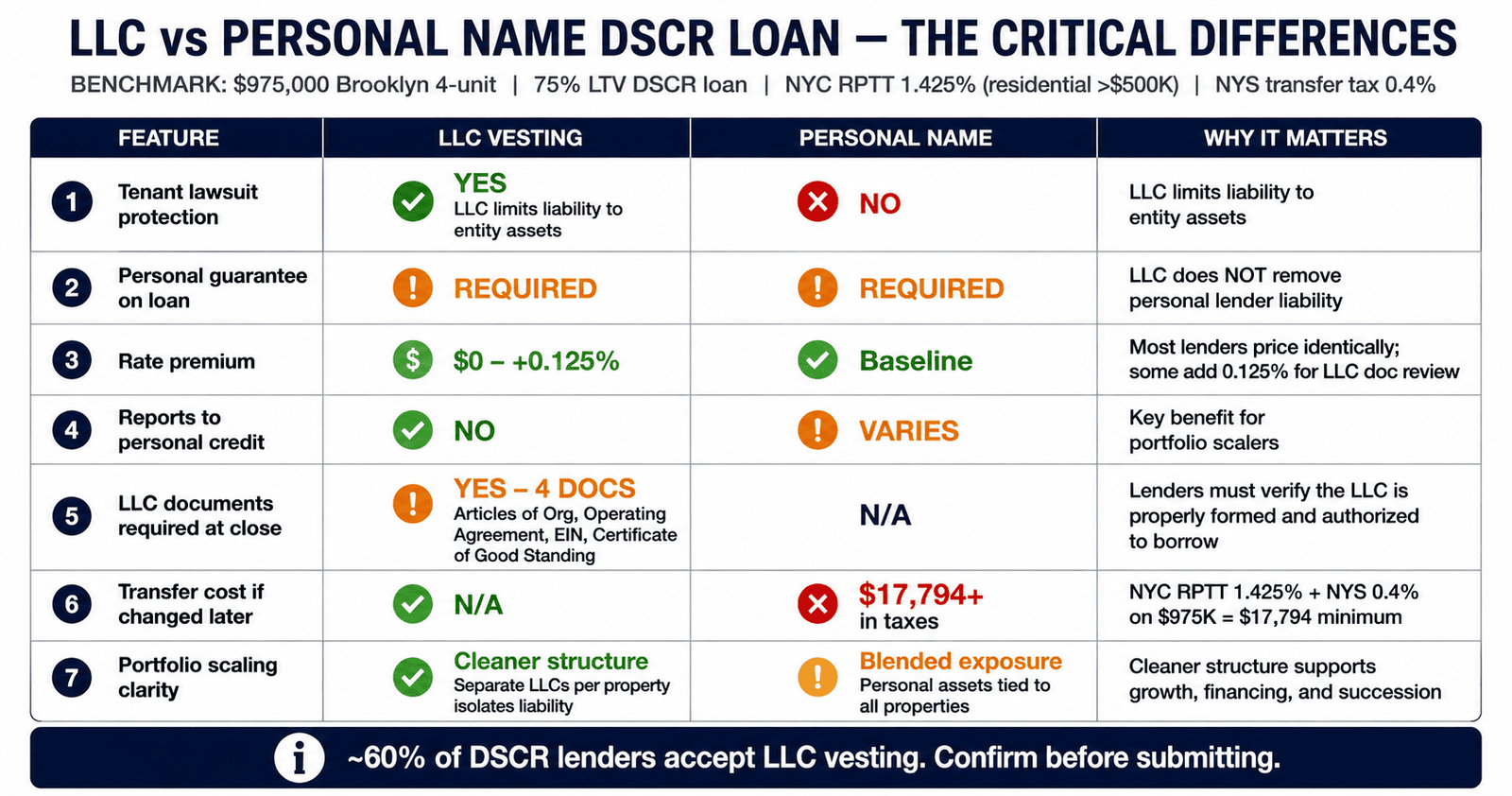
The Costly Transfer Trap When You Skip the LLC DSCR Loan Setup
The sequence that costs NYC investors the most money: close the DSCR loan in personal name, then decide to transfer the property to an LLC afterward. A deed transfer triggers the NYC Real Property Transfer Tax (RPTT) and the New York State real estate transfer tax. For a residential property with a sale price over $500,000, the NYC RPTT rate is 1.425%. The NYS rate is 0.4%. On a $975,000 Brooklyn 4-unit: NYC RPTT = $13,894 + NYS = $3,900 = $17,794 minimum.
| Transfer Cost Item | Calculation | Cost | Notes |
|---|---|---|---|
| NYC RPTT (residential >$500K) | $975,000 × 1.425% | $13,894 | Paid at recording. Due within 30 days. |
| NYS real estate transfer tax | $975,000 × 0.4% | $3,900 | State-level tax. Filed on TP-584 at closing. |
| Total transfer taxes | $13,894 + $3,900 | $17,794 | Minimum cost for deed-only transfer to LLC post-close. |
| NYC MRT (if new loan needed) | $731,250 × 1.925% | $14,077 | Applies only if lender requires LLC to take new mortgage. |
| PPP Year 2 (if still active) | $731,250 × 3% | $21,938 | Triggered if existing loan is retired during PPP window. |
| Total worst case (Yr 2, new loan) | $17,794 + $14,077 + $21,938 | $53,809 | vs. $1,000–$2,000 to set up LLC BEFORE closing. |
| NYC RPTT residential rate (>$500K): 1.425%. NYS transfer tax: 0.4%. NYC MRT (loans >$500K): 1.925%. PPP Year 2 at 3%. A mere-change-of-identity transfer to a wholly owned single-member LLC may qualify for NYC RPTT exemption in specific circumstances — consult an NYC real estate attorney. | |||
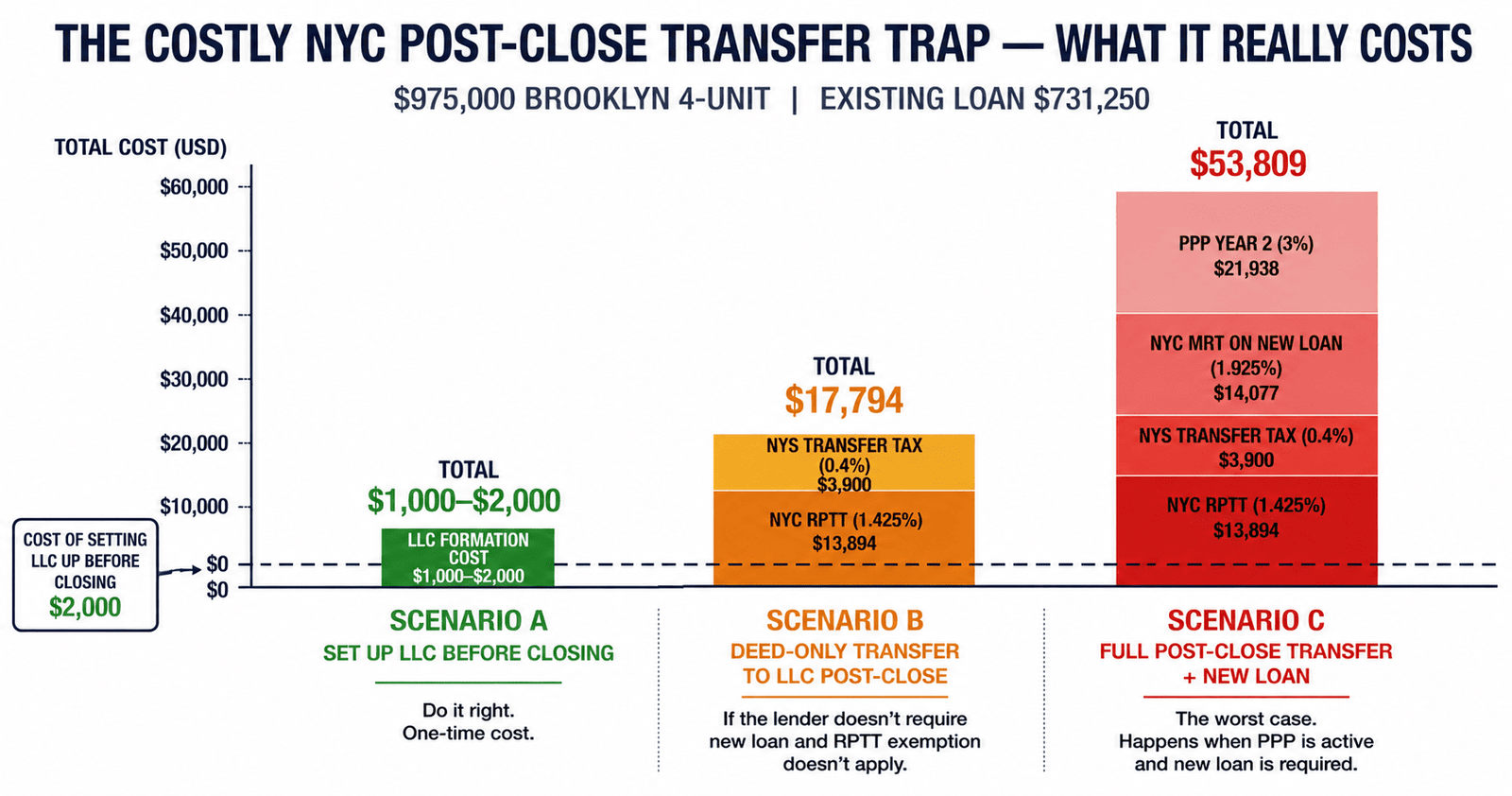
Note: NYC RPTT law includes a “mere change of identity or form” exemption that may apply when a sole owner transfers property to their wholly owned single-member LLC. Whether this exemption applies depends on specific circumstances and requires a legal opinion from an NYC real estate attorney. The correct default is to set up the LLC before closing, which eliminates the issue entirely.
The Smart Case for an LLC DSCR Loan in NYC
- Liability isolation from Day 1: A lawsuit on Property LLC A cannot reach Property LLC B or the investor’s personal assets.
- Credit reporting management: LLC DSCR loans do not report to personal credit. As the portfolio scales to 5–7 properties, the credit profile stays clean and does not reduce the borrower’s ability to access future conventional financing.
- Avoidance of transfer costs: Setting up the LLC before the first closing costs $1,000–$2,000. Transferring one property later costs $17,794 minimum.
- Portfolio bookkeeping: Each LLC has its own bank account, income/expense records, and tax pass-through. The accounting for a 10-property portfolio held across 10 LLCs is far cleaner than the same portfolio in personal name.
The Essential Documentation for an LLC DSCR Loan Application
The Critical Operating Agreement Language DSCR Lenders Require
The operating agreement is where more LLC DSCR applications stall than any other documentation requirement. Generic online LLC formation services often produce operating agreements that lack the specific borrowing authority language DSCR lenders require. The language must explicitly: (1) identify the managing member with authority to sign loan documents, (2) grant authority to enter into loan agreements and pledge LLC assets as collateral, (3) confirm there are no restrictions on borrowing that conflict with the loan terms, and (4) identify all members with 20–25%+ ownership who must personally guarantee.
For the complete LLC vs personal DSCR loan framework — rate differentials, program overlays, and entity requirements — download the DSCR Playbook.
Four documents are required at closing for LLC-vested DSCR loans: (1) Articles of Organization filed with the NY Secretary of State, (2) Operating Agreement with borrowing authority language, (3) EIN from the IRS, (4) Certificate of Good Standing from the NY Secretary of State. An NYC real estate attorney’s review of a generic operating agreement costs $500–$1,500 and takes 3–5 days. Discovering the deficiency at underwriting costs a 1–2 week delay. See also: no-ratio DSCR option.
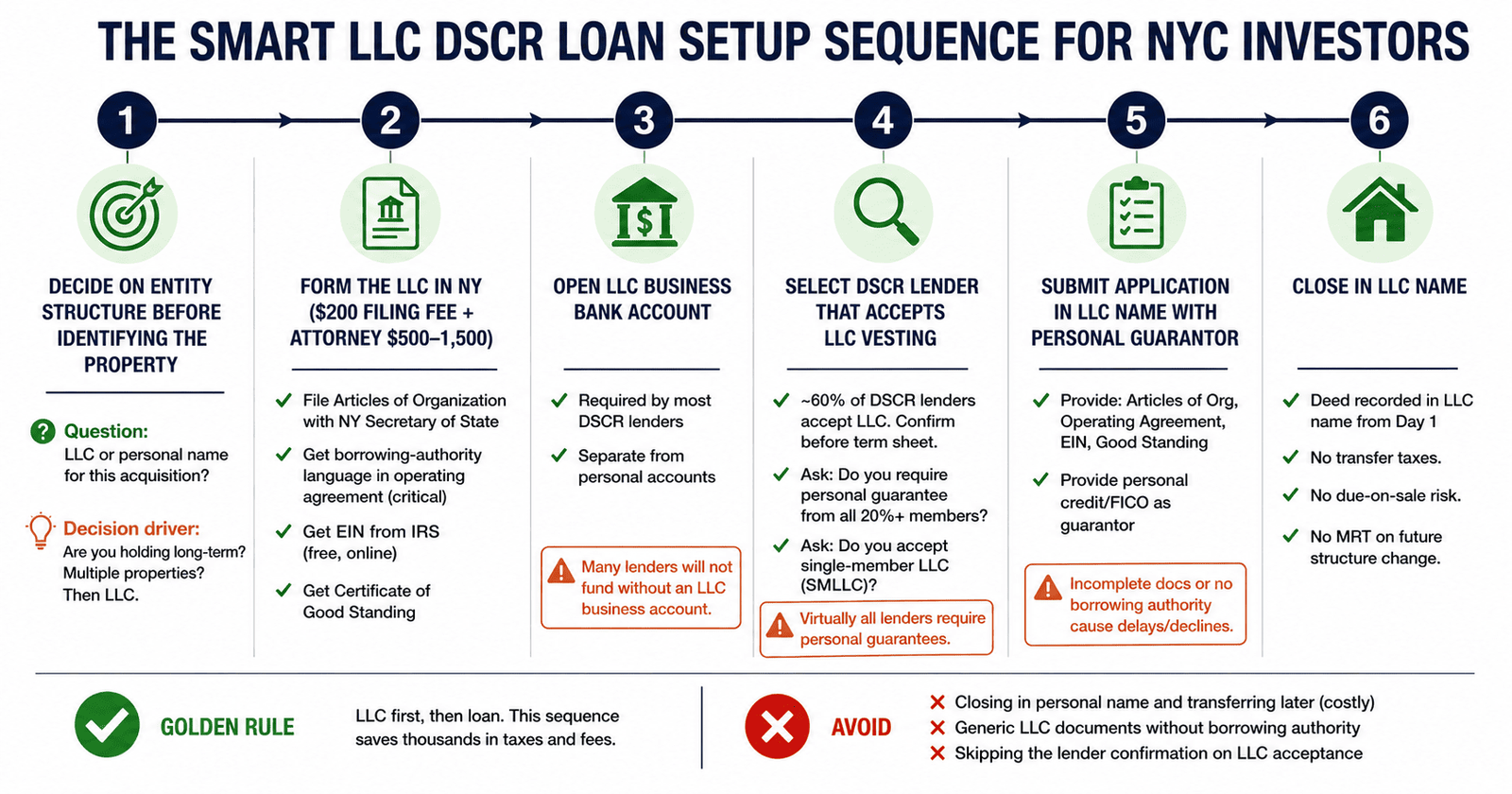
Critical FAQ: LLC DSCR Loan Answered
LLC DSCR Loan: The Smart Single-Member LLC Option Explained
Single-member LLCs (SMLLCs) are accepted by most DSCR lenders that accept entity vesting. The SMLLC is a disregarded entity for federal tax purposes — income and expenses flow through to the sole member’s personal return. The sole member still provides a personal guarantee. NYC note: NY abolished the LLC publication requirement in February 2023, eliminating the prior $1,500–$2,000 publication cost barrier for new NYC-area LLCs. The SMLLC remains the simplest path to LLC ownership for a single NYC investor.
LLC DSCR Loan: The Smart Multi-Property LLC Structure
Using the same LLC for multiple properties reduces liability isolation. A lawsuit on Property 1 can reach all properties’ equity within the same LLC. Most experienced DSCR investors use one LLC per property for maximum isolation. A practical middle ground: use one LLC for the first 2–3 properties while building cash flow, then separate into individual LLCs as the portfolio grows and there is more equity to protect.
LLC DSCR Loan: The Costly Personal-to-LLC Transfer After Closing
Three steps before executing any post-close transfer: (1) contact the existing lender to confirm whether they require a new loan in the LLC name or will accept a simple title transfer; (2) consult an NYC real estate attorney about whether the RPTT “mere change of identity” exemption applies; (3) model the full transfer cost. If the existing loan has an active PPP, the rational answer is to wait until Year 5–6 when the PPP expires, then transfer with only RPTT and NYS transfer taxes.
Have a live deal where vesting structure is the open question? The Deal Review confirms the right structure and the DSCR impact.
LLC vs Personal DSCR Loan: The Entity Setup Timing Question
One of the most common mistakes NYC investors make on LLC DSCR deals is forming the LLC after going under contract. Most DSCR lenders require that the LLC be in existence before the application is submitted — not just before closing. An LLC formed two weeks before closing may trigger a “new entity” overlay at some lenders: a rate add-on of 0.25%–0.50% or a requirement that the borrower also sign in personal capacity. Forming the LLC before finding the deal, or at minimum before executing the purchase agreement, eliminates this overlay for most programs.
The operating agreement is the second timing issue. Most DSCR lenders require a fully executed operating agreement as part of the LLC documentation package. A single-member LLC with no operating agreement — which is legally valid in most states — does not meet lender documentation standards. The operating agreement must designate the managing member, confirm the LLC purpose (real estate investment), and be signed and dated. Having this document prepared before the application goes in prevents a documentation condition that can delay closing by 1–2 weeks.
For investors building a portfolio, the LLC structure decision also affects future financing. Fannie Mae conventional investment loans cap individual borrowers at 10 financed properties. DSCR loans have no such cap — but the entity structure matters. A portfolio of properties in a single LLC is viewed differently than properties in separate LLCs or a series LLC structure. Confirm with the target lender at the start of portfolio building which entity structure they prefer for multi-property DSCR borrowers. The lender criteria page covers entity requirements and portfolio borrower overlays by DSCR program type.
The bottom line on LLC vs personal name for NYC DSCR investors: the rate difference is smaller than most investors assume, the documentation requirements are manageable with advance preparation, and the liability protection of the LLC is a real benefit that justifies the structure for most investors. The question is not whether to use an LLC — it is which LLC structure, formed when, and with which lender. Use the deal filter to confirm which programs are available for your specific entity structure before modeling the deal.
Have a live deal where vesting structure is the open question? The Deal Review confirms the right structure and the DSCR impact.
LLC DSCR Loan: The Proven Pre-Close Checklist
The correct sequence: decide on entity structure, set up the LLC, get the operating agreement reviewed by an attorney, open the LLC bank account, identify a DSCR lender that accepts LLC vesting — then make the offer and close. Everything that happens before the first closing determines the structure the investor will live with for the life of that loan. Changing it afterward is expensive in New York City.
For a buy-and-hold investor planning to scale in NYC outer-borough: LLC ownership from Deal 1, with proper operating agreement language, is the cleaner path. The personal guarantee is required. The liability protection for operational claims is real. The credit reporting benefit compounds as the portfolio grows. The transfer cost is avoided entirely. See the deal killers page for the full list of conditions that affect DSCR qualification before the structure decision compounds a qualifying problem.