Local Law 97 NOI: Critical DSCR Math for NYC Investors
- Local Law 97 carbon caps apply to buildings over 25,000 square feet — most outer-borough 1–4 unit multifamily is exempt
- For covered buildings, non-compliance penalties start at $268 per metric ton of CO₂ over the annual cap
- Compliance costs range from $15,000 to $150,000+ depending on building size and current equipment
- LL97 penalties are a direct NOI deduction — not a capital expense — and reduce cash flow every year the building remains non-compliant
- DSCR lenders are beginning to flag LL97 exposure during underwriting on larger outer-borough assets
- The 2030 cap drops 40% from 2024 levels — buildings that clear today may not clear in six years
Table of Contents
- Local Law 97 NOI: Who It Actually Covers
- Where LL97 Starts to Matter for DSCR Investors
- The DSCR Math: What a Local Law 97 Penalty Actually Costs
- Local Law 97 NOI: Impact on an 8-Unit Acquisition
- Pay the Fine or Retrofit: The Period 1 Decision
- What Outer-Borough DSCR Investors Need to Do Before Closing
- Frequently Asked Questions
- Does Local Law 97 apply to standard 1-4 unit DSCR investment properties?
- How does LL97 affect DSCR underwriting on covered buildings?
- What is the 2030 compliance risk for buildings that are currently compliant?
- Local Law 97 NOI: What the Compliance Cost Looks Like at the Deal Level
- The LL97 Penalty Math on a Covered Building
- LL97 Compliance Costs Before They Become Penalties
- Bottom Line — Local Law 97 DSCR 2026
Local Law 97 NOI compression is not an abstract regulatory risk — it is a direct dollar-per-month deduction on every covered building that exceeds its carbon emissions cap. The penalty is $268 per metric ton of CO₂-equivalent above the annual limit, assessed every year the building remains non-compliant. For outer-borough DSCR investors, the key question is whether the specific building under consideration is covered, how far over its limit it sits, and what that penalty costs in monthly NOI — and what it does to the DSCR formula. See also: insurance NOI compression.
| MARKET SNAPSHOT — Local Law 97, May 2026 | |
|---|---|
| Sources: BKDSCR Research | |
| Key Facts (NYC DOB / CredDaily / Urban Green Council): | |
| Coverage threshold | Buildings over 25,000 gross sq ft |
| Buildings covered | ~50,000 citywide (75% of NYC built sq footage) |
| First compliance period | 2024–2029 |
| Multifamily limit (R-2) | 0.00675 tCO2e per sq ft / year (Period 1) |
| Multifamily limit (2030) | 0.00407 tCO2e per sq ft / year (Period 2, -40%) |
| Penalty rate | $268 per metric ton CO2e over the annual limit |
| Penalty start date | May 1, 2026 (first assessments for 2024 emissions) |
| 2024 penalty exposure | $200M+ estimated for ~3,700 buildings (REBNY) |
| Current compliance | 92% of large buildings meet 2024 limits (Urban Green Council) |
| DSCR Relevance for Outer-Borough Investors: | |
| 1–4 unit residential | Below 25,000 sq ft threshold — LL97 does NOT apply |
| 5–8 unit walkups | Often below threshold — verify sq footage |
| Larger multifamily 25K+ | Subject to LL97 — penalty is a direct NOI deduction |
Start with the Deal Filter — property type, rent roll, unit count, and PITIA in 60 seconds.
Local Law 97 NOI: Who It Actually Covers
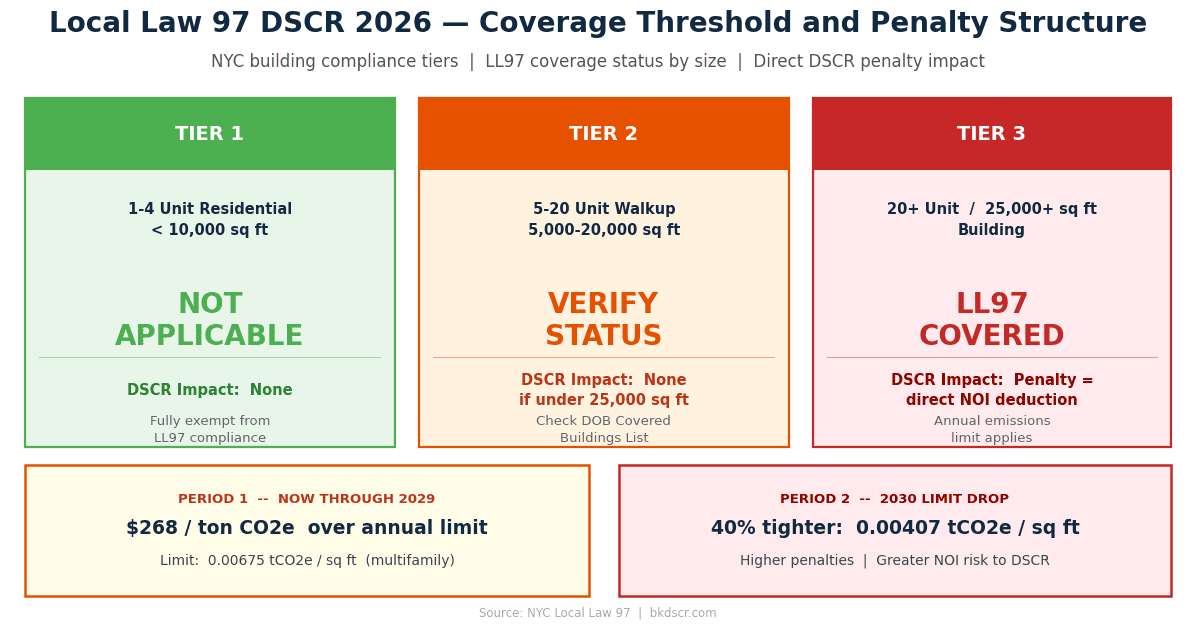
The first step for any outer-borough DSCR investor is determining whether the subject building is covered. LL97 applies to single buildings over 25,000 gross square feet, two or more buildings on the same tax lot together exceeding 50,000 square feet, and condominium complexes governed by the same board exceeding 50,000 square feet. Approximately 50,000 buildings citywide fall under the statute.
For the core outer-borough DSCR investor market — 1-4 unit residential properties — LL97 does not apply. The 25,000 square foot threshold excludes virtually all 1-4 unit walkups in Brooklyn, Queens, the Bronx, and Staten Island. A standard Brooklyn 4-unit with four 700–900 sq ft apartments runs 3,000–4,000 gross square feet — 6-8x below the threshold. This is the most important fact for investors in that market segment: LL97 is not your problem on a standard 4-unit acquisition. The full applicability threshold rules are published on the NYC Department of Buildings Local Law 97 compliance page.
The calculus changes as you move up the unit count. A 5-8 unit walkup in Brooklyn or the Bronx may run 5,000–15,000 gross square feet — still well below 25,000. A 12-20 unit building crosses into the zone where threshold verification is warranted. Any acquisition of a building over 20 units or approximately 15,000 sq ft should include a DOB Covered Buildings List check as standard pre-contract diligence. Checking lender criteria for multifamily programs before submitting a 5+ unit deal avoids last-minute loan structure surprises.
Where LL97 Starts to Matter for DSCR Investors
The building size that brings LL97 into DSCR relevance for outer-borough investors is approximately 8-12 units and above — particularly in older pre-war stock with gas-fired heating systems. A 30,000 sq ft Brooklyn multifamily building with an original 1950s boiler system running on natural gas is more likely to exceed its LL97 emissions limit than a 2000s-era building with updated mechanicals. Building age and heating system type are the two variables that most directly determine compliance exposure.
The DSCR Math: What a Local Law 97 Penalty Actually Costs
For covered buildings, the LL97 penalty is a straightforward NOI deduction. It is not a capital expense, not a one-time cost, and not offset by depreciation in any direct way for DSCR purposes. It is an annual operating expense that reduces net operating income — which flows directly into cash flow analysis. See also: NYC property tax DSCR.
The penalty calculation is: (actual emissions in tCO2e – allowed emissions in tCO2e) × $268. A 35,000 sq ft Brooklyn 8-unit building (R-2 multifamily) has an annual emissions limit of 35,000 × 0.00675 = 236.25 metric tons of CO2-equivalent. If that building is running 50% over its limit due to an older gas boiler system, the penalty is:
| LL97 PENALTY CALCULATION | FIGURE |
|---|---|
| Building size | 35,000 gross sq ft (8-unit walkup) |
| LL97 emissions limit (R-2) | 0.00675 × 35,000 = 236.25 tCO2e/year |
| Actual emissions (50% over) | 354.38 tCO2e/year |
| Excess emissions | 354.38 – 236.25 = 118.13 tCO2e |
| Annual LL97 penalty | 118.13 × $268 = $31,659/year |
| Monthly NOI deduction | $31,659 / 12 = $2,638/month |
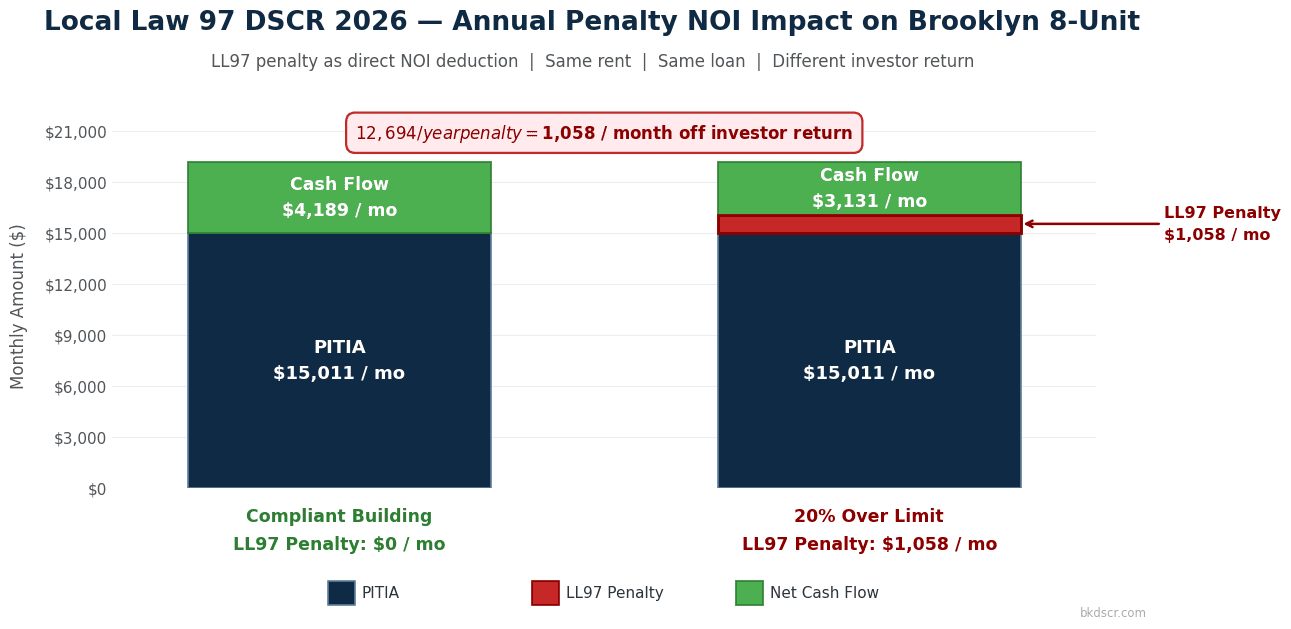
$2,638 per month in annual penalty is a significant cost hit. On a building with $18,000/month in gross rent, that penalty represents 14.7% of gross rent — entirely off the bottom line. For a more moderate exposure — a building 20% over its limit — the penalty on the same 35,000 sq ft building is approximately $12,694/year, or $1,058/month. That is still material.
For DSCR investors evaluating larger outer-borough acquisitions, this cost needs to be modeled in the cash flow analysis. The cash flow analyzer models all operating expenses including compliance costs — so you can see the full return picture, not just the DSCR ratio the lender calculates.
Local Law 97 NOI: Impact on an 8-Unit Acquisition
The following composite deal models a Brooklyn 8-unit acquisition — above the standard 4-unit DSCR investor market, but representative of investors who acquire larger outer-borough multifamily. The building is 35,000 sq ft, pre-war construction, gas-fired boiler, and is 20% over its LL97 emissions limit.
| DEAL INPUT | FIGURE |
|---|---|
| Property Type | 8-unit walkup, pre-war, 35,000 sq ft, Brooklyn |
| Purchase Price | $2,200,000 |
| Down Payment (25%) | $550,000 |
| Loan Amount | $1,650,000 |
| Rate / Term | 7.25% / 30-year fixed |
| Monthly P&I | $11,261 |
| Monthly Taxes | $2,800 (Brooklyn Class 2) |
| Monthly Insurance | $950 |
| Total PITIA | $15,011/month |
| Gross Monthly Rent | $19,200 (8 units × $2,400 avg) |
| Lender DSCR (no LL97) | $19,200 / $15,011 = 1.28 |
Now add the LL97 penalty at 20% over the emissions limit:
| Compliant Building | 20% Over Limit | |
|---|---|---|
| Annual LL97 penalty | $0 | $12,694 |
| Monthly penalty cost | $0 | $1,058 |
| Effective monthly NOI | $19,200 | $18,142 |
| Cash flow impact | No penalty deduction | $12,694/year off bottom line |
| Investor cash flow DSCR* | 1.28 | 1.21 |
* Note: DSCR lenders calculate on PITIA, not NOI. The penalty does not change the lender’s DSCR calculation — it changes the investor’s actual return. A deal that shows 1.28 DSCR to the lender may produce materially lower cash flow when the LL97 penalty is factored into operating expenses.
Get the DSCR Playbook — every input, threshold, and deal-killer for NYC outer-borough investors in one place.
Pay the Fine or Retrofit: The Period 1 Decision
For outer-borough buildings that are covered and moderately over their limit, property owners face a binary decision in the 2024–2029 compliance period: pay the penalty annually or invest in capital improvements to reduce emissions. According to CoR Advisors’ April 2026 DSCR loan requirements analysis, lenders are beginning to factor LL97 compliance status into underwriting on covered buildings — particularly for the 2030 period, where limits drop 40%.
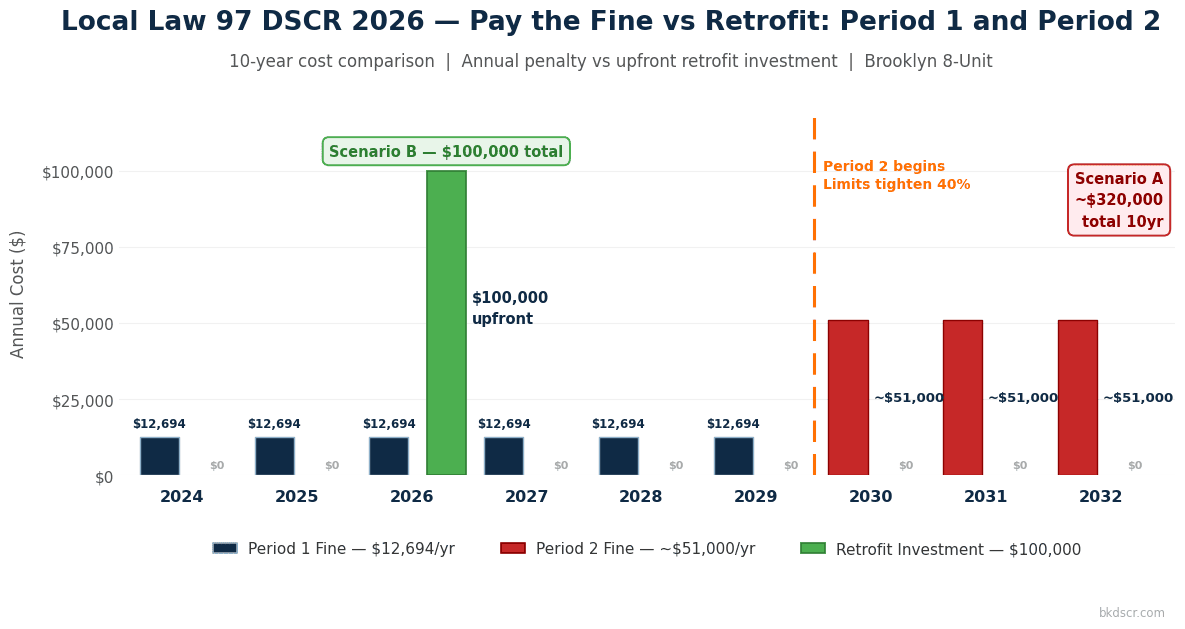
For a building that is 20% over its limit — like the composite deal above, with a $12,694/year penalty — a full boiler replacement might cost $80,000–$150,000. At $12,694/year, the simple payback on a $100,000 retrofit is 7.9 years — long enough that some owners are paying the fine for now while planning a capital project before 2030.
| Analysis | Pay the Fine | Retrofit Now |
|---|---|---|
| Annual LL97 cost | $12,694/year | $0 after retrofit |
| Capital outlay | $0 | $80,000 – $150,000 |
| Break-even (at $12,694) | N/A | 6.3 – 11.8 years |
| 2030 exposure | ~$51,000/year (limits tighten 40%) | Minimal if compliant |
| Recommendation | Viable for Period 1 only | Required before 2030 |
The calculus shifts dramatically for Period 2. The 2030–2034 emissions limit for multifamily drops from 0.00675 to 0.00407 tCO2e/sq ft — a 40% reduction. A building 20% over the Period 1 limit will be approximately 66% over the Period 2 limit on the same energy profile. The annual penalty at that exposure on a 35,000 sq ft building would be approximately $51,000/year. At that level, retrofit ROI becomes compelling. Investors acquiring covered buildings today should model the post-2030 penalty exposure explicitly before closing.
What Outer-Borough DSCR Investors Need to Do Before Closing
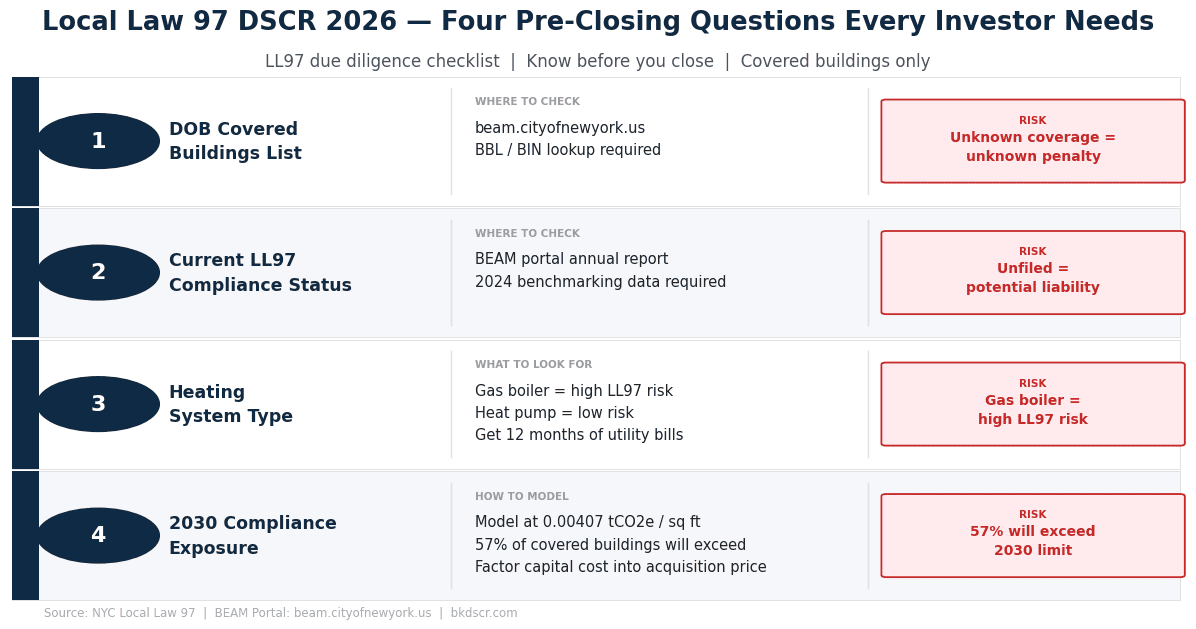
For investors acquiring covered buildings — or buildings close to the 25,000 sq ft threshold — four questions need to be answered before closing. These are also among the most common what kills deals at underwriting that investors discover at closing rather than at contract.
- Question 1: Is this building on the DOB Covered Buildings List? Check the NYC Department of Buildings Covered Buildings List at beam.cityofnewyork.us using the building’s BBL or BIN number. If the building is not on the preliminary list, confirm that neither the building’s square footage nor its combined lot area with adjacent buildings crosses the thresholds.
- Question 2: What is the building’s current LL97 compliance status? Request the seller’s most recent Energy Star Portfolio Manager benchmarking report and, if available, the LL97 annual report filed through the BEAM portal. If the 2024 report shows the building within its limit, it is in good shape for Period 1. If it shows excess emissions — factor the penalty into your operating cost model before making an offer.
- Question 3: What heating system does the building use? Natural gas-fired boilers are the primary driver of LL97 non-compliance in outer-borough multifamily. A building with a 1960s or 1970s gas boiler is far more likely to exceed its Period 1 limit. Ask for the last 12 months of utility bills and run a rough emissions estimate before due diligence.
- Question 4: What is the 2030 compliance exposure? Even if the building is compliant in Period 1, model the 2030 limit explicitly. The 40% reduction to 0.00407 tCO2e/sq ft will affect approximately 57% of all covered buildings. If the seller cannot provide a compliance pathway for 2030, factor the capital cost into your acquisition price.
Frequently Asked Questions
Does Local Law 97 apply to standard 1-4 unit DSCR investment properties?
No. The 25,000 gross square foot threshold excludes virtually all 1-4 unit residential properties in the outer boroughs. A standard Brooklyn or Queens 4-unit walkup with four 700–900 sq ft apartments runs 3,000–5,000 gross square feet — well below the threshold. Investors in the standard 1-4 unit DSCR market should confirm it does not apply to the specific building and move on to the variables that actually affect their DSCR: insurance, taxes, and rent structure.
How does LL97 affect DSCR underwriting on covered buildings?
LL97 penalties do not appear in the DSCR formula directly. The lender calculates DSCR as gross rent divided by PITIA — and the LL97 penalty is not part of PITIA. However, lenders are increasingly reviewing LL97 compliance status as part of broader due diligence on covered buildings. The penalty affects investor returns, cash-on-cash yield, and the true cash flow the asset produces — all of which affect the economics of the deal beyond the lender’s ratio.
What is the 2030 compliance risk for buildings that are currently compliant?
The 2030–2034 period reduces the multifamily emissions limit from 0.00675 to 0.00407 tCO2e/sq ft — a 40% reduction. According to the Urban Green Council, approximately 57% of all covered buildings currently meeting Period 1 limits will exceed Period 2 limits without additional capital investment. For investors acquiring covered buildings today, the 2030 exposure needs to be modeled at acquisition — not discovered at the first 2030 compliance filing.
Local Law 97 NOI: What the Compliance Cost Looks Like at the Deal Level
The LL97 Penalty Math on a Covered Building
For a covered building — one above 25,000 gross square feet — the LL97 penalty structure is $268 per ton of CO₂ equivalent emitted above the building’s annual cap. A 10-unit walk-up in Brooklyn running 15 tons over its annual limit faces a $4,020/year penalty, which flows directly to the operating expense line and reduces NOI by that amount. At a 6% cap rate, $4,020 in annual operating expense costs roughly $67,000 in value. On a DSCR loan, the same $4,020 reduces gross income available for debt service — and at a 7.5% rate on a $750,000 loan, the PITIA is approximately $5,775/month, meaning LL97 penalties absorb 5.8% of that capacity before a single dollar of rent is missed.
LL97 Compliance Costs Before They Become Penalties
Compliance is not free either. Electrification retrofits — heat pump systems replacing gas — run $8,000 to $15,000 per unit on outer-borough multifamily properties, based on 2025–2026 NYC contractor estimates. A 10-unit building at $12,000 per unit incurs $120,000 in capital expenditure to achieve compliance. Amortized over 10 years at zero cost of capital, that is $12,000/year — three times the penalty cost of staying non-compliant at 15 tons over the cap. The investor calculation is therefore: penalty versus retrofit cost versus energy savings versus property value impact. For most outer-borough DSCR investors, the answer depends on the building’s current systems, the local utility rates, and whether the retrofit qualifies for NYC retrofit financing programs.
The DSCR underwriting implication is direct: any building where LL97 penalties are already accruing should have those penalties reflected in the operating expense input to the DSCR formula. Submitting a rent roll without the LL97 operating expense creates a DSCR calculation the lender will not accept once the appraisal or operating statement review identifies the liability.
Bottom Line — Local Law 97 DSCR 2026
Local Law 97 DSCR 2026 is a material variable for a specific segment of the outer-borough investor market and largely irrelevant for another. Investors in the 1-4 unit DSCR market — where virtually all properties are below the 25,000 sq ft threshold — are not affected by LL97 directly. Confirm coverage status, move on.
Investors in the 8-20+ unit market in older outer-borough stock are acquiring buildings where LL97 compliance status, current penalty exposure, and 2030 capital requirements belong in the underwriting model before the offer is made. The $268/ton penalty is real, it is being assessed starting May 2026, and on a 35,000 sq ft building 20% over its limit, it runs $12,694/year — $1,058/month directly out of cash flow.
The 2030 limit tightening is the larger strategic issue. Period 2 will require approximately 40% lower emissions intensity from the same buildings. Investors who acquire covered buildings today without modeling 2030 capital requirements are underwriting to a cost structure that will change substantially in four years.
Run a Deal Review — current DSCR, stressed DSCR, NOI, and updated tax assessment modeled at current inputs, delivered within 48–72 hours.