
DSCR Mixed-Use Income: The Real 25% Lender Haircut
- DSCR mixed-use income split determines how the lender counts commercial rent — treatment ranges from full inclusion to 25% haircut to complete exclusion
- On a Brooklyn mixed-use with $6,900 residential and $3,800 commercial rent, the DSCR is 1.39 at full income, 1.27 with a 25% haircut, and 0.90 with commercial excluded
- Most DSCR lenders require 51%+ of gross income from residential units — if commercial exceeds 49%, many lenders reclassify as commercial and decline
- Commercial lease terms directly affect the haircut — NNN leases with 3+ years remaining get better treatment than gross leases or month-to-month tenancies
- NYC outer-borough mixed-use buildings are the most common DSCR deal type — the income split is the variable that determines whether the deal passes or fails
Table of Contents
- How the DSCR Mixed-Use Income Split Works
- The 51% Rule: When Mixed-Use Becomes Commercial
- What Drives the Size of the DSCR Mixed-Use Income Split Haircut
- The DSCR Mixed-Use Income Split Under Stress
- NYC Outer-Borough Mixed-Use: The Most Common DSCR Deal Type
- How to Position a Mixed-Use Deal for the Best DSCR Mixed-Use Income Split
- The Commercial Vacancy Scenario: DSCR Mixed-Use Income Split at Zero
- What NYC Investors Get Wrong About DSCR Mixed-Use Income Split
- FAQ: DSCR Mixed-Use Income Split
- Do All DSCR Lenders Accept the DSCR Mixed-Use Income Split?
- Can I count a home office or live-work unit as residential?
- What if my commercial tenant pays more than my residential tenants?
- How to Request the Most Favorable Haircut at Underwriting
- The 51% Rule: When a Mixed-Use Property Becomes Ineligible
- Bottom Line — DSCR Mixed-Use Income Split
DSCR mixed-use income split is the lender’s method for dividing a mixed-use property’s rent roll into residential and commercial components — and the treatment of the commercial component is where most deals get repriced, restructured, or declined. On a Brooklyn mixed-use with three residential units generating $6,900/month and one ground-floor commercial unit generating $3,800/month, the total gross rent is $10,700.
Monthly PITIA: $7,693. At full income, the Lender DSCR is 1.39 — a strong pass. Running the deal through the stress test with the haircut-adjusted income — not stated gross rent — is the correct starting point for any mixed-use analysis.
But the lender that haircuts commercial income by 25% counts only $2,850 of the commercial rent, dropping the qualifying income to $9,750 and the DSCR to 1.27. The lender that excludes commercial income entirely counts $6,900 — producing a DSCR of 0.90 and a hard FAIL. Same building, same rent roll, three different verdicts. The DSCR mixed-use income split is the variable. See also: Bronx mixed-use DSCR case. Overlooking the commercial income haircut is one of the most common deal killers on mixed-use DSCR applications.
| MARKET SNAPSHOT — DSCR Mixed-Use Income Split, June 2026 | |
|---|---|
| Sources: Griffin Funding | HomeAbroad | Clear House Lending | BKDSCR Research | |
| LENDER TREATMENT OF COMMERCIAL INCOME | |
| Full inclusion (100%) | Select lenders — rare |
| 25% haircut (75% of commercial income) | Most common treatment |
| 50% haircut (50% of commercial income) | Conservative lenders |
| Full exclusion (0%) | Most restrictive — some programs |
| MIXED-USE DSCR BENCHMARKS (June 2026) | |
| DSCR 30-yr fixed rates (Jun 2026) | 6.125%–7.5% |
| Mixed-use max LTV (most DSCR programs) | 70%–75% |
| BKDSCR standard | 1.25+ unstressed | 1.00+ combined stress |
Before running the income split on your mixed-use deal, Deal Filter — property type, rent roll, unit count, and PITIA in one pass to see where the deal lands before you submit.
How the DSCR Mixed-Use Income Split Works
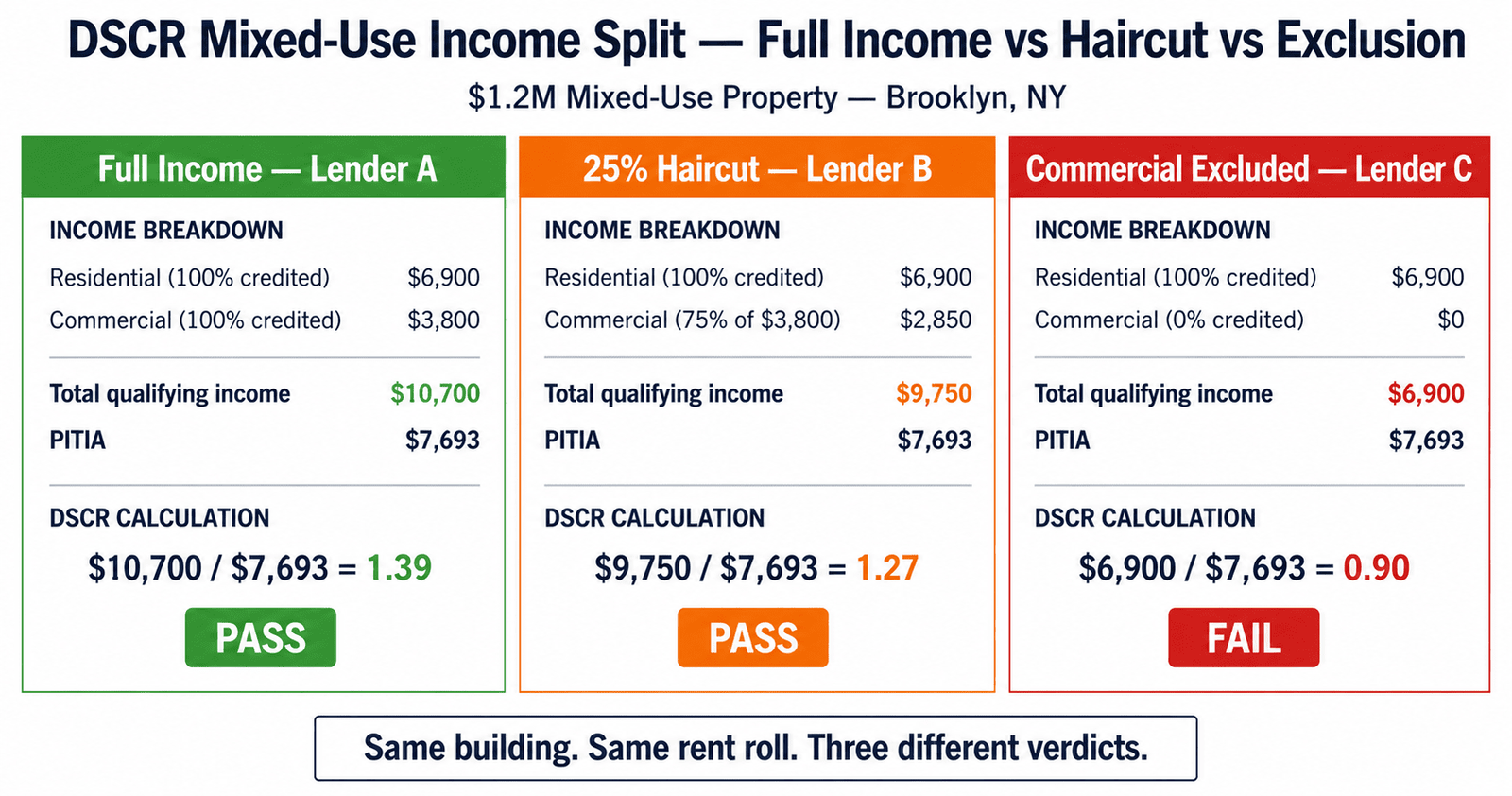
CAPTION: Same building: 1.39 DSCR at full income, 1.27 with 25% haircut, 0.90 with commercial excluded.
The DSCR mixed-use income split starts with a simple classification: the lender separates the rent roll into residential income (apartment leases) and commercial income (ground-floor retail, office, or service tenants). Residential income is counted at 100% of the actual lease amount — no discount, no haircut. Commercial income gets treated differently based on the lender’s underwriting guidelines. The DSCR formula page shows how each income component flows into the ratio calculation. See also: Queens mixed-use DSCR denial.
The haircut exists because commercial tenancies carry risks that residential leases do not. A bodega on a month-to-month lease can vacate with 30 days notice. A restaurant tenant can close due to business failure. A retail tenant’s rent may be tied to a percentage lease that fluctuates with sales. Lenders discount commercial income to account for this additional vacancy and credit risk — the haircut is not arbitrary, it is a risk adjustment.
The range of haircuts across DSCR lenders active in the NYC market: some lenders count 100% of commercial income with no discount. Most mainstream DSCR lenders apply a 25% haircut — counting 75% of the commercial rent. Conservative lenders apply a 50% haircut or exclude commercial income entirely. The DSCR mixed-use income split policy is not standardized across the industry. It varies by lender, and the same lender may apply different haircuts based on lease term, tenant creditworthiness, and commercial use type.
The 51% Rule: When Mixed-Use Becomes Commercial
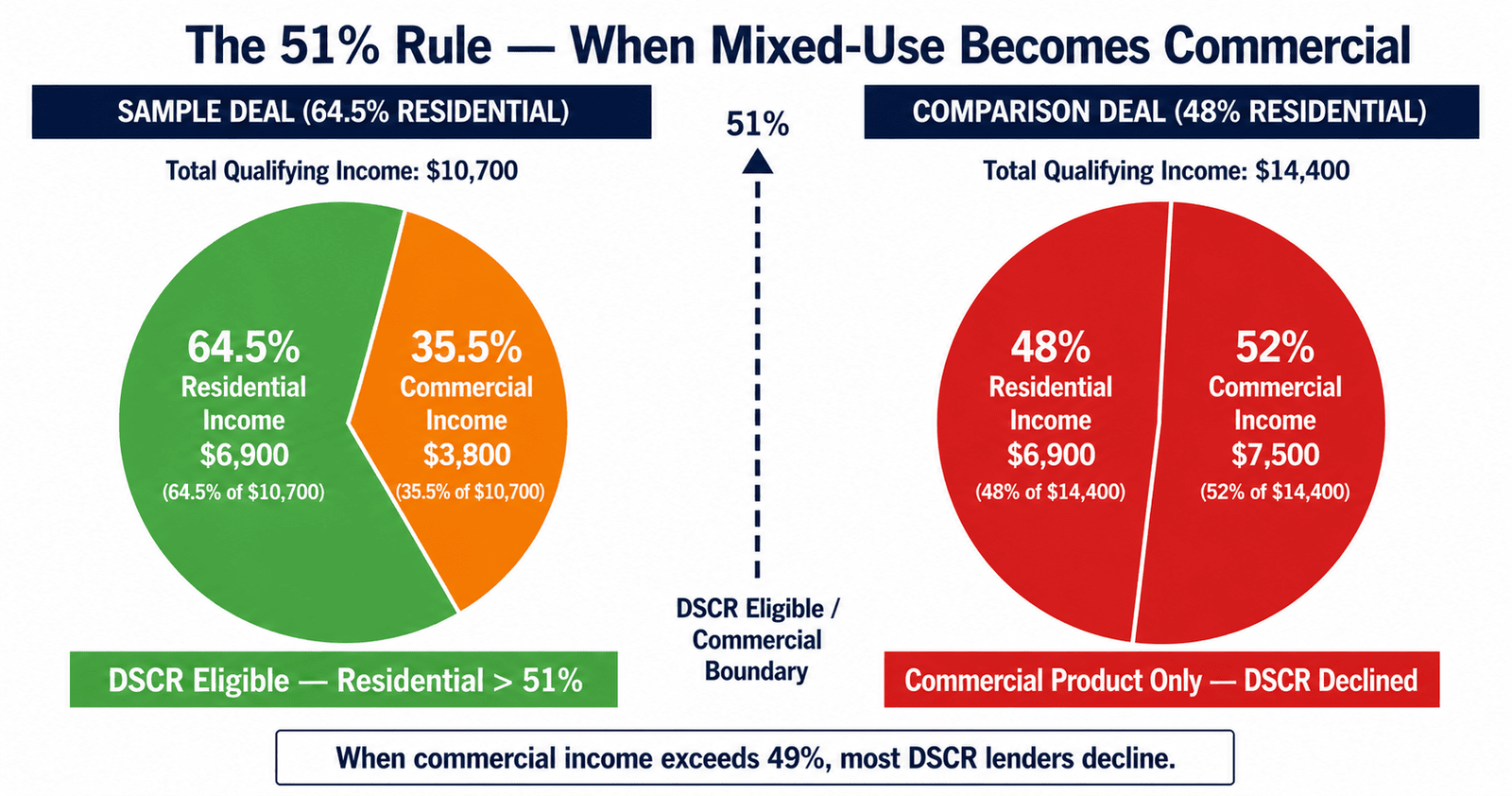
Most DSCR lenders require that residential income accounts for at least 51% of the total gross rent. On the sample deal, residential income is $6,900 out of $10,700 total — 64.5%. The deal qualifies as mixed-use. But if the commercial tenant’s rent were $7,500 instead of $3,800, commercial income would represent 52% of total gross — exceeding the 49% cap. Many DSCR lenders would reclassify the deal as commercial and decline it outright. The property would need commercial mortgage financing, which carries different underwriting, higher rates, and shorter terms.
Some lenders apply the 51% rule to square footage instead of income — or to both. A building where the ground floor commercial unit occupies 60% of the total square footage may be classified as commercial even if residential income exceeds 51% of the rent roll. The investor should confirm which metric the lender uses before submitting. According to Clear House, NYC multifamily and mixed-use financing options vary significantly by lender and by the commercial-to-residential ratio of the building.
What Drives the Size of the DSCR Mixed-Use Income Split Haircut
The haircut is not a single number — it is a function of how the lender evaluates the commercial tenancy. Four factors determine the discount applied to commercial income:
- Lease term remaining. A commercial tenant on a 5-year NNN lease with 3+ years remaining gets better treatment than a tenant on a month-to-month gross lease. The longer the remaining lease, the smaller the haircut.
- Tenant credit quality. A national chain pharmacy or bank branch carries less vacancy risk than a sole-proprietor nail salon. Stronger tenants receive smaller haircuts or no haircut at all.
- Commercial use type. Retail and food service carry higher turnover risk than professional office tenants. A medical practice with a 7-year lease gets better treatment than a restaurant on a 2-year lease.
- Lease structure. NNN leases where the tenant pays taxes, insurance, and maintenance are treated more favorably than gross leases where the landlord absorbs operating costs.
The investor who understands these factors can position the deal to minimize the haircut — by securing a longer commercial lease before the DSCR application, by documenting the tenant’s history, and by choosing a lender whose guidelines match the tenancy. The lender criteria page covers how different lenders evaluate mixed-use income and commercial lease quality.
The DSCR Mixed-Use Income Split Under Stress
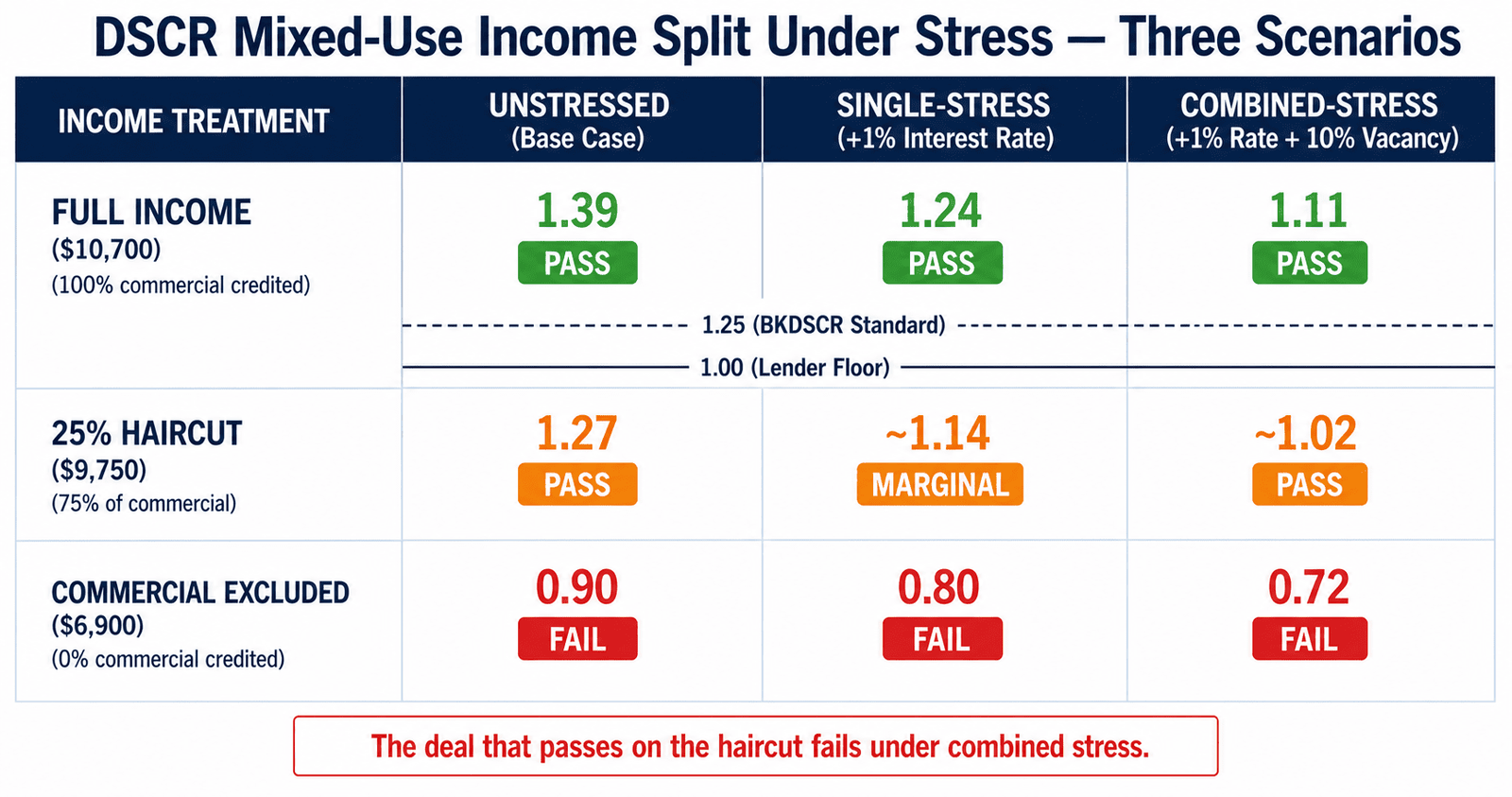
The BKDSCR stress test amplifies the DSCR mixed-use income split impact. At full income ($10,700/month), the unstressed DSCR is 1.39 and the single-stress DSCR at +1.0% rate is approximately 1.24. With a 25% commercial haircut ($9,750 qualifying income), the unstressed DSCR is 1.27 and the single-stress DSCR drops to approximately 1.14. With commercial excluded ($6,900), the deal fails at every level.
The stress test reveals the real risk. A deal that passes unstressed with a 25% haircut may fail under combined stress (rate + 10% vacancy). If the commercial tenant vacates — the exact scenario the haircut accounts for — the property’s actual income drops to residential only. The investor who underwrites at the haircut level but does not stress test the commercial vacancy scenario is carrying risk that the lender already priced into the deal.
If you want the complete framework for underwriting NYC mixed-use deals and understanding income splits, DSCR Playbook covers every input, every threshold, and every deal-killer.
NYC Outer-Borough Mixed-Use: The Most Common DSCR Deal Type
The classic NYC outer-borough mixed-use building is a 3-story walk-up with a ground-floor commercial unit and residential apartments above. This building type dominates the inventory in Bed-Stuy, Bushwick, Crown Heights, Flatbush, East New York, the South Bronx, Jamaica, and Astoria. The commercial tenant is typically a bodega, laundromat, barbershop, nail salon, deli, or small restaurant. The lease is often gross (not NNN), month-to-month or short-term, and at a rent that reflects the neighborhood retail market.
This profile is the hardest for DSCR mixed-use income split underwriting. The commercial tenant is a small business on a short lease with no national credit backing. Lenders applying a 25% haircut are being generous — some would exclude this income entirely. The investor who assumes full commercial rent and underwrites at 1.39 may discover at application that the lender counts only $2,850 — producing a 1.27 that passes but with thinner margins. According to FCMRE, the NYC commercial real estate market continues to show mixed performance, with outer-borough retail stabilizing but carrying higher vacancy risk than pre-pandemic levels.
The strategic move: underwrite at the haircut level from the start. If the deal works at 1.25 DSCR with a 25% commercial haircut, it works at any lender. If it only works at full income, the investor is one lender policy away from a deal that does not qualify.
The commercial tenant profile in each NYC outer-borough neighborhood affects the haircut differently. A Bed-Stuy building with a ground-floor coffee shop on a 5-year NNN lease at $4,200/month will receive a smaller haircut than a Brownsville building with a bodega on a month-to-month gross lease at $2,800/month — even though both are mixed-use with ground-floor commercial. The investor who negotiates lease terms before applying for DSCR financing directly controls the size of the haircut and the resulting DSCR.
In neighborhoods where commercial turnover is higher — East New York, Canarsie, parts of the South Bronx — the lender is more likely to apply the maximum haircut or exclude commercial income altogether. The submarket reputation affects the underwriter’s judgment even when the lease terms are favorable.
How to Position a Mixed-Use Deal for the Best DSCR Mixed-Use Income Split
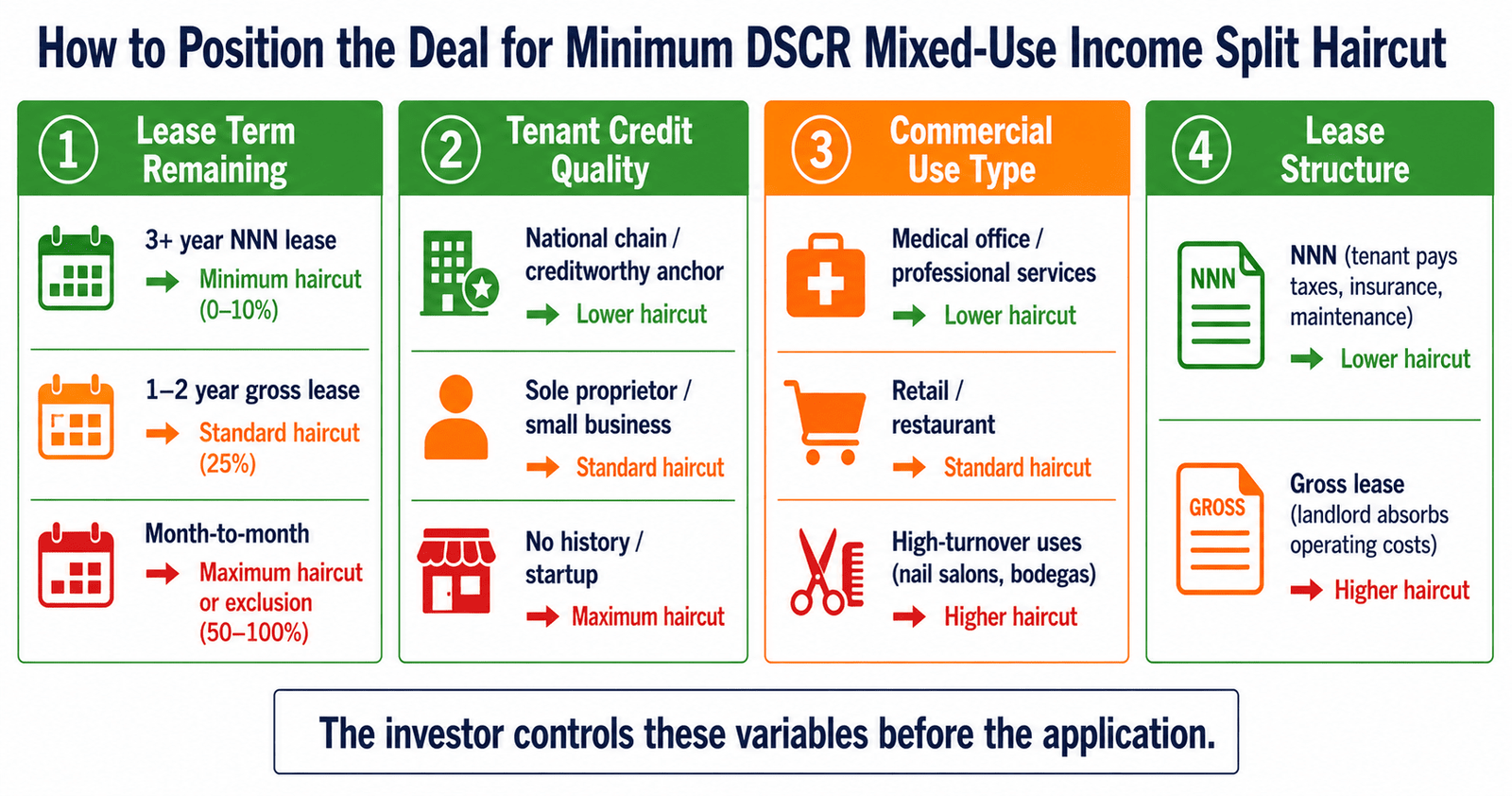
The investor can influence the DSCR mixed-use income split outcome before the deal reaches the lender. The first step is the commercial lease. A 3-year NNN lease with a creditworthy tenant gets the smallest haircut. If the current tenant is on a month-to-month gross lease, the investor should negotiate a longer-term lease before submitting the DSCR application. The cost of a lease negotiation is zero. The cost of a 25% haircut vs a 10% haircut on $3,800/month in commercial rent is $570/month in qualifying income — the difference between a 1.27 and a 1.34 DSCR on the sample deal.
The second step is lender selection. Not all DSCR lenders treat commercial income the same way. The investor should shop the deal to at least three lenders to compare income split policies. The lender that counts full commercial income at 1.39 DSCR may offer a higher rate — but the higher DSCR may unlock better LTV, lower reserves, and better prepay options. The income split interacts with every underwriting variable.
The third step is structuring the deal to ensure residential income exceeds 51% of total gross rent. On a deal where commercial income is approaching 49%, the investor may need to increase residential rents to shift the ratio. A $100/month increase across three residential units adds $300/month to the residential side — potentially moving the ratio from 48% to 52% and keeping the deal in DSCR eligibility.
The Commercial Vacancy Scenario: DSCR Mixed-Use Income Split at Zero
Every DSCR mixed-use income split analysis should include a commercial vacancy scenario. On the sample deal, residential income alone is $6,900 against PITIA of $7,693. The DSCR is 0.90 — a hard FAIL. The building cannot service its debt on residential income alone. If the commercial tenant vacates for three months, the investor carries $7,693/month in PITIA against $6,900 in income — a $793 monthly shortfall, or $2,379 over a three-month vacancy.
The stress test quantifies this risk before closing. The BKDSCR framework runs the commercial vacancy scenario alongside standard rate and vacancy stresses. If the deal cannot survive a commercial vacancy without going below 1.00 DSCR, the investor knows the commercial tenant is structurally necessary for the deal to work. That is a different risk profile than a building that passes at 1.25 on residential income alone and treats the commercial rent as upside.
What NYC Investors Get Wrong About DSCR Mixed-Use Income Split
- Assuming every lender counts full commercial income. Most do not. The 25% haircut is the most common treatment. The investor who underwrites at full income and discovers the haircut at application loses time and credibility.
- Ignoring the 51% residential threshold. If commercial income exceeds 49% of total gross rent, many DSCR lenders decline outright.
- Not securing a commercial lease before the DSCR application. A vacant commercial unit gets zero income at every lender. A month-to-month tenant gets the maximum haircut. A 3-year NNN lease gets the minimum.
- Treating the commercial haircut as permanent. If the investor secures a stronger tenant or extends the lease, the haircut may decrease on a future refinance.
- Running the DSCR at full income without stress testing the commercial vacancy. If the commercial tenant vacates, the DSCR drops to residential only. Know that floor before closing.
FAQ: DSCR Mixed-Use Income Split
Do All DSCR Lenders Accept the DSCR Mixed-Use Income Split?
No. Some DSCR lenders only finance residential properties. Mixed-use requires a lender that specifically underwrites commercial income alongside residential. Confirm eligibility before applying.
Can I count a home office or live-work unit as residential?
It depends on the certificate of occupancy. If the CO designates the unit as residential, the lender treats it as residential regardless of actual use. If the CO designates it as commercial, the lender applies the commercial income treatment. The CO classification determines the DSCR mixed-use income split.
What if my commercial tenant pays more than my residential tenants?
That is common in NYC mixed-use buildings where ground-floor commercial rents can exceed individual apartment rents. The risk is that a single commercial vacancy drops the DSCR more than any residential vacancy. The lender’s haircut accounts for this concentration risk. Ensure the deal passes the stress test even with the commercial unit vacant.
How to Request the Most Favorable Haircut at Underwriting
The DSCR mixed-use income split haircut is not always fixed by program. At some lenders, the underwriter has discretion to apply 75% credit (25% haircut) instead of 50% credit (50% haircut) when the commercial lease documentation supports it. The documentation that supports a better haircut: an executed lease with remaining term of 2+ years, a commercial tenant with 3+ years of continuous occupancy in the space, and an arm’s-length lease at market rate confirmed by a commercial rent comparable.
Submitting the full commercial lease package — not just the rent roll — gives the underwriter the basis to apply a favorable haircut. The pre-submission checklist covers what commercial lease documentation to include with any mixed-use DSCR application.
The 51% Rule: When a Mixed-Use Property Becomes Ineligible
Most DSCR lenders cap commercial square footage at 49% of gross building area. Above 50% commercial, the property shifts from residential DSCR program eligibility to commercial loan requirements — different underwriting standards, different rates, typically different down payment minimums. A 4-story building with one floor of ground-floor retail (25% of gross area) qualifies for residential DSCR. A 2-story building with ground-floor commercial (50% of gross area) may not. Confirm the commercial-to-residential square footage split before modeling any NYC mixed-use DSCR deal. The lender criteria page specifies which programs accept mixed-use and at what commercial percentage thresholds.
Bottom Line — DSCR Mixed-Use Income Split
The DSCR mixed-use income split is not a line item on the rate sheet. It is an underwriting policy that determines how much commercial rent the lender counts toward the DSCR calculation. The same building produces a 1.39 DSCR at full income, a 1.27 with a 25% haircut, and a 0.90 with commercial excluded. The deal verdict changes entirely based on which lender underwrites it.
The investor who controls this variable controls the deal outcome. Secure a long-term commercial lease before applying. Choose a lender whose mixed-use underwriting matches the building’s commercial profile. Underwrite at the haircut level — not full income. And stress test the residential-only scenario to know the floor. The DSCR mixed-use income split is the most common reason NYC mixed-use deals fail at underwriting. It is also the most preventable.
If you have a specific mixed-use deal and want to know your exact DSCR under full income, haircut, and residential-only scenarios, Deal Review delivers the full analysis within 48–72 hours.