
No-Ratio DSCR Programs: The Smart Fix When DSCR Is 0.98
Key Takeaways
- A no-ratio DSCR program does not calculate or require a minimum DSCR — approval is based on LTV, credit score, reserves, and property value alone
- No-ratio is not sub-1.0 DSCR: sub-1.0 still calculates the ratio to a 0.75 floor; no-ratio removes the income calculation entirely
- No-ratio requires 60–65% LTV (vs 75%), 720+ credit (vs 680), 12-month reserves (vs 6), and a rate premium of +0.75–1.25% — on a $975K deal, $97,500 more in down payment
- Three valid NYC use cases: vacant acquisitions, STRs where 1007 understates income, and rent-stabilized properties with leases below market rent
- The exit strategy: close at 65% LTV on no-ratio, renovate, lease up, refi to standard DSCR at 75% LTV after 6-month seasoning — recovering ~$78,423 of the extra down payment
- The dangerous wrong use: applying no-ratio to a deal where income exists but doesn’t cover debt service — no-ratio removes the check, not the problem
Table of Contents
- The Critical Trade-Off: What No-Ratio DSCR Actually Costs
- The Proven Use Cases for No-Ratio DSCR in NYC Outer-Borough
- No-Ratio DSCR: The Smart Vacant Acquisition Play
- No-Ratio DSCR and the Hidden STR Problem in NYC
- The Smart No-Ratio DSCR Refi Strategy After Lease-Up
- When No-Ratio DSCR Is the Dangerous Wrong Tool
- Critical FAQ: No-Ratio DSCR Programs Answered
- No-Ratio DSCR: The Critical Difference from No-Minimum Programs
- No-Ratio DSCR: The Hidden Refi Application Most Investors Miss
- No-Ratio DSCR Programs: The NYC-Specific Cases Where They Apply
No-ratio DSCR programs are the hidden tool most NYC outer-borough investors never find — and one of the most practical solutions for deals that standard income verification cannot support. A no-ratio DSCR loan removes the income calculation entirely: the lender does not run DSCR, does not require a minimum coverage ratio, and does not need lease documentation to underwrite the file.
According to Stacking Capital, the no-ratio DSCR structure exists specifically for investors whose deals cannot be qualified through standard income-based underwriting — whether because the property is vacant, the income structure is unusual, or the documentation required is unavailable at application.
This post explains exactly what no-ratio DSCR is, why it is structurally different from a sub-1.0 loan, what the real costs are, the three valid NYC use cases, the one scenario where it is actively dangerous, and the exit strategy that makes no-ratio economically rational for a long-hold outer-borough investor. According to Mofin Loans, NYC investors face documentation challenges on vacant, STR, and rent-stabilized properties that make the no-ratio structure a legitimate tool in the outer-borough lending toolkit when used correctly.
Running a deal that may not qualify under standard DSCR? Use the Deal Filter to confirm which program tier applies.
No-Ratio DSCR: The Hidden Program Structure Most Investors Miss
A no-ratio DSCR program is not a relaxed DSCR loan. It is a different product category. Standard DSCR requires 1.00–1.25 minimum. Sub-1.0 (down to 0.75) still calculates the ratio and requires a lower floor. No-ratio does not calculate the ratio at all. No income check. No 1007 requirement. No lease review. The lender underwrites entirely on LTV (60–65%), credit (720+), and 12-month PITIA reserves. See also: standard DSCR loan.
The key structural distinction: no-ratio is for deals where income verification is genuinely unavailable or structurally inappropriate — vacant properties, STRs, below-market leases. These are documentation problems, not cash flow problems. No-ratio solves documentation problems. It cannot solve cash flow problems.
| Feature | Standard DSCR | No-Ratio DSCR | What It Means |
|---|---|---|---|
| DSCR requirement | 1.00–1.25 min | None — N/A | Property cash flow is not calculated or required for qualification. |
| LTV cap (purchase) | 75% NYC | 60–65% | Investor must bring 35–40% down vs 25% for standard DSCR. |
| Rate premium | Baseline (~7.0%) | + 0.75–1.25% | Higher rate reflects the absence of income verification. |
| Credit minimum | 680 FICO | 720+ FICO | Lenders require stronger credit to offset removed income check. |
| Reserve requirement | 6 months PITIA | 12 months PITIA | Larger liquidity cushion required to compensate for no DSCR. |
| Lease required? | No (1007 for vacant) | No | Neither program requires a signed lease at application. |
| Lender availability | ~90% of DSCR lenders | ~15–25% of lenders | Fewer programs; ask specifically before shopping. |
| Extra down ($975K deal) | $243,750 (25%) | $341,250 (35%) | No-ratio costs $97,500 more to close on this benchmark deal. |
| Benchmark: $975,000 Brooklyn 4-unit purchase. Standard DSCR: 7.0% rate. No-ratio: 7.875% (+0.875%). Reserve requirement based on full PITIA. Lender availability per Griffin Funding and DSCR Authority estimates, June 2026. | |||
The comparison table shows what no-ratio costs relative to standard DSCR. On a $975,000 Brooklyn 4-unit purchase, no-ratio requires $97,500 more in down payment, a rate ~0.875% higher, 720+ FICO, and 12-month reserves. For an investor who has the capital and credit, these are manageable trade-offs for a specific acquisition.
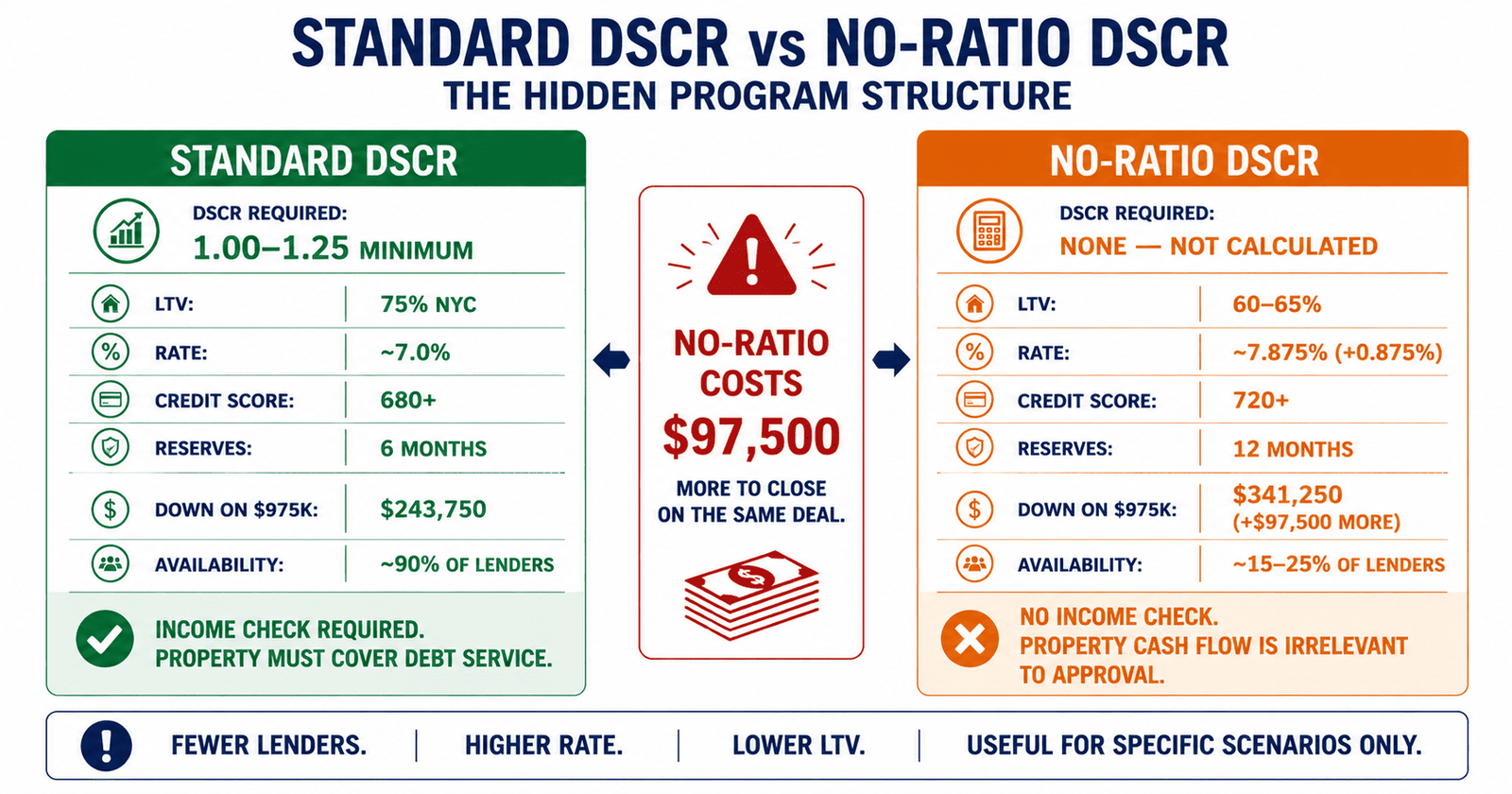
The Critical Trade-Off: What No-Ratio DSCR Actually Costs
The rate premium is ongoing for the life of the no-ratio loan. But the more significant cost is the down payment differential. Standard DSCR requires $243,750 (25% on $975K). No-ratio requires $341,250 (35%). That $97,500 in extra capital tied up as equity is the opportunity cost: a second deal that did not close. The exit strategy mitigates this substantially. Once the property is leased up and 6-month seasoning is complete, a standard DSCR cash-out refi at 75% LTV returns ~$78,423 after NYC MRT ($14,077) and closing costs. The no-ratio is a temporary bridge.
Use the DSCR formula to model the stabilized DSCR at the standard refi loan amount before committing to the no-ratio close.
The Proven Use Cases for No-Ratio DSCR in NYC Outer-Borough
| NYC Scenario | Standard DSCR Problem | No-Ratio Solution | BKDSCR Verdict |
|---|---|---|---|
| Vacant acquisition (full rehab) | No leases, no rent history. 1007 estimate may still qualify standard DSCR first. | No-ratio bypasses the income check. Qualifies on LTV (65%), credit (720+), 12-month reserves. | VALID. Strongest use case. Close, renovate, lease, refi to standard DSCR. |
| STR / Airbnb (NYC) | 1007 LTR comps understate STR income by 30–50%+. Standard DSCR uses 1007 figure. | Some lenders use AirDNA projections. No-ratio is the fallback when STR programs unavailable. | CONDITIONAL. Check STR-friendly lenders first. No-ratio is the fallback. |
| Below-market leases (rent-stab) | Existing leases $800–$1,000 below market. Standard DSCR uses actual lease, not market rent. | No-ratio removes the lease-based income constraint. Qualifies on asset and borrower profile. | VALID. NYC-specific rent stabilization creates an income documentation problem. |
| Broken DSCR deal | Standard DSCR fails at 1.10. Investor wants no-ratio to close anyway. | No-ratio will close the deal — but the property still can’t cover debt service. | WRONG TOOL. No-ratio removes the check. It does not fix the cash flow problem. |
No-Ratio DSCR: The Smart Vacant Acquisition Play
The strongest no-ratio use case is the vacant property acquisition. A distressed 3- or 4-family in Crown Heights, East New York, or the South Bronx with no lease history has no income to document. Standard DSCR will use the 1007 appraisal market rent estimate to calculate the ratio — which may still work. But if the lender’s credit matrix or DSCR floor creates a problem, no-ratio removes those constraints. Close at 65% LTV, renovate, lease all units to market-rate tenants, apply for standard DSCR refi at Month 5, recover the equity at Month 6–7.
The key pre-close verification: run the projected stabilized DSCR at the 75% LTV standard refi loan amount before closing. If it doesn’t clear 1.25 at stabilized rents, the deal does not work at any structure.
No-Ratio DSCR and the Hidden STR Problem in NYC
STR operators in tourist-heavy Brooklyn neighborhoods — Williamsburg, DUMBO, Bed-Stuy, Greenpoint — often face a 1007 problem. The 1007 long-term rent comparable for a 2BR may be $2,200–$2,600/month. Actual Airbnb gross revenue may be $5,000–$8,000/month. Standard DSCR uses the 1007. Before defaulting to no-ratio for an STR: verify whether the target lender offers an STR-income DSCR program using AirDNA revenue projections or 12-month verified STR deposit history.
These programs allow STR income to count at better rate and LTV than no-ratio. No-ratio is the fallback when STR-income programs are unavailable. See also: LLC DSCR vesting.
See lender criteria to identify which programs currently accept STR income for DSCR qualification.
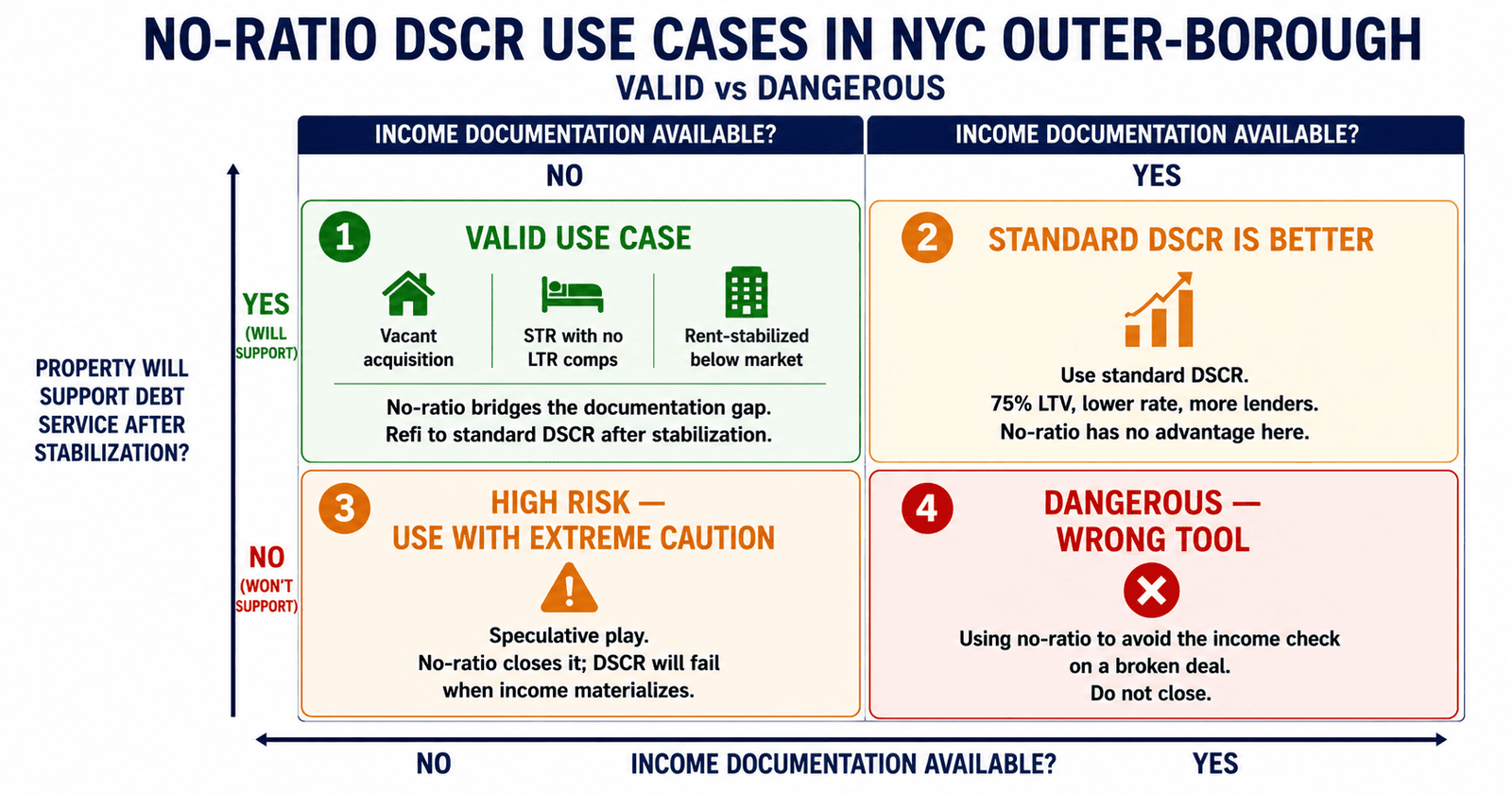
The Smart No-Ratio DSCR Refi Strategy After Lease-Up
For the complete framework on no-ratio DSCR programs, eligibility, and rate overlays, download the DSCR Playbook.
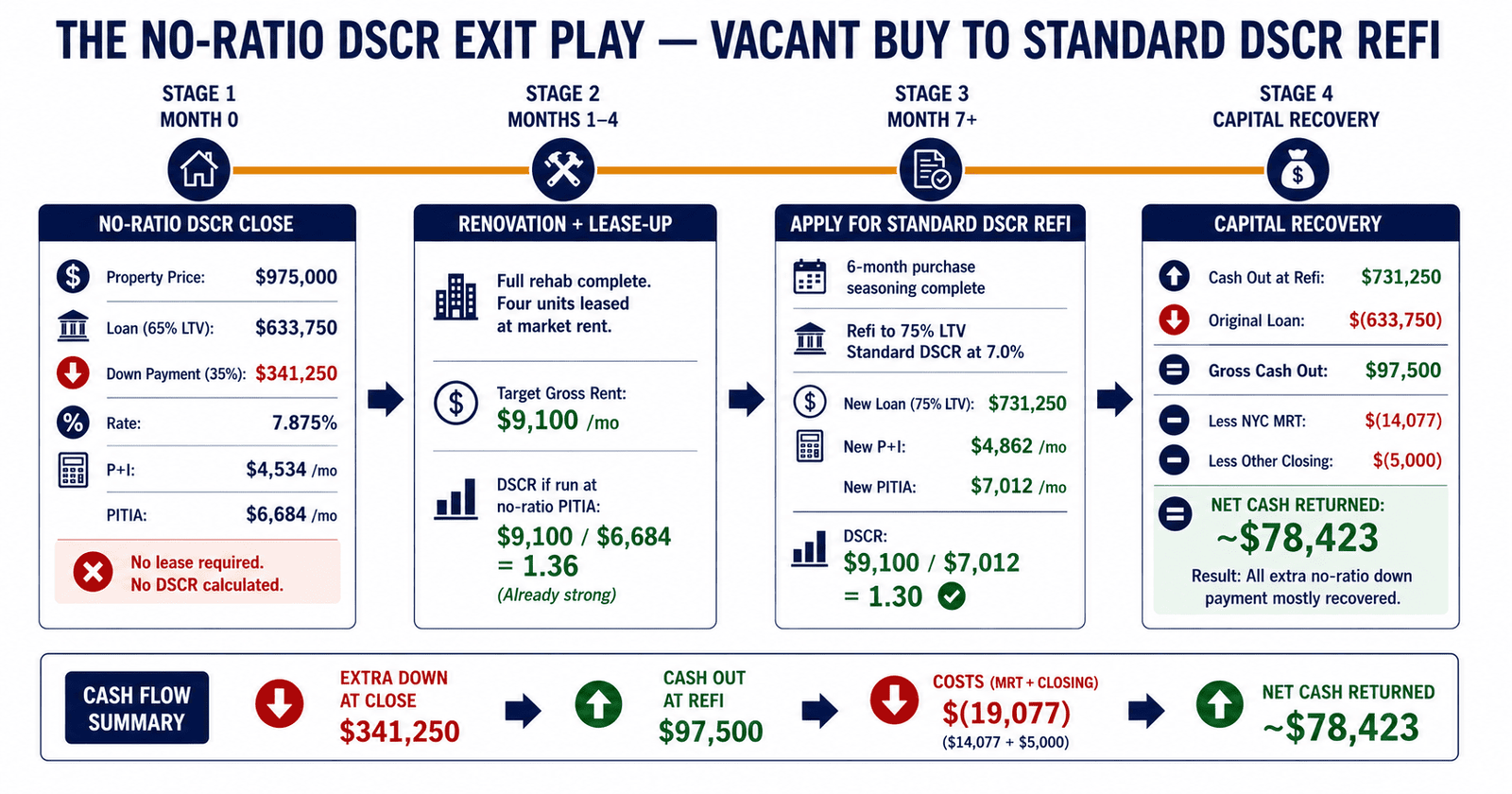
- Step 1: Model the stabilized DSCR at the 75% LTV standard refi amount BEFORE closing the no-ratio loan. Use the DSCR calculator at projected market rents. If it doesn’t clear 1.25, the deal does not work at any structure.
- Step 2: Renovate and lease all units to arm’s-length, market-rate tenants on 12-month leases. Weak lease documentation at refi will revert the underwriter to the 1007 figure.
- Step 3: Apply for standard DSCR refi at Month 5 (not Month 6 — underwriting overlaps the 6-month seasoning clock). Provide full rent roll, leases, and stabilized PITIA calculation.
- Step 4: Factor NYC MRT at refi close ($14,077 on $731,250 loan). Net capital returned: ~$78,423 after MRT and closing costs. Use the stress test to verify the stabilized DSCR at the refi amount before applying.
When No-Ratio DSCR Is the Dangerous Wrong Tool
No-ratio removes the income check. It does not create income that does not exist. Three wrong uses:
- Wrong use #1: The property has existing tenants, income is documented, but DSCR fails at 0.95. No-ratio closes the deal. The income problem does not go away after closing.
- Wrong use #2: Projected rents after renovation still won’t support 1.25 DSCR on the stabilized loan amount. Run the stabilized DSCR check before assuming the refi is viable.
- Wrong use #3: Using no-ratio to close faster because standard DSCR documentation collection is inconvenient. Standard DSCR is a better product for any deal that qualifies: lower rate, higher LTV, more lenders. The administrative inconvenience does not justify the no-ratio premium. See deal killers before defaulting to no-ratio.
Critical FAQ: No-Ratio DSCR Programs Answered
No-Ratio DSCR: The Critical Difference from No-Minimum Programs
Some DSCR programs advertise “no minimum DSCR” but still calculate the ratio — they just have no floor. True no-ratio programs do not calculate DSCR at all. The distinction matters at underwriting: if the lender is calculating DSCR and applying a sub-1.0 premium, it is not a no-ratio program regardless of how it is marketed. Ask the lender directly: “Do you calculate DSCR on this file at all, or is it truly no-income-verification?”
No-Ratio DSCR: The Hidden Refi Application Most Investors Miss
Yes, no-ratio DSCR refis exist. On a refi, the LTV cap is typically 60% (stricter than the 65% purchase cap), and the rate premium is similar. The use case is typically a property with a complex income structure that cannot be easily documented. An investor refinancing an existing property with no-ratio when standard DSCR would qualify is leaving money on the table. Verify that standard DSCR will not qualify before applying no-ratio to any refi.
No-Ratio DSCR: The Essential Appraisal Requirement Explained
Yes, an appraisal is required. No-ratio removes the income documentation requirement, not the collateral assessment. The appraisal determines the LTV, which is the primary qualifying factor. The appraiser will still complete the market rent schedule (1007) even though the lender is not using it for DSCR qualification — it is part of the standard appraisal form. Property value is the underwriting anchor for no-ratio programs.
No-Ratio DSCR and Mixed-Use: The Critical Program Limits
Mixed-use with a commercial ground floor typically requires a commercial lender, a portfolio lender, or a small-balance commercial program — not a residential DSCR product. If a no-ratio lender is willing to underwrite mixed-use under their residential DSCR program, the LTV will be more restrictive (55–60%), and the property must be majority-residential by unit count and square footage. Confirm program eligibility for mixed-use before ordering the appraisal.
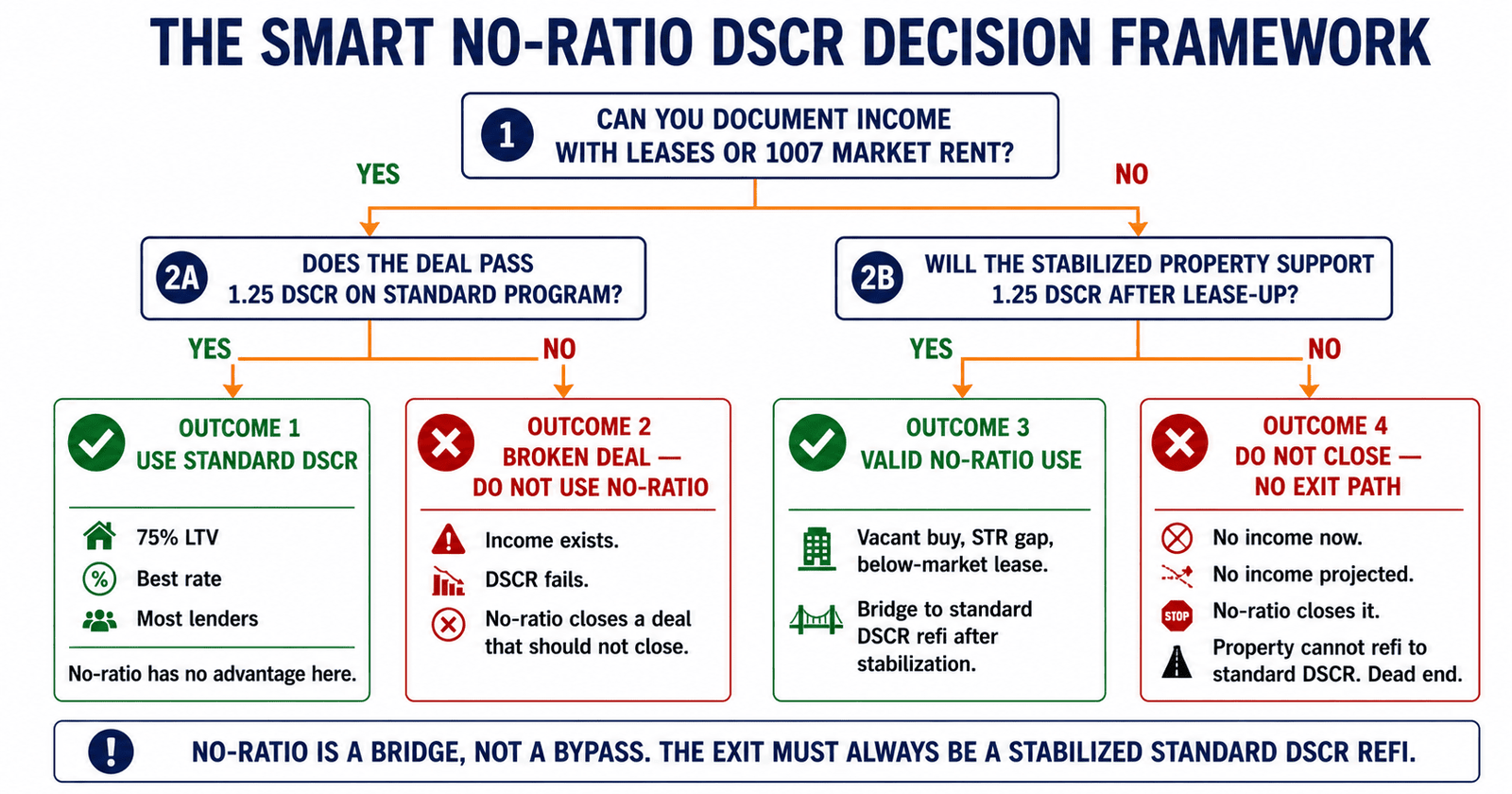
Confirm no-ratio program availability with the target lender before modeling the deal. Not all DSCR lenders offer no-ratio products, and those that do have specific LTV and credit overlays that vary by program. Use the lender criteria page to identify which programs offer no-ratio DSCR for NYC outer-borough properties before investing time in the full deal analysis.
No-Ratio DSCR Programs: The NYC-Specific Cases Where They Apply
The Mixed-Use Property Below DSCR Threshold
No-ratio DSCR programs appear most frequently in the NYC context on mixed-use properties where the commercial income haircut drops the qualifying DSCR below the standard program minimum. A Brooklyn 3-over-1 mixed-use with $7,200/month residential income and $1,500/month commercial income (after 50% haircut) has $8,700/month qualifying income. PITIA of $8,900/month. DSCR: 0.98 — below every standard DSCR lender’s floor. Under a no-ratio DSCR program, the lender does not calculate DSCR.
They underwrite on LTV (typically capped at 65% for no-ratio), credit score (typically 720+ minimum), and property type eligibility. The borrower brings more equity, demonstrates credit quality, and accepts a higher rate — typically 0.50%–0.75% above the standard DSCR rate. For a deal that does not qualify under the standard DSCR framework, the no-ratio program is the institutional financing alternative to a portfolio lender or a hard money bridge.
The Vacant or Partially Occupied Property
A property with two vacant units on a 4-unit building — 50% vacancy — has $0 qualifying income for those units under standard DSCR programs. If the two in-place units generate $4,400/month and PITIA is $5,200/month, DSCR is 0.85. No standard DSCR program approves this. A no-ratio program at 65% LTV with a 720+ FICO score may approve the loan based on the property’s long-term income potential, the borrower’s credit quality, and the equity cushion at 35% down.
The trade: the borrower pays a higher rate and brings more capital. The benefit: the institutional financing closes, allowing the investor to stabilize the property, fill the vacancies, and refinance into a standard DSCR product at 1.25+ after 6 months of seasoning.
The no-ratio DSCR program is not a permanent solution. It is a bridge to a standard DSCR qualification. Any NYC investor using a no-ratio program should have a clear stabilization and refi plan: timeline to full occupancy, projected rent roll at stabilization, projected DSCR at standard rates, and the break-even on the higher no-ratio rate versus the expected refi savings.
Use the Refi Analyzer to model the refi exit from the no-ratio program to the standard DSCR program before choosing the no-ratio structure. The deal killers page covers the property eligibility requirements that apply at each LTV tier under no-ratio programs.
No-Ratio DSCR: The Proven Pre-Closing Test
Before closing any no-ratio DSCR loan, run three checks: (1) verify WHY standard DSCR cannot be used — if it can be used, use it; (2) model the stabilized DSCR at projected market rents and at the 75% LTV standard refi loan amount, confirming it clears 1.25; (3) confirm the investor has 35% down plus 12 months PITIA reserves plus renovation capital if applicable. If any of the three checks fails, do not close the no-ratio loan.
No-ratio DSCR is a legitimate tool for a specific set of NYC acquisition scenarios where standard income documentation is genuinely unavailable. It is not a workaround for broken deals. Used correctly — as a bridge from a vacant or undocumented acquisition to a stabilized, fully-leased standard DSCR asset — it produces good outcomes. Used incorrectly, it closes a deal that should not have closed.
Have a deal where the standard DSCR calculation fails? The Deal Review identifies whether a no-ratio program applies and what the structure looks like.