
DSCR NOI Calculation: How Lenders Really Use $0 Units
Key Takeaways
- For 1–4 unit residential DSCR loans, lenders use Gross Rent ÷ PITIA — they do NOT subtract operating expenses from income
- NOI (with expense deductions) is used by commercial/5+ unit lenders and by investors for their own cash flow analysis
- The lender’s gross rent input = the lower of actual lease rents or the appraiser’s 1007 market rent estimate
- Vacant units are underwritten at $0 income by most DSCR lenders — NOT at 1007 market rent
- A 1.25 DSCR does not guarantee positive cash flow — investors must run their own NOI analysis separately
- NYC outer-borough operating expense ratios: 35–45% of gross rent (excluding taxes and insurance already in PITIA)
Table of Contents
- DSCR NOI Calculation: What Lenders Actually Use
- How DSCR Lenders Calculate Gross Rent: The 1007 Rule
- DSCR NOI Calculation: The Investor Version
- Why the Lender’s DSCR and the Investor’s NOI Are Both Necessary
- Common Mistakes in DSCR NOI Calculations
- Using NOI to qualify for a residential DSCR loan
- Using DSCR as a proxy for cash flow
- DSCR NOI Calculation: Double-counting taxes and insurance
- Applying commercial NOI-based DSCR to a residential loan
- FAQ: DSCR NOI Calculation
- DSCR NOI Calculation: Does vacancy affect the lender’s income input?
- If I self-manage, do I still include management fees in my NOI?
- Can I present proforma NOI to a DSCR lender to qualify for more?
- What is the difference between DSCR NOI on a 4-unit vs a 5-unit?
DSCR NOI calculation is one of the most misunderstood topics in DSCR lending — because for the most common DSCR loan structure (1–4 unit residential), lenders do not use Net Operating Income at all. They use gross rent. The lender’s income number is materially higher than what the property actually produces after operating costs. Investors who conflate the two end up overestimating cash flow or misunderstanding why their deal passed DSCR qualification but still produces thin returns.
According to Ridge Street, DSCR loans are underwritten based on the property’s rental income — meaning current gross rent, not a net income figure after deductions.
Before modeling any DSCR deal, understand exactly how income is calculated at the lender level. DSCR formula covers the complete income and denominator inputs with worked NYC examples.
DSCR NOI Calculation: What Lenders Actually Use
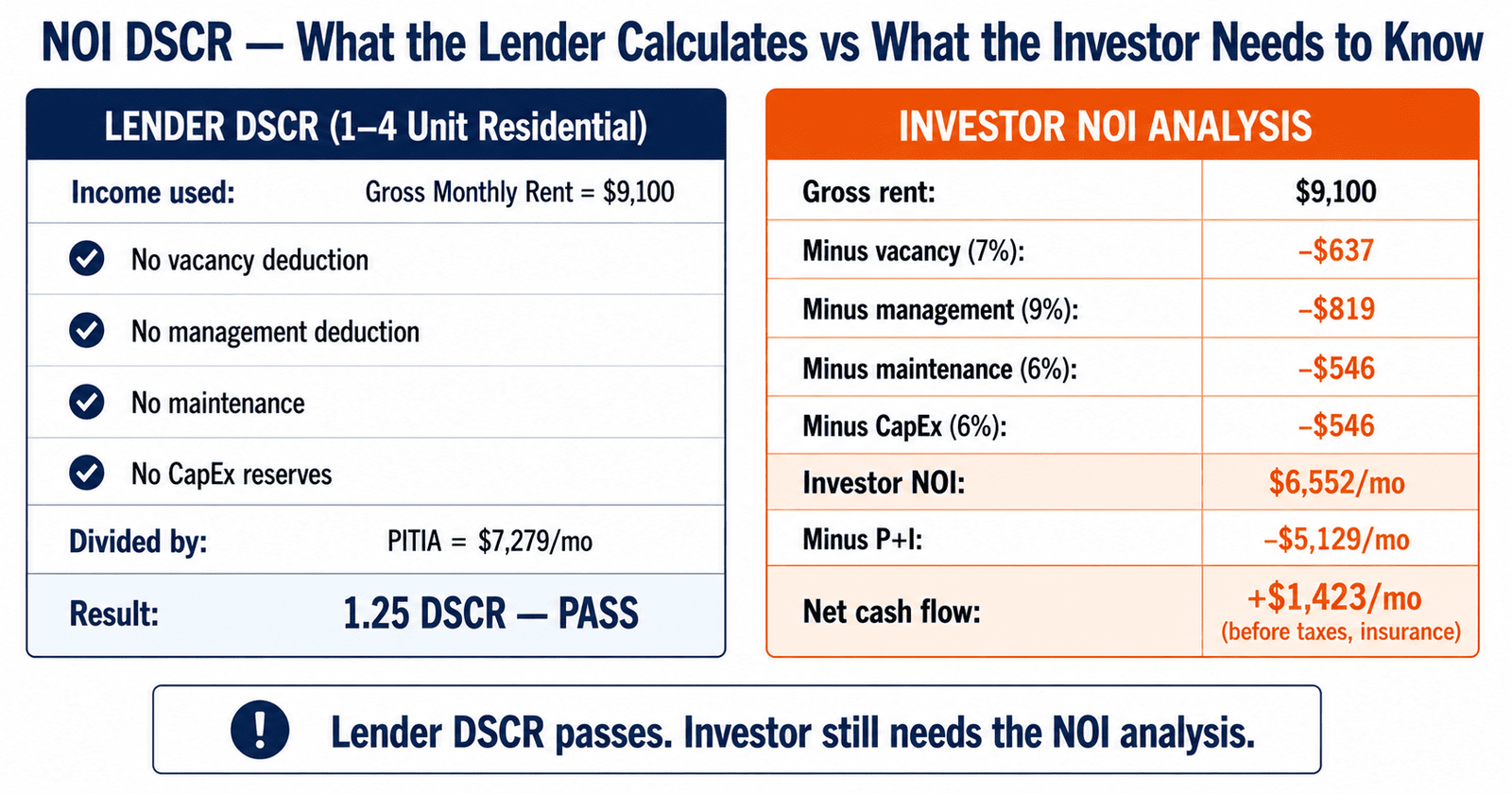
The DSCR formula for residential 1–4 unit investment properties is: Gross Monthly Rent ÷ Monthly PITIA. No vacancy deduction. No management fee subtraction. No maintenance or CapEx reserve. The income numerator is the gross scheduled rent from current leases or the appraiser’s 1007 market rent — whichever is lower. According to Commercial Loan, the distinction between residential and commercial DSCR underwriting is one of the most important structural differences in the 2026 lending environment. See also: PITIA DSCR breakdown.
Griffin Funding states it directly: lenders don’t approve 1–4 unit DSCR loans off NOI. For lending, DSCR is calculated as Gross Rent ÷ PITIA. The PITIA includes taxes and insurance that investors sometimes treat as operating expenses — but the lender handles them as denominator components, not income deductions. See also: 1.10 DSCR threshold.
| Line Item | Lender DSCR (1–4 Unit) | Investor NOI Analysis |
|---|---|---|
| Gross Monthly Rent | $9,100 (from lease or 1007) | $9,100 (same starting point) |
| Vacancy allowance | NOT subtracted | (−$455–$910) = 5–10% |
| Property management | NOT subtracted | (−$728–$910) = 8–10% |
| Maintenance / repairs | NOT subtracted | (−$455–$728) = 5–8% |
| CapEx / reserves | NOT subtracted | (−$455–$910) = 5–10% |
| Property taxes (T) | INCLUDED in PITIA denominator | In expenses OR denominator (not both) |
| Insurance (I) | INCLUDED in PITIA denominator | In expenses OR denominator (not both) |
| Effective income used | $9,100 (gross rent, no deductions) | ~$6,600 (after ~28% operating expenses) |
| Divided by | PITIA ($7,279/mo) | P+I only ($5,129/mo) |
| Result | DSCR 1.25 — PASS | Net cash flow ~$1,471/mo |
The lender uses $9,100 in the numerator. The investor’s NOI analysis uses approximately $6,600 after realistic operating expenses. The lender asks: can this property service its debt? The investor asks: does this property produce an adequate return? Both questions must be answered, but they are answered by different calculations.
How DSCR Lenders Calculate Gross Rent: The 1007 Rule
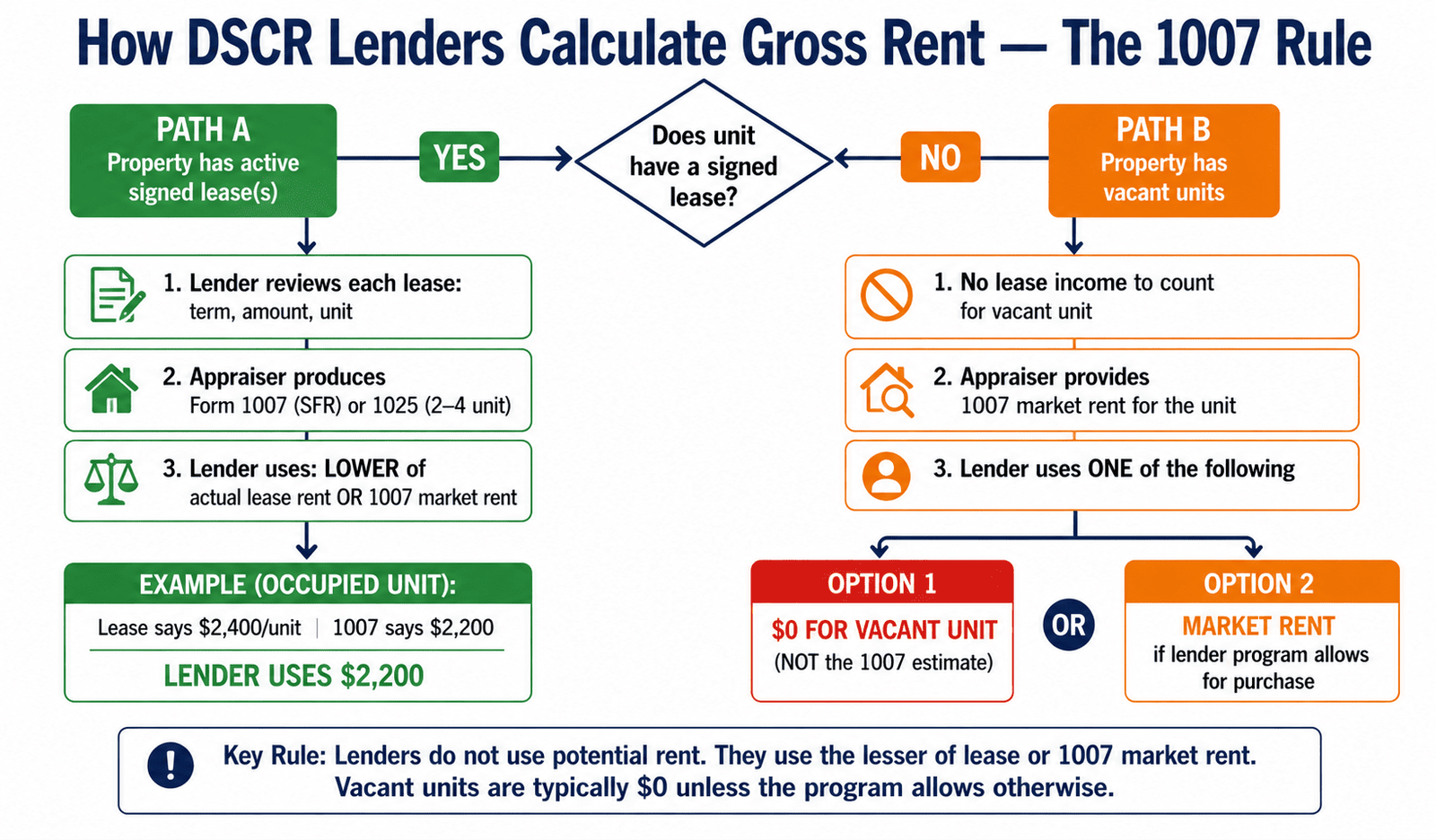
The gross rent the lender uses is not the investor’s assumption or asking rent. It comes from one of two sources:
- Occupied units with signed leases: The lender uses the LOWER of the actual lease rent or the appraiser’s 1007 market rent estimate. If the tenant pays $2,400/month and the 1007 says $2,200, the lender uses $2,200. If the tenant pays $2,000 in a market where 1007 says $2,300, the lender uses $2,000.
- Vacant units: Most DSCR lenders underwrite vacant units at $0 income on purchase loans. The 1007 market rent is produced but the income is not used in the DSCR numerator.
The 1007 rule creates a specific risk in rising-rent markets. Brooklyn rents rose 4% year-over-year through March 2026. An appraiser pulling comparable leases from 6–12 months prior will produce a 1007 that lags the current asking rent. An investor who models income at $2,400/unit may find the 1007 comes back at $2,200 — dropping DSCR from 1.32 to 1.21 on a deal modeled as a strong pass.
DSCR NOI Calculation: The Investor Version
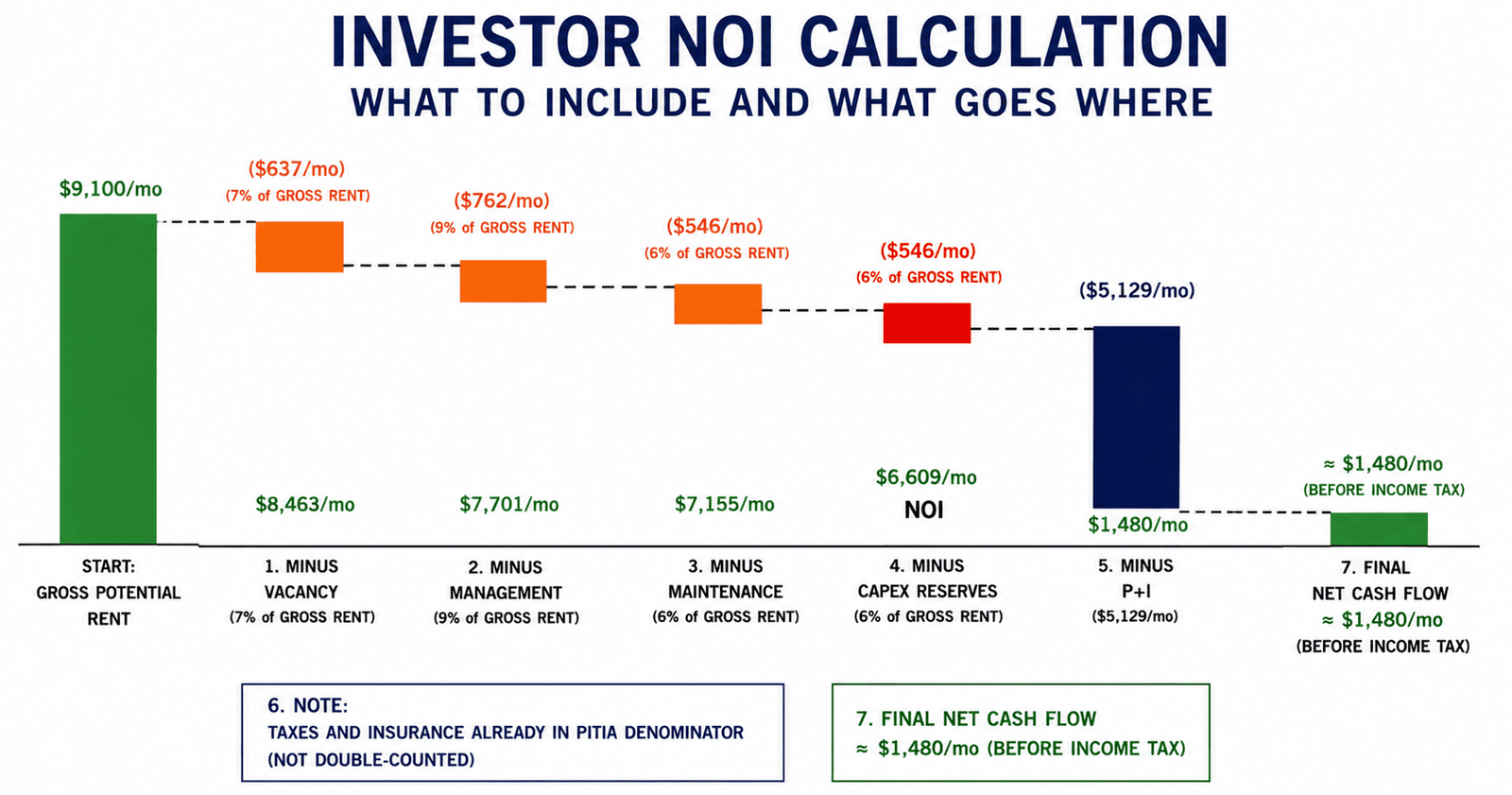
The investor must run a separate, expense-inclusive analysis. Investor NOI = Gross Potential Rent − Vacancy Loss − Operating Expenses.
- Property management (8–10%): Include at market rate even if self-managing. Self-management has an opportunity cost, and a deal that only works without a manager has hidden labor cost built in.
- Vacancy allowance (5–10%): Use 7% for most NYC outer-borough markets. Even in a 2% borough-wide vacancy market, individual unit turnover still produces vacancy.
- Maintenance and repairs (5–8%): Use 8% for pre-war buildings. NYC pre-war multifamily has aging plumbing, electrical, and heating systems.
- Capital expenditure reserves (5–10%): Long-term reserves for roof, boiler, windows, structural repairs. Pre-war: 8–10%. Newer construction: 5%.
| Expense Category | % of Gross Rent | NYC Outer-Borough Notes |
|---|---|---|
| Property management | 8–10% | Standard third-party rate in NYC outer boroughs |
| Vacancy allowance | 5–10% | Use 7% for most outer-borough markets; 5% for low-vacancy areas |
| Maintenance and repairs | 5–8% | Higher for pre-war buildings; use 8% for buildings built before 1980 |
| Capital expenditure reserves | 5–10% | Pre-war buildings: 8–10%; newer construction: 5% |
| Utilities (landlord-paid) | 0–5% | Depends on lease structure; many NYC investors pay heat/water |
| Landscaping / exterior | 0–2% | Minimal on most 1–4 unit outer-borough buildings |
| Total operating expense ratio | 35–45% | Excluding taxes and insurance (already in PITIA) |
Important: do NOT subtract taxes and insurance from gross rent as operating expenses AND use PITIA as the denominator — that double-counts T+I. Use either the lender’s model (gross rent ÷ PITIA) or the investor’s model (gross rent minus all expenses including T+I, divided by P+I only). The deal analysis page shows how BKDSCR models both approaches on the same deal without double-counting.
Get the complete DSCR underwriting framework including how lender income and investor NOI are modeled side by side. DSCR Playbook covers both calculations with worked NYC examples.
Why the Lender’s DSCR and the Investor’s NOI Are Both Necessary
A deal that fails the lender’s DSCR cannot be financed. A deal that passes the lender’s DSCR but fails the investor’s return threshold is financeable but not worth doing. The gap between the two is most acute in the NYC outer-borough market where operating expenses consume 35–45% of gross rent. A Brooklyn 4-unit with $9,100/month gross rent produces ~$6,600/month in investor NOI. Subtract P&I of $5,129/month and the monthly cash flow is ~$1,471 — about 9.4% cash-on-cash on a $187,500 down payment.
The stress test shows what happens when rent drops 10% and taxes rise 5% simultaneously: the 1.25 DSCR masked a stressed cash flow scenario the lender’s formula never surfaced.
Common Mistakes in DSCR NOI Calculations
Using NOI to qualify for a residential DSCR loan
Submitting an NOI-based DSCR calculation to a residential lender does not change how they qualify the loan. The lender computes Gross Rent ÷ PITIA regardless. See lender criteria for how residential DSCR lenders document and verify the income numerator.
Using DSCR as a proxy for cash flow
A 1.25 DSCR does not mean the property generates 25% more income than its costs. It means gross rent covers 125% of PITIA. After management, vacancy, maintenance, and CapEx reserves are deducted, actual cash flow over PITIA is far thinner. Run the full expense model on every deal.
DSCR NOI Calculation: Double-counting taxes and insurance
A common error: subtracting T+I as operating expenses in the NOI model while also using PITIA (which already includes T+I) as the denominator. Use one model consistently: lender model (gross rent ÷ PITIA) or investor model (gross rent minus all expenses including T+I, divided by P+I only).
Applying commercial NOI-based DSCR to a residential loan
Commercial 5+ unit lenders use Annual NOI ÷ Annual Debt Service. Investors who apply this formula to residential 1–4 unit deals find the result doesn’t match the lender’s qualified DSCR. Use the DSCR calculator to verify which formula applies to the specific property type before submission.
FAQ: DSCR NOI Calculation
DSCR NOI Calculation: Does vacancy affect the lender’s income input?
Yes, but not through a percentage deduction. The lender uses $0 for any currently vacant unit. A 7% vacancy allowance in the investor’s own model does not reduce the lender’s gross rent figure.
If I self-manage, do I still include management fees in my NOI?
Yes. Self-management has an opportunity cost that should be priced at the market management rate. A deal that only works if the investor self-manages is a deal with hidden labor cost — not a clean cash-flowing property.
Can I present proforma NOI to a DSCR lender to qualify for more?
No. Residential DSCR lenders use current actual income from signed leases or the 1007 market rent. Proforma projections, planned rents after renovation, or below-market tenants paying less than market are not accepted as the income basis.
What is the difference between DSCR NOI on a 4-unit vs a 5-unit?
Significant. A 1–4 unit residential DSCR loan uses Gross Rent ÷ PITIA with no expense deductions. A 5+ unit commercial DSCR loan uses Annual NOI ÷ Annual Debt Service, where NOI already has vacancy and operating expenses deducted. A 4-unit at $9,100 gross rent qualifies at 1.25 DSCR. The same building as a 5-unit would be underwritten on NOI, producing a different (usually lower) qualifying ratio on the same gross rent.
The DSCR NOI calculation also differs from commercial NOI underwriting in how vacancy is treated. On residential 1-4 unit DSCR loans, lenders use in-place executed lease income — full credit for occupied units, zero for vacant units. Commercial NOI underwriting typically applies a stabilized vacancy assumption of 5%–10% even on fully occupied properties. This means a 4-unit residential DSCR loan on a fully occupied building gets 100% rent credit (no vacancy haircut), while a commercial loan on the same fully occupied building might apply a 5% haircut.
The residential DSCR product actually produces a higher qualifying income on a fully occupied property than commercial NOI underwriting on the same property — one of the structural advantages of DSCR programs for 1-4 unit residential investors. The DSCR loans overview covers program eligibility by property type and unit count.
DSCR NOI Calculation: Why the Lender’s Number and the Investor’s Number Always Differ
The DSCR NOI calculation produces two different results depending on who is doing the math — and both are correct within their own framework. The lender calculates DSCR using gross rent divided by PITIA. The investor calculates DSCR (or NOI-based return) using net operating income divided by annual debt service. The lender’s DSCR does not deduct operating expenses — management, maintenance, vacancy, turnover. The investor’s NOI does.
A Brooklyn 4-unit with $10,000/month gross rent, $6,200/month PITIA, and $3,500/month in operating expenses (management, maintenance, vacancy reserve) produces a Lender DSCR of 1.61 and an investor NOI DSCR of 1.03. Both numbers are correct. The Lender DSCR is used for qualification. The investor NOI DSCR is used for investment analysis. Using the wrong number in the wrong context is the single most common NYC DSCR underwriting confusion.
The practical issue arises when investors present the lender with a cash flow analysis that includes operating expense deductions and call it “DSCR.” Lenders do not use operating expense-adjusted income for DSCR qualification on 1-4 unit residential DSCR loans. The income input is always gross rent — no deductions for management fees, vacancy, or maintenance. For 5+ unit commercial DSCR products, the income input is NOI (gross income minus operating expenses). Submitting a commercial-style NOI calculation on a 1-4 unit residential DSCR loan application does not improve the outcome — it creates confusion at underwriting and delays the process.
Run both calculations on every deal: the Lender DSCR (gross rent / PITIA) to confirm qualification, and the BKDSCR Conservative DSCR (gross rent minus management and maintenance / PITIA) to confirm investment merit. The deal analysis page explains the dual DSCR framework and why both numbers belong in the pre-submission analysis. A deal that qualifies at 1.28 Lender DSCR but runs only 0.97 Conservative DSCR is a qualified loan but a marginal investment. Knowing both numbers before committing is the standard at BKDSCR.
The Two Calculations Every DSCR Investor Must Run
DSCR NOI calculation in the residential context is actually two calculations. The lender’s version: Gross Monthly Rent ÷ Monthly PITIA. The investor’s version: Gross Rent minus all operating expenses, divided by P&I, producing cash flow and a cash-on-cash return. The lender’s calculation determines whether the loan is approved. The investor’s calculation determines whether the loan is worth taking.
On a Brooklyn 4-unit at $9,100 gross rent: 1.25 DSCR from the lender. ~$1,471/month in net cash flow from the investor. Both correct. Both necessary. Run both. Use verified T+I inputs in the lender’s PITIA. Use realistic NYC expense ratios (35–45% of gross rent) in the investor’s NOI model. If the deal passes both analyses, it belongs in the pipeline.
Take any deal through the filter to check qualifying DSCR before running a full NOI analysis. Deal Filter screens property type, rent roll, and estimated DSCR in one pass.