
NYC 3-Family vs 4-Family DSCR: The Real Tax Class Trap
Key Takeaways
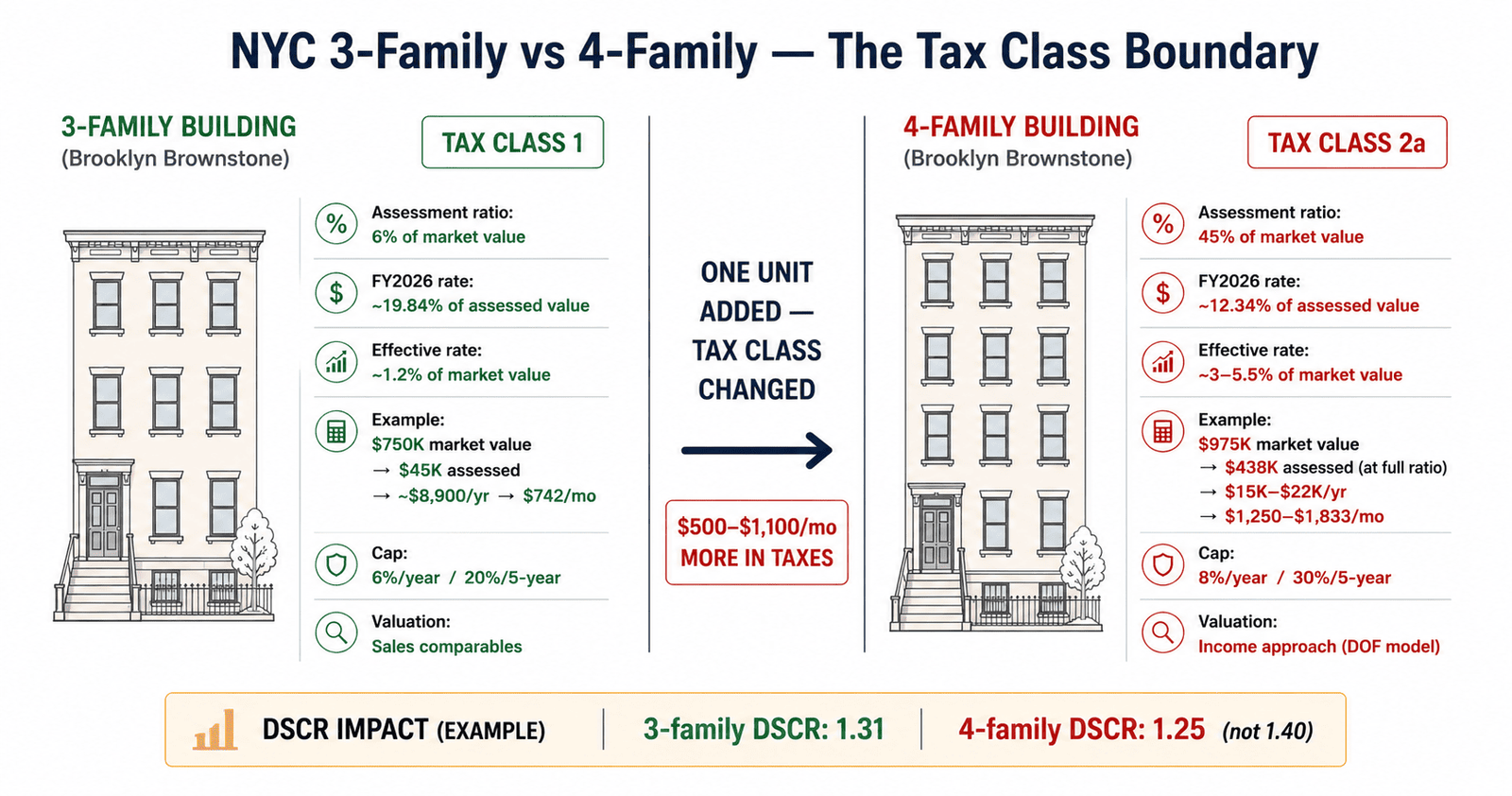
- A 3-family is NYC Tax Class 1 (6% assessment ratio, ~1.2% effective rate). A 4-family is Tax Class 2a (45% assessment ratio, ~3–5.5% effective rate). One unit crosses the boundary.
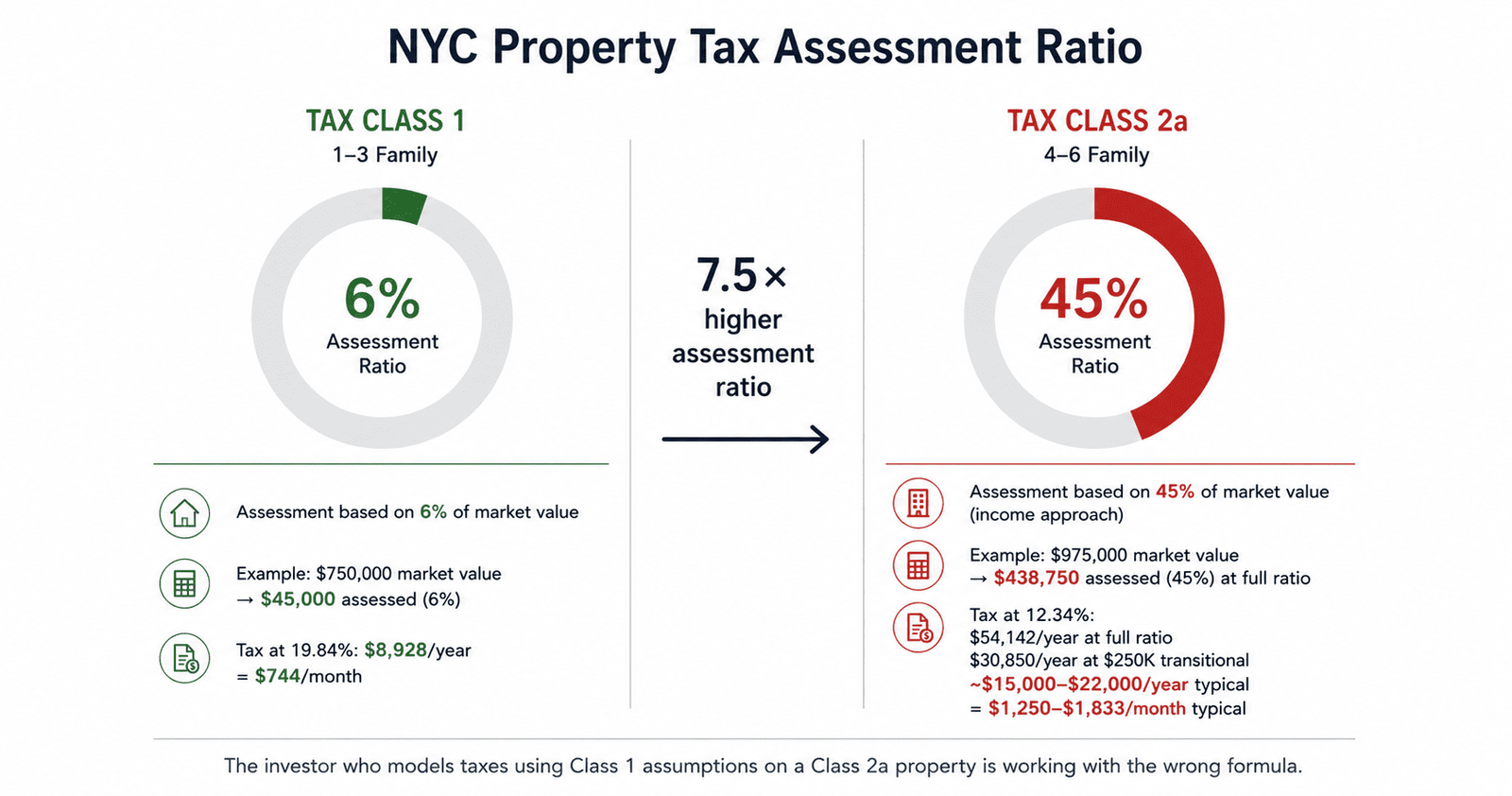
- The 7.5× assessment ratio difference means a 4-family carries materially higher effective taxes than a 3-family at the same market value — even accounting for Class 2a’s lower nominal rate
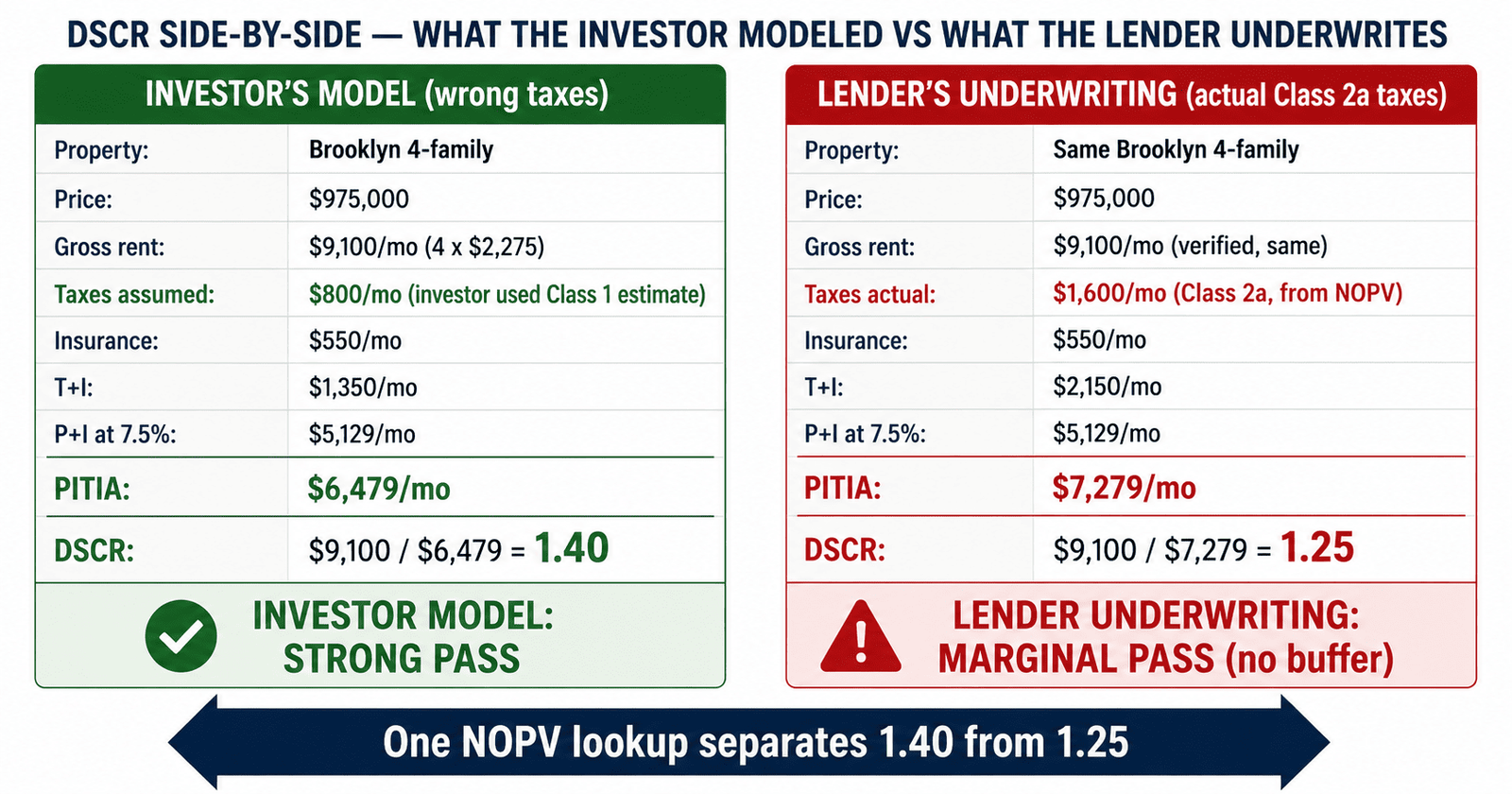
- Investors who model a 4-family using 3-family (Class 1) tax assumptions are $500–$1,100/month too low — which can move DSCR from 1.40 (investor model) to 1.25 (lender reality)
- Class 2a properties are valued using an income approach by the DOF, not comparable sales. As rents rise, the DOF’s income model follows — pushing assessed value and taxes higher over the hold period
- DSCR lenders pull the actual NOPV (Notice of Property Value) at underwriting. Only the NOPV is authoritative — not Zillow, StreetEasy, or broker pro formas
- The tax class verification takes 10 minutes at nyc.gov/finance. Skipping it is one of the most common and most expensive DSCR modeling errors in the NYC outer-borough market
Table of Contents
- NYC 3-Family 4-Family DSCR: The Assessment Math
- The DSCR Trap: Investor Model vs Lender Reality
- The Income Approach Risk: Why Class 2a Taxes Keep Rising
- NYC 3-Family vs 4-Family DSCR: The Five-Step Verification
- FAQ: NYC 3-Family vs 4-Family DSCR
- Can a 4-unit building ever be classified as Tax Class 1?
- NYC 3-Family vs 4-Family DSCR: If I convert a 4-family to a 3-family, does the tax class change?
- Does the tax class affect which DSCR programs a property qualifies for?
- NYC 3-Family vs 4-Family DSCR: How can the DOF income-approach value be lower than my purchase price?
- How to Confirm Tax Class Before Going Under Contract
- The 3-Family That Gets Assessed Like a 4-Family
NYC 3-family 4-family DSCR investors face a structural tax trap that shows up at underwriting — not at closing. A 3-family in NYC is Class 1. A 4-family is Class 2. That single unit difference changes the property tax calculation, the assessment methodology, and the annual cap on assessment increases — and it can swing the DSCR ratio by 0.08 to 0.15 points on the same purchase price.
NYC 3-family vs 4-family DSCR analysis begins with a fact most investors never learn until it shows up in their lender’s PITIA: adding one unit doesn’t just add one rent check. It crosses a hard statutory boundary in the NYC property tax code that changes the assessment formula from a 6% ratio to a 45% ratio. The difference in effective tax burden between a 3-family and a 4-family at similar market values can easily reach $500–$1,100/month — enough to collapse a 1.40 DSCR investor model to a 1.25 lender reality.
According to the Class 1 guide from the NYC Department of Finance, Class 1 covers 1–3 unit residential properties at a 6% assessment ratio. The Class 2 guide confirms that 4-unit buildings are Class 2a, assessed at 45% of market value using an income-approach model. Confirming the tax class with the lender before going under contract — lender criteria breaks down how each class is treated for DSCR qualification — avoids the most common 3-family underwriting surprise.
Before running any DSCR model on a 3-family or 4-family, use the Deal Filter to confirm tax class, unit count, and PITIA eligibility.
NYC 3-Family 4-Family DSCR: The Class Boundary
New York Real Property Tax Law §1802 divides every parcel into one of four tax classes. The boundary relevant to outer-borough DSCR investors runs directly between 3-unit and 4-unit residential properties:
- Tax Class 1: 1–3 family homes. Assessed at 6% of market value. FY2026 rate ~19.84% of assessed value. Effective rate ~1.2% of market value. Valuation: comparable sales.
- Tax Class 2a: 4–6 unit residential buildings. Assessed at 45% of market value. FY2026 rate ~12.34% of assessed value. Effective rate ~3–5.5% of market value. Valuation: income approach (DOF model).
The single-unit difference is not a gradual change. It is a categorical reclassification from one tax formula to another. An investor who uses the same tax estimate for a 3-family and a 4-family is making an error that will be corrected by the lender’s PITIA calculation at underwriting. See also: DSCR loan fundamentals.
NYC 3-Family 4-Family DSCR: The Assessment Math
| Factor | Class 1 (1–3 Family) | Class 2a (4–6 Units) | DSCR Consequence |
|---|---|---|---|
| Property types covered | 1–3 family homes | 4–6 unit buildings | One unit crosses the boundary. 3-family = Class 1. 4-family = Class 2a. |
| Assessment ratio | 6% of market value | 45% of market value | 7.5× higher assessment base. Direct PITIA multiplier on same market value. |
| FY2026 tax rate | ~19.84% of assessed value | ~12.34% of assessed value | Rate difference partially offsets ratio gap — but not fully. |
| Effective rate | ~1.2% of market value | ~3–5.5% of market value | Class 2a effective rate is 2.5–4.5× higher (compressed by caps on older assessments). |
| Assessment cap | 6%/yr · 20%/5-yr | 8%/yr · 30%/5-yr | Class 2a grows faster. On a rising income-approach value, taxes escalate more aggressively. |
| Valuation method | Sales comps (market) | Income approach (DOF model) | Class 2a value is DOF-modeled, not sale-comparable. Can diverge from purchase price. |
| Monthly tax estimate (est.) | $750–$917/mo | $1,250–$1,833/mo | $500–$1,100/mo PITIA gap from taxes alone. Fatal to investor models using Class 1 estimates. |
The nominal tax rate difference (19.84% for Class 1 vs 12.34% for Class 2a) is real but partially misleading. The Class 1 rate is applied to 6% of market value. The Class 2a rate is applied to up to 45% of market value. In practice, Class 2a properties protected by the 8%/year cap may have a transitional assessed value below the theoretical 45% ratio — especially in long-held buildings. For a recently transacted building (or a newly assessed building post-sale), the DOF may move the assessment toward 45% at up to 8%/year.
Annual taxes on a Brooklyn 4-family typically run $12,000–$22,000/year ($1,000–$1,833/month) depending on assessment history.
The DSCR Trap: Investor Model vs Lender Reality
| Input | 3-Family (Class 1) | 4-Family (Class 2a) — Actual |
|---|---|---|
| Purchase price | $750,000 | $975,000 |
| Gross monthly rent | $6,825 (3 × $2,275) | $9,100 (4 × $2,275) |
| LTV / Loan amount | 75% / $562,500 | 75% / $731,250 |
| P+I (7.5% rate) | $3,934/mo | $5,129/mo |
| Monthly taxes (actual) | $833/mo (Class 1) | $1,600/mo (Class 2a) |
| Monthly insurance | $450/mo | $550/mo |
| Total PITIA | $5,217/mo | $7,279/mo |
| Lender DSCR | $6,825 ÷ $5,217 = 1.31 | $9,100 ÷ $7,279 = 1.25 |
| BKDSCR verdict | PASS (1.31) | PASS — barely (1.25) |
| Investor model (wrong taxes) | N/A | $9,100 ÷ $6,479 = 1.40 (wrong) |
| DSCR gap (investor vs lender) | — | 1.40 → 1.25 = 0.15 miss |
| Investor’s wrong tax assumption: $800/mo (Class 1 rate applied to Class 2a property). Actual Class 2a taxes: $1,600/mo. The $800/mo error flips a 1.40 model to a 1.25 actual — eliminating all DSCR buffer. | ||
The table shows the exact DSCR gap created by the tax class error. The investor models taxes at $800/month (derived from 3-family mental comparison or broker pro forma). The lender pulls the actual NOPV and finds $1,600/month in Class 2a taxes. Investor modeled 1.40 DSCR; lender underwrites 1.25. The 1.25 passes the BKDSCR standard — but with zero margin.
Any adverse T+I event (a $200/month tax reassessment, an insurance increase, a 1007 appraisal $100/unit below asking) drops the deal below 1.25. See deal killers for the full list of conditions that operate against margin-free DSCR structures. See also: NYC property tax DSCR impact.
The Income Approach Risk: Why Class 2a Taxes Keep Rising
The income approach valuation used for Class 2a properties creates a compounding risk Class 1 investors do not face. The NYC DOF determines the market value of a 4-unit building by modeling the income it produces — estimating typical gross income, applying an expense ratio, and capitalizing the result. This is independent of what the investor paid and independent of comparable sale prices.
For the complete framework on NYC property tax classes, PITIA traps, and 3-family vs 4-family DSCR underwriting, download the DSCR Playbook.
In a rising-rent market, the DOF’s income model follows rents upward. As Brooklyn outer-borough rents rise (+4% YoY through March 2026), the DOF’s income-approach value rises with them, and the assessed value follows at up to 8%/year.
An investor purchasing with $1,200/month in taxes may find those taxes at $1,600/month by Year 5 — compressing DSCR without any change in the loan, rent roll, or insurance. Use the stress test to model what a $400/month tax increase over 5 years does to the deal’s DSCR.
NYC 3-Family vs 4-Family DSCR: The Five-Step Verification
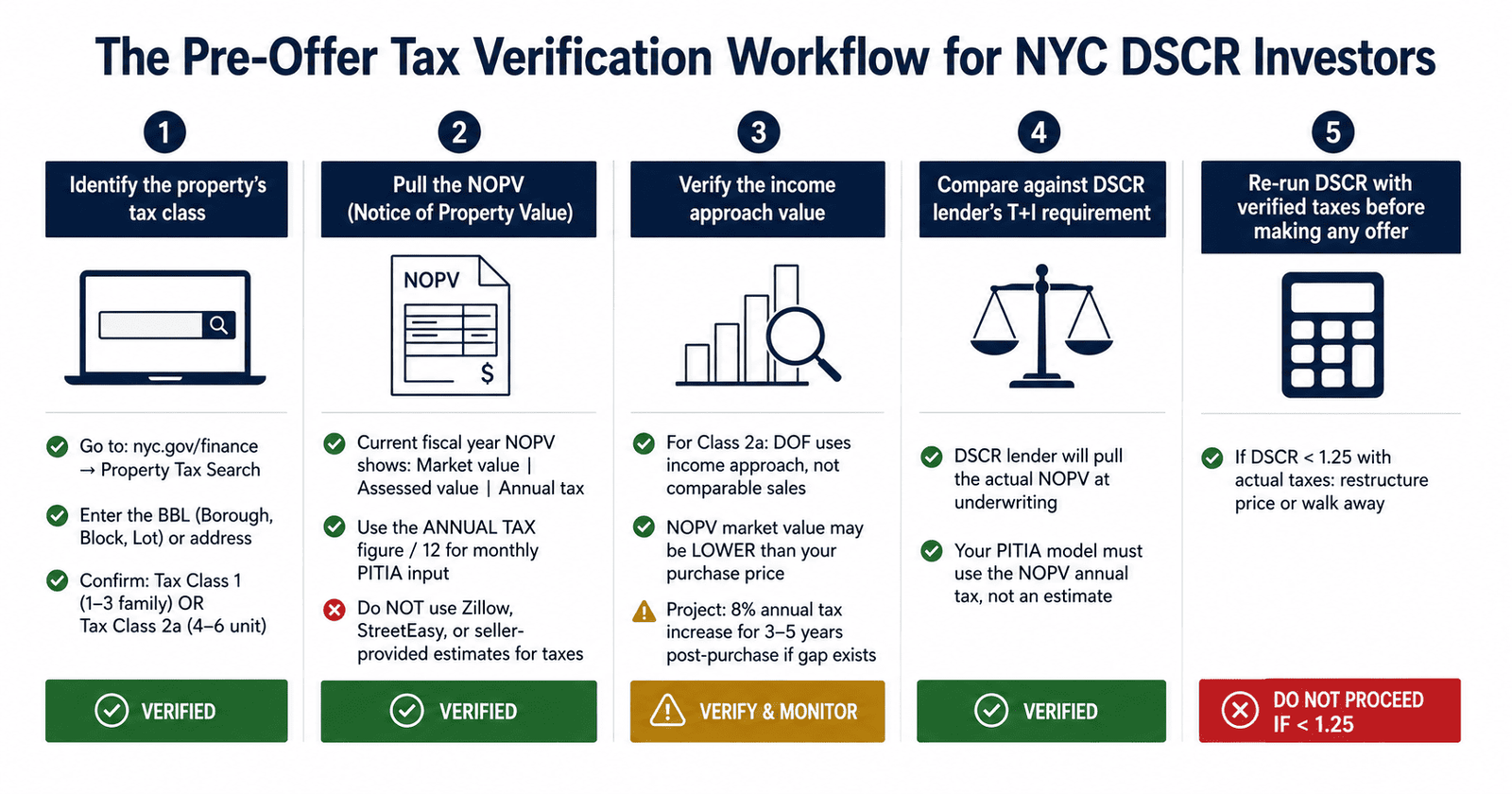
- Step 1 (Identify tax class): Go to nyc.gov/finance → Property Tax Search. Enter the BBL or address. Confirm: Tax Class 1 (1–3 family) or Tax Class 2a (4–6 unit). A 4-unit non-owner-occupied building should show Class 2a.
- Step 2 (Pull the NOPV): The Notice of Property Value is posted annually by the NYC DOF. It shows DOF market value, assessed value, and projected annual tax. Annual tax ÷ 12 = monthly tax input for PITIA. This is the authoritative figure.
- Step 3 (Check the income-approach gap): Compare the NOPV DOF market value to your purchase price. If DOF market value is significantly below your purchase price, expect the assessment to increase toward the 45% ratio at up to 8%/year post-purchase. Factor this into hold-period DSCR trajectory.
- Step 4 (Do not use listing estimates): Zillow, StreetEasy, and broker pro formas regularly show outdated tax figures based on Class 1 assumptions or prior-owner assessment history. None is the figure the DSCR lender will use.
- Step 5 (Re-run DSCR with verified taxes): Enter the verified monthly tax into the DSCR formula before modeling any offer price. A deal at 1.25 DSCR with accurate Class 2a taxes is fully understood before contract. A deal modeled with wrong taxes will surprise at underwriting.
FAQ: NYC 3-Family vs 4-Family DSCR
Can a 4-unit building ever be classified as Tax Class 1?
Generally, no. Under NY Real Property Tax Law §1802, Class 1 is specifically limited to 1–3 family homes. A 4-unit non-owner-occupied building is Class 2a by definition. Owner-occupied duplexes and triplexes are Class 1; a 4-unit with one owner-occupied unit is still Class 2a.
NYC 3-Family vs 4-Family DSCR: If I convert a 4-family to a 3-family, does the tax class change?
Yes, but the conversion must be reflected in the Certificate of Occupancy and verified by the DOF. Simply removing a kitchen or closing off a unit without a formal CofO change does not reclassify the property. A formal CofO amendment, DOF reclassification application, and typically a multi-year lag are required before the assessed value rolls down to the Class 1 formula. Consult a NYC property attorney before executing any conversion strategy.
Does the tax class affect which DSCR programs a property qualifies for?
Not directly. DSCR lenders evaluate by unit count and ownership type (non-owner-occupied 1–4 unit), not by tax class. A 4-family qualifies for residential DSCR programs the same as a 2-family or 3-family. The tax class affects the T+I component of PITIA, which affects the DSCR ratio, which affects whether the deal qualifies at the proposed purchase price and loan amount.
NYC 3-Family vs 4-Family DSCR: How can the DOF income-approach value be lower than my purchase price?
The DOF’s income approach models income using typical parameters for the building type and neighborhood — not the actual lease roll. If the building has below-market rents, rent-stabilized units, or recent vacancies, the DOF’s model may produce a value below what an investor paying for future rent upside would pay. The gap is not a problem at origination, but it is a signal that the assessment is likely to rise as the DOF’s model updates.
Buyers at above-DOF-value prices should model 5–8% annual tax increases for the first 3–5 years of ownership.
Have a 3-family or 4-family deal where the tax class or PITIA is the open question? The Deal Review runs the verified DSCR with the correct NYC tax inputs.
The good news: the NYC DOF property lookup takes under 5 minutes and is publicly available at no cost. Every NYC property address resolves to a BBL (borough-block-lot) number, and the BBL lookup confirms tax class, current assessment, annual tax bill, and any pending assessment changes. Run this lookup before any offer on any NYC 3- or 4-family property. The deal killers list includes tax class misidentification as a top-5 DSCR submission error — and it is entirely preventable.
NYC 3-Family vs 4-Family DSCR: The Pre-Submission Verification That Prevents the Trap
How to Confirm Tax Class Before Going Under Contract
The NYC 3-family vs 4-family DSCR tax class determination is not the investor’s job — it is the NYC Department of Finance’s job. But the investor needs to verify the result before modeling the deal. The DOF property search at nyc.gov/finance shows the tax class for every property in the five boroughs by address or BBL number. For any 3- or 4-family property under consideration, pull the DOF property detail before running the DSCR model.
A Class 1 designation means actual assessed value method — taxes may be lower than the Class 2 equivalent. A Class 2 designation means income-based assessment — taxes may be higher and more variable. The difference can be $2,000–$6,000/year in annual property taxes on the same building, which translates to 0.04–0.12 DSCR points.
The 3-Family That Gets Assessed Like a 4-Family
The most dangerous NYC 3-family vs 4-family DSCR scenario is the property that has been reclassified from Class 1 to Class 2 without the current owner’s knowledge. NYC DOF can reclassify properties based on permit history, income statements, or physical inspection. A 3-family that added a basement unit — legally or illegally — and received a certificate of occupancy change may now appear in the DOF records as a 4-unit Class 2 property.
The investor doing a deal on what the broker calls “a 3-family” needs to verify the DOF classification independently. Broker listings and prior MLS records are not authoritative. The DOF property detail is the only reliable source.
The practical pre-contract checklist for any NYC 3- or 4-family DSCR deal: pull the DOF property detail, confirm tax class, confirm annual tax bill, confirm the BBL matches the address, and check for any pending assessment changes or appeals. This takes 10 minutes. Failing to do it can result in a PITIA calculation that is $300–$500/month off —
which, on a deal where the margin between 1.22 and 1.25 DSCR is razor-thin, is the difference between a deal that funds and a deal that does not. The deal killers list covers tax class misidentification as one of the top NYC-specific DSCR deal failures.
The One Lookup That Changes the Model
NYC 3-family vs 4-family DSCR analysis requires exactly one additional data lookup that most national DSCR frameworks never mention: the Notice of Property Value for the specific building, from the NYC Department of Finance, before any offer is made. A 3-family and a 4-family in the same Brooklyn block, priced within $200,000 of each other, can have an $800–$1,000/month difference in property taxes because of the Class 1 / Class 2a boundary. The lender knows this.
The investor who learns it at underwriting, after signing a contract, is in a restructure-or-walk situation with a ticking clock and earnest money on the line.
The 3-family is not automatically the better deal. The 4-family is not automatically the trap. What creates the trap is modeling the 4-family with 3-family tax assumptions. That error is corrected in 10 minutes at nyc.gov/finance. The deal’s actual DSCR position — with verified Class 2a taxes, accurate income-approach escalation risk, and a stress test at combined adverse conditions — is what the investor should know before the offer, not after the appraisal.