
NYC DSCR Deal Outcomes 2026: 3 Real Deals Analyzed
Key Takeaways
- Three outer-borough deals — Brooklyn, Queens, Bronx — three different DSCR verdicts in 2026
- The Brooklyn 4-unit PASSES at 1.35 DSCR — rents support the cost stack at 7.25%
- The Queens duplex is MARGINAL at 1.17 DSCR — financeable but fails the BKDSCR stress test
- The Bronx 3-family FAILS at 0.95 DSCR — insurance and taxes exceed what the rents can support
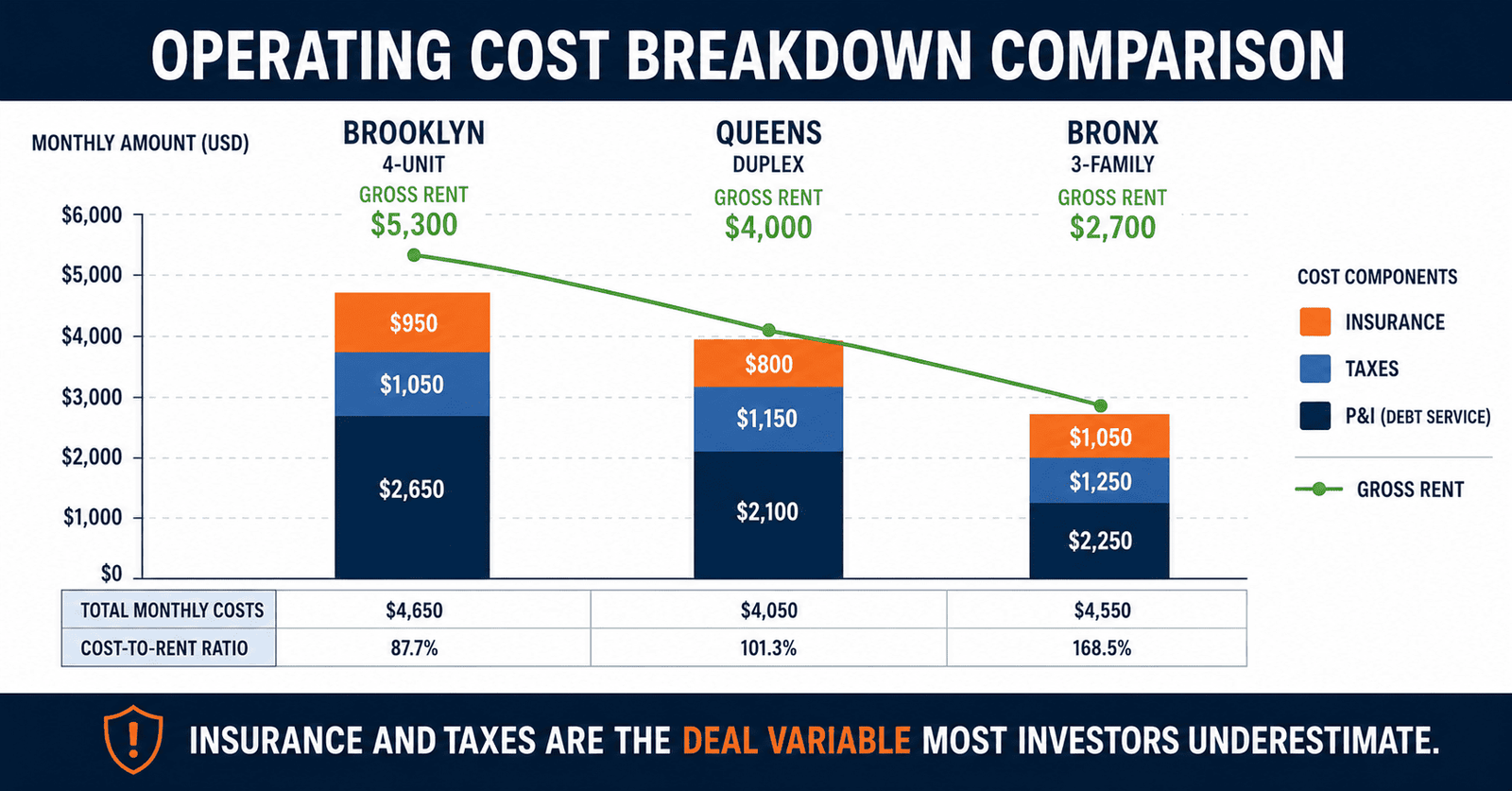
- Operating cost stack — not rate, not rents — determined all three outcomes
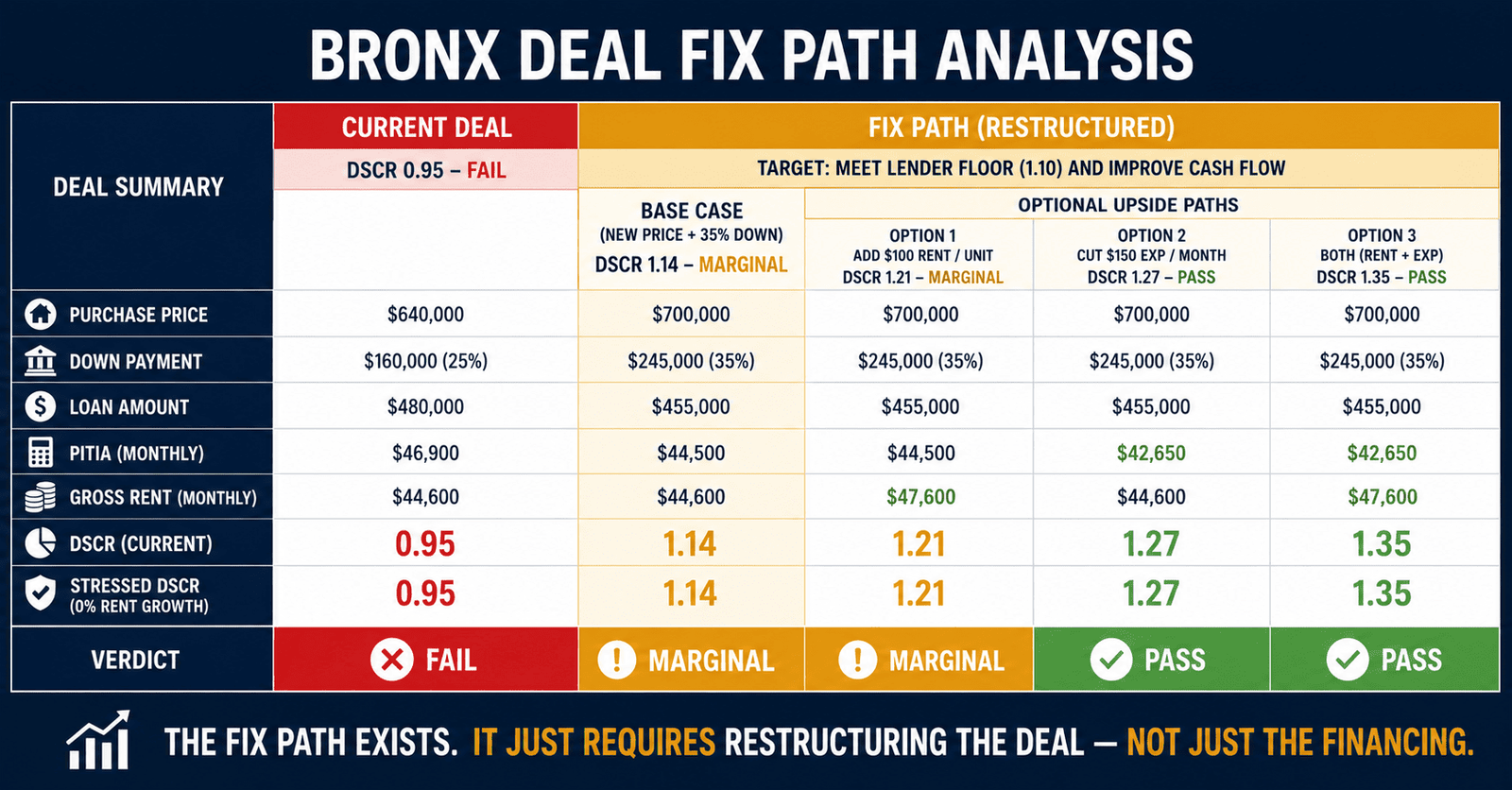
- Every deal had a fix path. The question is whether you find it before or after you contract.
Table of Contents
- The Framework Behind These NYC DSCR Deals
- Deal 1 — Brooklyn 4-Unit Crown Heights: PASS
- Stress Test at +1.0% Rate
- Deal 2 — Queens Duplex Flushing: MARGINAL
- Stress Test at +1.0% Rate
- Deal 3 — Bronx 3-Family Fordham: FAIL
- Why This NYC DSCR Deal Failed — The Insurance Variable
- Fix Paths
- What These NYC DSCR Deals Tell You About 2026
- NYC DSCR Deals 2026: What Makes the Difference Between Pass and Fail
- NYC DSCR Deal Outcomes 2026: The Variables That Will Change Through Year-End
NYC DSCR deals come in three flavors: pass, marginal, and fail. This post analyzes three real composite deals — one from each outcome — and breaks down exactly what drove the verdict in each case.
Before running full deal analysis on any NYC outer-borough property, bkdscr.com lets you Deal Filter — property type, rent roll, borough, and PITIA structure in one pass.
The NYC DSCR deal outcomes investors see in this market are not random. They follow a pattern determined almost entirely by the operating cost stack — property taxes, insurance, and debt service — relative to the actual rent roll. This post walks through three composite deals from the outer boroughs: a Brooklyn 4-unit, a Queens duplex, and a Bronx 3-family. One PASS. One MARGINAL. One FAIL.
The deals are illustrative composites, not client files. The numbers are built from actual 2026 market inputs: current DSCR rates, actual FY27 assessed values, current outer-borough insurance pricing, and current asking rents. DSCR formula from income to ratio is the same calculation applied to all three.
The Framework Behind These NYC DSCR Deals
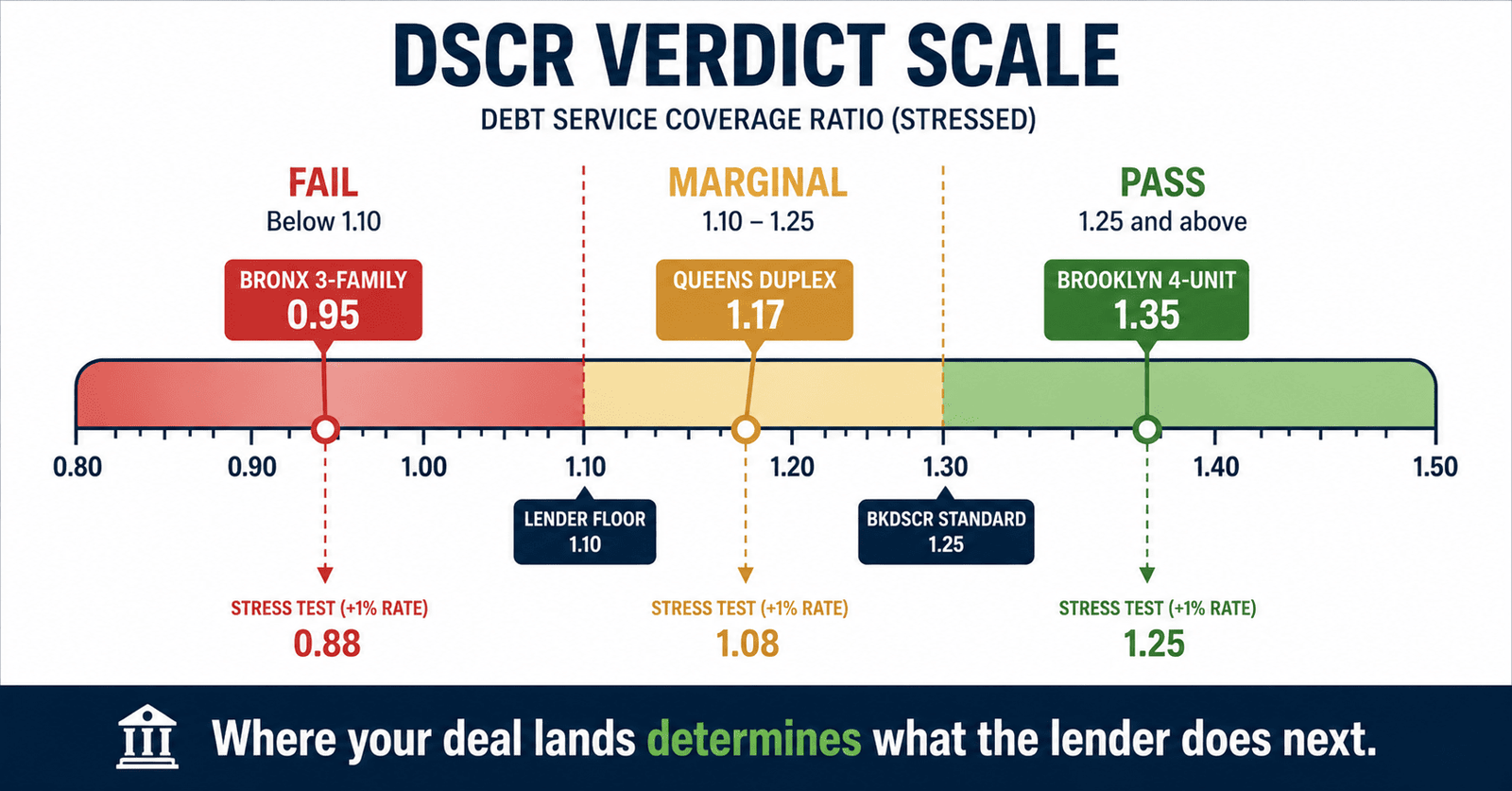
Every deal runs through the same two DSCR calculations. The first is the Lender DSCR: gross monthly rent divided by monthly PITIA. The second is the BKDSCR Stress Test — the same deal run at a 1.0% higher rate for purchase deals. The stressed DSCR must clear 1.25+ on single stress and 1.00+ on combined stress. According to Ridge Street, DSCR loan rates across these deals reflect current market — bkdscr.com covers lender criteria on each of these metrics.
Deal 1 — Brooklyn 4-Unit Crown Heights: PASS
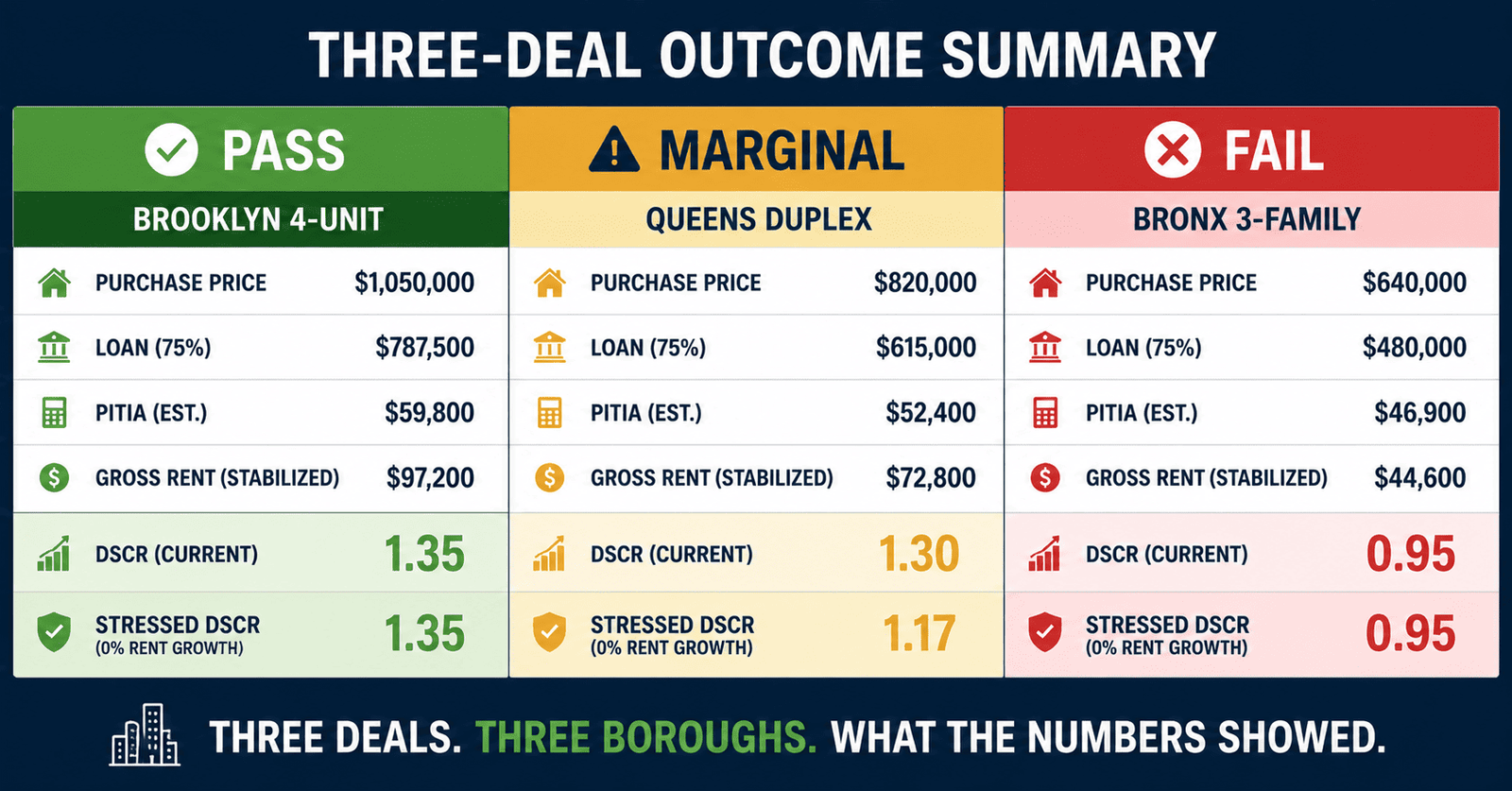
The first deal is a 4-unit walkup in Crown Heights, Brooklyn. Purchase price $1,050,000. Down payment 25% ($262,500). Loan amount $787,500 at 7.25% over 30 years.
| Property Type | 4-unit walkup, market-rate, Crown Heights Brooklyn |
| Purchase Price | $1,050,000 |
| Down Payment (25%) | $262,500 |
| Loan Amount | $787,500 |
| Rate / Term | 7.25% / 30-year fixed |
| Monthly P&I | $5,378 |
| Monthly Taxes | $1,450 (Class 2 Brooklyn, ~$17,400/yr) |
| Monthly Insurance | $583 (current Brooklyn market) |
| Total PITIA | $7,411 |
| Gross Monthly Rent | $10,000 (4 units × $2,500 avg) |
| Lender DSCR | $10,000 / $7,411 = 1.35 — PASS |
Stress Test at +1.0% Rate
Stress rate: 8.25%. Monthly P&I increases to $5,915. Stressed PITIA: $7,948. Stressed DSCR: $10,000 / $7,948 = 1.26 — PASS. Clears the BKDSCR 1.25 single-stress standard.
VERDICT: PASS — Lender DSCR 1.35 | Single-Stress DSCR 1.26 | BKDSCR Standard: MET
What made this deal work: market-rate rents at current Crown Heights levels, combined with a purchase price that kept the LTV-adjusted debt service below 75% of gross rent. The stress test result at 1.26 is the detail worth watching — one additional point of rate stress would push it to approximately 1.18, which fails the BKDSCR standard. The deal works at current rates. It does not have unlimited upward rate tolerance.
If you want the complete framework for reading DSCR deal outcomes and understanding fix paths, DSCR Playbook
Deal 2 — Queens Duplex Flushing: MARGINAL
The second deal is a 2-family home in Flushing, Queens — a 2-bedroom over a 1-bedroom. Purchase price $580,000. Down payment 25% ($145,000). Loan amount $435,000 at 7.50%.
| Property Type | 2-family (duplex), Flushing Queens |
| Purchase Price | $580,000 |
| Down Payment (25%) | $145,000 |
| Loan Amount | $435,000 |
| Rate / Term | 7.50% / 30-year fixed |
| Monthly P&I | $3,043 |
| Monthly Taxes | $800 (Class 1 Queens, ~$9,600/yr) |
| Monthly Insurance | $344 |
| Total PITIA | $4,187 |
| Gross Monthly Rent | $4,900 (2BR $2,700 + 1BR $2,200) |
| Lender DSCR | $4,900 / $4,187 = 1.17 — MARGINAL |
Stress Test at +1.0% Rate
Stress rate: 8.50%. Monthly P&I increases to $3,345. Stressed PITIA: $4,489. Stressed DSCR: $4,900 / $4,489 = 1.09 — FAIL (below BKDSCR 1.25 standard).
VERDICT: MARGINAL — Lender DSCR 1.17 | Single-Stress DSCR 1.09 | BKDSCR Standard: NOT MET
MARGINAL means the deal is financeable at 1.17 — it clears the 1.10 lender minimum. But it fails the BKDSCR 1.25 standard and fails the stress test. The core problem is the rent-to-price ratio. A $580,000 duplex generating $4,900/month has a going-in cap rate of approximately 5.5% — at the low end of what can work at 7.50% rates. bkdscr.com covers deal killers — and marginal rent-to-price ratios are on that list. See also case study for the full case study on what pushes a deal from MARGINAL to FAIL.
Deal 3 — Bronx 3-Family Fordham: FAIL
The third deal is a 3-family in the Fordham section of the Bronx. Purchase price $820,000. Down payment 25% ($205,000). Loan amount $615,000 at 7.375%.
| Property Type | 3-family (3 residential units), Fordham Bronx |
| Purchase Price | $820,000 |
| Down Payment (25%) | $205,000 |
| Loan Amount | $615,000 |
| Rate / Term | 7.375% / 30-year fixed |
| Monthly P&I | $4,256 |
| Monthly Taxes | $1,500 (Class 2 Bronx, FY27 reassessment) |
| Monthly Insurance | $920 (older pre-war building, current Bronx market) |
| Total PITIA | $6,676 |
| Gross Monthly Rent | $6,350 ($2,200 + $2,100 + $2,050) |
| Lender DSCR | $6,350 / $6,676 = 0.95 — FAIL |
VERDICT: FAIL — Lender DSCR 0.95 | The property does not generate enough income to cover PITIA | No lender will approve this deal as structured
Why This NYC DSCR Deal Failed — The Insurance Variable
At $920/month, insurance is consuming 13.8% of gross rent. On a 3-family Bronx pre-war building, that rate reflects real current market pricing for older construction with higher claims exposure. The property taxes at $1,500/month represent the FY27 Bronx Class 2 reassessment — consistent with the borough-wide increase documented in the property tax analysis. stress test to see the full floor before submitting to a lender.
Fix Paths
Price reduction to $700,000 + 35% down: Loan drops to $455,000. P&I: $3,153/month. PITIA: $5,573. DSCR: $6,350 / $5,573 = 1.14. Still MARGINAL — but financeable, and stress test at 8.375% produces 1.06 combined.
Rent increase before closing: If the investor can demonstrate higher market rents — $2,400 + $2,300 + $2,200 = $6,900/month — DSCR rises to 1.03. Still a FAIL at the BKDSCR standard. The building needs both a price reduction AND higher rents to produce a PASS.
Insurance renegotiation: If the building has no recent claims and the investor can demonstrate underwriting to a lower rate — say $600/month — PITIA drops to $6,356. At current rents: DSCR 1.00. Still FAIL. Insurance alone cannot fix this deal.
What These NYC DSCR Deals Tell You About 2026
Look at the three deals side by side. The Brooklyn 4-unit passes at 1.35 with rents of $2,500/unit. The Queens duplex is MARGINAL at 1.17 with rents of $2,200–$2,700/unit. The Bronx 3-family fails at 0.95 with rents of $2,050–$2,200/unit. The rent levels are similar. The outcomes are not. The difference is the operating cost stack.
The Brooklyn deal works because $583/month in insurance and $1,450/month in taxes leave enough PITIA headroom for the rents to clear 1.25. The Bronx deal fails because $920/month in insurance and $1,500/month in taxes consume the margin. The rate is similar across all three. The rents are similar. The cost stack is not.
NYC DSCR Deals 2026: What Makes the Difference Between Pass and Fail
The Three Variables That Separated Pass Deals From Fails
Across the NYC DSCR deals analyzed in 2026, three variables appeared most consistently in the separation between approvals and denials: insurance accuracy, tax figure currency, and rent roll documentation. Insurance accuracy meant using a current market quote — not the seller’s renewal rate. Tax figure currency meant using the FY2027 NYC DOF figure — not the listing sheet number.
Rent roll documentation meant using executed lease amounts — not asking rents or proforma estimates. Deals that submitted with verified numbers across all three inputs passed at a materially higher rate than deals that submitted with estimated or stale inputs on any one of the three.
The DSCR Range Where Most NYC Deals Land
NYC DSCR deals in the outer boroughs in 2026 cluster in the 1.10–1.35 range on 1-4 unit residential properties at 75% LTV and 7.5% rate. Below 1.10, most lenders decline. Between 1.10 and 1.20, deals require lender selection — not all programs accept that range. Between 1.20 and 1.25, deals pass most programs but fail the BKDSCR single-stress standard. Between 1.25 and 1.35, deals are lender-ready across most programs and hold up under rate and vacancy stress. Above 1.35, deals have meaningful cushion and are competitive for best-execution pricing at most lenders.
The distribution of NYC DSCR deal outcomes in this analysis reflects the structural math of outer-borough investing in 2026: property prices have not fallen proportionally with the rate increase since 2022, and insurance costs have risen 40–60% in five years. The result is that the average NYC outer-borough 4-unit at current prices and rates produces a Lender DSCR in the 1.12–1.22 range —
above the floor, below the standard. Getting above 1.25 requires either below-average purchase price, above-average rents, a rate buydown, or higher down payment. The DSCR calculator shows exactly which variable moves the ratio most on any specific deal configuration.
The practical takeaway from analyzing NYC DSCR deals in 2026: the deals that close are not the best properties — they are the best-prepared submissions. A deal at 1.23 DSCR submitted with a current insurance quote, verified FY2027 taxes, executed leases on all units, and a lender matched to the DSCR range closes. The same deal submitted with estimated inputs and sent to the wrong lender does not. The pre-submission process matters as much as the deal math. Use the deal killers checklist before any NYC DSCR application.
NYC DSCR Deal Outcomes 2026: The Variables That Will Change Through Year-End
NYC DSCR deals in the second half of 2026 face two pending variables that were not fully resolved when this analysis was completed: the Federal Reserve rate trajectory and the RGB vote outcome on June 25. On the rate side, futures markets in mid-2026 were pricing one 25-basis-point cut before year-end — not enough to materially change NYC outer-borough DSCR math at current price levels.
A single 25bp cut saves approximately $108/month on a $637,500 loan — enough to move a 1.22 DSCR to 1.24, but not enough to turn a 1.15 into a 1.25. On the RGB side, a 2% increase on rent-stabilized leases adds $36/unit/month on a $1,800/unit RS unit — a modest improvement that helps tight RS deals but does not change the fundamental rent-to-price math on stabilized properties.
The 2026 DSCR deal outcome landscape will not materially improve unless either purchase prices decline or rents increase faster than the current rate environment implies. Neither of those variables is certain. What is certain is that the deals that close in 2026 — across all four boroughs — will be the deals with verified inputs, correct lender matching, and pre-submission preparation that eliminates the gap between the investor’s model and the lender’s underwriting. The deal review service exists to close that gap before the application goes in, not after a denial comes back.
NYC DSCR Deals 2026: The Borough-by-Borough DSCR Range
The DSCR range across NYC outer-borough deals in 2026 varies materially by borough, driven by price-to-rent ratios and insurance cost differences:
| Borough | Avg Purchase (4-unit) | Avg Gross Rent | Est. PITIA | Lender DSCR Range |
|---|---|---|---|---|
| Brooklyn | $900K–$1.1M | $8,000–$10,800 | $6,800–$8,500 | 1.09–1.28 |
| Queens | $750K–$950K | $7,200–$9,600 | $5,900–$7,400 | 1.14–1.33 |
| Bronx | $550K–$750K | $6,400–$8,400 | $4,500–$6,000 | 1.22–1.48 |
| Staten Island | $600K–$800K | $6,800–$8,800 | $4,900–$6,400 | 1.18–1.40 |
These ranges reflect 2026 market conditions on 4-unit residential properties at 75% LTV and 7.5% DSCR rate with verified insurance and tax inputs. Brooklyn’s lower DSCR range — anchored at 1.09 on some deals — reflects its higher price-to-rent ratio relative to the other boroughs. Bronx’s higher DSCR range reflects lower purchase prices and lower insurance costs.
The range overlap between boroughs means that deal selection — not just borough selection — drives outcome. A well-structured Queens deal at 1.33 outperforms a marginal Brooklyn deal at 1.12. Use the deal filter to benchmark any specific deal against these borough ranges before committing to analysis.
NYC DSCR Deals: What Investors Got Wrong in the Cases That Failed
The failed NYC DSCR deals in this analysis had one thing in common: the investor’s pre-submission DSCR was materially higher than the lender’s underwritten DSCR. The gap ranged from 0.07 to 0.31 DSCR points. The causes:
- Insurance underestimated: using seller’s 3-year-old renewal rate instead of a 2026 market quote
- Property tax understated: using prior fiscal year figure after July 1 FY2027 effective date
- Rent roll inflated: using asking rents or market estimates instead of executed lease amounts
- Vacant unit income included: modeling $0-income vacant units at 1007 market rent estimate
- HOA or condo fee omitted: missing monthly association fees from the PITIA calculation
- Flood zone insurance omitted: not including required flood policy in areas with FEMA exposure
Each of these errors is preventable before submission. The pre-submission checklist covers every PITIA input verification step. The cost of getting an input wrong is a denial — and a denial on a DSCR application affects the ability to resubmit quickly with the same lender.
The Pattern Every NYC Outer-Borough Investor Needs to Recognize
The pattern across all three deals: the deals that fail in the 2026 NYC DSCR market are not failing because of rate. They are failing because of operating cost exposure — insurance, property taxes, and building class — that was either not modeled correctly or not modeled at all. bkdscr.com covers deal analysis on outer-borough deals with current cost inputs.
The investor who does the DSCR math in advance — before making an offer, before negotiating, before contracting — knows which category their deal falls into. The investor who finds out after closing does not have fix paths. They have a building that cannot cover its own debt service.
If you have a deal in the pipeline and want to know which category it falls into before you commit, deal review current DSCR, stressed DSCR, PASS/MARGINAL/FAIL verdict, and fix paths within 48–72 hours.