NYC Landlord Insurance DSCR Doubled: The Exact DSCR Cost Math
- NYC landlord insurance premiums rose 40–60% since 2022 for outer-borough multifamily — and more than doubled on pre-war buildings since 2019
- A $400/month insurance increase drops Lender DSCR by approximately 0.06–0.09 points at 75% LTV
- The BKDSCR standard requires current market insurance pricing — not the prior owner’s renewal rate
- Buildings over 12 units, mixed-use, and buildings with claims history face the largest increases
- Insurance is now the fastest-growing PITIA line item in the outer boroughs — ahead of property tax
- A deal that passes DSCR at the seller’s insurance number often fails at current market pricing
Table of Contents
- NYC Landlord Insurance Doubled: What the Premium Increases Actually Look Like
- What Changed Between 2019 and 2026
- The DSCR Math: What a $400/Month Insurance Increase Actually Costs
- NYC Landlord Insurance Doubled: Why the Bronx Is Hardest Hit
- Building Age and Claims History: The Two Variables That Control Your Premium
- How to Model NYC Landlord Insurance in Your DSCR Calculation
- Insurance Inputs to Use When You Cannot Get a Quote
- Five Moves That Reduce the Insurance PITIA Impact
- Frequently Asked Questions
- How much has NYC landlord insurance increased since 2019?
- Does the lender use my current insurance cost or a market estimate for DSCR?
- Can I use a higher deductible to improve my DSCR?
- Bottom Line — NYC Landlord Insurance DSCR 2026
NYC Landlord Insurance Doubled on some outer-borough buildings since 2019 — and unlike rate increases or tax reassessments, the insurance spike is structural, not cyclical. Carriers have exited the NYC market permanently. The Scaffold Law litigation environment has not changed. Water damage claims continue to drive loss ratios above sustainable levels. The result is a PITIA denominator that is materially higher than most investors underwrote — and a DSCR formula that reflects every dollar of that increase.
| MARKET SNAPSHOT — NYC Landlord Insurance, May 2026 | |
|---|---|
| Sources: BKDSCR Research | |
| Premium Increases Since 2019 (CredDaily / Daisy / BKDSCR analysis): | |
| Pre-war Brooklyn/Bronx buildings | +150% to +200% since 2019 |
| Post-1980 construction | +60% to +90% since 2019 |
| Flood-zone Staten Island/Queens | +180% to +250% (incl. flood policy) |
| NYC CRE insurance costs (CredDaily) | Up 30–40% in 2024–25 alone |
| Monthly Premium Ranges (May 2026, outer-borough 1-4 unit): | |
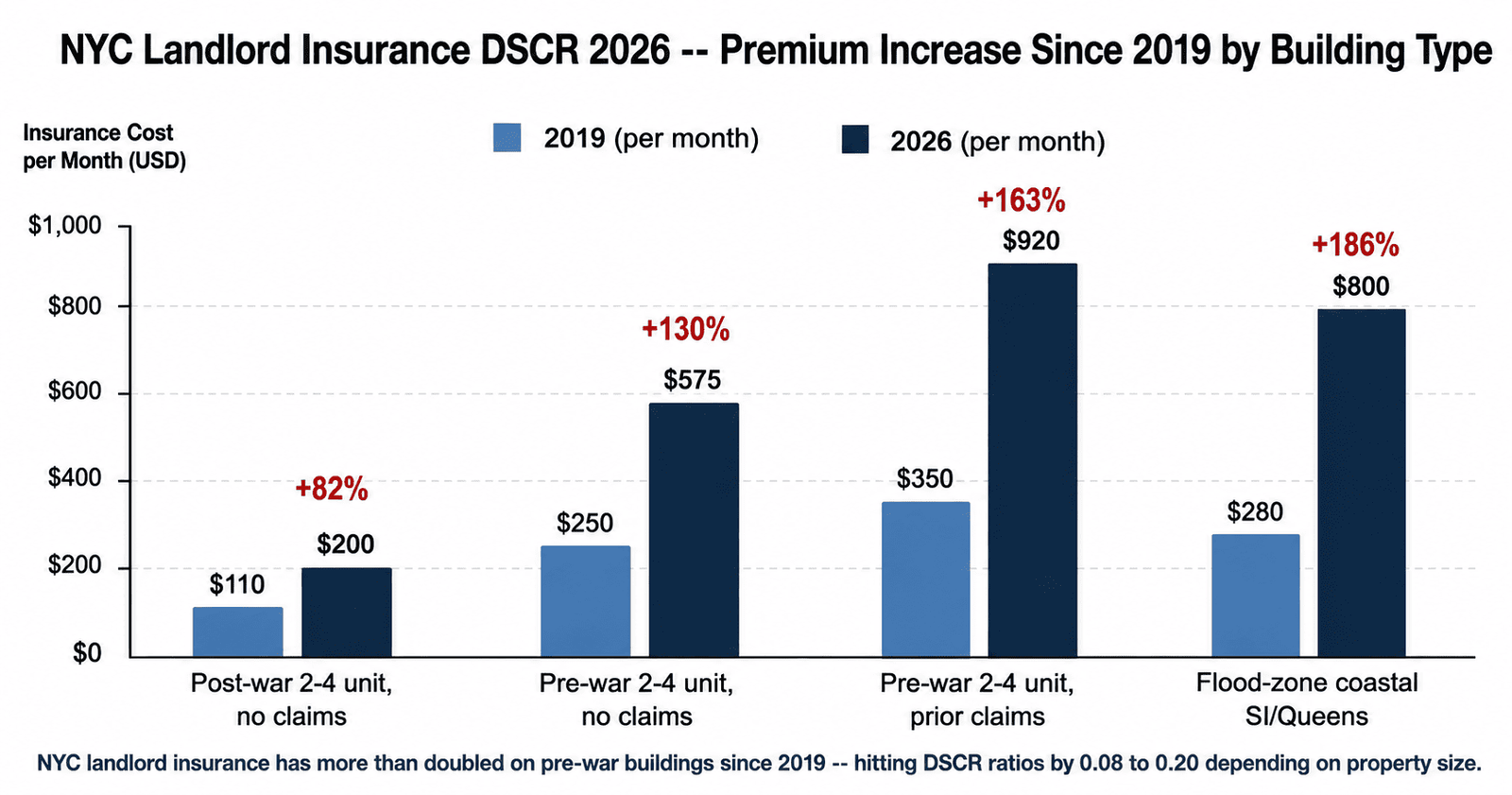
| Post-war 2-4 unit, clean claims | $175–$350/month |
| Pre-war 2-4 unit, no prior claims | $400–$700/month |
| Pre-war 2-4 unit, prior claims | $700–$1,200/month |
| Flood zone add-on (SI/Queens coast) | +$300–$600/month |
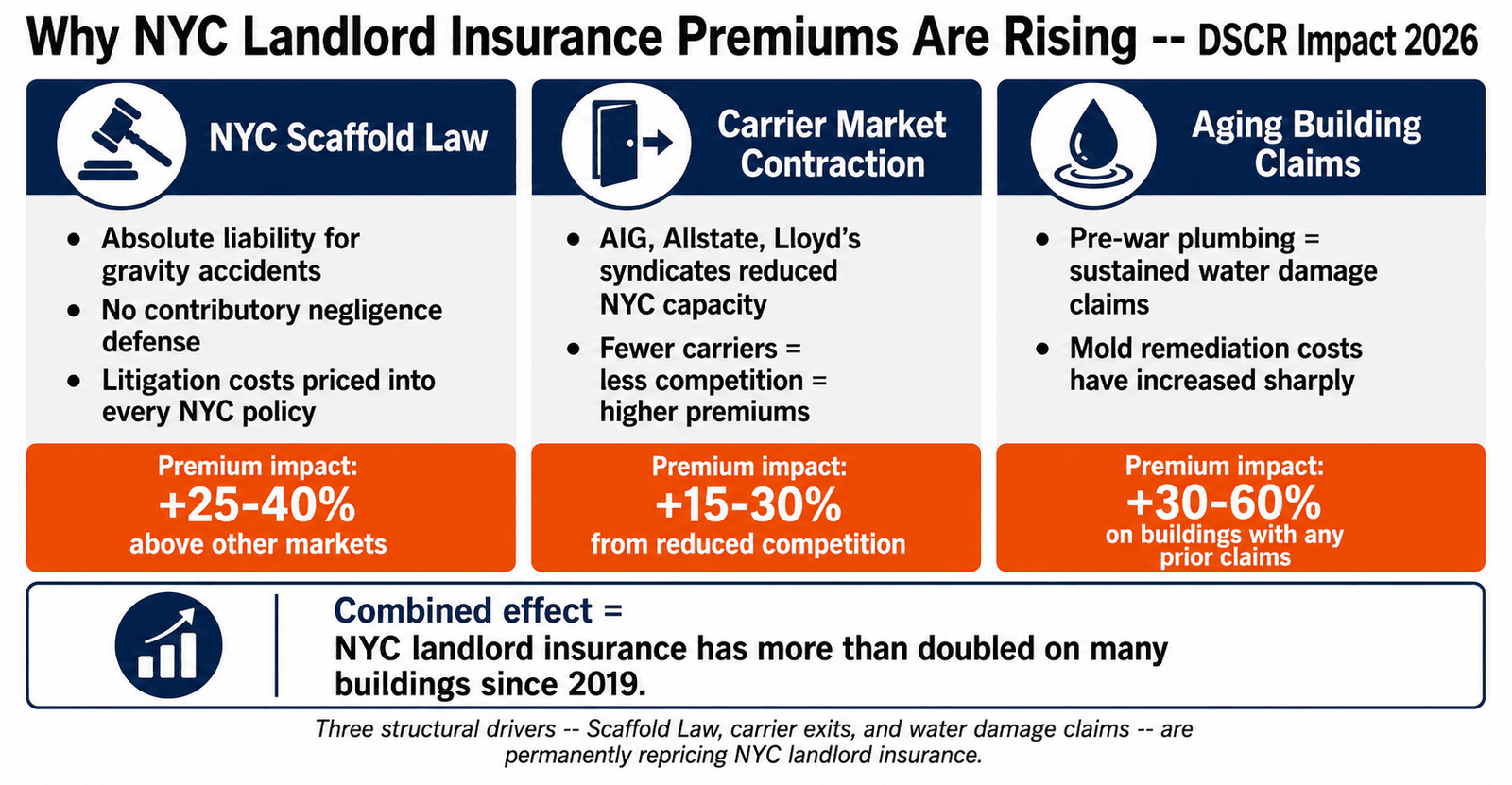
| Primary Drivers | NYC Scaffold Law litigation | Carrier exits | Water damage claims |
Start with the Deal Filter — property type, rent roll, unit count, and PITIA in 60 seconds.
NYC Landlord Insurance Doubled: What the Premium Increases Actually Look Like
According to CredDaily, commercial real estate insurance costs in New York rose 30–40% in 2024–25 alone — on top of the increases that had already accumulated since 2019. For multifamily landlords, this is not a one-time adjustment. It is a sustained repricing driven by three structural factors that are unlikely to reverse near-term. Before running any deal with elevated insurance, run a deal analysis to confirm PITIA does not disqualify the property.
The pattern is consistent with what Daisy’s 2026 analysis of rising building insurance costs documents: NYC landlords are seeing premium increases driven by loss history, building age, and carrier consolidation — not by general inflation. A building that had clean claims for a decade and renewed at $3,600/year in 2019 is now renewing at $7,200 to $9,600/year for equivalent coverage. That is $300 to $400 per month added directly to PITIA. See also: cap rate DSCR relationship.
What Changed Between 2019 and 2026
- Scaffold Law litigation. New York’s Labor Law Section 240 holds property owners absolutely liable for gravity-related construction accidents, regardless of worker negligence. With no legislative reform in sight, the pricing trajectory continues upward.
- Carrier exits. Multiple national carriers have reduced or eliminated their NYC multifamily exposure since 2020. Fewer carriers competing for the same risk pool means higher premiums for the remaining options.
- Water damage claims. Aging pre-war plumbing in Brooklyn, the Bronx, and upper Manhattan has produced a sustained pattern of water intrusion and mold claims. Insurers now price older NYC building stock at a meaningful premium over comparable buildings in other markets.
The DSCR Math: What a $400/Month Insurance Increase Actually Costs
DSCR is gross rent divided by PITIA. Insurance sits in the denominator alongside P&I, taxes, and HOA. Every dollar of insurance increase is a dollar added to PITIA — which is a dollar the property’s gross rent now has to cover. There is no offset. The rent does not go up because the insurance went up. The ratio simply falls. See also: NYC property tax DSCR math.
The following composite deal shows the DSCR impact on a Brooklyn 4-unit at current rates, modeling the difference between a 2019-era insurance premium and a 2026 renewal premium on the same building.
| DEAL INPUT | FIGURE |
|---|---|
| Property Type | 4-unit walkup, pre-war, Brooklyn outer-borough |
| Purchase Price | $950,000 |
| Down Payment (25%) | $237,500 |
| Loan Amount | $712,500 |
| Rate / Term | 7.25% / 30-year fixed |
| Monthly P&I | $4,865 |
| Monthly Taxes | $1,100 (Brooklyn Class 2) |
| Gross Monthly Rent | $9,200 (4 units) |
Now model the insurance line at 2019 levels vs 2026 levels for this pre-war building:
| 2019 Insurance | 2026 Insurance | |
|---|---|---|
| Monthly Insurance | $250/month | $650/month |
| Total PITIA | $6,215 | $6,615 |
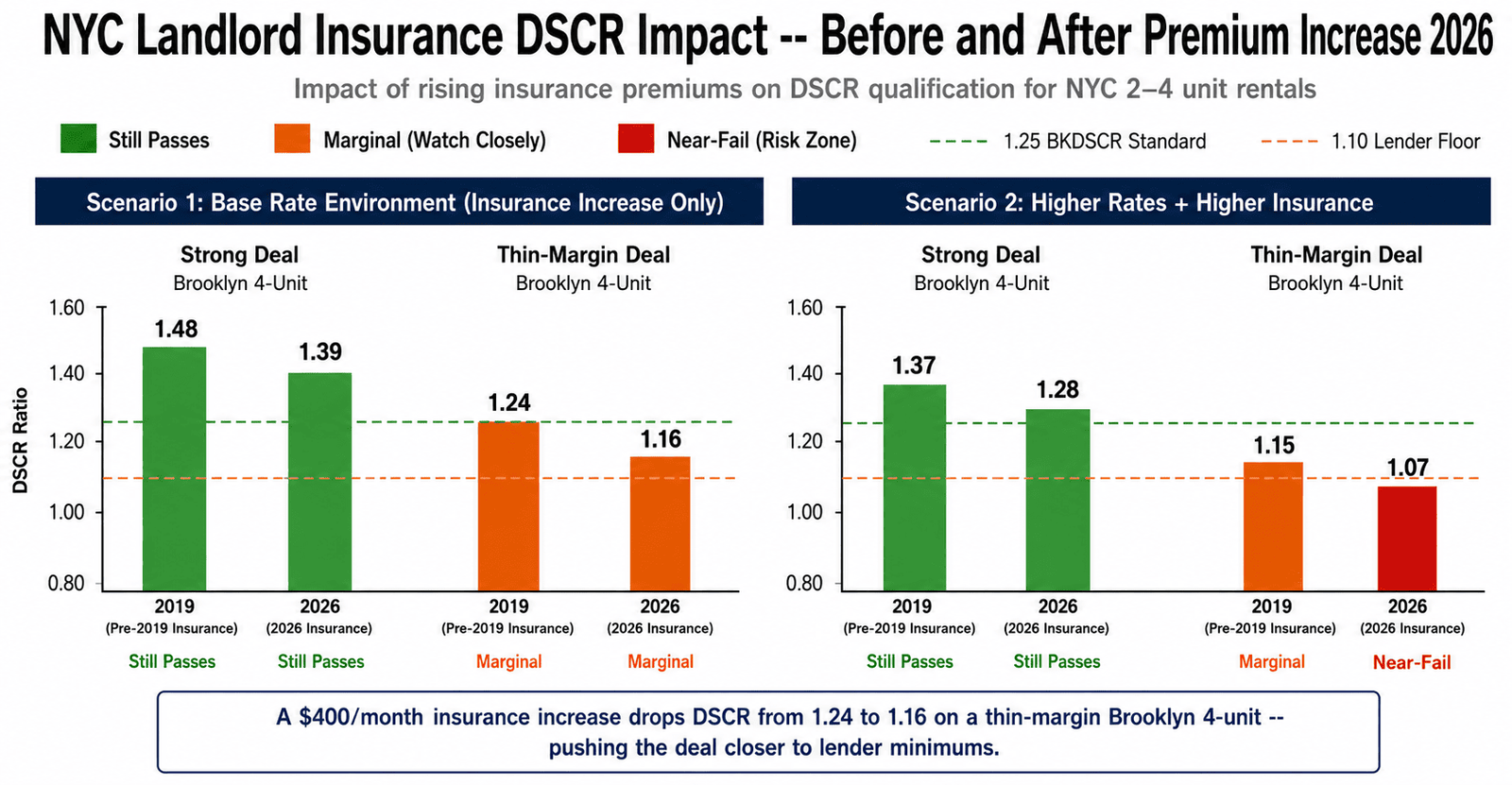
| Lender DSCR | 1.48 | 1.39 |
That is a 0.09-point DSCR decline from a single line item. On a deal that started at 1.48, the move to 1.39 is manageable — both clear the lender floor and the BKDSCR 1.25 stress standard. But now apply the same insurance increase to a deal that was already running thin:
| Thin-Margin Deal | 2019 Insurance | 2026 Insurance |
|---|---|---|
| Monthly Insurance | $250/month | $650/month |
| Total PITIA | $5,965 | $6,365 |
| Gross Monthly Rent | $7,400 | $7,400 |
| Lender DSCR | 1.24 | 1.16 |
| Stressed DSCR (+1%) | 1.15 | 1.07 |
| ⚠ INSURANCE IMPACT — 0.08-point DSCR drop | From marginal pass to near-fail | Stressed DSCR drops below 1.10 |
On a deal that was already marginal at 1.24 DSCR, a $400/month insurance increase drops the ratio to 1.16 — below the BKDSCR 1.25 stress standard and approaching the lender floor under stress. The deal that looked financeable at 2019 insurance levels does not look the same at 2026 renewal pricing.
NYC Landlord Insurance Doubled: Why the Bronx Is Hardest Hit
The insurance increase is not uniform across the five boroughs. The Bronx has been hit harder than any other outer-borough market — the combination of older pre-war building stock, higher prior claims rates from aging plumbing and roof systems, and a litigation environment that carriers have consistently priced at a premium. The DSCR impact in the Bronx is not 0.08 to 0.09 points — it is often 0.15 to 0.20 points on older buildings with any claims history.
A Bronx 3-family with a 2019 insurance premium of $350/month may be renewing in 2026 at $900 to $1,200/month if the building had any water damage or liability claim in the prior five years. At $1,100/month in insurance on a $6,800 gross rent, insurance alone is consuming 16.2% of gross rent — before P&I, taxes, or HOA are counted. That is a structural DSCR problem that no rent increase can fully offset at current market rent levels.
Building Age and Claims History: The Two Variables That Control Your Premium
- Building age and construction type. Pre-war wood-frame and brownstone construction carries the highest base premiums in 2026. These buildings have original plumbing systems that are 80–100+ years old and structural characteristics that increase the severity of any loss. Post-1980 brick construction with updated mechanicals prices materially lower. On the same block, the difference can be $300 to $500/month in annual premium for equivalent coverage.
- Claims history in the prior 5 years. A single water damage claim in the prior five years can increase renewal premiums by 40–80% and eliminate access to preferred carriers entirely. Before underwriting any NYC outer-borough deal, pull the CLUE (Comprehensive Loss Underwriting Exchange) report for the property. It documents every insurance claim filed on that address in the prior seven years. If the seller cannot document a clean loss history, build in a higher insurance assumption before you model DSCR.
Get the DSCR Playbook — every input, threshold, and deal-killer for NYC outer-borough investors in one place.
How to Model NYC Landlord Insurance in Your DSCR Calculation
Most investors underestimate insurance when modeling DSCR at the deal analysis stage. The most common error is using the seller’s current premium — which may reflect a policy written years ago, before the market repriced. The current renewal market is what your lender will see, and it is the number that ends up in PITIA.
The correct approach is to get a quote for the specific property before going under contract, not after. Call two or three brokers who specialize in NYC landlord coverage and ask for a ballpark premium on the specific address, building age, unit count, and coverage type required by your target lender (typically DP-3 with dwelling at replacement cost and $300,000+ liability). If the property has any prior claims, disclose them and ask for a quote that reflects that history.
Insurance Inputs to Use When You Cannot Get a Quote
If you need a planning estimate before getting actual quotes, use these conservative ranges for outer-borough NYC properties in 2026:
| PROPERTY TYPE | ESTIMATED PREMIUM |
|---|---|
| Post-war 2-4 unit, no claims (Brooklyn/Queens Class 1) | $175 – $325/month |
| Pre-war 2-4 unit, no prior claims (Brooklyn/Queens) | $400 – $650/month |
| Pre-war 2-4 unit, 1+ prior claims (any borough) | $700 – $1,100/month |
| Pre-war 3-4 unit, Bronx or North Brooklyn (high-risk tier) | $800 – $1,200/month |
| Any building in FEMA flood zone (SI/Queens coast) | Add $300 – $600/month |
Use the high end of the range as your DSCR planning input. If the actual quote comes in lower, the DSCR improves at closing. If you plan to the low end and the actual quote comes in higher, the deal may not close as modeled. Always run your deal through the stress test with your insurance estimate built in — it models your PITIA at +1.0% rate, showing the combined exposure of rate risk and insurance cost simultaneously.
Five Moves That Reduce the Insurance PITIA Impact
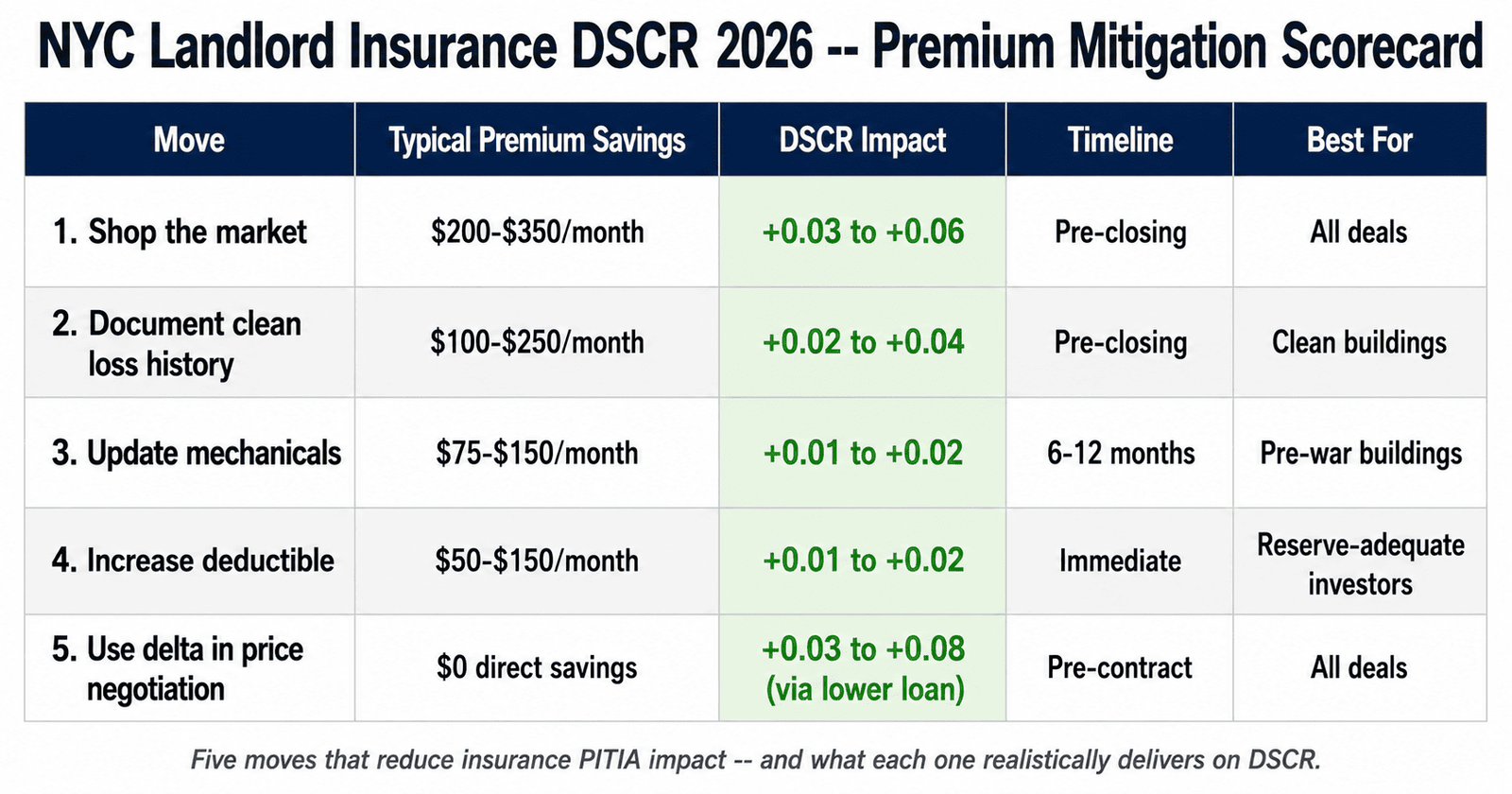
- Shop the market before binding. The first renewal quote is not the final quote. NYC landlord insurance pricing varies by 30–50% between carriers for comparable coverage on the same building. Use a commercial lines broker who specializes in NYC multifamily. On a $900/month renewal, finding an equivalent policy at $600/month adds $3,600/year back to NOI — enough to move the DSCR by 0.05–0.07 on a mid-size deal.
- Document a clean loss history. If the property has had no claims in the prior five years, request a CLUE report from the seller at contract and provide it to insurers at quote time. A verifiable clean loss history unlocks preferred carrier pricing.
- Update mechanicals before renewal. A documented electrical panel upgrade or plumbing update can reduce the risk profile a carrier assigns to a pre-war building. Some carriers offer discounts of 10–20% for properties with updated mechanicals.
- Increase the deductible. Moving from a $1,000 deductible to a $5,000 or $10,000 deductible can reduce annual premium by 15–25%. For investors with adequate reserves, this trade often makes sense from a DSCR perspective.
- Use the insurance cost in purchase price negotiation. If you obtain a quote pre-contract and the premium is materially higher than the seller’s current policy, that delta is a legitimate component of your offer price. A $400/month insurance increase over the seller’s current premium represents $4,800/year in additional operating cost — use it at the table.
Frequently Asked Questions
How much has NYC landlord insurance increased since 2019?
On pre-war 2-4 unit residential buildings in the outer boroughs, premiums have increased 130–200% since 2019 on a risk-adjusted basis. Post-war construction has seen increases in the 60–90% range. Flood-zone properties in Staten Island and coastal Queens have seen the largest increases — 180–250% when flood coverage is included — driven by FEMA flood map redesignations and carrier exits from coastal markets.
Does the lender use my current insurance cost or a market estimate for DSCR?
Lenders use the actual insurance cost that will be in force at closing — typically confirmed by a binder or declaration page from the insurer. If you provide an insurance estimate based on the seller’s current policy and your actual premium at closing is higher, the DSCR used in final underwriting will reflect the higher number. On a deal that was marginal at the lower estimate, that can produce a surprise at the closing table. Always get your own quote before the appraisal is ordered.
Can I use a higher deductible to improve my DSCR?
Yes. The lender specifies minimum coverage requirements — typically dwelling at replacement cost value, liability at $300,000 or more, and loss of rents coverage. The deductible is generally not specified by the lender. A higher deductible reduces monthly premium and therefore reduces PITIA, which improves DSCR. The trade-off is a higher out-of-pocket cost on any individual claim.
Bottom Line — NYC Landlord Insurance DSCR 2026
NYC landlord insurance DSCR 2026 is not a background line item. On pre-war outer-borough buildings, it is a primary variable that determines whether a deal qualifies, what rate tier it accesses, and how much margin it carries under stress. Premiums have more than doubled on some buildings since 2019, driven by structural market forces — the Scaffold Law, carrier exits, and water damage claims — that are unlikely to reverse near-term.
The investors who get surprised by insurance costs are the ones who modeled the seller’s current premium instead of obtaining their own quote before contract. The investors who get hurt by insurance costs are the ones who closed a deal at 1.24 DSCR and are renewing at 1.16 three years later because the premium doubled at renewal. Both errors are preventable — and both come from treating insurance as a static input in a market where it has been anything but.
The DSCR formula does not care that the insurance market changed. It divides gross rent by whatever PITIA actually is. If that PITIA includes a $900/month insurance premium on a pre-war Bronx building instead of the $350 the deal was originally underwritten at, the ratio tells you exactly what the deal is worth under current conditions — not what it was worth in 2019.
Run a Deal Review — current DSCR, stressed DSCR, NOI, and updated tax assessment modeled at current inputs, delivered within 48–72 hours.