
NYC Outer Borough DSCR Cap Rates: What 5–6% Actually Means in 2026
- NYC outer-borough cap rates sit at 5–6% — the break-even cap rate for 1.25 DSCR at 7.5% loan rate is ~7%
- At 75% LTV and 7.5% rate, no outer-borough market segment currently trades at the break-even cap rate
- The gap between going-in cap rates and the break-even is 1–2 full percentage points — not basis points
- At 6% cap rate, only 65% LTV produces a passing DSCR — requiring a 35% down payment
- The Bronx and outer Queens Class C market (5.5–6.5%) is closest to viable at current rates
- Deals that are closing are using lower LTV, assumable debt, value-add rent upside, or mixed-use income
Table of Contents
- The Negative Leverage Problem — Why 5-6% Cap Rates and 7.5% Loan Rates Don’t Work
- NYC Cap Rate DSCR — The Break-Even Math
- What Actually Passes DSCR at Today’s Cap Rate Range
- Which Outer Boroughs and Property Types Are Closest to Viable
- Bronx and Outer Queens: Most Viable at Current Rates
- Brooklyn and Core Queens: Structural Challenge
- Mixed-Use Properties: The Exception
- What Investors Are Doing to Make 5-6% Cap Rate Deals Work
- FAQ: Cap Rates and DSCR in the NYC Outer-Borough Market
- If cap rates are expected to fall in 2026, doesn’t that make the DSCR math worse?
- Can I use proforma rents to qualify for a DSCR loan?
- How do the 5-6% outer-borough cap rates compare to national multifamily?
- What would loan rates need to fall to for 5% cap rate deals to work at 75% LTV?
- The Cap Rate That Actually Works — and the Gap to Get There
NYC cap rate DSCR math is what outer-borough investors need to understand before they can evaluate whether a deal pencils at current rates. A 5% to 6% cap rate environment produces very different DSCR outcomes depending on how you finance the acquisition. Start with the Deal Filter — property type, rent roll, unit count, and PITIA in 60 seconds.
| MARKET SNAPSHOT — NYC Outer-Borough Cap Rates & DSCR Context, May 2026 | |
|---|---|
| Sources: CBRE Cap Rate Survey H2 2025 | CRE Daily | Alpha Realty Q1 2026 | Chandan Economics | |
| CAP RATES — Outer-Borough Multifamily, 2026 | Range (May 2026) |
| National multifamily avg cap rate (2026) | ~5.04% — longest plateau in 25 years |
| NYC outer-borough Class B cap rate | 4.9%–5.5% | Class C: 5.4%–6.5% |
| Free-market Brooklyn multifamily | 5.0%–5.75% cap rate |
| Bronx / outer Queens value plays | 5.5%–6.5% cap rate |
| NYC Q1 2026 multifamily transactions | 275 deals, ~$1.75B (+19.6% YoY) |
| DSCR CONTEXT — May 2026 | |
| DSCR 30-yr fixed rate (75% LTV) | 6.5%–7.875% | Benchmark: 7.5% |
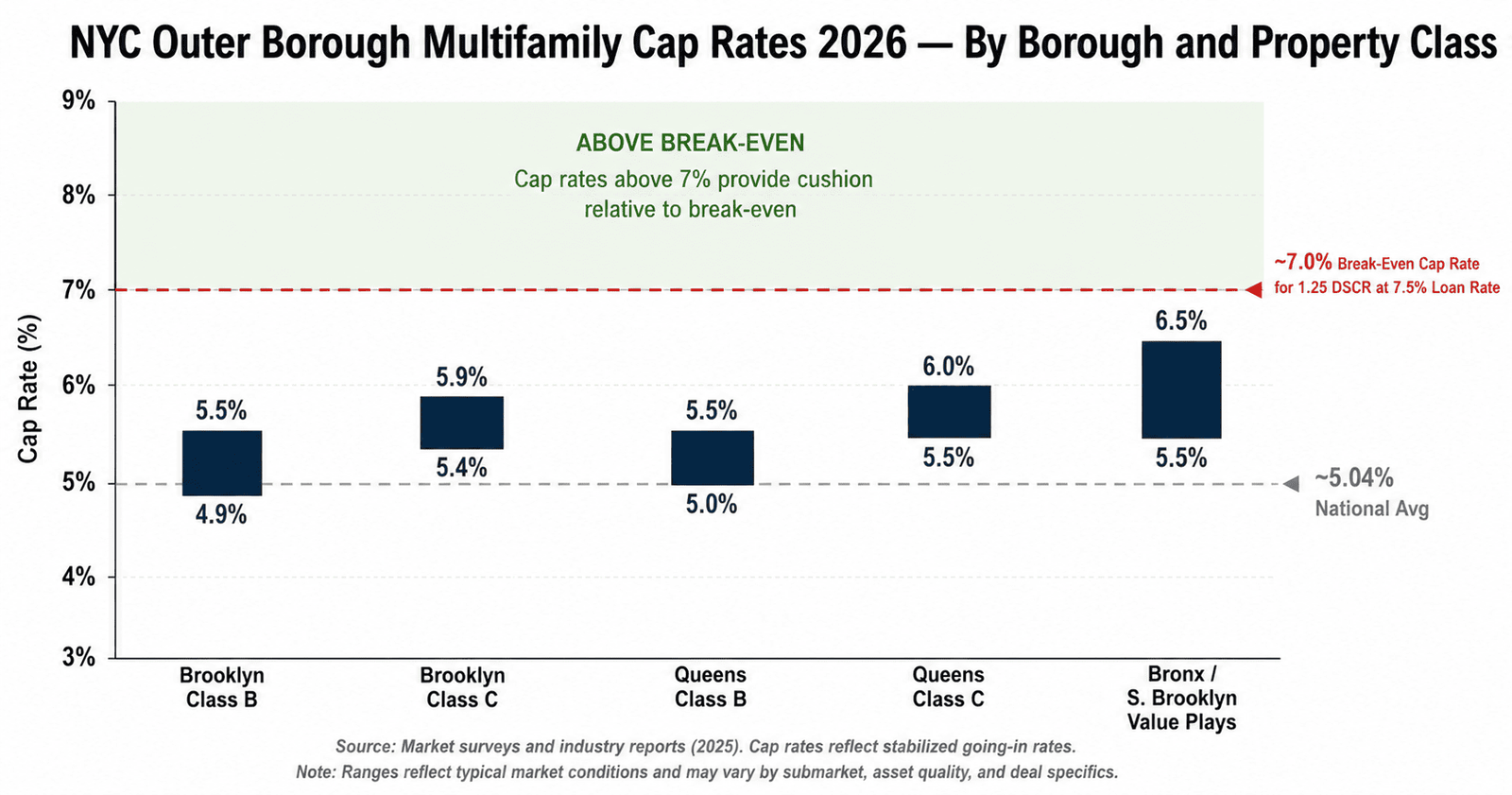
| Break-even cap rate for 1.25 DSCR at 7.5% | ~7.0% — market is 100–200 bps below |
| Negative leverage gap (Brooklyn Class B) | +1.5% to +2.6% above cap rate |
| BKDSCR standard | 1.25+ unstressed | 1.00+ combined stress |
The “gap” — the spread between the DSCR loan rate and the going-in cap rate — is the single number that determines whether a stabilized acquisition can produce a passing DSCR at standard leverage. A positive gap means negative leverage: every dollar borrowed at 7.5% produces less than 7.5 cents of unleveraged income. The outer-borough market is running a gap of 1 to 2.5 percentage points across most segments.
NYC Q1 2026 multifamily recorded 275 transactions totaling approximately $1.75 billion — a 19.6% year-over-year increase in deal count. Capital is moving. But most of it is moving with lower leverage, assumable debt structures, or value-add underwriting that projects above-market cap rates post-stabilization. According to CRE Daily, national multifamily cap rates have plateaued near 5.04% — the longest sustained plateau in 25 years — with analysts expecting only gradual downward pressure through 2026. The DSCR formula shows exactly how the gap between cap rate and loan rate flows through to the DSCR ratio. See also: Queens DSCR math.
The Negative Leverage Problem — Why 5-6% Cap Rates and 7.5% Loan Rates Don’t Work
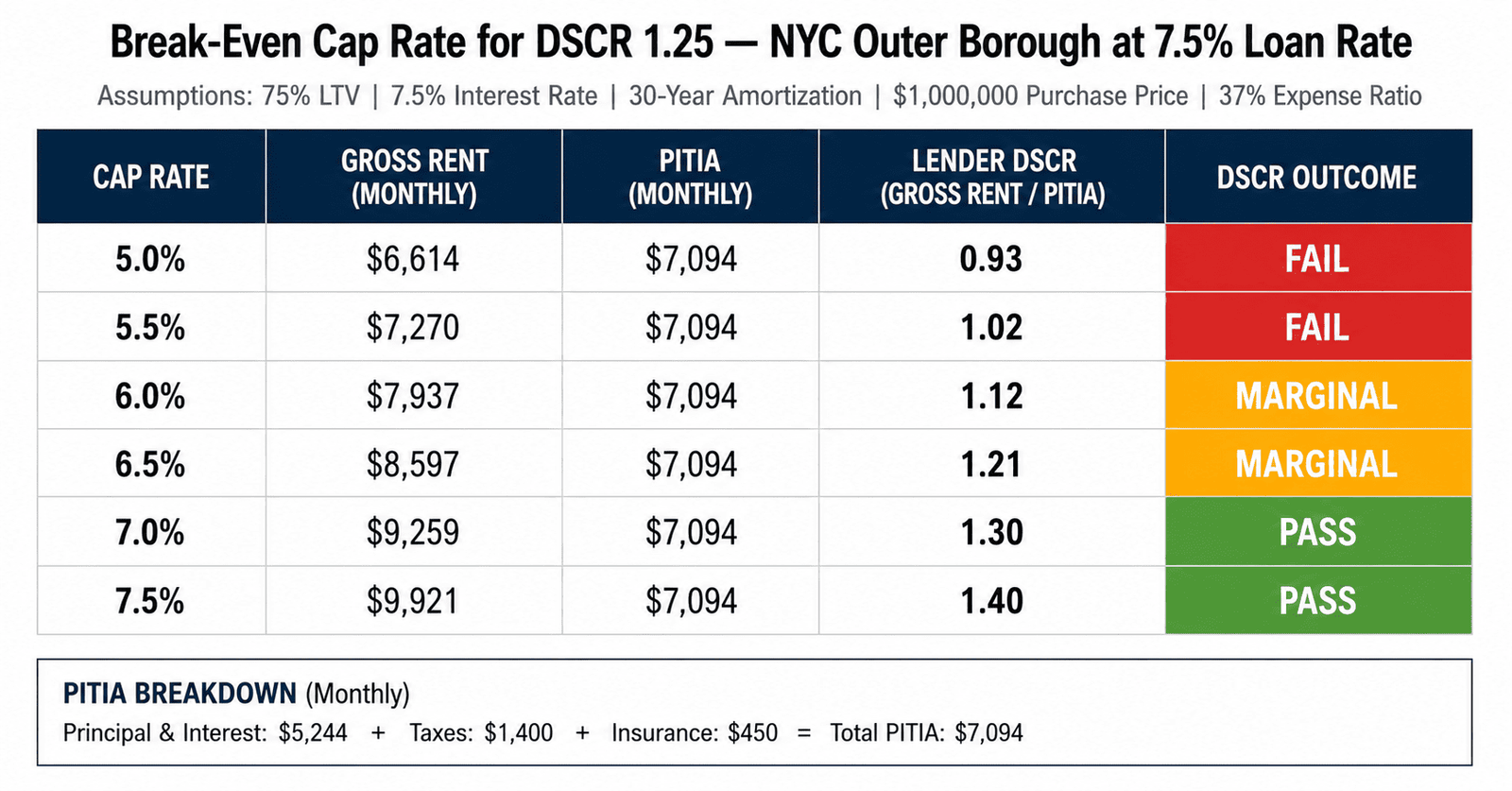
At a 5% going-in cap rate on a $1,000,000 purchase, the property generates $50,000 in annual NOI. At a 37% expense ratio, gross rent is approximately $6,614 per month. A 75% LTV loan at 7.5% produces monthly P&I of $5,244, plus T&I of approximately $1,850/month, for PITIA of $7,094. Lender DSCR: $6,614 / $7,094 = 0.93 — a hard FAIL. The deal cannot support its own debt service.
At 6% cap rate, gross rent increases to $7,937/month. PITIA stays at $7,094. Lender DSCR: 1.12 — still FAIL below the lender minimum of 1.20. At 7% cap rate, gross rent reaches $9,259/month. DSCR: 1.30 — the first cap rate that produces a PASS at the BKDSCR 1.25 standard.
At 75% LTV and a 7.5% DSCR rate, a stabilized outer-borough acquisition needs a going-in cap rate of approximately 7% to produce a 1.25 DSCR. The market is trading at 5–6%. The gap is 1–2 full percentage points — not basis points.
NYC Cap Rate DSCR — The Break-Even Math
Base assumptions: $1,000,000 purchase. 75% LTV ($750,000 loan). 7.5% rate, 30-year fixed. Expense ratio 37%. PITIA = P&I ($5,244/mo) + taxes ($1,400/mo) + insurance ($450/mo) = $7,094/mo.
| Going-In Cap Rate | Annual NOI | Gross Rent/Month | Lender DSCR | BKDSCR Verdict |
|---|---|---|---|---|
| 5.0% | $50,000 | $6,614 | 0.93 | FAIL |
| 5.5% | $55,000 | $7,270 | 1.02 | FAIL |
| 6.0% | $60,000 | $7,937 | 1.12 | MARGINAL |
| 6.5% | $65,000 | $8,597 | 1.21 | MARGINAL |
| 7.0% | $70,000 | $9,259 | 1.30 | PASS |
| 7.5% | $75,000 | $9,921 | 1.40 | PASS |
The 6.5% cap rate row is the inflection point. At 6.5% cap and 75% LTV, the deal produces a Lender DSCR of 1.21 — above the lender’s typical 1.20 floor, but below the BKDSCR stress test standard of 1.25+. A single rate stress pushes it below 1.20. The 7.0% cap rate is the first level that produces a PASS. The outer-borough market is trading 100–200 basis points below that threshold.
Get the DSCR Playbook — every input, threshold, and deal-killer for NYC outer-borough investors in one place.
What Actually Passes DSCR at Today’s Cap Rate Range
| Cap Rate | 65% LTV | 70% LTV | 75% LTV | 80% LTV |
|---|---|---|---|---|
| 5.0% | 1.04 FAIL | 0.97 FAIL | 0.89 FAIL | 0.82 FAIL |
| 5.5% | 1.15 MARGINAL | 1.07 FAIL | 0.98 FAIL | 0.90 FAIL |
| 6.0% | 1.27 PASS | 1.18 MARGINAL | 1.07 FAIL | 0.98 FAIL |
| 6.5% | 1.38 PASS | 1.29 PASS | 1.18 MARGINAL | 1.06 FAIL |
| 7.0% | 1.51 PASS | 1.41 PASS | 1.30 PASS | 1.19 MARGINAL |
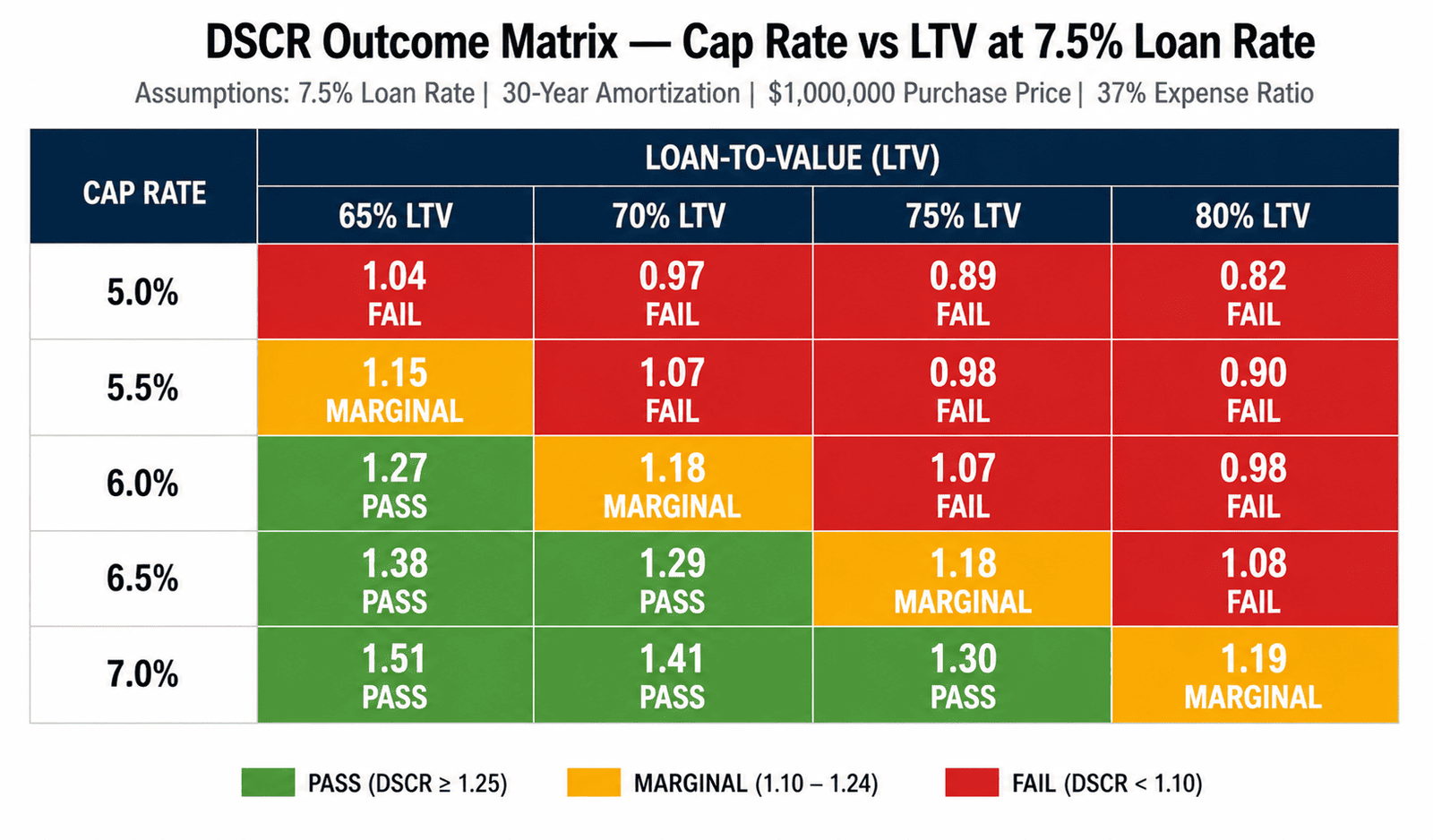
- 5% cap rate: no LTV structure produces a passing DSCR. Even at 65% LTV — a 35% down payment — the deal produces only 1.04 DSCR.
- 6% cap rate clears 1.25 only at 65% LTV. A 35% down payment on a $1M property equals $350,000 in equity at acquisition — a high bar that eliminates most leveraged buyers.
- 6.5% cap rate clears 1.25 at 65–70% LTV. This is the first range where standard leverage becomes workable with a moderate down payment increase. The Bronx and outer Queens Class C market reaches 6.5% on some deals — which is why those boroughs are seeing more DSCR deal completions.
- 7% cap rate clears 1.25 at 65–75% LTV. This is where the deal works at conventional leverage. The market needs to trade here for stabilized acquisitions to become broadly viable under DSCR financing at current rates.
The stress test applies rate and vacancy pressure on top of any DSCR you calculate from this matrix. A deal at 1.25 unstressed needs to hold 1.25+ under a +0.5% rate stress to meet the BKDSCR single-stress standard. At 6% cap and 65% LTV, the 1.27 unstressed DSCR is tight — a +1.0% rate stress pushes it below 1.20.
Which Outer Boroughs and Property Types Are Closest to Viable
Bronx and Outer Queens: Most Viable at Current Rates
The Bronx Class C market and outer Queens neighborhoods — Jamaica, Far Rockaway, Ridgewood, parts of the Rockaways — are trading closest to viable cap rates at 5.5% to 6.5%. Vacancy in the Bronx is effectively at zero. At 6.0–6.5% cap rates and 65–70% LTV, deals can produce DSCR in the 1.18–1.38 range — either passing or close to passing. See also: Brooklyn rent DSCR.
Brooklyn and Core Queens: Structural Challenge
Core Brooklyn and western Queens trade at cap rates where standard-leverage DSCR does not produce a passing verdict on stabilized income. High prices relative to income produce low cap rates, which produce low or failing DSCR at current loan rates. Investors closing deals in these markets are using one or more of the four structures in the next section.
Mixed-Use Properties: The Exception
Mixed-use properties — ground-floor commercial with residential above — can produce higher effective cap rates. A Brooklyn 4-unit with a ground-floor retail tenant renting at $3,000–$5,000/month adds $36,000–$60,000 in annual gross income. This can push effective cap rates into the 6–7% range on the right deal, producing a viable DSCR at standard leverage.
What Investors Are Doing to Make 5-6% Cap Rate Deals Work
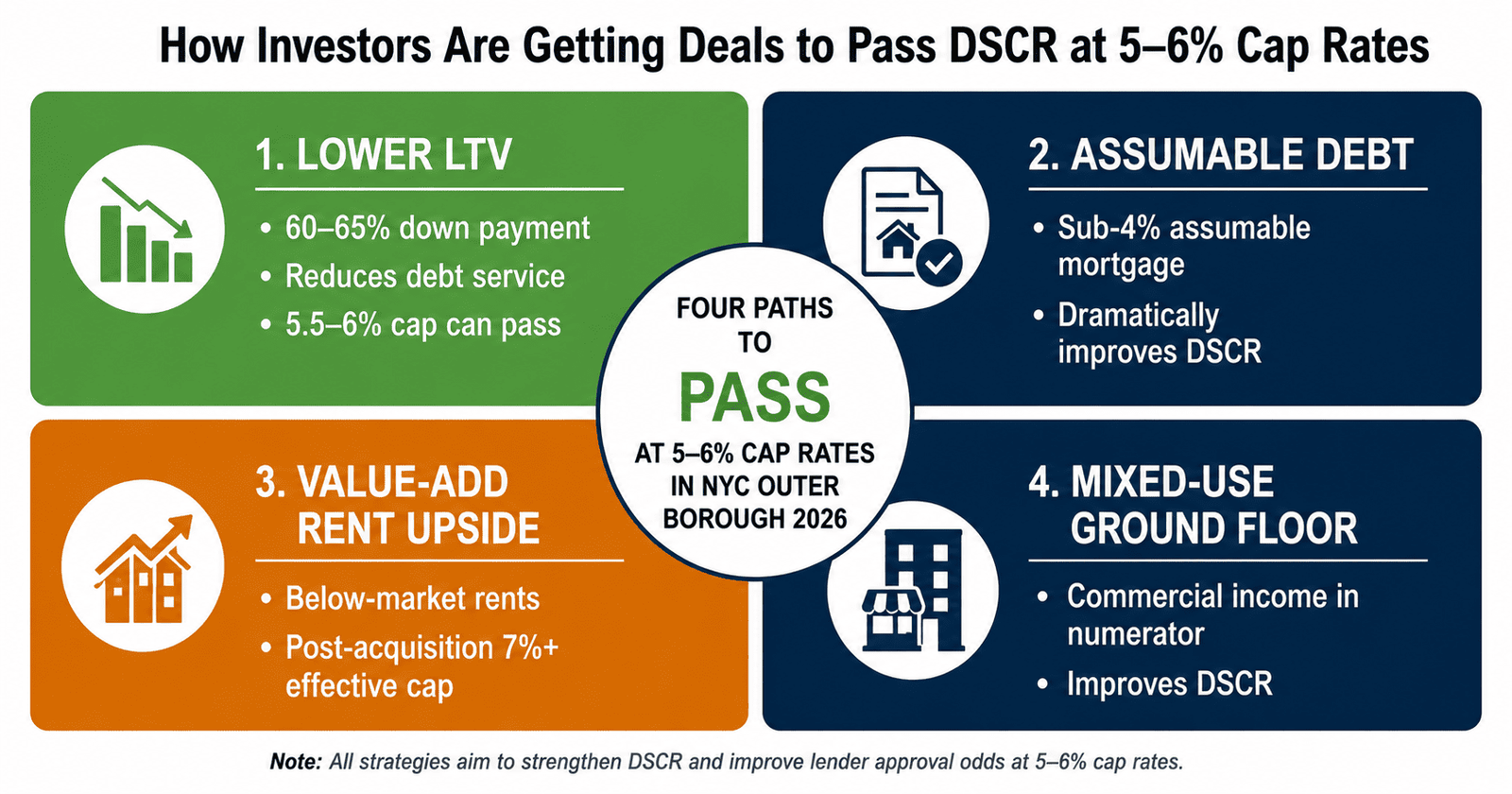
- Lower LTV (60–65% down). The most straightforward path: bring more equity to reduce debt service. At 65% LTV and a 6% cap rate, the deal clears 1.25. The capital requirement is higher, but the math works. Most common among cash-heavy buyers and 1031 exchange capital with large equity bases.
- Assumable debt below market rate. Properties with existing assumable mortgages at 3.5–4.5% dramatically change the DSCR calculation. A $500K assumable loan at 4.0% costs $2,387/month in P&I vs $3,496 at 7.5% — a $1,109/month PITIA difference. These deals trade at premiums, but the premium is often justified by the DSCR improvement.
- Value-add underwriting on below-market rents. A building trading at a 5% cap on current rents but with units 20–30% below market produces a proforma cap rate of 6.5–7% after lease-up. DSCR lenders underwrite on current rents — so investors who can close at current DSCR levels using lower LTV, then grow into the DSCR over 12–24 months, are executing the most common outer-borough playbook right now.
- Mixed-use commercial income. Adding commercial rental income to the DSCR numerator is legitimate and lender-accepted with a documented arms-length lease. A Brooklyn 4-unit with a $4,000/month ground-floor tenant adds $48,000 in annual gross income — potentially moving a 5% residential cap rate to a 6.5–7% effective cap rate on total income.
The deal analysis page walks through how each of these structures affects PITIA, DSCR, and the stress test outcome.
The most common ways standard-leverage deals fail in this environment are covered on the deal killers page — PITIA and documentation errors that get flagged before a deal ever reaches a lender.
PITIA documentation, tax certification, and DSCR thresholds on outer-borough deals are covered on the lender criteria page.
FAQ: Cap Rates and DSCR in the NYC Outer-Borough Market
If cap rates are expected to fall in 2026, doesn’t that make the DSCR math worse?
Yes. Falling cap rates mean rising prices relative to income. If a property generating $60,000 NOI trades at a 6% cap today ($1M) and cap rates compress to 5.5%, that same property trades at $1.09M. The debt service on the higher purchase price increases PITIA while the income stays flat. DSCR gets worse. Cap rate compression helps existing holders but hurts new buyers who need the acquisition to pencil as a DSCR deal.
Can I use proforma rents to qualify for a DSCR loan?
Most DSCR lenders underwrite on current actual rents — not proforma, not projected rents after planned increases. Some lenders will use appraiser-determined market rents if the current rent roll is significantly below market. But proforma rent assumptions for occupied units are generally not accepted. The going-in DSCR is calculated on existing income.
How do the 5-6% outer-borough cap rates compare to national multifamily?
The national multifamily average cap rate sits near 5.04% in 2026 — the longest plateau in 25 years. NYC outer-borough Class B is in line with or slightly above the national average. Class C in the Bronx and outer Queens is at the high end of the national range. The challenge is that NYC DSCR rates tend to run 25–75 basis points higher than equivalent properties in Sun Belt markets, compressing the spread further.
What would loan rates need to fall to for 5% cap rate deals to work at 75% LTV?
For a 5% cap rate deal to clear 1.25 DSCR at 75% LTV, loan rates would need to fall to the 3–4% range — the pre-2022 rate environment. At 5.5% loan rate, a 5% cap deal still produces only ~1.08 DSCR at 75% LTV. That rate environment is not the current 2026 forecast.
The Cap Rate That Actually Works — and the Gap to Get There
NYC Cap Rate DSCR tells a clear story: the stabilized acquisition market is structurally misaligned with DSCR financing at current rates. The gap between going-in cap rates (5–6%) and the break-even cap rate for 1.25 DSCR (~7%) is 1–2 full percentage points. That gap does not close through optimism about rent growth or assumptions about future appreciation. It closes through lower purchase prices, lower leverage, assumable debt, or value-add income growth.
The investors closing outer-borough DSCR deals right now are not buying at market cap rates with standard leverage and expecting it to work. They are buying selectively — targeting the Bronx and outer Queens where cap rates are closest to viable, using 60–65% LTV on core Brooklyn acquisitions, seeking assumable debt where it exists, or underwriting value-add rent upside as the path to viable DSCR after stabilization. These are the structures producing PASS verdicts in the current market.
A deal at 5% cap and 75% LTV does not pass. A deal at 5% cap and 65% LTV still does not pass. The numbers are clear. The deal analysis page runs the specific inputs — purchase price, actual rent roll, actual PITIA — and produces the exact DSCR before and after stress.
Run a Deal Review — current DSCR, stressed DSCR, NOI, and updated tax assessment modeled at current inputs, delivered within 48–72 hours.