
NYC Rent Freeze DSCR: The Mortgage Coverage Gap
Key Takeaways
- The 7-1 vote is final. On June 25, 2026, the NYC Rent Guidelines Board voted to freeze rents on both one- and two-year leases starting October 1, 2026 — the first two-year freeze in NYC history.
- Costs will not freeze with your rent. Operating expenses for rent-stabilized buildings — fuel, insurance, water, and taxes — are all rising sharply while the NYC rent freeze DSCR math locks income at zero growth.
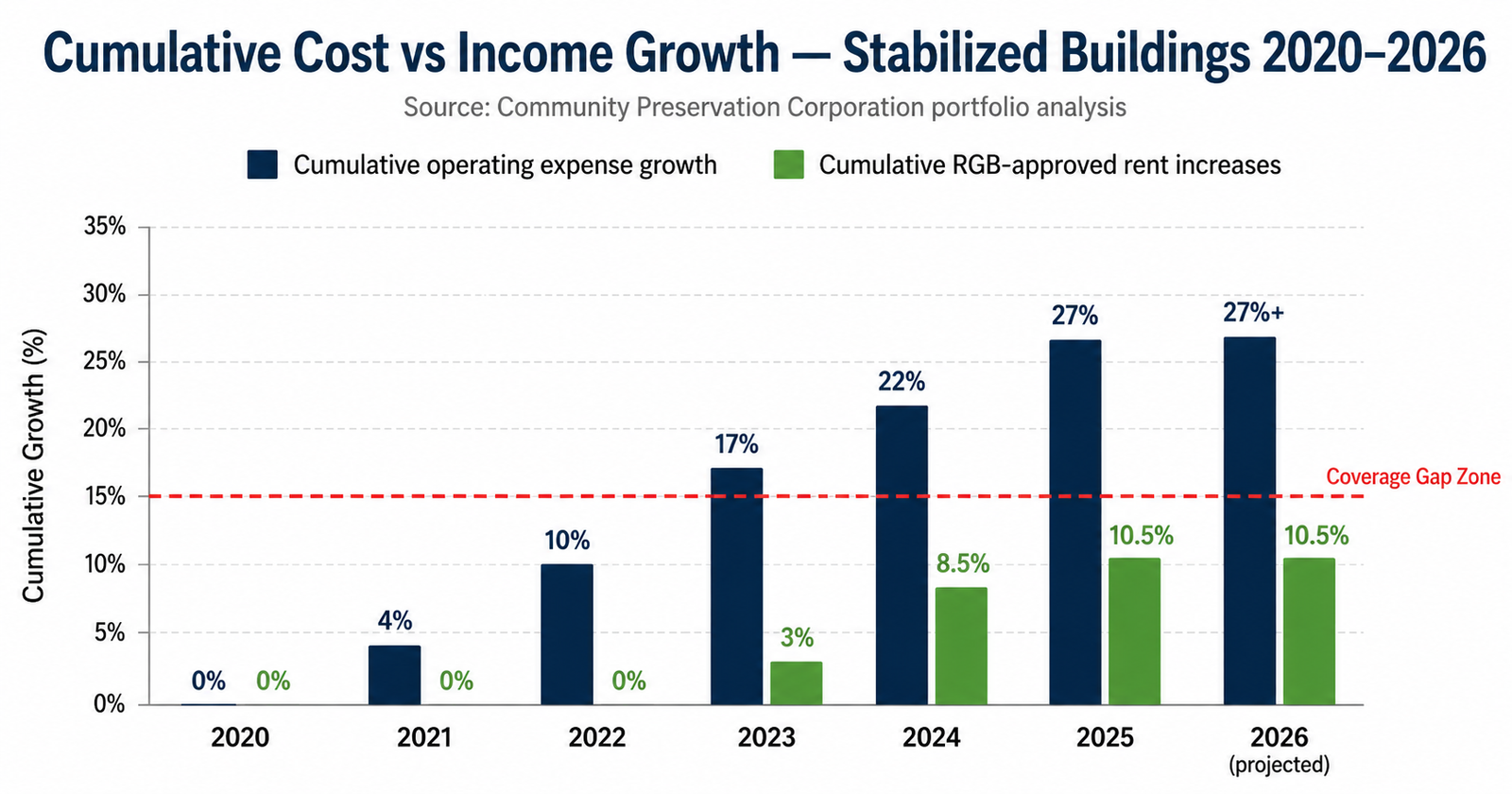
- The rent stabilization mortgage coverage gap is widening. Since 2020, operating costs are up roughly 27% while RGB-approved increases total approximately 11% — a 15-point cumulative gap that the 2026 freeze locks in place for another two years.
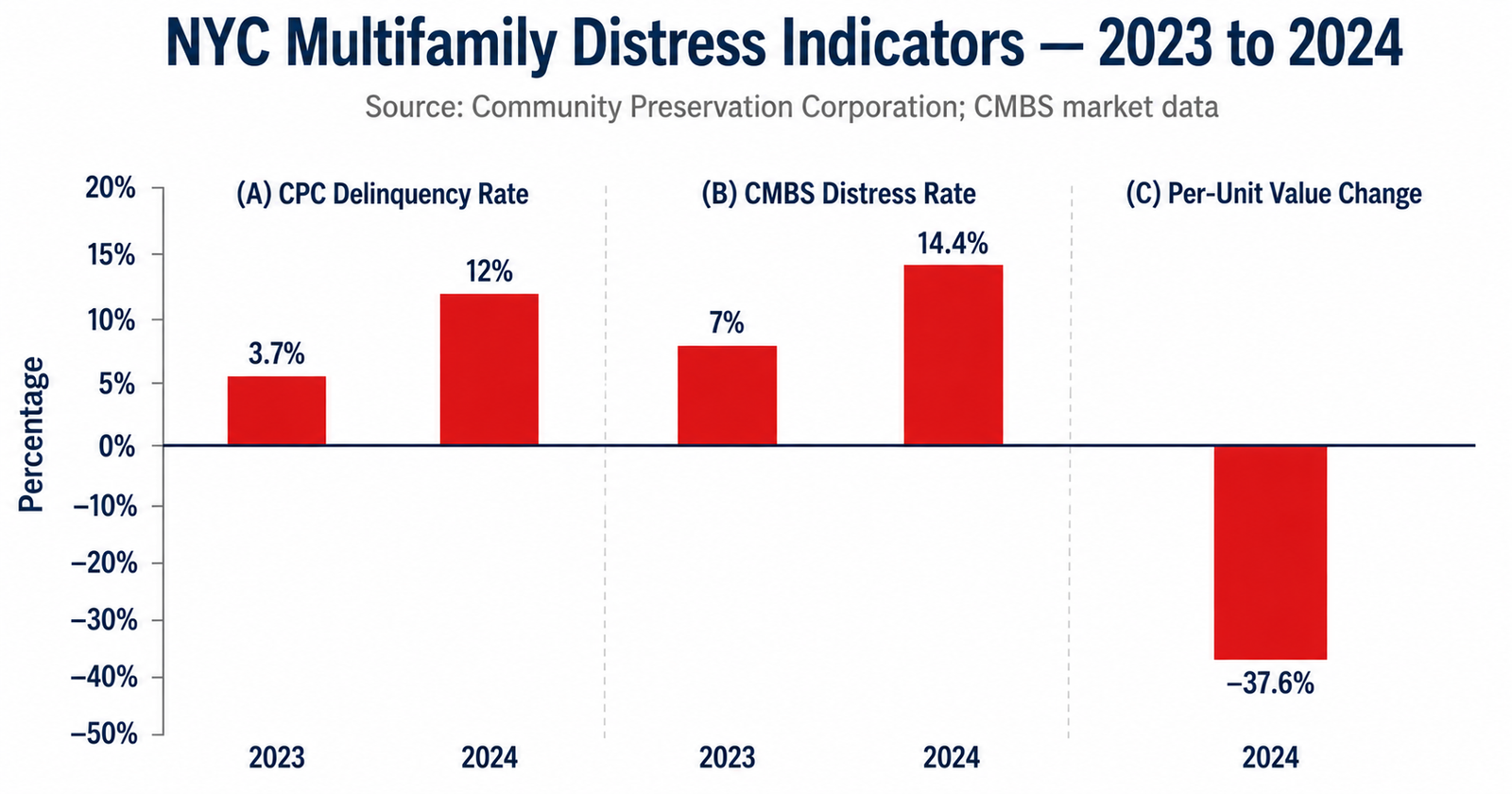
- Distress is already spreading. NYC multifamily CMBS distress doubled to 14.4% in 2024. CPC delinquency rates climbed from 3.7% to approximately 12% in the same period.
- HSTPA eliminated the recovery path. Vacancy bonuses and meaningful IAI recoupment no longer exist. A building that enters the 2026 rent freeze with a depressed rent roll has no mechanism to close that gap when the freeze lifts.
- Know your number before the lender does. For landlords with loans maturing in the next 12 to 36 months, running a current DSCR stress test is the most actionable step available right now.
Table of Contents
- A 7-1 Vote Just Eliminated Your Rental Income Growth
- Operating Costs Will Not Freeze With Your Rent
- How the Rent Stabilization Mortgage Coverage Gap Forms
- The DSCR Refinancing Crisis NYC 2026: The Data
- HSTPA 2019 Eliminated the Recovery Path
- Frequently Asked Questions
- What DSCR threshold should rent-stabilized NYC landlords be concerned about?
- Does the HSTPA change how lenders underwrite stabilized rent rolls?
- What should I do if my stabilized building is approaching loan renewal?
- Bottom Line: Know Your NYC Rent Freeze DSCR Before the Lender Does
The NYC rent freeze DSCR problem is no longer theoretical — on June 25, 2026, the Rent Guidelines Board voted 7-1 to freeze rents on both one-year and two-year leases starting October 1, 2026, the first two-year freeze in New York City history. For landlords managing rent-stabilized buildings already stretched by surging insurance bills, rising fuel costs, and mounting debt payments, the decision is not just politically frustrating. It is a direct threat to mortgage coverage and refinancing eligibility.
If your loan matures in the next 12 to 36 months, run your numbers through the DSCR Stress Test before your lender calculates it for you.
A 7-1 Vote Just Eliminated Your Rental Income Growth
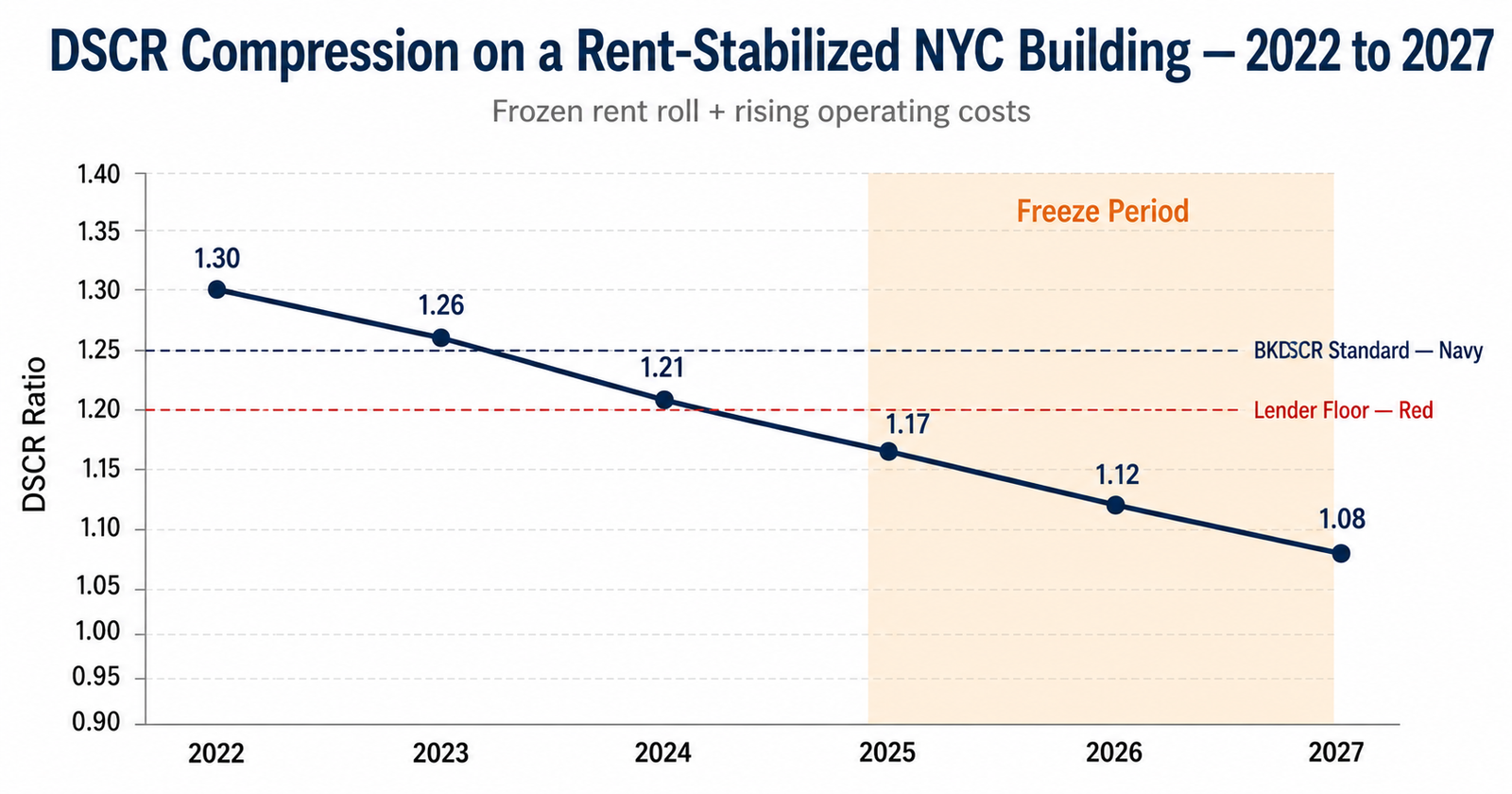
The math behind the 2026 NYC rent freeze DSCR problem is straightforward. When income is locked at zero growth and costs keep climbing, the gap between what a building earns and what it costs to run does not stay manageable. That gap is exactly what lenders measure through the Debt Service Coverage Ratio: net operating income divided by annual debt service. A building that was running at a comfortable 1.30 DSCR heading into 2026 can slide toward 1.10 or below within two years if operating costs continue their current trajectory. Understanding how DSCR is calculated is the starting point for any landlord evaluating their exposure.
Mayor Zohran Mamdani, who made a rent freeze a centerpiece of his campaign, appointed six of the board’s nine members since taking office in January. Board Chair Chantella Mitchell defended the process, saying members served with independence and integrity. But the outcome — and its financial consequences — are now a fixed reality. For rent-stabilized portfolio owners, the urgency is immediate.
The distinction between this freeze and prior ones matters. Under Mayor de Blasio, the RGB froze one-year leases three times between 2015 and 2021. The 2026 vote went further: for the first time ever, two-year leases are frozen as well. Landlords who planned to lock in a modest increase through a longer lease now have that option eliminated entirely, creating a minimum 24-month income lockout regardless of what happens to fuel prices, insurance premiums, or property taxes during that stretch.
The average monthly regulated rent was $1,599 according to the NYC Rent Guidelines Board’s own 2025 Income and Expense Study — in a city where the median rent for a newly leased apartment sits near $3,950, according to StreetEasy. That spread illustrates why stabilized buildings operate so differently from market-rate properties, and why any rent freeze lands with disproportionate force on owners of regulated stock.
Operating Costs Will Not Freeze With Your Rent
The RGB publishes an annual Price Index of Operating Costs (PIOC) that tracks what it actually costs to run a rent-stabilized building. Public comments submitted during the 2026 hearing process confirm that fuel, insurance, water and sewer rates, and real estate taxes are all moving sharply upward. The NYC Department of Environmental Protection’s own rate proposal calls for a 6% water and sewer rate increase alone. These rising expense lines are among the most common DSCR deal killers flagged on NYC multifamily properties.
One commenter captured the day-to-day reality plainly at the RGB’s public hearing: an oil tank fill running $14,000, property taxes on two buildings totaling $154,525, a mortgage rate reset from 3.65% to 6.12%, and rents on some units still sitting at $429 and $537 per month. These are not edge cases — they reflect the structural economics of older, stabilized stock citywide.
Zoom out from any single year and the picture is harder to absorb. Since 2020, operating expenses for rent-stabilized properties have increased by approximately 27%, according to analysis of Community Preservation Corporation portfolio data. Over that same period, RGB-approved rent increases have totaled roughly 11%. That is a 15-percentage-point gap between what buildings cost to run and what landlords are permitted to collect — compounding for years before the 2026 freeze added another two. This is the same expense compression dynamic covered in detail in NYC Landlord Insurance Doubled — The Exact DSCR Math.
The NYC Department of Finance’s Class 2 assessment data shows Brooklyn property tax assessments rising 16% in 2026, while insurance costs across the rent-stabilized sector rose dramatically between 2019 and 2025. This is not noise in the data — it is a structural transformation of the cost base for regulated housing.
How the Rent Stabilization Mortgage Coverage Gap Forms
The rent stabilization mortgage coverage gap is a function of two forces moving in opposite directions: frozen income and rising operating costs. When net operating income shrinks — even if the physical building has not changed — the DSCR falls. When DSCR falls below lender thresholds, refinancing eligibility narrows and loan covenant risk rises. The mechanics of this compression are the same ones that drive outcomes on the DSCR Stress Test.
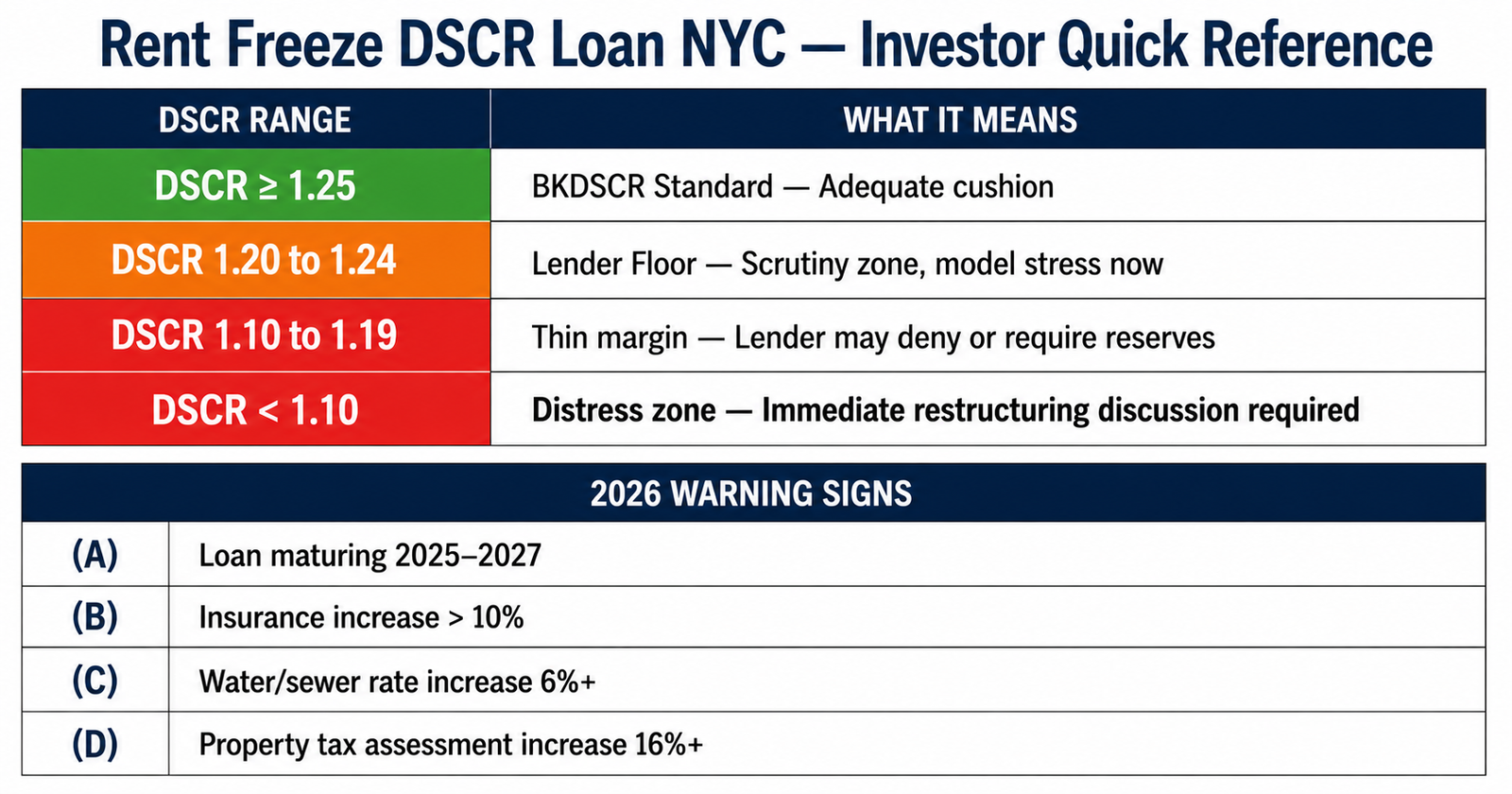
Most DSCR lenders require a minimum of 1.20 to qualify or refinance a loan. BKDSCR’s conservative standard is 1.25, which provides a meaningful buffer above that floor. A building that originally underwrote at 1.30 can cross the lender’s 1.20 threshold without a single missed payment — purely by having expenses outpace a frozen rent roll for 18 to 24 months. You can run your current property through the DSCR Calculator to see where your ratio stands against both thresholds.
In parts of the Bronx, more than 12% of stabilized buildings already operate at negative net operating income — meaning expenses exceed rental income before any debt service is considered. These buildings cannot cover their own costs. Layering a two-year freeze on top of an already-negative NOI does not just reduce a margin. It deepens a hole that becomes structurally harder to escape with each passing month. The Lender Criteria outlines exactly how underwriters evaluate these scenarios at renewal.
If your rent stabilized building is within 18 months of loan renewal? Use the Deal Filter — to run a 60-second viability screen before you talk to a lender.
The DSCR Refinancing Crisis NYC 2026: The Data
The DSCR refinancing crisis NYC 2026 was building before the freeze was announced. The Community Preservation Corporation (CPC) — one of the city’s most active lenders in regulated housing — saw its portfolio delinquency rate rise from 3.7% in 2023 to approximately 12% by December 2024. Some institutions have reported a 990% increase in non-performing loans, primarily tied to rent-regulated properties.
In the commercial mortgage-backed securities market, the distress rate for NYC multifamily properties went from 7% at the end of 2023 to 14.4% by the end of 2024. That is a doubling in a single year. CMBS distress rates are a leading indicator: those loans are subject to strict covenant monitoring and reflect deteriorating coverage environments before problems reach conventional balance-sheet lenders.
Asset values have followed operating fundamentals downward. The average per-unit sales price for 100% rent-stabilized buildings fell 37.6% in inflation-adjusted terms in 2024 compared to the prior year. A building worth $4 million at origination that has declined in market value now carries a different LTV profile at renewal — even if DSCR were adequate. Compressed DSCR combined with reduced collateral value is exactly the scenario lenders are most cautious about entering. Understanding the full picture of what lenders look for is covered in the NYC Rent Freeze: The Real DSCR Impact in 2026 analysis.
HSTPA 2019 Eliminated the Recovery Path
Before 2019, landlords had two meaningful tools for resetting income when a unit turned over or when capital improvements were made. Vacancy bonuses allowed a higher legal rent when a long-term tenant moved out — a mechanism for gradually closing the gap between stabilized and market rents. Individual Apartment Improvement rules allowed renovation costs to be recouped through permanent rent increases, which made investing in unit upgrades financially viable.
The Housing Stability and Tenant Protection Act of 2019 eliminated both. Vacancy bonuses were abolished. IAI recoupment was capped so severely that the math no longer supports meaningful renovation spending in most cases. According to the NYC Rent Guidelines Board, the legislative intent was to protect tenants from rent-reset strategies — and it succeeded. The byproduct was the removal of the only mechanisms by which a stabilized building’s income could organically recover from a period of below-market rents.
Post-HSTPA, a building that enters a freeze period with a depressed rent roll has no mechanism to close that gap when the freeze lifts. Even if the RGB approves increases in 2027 or 2028, those increases apply only to the already-depressed base rent. The accumulated shortfall from years of below-cost increases — combined with the 2026 freeze — becomes a permanent feature of the building’s income profile. That permanence is what lenders are pricing in at renewal, and it is the structural reason the NYC rent freeze DSCR problem is categorically different from the freezes of the de Blasio era.
The Bronx offers a documented historical precedent. During the 1970s, rising heating oil costs, outmigration, and rent regulations that could not keep pace with expenses led to mass building abandonment. Landlords deferred repairs, stopped paying property taxes, and walked away. A 1995 HPD-commissioned study estimated the city spent the equivalent of approximately $22 billion in 2026 dollars managing the resulting inventory. A 1991 survey found rodents present in 77% of city-managed units. The structural conditions that produced that crisis — frozen income, rising costs, aging stock, no capital recovery path — are present again. You can see how today’s expense stack maps against the deal analysis framework used on outer-borough multifamily properties.
Frequently Asked Questions
What DSCR threshold should rent-stabilized NYC landlords be concerned about?
Most DSCR lenders require a minimum of 1.20 to approve or refinance a rent freeze DSCR loan NYC. BKDSCR uses a more conservative standard of 1.25 — the additional cushion matters on stabilized properties because the income side of the ratio has no upward mechanism. A property at 1.22 that looks fine on paper can fall below the 1.20 lender floor within a single operating year if insurance and fuel costs move as the 2025 data suggests they will. The Lender Criteria outlines exactly how underwriters apply these thresholds at renewal.
Any property below 1.25 heading into 2026 should be modeled with an operating cost stress scenario before the next renewal date. A property below 1.20 is already in lender-scrutiny territory and warrants immediate analysis — not at renewal, but now.
Does the HSTPA change how lenders underwrite stabilized rent rolls?
Yes, and the change is significant. Pre-HSTPA, lenders could project some level of income recovery through vacancy turnover and IAI recoupment when underwriting stabilized properties. Post-HSTPA, those assumptions are no longer supportable. Lenders familiar with the NYC market now underwrite the stabilized rent roll at its current depressed level with no projected upside — which means any operating cost increase flows directly through to DSCR compression with no offsetting income growth on the other side.
This is why the NYC rent freeze DSCR problem is more severe than the headline number suggests. It is not just about the freeze year — it is about a permanent structural constraint on income growth that makes each year of cost escalation harder to absorb than the last. The broader underwriting implications of rent regulation are also covered in Why DSCR Loans Get Denied Even When Cash Flow Looks Good.
What should I do if my stabilized building is approaching loan renewal?
Run a current DSCR analysis that uses your actual 2025 operating costs — not the numbers from when the loan originated. Model a stress scenario with a 10% increase in insurance and a 6% increase in water/sewer costs. Then compare that stress-test DSCR against both the 1.25 BKDSCR standard and the 1.20 lender floor. If you fall below 1.25, you have time to explore restructuring options. If you fall below 1.20, the conversation with lenders needs to happen before they flag the file.
The Stress Test is designed specifically for this scenario — it models how rising operating costs interact with your current rent roll to project your DSCR at renewal. Use it before your lender runs the same numbers.
Bottom Line: Know Your NYC Rent Freeze DSCR Before the Lender Does
When a lender reviews a stabilized property for refinancing, the NYC rent freeze DSCR is typically the first number they calculate. Not the location. Not the occupancy rate. Not the age of the roof. The question is simple: does this building earn enough — after operating expenses — to cover its debt payments with a margin of safety?
For rent-stabilized owners, the answer to that question has been getting harder to defend with every year of cost escalation. The 2026 freeze accelerates that timeline. A property that cleared a lender’s 1.20 minimum in 2024 may not clear it in 2026 or 2027, especially once the full-year impact of frozen rents against rising operating costs flows through the financials. The data coming out of 2024 and 2025 — doubling CMBS distress rates, a 37.6% valuation decline, delinquency rates climbing steeply across regulated portfolios — suggests that many landlords are already on the wrong side of this threshold and do not yet know it.
Knowing your DSCR before a lender calculates it — and understanding how much runway remains before crossing a covenant threshold — is the difference between negotiating from a position of information and being caught off guard at renewal. For landlords with loans maturing in the next 12 to 36 months, this is the most urgent financial question on the table. Running a current analysis on each stabilized property in a portfolio is the starting point for any rational response to the 2026 rent freeze DSCR environment.
The rent stabilization mortgage coverage gap is not a problem that resolves itself. It widens with each month of frozen income against rising costs. The time to understand the numbers on your property is not at the next renewal meeting with your lender. It is now.
Run a Deal Review — find out how the 2026 rent freeze affects your stabilized building’s DSCR and refinancing eligibility before your lender does.