
NYC Rent Freeze: The Real DSCR Impact in 2026
Key Takeaways
- The NYC Rent Guidelines Board June 25 final vote could freeze rents at 0% for stabilized one-year leases
- A 0% rent freeze drops Lender DSCR by 0.05 to 0.12 points depending on the stabilized share of the rent roll
- Buildings with 100% rent-stabilized units are most exposed — market-rate buildings are unaffected
- The BKDSCR standard is 1.25+ unstressed — deals near that threshold are the ones that fail under a freeze
- Investors underwriting stabilized acquisitions should run the freeze scenario before contracting
- The RGB vote affects the numerator only (rent) — insurance, taxes, and rate risk are independent pressures
Table of Contents
- What the June 25 RGB Vote Actually Does
- NYC Rent Freeze 2026 DSCR Impact: The Real Numbers
- Which Buildings Are Most Exposed
- How to Run the Freeze Scenario Before the June 25 Vote
- FAQ: NYC Rent Freeze and DSCR
- Does a 0% RGB order affect DSCR loan qualification?
- Does the NYC Rent Freeze DSCR Ratio Apply to Market-Rate Buildings?
- Should I avoid stabilized buildings entirely?
- Run the RGB Scenario Before June 25
- NYC Rent Freeze DSCR: The Borough-by-Borough Exposure Map
- What Investors Who Own Stabilized Buildings Should Do Before June 25
- RGB Vote History and What It Tells Investors About June 25
- Rent-Stabilized vs Free-Market Buildings: The DSCR Divide
- What a 1% vs 2% RGB Order Does to DSCR in Real Dollars
- FAQ: NYC Rent Freeze DSCR 2026 — Additional Questions
- What happens to DSCR if the RGB votes 1% instead of 0%?
- Can I use projected rent increases for DSCR qualification if the RGB order hasn’t been voted yet?
- Does the freeze apply to leases already signed before June 25?
Start with the Deal Filter — property type, rent roll, unit count, and PITIA in 60 seconds.
| MARKET SNAPSHOT — NYC RGB Vote & DSCR Impact, May 2026 | |
|---|---|
| Sources: NYC RGB (nycrgb.org) | PropertyShark | Zumper (May 2026) | BKDSCR Research | |
| RGB VOTE DATA | |
| RGB June 25, 2026 final vote | Order #57 in effect — 1-yr lease increase TBD |
| RGB preliminary vote (May 2026) | 0%–2% on 1-year | 0%–4% on 2-year leases |
| Market rent growth (Brooklyn, May 2026) | +4.4% YoY | median 4-unit unit ~$2,500/month |
| DSCR IMPACT | |
| Rent-stabilized rent roll impact | 0% if freeze | ~2–3% if minimal order passes |
| DSCR impact of 0% rent increase | -0.05 to -0.12 DSCR points on stabilized buildings |
| Stabilized vs free-market DSCR gap | Stabilized buildings trade at 5–6% cap rate |
| DSCR loan benchmark (May 2026) | 7.5% 30-yr fixed | 75% LTV | 700+ FICO |
| BKDSCR standard | 1.25+ unstressed | 1.00+ combined stress |
NYC Rent Freeze math changed on May 7, 2026, when the NYC Rent Guidelines Board cast a preliminary vote setting the range at 0%–2% on one-year leases — with the final binding vote on June 25. On May 7, 2026, the NYC Rent Guidelines Board cast a preliminary vote setting the range at 0%–2% on one-year leases and 0%–4% on two-year leases — with the final vote on June 25. A 0% freeze does not just cap revenue. It freezes one side of the DSCR formula while operating costs, property taxes, insurance, and debt service continue to move.
What the June 25 RGB Vote Actually Does
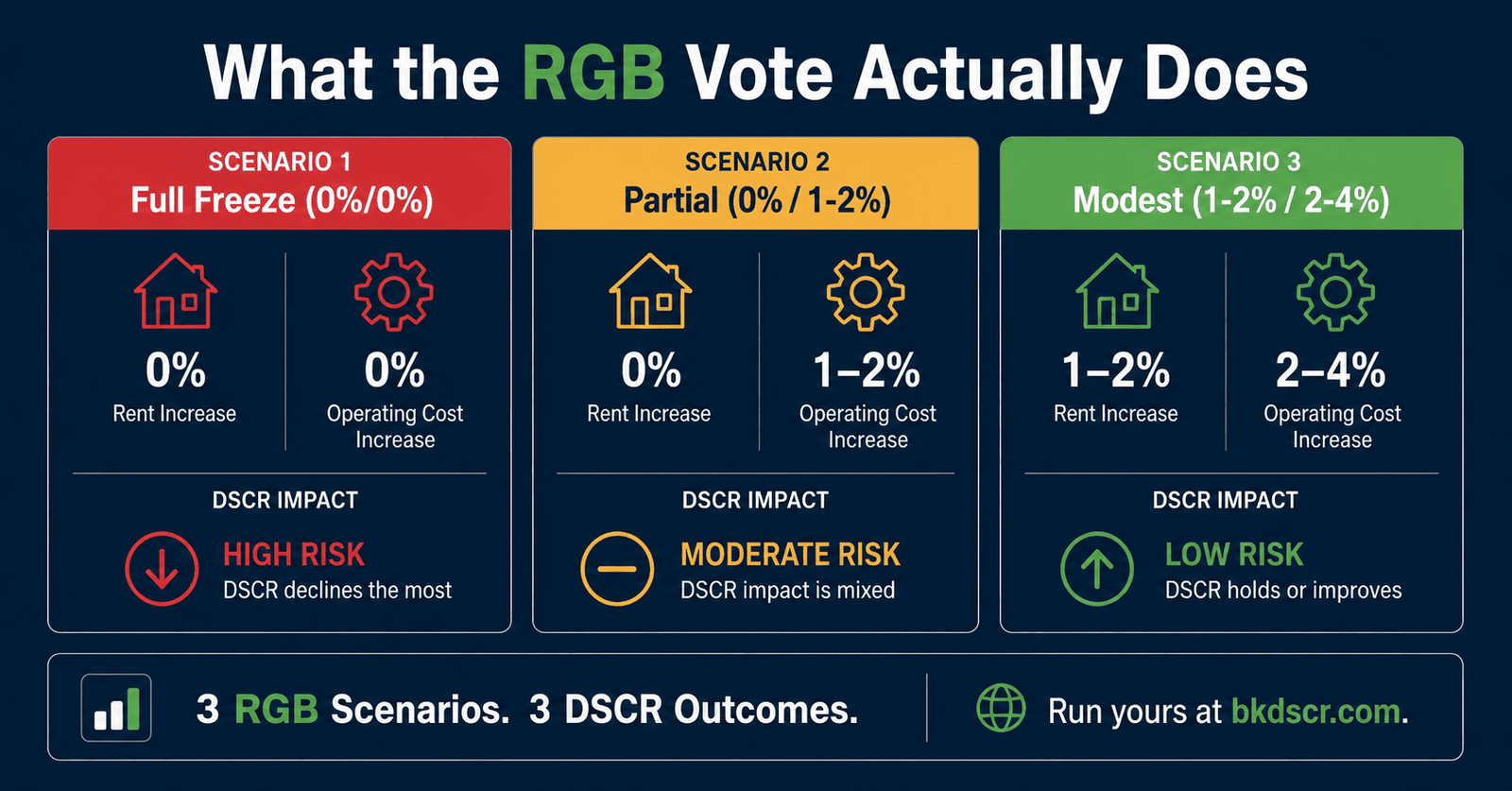
The NYC Rent Guidelines Board sets the maximum allowable rent increase for approximately one million rent-stabilized apartments citywide. The June 25, 2026 final vote determines what landlords can charge on lease renewals — a 0% freeze, a minimal increase, or a higher order. The RGB’s preliminary vote reflects the composition of the current board, which was reconstituted with six new members appointed by the current administration. According to RGB site, the June 25 vote is the binding determination that takes effect on October 1, 2026 leases.
For DSCR investors, the vote affects the numerator of the DSCR calculation — gross monthly rent. The denominator (PITIA) is unaffected. If rents are frozen at 0%, the DSCR on a stabilized building does not grow. If insurance and property taxes continue to rise — and they have, as covered in the analysis of property taxes — the DSCR compresses even without a rate change.
NYC Rent Freeze 2026 DSCR Impact: The Real Numbers
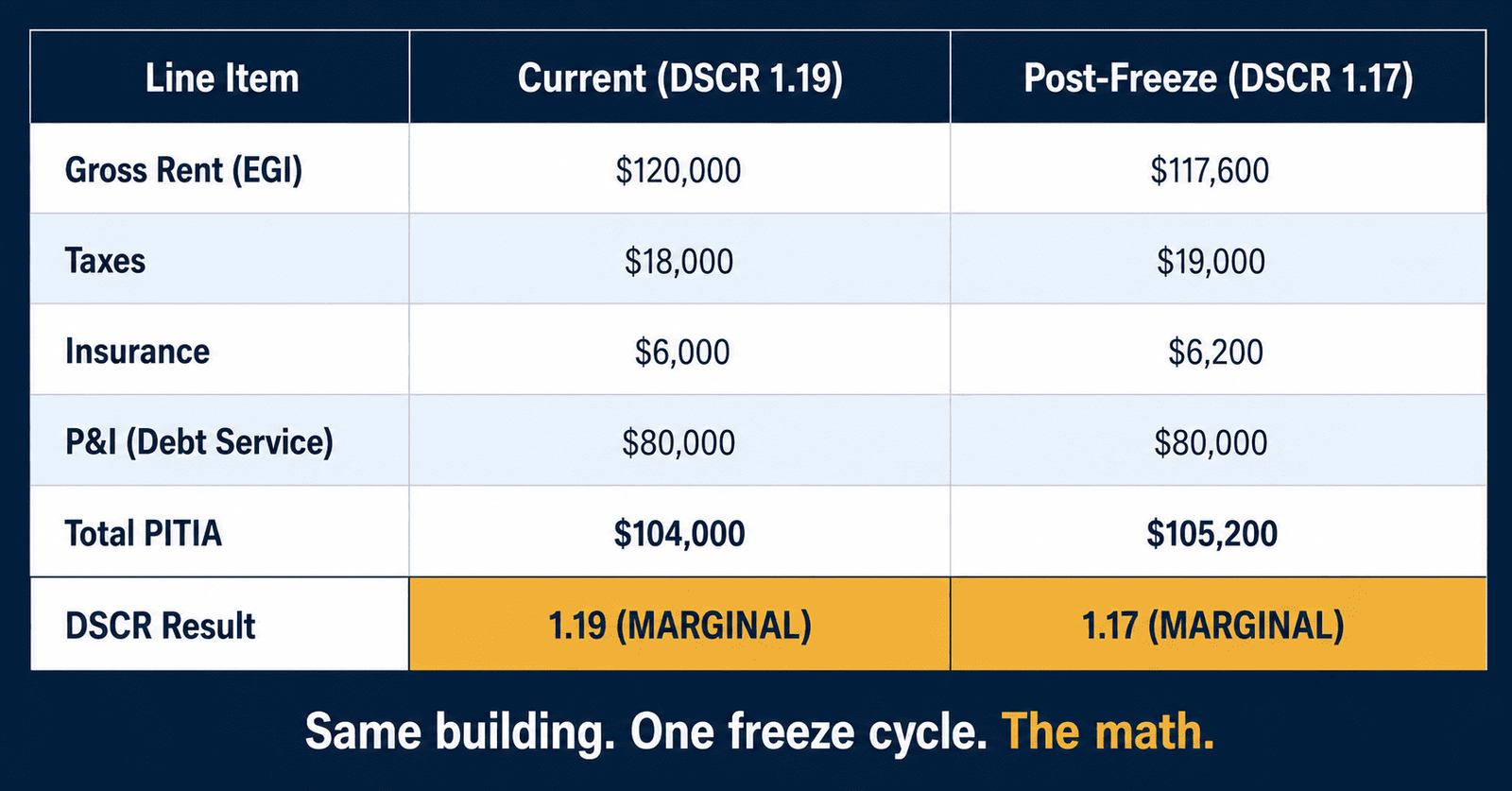
The compression math is straightforward. Take a 6-unit stabilized building in Brooklyn with a current rent roll of $10,200/month (average $1,700/unit). Monthly PITIA: $8,000. Current Lender DSCR: 1.27 — just above the BKDSCR standard. DSCR formula shows exactly how each input moves the ratio.
A 3% RGB order would raise rents to $10,506 — DSCR 1.31. A 0% freeze holds rents flat — DSCR stays at 1.27. But if insurance rises $100/month (consistent with 2022–2026 trends), the new PITIA is $8,100 and the DSCR drops to 1.26. Still passing — but one more cost increase away from MARGINAL. That is the risk profile of a deal at 1.27 DSCR with a fully stabilized rent roll.
Buildings with mixed rent rolls — part stabilized, part market-rate — have partial exposure. Market-rate units grow with the market. Stabilized units are capped by the RGB order. The higher the stabilized share, the more the freeze matters.
Get the DSCR Playbook — every input, threshold, and deal-killer for NYC outer-borough investors in one place.
Which Buildings Are Most Exposed
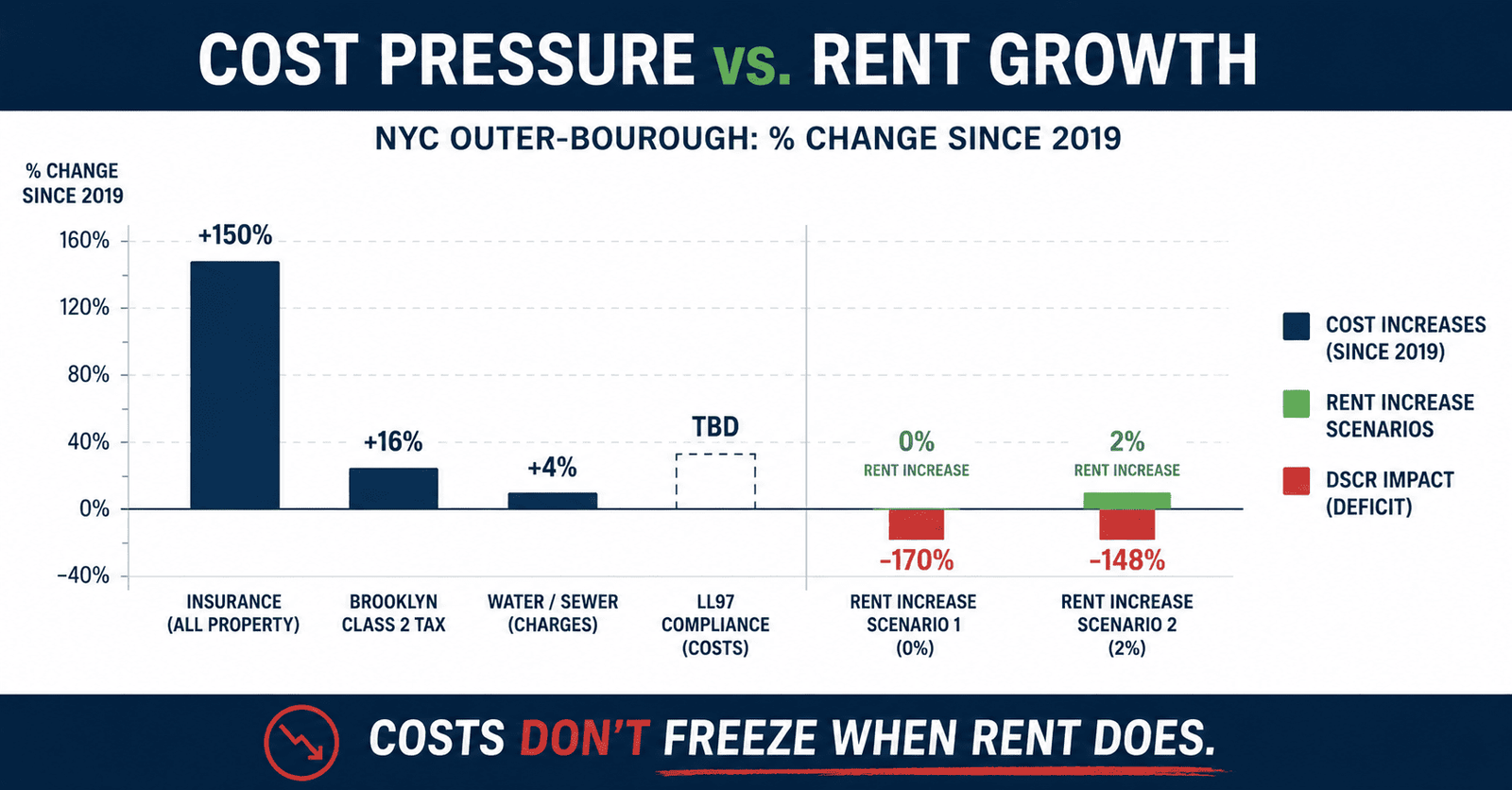
The buildings most exposed to a 0% RGB order share two characteristics: 100% or near-100% stabilized rent rolls and current DSCR in the 1.10–1.30 range. A fully stabilized building at 1.15 DSCR that absorbs a $150/month insurance increase without any rent growth drops to 1.08 — below the lender minimum. A stabilized building at 1.45 DSCR with healthy rent-to-PITIA headroom can absorb the freeze without threatening its financing.
The DSCR calculation doesn’t change for market-rate buildings. Their rents grow with the market regardless of what the RGB votes. The freeze risk is specific to the stabilized rent roll. The lender criteria page covers how lenders treat the regulatory risk of the rent roll when underwriting stabilized buildings.
How to Run the Freeze Scenario Before the June 25 Vote
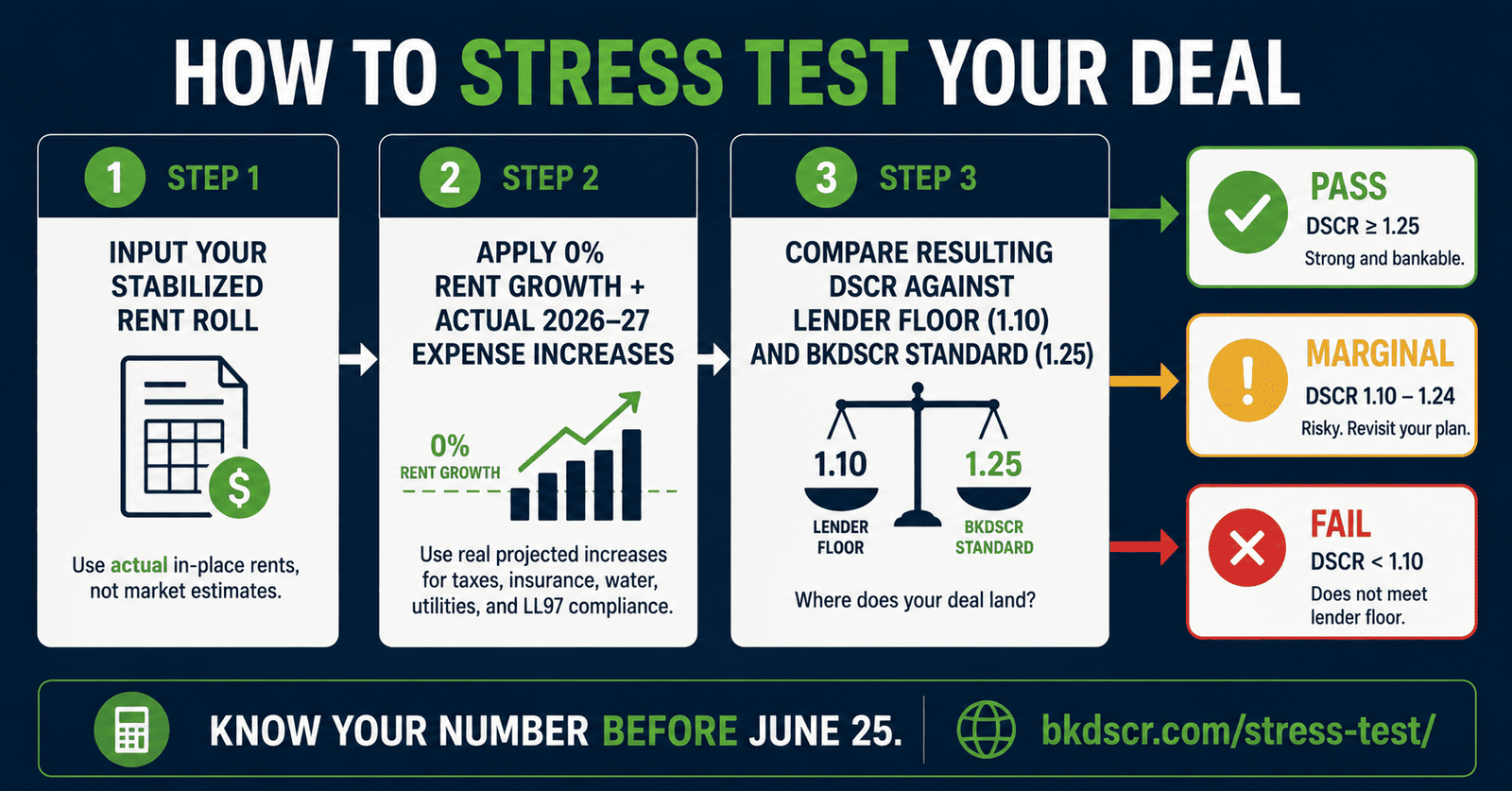
The stress test for an RGB freeze follows the same logic as a rate stress — it asks what the DSCR is under an adverse scenario before you commit. Run three versions:
- Base case: current rents, current PITIA — this is your going-in DSCR
- Freeze scenario: 0% rent increase, PITIA +$150/month for insurance — what does DSCR become in 12 months?
- Combined stress: freeze scenario + rate stress (+0.5% on refi, +1.0% on purchase) — what is the floor?
If the combined stressed DSCR stays above 1.00, the deal survives an adverse RGB outcome. If it drops below 1.00, the building cannot service its debt under adverse conditions. Before you contract on any stabilized building, run it through the stress test and run the freeze scenario explicitly. The deal killers page covers regulatory cost exposure on stabilized buildings.
FAQ: NYC Rent Freeze and DSCR
Does a 0% RGB order affect DSCR loan qualification?
Not directly at origination — the lender underwrites on current rents. But it affects your ability to refinance and the ongoing cash flow of the building. A deal that qualifies at 1.20 DSCR today and absorbs two years of insurance increases without any rent growth may not qualify for a refinance in two years.
Does the NYC Rent Freeze DSCR Ratio Apply to Market-Rate Buildings?
No. The RGB order applies to rent-stabilized leases only. Market-rate buildings can raise rents freely between tenancies. Mixed buildings have partial exposure proportional to their stabilized share.
Should I avoid stabilized buildings entirely?
Not necessarily. Stabilized buildings often trade at lower cap rates because buyers underwrite lower rent growth. If the purchase price reflects the regulatory risk and the current DSCR is strong enough to absorb a freeze plus cost inflation, the deal can still make sense. The question is whether the price accounts for the risk.
Run the RGB Scenario Before June 25
The June 25 vote is a known event on a known date. Investors who own stabilized buildings or are under contract on one should run the freeze scenario now — not after the vote. The DSCR math on a 0% freeze is not complicated. What’s complicated is finding out after closing that the building cannot absorb two more years of cost increases without rent growth.
Run a Deal Review — current DSCR, stressed DSCR, NOI, and updated tax assessment modeled at current inputs, delivered within 48–72 hours.
NYC Rent Freeze DSCR: The Borough-by-Borough Exposure Map
Rent stabilization exposure is not uniform across the outer boroughs. Brooklyn has the highest concentration of rent-stabilized units among outer-borough investor markets — buildings in Crown Heights, Flatbush, Bushwick, and Bed-Stuy are heavily stabilized, and the DSCR exposure from a 0% RGB order is most acute there. Queens has significant stabilized stock in Jackson Heights, Elmhurst, and Sunnyside. The Bronx is heavily stabilized citywide. Staten Island has relatively limited stabilized stock outside of a few pockets.
For DSCR investors, borough matters because it determines the probability that a given building has stabilized exposure. A Brooklyn 6-unit built before 1974 is almost certainly rent-stabilized unless it was deregulated through high-rent vacancy or substantial rehabilitation. A Staten Island 2-family built in 1985 is almost certainly market-rate. The due diligence step is confirming the regulatory status of every unit before running DSCR — the lender will verify this through the appraisal and the rent roll certification.
The DSCR compression from a 0% freeze is proportional to the stabilized share. A building with four stabilized units and two market-rate units sees two-thirds of its rent roll frozen. At a 3% market rent growth rate on the free units, the blended rent growth on the building is approximately 1% — less than the typical annual insurance and tax cost increase. That is a slow compression, not an immediate crisis. But on a fully stabilized building, 0% rent growth with 3–5% annual cost increases is a structural problem that compounds every year.
What Investors Who Own Stabilized Buildings Should Do Before June 25
The June 25 vote creates a decision window for two groups of investors: those currently under contract on stabilized buildings, and those who already own stabilized buildings and are evaluating a refinance.
For investors under contract, the RGB vote is a material event that should be explicitly modeled in the underwriting before closing. Run the freeze scenario on the current rent roll. If the deal clears 1.25 unstressed and 1.00 combined stressed under a 0% freeze plus a $150/month PITIA increase, you have a deal that survives the adverse outcome. If it only passes under a 2–3% RGB order, you are underwriting regulatory optimism. The closing date relative to the June 25 vote matters — a July close is post-vote and the outcome is known. A June close means you are closing with vote risk unresolved.
For investors evaluating a refinance on an existing stabilized building, the RGB vote affects the forward income projection that lenders use in their stress test. Some DSCR lenders will ask for a forward rent schedule on stabilized buildings — if the RGB order is 0%, the projected rents do not grow. That can affect the stressed DSCR calculation if the lender applies a rate stress on top of flat income projections.
The practical advice is the same in both cases: run the freeze scenario before the June 25 date, not after. The data required is the current rent roll, the regulatory status of each unit, the current PITIA, and the insurance renewal date. Plug in 0% rent growth for the stabilized units, your expected insurance increase, and your loan rate. That is your freeze-scenario DSCR. If it holds above 1.25, the deal is structurally sound. If it drops below 1.25, you need to understand the specific risk before proceeding.
RGB Vote History and What It Tells Investors About June 25
The RGB has issued orders every year since 1969. The range of historical outcomes includes a 0% freeze (2020 and 2021 during COVID), a 3.25% order (2022), 3% (2023), and 2.75% (2024). The preliminary range of 0%–2% on one-year leases in 2026 suggests the board is weighing tenant cost-of-living pressure against landlord operating cost increases.
The current board composition — six new members appointed in 2026 — is more tenant-friendly than prior boards, which is why the preliminary range extends to 0%. A 0% outcome is not certain, but it is explicitly on the table for the first time since 2021. Investors who own stabilized buildings should treat it as a planning scenario, not a tail risk.
Historical 0% orders in 2020 and 2021 coincided with COVID-related economic disruption. The 2026 context is different — the economy is not in crisis — but the board’s preliminary range signals genuine consideration of the 0% outcome on political and affordability grounds. The June 25 final vote will reflect the board’s weighting of those factors after the public comment period.
Rent-Stabilized vs Free-Market Buildings: The DSCR Divide
A free-market 4-unit in Brooklyn at $2,500/unit generates $10,000/month gross income. That income adjusts with the market — subject to lease terms. A rent-stabilized 4-unit with RGB-controlled leases at $1,800/unit generates $7,200/month. The DSCR difference at the same purchase price and PITIA is substantial: at a $5,500/month PITIA, the free-market deal runs 1.82 DSCR and the stabilized deal runs 1.31 DSCR. When the RGB votes 0%, the stabilized building’s income is frozen at $7,200. Any increase in property taxes, insurance, or maintenance comes entirely out of that fixed income — the DSCR denominator grows while the numerator stays flat.
What a 1% vs 2% RGB Order Does to DSCR in Real Dollars
At $1,800/unit on a 4-unit stabilized building, a 1% RGB increase adds $18/unit/month — $72/month total, $864/year. A 2% increase adds $36/unit/month — $144/month total, $1,728/year. At a 7.5% DSCR rate on a $750,000 loan with $12,000 annual taxes and $8,000 insurance, PITIA runs approximately $5,775/month. The 1% rent increase moves DSCR from 1.25 to 1.26. The 2% increase moves it to 1.27. Neither number changes the deal verdict — but the freeze scenario drops it to 1.24, below the BKDSCR 1.25 standard. The margin is 1 percentage point of rent growth, which is why the RGB vote matters to deal underwriting.
How the NYC Rent Freeze Interacts With Other 2026 DSCR Pressures
The RGB vote does not operate in isolation. Investors in stabilized outer-borough buildings are simultaneously facing three other cost pressures in 2026: FY27 property tax assessment increases (Brooklyn Class 2 up 16%, Bronx up 8–12%), insurance cost increases on older buildings (20–40% since 2022 in some zip codes), and a DSCR loan rate environment that remains above 7% for most outer-borough product.
The compounding effect of all four pressures — frozen rents, higher taxes, higher insurance, and no rate relief — is the scenario that threatens the most stabilized buildings in 2026. None of these pressures individually is sufficient to push a well-underwritten deal into default. Combined, over 24 months without any rent growth, they can move a 1.20 DSCR to 1.08. That is still above the lender floor — but it is below the BKDSCR standard, and it eliminates the margin for any additional adverse event.
Investors who are evaluating stabilized acquisitions in 2026 should model all four pressures simultaneously, not in isolation. The BKDSCR combined stress test applies a rate increase and a vacancy reduction simultaneously — the RGB freeze scenario adds a third dimension to that stress. A deal that clears the standard two-axis stress and also holds above 1.00 under a freeze scenario with cost increases is a deal with genuine structural margin. That is the standard worth targeting before closing on any stabilized outer-borough building in June 2026.
FAQ: NYC Rent Freeze DSCR 2026 — Additional Questions
What happens to DSCR if the RGB votes 1% instead of 0%?
At 1%, the rent growth on stabilized units is $17/month per $1,700 unit. On a 6-unit fully stabilized building, that is $102/month in additional gross rent. At a $8,000 PITIA, the DSCR improvement is approximately 0.013 points — from 1.27 to 1.28. Not material on its own, but combined with the insurance cost scenario, the difference between 0% and 1% is the difference between compression and flat performance.
Can I use projected rent increases for DSCR qualification if the RGB order hasn’t been voted yet?
No. DSCR lenders underwrite on current in-place rents. Projected increases from an unannounced RGB order are not an acceptable income input. The lender’s 1007 appraisal will reflect current market rent for stabilized units — which means the appraiser uses the current registered rent, not a projected post-RGB figure.
Does the freeze apply to leases already signed before June 25?
No. The RGB order takes effect on October 1, 2026 leases. Leases signed before the effective date at the prior renewal rate are not retroactively affected. The freeze applies to leases commencing on or after October 1, 2026 that are subject to RGB-covered renewal terms.