
Out-of-State DSCR Rental: 5 Proven Reasons Lenders Approve
Key Takeaways
- Out-of-state DSCR rentals pass lender review when property income covers PITIA — state is not a disqualifier
- Lenders add out-of-state overlays: executed PM agreement, lender-approved appraiser
- Sun Belt markets often produce stronger DSCR ratios than NYC due to lower tax and insurance stacks
- The BKDSCR standard applies regardless of state: 1.25+ unstressed, 1.00+ combined stress
- Vacant units are underwritten at zero income — even out of state. Current lease matters.
- LLC vesting is accepted by most DSCR lenders for out-of-state acquisitions
Table of Contents
- Why Out-of-State DSCR Rental Lender Approval Starts With the Formula
- The DSCR Formula Is Identical in Every State
- Reason 1 — The PITIA Is Structurally Lower Out-of-State
- Property Taxes: The Biggest Variable Between NYC and Most Out-of-State Markets
- Landlord Insurance: The Second Structural Advantage
- Reason 2 — Rent-to-Price Ratios Produce Stronger DSCR Out-of-State
- Reason 3 — DSCR Underwriting Is Property-Specific, Not Borrower-State-Specific
- What the Lender Reviews on an Out-of-State DSCR File
- Reason 4 — Most DSCR Lenders Operate in 40+ States
- Reason 5 — LLC Vesting Out-of-State Is Clean and Lender-Accepted
- What NYC Investors Need to Verify Before Closing Out-of-State on DSCR
- Out-of-State DSCR Rental Lender Approval: A Real Side-by-Side
- Out-of-State DSCR Rental: The Reserve and Closing Cost Differences
- FAQ: Out-of-State DSCR Rental Lender Approval
- Can a NYC investor get a DSCR loan on a property in Florida or Pennsylvania?
- Does buying out-of-state change the DSCR calculation?
- What state-specific requirements do I need to know before closing DSCR out-of-state?
- Bottom Line — Out-of-State DSCR Rental Lender Approval Is a Cost Structure Advantage
The out of state DSCR rental lender approval question is fundamentally a formula question. DSCR underwriting qualifies the property, not the borrower’s state of residence. If gross monthly rent divided by PITIA meets the lender’s minimum — typically 1.10 to 1.20, with 1.25 as the BKDSCR standard — the loan qualifies. The borrower’s zip code is irrelevant to that calculation. What changes is the cost structure: taxes, insurance, and price-to-rent ratios that produce materially different DSCR outcomes on the same loan amount across markets.
Before spending time on a full analysis, use the deal filter to confirm the property type, rent roll, and DSCR threshold clear the basic eligibility requirements for the target lender’s out-of-state program.
| MARKET SNAPSHOT — Out-of-State DSCR Loan Approvals, May 2026 | |
| Sources | Ridge Street Capital | AAA Lending | BKDSCR Research (May 2026) |
| DSCR 30-yr fixed (May 2026) | 6.5%–7.875% | out-of-state same rates as NYC |
| Out-of-state approval rate | Higher in Sun Belt (lower tax/insurance stack) |
| DSCR minimum (most lenders) | 1.10–1.20 | BKDSCR standard: 1.25+ unstressed |
| Appraiser requirement | Lender-ordered appraisal required — no investor selection |
| Property management | Most lenders require executed PM agreement at closing |
| Lease status | Occupied = actual lease | vacant = $0 income |
| LLC underwriting | Most DSCR lenders accept LLC vesting out-of-state |
Why Out-of-State DSCR Rental Lender Approval Starts With the Formula
DSCR underwriting is a formula applied to a property. The formula is gross monthly rent divided by monthly PITIA. The lender evaluates the property’s income against the property’s carrying cost. The borrower’s state of residence, the property’s distance from the investor, and the market the investor prefers are all irrelevant to that calculation.
A NYC investor buying a 4-unit in Allentown, Pennsylvania submits the same documents as a Allentown investor buying the same property: rent roll, executed leases, property insurance quote, tax bill, appraisal. The DSCR underwriting process is identical. The outcome depends on whether the property passes the formula — not on where the investor lives.
As Stacking Capital’s 2026 DSCR investor loan guide describes, DSCR loan qualification is a property-level test. The lender’s decision flows from the rent roll and the PITIA stack — both of which are property-specific variables that have nothing to do with the borrower’s geography.
The DSCR Formula Is Identical in Every State
The 1007 rent schedule establishes the qualifying rent. The appraisal establishes the market value. The lender’s rate sheet establishes the P+I. Taxes and insurance come from verified third-party sources. DSCR = rent / PITIA. This formula does not change based on the property’s state. A 1.31 DSCR in Pennsylvania is underwritten the same way as a 1.31 DSCR in Brooklyn. The lender’s minimum is the same. The stress test threshold is the same. The documentation is the same.
Reason 1 — The PITIA Is Structurally Lower Out-of-State
The PITIA denominator in the DSCR formula has three components the investor controls at acquisition: the loan amount (via purchase price and LTV), the rate (via lender selection and lock timing), and the down payment structure. Two components are market-driven and fixed: property taxes and landlord insurance. In NYC, both are structurally higher than in most out-of-state markets — and that structural difference is the primary reason out-of-state DSCR rental deals produce stronger ratios on the same loan amount.
Property Taxes: The Biggest Variable Between NYC and Most Out-of-State Markets
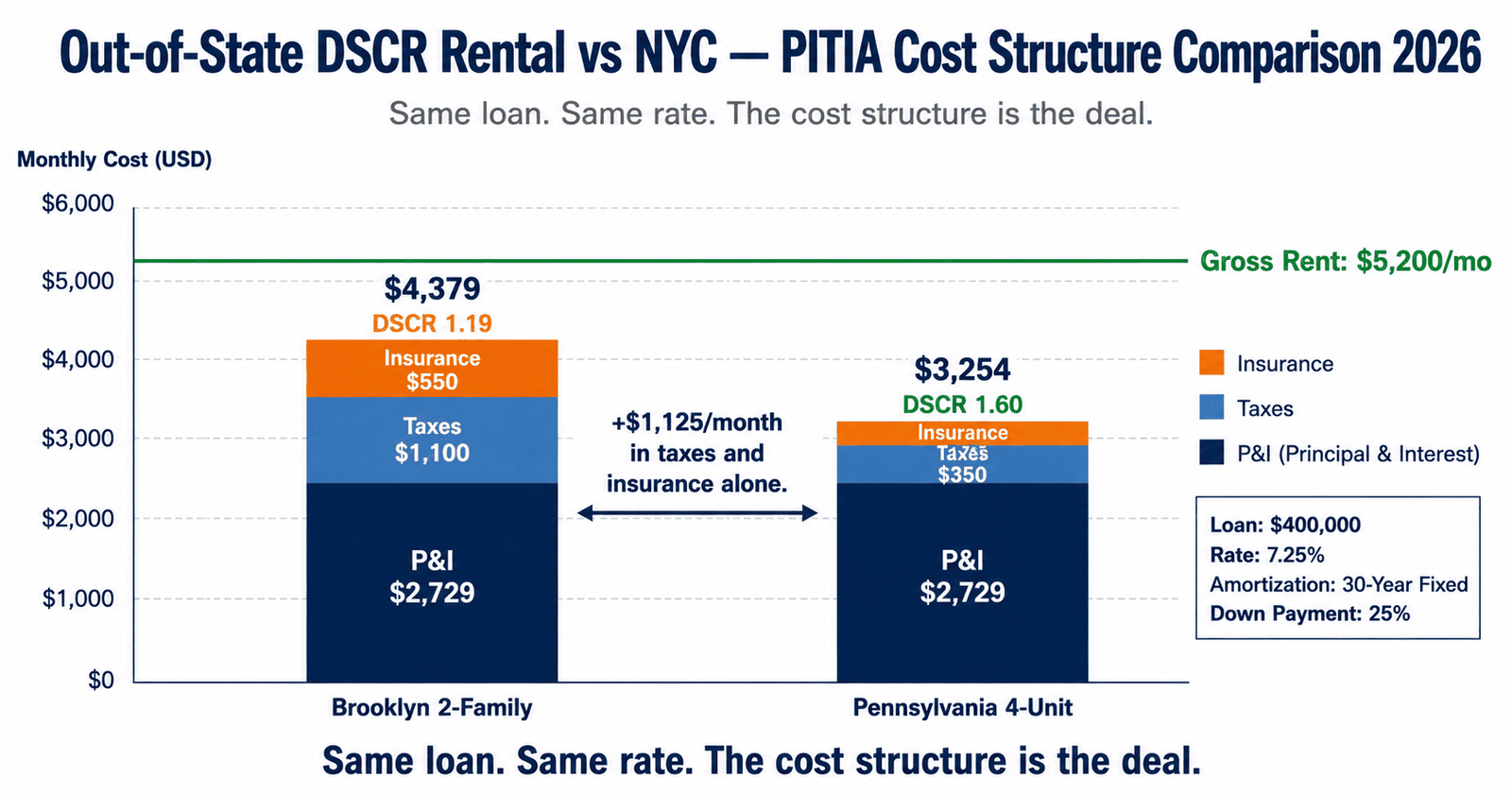
NYC Class 2 (2–4 unit residential) property tax assessments rose 6.9% in FY2027. On a $535,000 Brooklyn 2-family, annual taxes run approximately $13,200 — $1,100/month in PITIA. A comparable 4-unit in Allentown, Pennsylvania at $380,000 carries approximately $4,800/year in property taxes — $400/month. The $700/month difference in taxes alone shifts DSCR by approximately 0.18 points at the same rent and loan amount.
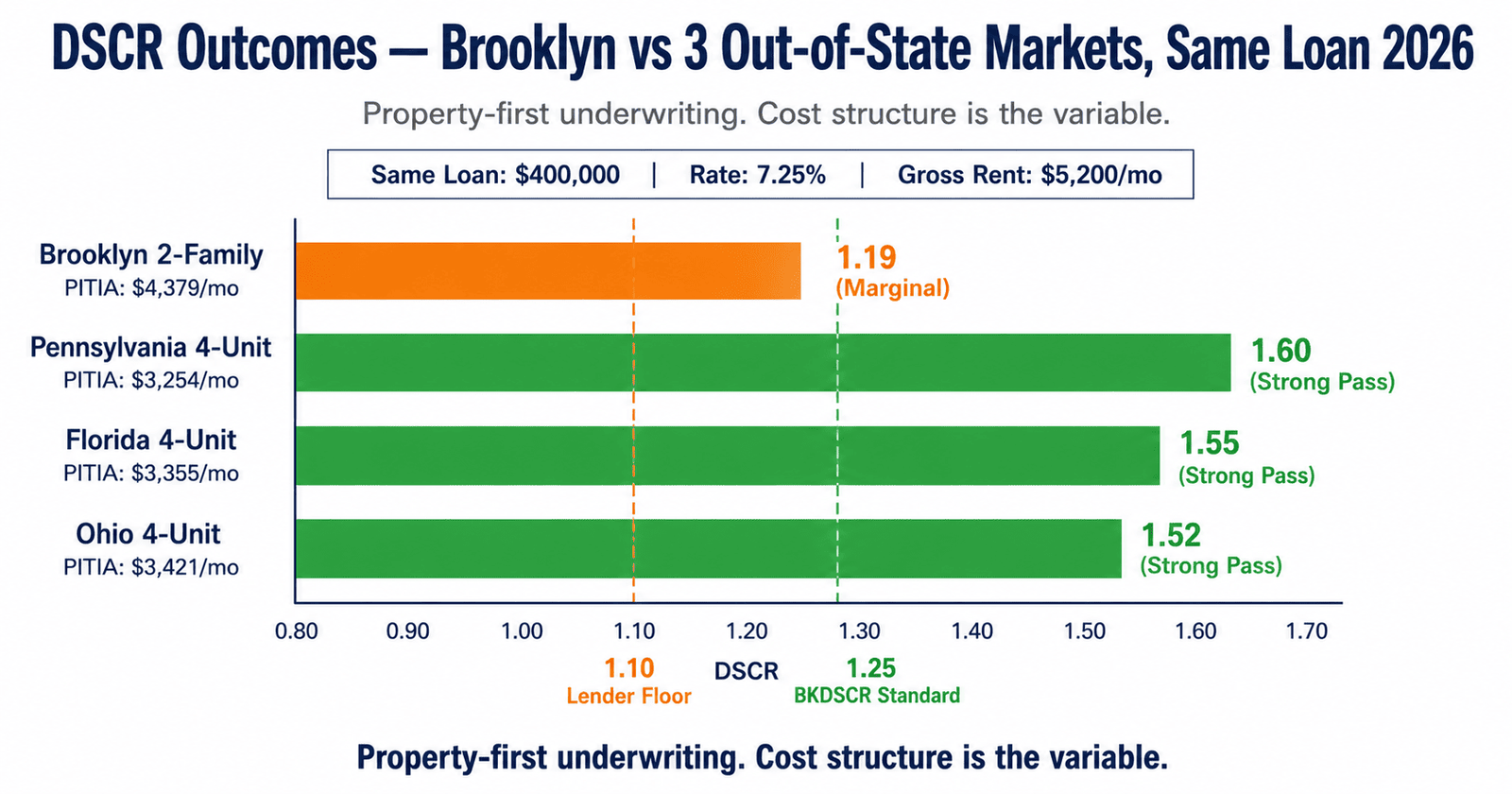
That $600 to $900 monthly difference in taxes alone is the difference between a 1.19 DSCR on the Brooklyn deal and a 1.52 DSCR on the Pennsylvania deal at the same rent level. The DSCR formula page shows exactly how each PITIA component flows into the ratio calculation.
Landlord Insurance: The Second Structural Advantage
NYC outer-borough landlord insurance has increased more than 150% since 2019, driven by climate-related underwriting changes and reinsurance cost increases. A Brooklyn 2-family that carried $3,600/year in landlord insurance in 2019 now costs $8,400–$11,000/year at 2026 renewal. A comparable rental property in Pennsylvania, Ohio, or the Carolinas carries $1,800–$3,600/year. The annual difference — $5,000 to $7,000 — is $417 to $583/month in PITIA. That moves DSCR by 0.10 to 0.15 points.
Reason 2 — Rent-to-Price Ratios Produce Stronger DSCR Out-of-State
The numerator in the DSCR formula — gross monthly rent — is driven by local market rents, not the investor’s home market. In most out-of-state markets, the price-to-rent ratio is more favorable than NYC outer-borough: lower purchase prices produce smaller loan amounts and lower P+I, while rents are sufficient to clear 1.25+ DSCR with meaningful margin.
A 4-unit in Allentown, Pennsylvania priced at $380,000 generates $4,800/month gross rent. At 75% LTV and 7.25%, monthly P+I is $1,942. Taxes: $400/month. Insurance: $175/month. PITIA: $2,517/month. DSCR: $4,800 / $2,517 = 1.91. The same loan structure on a $950,000 Brooklyn 4-unit with $8,800/month gross rent produces PITIA of $6,850/month and DSCR of 1.28. Both pass. The out-of-state deal has significantly more cushion.
This is not a secret — it is the math that makes out-of-state DSCR rental deals attractive to NYC investors who have been priced out of the margin they need to clear the stress test on local acquisitions.
For the complete framework on underwriting out-of-state deals the way lenders do — PITIA inputs, rent verification, stress test, and lender match — download the DSCR Playbook.
Reason 3 — DSCR Underwriting Is Property-Specific, Not Borrower-State-Specific
The central structural advantage of DSCR financing — the reason it was designed as a product category — is that it qualifies the investment property on its own income. The borrower’s W-2, tax returns, personal debt-to-income ratio, and state of residence are not part of the underwriting calculation. DSCR lenders are evaluating whether the property generates sufficient income to service the debt. That evaluation is identical regardless of where the investor lives.
An NYC-based investor buying a 4-unit in Tampa, Florida presents the same underwriting file as a Tampa investor buying the same property. The lender’s 1007 appraisal form is the same. The rent schedule verification is the same. The PITIA calculation is the same. The stress test threshold is the same. The out-of-state DSCR rental lender approval process adds two overlays — PM agreement and state-licensed appraiser — but does not change the qualification standard.
What the Lender Reviews on an Out-of-State DSCR File
The documentation list for an out-of-state DSCR deal is identical to a local DSCR deal with two additions. Standard items: executed leases on all occupied units, current landlord insurance quote, most recent property tax bill, appraisal with 1007 rent schedule, entity documents if LLC-vested. Out-of-state additions: executed property management agreement from a lender-approved PM company in the subject state, and confirmation that the appraiser is licensed in the subject state. Both are standard pre-close items that any competent out-of-state closing team handles routinely. Use the lender criteria page for the full out-of-state overlay breakdown by program.
Reason 4 — Most DSCR Lenders Operate in 40+ States
Lender state availability is one of the most common barriers investors cite when considering out-of-state DSCR rentals — and it is the most overstated barrier. The major non-QM DSCR lenders operate in 40 to 47 states. Investor-focused lenders like Lima One, Kiavi, CoreVest, and others have built their products specifically for multi-state rental investors. The lender pool for out-of-state DSCR is not materially different from the pool for NYC outer-borough deals.
The exceptions are worth knowing before contracting. Some states require specific lender licensing — Missouri, North Dakota, and South Dakota have historically been more restrictive. Confirm the lender operates in the subject state before executing a purchase agreement. This is a 5-minute call to the lender’s operations team — not a research project.
Certain states require DSCR loans to close in an LLC — Florida and Georgia are the most common examples. If the investor plans to hold in personal name, those states require either a different program structure or a different lender. Confirming vesting requirements before contracting prevents closing delays. The deal killers page covers LLC vesting requirements by state for DSCR investors.
Reason 5 — LLC Vesting Out-of-State Is Clean and Lender-Accepted
DSCR loans are classified as business-purpose mortgages, not consumer mortgages. They are designed for LLC vesting. Most DSCR lenders accept single-member LLCs, multi-member LLCs, and series LLCs on out-of-state properties without rate adjustment or additional documentation beyond standard entity paperwork. The LLC structure does not become more complex because the property is out-of-state.
An NYC-based investor with an existing LLC can close an out-of-state DSCR rental in that LLC or form a new entity in the subject state depending on the lender’s preference. Some lenders prefer the LLC be registered in the property’s state; others accept a foreign LLC registered as a foreign entity. Confirming the preference before forming the entity is a 10-minute conversation — not a legal complexity.
The DSCR product also bypasses the Fannie Mae 10-financed-property cap that limits conventional investment loan access for portfolio investors. An investor with 8 financed properties can still access DSCR financing on property 9 and 10 — in any state where the lender operates.
What NYC Investors Need to Verify Before Closing Out-of-State on DSCR
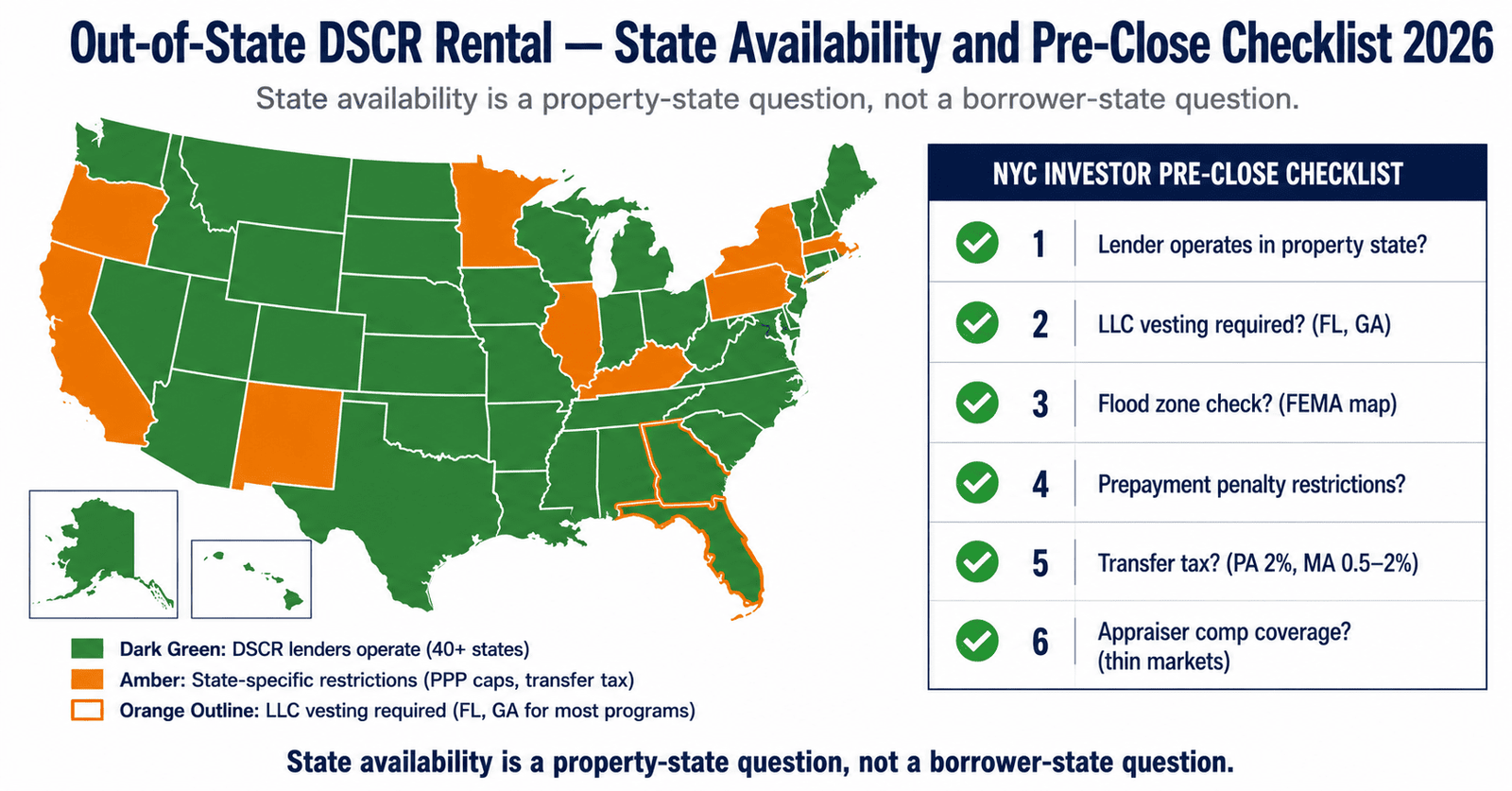
Out-of-state DSCR rental lender approval is not more complex than a local deal — but it does require pre-contract verification on six variables that do not arise on NYC deals.
- Lender state availability. Confirm the lender operates in the property state before executing a purchase agreement.
- LLC vesting requirement. Florida and Georgia require LLC vesting for most programs. Confirm before forming the entity.
- Flood zone check. Coastal Florida, Texas Gulf Coast, Alabama, Mississippi, and Louisiana carry FEMA flood zone exposure. Flood insurance adds $200–$700/month to PITIA in affected zones.
- Prepayment penalty restrictions. Some states limit certain PPP structures. Confirm the selected PPP is enforceable in the subject state before locking.
- Transfer tax and closing cost differences. Pennsylvania’s 2% transfer tax on sale price adds approximately $7,600 to a $380,000 purchase. Massachusetts transfer taxes run 0.5–2%. These are closing costs that affect total capital required.
- Appraisal comp coverage. Rural or low-density markets can produce thin appraisal comp pools. Confirm the appraiser has adequate comps in the subject market before ordering the appraisal.
Out-of-State DSCR Rental Lender Approval: A Real Side-by-Side
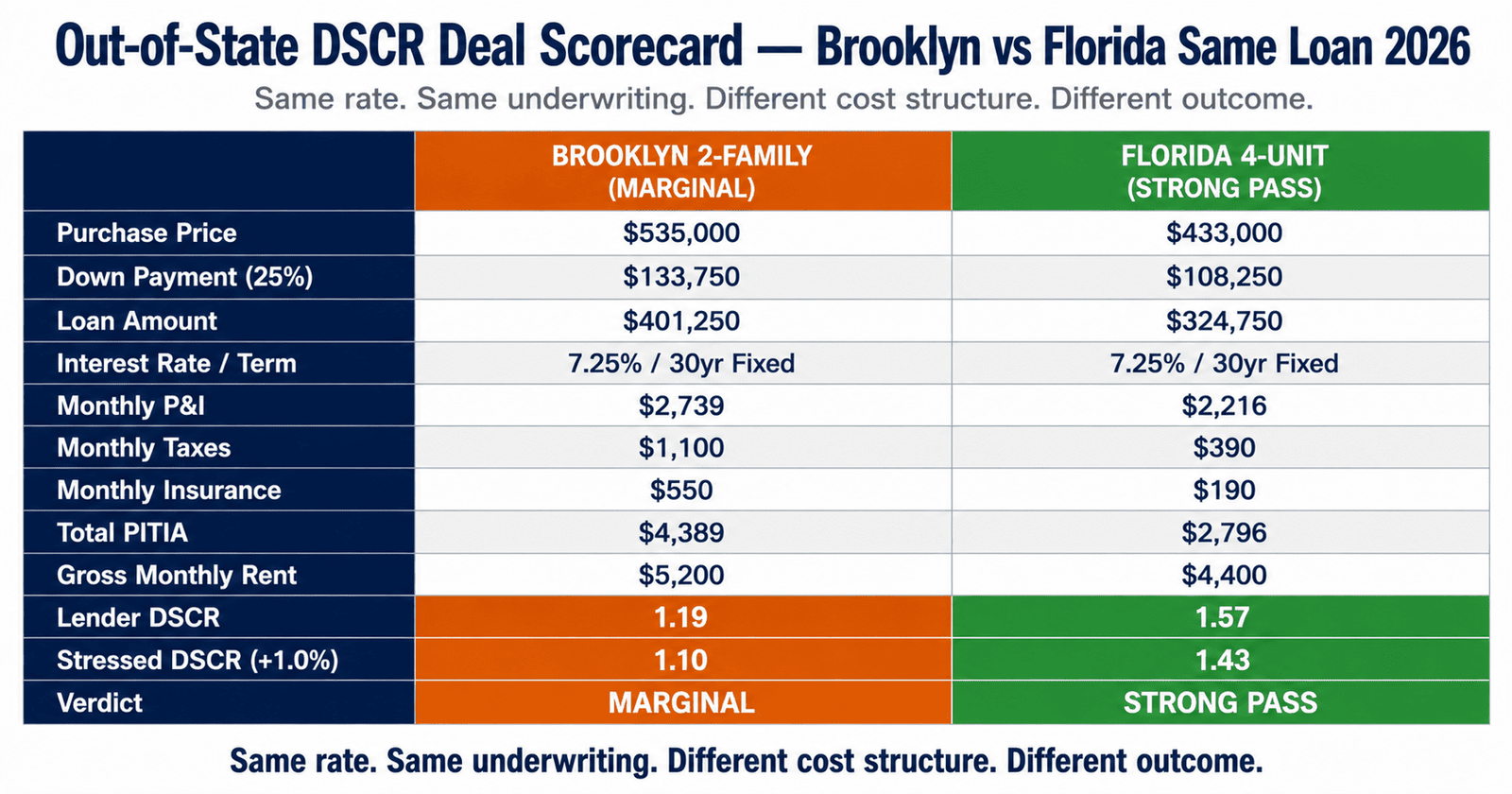
The clearest way to see why out-of-state DSCR rental deals pass lender review at stronger margins is a direct side-by-side comparison at the same loan amount and rate.
| Brooklyn 2-Family | Florida 4-Unit | |
| Purchase Price | $535,000 (75% LTV) | $433,000 (75% LTV) |
| Down Payment | $133,750 (25%) | $108,250 (25%) |
| Loan Amount | $401,250 | $324,750 |
| Rate / Term | 7.25% / 30-year fixed | 7.25% / 30-year fixed |
| Monthly P+I | $2,739 | $2,216 |
| Monthly Taxes | $1,100 | $390 |
| Monthly Insurance | $550 | $190 |
| Total PITIA | $4,389 | $2,796 |
| Gross Monthly Rent | $5,200 (2 units) | $4,400 (4 units) |
| Lender DSCR | 1.19 — MARGINAL | 1.57 — STRONG PASS |
| Stressed DSCR +1% | 1.10 (at lender floor) | 1.43 (strong) |
| Verdict | Passes with thin margin | Passes with full margin |
The Brooklyn deal qualifies at 1.19 and stresses to 1.10 — at the lender’s floor. The Florida deal qualifies at 1.57 and stresses to 1.43. Both are DSCR loan approvals. The difference is margin, not eligibility. For NYC investors who need margin — to pass the BKDSCR stress test at 1.25+ unstressed and 1.00+ combined stress — the out-of-state cost structure delivers what the NYC market cannot at current price levels.
Out-of-State DSCR Rental: The Reserve and Closing Cost Differences
Out-of-state DSCR loans carry the same reserve requirement as NYC deals — most lenders require 6 months of PITIA in reserves at closing. On a $300,000 out-of-state purchase at 75% LTV with a $1,750/month PITIA, the reserve requirement is $10,500. On a comparable NYC deal at $900,000 with a $6,800/month PITIA, the reserve requirement is $40,800. The capital required to hold in reserve is 75% lower on the out-of-state deal — freeing capital for additional acquisitions.
Closing costs also differ materially. NYC imposes a mortgage recording tax of 1.925% on loans above $500,000 — on a $637,500 NYC loan, that is $12,272 at closing. Most out-of-state markets have no equivalent tax. Florida, Texas, and the Carolinas have minimal mortgage recording fees — typically under $500. That $12,000 difference in closing friction is real capital that stays in the investor’s account on an out-of-state deal.
The combined effect — lower PITIA, lower reserves, lower closing costs — means an out-of-state DSCR rental acquisition requires substantially less total capital than a NYC equivalent at a comparable loan amount. For NYC investors with limited capital who cannot clear the full cost stack on an outer-borough deal, out-of-state DSCR rental is not a second choice. It is a structurally different capital deployment with a different risk and return profile. Use the deal analysis framework to compare both side by side before deciding which market to pursue.
FAQ: Out-of-State DSCR Rental Lender Approval
Can a NYC investor get a DSCR loan on a property in Florida or Pennsylvania?
Yes, without exception. DSCR lenders underwrite the property, not the borrower’s location. A NYC-based investor submits the same file as a local investor: rent roll, leases, insurance quote, tax bill, appraisal. The lender adds two out-of-state overlays — PM agreement and state-licensed appraiser — but the qualification standard is identical.
Does buying out-of-state change the DSCR calculation?
The formula is identical: gross monthly rent divided by monthly PITIA. What changes is the PITIA — lower taxes and insurance out-of-state produce a lower denominator and a stronger DSCR at the same rent level. The lender’s minimum does not change. The stress test threshold does not change. The documentation does not change.
What state-specific requirements do I need to know before closing DSCR out-of-state?
Six variables matter: lender state availability, LLC vesting requirements (FL, GA require LLC for most programs), flood zone check, prepayment penalty restrictions, transfer tax, and appraisal comp coverage. All six are verifiable before contracting. None is a deal-killer on its own — they are pre-close checklist items, not underwriting barriers.
Bottom Line — Out-of-State DSCR Rental Lender Approval Is a Cost Structure Advantage
Out-of-state DSCR rental deals pass lender review for a straightforward reason: the PITIA is lower. Property taxes and landlord insurance in most out-of-state markets run $700 to $1,600 per month less than comparable NYC outer-borough deals. That cost reduction flows directly into the DSCR denominator, producing ratios that clear lender floors with meaningful margin.
The underwriting is identical. The lender floor is the same. The appraisal process is the same. The documentation is the same. The borrower’s location is irrelevant to the qualification outcome because DSCR financing qualifies the property, not the person. See also: NYC cap rates and DSCR.
What changes for out-of-state deals is the pre-contract verification list — six items that any prepared investor confirms before signing a purchase agreement. The BKDSCR standard applies in every market: 1.25+ unstressed, 1.00+ combined stress. Run every out-of-state deal through the deal filter first, then the full analysis.
If you have a specific out-of-state rental deal and want a full DSCR analysis — current ratio, stressed ratio, reserve requirement, and lender match position for that market — the deal review delivers the analysis in the same format as any NYC deal, with the market-specific PITIA inputs built in.