
PITIA DSCR Loan Explained: What’s in the Denominator
- PITIA DSCR loan explained: P + I + T + I + A = the full monthly cost the lender uses as the denominator
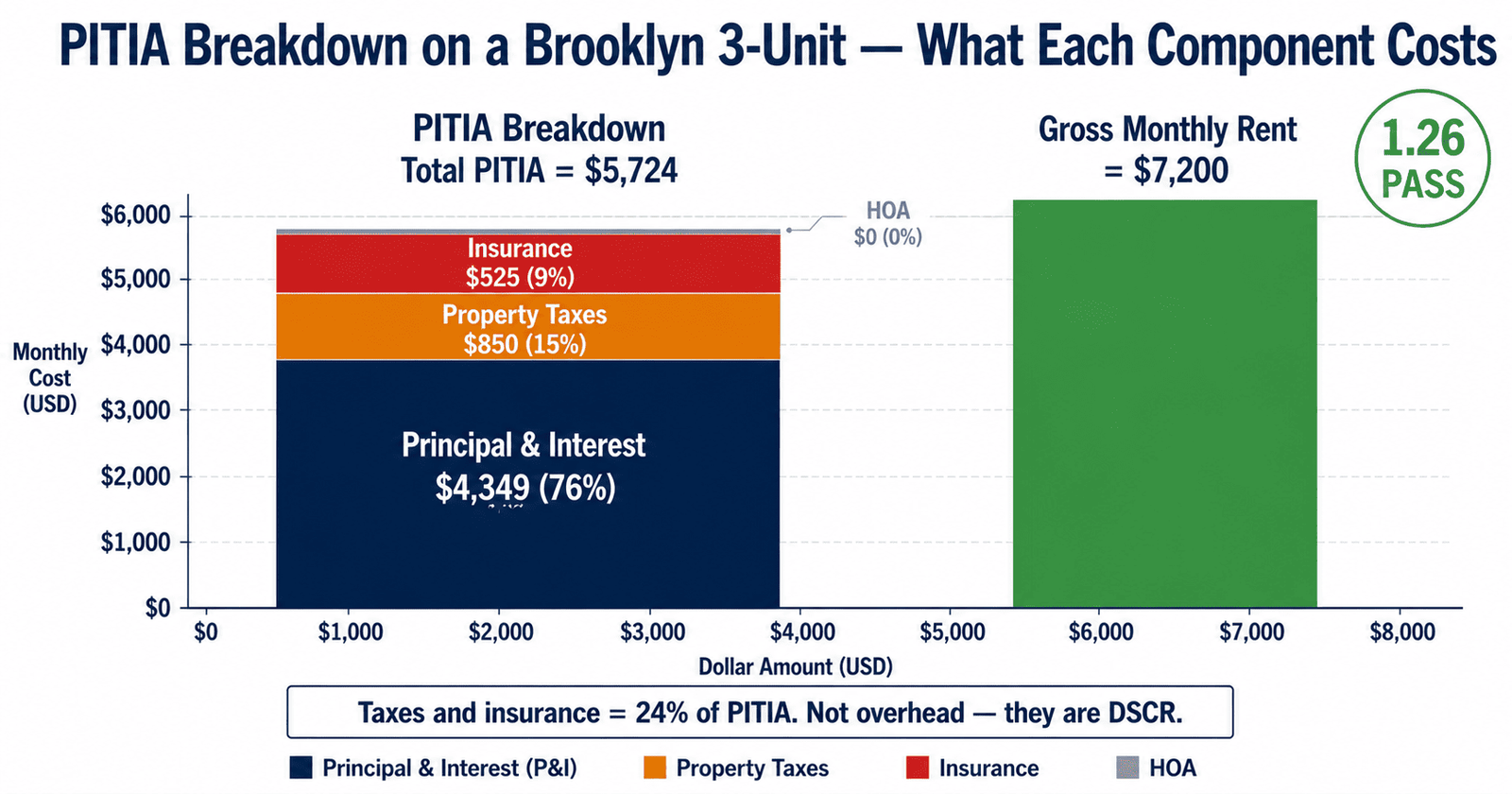
- On a Brooklyn 3-unit: P+I $4,349 (76%) + Taxes $850 (15%) + Insurance $525 (9%) = PITIA $5,724
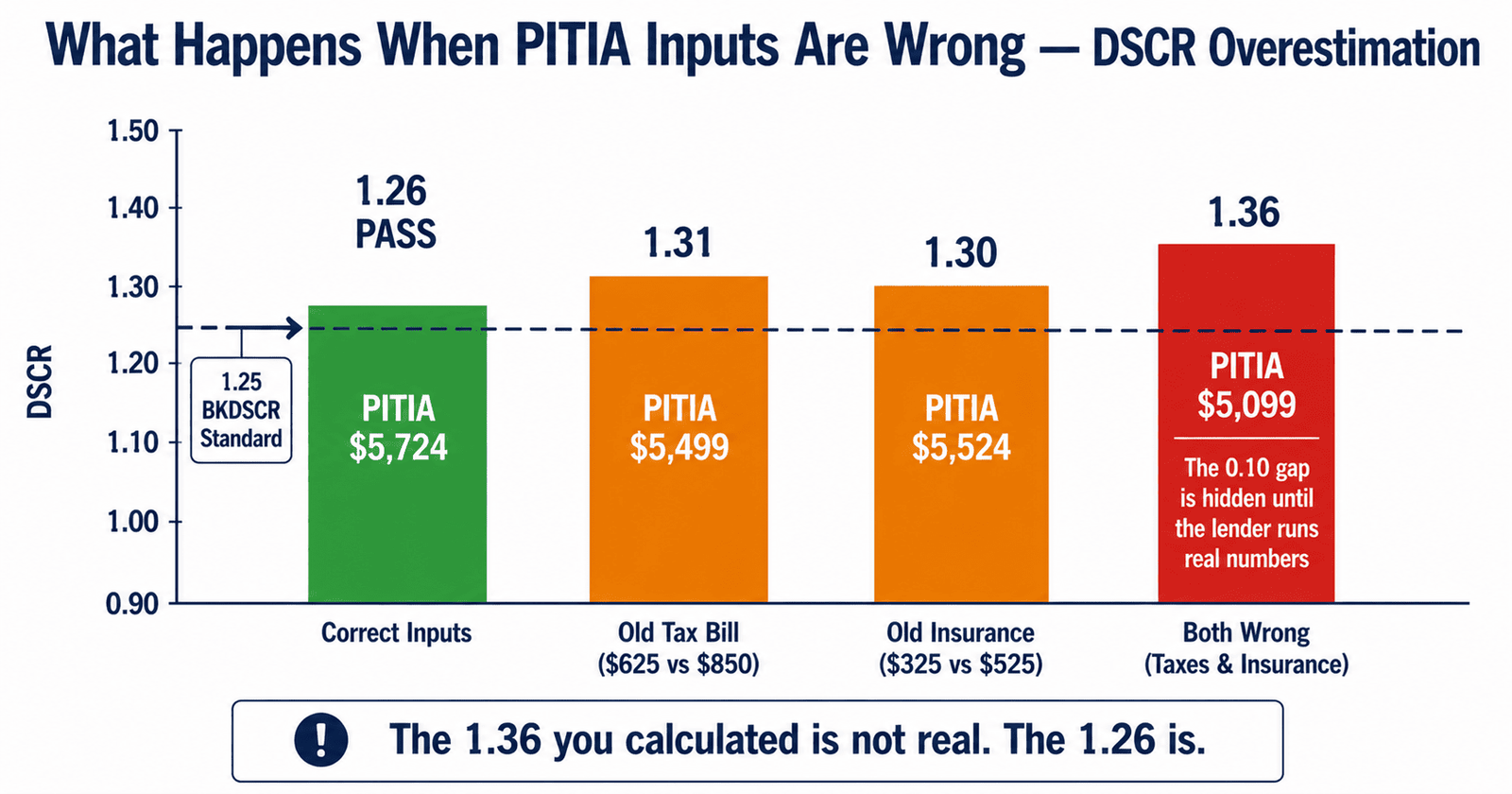
- Using old tax bill ($625 vs FY27 $850): DSCR reads 1.31 instead of 1.26 — a hidden 0.05 overestimate
- Using old insurance quote ($325 vs current $525): DSCR reads 1.30 instead of 1.26 — another 0.04 overestimate
- Both wrong together: DSCR reads 1.36 instead of 1.26 — the 0.10 gap is invisible until the lender runs real numbers
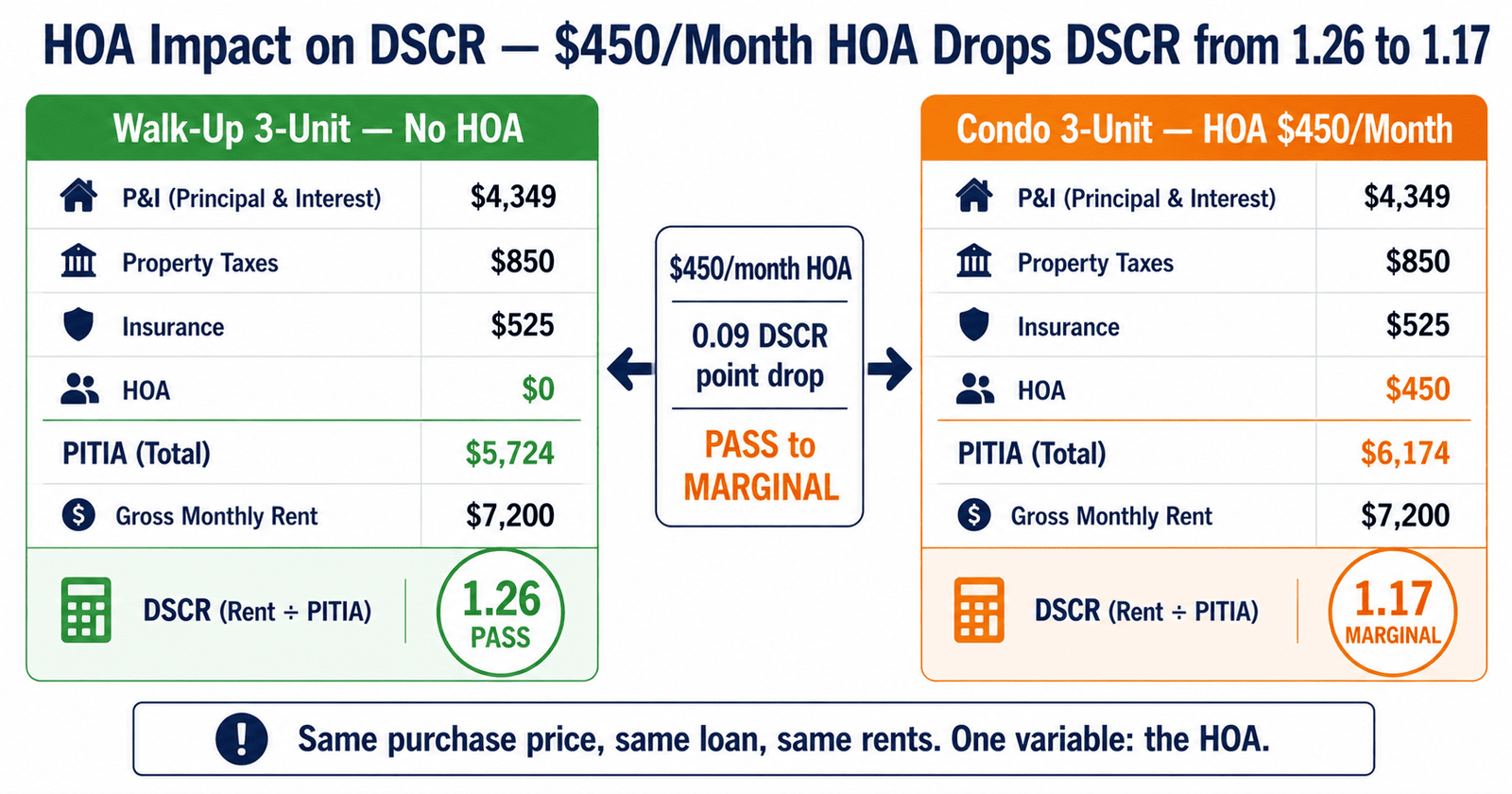
- HOA on condo deals: $450/month HOA drops DSCR from 1.26 PASS to 1.17 MARGINAL
Table of Contents
- What PITIA Means and Why It Is the Denominator
- The Brooklyn 3-Unit: What Each PITIA DSCR Loan Component Costs
- What the Lender Actually Verifies on a PITIA DSCR Loan
- Property Taxes: FY27 NOPV, Not the Seller’s Bill
- Insurance: Current Market Quote, Not Prior Owner’s Rate
- HOA / Association Dues: Non-Negotiable for Condos
- What Happens When PITIA DSCR Loan Inputs Are Wrong
- The DSCR Formula: Where Each PITIA Component Lives
- The NYC-Specific Variables That Make PITIA Inputs Hard to Get Right
- PITIA DSCR Loan: The Pre-Submission Verification Sequence
- The NYC-Specific Variables That Make PITIA DSCR Loan Inputs Hard to Get Right
- PITIA DSCR Loan: The 5-Step Pre-Submission Verification Sequence
- FAQ: PITIA and DSCR Underwriting
- How Does HOA Affect PITIA DSCR Loan Calculations?
- What Tax Number Should I Use for PITIA on a NYC Property?
- Can I Use Operating Expenses to Reduce PITIA?
- The Bottom Line — Verify Every PITIA Input Before You Submit
PITIA DSCR loan explained NYC 2026: Principal, Interest, Taxes, Insurance, and Association dues — all five components sit in the denominator of the DSCR formula. This post breaks down every component, shows what each costs on a real Brooklyn 3-unit at current 2026 inputs, and shows exactly what happens to DSCR when any one input is wrong.
Before submitting any NYC deal, use the deal filter — property type, loan amount, taxes, insurance, and rent roll confirmed before full analysis.
| MARKET SNAPSHOT — PITIA Components, NYC Outer Borough, May 2026 | |
| Sources | Griffin Funding | Ridge Street Capital | NYC DOF FY27 | BKDSCR Research |
| DSCR formula | Gross Monthly Rent / PITIA = DSCR |
| P+I on $637,500 at 7.25% (30-yr) | $4,349/month |
| Brooklyn Class 2 property taxes (FY27) | $850/month (increased per DOF NOPV) |
| NYC outer-borough landlord insurance | $525/month (current market; up 40–60% since 2022) |
| HOA / condo association dues | $300–$600/month typical NYC condo (if applicable) |
| DSCR minimum (most lenders) | 1.00–1.25 | BKDSCR standard: 1.25+ |
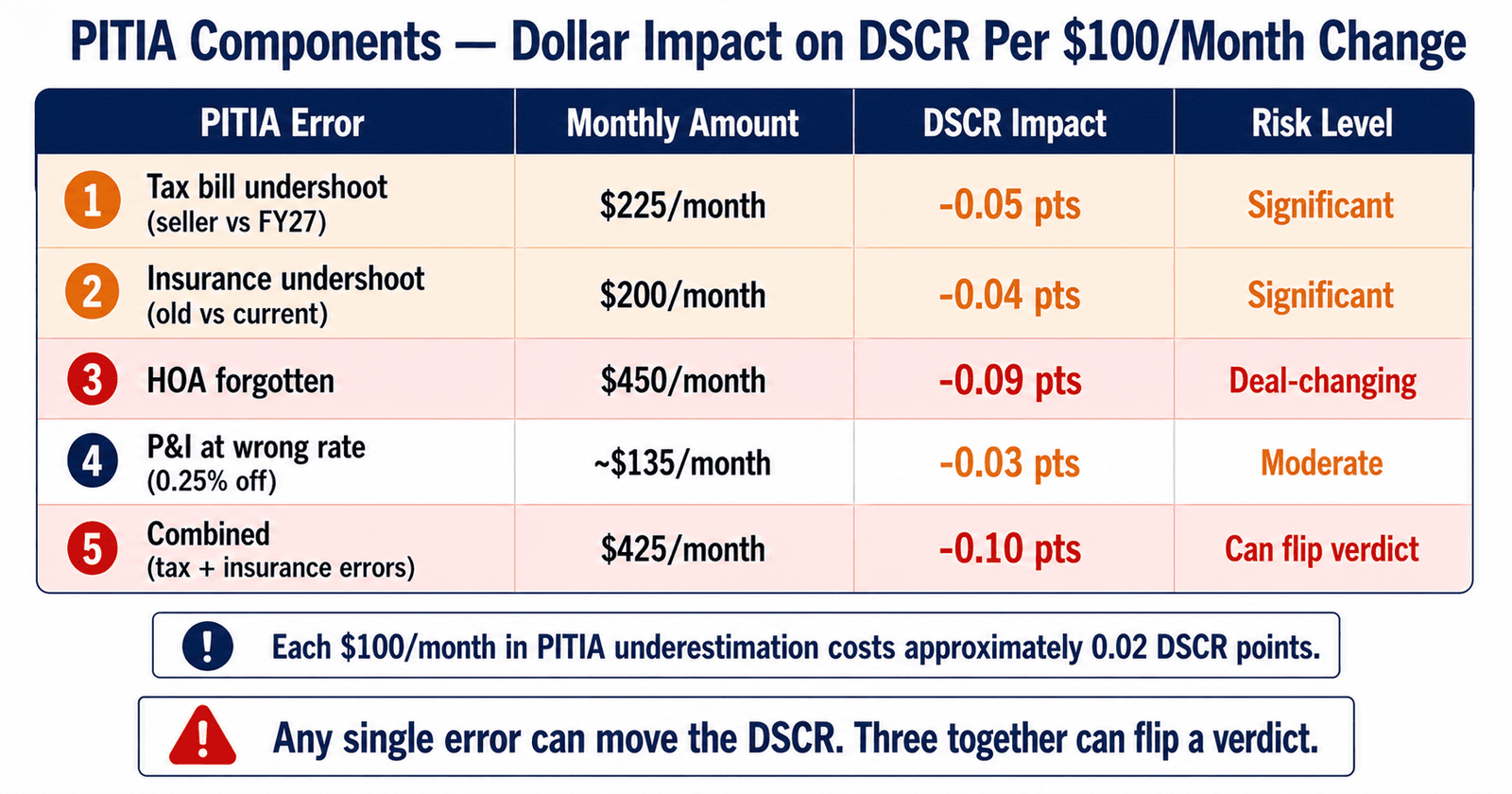
| Common PITIA error #1 | Using seller’s old tax bill (often $200–$300/month low) |
| Common PITIA error #2 | Using prior owner’s insurance quote (often $150–$200/month low) |
| Common PITIA error #3 | Forgetting HOA on condo deals (can drop DSCR 0.10+ points) |
What PITIA Means and Why It Is the Denominator
The DSCR formula is: Gross Monthly Rent ÷ PITIA = DSCR. Rent is the numerator. PITIA is the denominator. Every dollar added to PITIA reduces DSCR. Every dollar removed from PITIA improves it. This is why PITIA accuracy matters — a $225/month underestimate in property taxes alone costs 0.05 DSCR points. On a deal where the margin between pass and fail is 0.08 points, that error is the difference between a loan that funds and one that does not.
PITIA is not an approximation of the monthly mortgage payment. It is the complete monthly carrying cost of the property as the lender calculates it. As Griffin Funding’s DSCR loan guide explains, lenders evaluate the property’s income against its full carrying cost — not just the mortgage payment. The DSCR formula page shows the full calculation with outer-borough examples across all five PITIA components.
The Brooklyn 3-Unit: What Each PITIA DSCR Loan Component Costs
The deal: a Brooklyn 3-unit walk-up purchased at $850,000 with 25% down. Loan amount: $637,500. Rate: 7.25% 30-year fixed. The PITIA breakdown at verified 2026 inputs:
| PITIA Component | Monthly Amount | % of PITIA | What the Lender Verifies |
| Principal & Interest (P+I) | $4,349 | 76% | Calculated from actual loan amount, rate, and 30-yr term |
| Property Taxes (T) | $850 | 15% | FY27 NOPV from NYC DOF — NOT seller’s old tax bill |
| Insurance (I) | $525 | 9% | Current market quote — NOT prior owner’s rate |
| HOA / Association Dues (A) | $0 | 0% | Verified from HOA docs or appraisal (required if applicable) |
| TOTAL PITIA | $5,724 | 100% | Every dollar in denominator of DSCR |
| Gross monthly rent | $7,200 | — | Lower of in-place lease or appraiser market rent |
| DSCR | 1.26 — PASS | — | $7,200 / $5,724 |
What the Lender Actually Verifies on a PITIA DSCR Loan
Property Taxes: FY27 NOPV, Not the Seller’s Bill
The most common PITIA error on NYC deals is using the seller’s current tax bill to model DSCR. On this deal, the prior owner was paying approximately $625/month based on an older assessment. The FY27 NOPV shows $850/month — a $225/month difference. Using the old bill produces a DSCR of 1.31. Using the correct FY27 figure produces 1.26. The 0.05 gap is invisible until the lender’s underwriter pulls the actual tax record from the NYC DOF. Fix: pull the FY27 NOPV from nyc.gov/finance using the property BBL before building any DSCR model.
Insurance: Current Market Quote, Not Prior Owner’s Rate
NYC outer-borough landlord insurance has increased 40–60% since 2022. On this deal, the prior owner’s insurance was $325/month. The investor’s current market quote came in at $525/month — a $200/month difference. Using the old rate produces a DSCR of 1.30. Using the current market quote produces 1.26. Combined with the tax error, both wrong inputs produce a modeled DSCR of 1.36 against an actual underwritten DSCR of 1.26. The 0.10 gap means the deal appears to clear the BKDSCR 1.25 standard comfortably when it actually clears by 0.01.
HOA / Association Dues: Non-Negotiable for Condos
On a comparable deal where the same Brooklyn 3-unit is a condo with a $450/month HOA: PITIA becomes $6,174 instead of $5,724. DSCR drops from 1.26 to $7,200 / $6,174 = 1.17. The deal moves from PASS to MARGINAL on a single variable the investor forgot to include. Confirm HOA status from the deed, the appraisal, or the condo documents before building any PITIA model on a condo deal. See the deal killers page for the full list of PITIA errors that cause NYC DSCR applications to fail.
What Happens When PITIA DSCR Loan Inputs Are Wrong
| Scenario | PITIA Used | DSCR Calculated | Actual DSCR | Error |
| Correct inputs | $5,724 | 1.26 | 1.26 | None |
| Old tax bill ($625) | $5,499 | 1.31 | 1.26 | +0.05 overestimate |
| Old insurance ($325) | $5,524 | 1.30 | 1.26 | +0.04 overestimate |
| Both wrong | $5,099 | 1.36 | 1.26 | +0.10 overestimate |
| HOA forgotten ($450/mo) | $5,274 | 1.37 | 1.17 | +0.20 overestimate |
The DSCR Formula: Where Each PITIA Component Lives
Every PITIA component lives in the denominator of the DSCR formula. The formula written out in full:
DSCR = Gross Monthly Rent ÷ (P + I + T + I + A)
Numerator: Gross rent — lower of in-place lease or appraiser market rent. Denominator: Principal + Interest + Taxes + Insurance + Association dues. Every dollar added to the denominator reduces DSCR. The key distinction between residential DSCR and commercial real estate underwriting: in commercial NOI underwriting, operating expenses reduce the numerator. In residential DSCR underwriting, only PITIA appears in the denominator. Management fees, maintenance, and vacancy do not reduce the qualifying income. They affect the investor’s cash flow analysis but not the lender’s DSCR calculation. See the DSCR formula page for the complete breakdown.
The NYC-Specific Variables That Make PITIA Inputs Hard to Get Right
NYC outer-borough PITIA inputs are harder to verify correctly than most U.S. markets for three reasons. First, the property tax system is complex — Class 1 and Class 2 properties are assessed differently, assessments change annually on a July fiscal year cycle, and the NOPV figure can differ materially from what the seller’s tax bill shows.
Second, the landlord insurance market in NYC has been repricing aggressively since 2022. An insurance quote from 2023 does not reflect 2026 market rates. A building quoted at $5,400/year in 2023 may renew at $8,400–$10,000/year in 2026 — a $200–$380/month PITIA impact. Using a prior owner’s renewal rate from two years ago understates the denominator.
Third, the distinction between walk-up multifamily (no HOA) and condo buildings (HOA required) is not always obvious from a broker listing. Confirming HOA status from the deed, the appraisal, or the condo documents before building the PITIA model prevents the most avoidable DSCR overestimate in NYC outer-borough underwriting. Use the lender criteria page to confirm what documentation each lender requires for each PITIA component.
PITIA DSCR Loan: The Pre-Submission Verification Sequence
The correct sequence for building a verified PITIA model on any NYC DSCR deal:
- Step 1 — P+I: Get a rate quote from the target lender at the actual loan amount and LTV. Use that rate to calculate P+I. Do not use a rate from a comparison site or a rate sheet more than 48 hours old.
- Step 2 — Taxes: Pull the FY27 NOPV from nyc.gov/finance using the property BBL. Use the annual tax amount divided by 12. Do not use the seller’s bill, the listing sheet figure, or any prior fiscal year amount.
- Step 3 — Insurance: Get a current market insurance quote for the specific property address. This takes 24–48 hours. Do not use the prior owner’s renewal rate.
- Step 4 — HOA: Confirm HOA status from the property documents or appraisal. If HOA applies, get the current monthly amount from HOA financial statements or the purchase contract.
- Step 5 — Calculate and stress test: Sum all four verified components. Divide gross rent by verified PITIA. Run the stress test at +1% rate. If the deal clears 1.25 unstressed and 1.00 combined stress, it is submission-ready.
The NYC-Specific Variables That Make PITIA DSCR Loan Inputs Hard to Get Right
NYC outer-borough PITIA inputs are harder to verify correctly than most U.S. markets for three reasons. First, the property tax system is complex — Class 1 and Class 2 properties are assessed differently, assessments change annually on a July fiscal year cycle, and the NOPV figure can differ materially from what the seller’s tax bill shows. Using the wrong tax figure is the single most common PITIA error on NYC DSCR applications.
Second, the landlord insurance market in NYC has been repricing aggressively since 2022. An insurance quote from 2023 does not reflect 2026 market rates. A building quoted at $5,400/year in 2023 may renew at $8,400–$10,000/year in 2026 — a $200–$380/month PITIA impact. Using a prior owner’s renewal rate from two years ago is guaranteed to understate the PITIA denominator.
Third, the distinction between walk-up multifamily (no HOA) and condo buildings (HOA required) is not always obvious from a broker listing. Confirming HOA status from the deed, the appraisal, or the condo documents before building the PITIA model prevents the most avoidable DSCR overestimate in NYC outer-borough underwriting. Use the lender criteria page to confirm what documentation each lender requires for each PITIA component.
PITIA DSCR Loan: The 5-Step Pre-Submission Verification Sequence
The correct sequence for building a verified PITIA model on any NYC DSCR deal:
- Step 1 — P+I: Get a rate quote from the target lender at the actual loan amount and LTV. Use that rate to calculate P+I. Do not use a rate from a comparison site or a rate sheet more than 48 hours old.
- Step 2 — Taxes: Pull the FY27 NOPV from nyc.gov/finance using the property BBL. Use the annual tax amount divided by 12. Do not use the seller’s bill, the listing sheet, or any prior fiscal year amount.
- Step 3 — Insurance: Get a current market insurance quote for the specific property address. This takes 24–48 hours. Do not use the prior owner’s renewal rate.
- Step 4 — HOA: Confirm HOA status from the property documents or appraisal. If HOA applies, get the current monthly amount from HOA financial statements or the purchase contract.
- Step 5 — Calculate and stress test: Sum all four verified components. Divide gross rent by verified PITIA. Run the stress test at +1% rate. If the deal clears 1.25 unstressed and 1.00 combined stress, it is submission-ready.
The investors who submit clean, verified PITIA models close faster and with fewer underwriting conditions. Lenders flag PITIA discrepancies — when the investor’s model differs from the verified inputs, it triggers additional documentation requests and delays closing. Submitting verified numbers from the start is about efficiency as much as accuracy. Use the pre-submission checklist to confirm every PITIA input is verified before any application goes in.
FAQ: PITIA and DSCR Underwriting
How Does HOA Affect PITIA DSCR Loan Calculations?
HOA dues are included in PITIA regardless of whether the tenant or the landlord pays them. The lender adds the monthly HOA to the denominator of the DSCR formula. On NYC condo deals, this is non-negotiable. Forgetting a $450/month HOA drops DSCR from 1.26 to 1.17 on this deal — moving it from PASS to MARGINAL. Always pull the HOA schedule from the condo documents or appraisal before building any PITIA model on a condo deal.
What Tax Number Should I Use for PITIA on a NYC Property?
Use the FY27 Notice of Property Value from the NYC Department of Finance. It is searchable by address or BBL at nyc.gov/finance and takes under 5 minutes to retrieve. Do not use the seller’s current tax bill, the MLS listing tax figure, or any prior-year amount. The FY27 figure is the only number that reflects the current assessed value and current tax rate.
Can I Use Operating Expenses to Reduce PITIA?
No. Residential DSCR underwriting does not subtract operating expenses from the denominator. Management fees, maintenance, vacancy, and capital reserves affect the investor’s cash flow analysis but not the lender’s DSCR calculation. The formula uses gross rent in the numerator and full PITIA in the denominator — no deductions on either side.
The Bottom Line — Verify Every PITIA Input Before You Submit
PITIA DSCR loan explained NYC 2026: every dollar in the denominator is a dollar that reduces your ratio. Taxes, insurance, and HOA are DSCR inputs the lender verifies independently. The difference between a 1.36 modeled DSCR and a 1.26 underwritten DSCR on this deal is two stale inputs. That 0.10 gap is the difference between a deal that appears to have cushion and one that barely clears the standard.
Every $100/month of PITIA underestimation costs approximately 0.02 DSCR points. A $400/month combined error — old tax bill plus old insurance quote — costs 0.08 DSCR points. On a deal modeled at 1.28 DSCR, that error produces an actual lender DSCR of 1.20 — below the BKDSCR 1.25 standard. The deal that appeared comfortable is actually marginal. Investors who catch this before submitting verify every PITIA input from primary sources before building the model — not after the appraisal comes back lower than expected. The goal is simple: submit numbers the lender will confirm, not numbers that look good until underwriting corrects them. Use the deal analysis framework to run the full verified PITIA before any NYC DSCR application goes in.
The verification is not difficult. The FY27 NOPV is public. A current insurance quote takes 24–48 hours. HOA documentation is in the condo package. Doing all three before modeling the deal takes less time than the post-denial restructuring if the inputs are wrong at submission. Use the deal analysis framework — it builds PITIA verification into the standard pre-submission process.
If you have a live NYC deal and want your exact PITIA calculated, DSCR verified, and stress test run before submitting, the deal review delivers the complete analysis with verified NYC inputs.