
Staten Island BRRRR DSCR Stabilization: Brutal 1.27
Key Takeaways
- Staten Island BRRRR DSCR stabilization 2026: North Shore 2-family cleared BKDSCR 1.25 standard by 0.02 points — Lender DSCR 1.27
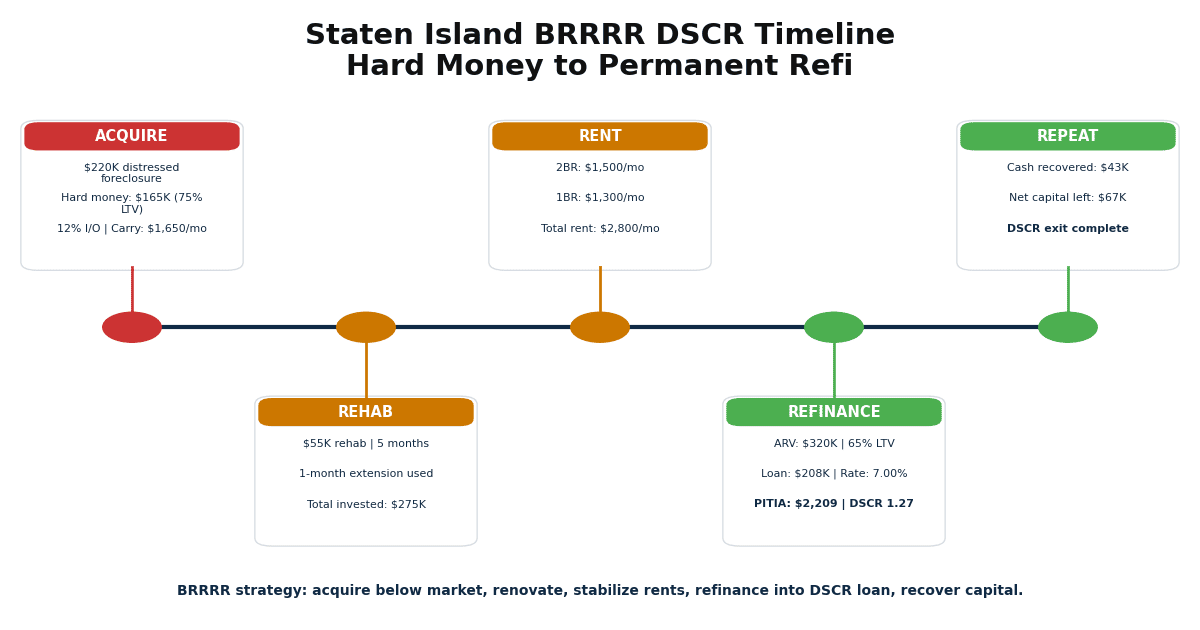
- $220K distressed purchase + $55K rehab = $275K total in | $165K hard money | 5-month rehab (one extension)
- ARV $320K | DSCR refi 65% LTV = $208K at 7.00% | PITIA $2,209 | Rent $2,800 | DSCR 1.27 PASS
- Stress test: single-stress (+1%) drops to 1.19 MARGINAL | combined stress 1.07 — above 1.00 floor
- Capital recovered: $43K of $110K invested | $67K still in deal | ~10.6% cash-on-cash on remaining equity
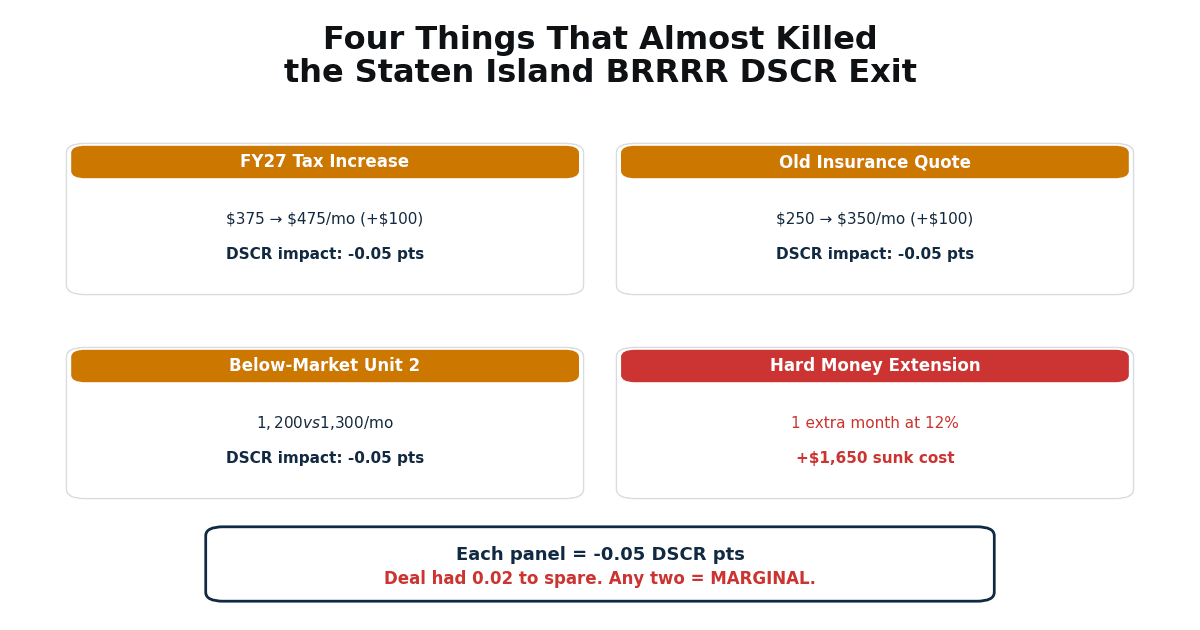
- Four near-misses each worth 0.05 DSCR points: FY27 tax increase, old insurance rate, Unit 2 below-market, HM extension
Table of Contents
- Staten Island BRRRR DSCR Stabilization — The Deal
- The BRRRR Execution: Hard Money, Rehab, Stabilization
- Acquisition and Hard Money
- Rehab: $55,000 Over Five Months
- Stabilization: Both Units at Market Rate
- The DSCR Exit: How Staten Island BRRRR DSCR Hit 1.27
- The Stress Test — Staten Island BRRRR DSCR at the Margin
- Four Near-Misses That Almost Killed the Staten Island BRRRR DSCR Exit
- Near-Miss 1: FY27 Property Tax Increase
- Why the Staten Island BRRRR DSCR Exit Was Tight
- What Investors Get Wrong on Staten Island BRRRR DSCR Exits
- FAQ: Staten Island BRRRR DSCR
- Can I use a DSCR loan for the BRRRR strategy on Staten Island?
- What LTV should I target for the DSCR exit on a Staten Island 2-family?
- What does “barely made it” mean for a BRRRR DSCR exit?
- The Bottom Line — What a 1.27 DSCR Exit Means for the BRRRR
This Staten Island BRRRR DSCR exit came in at 1.27 — above the lender floor, above the BKDSCR 1.25 standard, and clean on the stress test. This post walks through how stabilization timing, rent level, and loan sizing combined to produce a fundable exit ratio.
This is what the BRRRR strategy looks like at the margin in Staten Island in 2026. High hard money carry costs, an ARV that limits the refi loan, SI rents that are tight relative to PITIA at current rates, and a property tax system where the FY27 NOPV can move the DSCR by five basis points. The deal works — but it works because the investor got four things right that most investors get wrong.
Staten Island BRRRR DSCR stabilization 2026 is not a clean story. A North Shore 2-family acquired at $220,000 out of foreclosure, rehabbed for $55,000, stabilized at $2,800/month in gross rent, and refinanced into a 30-year DSCR product at 7.00% — the deal cleared the BKDSCR 1.25 standard by exactly 0.02 points. Lender DSCR at exit: 1.27. The deal passed. Four separate near-misses during execution would have pushed it to MARGINAL if they had not been caught before the application went in. See also: SI foreclosures.
Before spending time on a full analysis of your Staten Island BRRRR deal, Deal Filter — property type, rent roll, unit count, and PITIA in one pass to see where it lands before you go further.
Staten Island BRRRR DSCR Stabilization — The Deal
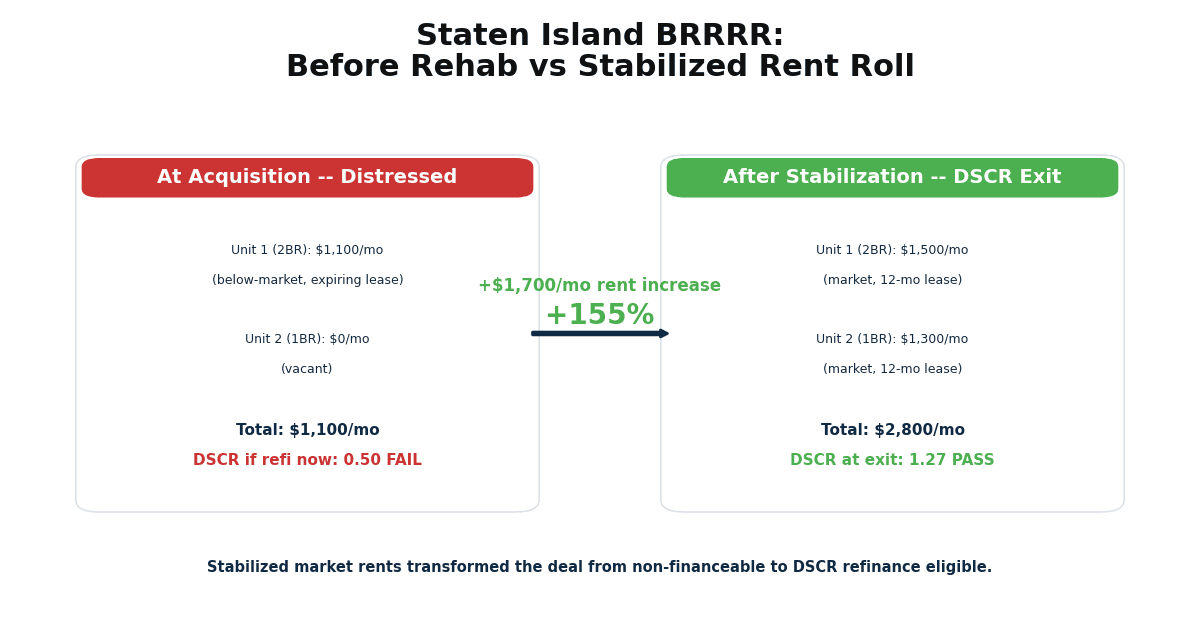
The property is a two-family walk-up on the North Shore of Staten Island. Two-bedroom unit on the upper floor, one-bedroom unit on the ground floor. The investor acquired it at foreclosure for $220,000 — well below the $550,000–$800,000 range for market-rate North Shore 2-family properties reported by DeFalco Realty in April 2026. The building needed significant work: outdated kitchens, deteriorating bathrooms, a failing roof, and single-pane windows throughout. One unit was occupied at $1,100/month on a below-market lease. The other was vacant.
The Staten Island foreclosure market has expanded sharply. Per the PropertyShark NYC foreclosure report, Staten Island foreclosure filings rose 123% year-over-year. This North Shore deal went to an investor because the deferred maintenance made conventional financing impossible — exactly the entry point the BRRRR strategy requires. bkdscr.com covers BRRRR analyzer for distressed-to-stabilized sequences.
| Stage | Input | Value | Notes |
|---|---|---|---|
| Acquire | Purchase price | $220,000 | Distressed foreclosure, North Shore Staten Island |
| Acquire | Hard money loan | $165,000 | 75% of purchase | 12% I/O | 6-month term |
| Acquire | Monthly carry | $1,650 | Interest-only at 12% on $165,000 |
| Rehab | Renovation budget | $55,000 | Kitchens, baths, roof, windows, cosmetic |
| Rehab | Timeline | 5 months | Budget was 4 months — one extension required |
| Rent | Unit 1 (2BR) | $1,500/month | Market rate — executed 12-month lease |
| Rent | Unit 2 (1BR) | $1,300/month | Market rate — executed 12-month lease |
| Rent | Total gross rent | $2,800/month | All units stabilized before DSCR application |
| Refinance | ARV appraisal | $320,000 | After-rehab value — lender-ordered appraisal |
| Refinance | DSCR refi loan | $208,000 | 65% LTV on $320,000 ARV |
| Refinance | Rate / term | 7.00% / 30-yr fixed | Lower rate at 65% LTV vs 7.25–7.50% at 75% |
| Refinance | Monthly P&I | $1,384 | On $208,000 at 7.00% |
| Refinance | Monthly taxes (FY27) | $475 | SI Class 1 FY27 NOPV — verified, not seller bill |
| Refinance | Monthly insurance | $350 | Current market quote for 2-unit SI property |
| Refinance | Monthly PITIA | $2,209 | $1,384 + $475 + $350 |
| Refinance | Lender DSCR | 1.27 | $2,800 / $2,209 — PASS above 1.20 lender minimum |
The BRRRR Execution: Hard Money, Rehab, Stabilization
Acquisition and Hard Money
The investor funded the acquisition with hard money: $165,000 at 75% of the $220,000 purchase price, 12% interest-only, 6-month term. Monthly carry: $1,650. Out of pocket at closing: $55,000. Per Ridge Street, hard money rates in 2026 run 10%–14% with 1–3 points origination. This deal was at the lower end, reflecting a clean title and defined rehab scope.
Rehab: $55,000 Over Five Months
The rehab budget was $55,000 covering kitchens, bathrooms, roof, windows, and cosmetic work. The plan called for four months. It ran five. A bathroom tile delivery delay pushed Unit 2 completion into week 18. The extension cost $1,650 in additional carry — a sunk cost that did not affect the DSCR calculation but compressed the time buffer before hard money maturity.
Stabilization: Both Units at Market Rate
Both units were leased before the DSCR application was submitted. DSCR lenders underwrite on executed current leases — not projected rents. The 2BR went at $1,500/month. The 1BR went at $1,300/month. Total stabilized gross rent: $2,800/month. Both on 12-month executed leases. Zumper’s May 2026 data shows SI median rent at $3,200/month, and vacancy remains under 3.5%.
The DSCR Exit: How Staten Island BRRRR DSCR Hit 1.27
The lender ordered an appraisal after stabilization. ARV: $320,000. The investor chose 65% LTV — $208,000 — rather than 75% ($240,000). The lower LTV produced a better rate (7.00% vs 7.25–7.50% at 75%), and the DSCR at 75% LTV came out at 1.19 — MARGINAL. At 65% LTV: 1.27 — PASS. The tradeoff: $32,000 less in cash proceeds. See also: marginal refi.
The DSCR calculator runs both the Lender DSCR (PITIA only) and the BKDSCR Conservative DSCR. Lender DSCR: $2,800 / $2,209 = 1.27 — PASS. BKDSCR Conservative DSCR (adding 8% management + $200/mo maintenance): $2,800 / $2,633 = 1.06 — MARGINAL. The lender’s number and the investor’s number tell different stories about this deal.
If you want the complete framework for running a BRRRR DSCR exit in NYC outer boroughs — ARV sensitivity, LTV comparison, and stress test standards — DSCR Playbook.
The Stress Test — Staten Island BRRRR DSCR at the Margin
The BKDSCR single-stress test adds one percentage point to the refi rate. At 8.00%, P&I on $208,000 rises to $1,526. Stressed PITIA: $2,351. Stressed DSCR: $2,800 / $2,351 = 1.19 — MARGINAL. The deal passes the lender and BKDSCR unstressed. It does not pass the BKDSCR 1.25 single-stress standard. Before submitting any BRRRR refi, stress test.
Combined stress (rate +1% and 10% vacancy): stressed rent = $2,520. DSCR: $2,520 / $2,351 = 1.07 — above the BKDSCR 1.00 combined stress floor. The deal survives combined stress. It does not survive single-stress at the BKDSCR standard. That is the honest risk profile on this exit.
| Scenario | Gross Rent | PITIA | DSCR | BKDSCR Verdict |
|---|---|---|---|---|
| Unstressed (refi exit) | $2,800 | $2,209 | 1.27 | PASS |
| Single-Stress (+1% to 8.00%) | $2,800 | $2,351 | 1.19 | MARGINAL |
| Combined Stress (+1% + 10% vac) | $2,520 | $2,351 | 1.07 | Above 1.00 floor |
| BKDSCR standard | — | — | 1.25+ | Required |
Four Near-Misses That Almost Killed the Staten Island BRRRR DSCR Exit
The deal closed at 1.27. The BKDSCR standard is 1.25. The margin was 0.02 points — about $44/month of gross rent. Four near-misses each had the potential to compress that margin:
| Near-Miss Item | PITIA Impact | Rent Impact | DSCR Impact | Caught? |
|---|---|---|---|---|
| FY27 tax increase ($375 to $475/mo) | +$100/month | None | -0.05 points | Yes — verified NOPV |
| Old insurance quote ($250 to $350/mo) | +$100/month | None | -0.05 points | Yes — new quote obtained |
| Unit 2 below-market offer ($1,200 vs $1,300) | None | -$100/month | -0.05 points | Yes — held at market |
| Hard money extension (1 extra month at 12%) | $1,650 sunk cost | None | No DSCR impact | N/A — sunk cost |
Near-Miss 1: FY27 Property Tax Increase
The prior owner’s tax history implied approximately $375/month. The FY27 NOPV showed $475/month — $100 more. At $375 taxes, the DSCR would have been $2,800 / $2,109 = 1.33. At $475: 1.27. The investor caught this by verifying the FY27 NOPV before the application. bkdscr.com covers deal killers — using the seller’s tax bill instead of the current NOPV is on that list.
Near-Miss 2: Old Insurance Rate
The first estimate used the prior owner’s renewal premium: $250/month. A current market quote for a post-rehab 2-unit SI property came in at $350/month. At $250 insurance, the DSCR would have been 1.32. At $350, it came in at 1.27. The new quote was required for the lender binder anyway.
Near-Miss 3: Unit 2 Below-Market Lease Offer
Near-Miss 4: Hard Money Extension
The one-month extension did not affect the DSCR — DSCR is calculated on stabilized rent at refi date. But the extension added $1,650 in sunk carry cost and delayed stabilization by 30 days. In a deal with 0.02 points of margin, every cost overrun matters operationally even when it does not affect the DSCR calculation directly.
Why the Staten Island BRRRR DSCR Exit Was Tight
The fundamental constraint on SI BRRRR DSCR exits is the relationship between rental income and ARV. North Shore 2-family ARVs in the $300,000–$400,000 range produce loan sizes at 65–75% LTV of $195,000–$300,000. At 7.00%, a $208,000 loan produces $1,384/month P&I. Add current SI taxes and insurance and PITIA exceeds $2,200. SI 2-family rents in this corridor run $1,300–$1,500/unit — total $2,600–$3,000/month. The margin is thin.
What Investors Get Wrong on Staten Island BRRRR DSCR Exits
- Modeling the DSCR exit at 75% LTV without checking the result: At SI rent levels, 75% LTV often produces MARGINAL. Run both 65% and 75% before choosing the LTV
- Using the prior owner’s tax bill instead of the FY27 NOPV: SI Class 1 assessments increased with the FY27 roll. The seller’s tax bill reflects historical figures
- Estimating insurance from the seller’s renewal: Get a current market quote before modeling. SI 2-family insurance has risen with the NYC outer-borough trend since 2022
- Accepting below-market rents to fill units fast: SI vacancy under 3.5% means tenants are available at market rates. $100 below market costs 0.05 DSCR points permanently
- Not modeling the stressed DSCR before submitting: A 1.27 unstressed that drops to 1.19 single-stressed is a materially different risk profile. Run the stress test before the application
- Underestimating hard money carry: Every month of extension at 12% adds cost. Build one month of extension buffer into the rehab timeline budget before starting
FAQ: Staten Island BRRRR DSCR
Can I use a DSCR loan for the BRRRR strategy on Staten Island?
Yes. DSCR lenders qualify on the property’s stabilized income, not the borrower’s W-2 or tax returns. Most programs require no seasoning period after stabilization — the loan is eligible as soon as both units are on executed leases. Do not apply before the property is fully stabilized.
What LTV should I target for the DSCR exit on a Staten Island 2-family?
Run the DSCR at both 65% and 75% LTV before choosing. At current SI 2-family rent levels, 75% LTV often produces MARGINAL while 65% LTV produces PASS. If the DSCR at 75% LTV clears 1.25 on your specific deal, take the 75%. If it falls below 1.25, 65% LTV is the path to a clean exit.
What does “barely made it” mean for a BRRRR DSCR exit?
It means the deal cleared the BKDSCR 1.25 unstressed standard by a small margin. The lender approved the loan. The asset is on long-term DSCR debt. “Barely made it” describes the risk profile going forward: a 1.27 that drops to 1.19 under rate stress cannot absorb a +1% rate environment while meeting the BKDSCR standard. Approved does not mean safe.
The Bottom Line — What a 1.27 DSCR Exit Means for the BRRRR
Staten Island BRRRR DSCR stabilization 2026 requires execution discipline that purchase deals do not. With a purchase, you underwrite a stabilized property on its current income. With a BRRRR, you create the stabilization — and every decision from the rehab timeline to the lease negotiation to the insurance quote affects the DSCR you bring to the refi lender. The 0.02-point margin on this deal was not luck. It was the product of catching four near-misses before they became errors.
The deal returned $43,000 of the $110,000 the investor put in — a 39% capital recovery. Monthly cash flow after PITIA: $591/month — $7,092/year. On $67,000 remaining equity, approximately 10.6% cash-on-cash return before management and maintenance. The deal works. It barely works. And it only works because the investor ran the DSCR numbers before every decision, not after.
The SI foreclosure pipeline remains elevated at +123% YoY. The deals that succeed at the DSCR exit treat the refi target as a constraint from day one — not a number calculated at the end. Run the DSCR exit at the ARV and rent assumptions before you make the offer. The 0.02 points that separates a PASS from a MARGINAL is not found at the lender — it is built into the deal before you close.
If you have a Staten Island BRRRR approaching stabilization and want your DSCR exit number, stress test, and BKDSCR verdict before you submit, Deal Review — PASS/MARGINAL/FAIL with fix paths within 48–72 hours.