
What DSCR Really Means: The Critical NYC Investor Ratio 2026
Key Takeaways
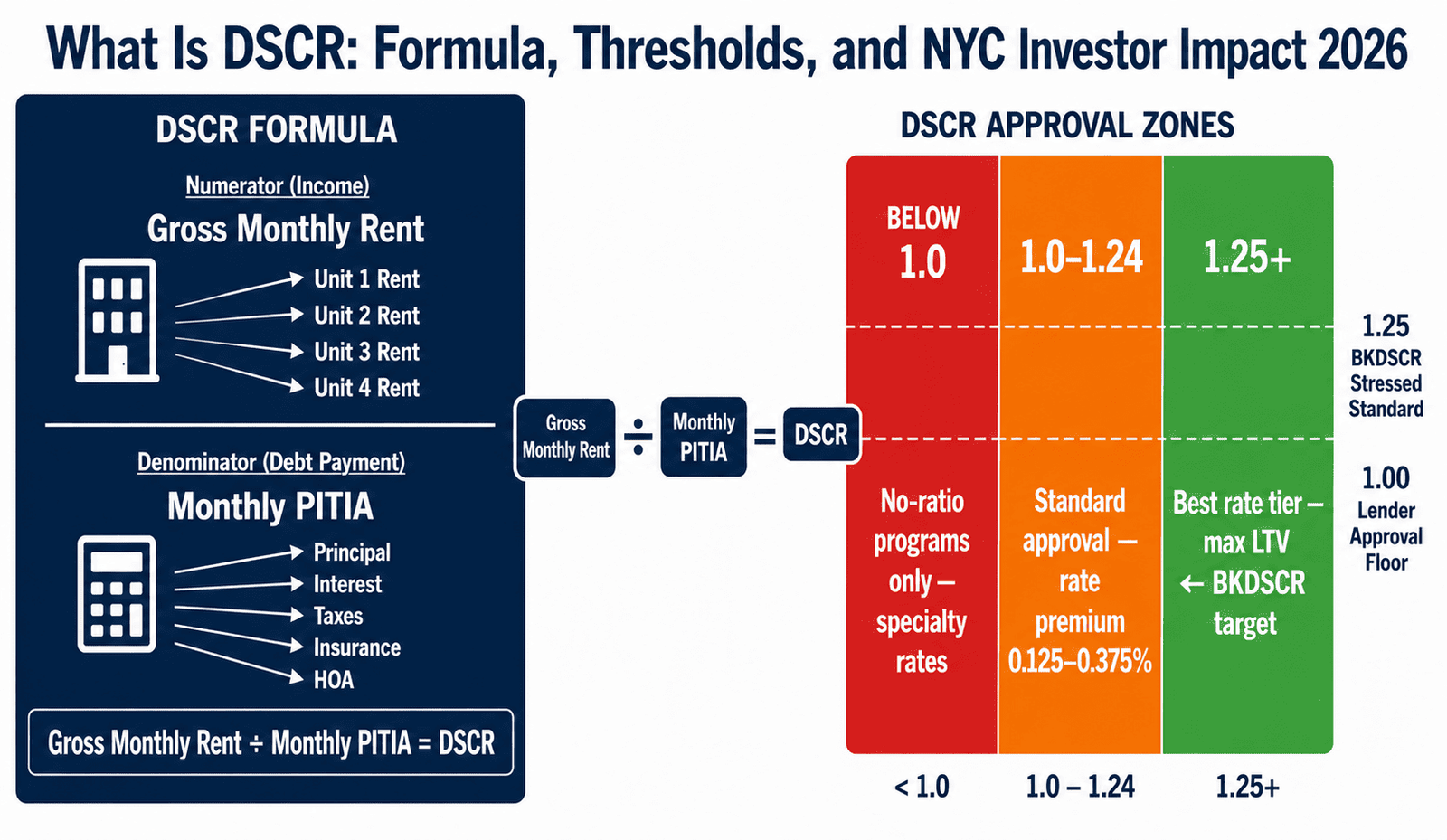
- DSCR stands for Debt Service Coverage Ratio — gross monthly rent divided by monthly PITIA
- A DSCR of 1.0 means the property breaks even — rent exactly covers the payment. Lenders want more.
- A DSCR of 1.25 or above unlocks the best lender rate tier in 2026
- The BKDSCR standard: 1.25+ unstressed, 1.00+ under combined stress (rate + one vacancy)
- NYC outer-borough deals are harder to DSCR-qualify than most U.S. markets — high taxes and insurance are the reason
- Lenders use the lesser of the appraiser’s market rent and the actual signed lease — not proforma income
Table of Contents
- What DSCR Actually Measures — and What It Does Not
- The DSCR Formula — Exactly How Lenders Calculate It
- Why PITIA, Not NOI
- The 3 DSCR Threshold Tiers Every NYC Investor Needs to Know
- A Worked NYC Outer-Borough DSCR Calculation
- What Makes NYC DSCR Qualification Harder Than Most U.S. Markets
- How Your DSCR Ratio Affects Rate, LTV, and Approval in 2026
- 5 Things NYC Investors Get Wrong About DSCR Before Applying
- 1. Using NOI Instead of Gross Rent
- 2. Leaving Taxes and Insurance Out of PITIA
- 3. Assuming Actual Rent Is Qualifying Rent
- 4. Treating Lender Minimum as the Target
- 5. Not Running the Stress Test Before Applying
- What Is DSCR: How DSCR Qualification Works Without Tax Returns or W-2s
- FAQ: What Is DSCR for NYC Investors
- What Is DSCR? Is 1.0 Enough to Get Approved in NYC?
- Does DSCR Use Actual Rent or Market Rent?
- How Do Property Taxes Affect DSCR in NYC?
- What Is DSCR: The Bottom Line for NYC Outer-Borough Investors
What is DSCR explained in plain terms for NYC investors in 2026? The short version: DSCR is gross monthly rent divided by monthly PITIA. The result tells the lender whether the property’s income covers its debt service, and by how much. A ratio above 1.25 clears the BKDSCR standard. A ratio below 1.0 means the property cannot service its own debt — and most lenders will not finance it.
The DSCR formula page walks through every input in the ratio with outer-borough examples. Start there before modeling any deal.
| MARKET SNAPSHOT — DSCR Loan Rates & NYC Outer Borough Data, May 2026 | |
| Sources | AAA Lending | Ridge Street Capital | Zumper (May 2026) | CBRE |
| DSCR 30-yr fixed rates (May 2026) | 6.5%–7.875% | benchmark 7.5% at 75% LTV, 720 FICO |
| BKDSCR DSCR standard (PASS) | 1.25+ unstressed | 1.00+ combined stress |
| NYC outer-borough avg rents | Brooklyn 4-unit ~$2,400–$2,600/unit | Queens ~$2,200–$2,400/unit |
| DSCR formula | Gross Monthly Rent / Monthly PITIA |
| PITIA components | P+I + Property Tax + Insurance + HOA (if any) |
| Lender DSCR minimum (most programs) | 1.10–1.20 (BKDSCR uses 1.25 standard) |
| No income docs required | No W-2s, no tax returns — rental income qualifies the loan |
Before you run your deal numbers, use the Deal Filter — property type, rent roll, unit count, and PITIA in 60 seconds.
What DSCR Actually Measures — and What It Does Not
DSCR is not a measure of whether a property is profitable. It does not account for management fees, maintenance, vacancy, or capital reserves. It measures one thing only: does the gross rental income cover the monthly debt service payment. A deal with a 1.25 DSCR may still produce negative cash flow after operating expenses. A deal at 1.10 DSCR may qualify with one lender and be declined by three others.
This distinction matters. An investor can run a property with a 1.15 DSCR and still lose money on a cash-flow basis once real operating costs are factored in. The BKDSCR framework addresses this by running both a Lender DSCR (gross rent / PITIA — the qualifying calculation) and a BKDSCR Conservative DSCR (gross rent minus management and maintenance / PITIA — the investor’s actual return calculation). Both numbers belong in any serious pre-submission analysis.
The DSCR Formula — Exactly How Lenders Calculate It
DSCR = Gross Monthly Rent ÷ Monthly PITIA
Where:
- Gross Monthly Rent = Total rent from all units (per appraiser’s 1007 rent schedule or signed lease, whichever is lower)
- PITIA = Principal + Interest + Taxes + Insurance + HOA (if any)
Example: Gross monthly rent $6,200 / Monthly PITIA $5,890 = DSCR 1.05. This deal passes most lender minimums but fails the BKDSCR 1.25 standard and would fail the stress test at +1% rate.
Why PITIA, Not NOI
Many investors who come from commercial real estate backgrounds are familiar with NOI-based underwriting. Residential DSCR loans do not use NOI. They use gross rent in the numerator — no deduction for vacancy, management, or maintenance — and full PITIA in the denominator. This is a critical distinction. Running NOI-based DSCR on a residential DSCR loan application produces a number the lender will not recognize and an analysis that does not reflect how the loan will actually be underwritten.
The PITIA denominator is also frequently underestimated by first-time DSCR borrowers. P+I is not PITIA. On a $700,000 loan at 7.5%, P+I is $4,895/month. Add $1,000/month in property taxes and $400/month in insurance and PITIA is $6,295/month — 29% higher than P+I alone. Every DSCR model that omits taxes and insurance produces a ratio that will not survive lender underwriting. See the deal killers page for the full list of PITIA errors that cause NYC DSCR applications to fail.
The 3 DSCR Threshold Tiers Every NYC Investor Needs to Know
DSCR lending operates on a three-tier approval and pricing structure in 2026. Understanding where a deal lands determines not just whether it qualifies, but what rate and terms the investor can access.
TIER 1: DSCR 1.25 and above — Best rate tier. Maximum LTV. Most lenders compete aggressively for these files. Typical profile: 740+ FICO, 20–25% down, 1.25+ DSCR.
TIER 2: DSCR 1.0 to 1.24 — Standard approval zone. Rate premium of 0.125–0.375% above Tier 1. Typical profile: 700–739 FICO, 25% down, 1.0–1.24 DSCR. Most NYC outer-borough deals land here. Approvable, but not best-tier.
TIER 3: DSCR below 1.0 — Specialty programs only. Rate premium of 0.5–1.5% above Tier 1. Requires 30–35% down and 700+ credit. Reserve requirements: 12 months. Some lenders go as low as 0.75 DSCR. Most standard programs do not.
The BKDSCR standard operates above the lender approval grid. The single-stress test (+1% rate) must hold at 1.25+. The combined stress test (rate +1% and one vacancy) must hold at 1.00+. A deal at 1.21 DSCR that stresses to 0.98 is technically approvable and structurally fragile. Use the stress test to confirm where every deal lands under both scenarios.
A Worked NYC Outer-Borough DSCR Calculation
The fastest way to understand what is DSCR in practice for NYC investors is to walk through a real calculation on a representative outer-borough deal.
3-Unit Walk-Up, East Flatbush, Brooklyn — DSCR Calculation
- Purchase price: $950,000
- Down payment (25%): $237,500
- Loan amount: $712,500
- Rate (30-yr fixed, 7.50%): Monthly P+I = $4,983
- Property taxes: $750/month
- Landlord insurance: $350/month
- Monthly PITIA: $6,083
- Gross rent (3 units × $1,800): $5,400/month
- DSCR: $5,400 ÷ $6,083 = 0.89 — FAIL
Rent needed to hit 1.0 DSCR: $6,083/month ($2,028/unit). Rent needed to hit 1.25 DSCR: $7,604/month ($2,535/unit).
The 0.89 DSCR on this deal is not a marginal miss. It is a structural problem. The rents at $1,800/unit are below the qualifying threshold by $228/unit. What changes the outcome? Lower purchase price (less loan), higher rents (more income), or both. Run the DSCR calculator at the actual market rent for the specific submarket before modeling any deal.
What Makes NYC DSCR Qualification Harder Than Most U.S. Markets
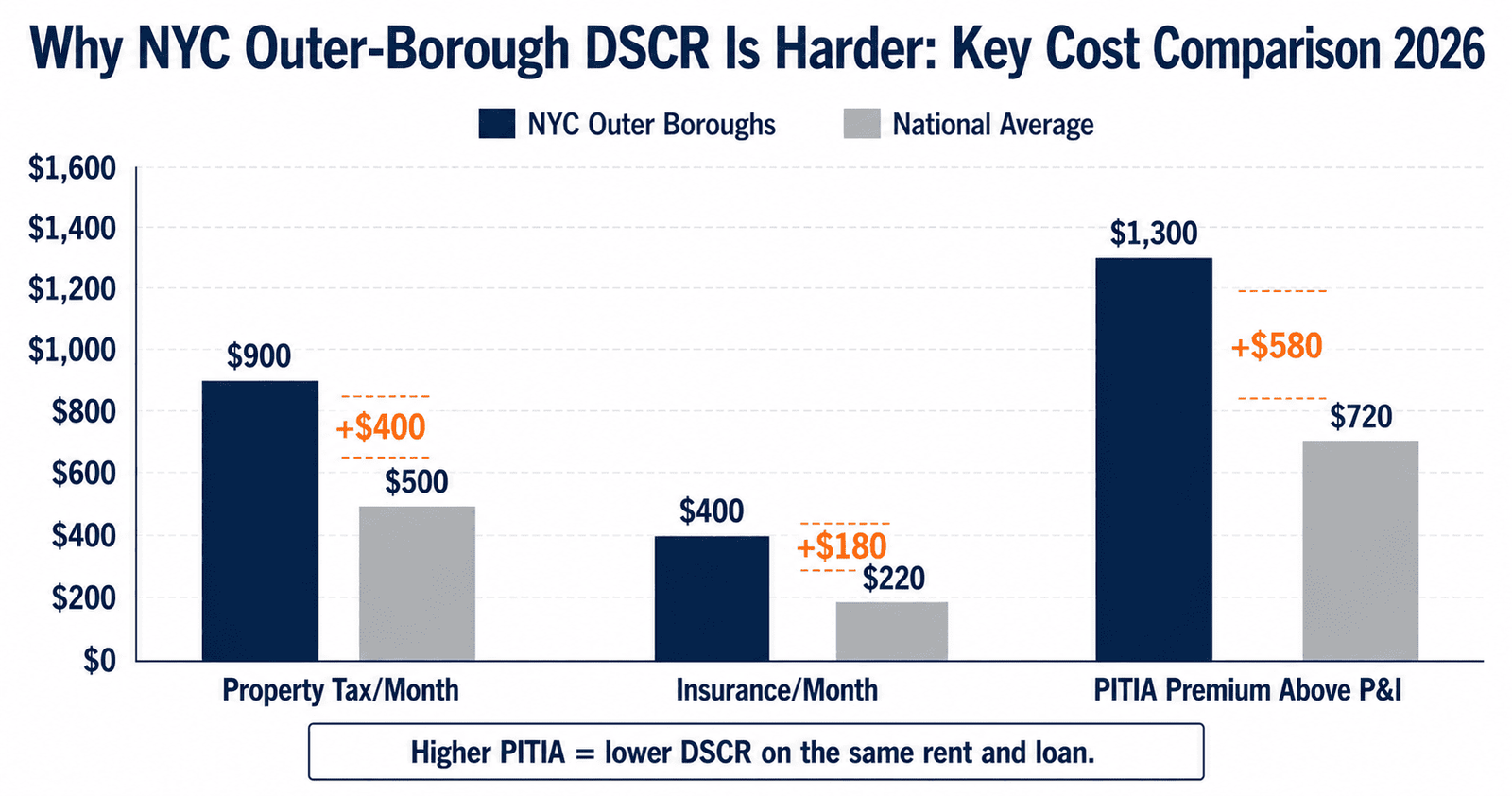
NYC outer-borough investors asking what is DSCR explained for their market specifically need to understand three structural factors that make NYC harder to qualify than most other U.S. markets:
- High purchase prices relative to rents. Brooklyn and Queens free-market multifamily trades at price-to-rent ratios that produce naturally lower DSCRs than most out-of-state markets. A $950,000 Brooklyn 4-unit at $9,600/month gross rent produces a different DSCR than a $380,000 Pennsylvania 4-unit at the same rent.
- High property taxes. NYC property taxes on small multifamily are substantial. Class 2 assessments rose 6.9% in FY2027. On a $950,000 building, annual taxes can run $9,000–$15,000 — adding $750–$1,250/month to PITIA.
- Insurance cost increases. Landlord insurance on outer-borough multifamily has increased more than 150% since 2019. A building that carried $3,600/year in 2019 may now cost $8,400–$11,000/year — adding $400–$600/month to PITIA.
The net effect: what is DSCR qualification for NYC investors means clearing a higher bar on the same loan amount than investors in most other markets. The lender criteria page covers the NYC-specific overlays that further tighten this threshold at most programs.
How Your DSCR Ratio Affects Rate, LTV, and Approval in 2026
DSCR is not just a yes/no approval gate. It is a pricing variable that affects your rate, your LTV, and your reserve requirements. Investors who understand this before they model a deal can make structural adjustments — down payment, loan amount, rate buydown — that move the deal from a suboptimal tier to a better one.
The rate premium for a deal in the 1.0–1.24 range runs approximately 0.125–0.375% above Tier 1 rates. On a $700,000 loan, 0.25% in rate costs $145/month — $1,740/year — in additional interest. Over a 5-year hold, that is $8,700 in additional interest cost. Knowing where the deal lands before applying — and whether a structural adjustment can push it to Tier 1 — is the difference between best-execution pricing and overpaying for the same financing.
Below 1.0, the cost increases significantly. Specialty programs that approve sub-1.0 DSCR deals charge 0.5–1.5% rate premiums and require 30–35% down and 12 months of reserves. Most investors who can achieve a 1.0+ DSCR through deal structuring should do so before considering sub-1.0 programs.
5 Things NYC Investors Get Wrong About DSCR Before Applying
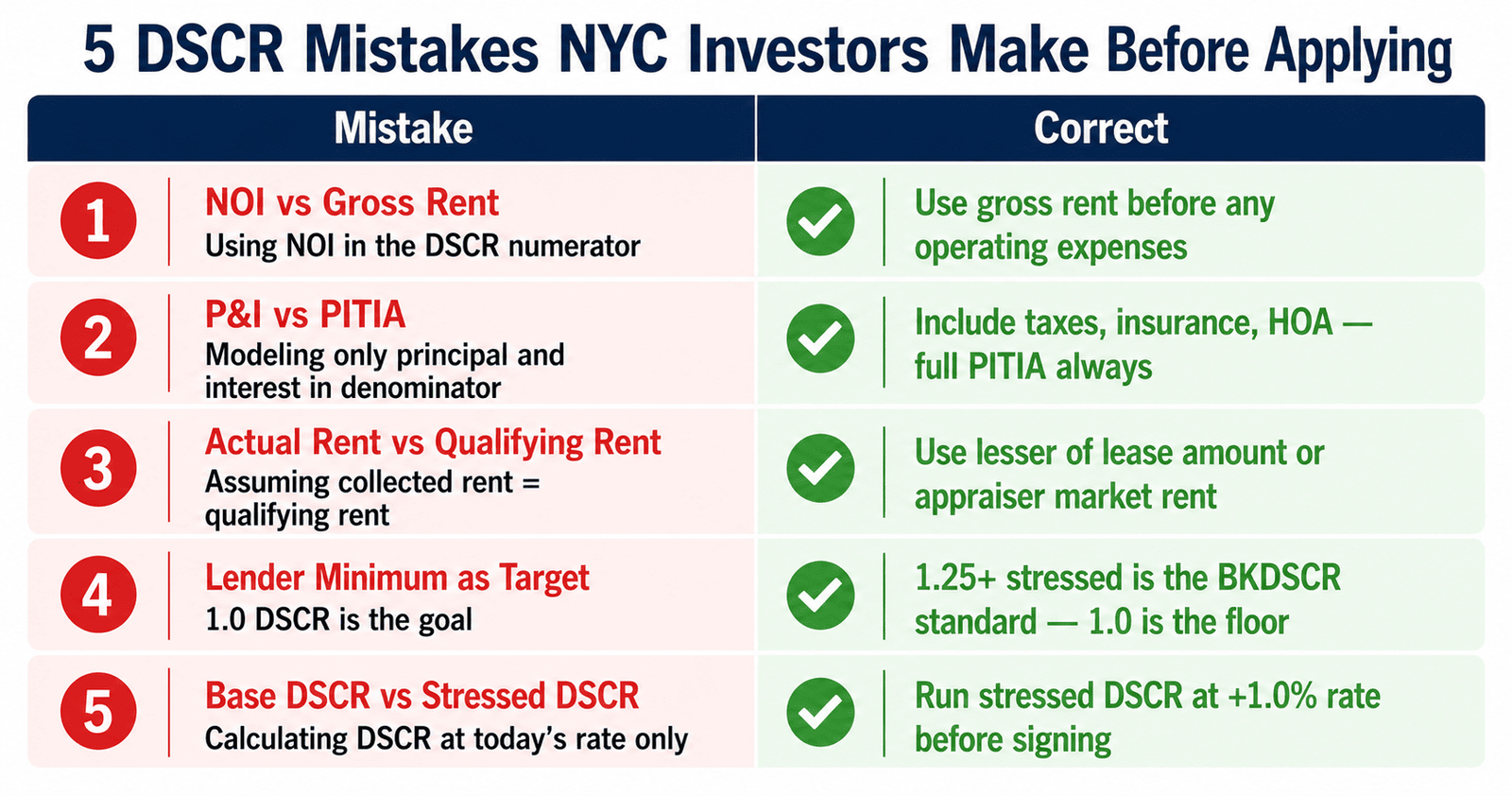
1. Using NOI Instead of Gross Rent
The residential DSCR formula uses gross rent — before vacancy, management, or operating expenses. Using NOI in the numerator produces a lower DSCR than the lender will calculate, and creates confusion at underwriting when the numbers don’t match.
2. Leaving Taxes and Insurance Out of PITIA
P+I is not PITIA. Many investors model the mortgage payment and forget that taxes and insurance are part of the denominator. On a NYC outer-borough deal, taxes and insurance can add $1,000–$1,800/month to PITIA — enough to move DSCR from a pass to a fail.
3. Assuming Actual Rent Is Qualifying Rent
Lenders use the lesser of the signed lease and the appraiser’s market rent from the 1007 form. If market rents have softened since the lease was signed, the qualifying rent may be lower than the actual rent. Model the deal at the 1007 market rent, not the in-place lease, to get an accurate pre-submission DSCR.
4. Treating Lender Minimum as the Target
A 1.0 DSCR gets you approved at most programs. It does not mean the deal is structured well. One vacancy, one insurance increase, or one rate reset can take a 1.0 DSCR deal cash-flow negative. The BKDSCR standard is 1.25+ for a reason — it provides the cushion that 1.0 does not.
5. Not Running the Stress Test Before Applying
Most investors calculate DSCR at today’s rate and stop there. The stress test at +1% rate is the step that separates a deal that works from a deal that works only if everything stays the same. On a $700,000 loan, a +1% rate increase adds approximately $438/month to P+I. On a deal where the current DSCR is 1.15, that increase drops it to 1.04 — above the lender floor but below the BKDSCR standard. Run the stress test before every application.
What Is DSCR: How DSCR Qualification Works Without Tax Returns or W-2s
DSCR loan qualification does not use personal tax returns or W-2 income. The entire underwriting centers on the property: what it earns in gross rent, what it costs to carry as PITIA, and whether the ratio meets the lender’s minimum. A self-employed investor with three years of net losses on Schedule C — who would be declined by every conventional lender — can qualify for a DSCR loan if the property’s gross rent exceeds PITIA by the required margin.
A W-2 employee with student loans, a car payment, and a high DTI — who fails conventional investment loan DTI tests — qualifies for DSCR if the property produces 1.25+ DSCR. This is what DSCR is at a structural level: an income-property loan underwritten on the income-property’s own economics. The borrower’s personal financial picture is secondary to the property’s numbers. As Stacking Capital’s DSCR investor loan guide describes, the borrower’s income history is essentially irrelevant — what matters is the property’s rent versus its carrying cost.
FAQ: What Is DSCR for NYC Investors
What Is DSCR? Is 1.0 Enough to Get Approved in NYC?
Yes — a 1.0 DSCR meets the minimum threshold for most standard DSCR programs in 2026. But 1.0 is the floor, not the target. At 1.0 DSCR, the deal is at the lender’s minimum and has no cushion for rate changes, vacancy, or cost increases. The BKDSCR standard is 1.25+ unstressed and 1.00+ under combined stress — which means the deal should hold at 1.00+ even with a +1% rate and one vacant unit simultaneously.
Does DSCR Use Actual Rent or Market Rent?
Lenders use the lesser of the signed lease amount and the appraiser’s market rent from the 1007 rent schedule. If the in-place lease is above market, the lender uses the lower 1007 market rent. If the in-place lease is below market, the lender uses the lease amount. The qualifying rent is always the lower of the two.
How Do Property Taxes Affect DSCR in NYC?
Significantly. Property taxes are part of the PITIA denominator and are one of the two primary reasons NYC outer-borough DSCR qualification is harder than most U.S. markets. On a $950,000 Brooklyn 4-unit, property taxes can run $9,000–$15,000/year — $750–$1,250/month in PITIA. That tax load alone can move DSCR from 1.28 to 1.09 compared to a comparable deal with lower taxes.
What Is DSCR: The Bottom Line for NYC Outer-Borough Investors
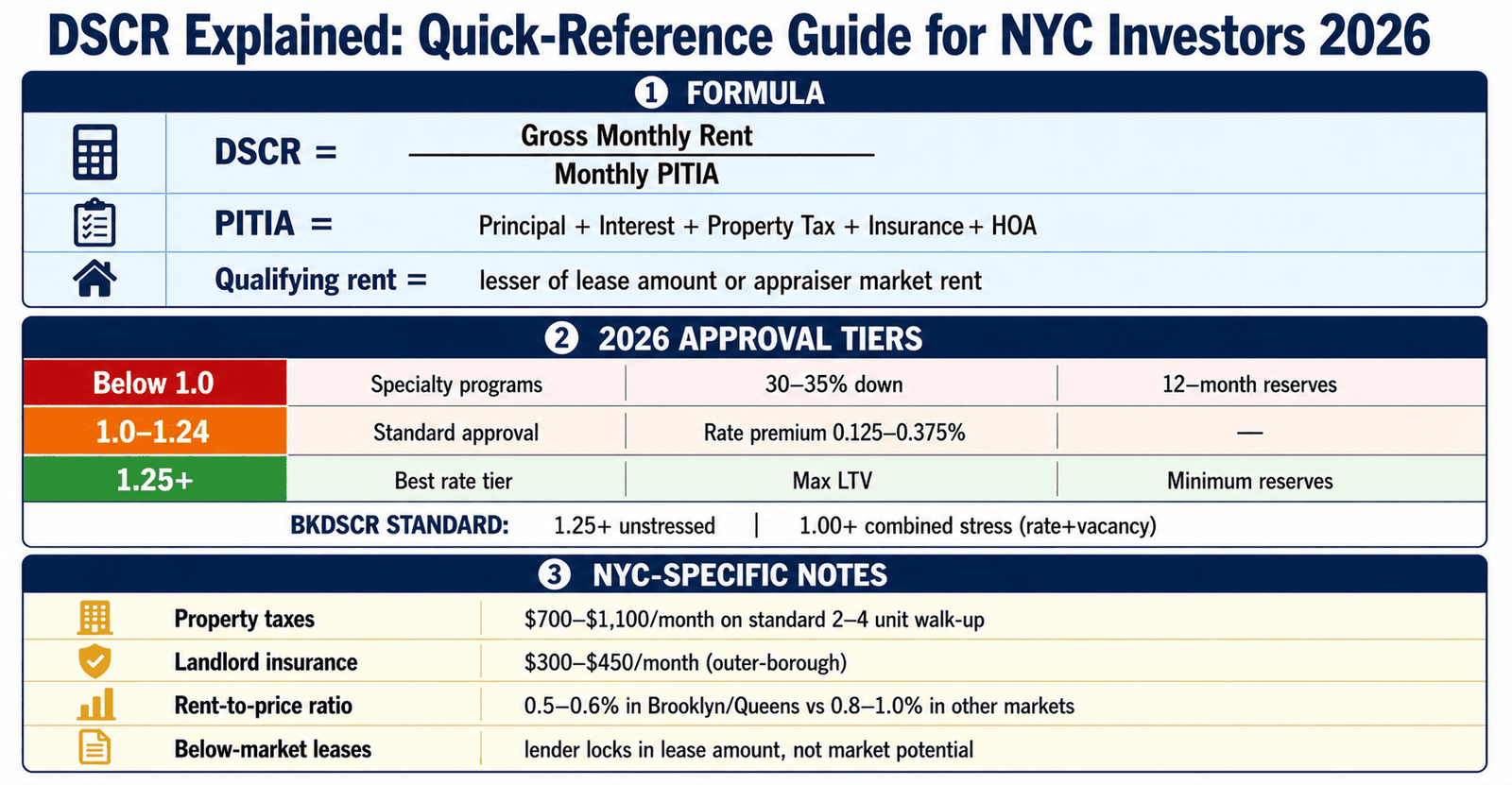
What is DSCR explained clearly for NYC investors in 2026? It is the ratio that determines whether a rental property qualifies for DSCR financing — and at what rate and terms. Gross monthly rent divided by monthly PITIA. Clear 1.25 and you are in the best rate tier. Clear 1.10 and most programs approve you. Fall below 1.0 and you need a specialty program with a higher rate and more capital required.
For outer-borough investors in Brooklyn, Queens, the Bronx, and Staten Island, DSCR qualification is harder than in most U.S. markets because of the tax and insurance cost stack. The formula is the same everywhere. The inputs are not. NYC PITIA is structurally higher — which is why the BKDSCR standard exists: 1.25+ unstressed, 1.00+ under combined stress. That standard accounts for what NYC deals face over a 5–7 year hold period, not just at the time of origination.
The practical framework before you apply: calculate the full PITIA — P+I, taxes, insurance, HOA if any. Use the lesser of the signed lease and the appraiser’s market rent. Run the deal at current rate and at +1%. If it clears 1.25 at current rate and 1.00 at combined stress, it is lender-ready. If it does not, identify which variable to address before submitting. The deal analysis page covers both calculations in detail.
If you have a specific deal and want to know your exact DSCR, stressed DSCR, and lender match position, the deal review delivers the full analysis with NYC-specific inputs built in.