
Queens Mixed-Use DSCR Denial: The Commercial Income Trap
Key Takeaways
- Queens mixed-use DSCR commercial income split 2026: $3,000/month commercial rent excluded by lender — month-to-month lease = $0 income credit
- Full income DSCR on this deal: 1.34 — PASS. Residential-only DSCR: 1.00 — hard FAIL. The income split is the entire verdict
- The 51% residential rule (sq ft) gets the deal into the DSCR program — it does not guarantee commercial income is counted for DSCR
- Mixed-use DSCR minimum is 1.20–1.25 at most programs — stricter than the 1.10–1.15 residential floor
- Fix path 1: lock commercial tenant into 2-year executed lease before closing — DSCR returns to 1.34 — PASS
- Fix path 2: increase down payment to 35% (65% LTV) — residential-only DSCR rises to 1.11 — MARGINAL but financeable
Table of Contents
- Queens Mixed-Use DSCR Denial: The Deal That Failed Underwriting in 2026
- How Queens Mixed-Use DSCR Denial Happens: The Commercial Income Rule
- The 51% Rule Gets You In — It Does Not Mean Commercial Income Counts
- Queens Mixed-Use Cap Rates and the Price Context
- Why Commercial Income Gets Excluded from DSCR Calculations
- The Stress Test — What the Fixed Version Looks Like
- Fix Paths for This Queens Mixed-Use DSCR Denial
- Fix Path 1 — Lock the Commercial Lease (Best Outcome)
- Fix Path 2 — Increase Down Payment to 35%
- Fix Path 3 — Renegotiate the Purchase Price
- What Investors Get Wrong on Queens Mixed-Use DSCR Denial Deals
- FAQ: Queens Mixed-Use DSCR Denial
- Does the 51% residential rule guarantee my commercial income counts for DSCR?
- What is the minimum DSCR for a mixed-use property?
- Will a month-to-month commercial tenant kill my mixed-use DSCR deal?
- Can I use projected rents on the commercial unit to qualify?
- Bottom Line — Queens Mixed-Use DSCR Denial
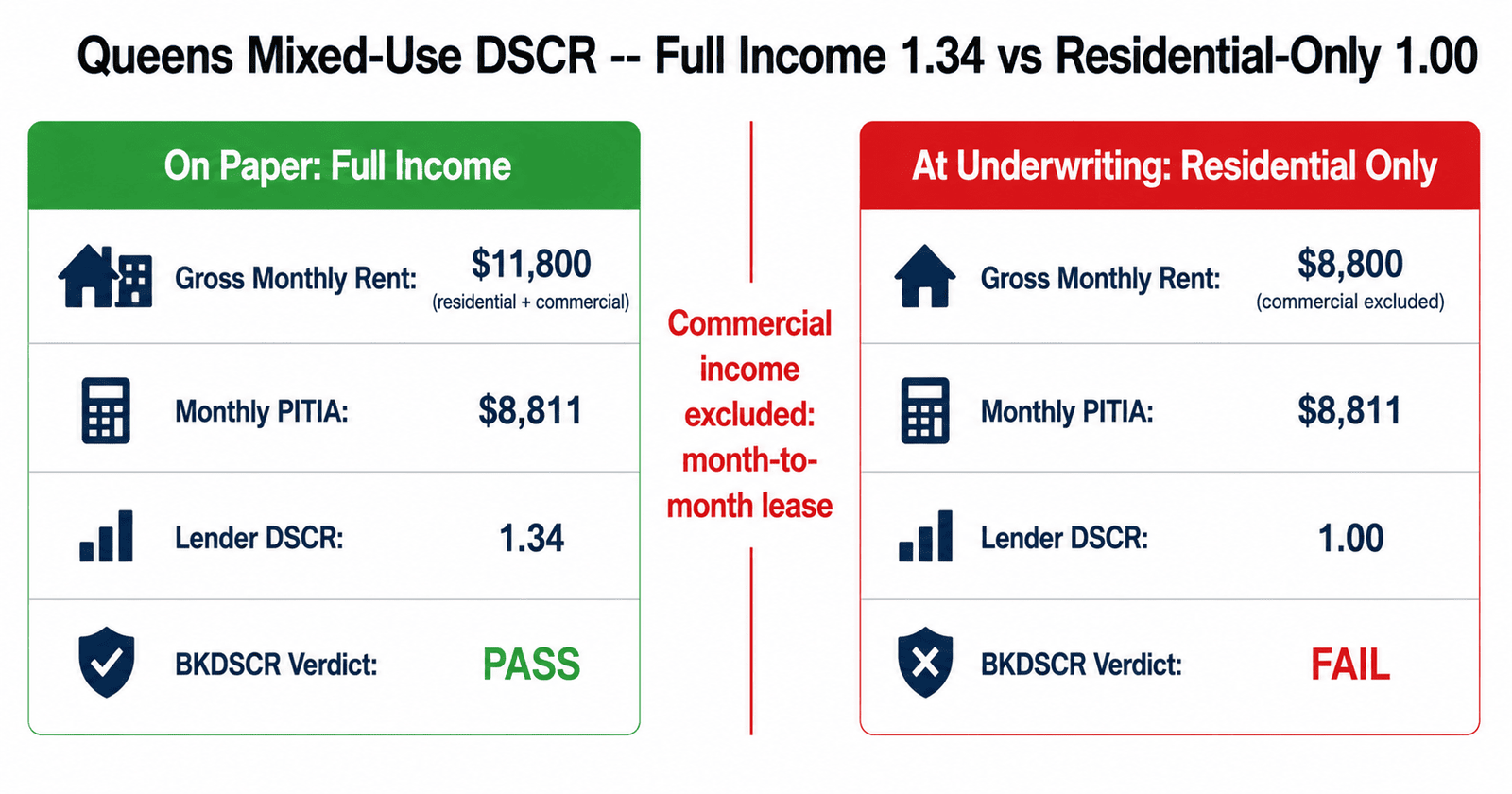
Queens Mixed-Use DSCR Denial is what this deal became at underwriting. A pre-war 5-unit mixed-use building in Jackson Heights, Queens — four residential apartments above a ground-floor laundromat. Gross monthly rents on paper: $11,800. PITIA: $8,811. Calculated DSCR: 1.34. The lender’s computed DSCR after applying its commercial income rules: 1.00. The loan was declined.
Start with the Deal Filter — property type, rent roll, unit count, and PITIA in 60 seconds.
Queens Mixed-Use DSCR Denial: The Deal That Failed Underwriting in 2026
The property is a five-story mixed-use building in Jackson Heights, Queens. Four market-rate residential apartments occupy floors two through five. A laundromat occupies the entire ground floor commercial space. The building is approximately 68% residential by square footage — which clears the 51% residential threshold required to qualify for a residential DSCR program. The investor ran the numbers and saw a clean deal.
Queens rental market data supports that read. According to Chandan Economics, Queens rents rose 4.4% year-over-year through February 2026, consistent with the broader NYC metro growth rate of 4.2%. Four units at $2,200/month is a realistic and supportable rent roll for Jackson Heights at current market rates. The laundromat at $3,000/month is a locked-in cash flow source. Or so the investor assumed. See also: Queens rental.
The deal numbers looked like this before the lender applied its underwriting rules. The deal analysis page covers outer-borough properties with mixed income streams — including how commercial income treatment changes the computed ratio.
| Input | Value | Notes |
|---|---|---|
| Property Type | 5-unit mixed-use | Jackson Heights Queens — 4 residential + 1 ground-floor retail |
| Purchase Price | $1,150,000 | 75% LTV applies; mixed-use cap at most programs |
| Down Payment (25%) | $287,500 | Standard 25%; some programs require 30% for mixed-use |
| Loan Amount | $862,500 | 30-year fixed DSCR product |
| Rate / Term | 7.625% / 30-yr | Mixed-use carries ~0.25% rate premium over pure residential |
| Monthly P&I | $6,111 | On $862,500 at 7.625% |
| Monthly Taxes | $1,900 | Queens Class 2 mixed-use FY27 — commercial component raises bill |
| Monthly Insurance | $800 | Mixed-use retail premium — laundromat adds liability exposure |
| Monthly PITIA | $8,811 | Total debt service + impounds |
| Residential Rent | $8,800 | 4 units × $2,200/month (Queens Jackson Heights market rate) |
| Commercial Rent | $3,000 | Ground-floor laundromat — month-to-month lease |
| Total Gross Rent | $11,800 | Full income on paper; lender credits differ |
| DSCR Calculation | Numerator | PITIA | DSCR | Verdict | |
|---|---|---|---|---|---|
| Full income (paper) | $11,800 | $8,811 | 1.34 | FAIL* | PASS |
| Residential only (lender) | $8,800 | $8,811 | 1.00 | FAIL | |
| BKDSCR 1.25 standard | — | — | 1.25+ | Required |
How Queens Mixed-Use DSCR Denial Happens: The Commercial Income Rule
DSCR lenders underwriting a mixed-use property do not automatically count all income in the ratio. The commercial income split at underwriting is driven by a specific rule most investors do not know until it kills their approval: commercial income is only credited if the lease is fully executed and has at least 12 months of remaining term. Month-to-month commercial tenancy = $0 income credit. No exceptions.
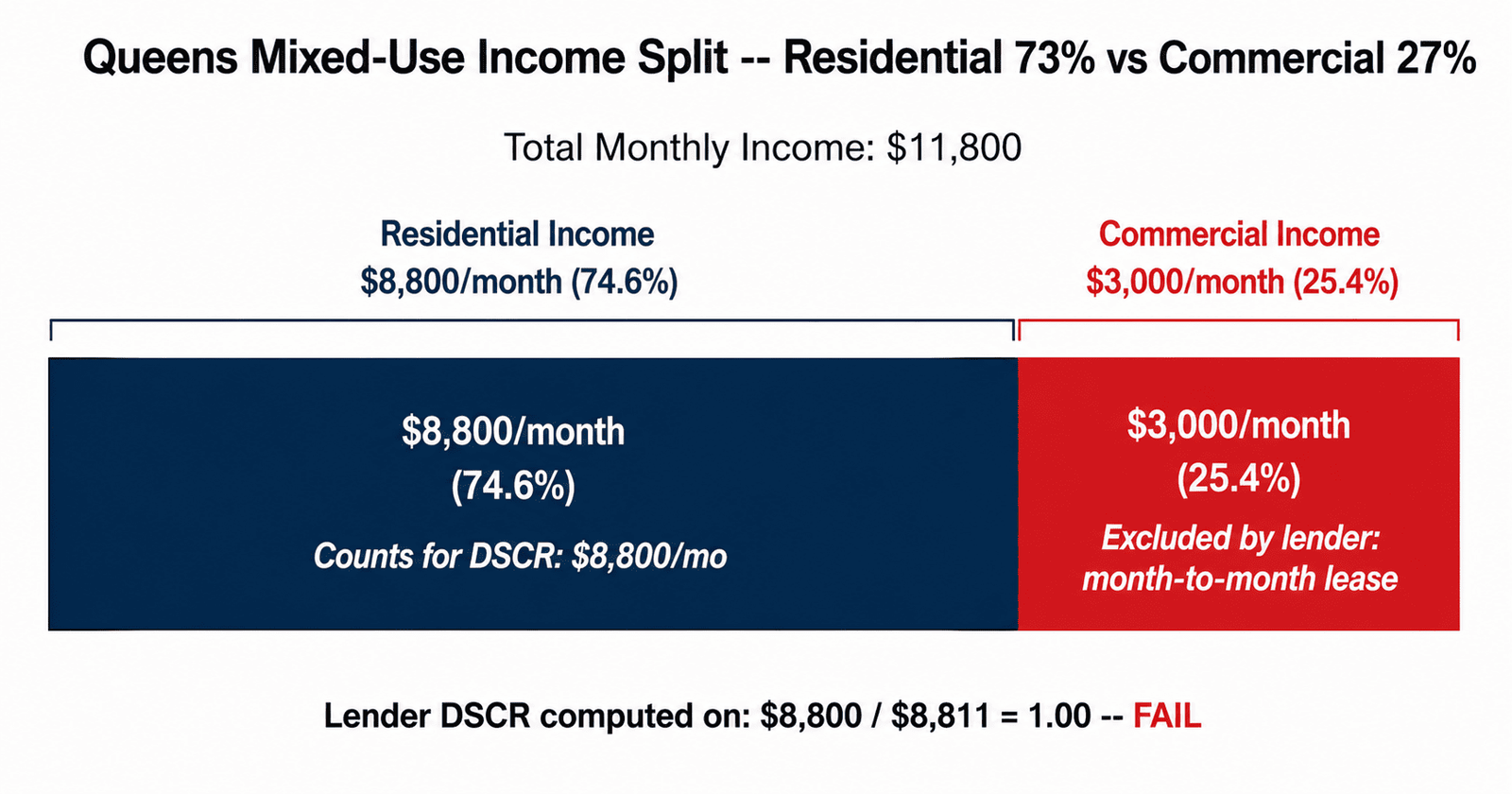
The Jackson Heights laundromat was on a month-to-month arrangement that had been running for four years. The tenant paid on time, never missed, and was effectively a permanent occupant. None of that matters to the underwriter. What matters is the lease document. No executed lease with 12+ months remaining means the lender cannot rely on that income to service the debt. The lender’s DSCR calculation used $8,800/month of residential income against $8,811/month of PITIA. DSCR: 1.00.
The 51% Rule Gets You In — It Does Not Mean Commercial Income Counts
Investors frequently confuse two separate rules. The first rule is the 51% residential by square footage threshold — this determines which loan program the deal falls into. Clear above 51% residential? You can apply for a residential DSCR product instead of a commercial multifamily loan. This matters because residential DSCR products carry lower rates (7.25–7.625% vs 8.0–8.5%+ for commercial), lower minimum DSCR thresholds, and longer fixed-rate terms.
The second rule is how commercial income is credited in the DSCR calculation. Passing the 51% test only opens the door to the residential DSCR program. Once inside that program, the lender applies a separate overlay for commercial income: full credit with a valid multi-year lease, zero credit with month-to-month tenancy. Passing the first rule says nothing about the second. The lender criteria page covers the overlay level for mixed-use properties in NYC.
Queens Mixed-Use Cap Rates and the Price Context
Queens outer-borough mixed-use properties on commercial corridors — Jackson Heights, Flushing, Jamaica, Astoria — typically trade at 5.0–5.8% going-in cap rates in the current market. A $1,150,000 purchase price on a building generating $11,800/month in gross income represents an approximate gross rent multiplier of 8.1x and a going-in cap rate of roughly 5.5% after operating expenses. That is within the normal Queens mixed-use range — tight for DSCR at current rates, but not unusual.
The problem is not the purchase price. The problem is that the effective income the lender uses for DSCR is $3,000/month less than the actual cash flow of the building. When the lender’s income assumption is $8,800 instead of $11,800, the cap rate the lender underwrites is effectively 2.7% — well below what PITIA demands at a 7.625% mortgage rate. This same dynamic — the gap between cash flow and lender-credited income — is examined across three outer-borough deals in the analysis of deal breakdowns.
Why Commercial Income Gets Excluded from DSCR Calculations
The underwriting logic is sound even if the result is frustrating. A month-to-month commercial tenant can leave with 30 days’ notice. The lender’s job is to underwrite to the scenario where that income is gone — and the building still covers its debt service. If it cannot, the loan does not close.
What changes across lenders is what it takes to get the commercial income credited. At most residential DSCR programs:
- Month-to-month lease: $0 credit. Full exclusion from DSCR numerator
- Lease with less than 12 months remaining: excluded or heavily discounted (50–75% of face value)
- Lease with 12–24 months remaining: full credit at most programs; some require 24+ months
- Lease with 24+ months remaining: full credit, strongest position with lender
- National tenant / investment-grade: full credit regardless of term; treated as stabilized income
The laundromat tenant in this deal falls into the first category. The investor had never thought to formalize the arrangement because the tenant always paid and the building ran smoothly. The lender does not evaluate history. It evaluates documentation.
Get the DSCR Playbook — every input, threshold, and deal-killer for NYC outer-borough investors in one place.
The Stress Test — What the Fixed Version Looks Like
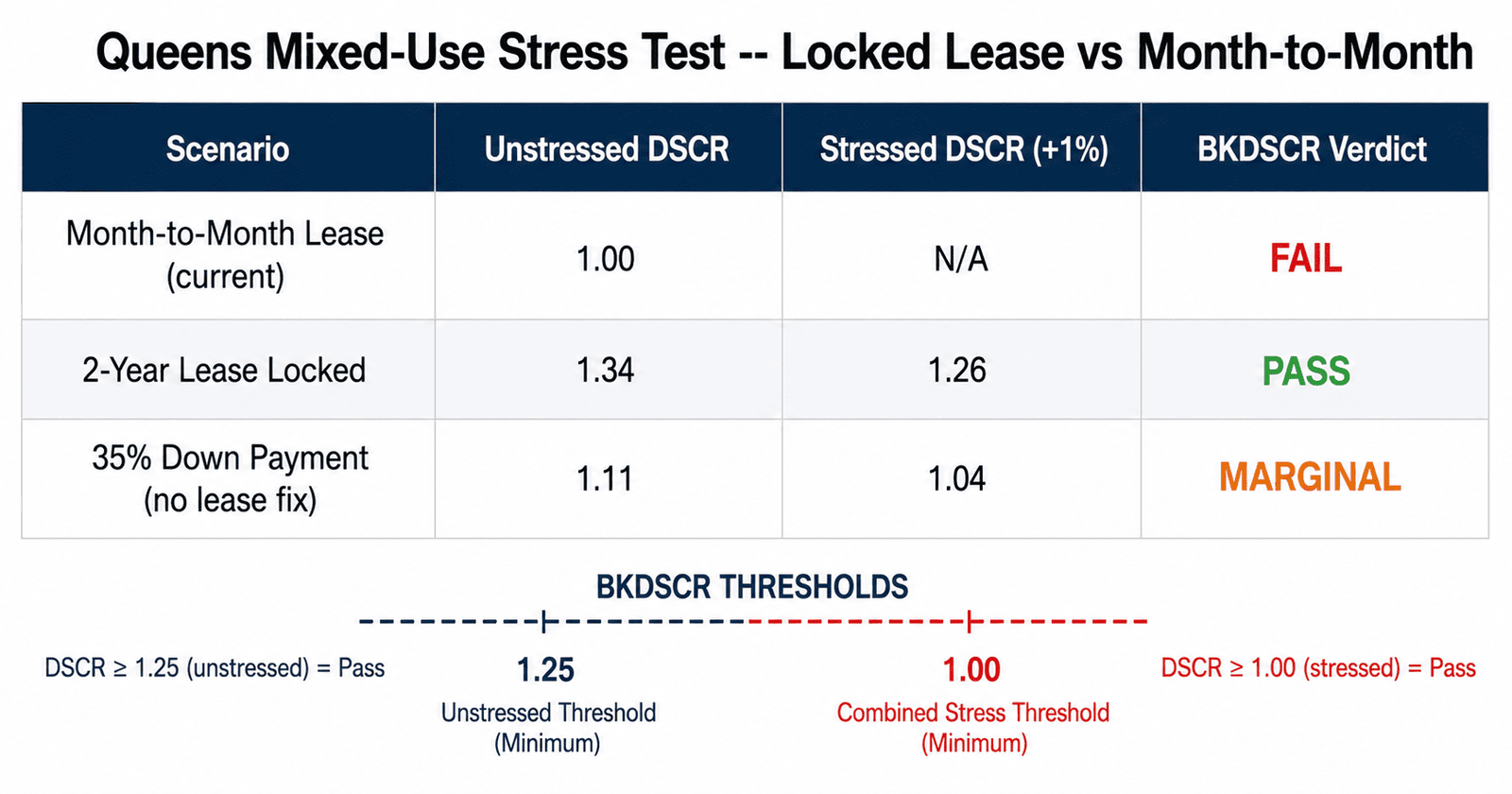
If the investor gets the commercial tenant to execute a two-year lease before closing, the deal’s income picture changes entirely. Commercial income credited: $3,000/month. Total gross income: $11,800. DSCR unstressed: $11,800 / $8,811 = 1.34 — PASS above the BKDSCR standard of 1.25+.
The BKDSCR stress test applies one percentage point of additional rate pressure to the purchase scenario. At 8.625%, the monthly P&I on $862,500 rises to approximately $6,647. Stressed PITIA: $9,347. Stressed DSCR: $11,800 / $9,347 = 1.26 — above the 1.25 single-stress threshold. Before you submit any deal, stress test — and run it on the lender’s income assumption, not the investor’s.
Fix Paths for This Queens Mixed-Use DSCR Denial
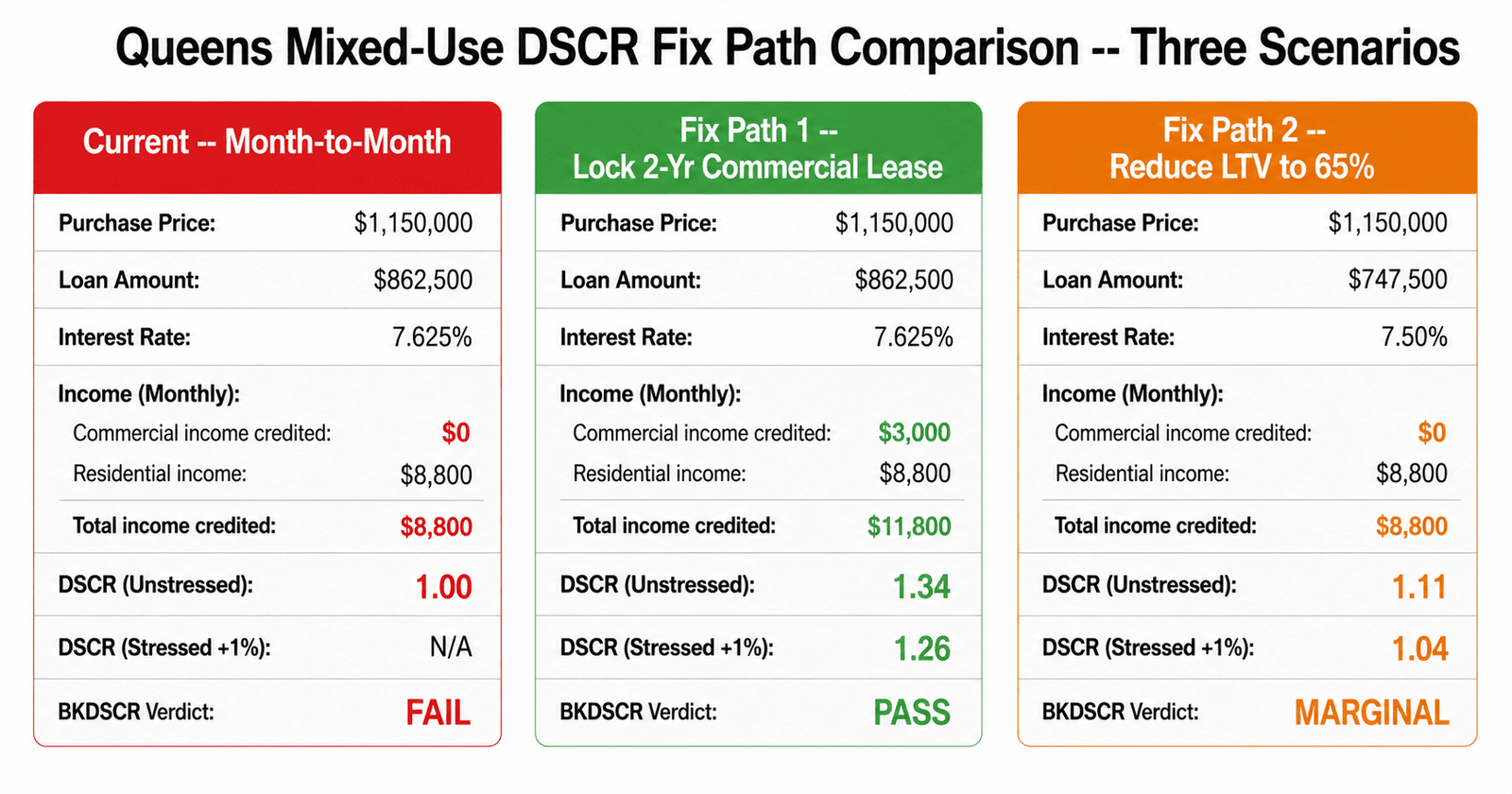
| Fix Path | Action Required | Residential DSCR | Lender Verdict | Full DSCR | Full Income Verdict |
|---|---|---|---|---|---|
| Fix 1 — Lock lease | Get commercial tenant on 2-yr executed lease before closing | $8,800/$8,811 = 0.99 | Residential only: FAIL — but lender uses full income when lease locked | 1.34 | PASS |
| Fix 2 — Lower LTV 65% | 35% down ($402,500); loan drops to $747,500 | $8,800/$7,900 = 1.11 | MARGINAL | 1.49 | PASS |
| Fix 3 — Price cut | Renegotiate to $980K; loan $735K at 7.625% | $8,800/$7,898 = 1.11 | MARGINAL | 1.49 | PASS |
Lender Verdict = based on residential income only (commercial excluded when lease is month-to-month). Full Income Verdict = based on full income including commercial. Fix 2 and Fix 3: commercial lease still month-to-month — lender uses residential only (1.11 MARGINAL). Full income DSCR 1.49 shown for reference only.
Fix Path 1 — Lock the Commercial Lease (Best Outcome)
The investor needs to approach the laundromat operator and request a formal two-year lease before closing. The ask is simple: formalize what you’ve been doing. The tenant gets nothing taken away — same rent, same location — and the investor gets the documentation the lender requires. Most month-to-month commercial tenants in NYC outer-borough mixed-use buildings will agree to a two-year lease at current terms when the alternative is an uncertain sale process.
If the tenant agrees, the commercial income moves from $0 to $3,000/month in the lender’s DSCR calculation. DSCR: 1.34. Stressed DSCR: 1.26. Both clear the BKDSCR standard. The deal killers page covers commercial lease documentation specifically for mixed-use acquisitions.
Fix Path 2 — Increase Down Payment to 35%
If the tenant will not sign a lease, the investor can reduce the LTV to 65% by putting 35% down ($402,500 instead of $287,500). Loan amount drops to $747,500. At 7.50% (slightly lower rate at lower LTV), monthly P&I is approximately $5,228. PITIA: $7,928. Residential-only DSCR: $8,800 / $7,928 = 1.11 — MARGINAL. This clears the 1.10 lender floor but does not meet the BKDSCR 1.25 standard. The deal is financeable but stressed.
Fix Path 3 — Renegotiate the Purchase Price
A price reduction to $980,000 (14.8% below asking) keeps the 25% down payment at $245,000 but drops the loan to $735,000. At 7.625%, monthly P&I falls to approximately $5,214. PITIA: $7,914. Residential-only DSCR: $8,800 / $7,914 = 1.11 — identical to Fix Path 2 in outcome but achieved through price rather than equity. Whether the seller accepts a $170,000 reduction depends on how motivated they are.
What Investors Get Wrong on Queens Mixed-Use DSCR Denial Deals
- Counting full commercial income without checking lease status: If the commercial lease is month-to-month, the income is $0 in the lender’s model regardless of how long the tenant has been there
- Assuming the 51% rule guarantees income credit: The 51% residential rule determines loan program, not income treatment. Two separate tests. Clearing the first does not clear the second
- Using the seller’s rent figures without verifying against Queens market rates: Below-market residential rents compound the commercial income problem. Only executed leases at current amounts count
- Missing the mixed-use rate premium: Mixed-use properties carry a 0.125–0.375% rate premium over pure residential at most DSCR programs. Modeling the deal at the residential rate understates PITIA
- Using the wrong DSCR minimum: Mixed-use DSCR minimum is typically 1.20–1.25, not the 1.10–1.15 that applies to pure residential
- Skipping the stress test because the unstressed DSCR looks strong: A 1.34 unstressed DSCR built on commercial income that may not be credited is not a safe margin. The stress test must be run on the lender’s income assumption
FAQ: Queens Mixed-Use DSCR Denial
Does the 51% residential rule guarantee my commercial income counts for DSCR?
No. The 51% residential rule determines which loan program you qualify for — residential DSCR vs. commercial multifamily. Once inside the residential DSCR program, the lender applies a separate overlay for commercial income. Month-to-month commercial tenancy receives $0 income credit at most programs regardless of the 51% test result. You can clear the first test and fail the second.
What is the minimum DSCR for a mixed-use property?
Most residential DSCR programs that accept mixed-use properties require a minimum DSCR of 1.20 to 1.25 — higher than the 1.10 to 1.15 minimum that applies to pure residential rentals. The BKDSCR standard is 1.25+ unstressed for any outer-borough deal, with 1.00+ on combined stress. On a mixed-use deal where commercial income is partially or fully excluded, the effective minimum against residential income alone is more demanding than the nominal floor suggests.
Will a month-to-month commercial tenant kill my mixed-use DSCR deal?
Likely yes — unless the residential income alone produces a DSCR above the lender’s minimum without the commercial rent. In the Jackson Heights deal, residential income alone produced a DSCR of 1.00 — below 1.00. That is a hard denial regardless of program or lender. If the residential income on your mixed-use deal produces 1.20+ on its own, a month-to-month commercial tenant creates a margin problem, not a denial.
Can I use projected rents on the commercial unit to qualify?
No. DSCR lenders underwrite on executed current leases, not proforma or projected commercial rents. A vacant commercial space or a month-to-month tenant at any rent produces $0 income credit.
Bottom Line — Queens Mixed-Use DSCR Denial
The Jackson Heights deal did not fail because the price was wrong, the rents were wrong, or the rate was unexpected. It failed because a month-to-month commercial lease stripped $3,000/month from the lender’s income calculation and the residential income alone could not carry the PITIA. A 1.34 DSCR on paper became a 1.00 DSCR at underwriting. Queens Mixed-Use DSCR Denial is exactly what it sounds like: the income available to the investor is not the income available to the lender, and the difference is determined by a lease document.
The fix exists and it is straightforward: get the commercial tenant on a two-year executed lease before submitting the loan application. Not after the application is in. Not after the denial. Before. A tenant who has been paying reliably for four years is almost always willing to sign a two-year lease at current terms when the ask is explained clearly. This is a pre-submission step that investors skip because they assume consistent payment history is proof enough. It is not proof of anything at a lender that underwrites to documentation.
Queens outer-borough mixed-use buildings are good assets. The income diversification — residential stability plus commercial premium — is a real structural advantage when it is properly documented. The problem is not the asset class. The problem is the gap between how investors think about mixed-use income and how lenders compute it. That gap is a lease document wide.
Run a Deal Review — current DSCR, stressed DSCR, NOI, and updated tax assessment modeled at current inputs, delivered within 48–72 hours.